
BuzzSkito Mosquito & Tick Control Specialists · Published July 21, 2026
Bed-Bug Control in Canada: Why One Product Is Never the Answer
Bed bugs are the most persistent household pest a Canadian homeowner is likely to face, and the reason is biology, not effort. A single female lays hundreds of eggs in her lifetime, glues them into cracks and seams with a coating that shrugs off most sprays, and the population hides within a few metres of where you sleep — in the box spring, the frame, the headboard, the baseboards, even wall outlets. Any tool that hits only one part of that picture leaves a reservoir to rebuild from. That is why this hub is organised around a plan rather than a product: you win by stacking methods that each cover a different weakness, then holding the line for weeks until the monitors go quiet.
This page is the map. Below is the layered protocol, the honest ranking of every tool category, a room-by-room walkthrough, guidance on what you are actually paying for as the budget climbs, and a clear line on when a smart homeowner should stop and call a licensed professional. Each category links out to a dedicated deep-dive if you want the model-by-model detail. Francophone readers can follow the mattress-evidence half of it in French: traces de punaises de lit sur un matelas.
Check current Canadian availability of the core kit:
The Layered Plan That Actually Works
Every successful bed-bug treatment — professional or DIY — is really the same five-part protocol. Skip a layer and you leave a survival route open. In order of who does the heavy lifting:
- An egg-killer (heat or steam). This is non-negotiable, because eggs are what most treatments miss. A whole-room heater raises the entire room past the lethal threshold in one shot; a dry-vapour steamer does the same job seam by seam for a smaller, contained problem; and a heat chamber handles everything portable.
- A residual (desiccant dust). Heat leaves nothing behind, so a long-lasting killer has to sit in the cracks. CimeXa (amorphous silica) and diatomaceous earth dehydrate any bug that crosses them for months, and resistance is impossible against a physical mechanism.
- Containment (encasements). A mattress and box-spring encasement seals whatever is inside so it starves and cannot bite, and turns future inspection into a glance at a smooth white surface.
- Removal (vacuum + steam). A sealed-HEPA vacuum physically strips live bugs and debris from seams before you treat, delivering an immediate population drop.
- Monitoring (interceptors + detectors). Interceptor traps under every bed and furniture leg and dedicated detectors tell you whether the numbers are falling and when it is genuinely safe to stop.
Notice what is not at the top of that list: sprays. They are a knockdown supplement, not the strategy, for reasons the next section makes plain.
Why Sprays Are the Weakest Leg (and Heat Is the Strongest)
The retail shelf is dominated by contact sprays, which is exactly backwards from how effective they are. A spray kills the bugs it physically soaks and then evaporates, leaving no lasting barrier, and it never penetrates the cemented eggs deep in a seam — so the next generation hatches on schedule. On top of that, bed bugs across North America carry widespread resistance to the pyrethroid chemistry most retail sprays use, so a spray can fail even on the bugs it hits. Our breakdown of whether bed-bug sprays actually work goes deeper, and the answer is: as a supplement to knock down a visible cluster, sometimes; as a plan, never.
Heat is the mirror image. It is mechanical, not chemical, so there is nothing for a bug to be resistant to, and it kills every life stage including the eggs. That is why professional treatment centres on heat and why the most complete DIY tool is a heater. The one thing heat cannot do is protect you tomorrow — the moment the room cools, a bug that walks in from next door is unaffected — which is precisely why heat is always married to a residual desiccant and to interceptors. For a plan built on physical methods, heat, steam, and silica dust together keep conventional sprays to a minimum; our natural bed-bug treatment guide covers where the genuinely effective natural options end and the marketing begins.
Room-by-Room Treatment Protocol
Here is the sequence that turns the toolkit into a result. Work one room fully before moving on, and resist the urge to rush.
- Confirm and monitor first. Put interceptors under every leg before you treat, so you have a baseline. Not sure you even have them? Start with how to check for bed bugs and the tell-tale bite and fecal-spot signs.
- Reduce clutter and bag belongings. Everything portable goes into sealed bags, then through a heat chamber or a hot dryer cycle. Do not spread items to other rooms.
- Vacuum the harbourage. With a sealed-HEPA vacuum and the crevice tool, work every seam, staple, bolt hole, and baseboard; seal and bin the bag outdoors immediately.
- Kill the eggs. Run the whole-room heater to lethal temperature, or steam every seam and tuft with a dry-vapour steamer.
- Lay the residual. Puff a thin film of desiccant dust into cracks, outlets, frame joints, and voids — thin, because a visible pile repels bugs instead of dusting them.
- Encase and isolate the bed. Fit encasements, pull the bed away from the wall, keep bedding off the floor, and let the interceptors do the climbing-guard job.
- Wait, monitor, re-treat. Check the traps weekly and re-treat until they stay empty for two to three clear weeks.
For the situation-specific playbooks — a whole-house DIY job, an apartment with shared walls, or a pure heat approach — see how to get rid of bed bugs, bed bugs in an apartment, the full DIY walkthrough, and DIY heat treatment. Worried specifically about the eggs surviving? Our guide to killing bed-bug eggs covers the temperature-and-dwell details.
How to Choose: What You Are Actually Paying For
The cost of a DIY bed-bug plan can range from under a hundred dollars to well over a thousand, and it is worth being clear-eyed about which spending genuinely buys results versus convenience. Prioritise in this order:
- An egg-killer (buy this first if you can). The single biggest determinant of success is whether your plan reaches eggs. A steamer is the affordable entry; a whole-room heater is the premium that clears a live infestation in a day. For a contained one-room problem, steam; for a spread-out or recurring one, heat.
- A residual dust (cheap, essential). A tub of CimeXa or food-grade diatomaceous earth costs little and works for months. There is no reason to skip it — it is the best value in the entire kit.
- Interceptors and encasements (cheap, essential). Together they cost less than a single professional visit and provide both containment and the feedback loop that tells you whether you are winning. Never treat blind.
- A heat chamber (worth it if you travel or cannot launder). If the source is travel, or you have belongings you cannot wash or spray, a chamber pays for itself. Otherwise it is optional.
- Premium sprays and gadgets (mostly skippable). Expensive branded sprays do not out-perform the plan above, and most detector gadgets duplicate what a cheap interceptor already tells you. Spend here last, if at all.
Read that as a spending map: put your money into an egg-killer, a residual, and monitoring, and treat everything else as optional. The most expensive mistake is not overspending on a heater — it is underspending on a cheap spray, watching it fail, and paying again in weeks of lost sleep and a rebounding population. If the numbers push you toward comparing DIY against a pro, our Canadian pest-control cost guide lays out what professional bed-bug work typically runs so you can judge the crossover point. Prevention is the cheapest line on that map, and for GTA readers most of it happens at the front door — see the commuter routine for Toronto transit riders.
When to Stop DIY and Call a Professional
DIY is the right first move for a small, contained, early infestation caught in one room. It stops being the right move at clear signals, and recognising them early saves months. Call a licensed professional when the infestation has spread beyond one room; when you share walls, floors, or ceilings in a multi-unit building (notify your landlord in writing — in most provinces building treatment is their responsibility); when clutter makes thorough treatment impossible; when someone in the home is medically vulnerable; or when you have run two complete DIY cycles and the interceptor traps are still catching bugs. Professionals bring commercial heat equipment, commercial-class products you cannot buy at retail, and the trained eye to find harbourage you will miss. Escalating is not failure — it is the cheaper path once DIY has genuinely stalled.
Frequently Asked Questions
What is the best way to get rid of bed bugs in Canada?+
The most reliable DIY approach in Canada is a layered heat-plus-residual plan, not any single product. Heat is the only method that kills bed bugs at every life stage including the cemented eggs, so a whole-room heater or a portable heat chamber for belongings does the heavy lifting. Around that, you steam seams and tufts, vacuum with a sealed-HEPA machine, encase the mattress and box spring to trap survivors, dust cracks and voids with a desiccant like CimeXa or diatomaceous earth (check the label for a PCP registration number), and monitor with interceptor traps under every bed and furniture leg. A single spray never clears a real infestation — the eggs and hidden bugs survive it. If the infestation is widespread or you have treated twice without winning, a licensed exterminator is the honest next step.
Can you actually get rid of bed bugs yourself, or do you need a professional?+
A disciplined homeowner can clear a contained, early infestation — one bed, one room, caught quickly — with the right equipment and patience. Heat chambers, whole-room heaters, steamers, encasements, desiccant dusts, and interceptor traps are all sold to Canadian consumers and all work when used correctly and consistently over several weeks. The honest limits: infestations that have spread across multiple rooms, shared walls in an apartment building, heavy clutter you cannot process, or two failed DIY rounds are signals to bring in a licensed professional. Bed bugs are forgiving of almost nothing except thoroughness, so if you cannot commit to the full protocol for the full timeline, professional treatment is cheaper than a half-done DIY job that lets the population rebound.
Does heat really kill bed bugs and their eggs?+
Yes — heat is the single most effective weapon against bed bugs because it kills every life stage, including eggs, which most sprays cannot touch. Bed bugs die when their core reaches roughly 45°C (113°F) held for long enough, and eggs need a similar sustained dose; professionals target the whole room to about 50–60°C to guarantee lethal temperatures reach into cracks and fabric. That is why the products in this hub centre on heat: portable heat chambers for clothing, bedding, luggage, and books; and whole-room heaters that raise an entire bedroom to killing temperature. The catch is that heat leaves no residual — nothing stops a bug that walks back in tomorrow — so heat is always paired with a residual dust and interceptors.
What temperature and how long kills bed bugs?+
Bed bugs and their eggs die when held at about 45°C (113°F) for 90 minutes, or faster at higher temperatures — a few minutes at 50°C (122°F). The practical problem is not the target number, it is getting that heat into the centre of a mattress, the core of a stuffed suitcase, or the crack behind a baseboard, because insulation and thermal mass keep cold pockets alive. That is exactly why consumer heat chambers run to 60°C+ and hold for hours, and why whole-room heaters drive the ambient air well past the lethal threshold: the margin ensures the coldest hidden spot still reaches killing temperature. Never improvise with a home oven or a car in the sun — uneven, unreliable heat that misses the cold pockets simply breeds survivors.
Do bed bug sprays actually work?+
Most consumer contact sprays kill the bugs they physically soak, then evaporate and do nothing — and they never reach the eggs cemented deep in seams, so they leave the next generation to hatch. Worse, bed bugs across North America have widespread resistance to the pyrethroid insecticides that dominate the retail shelf, so a spray can genuinely fail even on the bugs it hits. Sprays have a role as a knockdown tool on visible clusters and as a crack-and-crevice treatment, but they are the weakest leg of a real plan. The durable killer is a residual desiccant dust (CimeXa or diatomaceous earth) that stays put in cracks for months and kills by dehydration, which bugs cannot develop resistance to. Treat sprays as a supplement, never the strategy.
How long does it take to get rid of bed bugs?+
Plan for four to eight weeks of active work even when everything goes right, because you are fighting a life cycle, not just the bugs you can see. Eggs you miss hatch over one to two weeks, and any survivor takes several weeks to mature and lay again, so you treat, wait, monitor with interceptor traps, and re-treat until the traps stay empty for a clear stretch. A fast heat treatment can kill everything present in a single day, but reintroduction and missed eggs mean you still monitor for weeks afterward. Rushing is the classic failure: people stop at the first quiet week, the survivors rebound, and the infestation comes back worse. Keep monitoring for at least two to three weeks past the last sign of activity before you call it won.
What is the cheapest way to treat bed bugs at home?+
The most cost-effective starter kit is a desiccant dust plus interceptor traps plus mattress and box-spring encasements — together they cost far less than a heater or a professional visit and address the core of a small, early problem. The dust (CimeXa or a quality diatomaceous earth) provides the long-lasting residual kill in cracks and voids; the encasements trap any bugs already in the mattress and make future inspection trivial; the interceptors catch bugs travelling up furniture legs and tell you whether you are winning. Add a steamer or a heat chamber when the budget allows, because those close the gap on eggs and belongings that dust alone cannot reach. The false economy is a cheap spray — it feels like action but leaves the eggs, so you pay twice.
How do I get rid of bed bugs in an apartment?+
Apartments add a hard constraint: shared walls, floors, and ceilings mean bugs can migrate between units, so even a perfect job in your suite can be re-seeded from next door. Notify your landlord in writing immediately — in most Canadian provinces the landlord is responsible for professional treatment of the building, and coordinated, whole-building treatment is the only thing that reliably works when neighbours are involved. On your side, focus on containment and monitoring: encase the mattress and box spring, run interceptor traps under every bed and sofa leg, dust cracks and the perimeter where pipes and wires pass through walls, and avoid moving infested items through shared hallways. DIY heat and dust protect your unit, but the building-level fix has to be coordinated.
Are natural or non-toxic bed bug treatments effective?+
Some are genuinely effective and some are marketing. The two methods that actually work without conventional insecticide sprays are heat and desiccant dusts: heat kills everything mechanically, and desiccants like diatomaceous earth and amorphous silica (CimeXa) kill by drying the insect out, a physical mechanism bugs cannot evolve around. Essential-oil sprays and "natural" botanical products are far weaker — a few can repel or kill on direct contact but leave no meaningful residual and never touch eggs. If you want to keep conventional sprays out of your home, build the plan on heat, steam, encasements, silica dust, and interceptors rather than on scented sprays. That gives you a protocol built mostly on physical methods that still hits every leg of the life cycle.
How do I know if I actually have bed bugs?+
Look for the specific signs rather than guessing from bites, because bites alone are unreliable — people react very differently and some not at all. The tell-tale evidence is small rust or black dots (digested-blood fecal spots) along mattress seams and box-spring edges, tiny pale shed skins, live bugs the size and colour of an apple seed in seams and cracks, and occasionally a sweet musty odour in a heavy infestation. Interceptor traps under the bed legs and dedicated bed-bug monitors turn suspicion into confirmation by physically catching travelling bugs. If you are not sure, a detailed visual inspection of seams, the box-spring underside, headboard, and nearby baseboards — with a flashlight — beats reacting to bites.
Can I treat just my mattress and be done?+
No — and believing you can is one of the most common reasons DIY fails. Bed bugs harbour wherever they can hide within a few metres of where you sleep: the box spring, bed frame joints and bolt holes, the headboard, baseboards, electrical outlets, the seams of nearby furniture, curtains, and behind picture frames. Treating only the mattress leaves untouched reservoirs that simply re-infest it. Encasing the mattress and box spring is a valuable step because it traps whatever is inside and simplifies inspection, but it is one part of a room-wide treatment, not a standalone cure. Plan to treat the whole room and monitor the whole room.
When should I stop DIY and call a professional?+
Call a licensed professional when the infestation has spread beyond one room, when you share walls in a multi-unit building, when clutter or hoarding makes thorough treatment impossible, when anyone in the home is medically vulnerable, or when you have run two complete DIY rounds without clearing the interceptor traps. Professionals bring commercial heat equipment, commercial-class products you cannot buy retail, and the experience to find harbourage you will miss. There is no shame in it — DIY is the right first move for a small, contained, early problem, but throwing more months at a losing DIY fight lets the population entrench. If the traps are not trending toward empty after a full, honest treatment cycle, escalate.
The Full Bed-Bug Library
Every deep-dive guide in the vertical, grouped by job:
Kill the eggs — heat & steam
- Best Whole-Room Bed-Bug Heater Canada
- Best Bed-Bug Heat Chamber Canada
- Best Bed-Bug Luggage Heater Canada
- PackTite Closet Review · PackTite Portable Review
- ThermalStrike Ranger Review
- ZappBug Heater Review · ZappBug Room Review · ZappBug Oven 2 Review
- Best Bed-Bug Steamer Canada
- Dupray Steamer Review · Dupray vs McCulloch · Vapamore MR-100 Review
- How to Kill Bed-Bug Eggs · DIY Heat Treatment
Residual, dust & spray
- CimeXa Review · Diatomaceous Earth for Bed Bugs
- Doktor Doom Sleep Tight Review
- Bed-Bug Spray Canada · Best Natural Bed-Bug Spray · Do Bed-Bug Sprays Work?
Contain, remove & monitor
Identify & the game plan
Keep reading
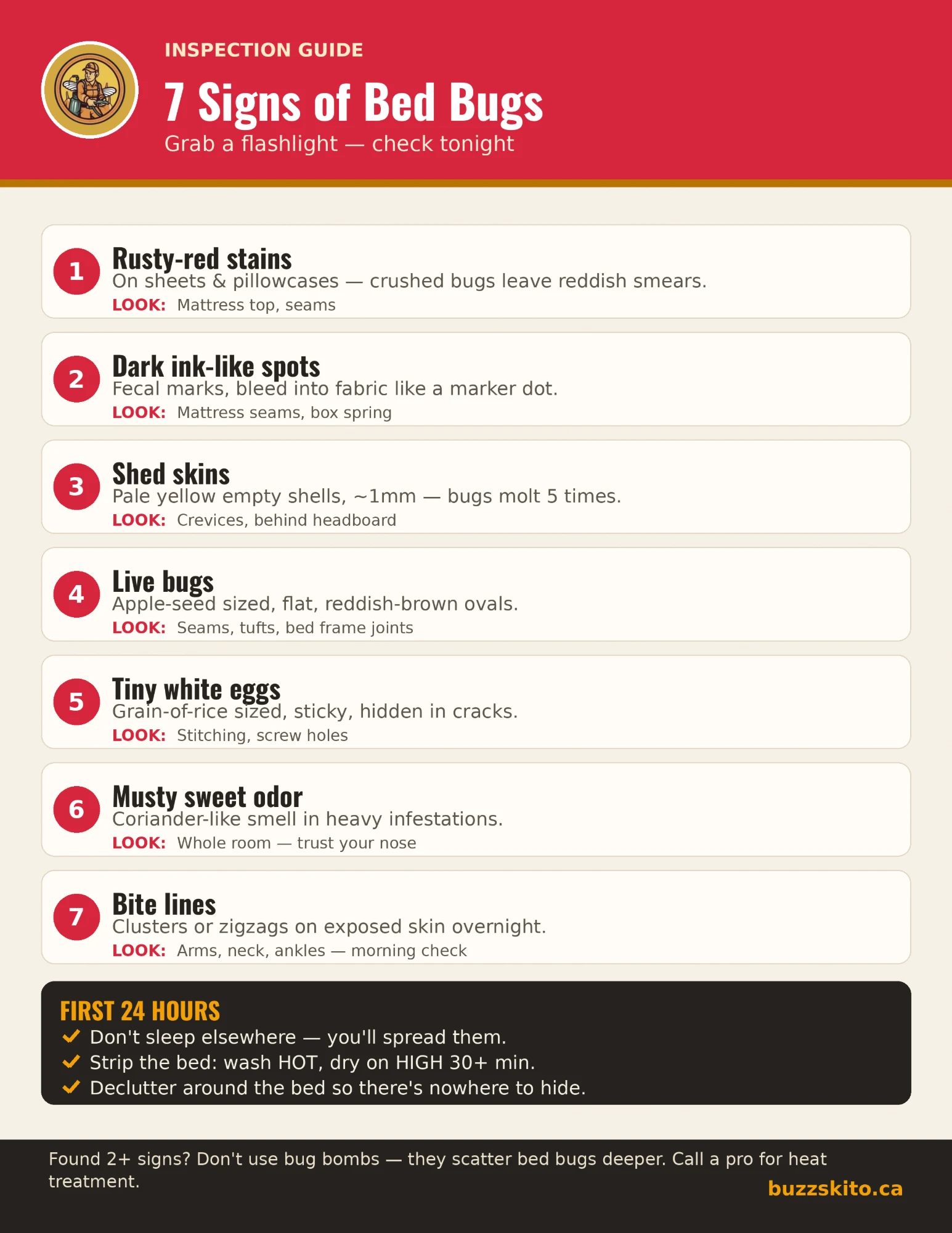 Signs of Bed Bugs: A 7-Point Checklist to Run TonightThe seven signs of bed bugs, from live bugs and ink-like spots to bites, with where to look tonight, what each is…
- PackTite Portable Review Canada 2026 — Is the Small Folding Bed-Bug Heater Worth It?An independent Canadian review of the PackTite Portable folding bed-bug heat chamber: what temperature it reaches, what…
- Bed Bug Shells, Casings and Shed Skins — What You Found, and What It Actually ProvesBed bug shells are moulted skins, not dead bugs. What a casing proves about feeding and breeding, how to tell one from…