
BuzzSkito Mosquito & Tick Control Specialists · Published July 21, 2026
What Is the Best Bed Bug Detector in Canada?
A set of passive interceptor traps is the best bed-bug detector for most Canadian homes — not because it is clever or expensive, but because it does the one thing detection actually requires better than anything else at the price: it sits in the bug’s path and quietly catches whatever moves through, night after night, for months, with no power and no refills. Bed bugs are ambush feeders that travel from a hiding place to a sleeping host and back, and the legs of your bed are the highway they use. An interceptor under each leg turns that highway into a toll booth you can read every morning.
Every other detector on this page is a variation on a single question — are there bed bugs moving here? — answered with a different trade-off. An active lured monitor trades cost for speed, generating heat or carbon dioxide to pull bugs out of hiding so you get an answer in a night instead of a fortnight. A glue-strip monitor trades catch-rate for reach, slipping into drawers and luggage where a cup will not fit. An inspection kit trades passivity for effort, letting you go and look for the bugs yourself. All five appear in our picks because different situations need different trade-offs, but the reasoning below explains why the humble interceptor sits at the top.
Check current Canadian availability of the main detector types:
Passive vs Active: The Distinction That Decides Everything
The single most useful concept in bed-bug detection is the split between passive and active monitors, because it maps directly onto the two situations you might be in. A passive monitor waits for the bugs to come to it. It relies on the insects already travelling through the monitored zone, which is why it is superb where you sleep or sit — the exact place traffic concentrates — and why it can be slow to register a brand-new, low-level introduction where only a handful of bugs are moving. An active monitor does the opposite: it manufactures a reason for the bugs to move, radiating the warmth, carbon dioxide, or chemical scent that a host-seeking bed bug is wired to hunt. That lure pulls bugs out of harbourage and toward the trap, so a smaller population registers sooner, and crucially, it works in a room where no human is providing the cue.
Which you need follows from your question. If your question is “I want to know the moment anything shows up, and I want to keep knowing for months,” passive interceptors are the answer — cheap enough to leave under every leg indefinitely. If your question is “I need a confident answer now, in a room nobody is sleeping in, and the cost of being wrong is high,” an active lured monitor earns its premium. Most thorough setups use both: interceptors for the long continuous watch, an active monitor when a specific decision hangs on a fast, sensitive result.
Why Interceptors Are the Backbone of Any Detection Plan
The interceptor is a shallow plastic dish with two concentric wells. The furniture leg sits in the raised centre; the two moats surround it. A bed bug climbing up from the floor to reach the bed falls into the outer well and cannot scale the slick inner wall to continue — and a bug climbing down after feeding falls into the inner well and is stuck there. Either way it is caught, alive and visible, on a surface you can inspect in seconds. Monitoring research has repeatedly ranked pitfall interceptors among the most dependable low-cost detection tools available, and they carry a bonus the other detectors do not: once a bed is cleaned and pulled clear of the wall, interceptors act as a partial barrier, catching any bug that tries to re-colonise it from elsewhere in the room.
Their limitation is the flip side of how they work. An interceptor only catches bugs that cross the floor, so an infestation already established inside the mattress, box spring, or headboard — where the bugs never need to descend — can persist without tripping a single trap. That is why interceptors are an early-warning and progress-tracking system, not a diagnosis of the whole problem, and why a negative reading has to be paired with a real inspection. For the deep dive on selecting and reading them, our dedicated guide to bed-bug interceptor traps in Canada covers brands, placement, and how to interpret catches over time.
Where Active Lured Monitors Pull Ahead
Active monitors are the right tool precisely when passive traps are at their weakest: a very low-level infestation, an unoccupied room, or a time-sensitive decision. Because they generate a host cue rather than depending on ambient traffic, they can coax out and detect bugs that a passive trap would take weeks to catch — or might miss entirely if nobody is sleeping in the room to draw the bugs across the floor. That makes them the go-to for a landlord-tenant dispute, a real-estate transaction, a move into a new apartment, or a household where someone is immunocompromised and a wrong “all-clear” carries real cost.
The trade-offs are honest ones. Active monitors cost meaningfully more than a bag of interceptors, some need power or a refillable lure, and they run for a defined test window rather than sitting under a leg for a whole season. Historically the most sensitive active systems were professional-only units; the consumer market now offers heat-and-CO₂ monitors you can run yourself, though quality and design vary widely, so read current listings carefully. The way to think about the spend: you are buying speed and sensitivity for a specific question, not continuous coverage. When the question is worth answering fast and right, it is money well spent; for routine background peace of mind, the passive layer alone does the job.
Glue Monitors and Inspection Kits: The Supporting Cast
Glue-strip monitors such as BuggyBeds fill the gaps an interceptor physically cannot reach. They are thin adhesive cards you tuck inside nightstand drawers, behind and inside a headboard, between a mattress and box spring, or into luggage after a trip — the enclosed micro-habitats where bed bugs love to shelter but a leg-cup will never sit. They are cheap and discreet, which makes them ideal for spot-checking furniture before you bring it home and for travel hygiene. Their weakness is that, being wholly passive and small, they only catch a bug that happens to crawl directly across the sticky face, so they miss far more than a well-placed interceptor at the primary travel route. Deploy them as a supplementary layer, never as your main line. Monitors earn their keep the moment you find marks you cannot explain, so reading the black spots and rust-coloured smears is the step that tells you whether a detector is warranted at all.
An inspection kit — a bright, tightly focused flashlight, a magnifier, and a few monitor cards — solves a different need: it lets you go looking rather than waiting. Held at a low angle, a good light throws shadow across the tiny ridges of a mattress seam and makes bugs, shed skins, and dark faecal spotting jump out. It is the natural companion to a catch in an interceptor, when you want to confirm what you have and find the harbourage. If you are at the “am I imagining this?” stage, our walkthrough on how to check for bed bugs in Canada shows exactly what to look for and where, and our field guide to bed-bug bites helps you tell them from other bites before you spend a cent.
How to Place and Read Your Detectors
Placement is where most home monitoring quietly fails, because a perfectly good trap the bugs can simply walk around tells you nothing. Get the fundamentals right:
- One interceptor under every leg. Bed, and any upholstered chair or sofa where someone regularly sits or sleeps. Every leg — a bug uses whichever one is closest.
- Don’t let anything bridge the trap. Pull the bed away from the wall, keep duvets, skirts, and sheets from touching the floor, and clear out under-bed storage. A single draped blanket gives the bugs a bypass around your moat.
- Glue strips go where cups can’t. Inside drawers, behind the headboard, along the baseboard directly behind the bed, and inside luggage after any travel.
- Active monitors go central and clear. Place a lured monitor in the middle of the room you are testing, away from competing heat sources like radiators or electronics that would dilute its cue.
- Read and log, don’t just glance. Check every trap regularly and write down catches with dates. The trend — rising, falling, flat — is the information, not a single snapshot.
- Give a negative time. Leave passive traps in place at least two to four weeks before you trust an empty result, and six to eight weeks after treatment before you declare it over.
How to Choose: What You Are Actually Paying For
Detectors span a wide range, from a few dollars of plastic to a genuinely pricey active unit, so it pays to be clear about where your money does real work for your situation. Prioritise in this order:
- Full-bed interceptor coverage (buy this first, always). The cheapest high-value move in all of bed-bug detection is putting a trap under every single leg. Do this before anything else, whatever your budget.
- Speed and sensitivity, via an active monitor (buy when the stakes are high). A new lease, a property sale, a vulnerable household, or a documented dispute justifies the premium of a lured monitor that answers fast. For routine reassurance, skip it.
- Reach into enclosed spaces (a few dollars, worth it). Glue strips for drawers, furniture, and luggage are cheap insurance against the spots interceptors miss.
- Your own eyes, equipped (cheap and reusable). A proper light and magnifier turn every future scare into a five-minute check instead of a panicked call.
- Build quality on the interceptors (pay a little more if furniture is heavy). Premium cups have better climb texture and won’t crack under a loaded bed frame; budget multipacks are fine for lighter furniture.
Read that as a spending map: nearly everyone should own interceptors for every leg and a glue-strip pack, which together cost very little. The one real decision is whether your situation warrants adding an active monitor — and that is a question about the cost of being wrong, not about the price of the device.
Detecting Is the Start, Not the Finish
The most important mindset shift is this: a detector answers “is something here?” — it does not answer “how do I get rid of it?” A catch in an interceptor is a signal to act while the population is small and cheap to clear, not a result you sit on waiting to catch more. The moment you confirm a bed bug, keep the traps in place as your progress tracker and move to control: encase the mattress and box spring to trap and starve what is inside, then work the seams and harbourage with steam and a sealed-HEPA vacuum. For the full end-to-end plan — from first catch to confirmed clear — our how to get rid of bed bugs in Canada guide ties the detection and treatment steps together, and the bed-bug control hub collects every companion guide in one place.
And be realistic about the limits of DIY monitoring. Detectors tell you about the spot you monitored; a trained inspector or a canine team can find harbourage no passive trap will ever reach. The best outcomes usually combine both — professional assessment for the diagnosis, detectors for the weeks of continuous coverage that prove whether the numbers are truly falling. For French-speaking households running the same checks, notre guide des traces sur le matelas covers reading the evidence before a detector goes down.
Frequently Asked Questions
What is the best bed bug detector in Canada?+
For most Canadian homes, the best bed-bug detector is a set of passive interceptor traps — pitfall cups like the Aspectek interceptors that sit under each bed and sofa leg. They are cheap, need no power or lure, work around the clock for months, and catch bugs travelling between their harbourage and you, which is exactly the traffic you want to intercept. If you need a faster or more sensitive answer — an empty apartment, a suspected low-level infestation, or a landlord dispute where you need documented proof — an active lured monitor that uses a heat or CO₂ cue to draw bugs out is worth the extra cost. Passive glue monitors like BuggyBeds strips are the budget layer you tuck into drawers and luggage. In practice the strongest setup is not one detector but a layered one: interceptors under every leg, a lured monitor if you need speed, and monitor strips in the gaps.
What is the difference between a passive and an active bed bug monitor?+
A passive monitor waits. It sits in the bug’s path — under a bed leg, inside a drawer, tucked against a baseboard — and catches whatever wanders in, using nothing but a pitfall well or a sticky surface. It relies on the bugs already moving through the area, so it works best where you sleep or sit, and it can take days to weeks to register a low-level infestation. An active monitor lures. It generates a cue that host-seeking bed bugs hunt for — warmth, carbon dioxide, or a chemical kairomone — to pull bugs out of hiding and toward the trap, so it detects a smaller population faster and works even in a room nobody is sleeping in. Active monitors cost more, some need power or refills, and they run for a set window rather than indefinitely. Passive for cheap continuous coverage; active for speed and sensitivity.
Do bed bug interceptor traps actually work?+
Yes, for what they are designed to do: intercepting and monitoring. An interceptor is a shallow two-well plastic cup that goes under each furniture leg. A bed bug trying to climb up to reach you, or climb down after feeding, falls into the outer moat and cannot scale the slippery inner wall, so it is trapped and visible. Peer-reviewed monitoring studies consistently rank pitfall interceptors among the most reliable low-cost detection tools available, and they double as a partial barrier that keeps bugs off a bed you have already cleaned. What they do not do is clear an infestation on their own — bugs already living in the mattress or headboard never have to touch the floor. Treat interceptors as your always-on early-warning system and your proof of progress, not as a cure.
How long does it take a bed bug detector to catch something?+
It depends on the population and the detector type. A heavy infestation can register in an interceptor within a night or two. A very low-level problem — a few bugs picked up from a hotel or a bus — may take one to several weeks to show up in a passive trap, because there simply are not many bugs moving yet. Active lured monitors compress that window: by generating heat or CO₂ they draw bugs out sooner, which is why they are the tool of choice when you need a fast answer or want to rule out an infestation with more confidence. The practical rule is to leave passive detectors in place for at least two to four weeks before you trust a negative result, and to inspect and log them regularly rather than checking once and forgetting them.
Are BuggyBeds and glue-strip monitors any good?+
They fill a real niche. Glue-strip monitors such as BuggyBeds are thin adhesive cards you slip into drawers, behind headboards, into luggage, or between a mattress and box spring — places an interceptor cup cannot go. They are inexpensive, discreet, and useful for spot-checking furniture, travel bags, and storage. Their limitation is that they are entirely passive and depend on a bug happening to crawl directly across the sticky surface, so they miss more than a well-placed interceptor at the primary travel route under the bed legs. Use them as a supplementary layer in the spots interceptors cannot reach, not as your main line of defence.
Can a bed bug detector replace a professional inspection?+
No, and it is important to be honest about that. Detectors tell you whether bugs are moving through a monitored spot; they do not tell you the full extent or exact location of an infestation, and a negative reading is never absolute proof of an all-clear — it only means nothing was caught where you placed the trap. A trained inspector, and increasingly a canine detection team, can find harbourage in seams, wall voids, and furniture joints that no passive trap will ever see. The smart use of detectors is as continuous monitoring between or alongside professional assessment: they extend a one-time inspection into weeks of coverage and give you an objective, datable record of whether numbers are rising or falling.
Where should I place bed bug interceptors and monitors?+
Put an interceptor under every leg of the bed and every leg of any upholstered chair or sofa where someone regularly sits or sleeps — those legs are the highways between the bug’s hiding place and its meal. Make sure nothing bridges the trap: pull the bed away from the wall, keep bedding and skirts from touching the floor, and remove under-bed storage, or the bugs simply walk around your moat. For glue-strip monitors, target the enclosed spaces interceptors miss: inside nightstand drawers, behind and inside the headboard, along the baseboard behind the bed, and inside luggage after travel. Active lured monitors go in the centre of the room you want to test, away from competing heat sources.
How much should I spend on a bed bug detector?+
Match the spend to the stakes. A basic set of passive interceptors is inexpensive and covers the single most important job — continuous monitoring under the bed — so almost everyone should own a set regardless of budget. Glue-strip monitors add a few dollars for drawer-and-luggage coverage. The real cost decision is whether to add an active lured monitor: these are meaningfully pricier, sometimes need power or a refillable lure, but they buy you speed and sensitivity that passive traps cannot match. Spend up on an active monitor when the cost of a wrong answer is high — a new lease, a real-estate deal, an immunocompromised household, or a dispute where you need documented evidence. For routine peace of mind, the passive layer alone is enough.
Are the bed bug detectors sold in Canada different from US ones?+
The detectors themselves are devices, not pesticides, so they carry no PMRA or Health Canada pesticide registration and there is no legal barrier to buying interceptors, glue monitors, or lured traps in Canada — the products on Amazon.ca are the same globally sold designs. The distinction matters more for the treatment products people reach for next: a bed-bug spray or dust must be PMRA-registered to be legal for sale and use in Canada, and grey-market US insecticides bought online frequently are not. When you move from detecting to treating, verify Canadian registration on any chemical product; for the detectors on this page, availability is not the concern — placement and follow-through are.
I caught one bug in a detector — now what?+
First, confirm it is a bed bug and not a carpet beetle, spider beetle, or bat bug, which are commonly mistaken for one another; our guide on how to check for bed bugs walks through the identifying features. If it is a bed bug, one catch means active traffic, so escalate from detecting to a full inspection and treatment plan rather than waiting to catch more. Leave the interceptors in place — they now become your progress tracker — and start non-chemical control: encase the mattress and box spring, vacuum and steam the seams and harbourage, and consider whether the level warrants a professional. A single catch is not a crisis, but it is a clear signal to act while the population is still small and cheap to clear.
Do I still need detectors after treatment?+
Absolutely — this is when they earn their keep most. The hardest question in any bed-bug job is whether it is truly over, because a treatment can miss a pocket of eggs that hatch weeks later. Leaving interceptors under every leg after treatment gives you an objective, ongoing readout: no catches over several weeks of monitoring is far stronger evidence of success than simply not being bitten, since people stop reacting to bites or a low-level population can persist unnoticed. Keep the traps in place and inspected for at least six to eight weeks past the last sign of activity before you declare victory.
Can I make a DIY bed bug detector instead of buying one?+
You can, and a homemade pitfall trap built from stacked plastic dishes with a talc-dusted inner wall does genuinely catch bugs on the same principle as a commercial interceptor. The catch is consistency: manufactured interceptors have a reliably climbable outer texture and a reliably slippery inner well, they stack neatly under a leg without tipping, and they are cheap enough that the DIY savings are marginal. A homemade active lure — dry ice for CO₂, for instance — can work for a one-off test but is fiddly and short-lived. For continuous, trustworthy monitoring, inexpensive commercial interceptors are the better value; save the DIY approach for a quick single-night check when you have nothing else on hand.
Related Reading
- Bed-Bug Interceptor Traps Canada — Brands, Placement & Reading Catches
- How to Check for Bed Bugs in Canada — A Room-by-Room Inspection
- Bed-Bug Mattress Encasement Canada — Trap and Starve What’s Inside
- Best Bed-Bug Steamer Canada — Heat That Kills the Eggs
- Best Sealed-HEPA Vacuum for Bed Bugs & Fleas Canada
- How to Get Rid of Bed Bugs in Canada — The Full Plan
- Bed-Bug Control Canada — The Complete Hub
- Best Pest Control Equipment Canada — The Device Hub
Keep reading
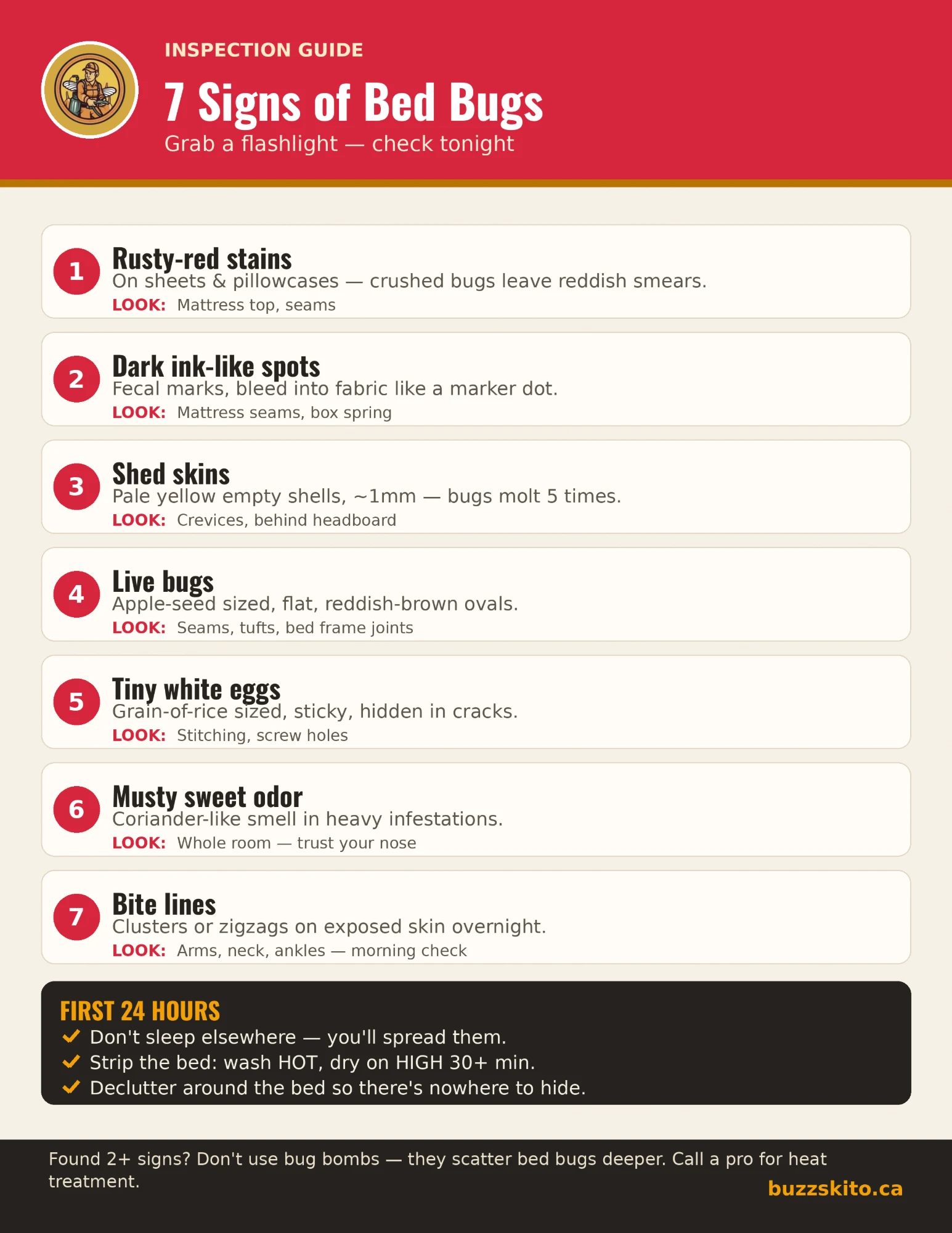 Signs of Bed Bugs: A 7-Point Checklist to Run TonightThe seven signs of bed bugs, from live bugs and ink-like spots to bites, with where to look tonight, what each is…
- Konk Bed Bug Killer Review Canada 2026 — The Legal, In-Store Aerosol, Honestly AssessedIndependent Canadian review of Konk Bed Bug Killer: what the PMRA-registered aerosol does well, where pyrethroid…
- DIY Bed Bug Heat Treatment Canada 2026 — The Temperatures, Gear & Protocol That Actually…A complete DIY bed bug heat treatment guide for Canada: the exact lethal temperatures and dwell times, portable heat…