
BuzzSkito Mosquito & Tick Control Specialists · Published July 21, 2026
What Is the ZappBug Heater, and Why Does Heat Win Against Bed Bugs?
The ZappBug Heater is a portable heat chamber: a fabric-and-wire-frame box that pops up like a camping tent, takes a load of your belongings, and holds them above the temperature at which no bed bug — egg, nymph, or adult — survives. It exists because of an inconvenient biological fact: bed bugs are extraordinarily good at surviving chemicals and extraordinarily bad at surviving heat. Adults and nymphs die at a sustained 45°C. Eggs, the stage that defeats almost every spray on the shelf, die at roughly 48°C held for about 90 minutes. At 50°C, every life stage dies within minutes. There is no resistance mechanism against being cooked, which is why professional exterminators bet entire whole-home treatments on exactly this physics.
The chamber applies that physics at the scale where a homeowner can actually control it: a sealed, insulated volume small enough for a single 1500-watt heater — running off any standard Canadian 120-volt outlet — to push past lethal temperature and hold it there. That containment is the whole trick. Heat that would dissipate uselessly into a room concentrates inside the chamber, and the bugs riding in your suitcase seams and book spines have nowhere colder to run.
This review sits under our broader bed bug heater guide for Canada, which maps the full landscape of heat options; here we go deep on the single product we would actually buy first.
Check current Canadian availability:
Setup: Genuinely a One-Person, Five-Minute Job
Out of the box you get the collapsible chamber, the heater unit, and a wireless digital thermometer with a probe. The chamber unfolds the way a pop-up tent does — spring the wire frame open, square it up, and you have the working volume standing on your floor. The heater sits inside at one end, you load your items with air gaps around them, zip the chamber closed with the thermometer probe buried in the middle of your densest item, and plug in. There is no assembly in any meaningful sense, no tools, and no special wiring; the one electrical rule worth respecting is to give the heater its own circuit — 1500 watts is most of what a typical household breaker can supply, so do not share it with a space heater, kettle, or microwave mid-cycle.
Between uses the chamber folds flat and slides under a bed or into a closet. That matters more than it sounds: bed bug episodes have long tails, and the owners who win are the ones who keep running precautionary cycles — every returning suitcase, every second-hand find — for months after the last bite.
Cycle Times: The Honest Numbers
Marketing photos show a timer; reality shows a thermometer. The kill standard is a sustained core temperature — 49°C held with margin — and how long that takes depends almost entirely on load density:
- Airy loads (1–2 hours to temperature): bedding, pillows, jackets, loose clothing. Heat penetrates fast; you will typically hit lethal core temperature within an hour or two, then hold for another hour of insurance.
- Medium loads (2–4 hours): a half-packed duffel, shoes, backpacks. Leave space between items and stand shoes open.
- Dense loads (4–8 hours): a fully packed carry-on, banker boxes of books or files. The centre of a packed suitcase lags the chamber air by hours — this is where impatience kills results, because a 90%-done cycle leaves the eggs at the core alive.
The wireless thermometer is what makes those numbers trustworthy: the probe goes in the middle of the worst-case item, and the display sits outside the chamber where you can watch it. You end the cycle when the core has held lethal temperature — not when the air feels hot, not when the timer you guessed at runs out. Improvised alternatives (black bags in the sun, an oven, a car dashboard in July) all fail on exactly this point: no measurement, no even heating, no verified kill.
Capacity in Real Items — and the Electronics Question
The interior is roughly 38 by 23 by 23 inches, which translates to genuinely useful loads: a carry-on suitcase with its contents plus several pairs of shoes; a complete queen bedding set with pillows; two or three banker boxes of books; a stack of coats and a duvet. For a returning traveller — travel is among the most commonly cited routes bed bugs take into a home — the entire trip’s luggage goes in unopened, which is precisely the use case that justifies owning one before you ever see a bug.
Electronics deserve their own paragraph because they are both a classic harbourage and the item people are most afraid to treat. The good news: most consumer electronics carry manufacturer storage temperature ratings of 60°C or higher — comfortably above the 49–50°C a chamber cycle reaches. A powered-off laptop, phone, console, or router generally comes through a cycle unharmed, and treating them matters because bed bugs love the warm, dark seams of electronics. The rules: device off, check the manufacturer’s storage spec first, and never run a cycle with a device powered on.
The hard exclusion list is about everything else: aerosol cans, lighters, and loose batteries (pressure and fire risk); candles, crayons, cosmetics, and chocolate (melt); medications (most degrade above room temperature); vinyl records, cassettes, and photographs (warp); and glued or finished musical instruments (delamination). For irreplaceable delicates, the alternative is isolation — sealed in a bag for several months until anything inside has starved — rather than heat.
ZappBug Heater vs Renting a Heater vs Paying a Pro
The chamber is the smallest of three heat plays, and knowing where its jurisdiction ends is most of buying it intelligently.
Against DIY room-heat rental: this is the comparison where we will be blunt. Renting propane or electric room heaters (roughly $150–$350 per day in Canadian cities) to cook a bedroom yourself is the approach with the worst failure profile in the entire bed bug playbook. Rooms are not sealed chambers: wall voids, outlet boxes, baseboard gaps, and the underside of heavy furniture lag the air temperature by hours and become survival refuges, while the bugs themselves actively migrate along cables and pipe chases into cooler adjacent rooms — you can turn one infested bedroom into three. Add unattended high-output heaters, scorched finishes, and awkward conversations with your home insurer, and the rental route manages to be simultaneously more dangerous and less effective than either alternative. A chamber inverts every one of those failure modes: small sealed volume, single monitored heater, verified core temperature.
Against professional heat treatment: no contest on scope — and that is fine, because they are partners, not rivals. A professional crew heats your entire home to lethal temperature with industrial equipment and dozens of remote sensors, typically for $2,000–$5,000+ in Canada, and for an established infestation that (or a multi-visit chemical program in the $600–$1,800 range) is the right call. What the pros cannot do is follow your life afterwards. Every suitcase that comes home, every kid’s backpack from a sleepover, every marketplace find is a potential re-introduction, and re-introduction after a four-figure treatment is the most expensive way to learn this lesson. The chamber is the airlock that protects the investment. Full pricing context lives in our pest control cost guide for Canada.
The Regulatory Angle: Why Heat Beats the Grey Market
Spend an evening in bed bug forums and you will meet the grey market: Canadians being told to order Crossfire, Temprid FX, or other US-market concentrates because “the stuff in Canada doesn’t work.” Understand what that advice actually entails. Those products are not registered by Health Canada’s PMRA for sale to Canadian consumers, importing unregistered pesticides is a violation of the Pest Control Products Act, and — the part the forums skip — the resistance problem that motivates the smuggling doesn’t respect the border. Pyrethroid resistance is now widespread in bed bug populations across North America, including the Canadian ones in your apartment building, and several of the smuggled products lean on the very chemistry the bugs have already beaten.
Heat exits that entire argument. A chamber is a physical device, not a pesticide — there is no PMRA registration to check because none is required, nothing to import illegally, no pesticide applied to your bedding, and no resistance mechanism now or ever. A pyrethroid-resistant bed bug and a susceptible one die at exactly the same 49°C. When the legal, heat-only option is also the one with the cleaner kill science, the buying decision gets easy.
Verdict: 8.6/10 — Buy It for What It Is
The ZappBug Heater earns its 8.6 by being the best version of a precisely scoped tool. Within its jurisdiction — everything portable you own — it is close to unimprovable: verified lethal temperatures, egg kill that chemicals cannot match, one-outlet operation, honest instrumentation, and a folded footprint that makes precautionary use realistic for years. The score stops short of the 9s for reasons that are about scope and supply rather than performance: it cannot touch the mattress and room half of an infestation, dense loads demand real patience, and a small manufacturer’s Canadian stock has wobbled in past seasons — if the listing is empty when you look, the ThermalStrike Ranger is the credible same-bracket fallback, and we would rather you own either one this week than the “perfect” one next month.
Buy it early — ideally as the returning-traveller airlock before you ever see a bite — pair it with encasements, interceptors, and professional help if the problem is established, and it is one of the few bed bug purchases with essentially no way to regret it.
If the loads you are picturing are bigger than one suitcase, the same brand scales in two steps. The Oven 2, the twin-heater box takes a family’s luggage or a full closet in one cycle — with the caveat that it wants two separate electrical circuits. Above that sits the walk-in Room enclosure, which treats a whole bedroom’s worth of clothing, bedding and boxes at once and ships with placed probes so you can confirm the coldest item crossed the line.
The competing brand is PackTite, and the shapes are genuinely different rather than interchangeable: the Closet-versus-Room comparison explains why a hanging chamber suits coats and linens while a cube suits mixed loads, and the PackTite Closet on its own terms covers the Canadian-stock caveat that comes with a US brand. Where the ThermalStrike Ranger is mentioned above as a fallback, the heated-suitcase review explains why a bag that cooks its own contents turns prevention into a habit.
And if the honest answer is that the bugs are in the room rather than in your belongings, no chamber of any size is the right purchase — the whole-room heat equipment guide covers what Canadians can legally buy at that scale and the dwell times a room actually needs.
Frequently Asked Questions
Does the ZappBug Heater really kill bed bugs?+
Yes — when the cycle is run correctly. Heat is one of the best-documented bed bug kill methods in entomology: adults and nymphs die at a sustained 45°C, eggs need roughly 48°C held for about 90 minutes, and everything dies within minutes at 50°C. The ZappBug Heater raises the chamber above those thresholds and its included wireless thermometer lets you confirm the core of your densest item — not just the air — actually reached lethal temperature before you stop the cycle. The failure mode is not the science; it is impatience. Stop the cycle before the centre of a packed suitcase hits 49°C and the eggs buried there survive.
Is the ZappBug Heater available in Canada?+
Yes. As of July 2026 the ZappBug Heater is listed on Amazon.ca, sold and shipped by ZappBug directly, and the larger ZappBug Room is also listed. Canadian specialty retailers such as Bed Bug SOS also carry the line. Stock has fluctuated in past seasons — ZappBug is a small US manufacturer, not a mass-market brand — so if the Heater shows as unavailable when you check, the ThermalStrike Ranger is the closest comparable portable heat chamber sold into Canada, and the honest move is to buy whichever of the two is actually in stock rather than wait weeks mid-infestation.
What temperature kills bed bugs?+
Adults and nymphs die at a sustained 45°C (113°F) in roughly 90 minutes, and in about 20 minutes at 48°C. Eggs are the tough stage: they need approximately 48°C (118°F) held for 90 minutes. At 50°C (122°F) and above, all life stages die within minutes. That is why professional heat treatments and chamber protocols target a sustained core temperature of about 49–50°C — it kills eggs with margin, which chemical sprays largely fail to do.
How long does a ZappBug Heater cycle take?+
Plan on 2 to 8 hours depending on load density. Loose, airy loads — bedding, pillows, jackets on top of each other — typically reach lethal core temperature in 1 to 2 hours, after which you hold for another hour of margin. Dense loads are much slower: a packed carry-on suitcase or a box of books can take 4 or more hours just to reach 49°C at the centre. The wireless thermometer is what tells you the truth — put the probe in the middle of the densest item and run until it reads lethal temperature for a sustained hold, not until the air inside feels hot.
What fits inside the ZappBug Heater?+
The chamber gives you a roughly 38 by 23 by 23 inch interior — genuinely useful mid-size capacity. In real items per cycle: a full set of queen bedding plus pillows; or a carry-on suitcase with contents plus several pairs of shoes; or two to three banker boxes of books and papers; or a couple of backpacks, coats, and a duvet. What it will not fit: mattresses, box springs, couch cushions from a large sectional, or furniture. For those you are looking at the much larger ZappBug Room or a professional treatment.
Can I put electronics in a bed bug heat chamber?+
Usually yes, with two checks. Most consumer electronics have manufacturer storage-temperature ratings of 60°C or higher, comfortably above the 49–50°C a chamber cycle reaches — so phones, laptops, game consoles, and routers (all powered off) generally come through fine, and electronics are a classic bed bug harbourage worth treating. Check the specific manufacturer storage spec first, and never run a device while it is in the chamber. If an item is irreplaceable or its spec sheet is silent, leave it out and treat it by isolation in a sealed bag for several months instead.
What should never go in a heat chamber?+
Anything pressurized, flammable, or heat-deformable: aerosol cans, lighters, e-cigarette cartridges, and batteries outside of a device with a rated storage temperature. Also skip candles, crayons, cosmetics, chocolate, medications (many degrade above 25–30°C), vinyl records, cassettes, photographs, and glued or finished musical instruments — a violin or guitar can delaminate. Wine and carbonated drinks can burst. When in doubt, the alternative for delicate valuables is months of sealed-bag isolation, not heat.
ZappBug Heater vs ZappBug Room — which should I buy?+
The Heater for almost everyone. It runs on one 1500-watt unit from a standard household outlet, sets up in minutes, and handles the belongings-scale problem — luggage, bedding, clothes, books, shoes — that heat chambers are actually good at. The ZappBug Room is a different commitment: a chamber big enough for mattresses and furniture, at a four-figure price, drawing enough power that you must spread multiple heater units across separate circuits. It makes sense for landlords, frequent-turnover situations, or people facing repeated infestations; for a single household episode, the Heater plus a professional treatment quote is usually smarter money.
Is a heat chamber better than renting a bed bug heater?+
They solve different problems, and DIY whole-room rental is the option we caution against most. Rental propane or electric room heaters run roughly $150–$350 per day in Canadian cities, and whole-room DIY heat fails in a specific, well-documented way: cold spots. Wall voids, baseboard gaps, and the underside of furniture lag the air temperature, bugs actively flee along cables and pipes into cooler adjacent rooms, and a room that "felt hot" can leave the infestation alive with a fire-risk and insurance question attached. A chamber flips that logic — a small, sealed, monitored volume you can verifiably take lethal, item by item.
How much does professional bed bug heat treatment cost in Canada?+
Whole-home professional heat treatment in Canada typically runs $2,000–$5,000+ depending on square footage and severity, and chemical-program alternatives with multiple visits usually land in the $600–$1,800 range. That context is exactly why a heat chamber at a few hundred dollars earns its place: it does not replace a professional job on an established infestation, but it protects the professional job — treating everything that leaves and re-enters the home so you do not re-seed the problem — and for a caught-early, localized problem it can be the whole solution. See our Canadian pest control cost guide for the full pricing landscape.
Will a heat chamber alone get rid of a bed bug infestation?+
A light, early one — possibly. An established one — no, and no honest review will tell you otherwise. The chamber sterilizes belongings; it does nothing about the bugs and eggs in your mattress seams, bed frame, baseboards, and outlet boxes. The winning pattern is the chamber plus mattress and box-spring encasements, interceptor cups under bed legs, aggressive vacuuming, and — for anything beyond a few isolated bites — a professional treatment, with the chamber handling laundry, luggage, and everything the pros cannot run through their process. Our bed bug heater guide covers how the whole strategy fits together.
Do bed bug heat chambers need PMRA registration in Canada?+
No — and that is one of their quiet advantages. Heat chambers are devices that kill by physical means, so they fall outside pesticide regulation entirely; there is no PMRA registration number to check and nothing to import illegally. Contrast that with the US-market bed bug sprays Canadians find in Reddit threads — products like Crossfire and Temprid FX are not registered for sale to Canadian consumers, and importing unregistered pesticides violates the Pest Control Products Act. Heat also sidesteps the pyrethroid resistance now widespread in Canadian bed bug populations: a resistant bug cooks at exactly the same temperature as a susceptible one.
Related Guides
Keep reading
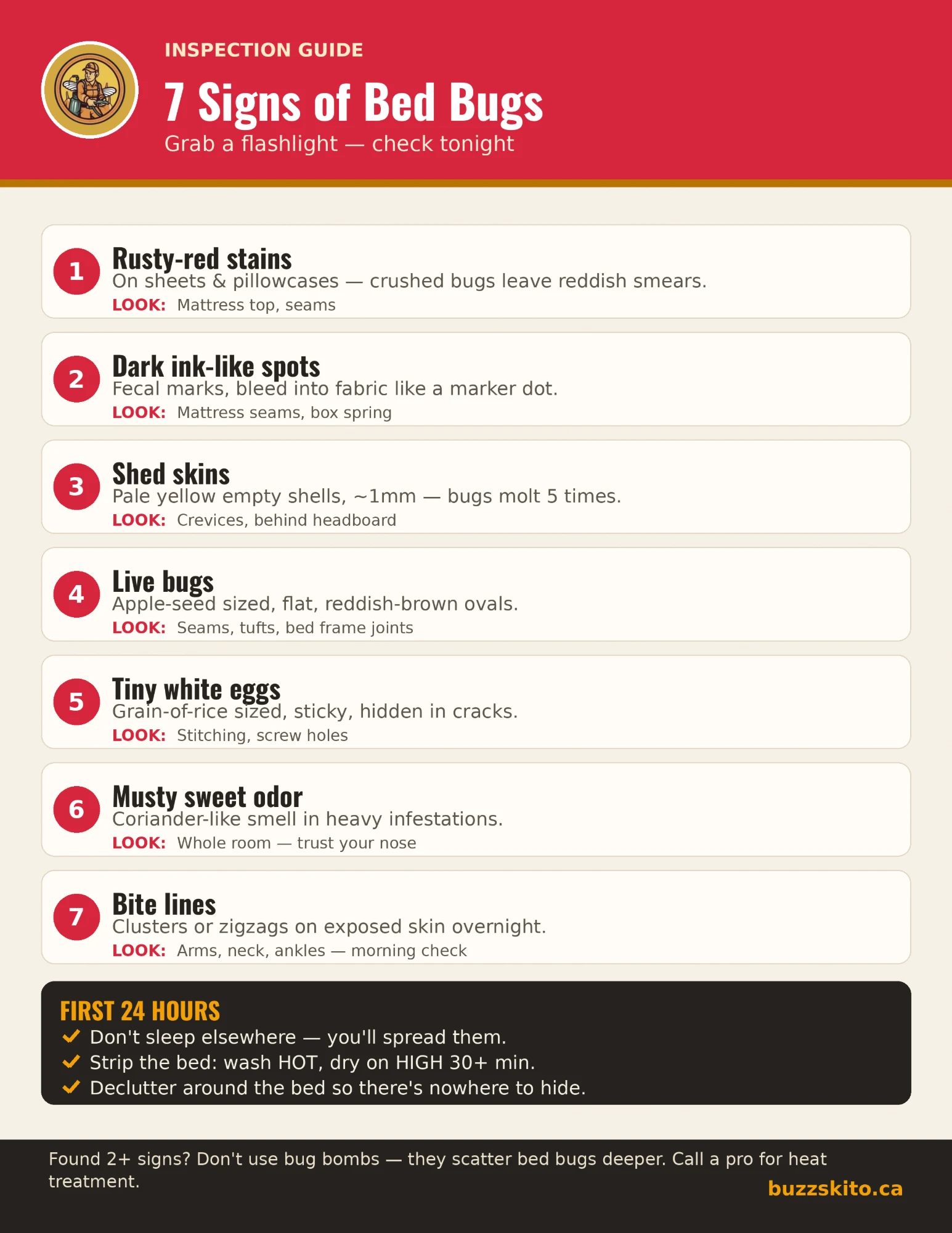 Signs of Bed Bugs: A 7-Point Checklist to Run TonightThe seven signs of bed bugs, from live bugs and ink-like spots to bites, with where to look tonight, what each is…
- Best Bed Bug Mattress Encasement in Canada 2026 — SafeRest vs Utopia + the 12–18 Month…SafeRest vs Utopia bed bug encasements — encasement vs cover explained, the 12-18 month containment rule, zipper…
- CimeXa Bed Bug Review Canada 2026 — Does the Silica Dust Actually Work?Independent Canadian review of CimeXa silica gel dust for bed bugs: how amorphous silica desiccant kills, why it beats…