
BuzzSkito Mosquito & Tick Control Specialists · Published July 21, 2026
What Is the Best Bed-Bug Luggage Heater in Canada?
A hanging closet-style heat chamber is the best bed-bug luggage heater for most Canadian homes — not because it is the biggest or the most powerful, but because it does the two things this job actually demands: it fits a real load (a full suitcase plus the clothing inside it), and it lets you verify that the coldest item in that load reached the temperature that kills bed-bug eggs. Everything else in our picks is a variation on those two ideas. A folding suitcase-style unit trades capacity for the ability to pack flat and travel with you; a large rigid box trades portability for treating several bags at once; a budget folding chamber trades size and features for price. All four appear above because different travellers and households need different trade-offs, but the reasoning below explains why the closet chamber sits at the top.
The single idea that separates a heat treatment that works from one that quietly fails is this: bed bugs and their eggs die from sustained heat at the cold core of the load, not from hot air brushing the surface. That distinction is invisible — a bag can feel warm and be full of viable eggs — and it is the most important thing to understand before you spend money.
Check current Canadian availability of the four picks:
Why Heat Works When Sprays and Suction Do Not
Bed bugs have a hard-won reputation for surviving what you throw at them. Many populations shrug off common insecticides, and their eggs are cemented into fabric seams where a vacuum cannot lift them and a surface spray struggles to reach. Heat is the great equaliser: no bed bug at any life stage has evolved resistance to being cooked. Adults and nymphs die when their tissue is held at roughly 45°C (113°F) for a sustained period, and the eggs — always the toughest stage — are reliably destroyed at about 48–50°C (118–122°F) held long enough. A luggage heater is engineered to reach that egg-killing band and hold it, which is why one clean cycle can decontaminate an entire bag that no amount of spraying would clear.
That is also why heat is the natural companion to the other non-chemical tools. A bed-bug steamer delivers lethal heat to seams and tufts on furniture you cannot fit in a chamber; a sealed-HEPA vacuum physically removes the adults and loose debris first. The luggage heater covers the category those two cannot: portable belongings — the suitcase, shoes, books, and electronics — treated whole, in one pass, with the same heat principle.
The Cold Core: The One Thing That Decides Success
If you take away a single idea from this guide, make it this. When you switch a heat chamber on, the air inside reaches temperature quickly, but the objects in the load lag far behind — and the more tightly something is packed, the slower its centre heats. A loosely draped shirt reaches lethal temperature in minutes; the middle of a rolled sleeping bag, a stuffed shoe, or a densely packed corner of a suitcase can take an hour or more. Bed-bug eggs tucked into that cold core survive if the heat never fully reaches them, and a partially heated load is the worst possible outcome: it looks and feels treated, so you stop worrying, while viable eggs hatch a week later and the problem restarts.
This is exactly why the good chambers ship with a remote probe thermometer, and why the mediocre ones that omit it are a false economy. You tuck the probe into the densest, most tightly packed part of the load — not the open air of the chamber — and you do not start counting dwell time until that reading crosses into the kill zone. Everything about how you pack follows from this: pack loosely, leave gaps for air to circulate, unroll and unfold what you can, and never overstuff the chamber to save a cycle. An overpacked chamber is the most common way a heat treatment fails.
Luggage Heater vs the Dryer: Use Both, for Different Things
A hot wash followed by a full high-heat dryer cycle genuinely kills bed bugs on washable clothing, and if you already own a dryer it costs nothing. For launderable clothes, that is often all you need — there is no reason to buy a chamber to treat a load of t-shirts. Be honest with yourself about that before you spend.
Where the heat chamber becomes irreplaceable is everything you cannot put in a machine. The suitcase itself — wheels, seams, lining, the exact places bed bugs ride home from a hotel. Shoes. Leather goods and belts. Books, papers, and documents. Backpacks and their frames. Electronics and cords. Delicate fabrics a dryer would shrink or ruin. A luggage heater treats all of it as a single load in one cycle, including the bag that carried the problem in the first place. The sensible household approach is both tools: the dryer for washable clothing, the chamber for the luggage and everything that cannot be washed.
Sizing a Heat Chamber: Match the Largest Load, Not the Smallest
Because these are a real investment, sizing is where people most often waste money in both directions — buying too small and running endless cycles, or buying a room-sized unit for a single carry-on. Match the chamber to your largest realistic load:
- Hanging closet chamber (the versatile default). Fits a full checked or carry-on bag plus loose clothing, and hangs to save floor footprint. The right first purchase for a household or anyone who travels regularly.
- Folding suitcase-style heater (for the road). Sized for a single bag and its contents, its whole advantage is packing flat so it travels with you and treats luggage at the destination or on return — not just at home.
- Large rigid box or heated room (for volume). The choice when you routinely treat several bags, a big duffel, bulky bedding, or gear at once, and running four small cycles would be maddening.
- Budget folding chamber (occasional single-bag need). Fine for a carry-on or a load of clothing now and then, provided you pack it loosely and verify the temperature every time.
The failure mode to avoid is buying a chamber that is too small and then cramming it — because a packed-solid chamber blocks the airflow that carries heat to the cold core, and undersizing is a direct route to a cycle that warms the load without killing the eggs.
Each of those four shapes has a real product behind it. The hanging default is the PackTite Closet, sized for bulky loads of clothing and linens; the fold-flat option for shoes, books and travel gear is the smaller PackTite Portable; and the road-going version that skips the chamber entirely is a hard-shell suitcase with heating elements in its own walls, which you pack, travel with, then plug in at the front door. At the volume end sits the ZappBug Room, for a whole bedroom’s belongings in one cycle.
How to Choose: What You Are Actually Paying For
These chambers span a wide price range, and it pays to know which premium features earn their cost for this job versus which are nice-to-haves. Prioritise your money in this order:
- Even heat with no cold spots (pay for this). A chamber with good air circulation heats the whole load uniformly. Uneven heat is the root cause of surviving eggs, and it is the one thing you cannot fix after the fact.
- A genuine target temperature in the egg-kill band (pay for this). The unit must actually reach and hold roughly 50°C at the load, not merely get warm. A chamber that tops out below the egg-killing temperature is not a cheaper version of the right tool — it is a tool that leaves eggs alive.
- A reliable probe thermometer (pay for this). Verification is the entire difference between hoping and knowing. The probe is how you confirm the cold core reached temperature; a chamber without one asks you to trust a result you cannot see.
- Capacity that matches your load (size correctly). Enough room to pack loosely, not so much that you are paying for volume you will never fill.
- Portability and folding convenience (skip if you do not need it). Wonderful for travellers, irrelevant for a home unit. Buy it only if you will genuinely treat luggage on the road.
Read that as a spending map: put your dollars into even heat, real temperature, and verification, and treat capacity as a sizing decision rather than a bigger-is-better one. A folding travel unit can be an excellent choice — it simply asks you to accept single-bag capacity in exchange for the ability to decontaminate luggage wherever you are, which is a fair trade for a frequent traveller.
The Grey-Market Trap: Buy a Canadian-Certified Unit
A heat chamber is an electrical appliance, so the compliance angle here is electrical safety, not pesticide regulation — because these are devices and not pesticides, they carry no PMRA registration requirement at all. What does matter is buying a model with a proper Canadian retail presence. Some heat chambers are marketed heavily in the United States under US-only listings and voltages; buying those grey-market can leave you with a warranty that is not honoured in Canada and, occasionally, a plug or voltage that is not a clean match for a 120V household outlet. It is a small thing to check and an easy one to get right: choose a unit whose Canadian listing shows appropriate electrical certification and standard 120V operation, and skip the imported-only options no matter how loudly they are advertised south of the border.
Is the Expensive Chamber Worth It, or Will a Cheap One Do?
The honest answer depends on your situation, and there is a legitimate cheaper path for some people. If your only need is treating washable clothing, your dryer already does the job and you may not need to buy anything. A budget folding chamber covers an occasional single-bag need competently, as long as you pack it loosely and verify the temperature every time.
But if you travel often, are managing an active infestation, or need to decontaminate belongings you cannot wash, the premium genuinely earns its cost. The three things you pay for — even heat, a real egg-killing temperature, and a probe to verify it — are precisely the three things a bargain chamber fakes or omits. A cheap unit that heats unevenly or never quite reaches the egg-kill band can leave live eggs while looking like it worked, and for a pest where one surviving egg restarts the whole problem, that is the failure you most want to avoid. The way to overspend, on the other hand, is to buy a room-sized unit for loads that a single closet chamber would handle. Buy even heat, buy real temperature, buy verification — and size to your load rather than to the biggest box on the shelf.
If you are weighing a full heat kit against calling a professional heat-treatment service, our bed-bug heater guide covers the larger room-and-furniture heaters, and the broader pest-control equipment hub maps how the vacuum, steamer, and heat chamber fit together into one honest DIY plan.
For the trip itself rather than the homecoming, the companion purchase is a can small enough to clear airport liquid limits — the carry-on rules and which travel sprays are PMRA-registered covers the 100 mL cap and why you treat the bag rather than the hotel room.
Frequently Asked Questions
What is the best bed bug luggage heater in Canada?+
For most Canadian travellers, the best bed-bug luggage heater is a hanging closet-style heat chamber such as the PackTite Closet: it holds a full suitcase plus clothing, reaches and sustains the ~50°C (120°F+) internal temperature that kills every bed-bug life stage including eggs, and comes with a probe thermometer so you can confirm the core of your bag actually got hot. A folding suitcase-style unit like the ThermalStrike Ranger is the best pick if you want a heater that packs flat and travels with you, and a large rigid heat box or heated room is the right tool if you need to treat several bags, a duffel, or bulky gear at once. Whatever you choose, the rule that matters is holding lethal temperature at the coldest point inside the load long enough — not just heating the air around it.
What temperature kills bed bugs and their eggs?+
Bed bugs die when their body tissue is held at roughly 45°C (113°F) for an extended period, and their eggs — the hardest stage to kill — need about 48–50°C (118–122°F) sustained to be reliably destroyed. That is why a good luggage heater targets an internal air temperature of around 50°C or a little above and then holds it for the full recommended cycle, often an hour or more once the coldest item in the load has reached temperature. The critical detail is the coldest point: a tightly packed shoe, a folded pair of jeans, or the middle of a rolled sleeping bag lags well behind the surrounding air, so the whole cycle is timed from when that cold core hits the kill zone, not from when you switched the unit on.
How does a bed bug luggage heater actually work?+
A luggage heat chamber is a fabric or rigid enclosure with a low-wattage heating element and a fan that circulates hot air evenly around whatever you put inside. You load your suitcase, backpack, or clothing, zip it closed, run the element until the interior reaches the target temperature, and hold it there for the recommended dwell time. Because bed bugs and their eggs cannot survive sustained heat, everything in the chamber — adults, nymphs, and eggs hidden in seams and pockets — is killed without chemicals, without washing, and without damaging most travel gear. The best units include a remote probe thermometer you tuck into the densest part of the load so you can verify the cold core actually reached lethal temperature before you start the timer.
Is a luggage heater better than just washing and drying my clothes?+
They do different jobs. A hot wash followed by a full hot-dryer cycle does kill bed bugs on washable clothing and is free if you already own a dryer, so for launderable items the dryer is often all you need. A luggage heater earns its place with everything you cannot throw in a machine: the suitcase itself, shoes, leather goods, books, electronics, backpacks, and delicate fabrics that a dryer would ruin. It treats the whole bag as a unit — including the seams and wheel wells where bed bugs hide — in one cycle. Many people use both: dryer for the launderable clothes, heat chamber for the luggage and everything that cannot be washed.
Can a luggage heater damage electronics, shoes, or delicate items?+
Generally no, when used as directed. These chambers run at around 50°C — hot enough to kill bed bugs but well below the temperature that harms most travel goods, clothing, leather, or books. Manufacturers do advise removing items that are genuinely heat-sensitive: pressurized cans, candles, crayons, some cosmetics and medications, and certain electronics with lithium batteries, which have their own temperature limits. When in doubt, check the manufacturer guidance for the specific unit and pull anything questionable. For the vast majority of what goes in a suitcase — clothes, shoes, toiletries in solid form, the bag itself — a properly run heat cycle is safe.
How long does a full heat cycle take?+
Plan on several hours end to end. The chamber first has to warm up, then the coldest, most tightly packed item inside has to reach the kill temperature, and only then does the real dwell-time clock start — often another hour or more at temperature. A loosely packed bag treats faster than a densely stuffed one because heat penetrates dense loads slowly, so how you pack matters as much as the unit. Most manufacturers quote total cycles in the range of a few hours; following the instructions for your specific model and using the probe thermometer to confirm the cold core reached temperature is what guarantees the eggs are actually dead rather than merely warm.
Do I need a heat chamber if I am not travelling?+
A luggage heater is not only for travel. Any time you need to heat-treat a discrete load of belongings — items coming out of storage, a returned rental, second-hand furniture-adjacent goods like cushions and pillows, a child's backpack after a school outbreak, or clothing from an affected home — a heat chamber treats it chemical-free in a single cycle. People managing a home infestation use these units continuously to treat items as they move things in and out of a treated room, so nothing re-introduces bugs. If your need is treating an entire room or large furniture rather than portable loads, a larger heater or a whole-room heat approach is the better fit.
Are these heat chambers sold and certified for use in Canada?+
The mainstream models are widely available on Amazon.ca and ship within Canada, but electrical certification is worth a moment of attention. A heat chamber is an electrical appliance, so look for a unit whose Canadian listing shows appropriate electrical safety certification and that runs on standard 120V household power. Some products marketed heavily in the United States are sold there under US-only listings or voltages; buying those grey-market can leave you with a warranty that is not honoured in Canada and, occasionally, a plug or voltage that is not a clean match. Choosing a model with a proper Canadian retail presence avoids all of that. Because these are heating devices and not pesticides, they carry no PMRA pesticide registration requirement — the regulatory angle here is electrical safety, not pest-control approval.
What size heat chamber do I need?+
Match the chamber to your largest realistic load, not your smallest. A hanging closet-style unit swallows a full carry-on or checked bag plus loose clothing and is the versatile all-rounder for a household or a frequent traveller. A folding suitcase-style heater is sized for a single bag and the clothing inside it, and its advantage is packing flat to travel with you. A large rigid box or heated-room style unit is for when you routinely treat several bags, a big duffel, bulky bedding, or gear at once. Buying too small forces you to run multiple cycles or, worse, overpack the chamber so heat cannot circulate — undersizing is the most common way people end up with a cycle that fails to kill the eggs.
Does a heat chamber prevent bed bugs, or only kill the ones I already have?+
Primarily it kills what is already there, and that is exactly its value: it lets you decontaminate luggage and belongings so you do not carry a hitchhiker home from a hotel, a trip, or an affected building. Used proactively after every trip, that decontamination step is a genuine prevention tool — the single most common way bed bugs enter a home is riding in on luggage and clothing, and a heat cycle breaks that chain. It does not create a lasting barrier the way a residual treatment would; it treats the specific load you put inside it, each time. Pair it with careful travel habits — inspecting hotel beds, keeping bags off the floor and bed — for the strongest prevention.
Can I build a DIY heat chamber instead of buying one?+
People try, and it is where most heat treatments go wrong. A car in the sun, a hot attic, or a space heater in a sealed tote can reach high temperatures, but they cannot reliably hold an even, verified lethal temperature at the cold core of a packed load — and hot spots risk fire or damage while cold spots let eggs survive. The whole point of a purpose-built chamber is controlled, even heat plus a thermometer to confirm the coldest item actually reached the kill zone. A partial DIY heat that warms the surface but not the core can look successful while leaving viable eggs behind, which is the worst outcome: you think you are clear and you are not. For a job where a single surviving egg restarts the problem, verified even heat is worth the purpose-built tool.
Is an expensive heat chamber worth it, or will a cheap one do?+
For a one-time need on washable belongings, your dryer may be all you require and you can skip a chamber entirely. But if you are buying one, the premium buys three things a bargain unit often fakes: even heat with no cold spots, a genuine target temperature that actually reaches the egg-killing range rather than merely getting warm, and a reliable probe thermometer so you can verify the result instead of hoping. A cheap chamber that heats unevenly or tops out below the egg-kill temperature is not a smaller version of the right tool — it is a unit that can leave live eggs while looking like it worked. Spend on even heat, real temperature, and verification; skip the capacity you will never use.
Related Reading
- Best Pest-Control Equipment Canada — The Full DIY Device Hub
- Bed-Bug Heater Canada — Room & Furniture Heat Treatment
- ZappBug Heater Review Canada — Is It Worth It?
- Best Bed-Bug Steamer Canada — Heat That Kills the Eggs
- Best Sealed-HEPA Vacuum for Bed Bugs & Fleas Canada
- Dupray vs McCulloch Steamer Canada — Which Kills More?
Keep reading
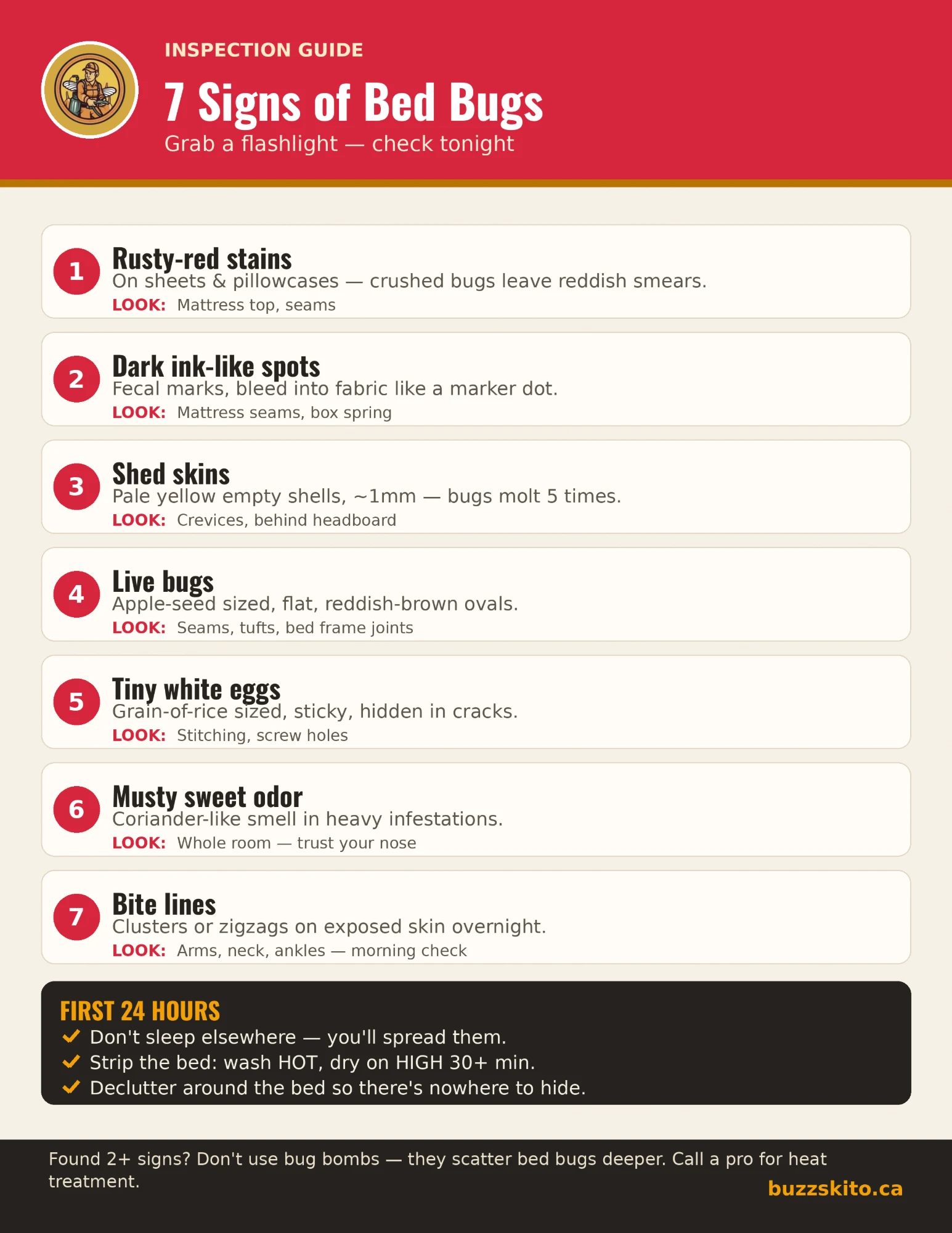 Signs of Bed Bugs: A 7-Point Checklist to Run TonightThe seven signs of bed bugs, from live bugs and ink-like spots to bites, with where to look tonight, what each is…
- Best Bed Bug Spray for Travel Canada 2026 — Carry-On-Legal Luggage & Hotel PicksThe best carry-on-legal bed-bug sprays for travel in Canada: TSA/CATSA 100 mL rules, PMRA-registered picks like Doktor…
- How to Get Rid of Bed Bugs in Canada 2026 — The Complete Step-by-Step PlanThe complete step-by-step plan to get rid of bed bugs in Canada: confirm, isolate the bed, encase, intercept,…