
BuzzSkito Mosquito & Tick Control Specialists · Published July 21, 2026
What Is the Best Whole-Room Bed Bug Heat Equipment in Canada?
The best whole-room bed bug heat equipment for a Canadian home is a purpose-built portable heat system matched to the room you are treating — either a room-scale collapsible enclosure like the ZappBug Room that you load with furniture and belongings, or a dedicated forced-air portable heater such as a Nuventa unit that raises the ambient air of the room itself. Which one is “best” is not a fixed answer; it depends entirely on where the bugs are living. If they are in things you can move or fold, the enclosure wins because its walls do the containment for you. If they are dug into baseboards, wall voids, or a heavy bed you cannot take apart, you need a heater that treats the fixed structure in place.
What both approaches share is the one thing that actually decides whether the treatment works: every hidden spot in the room has to reach and hold a lethal temperature. Bed bugs are killed by heat, but their eggs are stubborn, and eggs buried in a mattress core or tucked into a cold corner are exactly where amateur heat jobs leave survivors. The rest of this guide is about how to buy and run equipment that actually gets the cold spots hot — because that, not the wattage on the box, is where the money is won or lost.
Check current Canadian availability of the main heat-equipment types:
The Physics You Cannot Cheat: Temperature and Dwell Time
Everything about whole-room heat comes down to two numbers and one distinction. Bed bugs themselves die fairly quickly at around 45°C (113°F). Their eggs are the problem: to reliably kill eggs you want every surface and hidden void to hold at roughly 48–50°C (118–122°F) or higher for a sustained dwell — commonly 60 to 90 minutes at temperature, not merely the instant the air touches that number.
The distinction that trips up almost every DIYer is that air temperature is not object temperature. Your heater can push the room air to 50°C in an hour, but the core of a thick mattress, the wood inside a bed frame, and the centre of a stack of books lag far behind and take a long soak to catch up. Call the job done when the air reads hot and you have cooked the surface while leaving live eggs an inch deep in the foam. This single misunderstanding — treating the air reading as if it were the whole-object reading — is the most common reason a heat treatment “fails” and the bugs are back a week later. The equipment that succeeds is the equipment that lets you monitor the coldest, densest spot and keep heating until it is above temperature.
Enclosure vs Ambient Heater: Two Ways to Win
The room-scale enclosure and the portable ambient heater represent two genuinely different strategies, and understanding the trade-off is how you buy the right one.
The enclosure — the ZappBug Room being the room-scale example — is a large collapsible heat box you assemble in the middle of the space and pack with your mattress, furniture, and belongings. Its reflective walls trap the heat and even it out, so the interior reaches temperature far more predictably than an open room ever could. You are no longer fighting the building; you have built a small, insulated environment you fully control. The limitation is equally clear: it only treats what you can fit inside. Bugs living in the baseboards, the wall, or a bolted-down platform bed are outside the box and untouched.
The ambient heater — a Nuventa-style forced-air unit — heats the actual room air and, with enough airflow, pushes that heat into the structure and the furniture in place. This is the tool for an infestation that has moved into the fabric of the room. Its weakness is the mirror image of the enclosure’s strength: it has to overcome the room itself, and an uninsulated exterior wall, a cold concrete slab, or heat leaking out around a door can leave a cold pocket the heater never conquers. Many serious DIYers end up owning both — the enclosure for everything movable, the heater for the fixed structure — because together they close the gaps each one leaves alone.
How to Size the Equipment to Your Room
This is the high-ticket decision, so get it right before you spend. Sizing a bed-bug heater is not about matching the average room; it is about beating the hardest-to-heat corner. Walk the room and find the spots that will fight you: an exterior wall, a north-facing corner, a concrete floor, a window that leaks, the dense core of the mattress and any heavy furniture. Those are the places that decide whether the job succeeds.
As a working rule of thumb, a single consumer-grade portable bed-bug heater is realistic for a well-sealed small-to-medium bedroom — roughly up to 150–200 square feet with a standard eight-foot ceiling. Push past that, or add poor insulation, an exterior corner, or a heat-sapping slab, and one unit will struggle to raise and hold the whole volume. At that point your honest options are: run two heaters, step up to a higher-output certified unit, or switch strategy entirely and treat the furniture inside an enclosure rather than fighting the room. What you should not do is buy one under-sized heater, hope, and discover the failure only when the bugs return. Consider the airflow too — a heater with weak circulation stratifies the room, banking hot air at the ceiling while the floor and the baseboards where bugs actually live stay cool. This is why the fan-and-thermometer kit earns its place in the picks above: airflow moves the heat where it needs to go, and remote sensors in the cold corners tell you the truth.
What You Are Actually Paying For
Whole-room heat equipment spans a wide price range, and it is worth being clear about which features earn their cost for this specific job versus which are marketing. Prioritise your money in this order:
- Genuine, controllable output matched to your room (pay for this). Under-powering the space is the number-one failure. Buy enough heat for the worst corner, not the average.
- Containment or airflow that reaches the cold spots (pay for this). An enclosure’s walls or a heater’s fan is what actually drives heat into cracks. Raw wattage with no circulation stratifies and misses.
- Real monitoring — remote thermometers (pay for this, it is cheap). The single best-value purchase on the whole job. Sensors in the cold spots turn guesswork into a measured dwell time.
- Canadian electrical certification and 120V operation (non-negotiable). A cCSAus or cULus mark and a standard-outlet plug. This is a safety line, not a luxury.
- Built-in safety cutoffs (make sure they are present). Tip-over and over-temperature shutoffs. Purpose-built bed-bug heaters have them; improvised space-heater rigs do not.
Read that as a spending map: put your dollars into output, containment or airflow, and monitoring, and treat everything else as secondary. The way to overspend is to import a huge commercial machine you cannot safely run in a home; the way to under-spend is to skip the thermometers and fly blind on the one measurement that determines success.
Why Grey-Market US 240V Heaters Are the Wrong Buy
A search for bed-bug heaters surfaces a lot of high-output US commercial units, and some look tempting on their power figures. Be careful. Many are designed for 240-volt or dedicated commercial circuits, and importing one grey-market into a Canadian home creates a stack of real problems: it may be incompatible with standard 120V outlets, it can exceed the breaker and circuit limits of an ordinary residential room, it typically carries no Canadian electrical certification (no cCSAus or cULus mark), and its warranty and support often do not extend to Canada at all.
To be clear about the regulatory side: heaters are devices, not pesticides, so unlike a spray there is no PMRA or Health Canada pesticide registration involved — you are not breaking a pesticide rule by owning one. But there are genuine electrical-safety and home-insurance implications to running an uncertified high-draw heater in a residential bedroom, and a fire from an improperly certified appliance is exactly the kind of thing an insurer scrutinises. For a homeowner, a certified consumer-grade portable unit or an enclosure that runs on a normal outlet is the safer, saner tool than a commercial 240V machine that was never meant for your living space.
Running the Treatment Safely
Heat treatment works precisely because it takes a room to a temperature hot enough to be dangerous if handled carelessly, so the safety routine is not optional. Before you start, remove everything heat-sensitive or hazardous: aerosol cans, lighters and butane, cosmetics and medications, candles and wax, some electronics, vinyl records, houseplants, and anything pressurised or flammable. During the treatment, keep heaters the manufacturer’s specified distance from curtains, bedding, and walls, never run a unit unattended overnight, do not gang multiple high-draw heaters onto one circuit, and keep a working smoke alarm and a fire extinguisher in reach. People and pets stay out of the room while it is at temperature.
This is another argument for purpose-built equipment over improvisation. Consumer bed-bug heaters and enclosures include tip-over and over-temperature cutoffs that shut the unit down if something goes wrong; a couple of hardware-store space heaters pushed past their design intent do not, which is how DIY heat attempts occasionally become house fires. If you would not feel comfortable leaving the setup running while you supervise it closely for hours, it is the wrong setup.
Heat Is a Knockdown, Not a Whole Plan
The biggest strategic mistake with heat is treating it as a one-and-done. Heat has a genuine superpower — it kills all life stages, eggs included, in a single session — but it has a matching weakness: it leaves no residual. The moment the room cools, there is nothing left to kill a bug that walked into a wall void, rode out the treatment in an adjacent room, or hitchhikes back in on a bag next week. A single survivor or re-introduction restarts the whole problem.
Serious plans therefore pair the heat knockdown with a residual follow-through. Apply a labelled Canadian desiccant such as a silica-gel dust into wall voids, cracks, and the bed frame, or lay down a registered bed-bug spray around the perimeter, so anything that survived or wanders in over the following weeks meets a lethal surface. Then set interceptor traps under the bed legs to monitor whether the numbers are truly at zero. For the full sequence — heat, residual, monitor, repeat — our DIY bed-bug heat treatment guide and the broader how to get rid of bed bugs in Canada walkthrough lay out the whole plan step by step.
When to Stop DIY and Call a Professional
DIY whole-room heat makes the most sense for a single, contained room where you can move belongings, seal the space reasonably well, monitor the cold spots carefully, and accept that you might need a second pass. Within those bounds, a homeowner with the right equipment and real patience can genuinely eradicate an infestation.
It stops making sense when the scope outgrows a single portable unit. A whole infested apartment, a multi-room home where bugs have spread through shared walls, or any situation where you simply cannot afford a miss is where professional thermal remediation earns its higher price: pros over-power the space with multiple heaters and high-CFM fans and monitor several precise remote sensors to erase the cold pockets a single consumer unit leaves behind. The honest comparison is not equipment cost alone — it is equipment cost plus the risk of a failed job. If a miss would mean weeks of re-infestation and hiring a pro anyway, paying for the professional rigour up front is often the cheaper path. If you are weighing the two, our Canadian pest control cost guide lays out what professional bed-bug work typically runs so you can judge where your money is best spent.
Frequently Asked Questions
What is the best whole-room bed bug heat treatment equipment in Canada?+
For a Canadian homeowner treating a full bedroom without hiring a pro, the best whole-room bed bug heater is a purpose-built portable heat system — a large collapsible heat enclosure like the ZappBug Room for the furniture and belongings, or a dedicated forced-air bed-bug heater such as a Nuventa portable unit paired with a good thermometer to raise ambient room air to a lethal, sustained temperature. Neither is a plug-in-and-walk-away gadget. Whole-room heat only works when every part of the space — mattress core, wall voids near baseboards, the backs of drawers — holds above roughly 48–50°C (118–122°F) long enough to kill eggs, and that demands real airflow, monitoring, and patience. If any cold pocket survives, the bugs move into it and you have simply herded them, not killed them.
What temperature kills bed bugs and their eggs?+
Bed bugs die quickly at about 45°C (113°F), but their eggs are tougher and are the reason amateur heat jobs fail. The industry target is to hold every surface and hidden void at roughly 48–50°C (118–122°F) or higher for a sustained period — often 60 to 90 minutes of true dwell time at temperature, not just the moment the air hits that number. The critical, counter-intuitive point is that air temperature is not object temperature: a mattress core, a stack of books, or the wood inside a bed frame lags far behind the room air and needs a long soak to catch up. This is why a cheap space heater that reads 50°C on its own dial routinely leaves live eggs deep inside furniture.
Do whole-room DIY bed bug heaters actually work?+
They can, but only when the equipment is matched to the room and run correctly. A properly sized portable heater or heat enclosure, plenty of airflow to move hot air into cracks, and remote thermometers placed in the coldest spots can absolutely reach eradication temperatures across a bedroom. Where DIY fails is cold spots: an outside wall, a cool concrete slab, the centre of a dense mattress, or the far corner behind a dresser stays below lethal temperature while the room-air reading looks fine, and eggs there survive. Professionals over-power the room, use multiple heaters and high-CFM fans, and monitor several remote sensors precisely to eliminate those pockets. A homeowner can approximate this on a single room with discipline, but should be honest that a large or leaky room may be beyond a single portable unit.
Should I heat the whole room or just use a heat chamber for my belongings?+
For most people, a heat chamber for belongings is the smarter first move, and heating the whole room is the harder, higher-risk project. A collapsible heat box treats mattresses folded inside, luggage, clothing, books, and electronics-safe items in a controlled, insulated space that reaches temperature reliably — the walls of the box do the containment for you. Heating an entire room means overcoming the room itself: uninsulated exterior walls, heat leaking out gaps, and furniture that soaks heat slowly. If your infestation is contained to items you can move, a chamber wins. If bugs are established in the structure — baseboards, wall voids, a heavy platform bed you cannot dismantle — then whole-room heat, or a professional, becomes the real option.
How big a room can a single portable bed bug heater treat?+
As a rough guide, a single consumer-grade portable bed-bug heater in the common wattage range is realistic for a small-to-medium bedroom — think a well-sealed room up to roughly 150–200 square feet with an eight-foot ceiling. Beyond that, or in a room with poor insulation, an exterior corner, or a concrete floor pulling heat away, one unit struggles to raise and hold the whole volume at a lethal temperature. Larger or leaky rooms need either two heaters, a much higher-output unit, or the enclosure approach where you treat the furniture inside a heat box rather than fighting the room. Always size to the coldest, hardest-to-heat corner, not to the average — the job is only done when the worst spot is above temperature.
What is the difference between the ZappBug Room and a portable heater like the Nuventa?+
They solve the job two different ways. The ZappBug Room is a large collapsible heat enclosure — effectively a room-sized heat box you build in the middle of the space and load with furniture, a mattress, and belongings; its own reflective walls trap and even out the heat so items inside reach temperature reliably. A portable forced-air heater such as a Nuventa unit instead heats the ambient air of the actual room and, with enough airflow, drives that heat into the structure and furnishings in place. The enclosure is more forgiving because the container does the work; the ambient-heater route treats things you cannot move but is far more sensitive to room insulation, air leaks, and cold spots. Many serious DIYers own both: the enclosure for movable items, the heater for the fixed structure.
Are US 240-volt bed bug heaters a good buy in Canada?+
Be careful here. A lot of the highest-output bed-bug heaters marketed online are US commercial units, some designed for 240-volt or special circuits, and buying one grey-market into Canada creates real problems: electrical compatibility with standard Canadian 120-volt outlets, breaker and circuit limits in a typical home, no Canadian electrical certification (look for a cCSAus or cULus mark), and warranty or support that does not cover Canada. Heaters are devices, not pesticides, so there is no PMRA or Health Canada pesticide registration involved — but there are genuine electrical-safety and insurance implications to running an uncertified high-draw heater in a residential room. For a homeowner, a certified consumer-grade portable unit or an enclosure that runs on a normal outlet is the safer, saner choice than importing a commercial 240V machine.
What safety precautions matter with whole-room heat treatment?+
Heat treatment is effective but not casual — it runs a room to a temperature hot enough to damage some belongings and to start a fire if done carelessly. Remove anything heat-sensitive first: aerosol cans, lighters, butane, cosmetics and medications, candles and wax, vinyl records, some electronics, houseplants, and anything pressurised or flammable. Keep heaters clear of curtains, bedding, and walls per the manufacturer spacing, never run them unattended overnight, do not overload a circuit with multiple high-draw units on one breaker, and keep a working smoke alarm and an extinguisher nearby. Pets and people stay out of the room during treatment. Read the specific unit manual — consumer bed-bug heaters have built-in tip-over and over-temperature cutoffs, and cheap improvised space-heater setups do not.
How long does a whole-room bed bug heat treatment take?+
Plan for the better part of a day per room, not an hour. You need time to raise the whole room and its contents to temperature — which can take one to three hours depending on the heater output and how well the room holds heat — then a sustained dwell of at least 60 to 90 minutes with every monitored spot above the lethal threshold, then a controlled cool-down. Dense items like a thick mattress, a full dresser, or a book stack lengthen the soak because their cores lag the air badly. Rushing the dwell time is the single most common DIY failure: the air hits temperature, the impatient operator calls it done, and the eggs buried in a mattress core were never actually cooked.
Do I still need sprays or other tools if I heat treat the room?+
Usually yes, because heat has one big weakness: it kills what is in the room at that moment but leaves no residual, so a single bug that walked into a wall void or the next room re-starts the infestation. Serious plans pair heat with a residual barrier — a labelled Canadian desiccant dust such as silica gel in wall voids and cracks, or a registered bed-bug spray around the perimeter — so anything that survived or wanders back in is dealt with over the following weeks. Interceptor traps under the bed legs let you monitor whether the heat worked. Think of whole-room heat as the heavy knockdown blow and the residual products plus monitoring as the follow-through that finishes the job.
Can I just use my home furnace or a couple of space heaters to heat the room?+
It rarely works and it is the classic way DIYers waste a weekend. A home furnace cannot push a single room to the high, sustained temperatures required without cooking the rest of the house, and ordinary space heaters usually cannot raise a whole room above the lethal egg-killing threshold, hold it there for the required dwell, or drive heat into the cold pockets where bugs hide — and they lack the tip-over and over-temperature safety cutoffs that purpose-built units have. People try it, get the room air to feel hot, and then find live bugs a week later because the mattress core and wall-baseboard junction never reached temperature. If you are going the heat route, use equipment designed and certified for it, with real thermometers in the cold spots, rather than improvising.
Is whole-room DIY heat cheaper than hiring a professional?+
On equipment cost alone, yes — buying a portable heater or an enclosure is a fraction of a professional whole-home thermal remediation, which is one of the priciest treatments in pest control. But the honest comparison includes the risk of failure: a botched DIY heat job that leaves surviving eggs means weeks of re-infestation, repeated attempts, and often paying a professional anyway. DIY heat makes the most sense for a single, contained room where you can move belongings, seal the space reasonably well, monitor carefully, and accept that you may need a second pass. For a whole apartment, a badly infested multi-room home, or a situation where you cannot risk a miss, the professional cost buys the equipment power and monitoring rigour that a single consumer unit cannot match.
Related Reading
- ZappBug Room Review Canada — The Room-Scale Heat Enclosure Up Close
- Best Bed-Bug Heat Chamber Canada — Treat Belongings the Reliable Way
- Bed-Bug Heat Treatment DIY Canada — The Full Step-by-Step Plan
- Bed-Bug Heater Canada — The Equipment Overview
- CimeXa Silica Dust Review Canada — The Residual Follow-Through
- How to Get Rid of Bed Bugs in Canada — The Complete Guide
- Best Pest Control Equipment Canada — The Full Device Hub
Keep reading
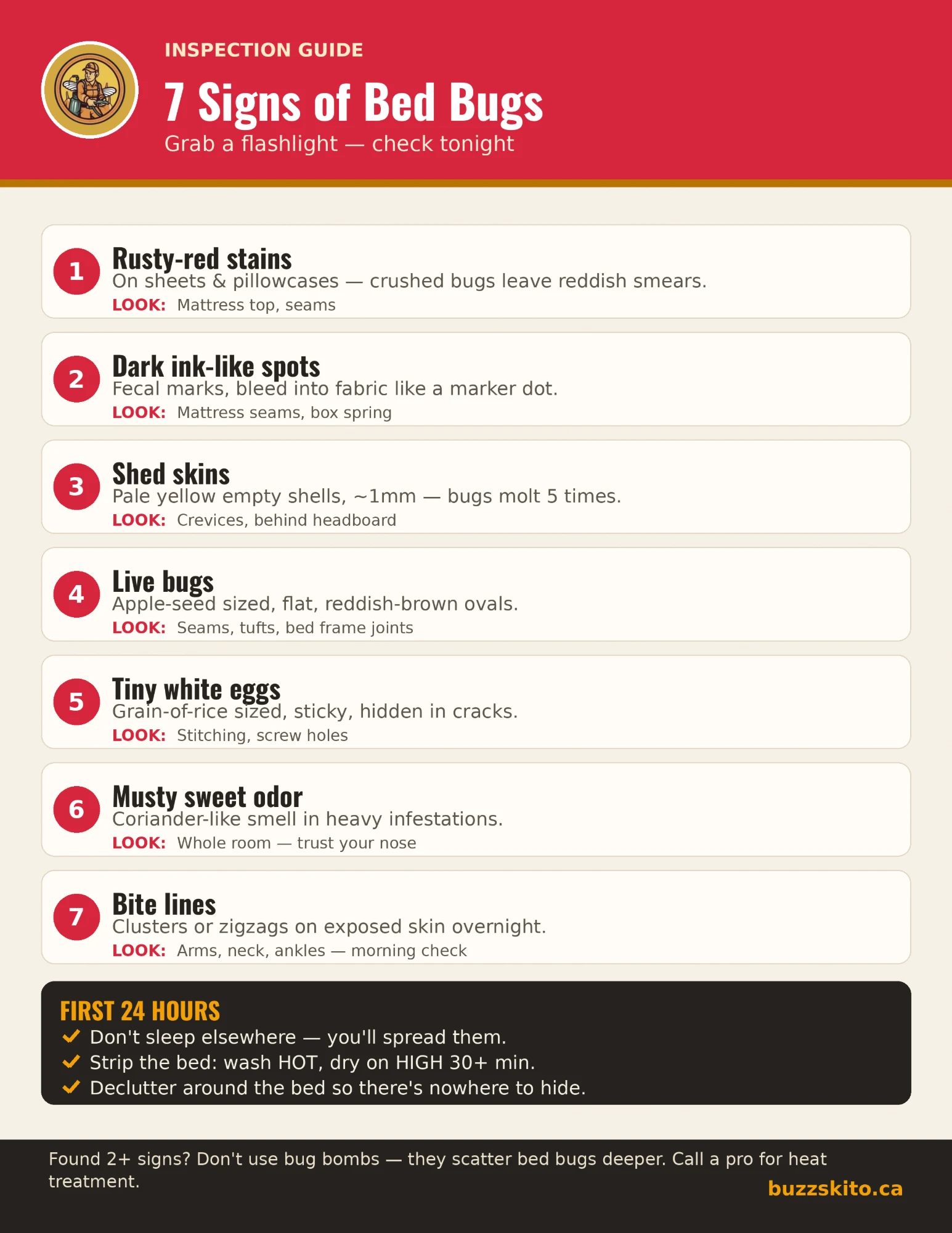 Signs of Bed Bugs: A 7-Point Checklist to Run TonightThe seven signs of bed bugs, from live bugs and ink-like spots to bites, with where to look tonight, what each is…
- Best Bed Bug Spray for Travel Canada 2026 — Carry-On-Legal Luggage & Hotel PicksThe best carry-on-legal bed-bug sprays for travel in Canada: TSA/CATSA 100 mL rules, PMRA-registered picks like Doktor…
- How to Get Rid of Bed Bugs in an Apartment (Canada 2026) — A Renter’s Containment-First…A renter’s step-by-step plan for getting rid of bed bugs in a Canadian apartment: what your landlord must pay for, the…