Quick Answer
Effective tick control for Ontario yards is three layers working together: habitat modification (clear leaf litter, mow edges, add a gravel border), professional barrier spray on the specific zones where ticks concentrate, and personal protection — permethrin-treated clothing plus daily tick checks. Each layer covers a different failure mode: habitat work removes the humid leaf litter ticks need, the residual acaricide acts on the questing zones for a few weeks at a time, and personal protection catches the ticks that get through. None of the three eliminates ticks on its own, and none of them makes the tick check optional.
- The three-layer approach (habitat, barrier spray, personal protection) works because each layer covers what the other two miss — none of them clears a property on its own.
- The blacklegged (deer) tick is Canada’s primary Lyme vector; poppy-seed-sized nymphs active in May–June cause the majority of Ontario Lyme cases.
- Field studies find the overwhelming majority of yard ticks within about 3 metres of the lawn-to-wild transition edge.
- A professional barrier spray acts on ticks at all life stages on contact and leaves a temporary residual, so applications are repeated through the season.
- Keep people and pets off treated areas until the spray has dried, as the product label directs.
- Adult blacklegged ticks stay active on warm days above 4°C, so activity is possible even in December and March.
— BuzzSkito, GTA mosquito & tick control · 150+ five-star Google reviews
Ticks are active in Toronto and across the GTA on any day above 4°C, with a nymph peak in May–June and an adult peak in September–October — so the 2026 plan starts in spring, not midsummer. This guide covers tick species, lifecycle, Lyme disease risk, where ticks hide in your yard, prevention strategies, and when to call a professional. For city-specific information, visit our Tick Control hub page or our Toronto tick spray service.
As an Amazon Associate I earn from qualifying purchases. BuzzSkito only points to products we would genuinely use or recommend, at no extra cost to you.
Before the three layers, the one item every Ontario household with a yard should already own: a fine-tipped tick remover that grips at the skin line and lifts the whole tick out, kept in the first-aid kit and the glovebox for after-hike checks. Check price on Amazon.ca →
BuzzSkito Mosquito & Tick Control Specialists · Published March 15, 2026
Tick Species in Ontario: What You're Dealing With
Three tick species are most relevant to Ontario homeowners:
- Blacklegged tick (Ixodes scapularis) — the Lyme disease carrier: Also called the deer tick, this is the species Ontario homeowners need to be most concerned about. Blacklegged ticks are the primary vector for Lyme disease in Canada. They are active in four stages: egg, larva (6 legs, tiny), nymph (8 legs, poppy seed–sized), and adult (sesame seed–sized). All active stages — larva, nymph, adult — can bite humans.
- American dog tick (Dermacentor variabilis): Larger and more commonly noticed. The American dog tick can transmit Rocky Mountain Spotted Fever (rare in Ontario) and cause tick paralysis. It does not transmit Lyme disease.
- Lone star tick (Amblyomma americanum): An emerging species in southwestern Ontario, associated with climate warming. Can cause a unique red meat allergy (alpha-gal syndrome). Distribution is currently limited but expanding.
The Tick Lifecycle and Why It Matters
Understanding the blacklegged tick lifecycle is essential for timing effective treatment:
- Spring (May–June): Nymphs emerge — this is the most dangerous period. Nymphs are poppy-seed sized and incredibly difficult to detect on skin. They feed for 3–5 days and are responsible for the majority of Lyme disease cases in Ontario because they're so hard to see and remove promptly.
- Summer (July–August): Larval ticks hatch and begin feeding. Lower Lyme disease risk (larvae rarely carry the pathogen at this stage) but populations are building.
- Fall (September–October): Adult ticks emerge. Adults are sesame-seed sized and more easily spotted. They aggressively seek large mammal hosts (deer, dogs, humans) to obtain a blood meal before winter. Risk remains high.
- Winter: Adult blacklegged ticks can remain active on warm days (above 4°C) — unusual among Ontario ticks. Even in December and March, activity is possible.
See our full seasonal guide: When Are Ticks Active in Ontario?
Where Ticks Hide in Your Yard
One of the most important misconceptions about ticks: they don't live in forests. They live at the edge — the transition zone between maintained lawn and any naturalized vegetation. The specific sites where ticks concentrate on a residential property:
- Lawn edges bordering woods, ravines, or natural areas — the primary entry point for ticks onto your property
- Leaf litter in garden beds — ticks overwinter in leaf litter and emerge in spring
- Woodpiles and brush piles — dark, humid microhabitats that ticks (and mice, which carry the Lyme pathogen) use
- Under decks and porches — shaded, humid areas where ticks persist through hot weather
- Tall grass and dense ground cover — ticks quest (wait for hosts) at the tips of grass blades and vegetation
- Along fence lines — especially fences adjacent to naturalized areas
In the west end of the GTA that edge is usually a Humber River valley slope or a ravine lot line, which is why Etobicoke tick spray is aimed at the fence line and the wooded margin rather than the open lawn.
Toronto proper has more of that edge than almost anywhere else in the province, because the ravine system carries continuous wooded habitat into the middle of residential neighbourhoods rather than stopping at the city limits. Why Toronto is a tick hot spot in 2026 maps which corridors matter and what a ravine-backing lot should expect.
Read about tick identification: How to Identify Ticks in Ontario
Lyme Disease in Ontario: The Risk Is Real
Lyme disease cases in Canada have increased significantly since the early 2000s, driven by the northward expansion of blacklegged tick populations as winters warm. Ontario reports hundreds of confirmed Lyme disease cases annually, with the actual number believed to be significantly higher due to under-reporting and delayed diagnosis.
Early-stage Lyme disease (caught within days of the tick bite) is treatable with antibiotics. Disseminated or late-stage Lyme disease can cause serious, chronic health problems including joint inflammation, neurological symptoms, and cardiac effects. Early detection and prevention are critical.
Full guide: Lyme Disease Prevention in Ontario
How Professional Tick Spray Works
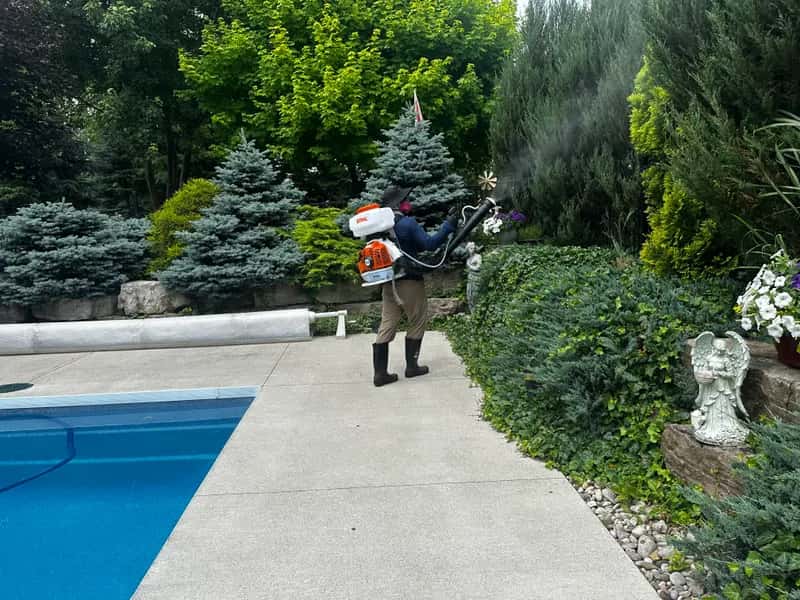
BuzzSkito's tick control service applies a residual insecticide barrier to the specific areas where ticks concentrate: lawn edges, leaf litter zones, garden borders, fence lines, and under-deck areas. The treatment:
- Kills ticks at all life stages (larva, nymph, adult) on contact
- Leaves a temporary residual that wears down over the following weeks, so applications are repeated through the season
- Is applied by licensed technicians who know exactly where to target for maximum effectiveness
- Is applied according to label directions — stay off treated areas until the spray has dried, as the label directs
Compare your options: Best Tick Control for Your Yard: Comparison Guide
The 3-Zone Tick Defence Plan for Ontario Yards
Every GTA property we assess breaks down into the same three risk zones. Once you see your yard this way, tick control stops being guesswork — you know exactly where to focus effort, and where you can relax.
Zone 1: The Transition Edge — Highest Risk
This is the 2–3 metre band where maintained lawn meets anything wild: a ravine lot line, a cedar hedge, a naturalized garden, or a neighbour's overgrown fence line. Field studies of residential properties consistently find the overwhelming majority of ticks within about 3 metres of this edge — it's where questing ticks wait on grass tips for a passing host, and where a barrier spray earns its keep. Priorities here: keep the edge mowed tight, install a 1-metre gravel or wood-chip border, and make this band the focus of any spray treatment. Never place play structures, hammocks, or seating inside Zone 1.
Zone 2: Shaded Structures and Storage — The Reservoir
Under decks, woodpiles, stone walls, sheds, and dense perennial beds. Ticks shelter here through hot, dry weather — but more importantly, so do the white-footed mice that infect blacklegged ticks with the Lyme bacterium in the first place. This is the zone where tick tubes do their best work, and where targeted treatment along under-deck edges and wall bases matters most. Raise firewood off the ground, declutter, and seal the gaps that invite rodent nesting.
Zone 3: Open, Sunny Lawn — Lowest Risk
Ticks dehydrate quickly in direct sun and short grass, so the middle of a mowed, sunlit lawn is genuinely low-risk. Your job in Zone 3 is simply to keep it that way: mow weekly, rake leaves promptly in fall, and position patios, trampolines, and play sets here — at least 3 metres from any Zone 1 edge. A family that understands these three zones can cut its tick exposure dramatically before a single product is applied.
DIY Tick Prevention for Your Yard
Habitat modification reduces tick populations even before professional treatment. Key steps:
- Remove leaf litter from garden beds and lawn edges each spring
- Keep grass mowed short, especially at property edges
- Create a 1-metre gravel or wood chip barrier between lawn and any wooded areas
- Move woodpiles away from the house and off the ground
- Trim shrubs and ground cover that create humid, shaded environments
- Control deer access to your property — deer carry adult ticks onto your land
Beyond habitat work, what you wear into the high-risk zones adds a personal layer of protection. Permethrin belongs on fabric, not skin — it kills ticks on contact with the cloth rather than simply repelling them. In Canada, though, the do-it-yourself version is off the table: Health Canada does not approve permethrin liquids and sprays for consumers to treat their own clothing. The route that remains open is buying the treatment already in the garment — factory-treated clothing, where the permethrin is bonded in at manufacture and lasts up to 70 wash cycles. Treated socks and trouser legs cover the ankles and lower legs a questing tick reaches first, so those are the pieces worth owning before yard work: Check treated clothing on Amazon.ca →
For the full breakdown, see our guides to permethrin for yard & clothing in Canada and the best tick repellents for your yard.
Tick Control Product Stack: What Works and What Doesn't
The tick control aisle is full of products with wildly different levels of evidence behind them. Here's our honest assessment — including the products that compete with our own service, and the ones we'd skip entirely.
Worth Your Money
- Factory-treated permethrin clothing: The single best personal-protection step for anyone working in Zone 1 or Zone 2. The permethrin is bonded into the fabric at manufacture, so it kills ticks on contact and lasts up to 70 wash cycles. Buy the garments already treated — Health Canada does not approve permethrin sprays for consumers to treat their own clothing.
- Tick tubes: Biodegradable tubes filled with permethrin-treated cotton that mice carry back to their nests, killing larval ticks at the source. Slow-acting — expect results over a full season, not overnight — but aimed squarely at the mouse nests that keep the tick cycle going around woodpiles, sheds, and stone walls. Thermacell Tick Control Tubes are the widely available option in Canada: Check price on Amazon.ca →
- Icaridin (picaridin) or DEET on skin: Check the label for the PCP registration number and for ticks listed alongside mosquitoes. Apply to ankles and lower legs before yard work.
- A proper tick removal tool: Cheap insurance in the first-aid kit. Clean removal within 24–36 hours of attachment dramatically reduces Lyme transmission risk.
- Professional residual barrier spray: The backbone of the plan — 5 targeted treatments across the season keep Zones 1 and 2 treated from spring nymph season through fall adult season.
Save Your Money
- Ultrasonic tick repellers: No peer-reviewed evidence they affect ticks at all. Ticks find hosts by CO2, heat, and scent — not sound.
- Cedar oil and essential-oil yard sprays: Some short-lived knockdown, but protection is measured in days rather than weeks, and field results are inconsistent.
- Diatomaceous earth outdoors: Only works while bone-dry — one rain or heavy dew and it's inert. Impractical for Ontario yards.
- Bug zappers: Ticks don't fly. Zappers kill moths and beneficial insects, not ticks.
- “Tick-repelling” plants: No meaningful field evidence that planting lavender or rosemary changes tick density in a yard.
Related Product Guides
What to Do If You Find a Tick
If you find a tick attached to your skin, remove it promptly with fine-tipped tweezers. See our complete guide: How to Remove a Tick Safely
A dedicated removal tool kept in your first-aid kit makes clean, complete removal easier than makeshift tweezers — it grips close to the skin and lifts the whole tick out without squeezing: Check price on Amazon.ca → We compare the options in our tick removal tool guide.
As an Amazon Associate I earn from qualifying purchases. Price shown on Amazon.ca, at no extra cost to you.
🏆 Our Top Pick — Tick Removal Tool
8.7/10· BuzzSkito ratingFine-Tip Tick Removal Tool Set
The one product every Ontario household with a yard should own. A dedicated remover grips the tick right at the skin and lifts the whole body out in one motion — no squeezing, no leftover mouthparts, no folk remedies. Keep one in the first-aid kit and one in the car for after-hike checks.
Pros
- Grips close to the skin for complete removal
- Cheap insurance against a botched extraction
- Compact — fits any first-aid kit or glovebox
Cons
- Not a substitute for daily tick checks
- Still need prompt removal within 24–36 hours
Tick Control by GTA City
A few parts of the GTA carry enough geography of their own to deserve a closer look. We map the local habitat, the higher-risk neighbourhoods, and the treatment timing in our guides to tick control across Vaughan, King City and Woodbridge, tick prevention in Caledon and Halton Hills, and mosquito and tick control in Stoney Creek.
The Escarpment side of Hamilton is its own case again, with Dundas Valley and the Ancaster woodlots pushing tick pressure right up to the property line: tick control in Ancaster, Dundas and Hamilton covers that corridor.
Halton splits the same way between creek valleys and escarpment: when ticks are active in Oakville follows the Sixteen Mile and Bronte Creek corridors through the season, and tick season in Burlington does the same along the escarpment edge and the lakefront.
Answers to the Tick Questions People Ask Most
Each guide below takes one common tick question and answers it in full, so you can go straight to the one that matches what you found, where you live, or which animal you are worried about.
If you are holding something small and dark and are not sure what it is, start with what ticks look like at each life stage, which covers legs, size, and how an unfed tick differs from an engorged one. To tell one species from another, the tick identification chart for the common North American types sets the markings side by side. A whole cluster of very small ticks is a separate case, explained in the guide to seed ticks and other baby ticks. And when the suspect may not be a tick at all, the bugs most often mistaken for ticks shows the lookalikes and where each one turns up.
The next question is usually about risk. Which ticks carry Lyme disease, with pictures explains which species matter in the United States and where each one lives. Readers in the Great Lakes region can turn to the guide to ticks in Michigan, which draws on the state health department’s own material for species, season, and how to submit a tick for identification. If you are wondering how a tick reached you in the first place, whether ticks fly or jump settles that.
Dog owners have two guides of their own. Finding and removing ticks on dogs covers where to check, how to tell an attached tick from a skin tag or a scab, and what to ask a veterinarian about preventives. What kills ticks on dogs instantly gives a straight answer to that search and explains what to do about a tick that is already attached.
For control beyond this page, what kills ticks on clothing, gear, skin, and in the yard sorts the methods by where the tick is and names the popular ones that fall short. Backyard flock owners ask a related question, and whether chickens, guinea fowl, and opossums eat enough ticks to matter walks through what the published studies measured.
Frequently Asked Questions
Are there ticks in Toronto?
Yes. Blacklegged ticks — the Lyme disease vector — are established across the Greater Toronto Area, and Ontario public health surveillance has documented them in every GTA municipality, Toronto included. The ravine network (the Don, Humber, and Rouge valleys) and the conservation lands at the city edges are the highest-pressure habitat, and any backyard that meets a ravine, woodlot, or naturalized area can hold ticks. They are active on any day above 4°C, with a nymph peak in May–June and an adult peak in September–October, so yard treatment targets that lawn-to-wild transition band rather than the open lawn.
What is the most effective way to control ticks in a yard?
Professional barrier spray targeting the high-risk zones in your yard — lawn edges, leaf litter, garden beds, fence lines, under decks, and woodpiles — is the core of residential tick control. Combined with habitat modification (leaf removal, mowing, wood-edge barriers) and daily tick checks, it gives you a layered plan rather than a single measure.
Can I get Lyme disease from ticks in my backyard in Ontario?
Yes. Blacklegged ticks (the primary Lyme disease carrier) are established throughout Southern Ontario. Ontario public health agencies have confirmed Lyme-disease-carrying tick populations in Mississauga, Hamilton, Oakville, and across the GTA. Your backyard — particularly if it backs onto wooded or naturalized areas — is a realistic exposure site.
How do I know if I have ticks in my yard?
The easiest method is a drag cloth test: attach white flannel to a stick and drag it slowly through lawn edges, along fences, and through garden beds. Ticks will cling to the cloth. You can also walk slowly through suspect areas wearing white socks and watch for small dark specks. Alternatively, have BuzzSkito assess your property as part of a free quote.
What time of year are ticks most dangerous in Ontario?
The blacklegged tick has two peak activity periods in Ontario: spring nymph season (May–June), when tiny nymphs are hardest to spot and transmit Lyme disease most frequently, and fall adult season (September–October). Adult ticks can also be active on warm winter days. See our full seasonal guide.