
BuzzSkito Mosquito & Tick Control Specialists · Published July 21, 2026
Why Heat Is the Method That Actually Kills Bed Bug Eggs
Every DIY bed bug method runs into the same wall eventually: the eggs. Female bed bugs cement their eggs to fabric with a coating that vacuuming cannot lift, and many contact sprays do not penetrate the shell, so a treatment that wipes out the adults but spares the eggs simply resets the clock — a fresh generation hatches in about ten days and you are back where you started. Heat is one of the very few approaches that solves this. A high-enough temperature, held long enough, cooks the developing embryo inside the shell and kills every life stage at once: adults, nymphs, and eggs. That is the entire reason heat treatment is worth the effort and the gear.
But that advantage comes with one strict condition, and understanding it is the difference between a treatment that works and one that quietly fails. The lethal temperature has to reach the bug, wherever it is hiding — and bed bugs hide in exactly the coldest, most heat-shielded places: deep in a folded quilt, the core of a packed duffel, the toe of a shoe, a mattress seam. Everything below is about getting the heat all the way in there and proving that it arrived.
Check current Canadian availability of the DIY heat gear:
The Numbers: Lethal Temperature and Dwell Time
Here is the biology in plain figures. Bed bugs begin to die when their body core is held around 45 °C (113 °F), but their eggs — the toughest stage — need more. Research from Virginia Tech and others established that all life stages, eggs included, are reliably killed when held at 48 °C (118 °F) for about 90 minutes or 50 °C (122 °F) for about 60 minutes. Those are the thresholds every commercial heat chamber is engineered around.
The word that does all the work in those numbers is held, and the temperature that matters is the one at the coldest point of your load — not the air temperature the heater proudly displays. The centre of a rolled sleeping bag, the inside of a stuffed backpack, the middle of a folded stack of jeans: these all lag far behind the surrounding air, sometimes by many degrees and by an hour or more. That lag is why practical DIY protocols do not aim for exactly 48 °C. They push the air to 55–60 °C (130–140 °F) and hold it for several hours, so that even the slowest, coldest core is dragged well past the lethal line with margin to spare. Aim high, hold long, and measure the middle.
The Core-Temperature Rule (the Step Everyone Skips)
If you take one thing from this guide, take this: buy a probe thermometer and bury it in the densest part of the load. This single cheap tool is what separates a treatment that works from a hopeful guess. The heater tells you the air is hot; the probe tells you whether the bug’s hiding spot is hot — and only the second one matters.
The protocol is simple. Load the chamber, thread the probe into the very centre of the thickest, most tightly packed item, and start heating. Ignore the air temperature for timing purposes. Watch the probe. The moment the probe reaches your target — say 50 °C — start your dwell clock, and keep the heat on until it has held that target for the full dwell time. The most common DIY failure in the world is pulling items out when the surface feels hot and the timer “seems” long enough, while the core is still ten degrees short. A surviving egg in the middle of a duffel does not care how hot the outside got.
- Do not pack the chamber tight. Air needs to circulate; a jammed load creates cold cores that never reach temperature. Fewer, looser items per run beats one overstuffed run that fails.
- Unfold and open things up. Unroll sleeping bags, unzip bags, loosen shoe laces, fan out stacks — anything that lets heat reach the interior faster.
- Give it time. A full cycle is commonly 4–8 hours. Dense loads take longer. Patience here is the whole method.
- Trust the probe, not the clock or your hand. Stop only when the coldest point has held target temperature for the full dwell time.
Portable Heat Chambers: the Safe DIY Path
The clean, reliable way to do DIY heat is a purpose-built portable heat chamber — a fabric or panel enclosure with a heating element engineered specifically to reach and hold lethal bed-bug temperatures without becoming a fire hazard. They come in a range of sizes, and the right one depends on the size of your problem. A chamber is also the single biggest line item in a DIY budget, so check it against what professional heat treatment is quoted at in Canada before you commit — for a whole-home infestation the arithmetic sometimes favours the pro.
At the compact end, a PackTite-style chamber is the traveller’s tool: collapsible, easy to store, and sized for luggage, a few garments, shoes, and books. Its best use is as a permanent habit — you run everything through it after a trip or a stay somewhere questionable, so you never bring an infestation home in the first place. The portable PackTite is the archetype here. In the middle sit oven-style boxes like the ThermalStrike Ranger and the ZappBug Oven 2 — more capacity than a travel unit, good for a couple processing clothing and bedding in batches. At the large end, the ZappBug Room is effectively a walk-in chamber that can swallow whole loads of bedding, cushions, backpacks, and small furniture in one run, which is what an active home infestation actually needs. Our ZappBug heater review and the whole-room heater roundup compare the full range.
Whatever the size, the compliance point in Canada is the same: the chamber is a device, not a pesticide, so it needs no PMRA registration and is fully legal to buy and run. What you should scrutinise is the electrical certification. A high-draw appliance you leave running unattended for hours should carry CSA or cUL marks appropriate for Canadian outlets — a detail some US-market listings skip.
Space Heaters and the Whole-Room Temptation
Sooner or later everyone doing DIY heat wonders: why not just crank a few space heaters and cook the whole bedroom? This is the point where the honest answer is don’t, and it is worth being blunt about why.
First, safety. Consumer space heaters are not built to raise a furnished room to 50 °C and hold it for hours. Running several at once overloads circuits; running them unattended near bedding and furniture is exactly the scenario house fires come from. This is not a theoretical caution — improvised bed-bug heat-ups have started real fires. Second, even when nothing burns, it usually does not work. Without industrial fans forcing hot air into every void, a DIY room heat-up leaves cold pockets behind the headboard, under the dresser, inside the mattress, and along the cool exterior wall — precisely where bed bugs retreat as things warm up. You get all the danger and none of the kill.
Whole-room heat done right — the professional version — uses high-output electric heaters, powerful air movers, and temperature sensors placed at the coldest points so the technician can prove every corner crossed the lethal line. That is a genuinely different tool set from anything you can safely rig at home. The DIY answer to a whole-room problem is not to imitate it badly; it is to treat the movable contents in a proper chamber and treat the fixed surfaces with steam, which is what the next section covers.
Heat the Movable, Steam the Fixed, Trap to Verify
A portable heat chamber, however large, only treats what fits inside it. It cannot treat the bed frame, the mattress once it is back in place, the box spring, the headboard, the baseboards, or the wall-floor junction where bed bugs also harbour. So DIY heat is one layer of a plan, never the whole plan. The complete protocol has three parts:
- Heat the movable. Everything that fits in the chamber — clothing, bedding, cushions, curtains, backpacks, shoes, books, soft toys — goes through a full lethal cycle, verified by the probe. Keep treated items sealed in clean bags so they cannot be re-infested while you work on the room.
- Steam the fixed. Run a dry-vapour bed-bug steamer slowly over mattress seams, box-spring fabric, frame joints and bolt holes, the headboard, and the baseboards — the harbourages a chamber can never reach. Our Dupray steamer review covers what temperature and dwell you need. First, vacuum those same surfaces to remove the live insects and debris, then steam to kill the eggs the vacuum leaves behind.
- Trap to verify. Place interceptor traps under every bed and furniture leg. They catch stragglers travelling between the harbourage and you, and — just as important — they tell you week over week whether the numbers are actually dropping. A mattress encasement then seals the bed so anything left inside cannot get out or feed.
Heat, steam, trap. Each covers what the others cannot, and together they form an actual eradication plan rather than a collection of hopeful tactics. If you want the full step-by-step for a room or an apartment, our guides to getting rid of bed bugs yourself and bed bugs in an apartment sequence the whole campaign, and the killing bed bug eggs guide goes deep on the hardest stage.
What Heat Can Damage — Triage Before You Treat
Heat hot enough to kill bed bugs is hot enough to ruin some belongings, so sort before you load. Most everyday items are fine — cotton, wool, and synthetic clothing, shoes, bedding, backpacks, and books all tolerate 55–60 °C without trouble. But keep the following out of any heat chamber:
- Candles, crayons, and wax items — they melt.
- Some cosmetics, lip balms, and pressurised cans, plus lighters — heat and pressure do not mix.
- Vinyl records and heat-sensitive plastics — they warp.
- Certain electronics and battery packs — check the manufacturer’s temperature limits first.
- Musical instruments and anything with glue joints that can soften.
For heat-sensitive items, use the opposite of heat: sealed in a bag, most small objects can be cold-treated in a chest freezer at −18 °C, though it takes several days to be sure the core froze through. When in doubt, run the chamber at the lower end of the lethal range for a longer dwell rather than the maximum setting, and always read the instruction sheet that ships with a commercial chamber — it lists the specific items the manufacturer says to keep out.
DIY vs Professional Heat — and When to Combine Them
DIY heat and professional heat are not really rivals; they cover different territory. Professional heat treatment raises an entire room or home to a lethal temperature in one shot, reaching inside walls, under carpet, and deep in the mattress — harbourages you cannot treat yourself. DIY heat treats the contents: everything movable that fits in a chamber, which is exactly the pile a professional would otherwise ask you to bag and treat anyway.
The most cost-effective mindset is to buy a heat chamber as a permanent tool — a one-time purchase you reuse forever, including as a routine step every time you travel — and to use it aggressively at the first sign of trouble. For a small, caught-early problem, contents-only heat plus steam and traps may end it. For an established or spreading infestation, you may still need professional whole-room heat for the structure, with your chamber handling the belongings alongside. If you are weighing the two, our Canadian pest control cost guide lays out what professional bed-bug work typically runs, and the bed bug control hub maps every method against every part of the room so you can see where DIY heat fits in the larger campaign.
Frequently Asked Questions
Can you really do bed bug heat treatment yourself in Canada?+
Yes — for the contents of a home you can absolutely do heat treatment yourself, and it is one of the most reliable non-chemical methods available. What you cannot safely DIY is heating an entire occupied room or apartment to lethal temperature, which is what professionals do with industrial electric heaters and thermometers on every surface. The realistic DIY version treats what you can put inside a controlled heat container: a portable heat chamber like a ZappBug or a PackTite for clothing, bedding, shoes, books, electronics-safe items, and small furnishings. For the bed frame, mattress, and room itself, DIY heat is paired with a steamer, interceptor traps, and often a residual dust. Heat kills bed bugs and their eggs at every life stage when you hold a high-enough temperature long enough — the whole game is reaching and sustaining that temperature at the coldest point of whatever you are treating.
What temperature kills bed bugs and their eggs?+
Bed bugs die when their body core is held at roughly 45 °C (113 °F) for an extended period, and their eggs — the hardest stage to kill — need about 48–50 °C (118–122 °F) sustained to be reliably destroyed. Research from Virginia Tech and others found that all life stages, including eggs, die when held at 48 °C (118 °F) for 90 minutes or at 50 °C (122 °F) for about 60 minutes. The critical word is sustained, and it applies to the coldest spot in the load, not the air temperature the heater reports. The centre of a packed duffel bag, the inside of a shoe, or the core of a rolled sleeping bag lags far behind the air around it, so practical DIY protocols aim higher — an air temperature of 55–60 °C (130–140 °F) held for several hours — to guarantee the cold core actually crosses the lethal line.
How long does DIY bed bug heat treatment take?+
Plan on several hours per load, not minutes. A portable heat chamber typically needs 30–60 minutes just to bring the air up to target, then several more hours to drive that heat into the core of dense items — a full run is commonly 4–8 hours depending on how tightly the chamber is packed and how bulky the contents are. Denser and more tightly packed loads take dramatically longer because heat has to conduct all the way to the middle. The single most common DIY failure is pulling items out too early, when the surface is hot but the core has not yet crossed the lethal threshold. Use a probe thermometer buried in the densest part of the load and do not stop the clock until that probe has held the target temperature for the full dwell time.
What equipment do I need for DIY bed bug heat treatment?+
At minimum: a controlled heat source and a way to measure the temperature at the coldest point. The cleanest option is a purpose-built portable heat chamber (ZappBug Oven, ZappBug Room, ThermalStrike, or a PackTite) that is engineered to reach and hold lethal temperatures safely. If you improvise with space heaters inside a sealed room or a tent, you also need multiple thermometers, a way to circulate air so there are no cold pockets, and constant supervision for fire safety. A remote probe thermometer buried in the load is non-negotiable regardless of method — it is the only way to know the core actually got hot enough. Round out the kit with a steamer for the bed and seams heat cannot reach, interceptor traps to monitor, and heavy contractor bags to hold treated versus untreated items separately.
Is a ZappBug or PackTite better for DIY heat treatment?+
They serve different sizes of problem. PackTite-style chambers are compact, collapsible, and ideal for travellers and for treating luggage, a few garments, shoes, and books after a trip or a hotel stay — the classic "I might have brought something home" use case. ZappBug makes a range from a small oven up to a large walk-in-style room, so a ZappBug Room can handle whole loads of bedding, cushions, backpacks, and even small furniture in a single run, which suits an active infestation at home. If you mostly need to decontaminate incoming items and travel gear, a PackTite is enough; if you are fighting a live infestation and need to process large volumes of household soft goods, a larger ZappBug-style chamber does far more per run.
Can I just use space heaters to heat a whole room myself?+
This is where DIY heat gets risky, and honestly is where most people should stop. Consumer space heaters are not designed to raise an entire furnished room to 50 °C and hold it evenly for hours, and pushing them to try creates real fire and electrical hazards — overloaded circuits, heaters running unattended, and furniture or bedding too close to elements. Even when it does not start a fire, a DIY room heat-up almost always leaves cold pockets behind walls, under furniture, and inside the mattress where bed bugs simply retreat and survive, so you get the danger without the kill. Professionals use purpose-built high-output electric heaters, powerful fans to eliminate cold spots, and sensors placed at the coldest points throughout the room. For whole-room heat, a contained heat chamber for the movable items plus a steamer for the fixed ones is the safe, effective DIY path.
Does heat treatment kill bed bug eggs?+
Yes — and that is exactly why heat is so valuable. Bed bug eggs are the Achilles heel of most other methods: they are cemented to fabric with a coating that vacuuming cannot lift, and many contact sprays do not penetrate the shell, so a treatment that kills adults but spares the eggs just resets the clock in ten days. Heat is one of the few approaches that reliably kills every life stage at once, eggs included, because the lethal temperature cooks the developing embryo inside the shell. The catch is the same as always: the egg has to actually reach that temperature. Eggs tucked deep in a mattress seam or the core of a packed bag are the last thing to heat up, which is why sustained dwell time and a core-temperature reading matter so much.
What can be damaged by bed bug heat treatment?+
Heat that kills bed bugs is warm enough to damage some belongings, so triage before you treat. Keep out of a heat chamber: candles and wax items, crayons, some cosmetics and lip balms, vinyl records, certain electronics and battery packs, pressurized cans and lighters, musical instruments, and anything with glue that can soften. Most cotton, wool, synthetic clothing, shoes, bedding, backpacks, and books tolerate the temperatures fine. When in doubt, either leave the item out and treat it another way — cold treatment in a freezer, or a careful steam — or run the chamber at the lower end of the lethal range for a longer time rather than the highest setting. Read the instructions that come with any commercial chamber; they list heat-sensitive items you should never put inside.
Do I still need to steam and use traps if I heat-treat?+
Almost always, yes. A portable heat chamber only treats what fits inside it — clothing, bedding, cushions, small items — but it cannot treat the bed frame, the mattress once it is back on the bed, the baseboards, or the wall-floor junction where bed bugs also harbour. So DIY heat is one layer of a plan, not the whole plan. After you heat-treat your soft goods, run a steamer over the mattress seams, box spring, headboard, and frame joints to kill anything living in the fixed parts of the room, and place interceptor traps under the bed and furniture legs to catch and monitor stragglers. Heat the movable, steam the fixed, and trap to verify — that trio is what turns individual tactics into an actual eradication plan.
How is DIY heat different from professional heat treatment?+
Scale and coverage. Professional heat treatment raises the temperature of an entire room or home to a lethal level using high-output electric heaters, industrial fans that push hot air into every void, and temperature sensors placed at the coldest points so the technician can prove every corner crossed the lethal line. It treats the structure itself — inside walls, under carpet, deep in the mattress — in one shot, which DIY cannot match. DIY heat treats the contents: everything movable that fits in a chamber. Both rely on the same biology, but professional heat reaches the harbourages you cannot, while DIY heat handles the belongings a professional would otherwise ask you to bag and treat anyway. For a heavy or spreading infestation, the two are complementary rather than either-or.
Is DIY heat treatment cheaper than hiring a professional?+
Upfront, yes — a portable heat chamber is a one-time purchase that costs a fraction of a professional whole-home heat treatment, and you can reuse it indefinitely, including as a routine decontamination step every time you travel. That makes DIY heat genuinely economical for prevention and for small, caught-early infestations. The honest trade-off is coverage: DIY heat cannot treat the structure, so for an established infestation you may spend on the chamber and still need professional help for the room itself. The most cost-effective mindset is to buy the chamber as a permanent tool for belongings and travel gear, use it aggressively at the first sign of trouble, and reserve professional whole-room heat for when the infestation has clearly spread beyond what your contents-only approach can contain.
Are US-only bed bug heaters a problem to buy in Canada?+
They can be, on two fronts. First, electrical: some heat products sold on US marketplaces are built for US voltage and carry US safety certification rather than the CSA or cUL marks Canadian electrical code expects, which matters for a high-draw device you run unattended for hours. Second, chemical add-ons: heat itself is a device and needs no pesticide registration, but if a "kit" bundles a spray or dust, that pesticide must be PMRA-registered to be legal for sale and use in Canada, and many US formulations are not. Buy the heat chamber from a Canadian-available listing with the right electrical certification, and treat any bundled US pesticide as a red flag — pair your heat with a Canadian-legal product instead. The chamber is the part worth importing carefully; the chemistry should stay domestic.
Related Reading
- Best Whole-Room Bed-Bug Heater Canada — The Big Chambers Compared
- ZappBug Room Review Canada
- PackTite Closet Review Canada
- ThermalStrike Ranger Review Canada
- Best Bed-Bug Steamer Canada — Heat for the Fixed Surfaces
- Bed-Bug Interceptor Traps Canada — Monitor and Verify
- How to Kill Bed Bug Eggs in Canada
- Best Pest Control Equipment Canada — The Full Device Hub
Keep reading
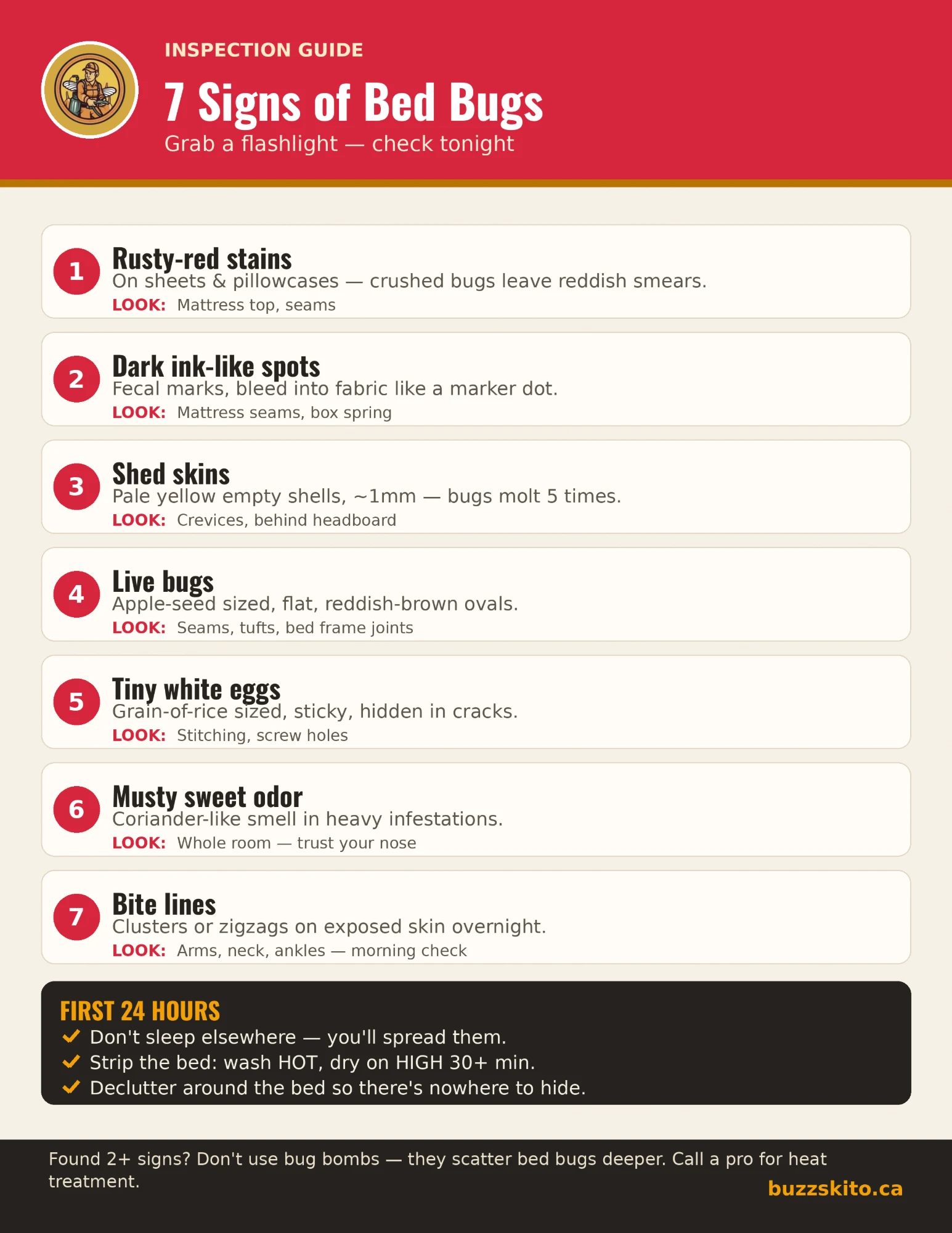 Signs of Bed Bugs: A 7-Point Checklist to Run TonightThe seven signs of bed bugs, from live bugs and ink-like spots to bites, with where to look tonight, what each is…
- Bed Bug Heater: Rent or Buy in Canada — The Arithmetic That Actually Decides ItRenting a bed bug heat chamber is barely possible in Canada. The cycle-count arithmetic that decides buy vs hire, how…
- Bugs That Look Like Bed Bugs: Eight Look-Alikes and How to Tell Them ApartEight bugs often get mistaken for bed bugs: bat bugs, swallow bugs, carpet beetle larvae, spider beetles, booklice,…