
BuzzSkito Mosquito & Tick Control Specialists · Published July 21, 2026
What the ZappBug Room Actually Is
The ZappBug Room is the largest enclosure in the ZappBug family, and understanding it starts with understanding what it is not. It is not the compact ZappBug Heater or the mid-sized ZappBug Oven 2 — the suitcase-and-tote units most people picture when they hear the brand. The Room is a big, collapsible fabric box, closer to the footprint of a small closet, that you assemble on the floor, load with belongings, seal, and heat until everything inside is held at a temperature lethal to bed bugs and their eggs. Where the smaller units treat one bag at a time, the Room is built to treat a mountain: a whole bedroom’s worth of clothing, bedding, cushions, shoes, books, boxes, and small furniture in a single cycle.
That capacity is the entire reason the Room exists, and it is the main thing you are paying the premium for. If you have ever tried to clear an active infestation by running load after load through a small heater — a genuinely miserable, days-long grind — the appeal of doing it in one or two big cycles is obvious. But the same size that makes the Room powerful also makes it slower to heat through, bulkier to store, and pointless for anyone who only needs to zap a single suitcase. This review is about matching the tool to the job honestly.
Check current Canadian availability of the Room and its closest alternatives:
How Heat Kills Bed Bugs — and Why Eggs Are the Point
Heat is the reason serious DIY bed-bug plans revolve around enclosures like this one. Bed bugs die when their core temperature is held above roughly 48–50°C for a sustained period, and — crucially — their eggs die at the same sustained heat. That egg-killing property is what sets heat apart from almost everything else in the toolkit. Eggs are the stage that survives casual sprays, quick wipe-downs, and impatient effort; a treatment that kills adults and nymphs but leaves viable eggs behind simply resets the clock, and two weeks later you are back where you started. Heat, applied correctly, closes that loophole.
The critical phrase is “applied correctly.” The bugs do not die because the air inside the enclosure got hot; they die because they got hot, wherever they are hiding, and stayed hot long enough. A bed bug buried in the folded centre of a thick comforter is shielded by the fabric around it, and that cold pocket is the last place to reach lethal temperature. The whole art of using the Room well is making sure the coldest, most-buried point of your load crosses into the kill range and holds there — which is exactly why loading technique and a thermometer are not afterthoughts.
Loading the Room: Airflow Beats Stuffing
The instinct with a big enclosure is to cram it full to get everything done in one cycle. Resist it. A load packed tight into a solid brick of compressed fabric is a load whose centre may never reach lethal heat, no matter how long you run it. Hot air has to be able to circulate around and between items, and the denser the packing, the slower and more uneven the penetration.
- Pack loosely. Leave gaps for air to move. A three-quarters-full, airy load treats more reliably than a stuffed one.
- Unfold the bulky things. Drape comforters, duvets, and blankets rather than balling them up — a folded core is the hardest place to heat.
- Open everything. Unlace and open shoes, unzip and empty bags, open boxes, stand books on end so heat reaches the spine and pages.
- Bury your probe in the worst case. Place your thermometer sensor at the centre of the densest, slowest item, so you are always measuring the coldest point — not the easy air around it.
- Run a second cycle rather than overfill. Two honest loads beat one heroic load with a cold, survivor-harbouring core.
You Need a Probe Thermometer — Full Stop
This is the single most important thing in the whole review, and it is the step people skip. The temperature of the air inside the enclosure tells you almost nothing about whether the middle of a packed duffel bag reached a lethal reading. Air heats fast; dense fabric cores heat slowly. If you treat by watching the ambient temperature, you are treating blind, and blind heat treatments are precisely where survivors and re-infestations come from.
The fix is cheap and simple: a remote probe thermometer. Place the sensor at the coldest, most-buried point of your load — the centre of the thickest item — run the thin lead out through the enclosure, and watch the buried reading climb into and hold in the kill range for a sustained period before you call the cycle done. You are not watching the machine; you are watching the worst-case spot inside the load. Treat that reading as the truth and everything else as noise. A probe turns the Room from “a hot box I hope worked” into “a treatment I can verify,” and that difference is the whole game.
Cycle Times: Plan for a Patient Half-Day
Expect several hours per load, and understand where that time goes. First the enclosure has to come up to temperature, which is the fast part. Then — the part everyone underestimates — the heat has to penetrate to the cold core of the pile and hold there long enough to be lethal, which is the slow part. A loose load of light summer clothing heats through relatively quickly. A tightly packed load with books, shoes, or thick winter bedding at the centre can take dramatically longer, because those dense items insulate their own middles against the very heat you are trying to drive in.
Rushing the cycle is the most common way a heat treatment fails. The temptation to call it done when the air reads hot, or to open up early because “it’s been ages,” is exactly how a buried survivor lives to re-seed the room. Let the buried probe reading — not the clock, not the ambient temperature, and not your patience — decide when the cycle is finished. If you are treating a whole room across several loads, block out the better part of a day and accept that the process rewards patience and punishes shortcuts.
What the Room Can and Cannot Treat
The Room is superb at one half of the bed-bug problem and useless at the other, and being clear about the boundary prevents a lot of wasted effort. It treats portable belongings beautifully: everything you can carry into it and load loosely. What it cannot treat is everything that stays in the room — the mattress, box spring, bed frame, headboard, baseboards, outlet gaps, and any furniture too big for the enclosure. Those fixed harbourages hold a large share of a real infestation, and no enclosure heater reaches them.
So the Room is one part of a plan, never the whole plan. You heat-treat everything portable to break the infestation in your belongings, and you tackle the fixed half separately: a dry-vapour steamer run slowly over mattress seams, frame joints, and baseboards to kill bugs and eggs in place; interceptor traps under the bed legs to monitor whether the numbers are actually falling; and a sealed mattress encasement to trap anything left in the mattress and make future inspection trivial. The Room clears your stuff; those tools clear your room. Skip either half and the problem survives.
How to Choose: Is the Room the Right Size for You?
This is the decision the whole purchase turns on, because the ZappBug family is a ladder of capacities and the Room sits at the top. Buying the Room when you needed the Heater wastes money; buying the Heater when you needed the Room wastes weeks of your life running tiny loads. Match the tool to the volume and the frequency:
- Buy the Room if you have a genuinely large volume to treat — a whole bedroom of soft goods — and especially if an active infestation means you will run repeated batch cycles over weeks. Large households, landlords, cleaners, and frequent travellers who will reuse it justify the premium easily.
- Buy the ZappBug Oven 2 if your loads are moderate — several totes’ worth at a time — and you can accept a few more cycles to clear a room. It is the sensible middle of the ladder.
- Buy a heated bag like the ThermalStrike Ranger if you mostly need to treat one bag at a time — a traveller returning from a trip, a spot treatment, a single suitcase. For that use the Room is enormous overkill.
- Don’t buy any enclosure if your problem is really about the bed and room, not your belongings — there, a steamer, traps, and an encasement are the tools, and heat enclosures are the wrong purchase.
The honest summary: the Room is a specialist tool for a high-volume, repeat-use job. When that is your job, nothing in the consumer range does it faster. When it is not, you are paying a premium for capacity you will never fill. For a wider look at how the whole-room enclosures stack up against each other, our best whole-room bed-bug heater guide lays out the full field, and the PackTite Closet review covers the closest large-format alternative.
What You’re Actually Paying For
Premium heat enclosures span a wide price range, so it is worth naming what the money buys with the Room specifically. You are paying for volume — the ability to treat a room’s worth of goods at once instead of in a dozen small batches — and for the time that volume saves across an infestation that needs repeated treatment. You are also paying for a purpose-built, reusable tool that sidesteps the whole regulatory question that hangs over chemical products: because a heater is an appliance and not a pesticide, there is no PMRA registration to verify and none of the grey-market uncertainty that surrounds imported bug sprays. That compliance simplicity is a genuine, underrated part of the value for Canadian buyers.
What you are not paying for is a magic wand. The Room does not treat your room, it does not verify its own kill (that is the thermometer’s job), and it does not forgive impatient, over-stuffed loading. Spend the premium only when the volume and repeat-use case is real; when it isn’t, the smaller ZappBug units or a steamer-and-traps approach will serve you better for far less. If you want the full DIY protocol that the Room slots into, our DIY bed-bug heat treatment guide walks through the whole sequence, and the bed-bug heater overview covers the smaller units in more depth.
Frequently Asked Questions
What is the ZappBug Room and how is it different from the regular ZappBug?+
The ZappBug Room is a large fabric-panel heating enclosure that you assemble around a pile of belongings — think a walk-in-sized fabric box roughly the footprint of a small closet — and heat to a lethal internal temperature to kill bed bugs at every life stage, including eggs. It is fundamentally different from the smaller ZappBug Heater and the ZappBug Oven 2, which are suitcase-and-tote-sized units for individual items. The Room trades portability for volume: instead of treating one bag at a time, you load a mountain of clothing, bedding, boxes, and small furniture in a single cycle. That capacity is the entire reason it exists and the main thing you are paying the premium for.
Does the ZappBug Room actually kill bed bugs and their eggs?+
Heat is one of the few methods that reliably kills bed bugs at every stage, eggs included, and the ZappBug Room is built to reach and hold the temperature range where that happens. Bed bugs die when their core is held above roughly 48–50°C for a sustained period, and eggs — which resist almost everything else — succumb to the same sustained heat. The catch is that killing bugs is not automatic just because the air inside is hot: the heat has to penetrate to the centre of whatever you loaded, and the coldest spot in the pile has to reach lethal temperature and stay there long enough. That is why a thermometer and correct loading matter as much as the machine itself.
What size items can the ZappBug Room hold?+
The Room is the largest consumer ZappBug enclosure, sized to swallow the entire contents of an infested bedroom in a cycle or two: piles of clothing and linens, cushions, pillows, shoes, books, boxes, backpacks, small chairs and side tables, and disassembled bed slats. It is not built for a whole mattress or a sofa — those need a professional whole-room heat treatment — but for the mountain of soft goods and small hard items that a bed-bug situation contaminates, its volume is its whole point. If you only ever need to treat a suitcase or a single tote, the smaller ZappBug units are the more sensible buy.
How long does a ZappBug Room cycle take?+
Plan on several hours per load, not minutes. The enclosure needs time to come up to temperature, and then — the part people underestimate — the heat needs additional hours to penetrate to the cold core of a dense pile and hold there long enough to be lethal. A loosely packed load of light clothing heats through relatively quickly; a tightly packed load with books, shoes, or thick bedding at the centre can take a great deal longer because those dense items shield their own middles. Rushing the cycle is the single most common way a heat treatment fails, so the honest expectation is a slow, patient, half-day-per-load process.
Do I need a separate thermometer with the ZappBug Room?+
Yes — a remote probe thermometer placed at the coldest, most-buried point of your load is not optional if you want confidence the treatment worked. The temperature of the air inside the enclosure tells you almost nothing about whether the centre of a packed duffel bag reached lethal heat. Serious users place the probe deep inside the densest item, run the sensor lead out through the enclosure, and watch that the buried reading — not the ambient reading — climbs into and holds in the kill range. Treating without a probe is treating blind, and blind heat treatments are where survivors and re-infestations come from.
Is the ZappBug Room worth the price versus the smaller ZappBug units?+
It comes down to volume and how often you will use it. The Room is a premium purchase, and for a one-time treatment of a small number of items it is overkill — the ZappBug Heater or Oven 2 will do the job for far less. The Room earns its cost when you have a large volume to treat, an active infestation that will need repeated batch cycles over weeks, a large household, or a landlord, cleaner, or frequent-traveller use case where you will run it again and again. If you are buying it for a single closet of clothes you will never treat again, the smaller units are the smarter money. If you will be batch-treating a whole room repeatedly, the capacity pays for itself in time saved.
Can the ZappBug Room damage my belongings?+
It can, if you load the wrong things. Sustained heat in the kill range is safe for most clothing, bedding, shoes, and books, but it can warp, melt, or damage heat-sensitive items: candles, crayons, vinyl records, some cosmetics and medications, aerosol cans, anything with a battery, electronics, and certain plastics and glued items. The rule is simple — never put anything heat-sensitive or pressurised inside, and when in doubt, leave it out and treat it another way. Read the manufacturer guidance on what to exclude before your first cycle, because a melted item is a lesson you only need to learn once.
Does the ZappBug Room get rid of bed bugs on its own?+
It treats your portable belongings thoroughly, but it does not treat your room. Bed bugs also live in the mattress, the bed frame, the box spring, baseboards, outlets, and furniture — none of which fit in an enclosure. So the Room is one powerful part of a plan, not the whole plan: you heat-treat everything portable to break the infestation in your belongings, and you deal with the bed and room separately using a steamer on seams and frames, interceptor traps under the bed legs to monitor, and an encasement to seal the mattress. Relying on the Room alone leaves the fixed harbourage untreated and the problem alive.
How should I load the ZappBug Room for the best results?+
Load for airflow and penetration, not for maximum stuffing. Pack loosely so hot air can circulate around and between items rather than hitting a solid wall of compressed fabric; unfold and drape bulky bedding rather than cramming it in a ball; open books and stand them, open bags and empty pockets, and unlace and open shoes. Place the densest, slowest-to-heat item where you have put your thermometer probe so you are measuring the true worst case. A load that is packed tight to fit more in one cycle is a load whose centre never gets hot — you gain nothing by overfilling and you risk survivors.
Is the ZappBug Room a Health Canada or PMRA-regulated product?+
No — a heater is an appliance, not a pesticide, so it carries no PMRA registration requirement and there is nothing to check on the Health Canada side before you use one. That is actually one of heat treatment’s quiet advantages for Canadian buyers: it sidesteps the whole question of which chemical products are legally registered for sale and use here. You are killing bed bugs with temperature, not a regulated active ingredient, so the compliance friction that surrounds imported grey-market bug sprays simply does not apply. Buy the appliance, use it correctly, and there is no registration box to tick.
What is the difference between the ZappBug Room and a professional whole-room heat treatment?+
They solve overlapping but different problems. A professional whole-room (or whole-home) heat treatment brings in industrial heaters to raise the temperature of your entire room or house so the fixed structure — mattress, frame, walls, baseboards — is treated in place, and it is expensive but comprehensive. The ZappBug Room heats only what you can carry into the enclosure; it cannot treat the room itself. Think of the Room as the DIY tool for the portable half of the problem and professional heat as the service for the fixed half. Many real-world plans use the Room for belongings while tackling the bed and room by other means, rather than paying for a full professional heat job.
Can I use the ZappBug Room for anything besides bed bugs?+
Sustained lethal heat is effective against a range of fabric and pantry pests, so people also use enclosure heaters on clothes moths, carpet beetles, and items that may be carrying other hitchhiking insects picked up in travel or second-hand purchases. The same rules apply: the cold core of each item has to reach and hold kill temperature, verified by a probe, and heat-sensitive items must be left out. That said, the Room is marketed and sized around bed bugs, and that is where its capacity makes the most sense — for a stray moth problem the smaller units are usually plenty.
Related Reading
- Best Whole-Room Bed-Bug Heater Canada — The Full Field Compared
- PackTite Closet Review Canada — The Large-Format Alternative
- ZappBug Oven 2 Review Canada — The Mid-Sized Enclosure
- ThermalStrike Ranger Review Canada — The Heated Bag
- ZappBug Heater Review Canada — The Compact Unit
- DIY Bed-Bug Heat Treatment Canada — The Full Protocol
- Best Bed-Bug Steamer Canada — Heat for the Fixed Harbourage
- Best Pest-Control Equipment in Canada — The Full Device Hub
Keep reading
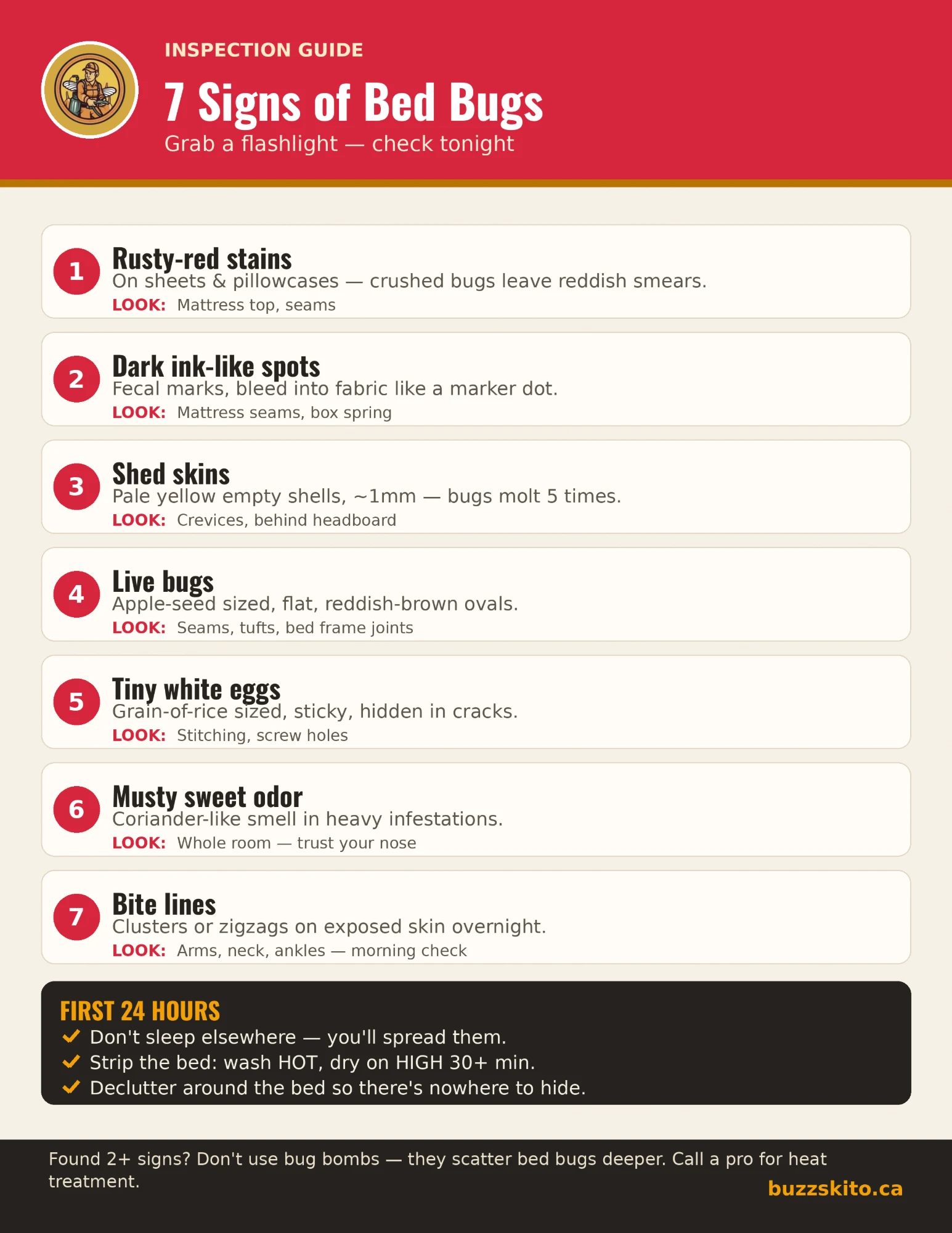 Signs of Bed Bugs: A 7-Point Checklist to Run TonightThe seven signs of bed bugs, from live bugs and ink-like spots to bites, with where to look tonight, what each is…
- Bed Bugs on a Mattress: The Signs and How to Treat the BedDark dots along the seams, rusty smears and pale shed skins are the signs of bed bugs on a mattress. How to vacuum,…
- Doktor Doom Sleep Tight Review Canada 2026 — The PMRA-Registered Mattress Spray, Tested…An independent Canadian review of Doktor Doom Sleep Tight bed bug spray: why its PMRA registration matters, how fast it…