
BuzzSkito Mosquito & Tick Control Specialists · Published July 21, 2026
What Is CimeXa, and Why Do Professionals Reach for Silica Gel?
CimeXa is a desiccant dust: an engineered, ultra-fine amorphous silica gel that kills insects not by poisoning them but by drying them out. That distinction sounds academic until you understand what has happened to bed bug control over the last two decades. Bed bugs have become spectacularly good at surviving the chemicals thrown at them — pyrethroid resistance is now the rule, not the exception, across North American populations — and a dust that kills by physics rather than chemistry simply steps outside that arms race. A bed bug cannot evolve resistance to dehydration any more than it can evolve resistance to being stepped on.
The mechanism is mechanical and elegant. An insect’s waterproofing is a thin waxy layer on its exoskeleton; lose that layer and it cannot hold moisture, and a creature the size of a bed bug has very little water to lose. CimeXa’s microscopic silica particles cling to that cuticle as the bug walks through a treated crack, abrade and absorb the wax, and over the following days the insect desiccates and dies. Because the particles are so fine and so absorbent — silica gel has an enormous surface area per gram — a barely-visible film does the work that a heavier deposit of a coarser dust would need. This is why pest professionals keep it on the truck: a resistance-proof residual that, applied correctly, essentially never wears out.
This review sits alongside our broader Canadian bed bug control hub and our pest control equipment guide; here we go deep on the single dust we would reach for first.
Check current Canadian availability:
CimeXa vs Diatomaceous Earth: Same Idea, Different League
The obvious question for anyone who has read a single bed bug thread is: why not just use diatomaceous earth? DE is cheap, sold everywhere, and kills by the same desiccant principle. The answer is that CimeXa and DE are both silica, but they are not the same material, and the difference is measurable. Diatomaceous earth is crushed fossilized diatoms — a comparatively coarse, dense powder. CimeXa is engineered amorphous silica gel with a far higher surface area, a much lighter particle, and dramatically better wax-absorbing capacity per grain.
That translates into three practical advantages. First, speed: Purdue University lab work comparing silica gel to diatomaceous earth against bed bugs found the silica gel killing far faster and more completely — a difference of days, which matters when you are trying to break an infestation before it spreads. Second, application: because each particle absorbs so much more wax, CimeXa works as a thin, almost-invisible film, whereas DE generally needs a heavier deposit — and heavier deposits are exactly what bed bugs detect and walk around. Third, clinging: the finer, lighter silica gel adheres to the insect’s cuticle better, so more of it makes the trip back to the harbourage. None of this makes DE useless — it is genuinely effective, resistance-proof, and the right budget pick — but if you can get the pro-grade silica gel, it is the better dust, and our diatomaceous earth for bed bugs guide covers where DE still earns a place.
The Near-Permanent Residual: A Dust’s Superpower
Here is the property that makes a desiccant dust different in kind from any liquid: it does not break down. A sprayed residual degrades over weeks — UV, humidity, and simple chemistry chew through it, which is why label re-treatment intervals exist. A film of silica gel laid into a dry, undisturbed void has no such clock. The manufacturer cites up to ten years of residual activity, and while nobody is auditing a decade-old crack, the underlying point holds: a bed bug crossing that treated joint many months after you applied it dies exactly as reliably as one crossing it on the first day.
That longevity reframes what the dust is for. It is not primarily a way to kill the bugs you have today — it is slow, and other tools do knockdown better. It is a way to make the geography of your home permanently hostile: every crack, void, and travel route becomes a place a bed bug cannot survive crossing, this season and next. Two things end that protection, and both are within your control — moisture, which clumps the dust and stops it working, and disturbance, which physically removes it (so do not vacuum or wipe your treated voids). Applied where it stays dry and untouched, CimeXa is closer to a permanent modification of the building than to a treatment.
How to Apply CimeXa Correctly — Thin Is Everything
The single most common way people waste CimeXa — and undercut its effectiveness — is applying too much. A visible pile of dust is worse than a thin film in two ways: it wastes product, and bed bugs actively detect and detour around heavy deposits, so a mound in a corner protects nothing. The goal is a barely-perceptible haze that a bug cannot see to avoid but cannot cross without picking up a lethal dose. That is a job for a tool, not a shaking bottle.
- Use a bellows/hand duster. Squeezing a bellows aerosolizes the powder into the thin, even film that actually works and pushes it deep into voids you cannot otherwise reach — into a bolt hole, behind a baseboard, up under a switch plate. Buy the duster with the dust; it is the difference between a professional application and a mess.
- Wear a dust mask. Whatever the label says about hazards, amorphous silica is a very fine powder and you should not breathe any fine dust. An N95 and keeping pets and kids out until the air clears is basic sense.
- Target harbourage and travel routes, not open surfaces. Bed-frame joints and bolt holes; box-spring staples and the fabric edge; cracks in the headboard; baseboard gaps and the wall-floor junction; behind outlet and switch plates with the power off; the gap where carpet meets the wall; furniture voids near the bed.
- Never broadcast it across mattress tops, floors, or living surfaces. Dust belongs in the cracks bugs hide and travel in, not on the surfaces you touch and sleep on.
- Keep it dry. Do not apply in damp areas or where it can get wet; moisture clumps silica gel and kills its activity.
Applied this way, a small bottle covers an entire bedroom’s harbourage several times over, with plenty left for the precautionary re-dusting that keeps a home protected in the months after the visible problem is gone.
What You’re Actually Paying For — and When a Cheaper Dust Will Do
CimeXa is not expensive in absolute terms, but it costs more than a bag of diatomaceous earth, so it is worth being clear about what the premium buys and when you can skip it. You are paying for engineered particle science: higher surface area, faster kill, a thinner effective film, and better cling. For an active or spreading infestation, where killing bugs quickly and reliably before they colonize the rest of a unit genuinely matters, that speed advantage is worth the modest extra outlay — the faster the residual works, the fewer bugs survive to lay the next batch of eggs.
For a light, precautionary, or budget-constrained situation — dusting the voids of a guest room, hardening a home after travel, or working with almost no money — diatomaceous earth is a legitimate, effective, resistance-proof choice and there is no shame in reaching for it. The mistake in the other direction is more expensive: buying grey-market US chemical concentrates because a forum promised they are “stronger.” They are not stronger against a resistant population, they are frequently illegal to import into Canada, and they trade a clean physical mechanism for one the bugs may already beat. If you want the best dust and can buy the Canadian-cleared version, CimeXa is the pick; if you want the value option, DE; the chemical grey market is the option to avoid regardless of budget.
Where CimeXa Fits in a Real Bed Bug Plan
No dust clears an established infestation by itself, and any review that implies otherwise is selling you something. CimeXa is a residual barrier: it kills bugs that cross treated cracks and voids, and it does nothing for the eggs cemented into a mattress seam you did not dust or the bugs harbouring somewhere you missed. Its power is as the long-term backstop in a layered plan, and the layers are well established:
- Heat for the eggs. A bed bug steamer reaches into seams and folds and kills the eggs suction and dust cannot, and a heat chamber or heater sterilizes belongings.
- Encase the mattress and box spring. A zippered encasement traps anything inside and denies bugs the seams they love.
- Monitor with interceptors. Interceptor cups under the bed legs catch travelling bugs and tell you, week over week, whether the numbers are falling.
- Remove the visible population. A sealed-HEPA vacuum physically lifts adults and nymphs before you dust and steam.
- Dust the voids — CimeXa’s job. Once the population is knocked down, the silica gel in every crack and travel route keeps killing survivors and re-invaders for years.
For anything beyond a caught-early, localized problem — a spreading infestation in an apartment, or bugs established in furniture and walls — a professional treatment is the honest answer, with the dust working as the permanent backstop the pros leave behind. Our guides on how to get rid of bed bugs in Canada and bed bugs in an apartment walk through how the pieces fit together.
The Regulatory Angle: Legal, Resistance-Proof, No Grey Market
Spend any time in bed bug forums and you will be pointed toward the grey market: Canadians told to import US-market concentrates like Crossfire or Temprid FX because “the products here don’t work.” It is worth understanding what that advice actually entails. Those products are not registered for sale to Canadian consumers under the Pest Control Products Act, importing unregistered pesticides violates the Pest Control Products Act, and — the part the threads skip — the resistance that motivates the smuggling does not stop at the border. Pyrethroid resistance is widespread in Canadian bed bug populations, and several smuggled products lean on exactly the chemistry the bugs already survive.
A desiccant dust sidesteps the whole trap. Because it kills by a physical mechanism, there is no resistance to defeat it — now or ever — and because silica gel is sold through legitimate Canadian retail, there is nothing to smuggle. Unlike a purely physical device such as a heat chamber, a dust is still classed as a pest control product, so the one thing to verify is that you are buying a version with a Canadian PCP registration number rather than a US-only listing that happens to ship. Do that, and you have the rare combination of the more effective option also being the fully legal one: a resistance-proof kill, no border risk, and no ambiguity about what is going into your home.
Verdict: 9.1/10 — The Best Dust, Used the Right Way
CimeXa earns its 9.1 by being the best version of a precisely scoped tool. As a residual barrier it is close to unimprovable: a resistance-proof kill mechanism, a faster and thinner-applying performance than diatomaceous earth, a residual measured in years rather than weeks, and value so good that one bottle outlasts the problem. The score stops short of a perfect mark for reasons of scope, not quality — it is deliberately slow, it treats voids and travel routes rather than eggs, and it demands a duster and a light hand to work as designed. Those are not flaws so much as the honest boundaries of what a dust is.
Buy it as the permanent backstop in a layered plan, apply it thin and dry into every crack and void, and it is one of the few bed bug purchases that keeps paying off for years. Reach for diatomaceous earth if budget is the deciding factor, avoid the chemical grey market entirely, and let the silica gel do the quiet, patient work of making your home a place a bed bug cannot cross.
Frequently Asked Questions
Does CimeXa really kill bed bugs?+
Yes — and it kills them by a mechanism they cannot evolve around. CimeXa is amorphous silica gel, a desiccant: its microscopic particles cling to a bed bug’s waxy outer cuticle, abrade and absorb the protective wax layer, and the insect dies of dehydration over a few days. Because the kill is physical rather than chemical, the pyrethroid resistance now widespread in North American bed bug populations is irrelevant — a resistant bug dries out at exactly the same rate as a susceptible one. University lab work (notably from Purdue) has shown silica gel dusts killing bed bugs far faster and more completely than diatomaceous earth. The catch is that desiccation takes days, not minutes, so CimeXa is a residual barrier you apply and leave, not a knockdown spray.
Is CimeXa the same as diatomaceous earth?+
No, and the difference is the whole reason to consider it. Both are desiccant dusts that kill by drying insects out, but they are made of different silica. Diatomaceous earth (DE) is crushed fossilized diatoms — a coarser, crystalline-adjacent powder. CimeXa is engineered amorphous (non-crystalline) silica gel with a far higher surface area and a much lighter, finer particle. In practice that means CimeXa absorbs more wax per particle, works faster, needs a much thinner application to stay effective, and clings to insects better. Purdue testing found silica gel killing bed bugs in a fraction of the time DE took. DE is cheaper and more widely stocked; CimeXa is the more effective dust where you can get the pro-grade version.
Is CimeXa safe to use around people and pets?+
Follow the label, and treat it as the fine dust it is. Amorphous silica gel kills insects by a physical drying action rather than a nervous-system poison, and it carries no resistance concerns of the kind pyrethroids do. It is a very fine dust and, like any fine powder, you should not breathe it: wear a dust mask (N95 or better) when applying, keep pets and children out of the room until the visible airborne dust settles, and apply a barely-there film into cracks and voids rather than a visible pile out in the open. Amorphous silica is not the same hazard as crystalline silica, but respiratory common sense still applies. Always follow the exact label directions on the product you buy in Canada.
How long does CimeXa last once applied?+
Indefinitely, as long as it stays dry and undisturbed — the manufacturer cites up to 10 years of residual activity in an undisturbed void. That extraordinary longevity is the single biggest argument for a desiccant dust over a liquid: a bed bug crossing a treated crack six months after you applied it dies just as reliably as one crossing it on day one. The practical limits are moisture (the dust clumps and stops working if it gets wet) and disturbance (vacuuming or wiping removes it). Applied into dry, protected harbourage — cracks, voids, under baseboards, inside the bed frame — a light film of CimeXa keeps working long after any spray would have broken down.
Where should I apply CimeXa for bed bugs?+
Into the cracks, crevices, and voids where bed bugs travel and hide — never as a broadcast layer across open floors or mattress tops. Target the bed-frame joints and bolt holes, the seams and staple line of the box spring, cracks in the headboard, baseboard gaps and the wall-floor junction, behind and around electrical outlet and switch plates (power off), gaps where carpet meets the wall, and inside furniture voids near the bed. A puffer or hand duster laying down a thin, almost invisible film is the goal. A visible pile of dust is both wasteful and something bugs will simply walk around — they detect and avoid heavy deposits, so less is genuinely more.
Do I need a duster to apply CimeXa?+
A hand bellows duster is strongly recommended and turns a frustrating job into an easy one. Trying to sprinkle silica gel from the bottle produces clumps and uneven piles that bugs avoid; a proper duster aerosolizes the powder into the thin, even film that actually works and pushes it deep into voids you cannot reach any other way — into a bolt hole, behind a baseboard, up under a switch plate. Buy the duster with the dust. It is a small tool that makes the difference between a professional-quality application and a wasteful, ineffective mess, and it is the reason a little CimeXa goes a very long way.
CimeXa vs bed bug spray — which is better?+
They do different jobs and the best plans use both. A liquid spray gives you contact knockdown — it kills the bugs it directly wets right now — but its residual breaks down over weeks and, if it is a pyrethroid, resistant bed bugs may survive it entirely. CimeXa gives you no instant knockdown but an essentially permanent, resistance-proof residual barrier in the voids the spray cannot coat well. The professional pattern is to treat with the appropriate contact product for immediate reduction, then dust the cracks and voids with silica gel as the long-term backstop that keeps killing survivors and re-invaders for years. Dust is the marathon; spray is the sprint.
Is CimeXa available and legal in Canada?+
Availability shifts, so the honest advice is to check current Canadian listings rather than assume. Silica gel desiccant dusts are sold into the Canadian market, and CimeXa has appeared on Amazon.ca and through Canadian pest-supply retailers, but stock and the exact registered product can vary. Before you buy, confirm the listing ships to Canada and — because it is a pest control product — that the version you buy carries a Canadian PCP registration number. This matters: many bed bug products Canadians are pushed toward in online forums (US concentrates like Crossfire or Temprid FX) are not registered for sale in Canada and are illegal to import. A desiccant dust available through legitimate Canadian retail sidesteps that whole problem.
How much CimeXa do I need for a typical infestation?+
Far less than people expect, which is why it is such good value. Because the effective application is a barely-visible film and not a thick layer, a single small bottle treats an entire bedroom’s cracks, voids, and bed frame many times over, and a larger bottle can cover a whole apartment with plenty left for the precautionary re-treatments that matter over the following months. The most common mistake is over-applying — laying down visible piles wastes product, looks alarming, and actually works worse because bugs avoid heavy deposits. Buy one duster, apply thin, and you will likely still have dust left when the infestation is long gone.
Will CimeXa get rid of bed bugs on its own?+
For a light, early, well-applied case — sometimes. For an established infestation — no, and no honest review claims otherwise. A desiccant dust is a superb residual barrier, but it only kills bugs that walk across treated surfaces, and it does nothing for eggs cemented in seams you did not dust or bugs harbouring somewhere you missed. The winning pattern pairs CimeXa with mattress and box-spring encasements, interceptor cups under the bed legs, aggressive vacuuming, and heat for the eggs — and, for anything beyond a caught-early problem, a professional treatment, with the dust working as the long-term backstop in the voids. It is a keystone tool in a plan, not the whole plan.
Does CimeXa need PMRA registration, and why does that matter?+
Yes — unlike a purely physical device such as a heat chamber, a desiccant dust is a pest control product, so the version you buy should carry a Canadian PCP registration number, and that is a feature, not a hurdle. The reason it matters is the grey market: bed bug forums routinely tell Canadians to import US-only sprays like Crossfire and Temprid FX, which are not PMRA-registered for Canadian consumers and are illegal to bring in — and which lean on the very pyrethroid chemistry resistant bed bugs already survive. A desiccant dust bought through legitimate Canadian retail gives you a resistance-proof mechanism, no border risk, and no ambiguity about what you are putting in your home.
Related Guides
- Bed Bug Control Canada — The Complete Plan
- Diatomaceous Earth for Bed Bugs — The Budget Desiccant
- Bed Bug Spray Canada — What Actually Works
- Best Bed-Bug Steamer Canada — Heat That Kills the Eggs
- Bed-Bug Interceptor Traps Canada — Monitor and Protect the Bed
- Bed-Bug Mattress Encasements Canada
- Best Sealed-HEPA Vacuum for Bed Bugs & Fleas Canada
- Best Pest Control Equipment in Canada — The Full Kit
Keep reading
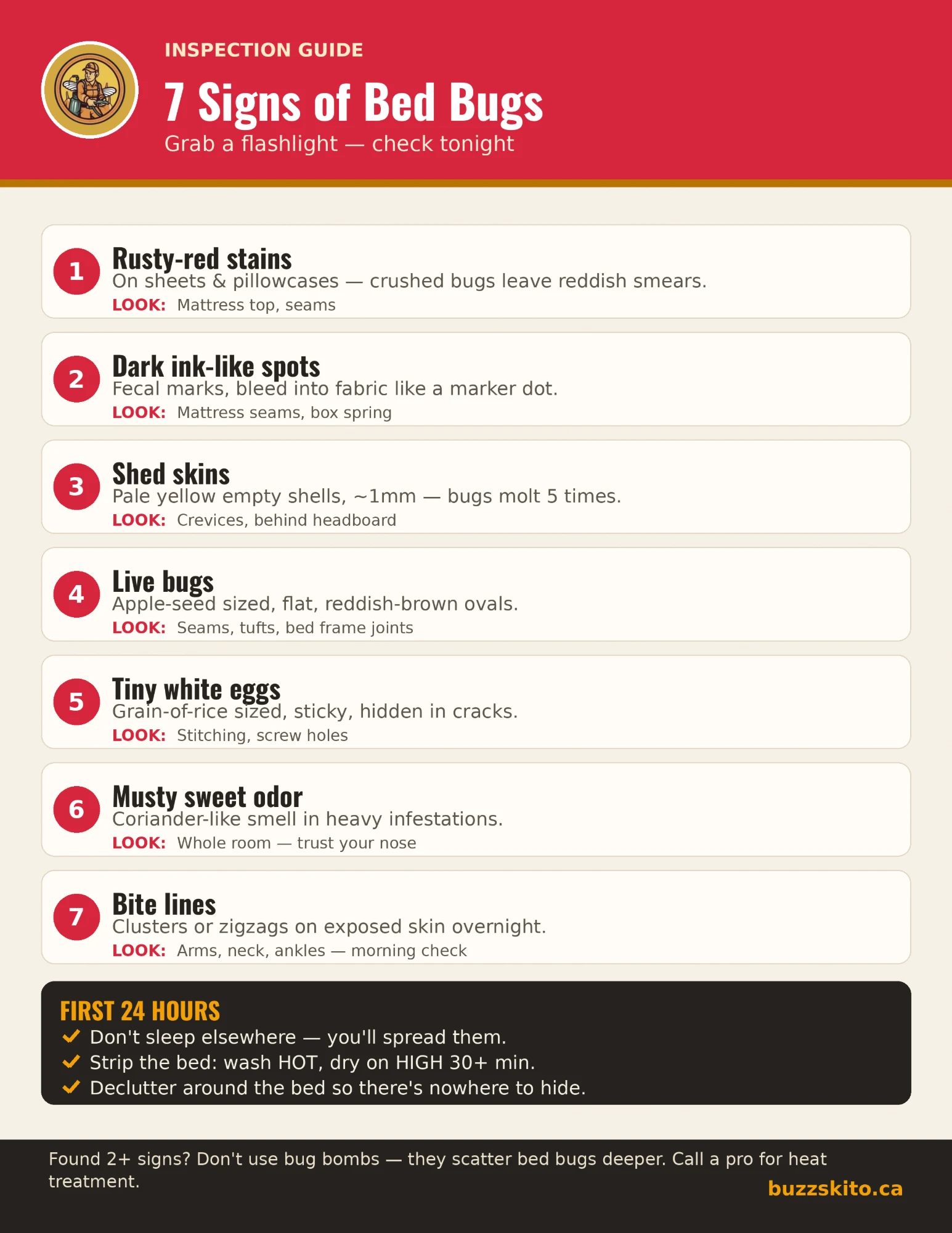 Signs of Bed Bugs: A 7-Point Checklist to Run TonightThe seven signs of bed bugs, from live bugs and ink-like spots to bites, with where to look tonight, what each is…
- Doktor Doom Sleep Tight Review Canada 2026 — The PMRA-Registered Mattress Spray, Tested…An independent Canadian review of Doktor Doom Sleep Tight bed bug spray: why its PMRA registration matters, how fast it…
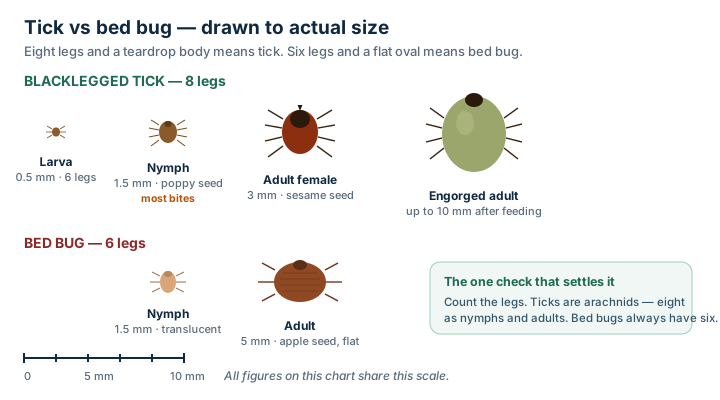 Tick vs Bed Bug: How to Tell Them Apart (ID Chart)Count the legs: ticks have 8, bed bugs have 6. Ticks attach for days outdoors; bed bugs feed for minutes indoors. Full…