
BuzzSkito Mosquito & Tick Control Specialists · Published July 21, 2026
Heat vs Chemical for Bed Bugs: The Short Version
Ask which method “works,” and the honest answer is that both do — but they fail in completely different ways, and one fails far less often for a home treatment. Heat is the physical method: raise the temperature of the bugs and their environment past a lethal threshold and hold it there, and everything dies, from the newest-laid egg to the toughest adult. Chemical is the biological method: deposit an insecticide the bug contacts and absorbs, and it dies — if the dose reaches it, and if that bug’s population is not resistant, and if the target is not sealed inside an egg.
Those two “ifs” on the chemical side — resistance and eggs — are exactly where most DIY spray-only treatments stall, and they are precisely the two problems heat does not have. That is why, when we have to name a single better primary method for a Canadian household, we name heat, and we route to a portable heat chamber like the ZappBug as the tool. But naming a winner is not the same as declaring the loser useless. A registered residual spray does something heat physically cannot, and the best treatments use both. The rest of this guide explains why heat leads, where chemical is genuinely better, and how to combine them.
Check current Canadian availability for the tool in each method:
Why Heat Wins Problem #1: The Eggs
The whole difficulty of bed bugs lives in their eggs. A female cements each egg to a surface with a durable adhesive coating, and that shell is not just glue — it is armour. It shields the developing bug from most contact and residual insecticides at the concentrations a consumer product is allowed to deliver. The practical result is the pattern every frustrated DIY-er discovers: you spray, the adults you can see die or scatter, you feel like you have won — and roughly a week later a fresh generation hatches from eggs the spray never killed, and you are back where you started. Bed bugs are notorious for exactly this rebound.
Heat has no equivalent loophole. There is no shell thick enough to insulate an egg from sustained lethal temperature; the heat penetrates the whole mass and denatures the proteins the egg depends on. Put the infested items in a chamber, bring the interior to the lethal target, hold it, and the eggs die in the same cycle as everything else. This is the core reason heat is the more complete method: it closes the egg gap that a spray leaves open. If the infestation lives in things you can bag — bedding, clothing, a suitcase, small furnishings — heat is the surest way to kill every egg at once. Our guides to killing bed-bug eggs and whether sprays actually work dig into this failure mode in detail.
Why Heat Wins Problem #2: Resistance
The second crack in the chemical foundation is resistance. Most consumer bed-bug sprays sold in North America are built on pyrethroids (and the related pyrethrins), and bed-bug populations across the continent have developed widespread, well-documented resistance to that entire chemical class. A resistant bug can be sprayed directly, walk through the residue, and simply not die — its physiology has adapted to metabolise or tolerate the dose. You cannot tell by looking whether the bugs in your home are resistant, which means a spray-only plan is a gamble on the genetics of your particular infestation.
Heat is immune to this on a fundamental level: there is no biological mechanism by which an insect “evolves resistance” to having its proteins cooked. Lethal heat kills a resistant bug exactly as fast as a susceptible one. That reliability — a kill you can count on regardless of what strain you are dealing with — is why professionals lean on heat for tough infestations and why it is the safer bet for a homeowner who cannot lab-test their bugs. When you cook them, the resistance question never even comes up.
Why Heat Wins Problem #3: Safety and Residue
The third advantage is one you feel every day after treatment, not just during it. A heater is an appliance. It leaves nothing behind: no residue on a surface your child touches, no chemical film on a mattress you sleep on, no re-entry interval to wait out, nothing to off-gas. You treat an item and use it immediately. For households with young kids, pets, asthma, or chemical sensitivities, that is not a minor convenience — it is the difference between a method you can use freely and one you have to manage carefully.
Chemicals, used strictly to their Canadian label, are designed to be safe, and a registered residual applied correctly to cracks and baseboards poses little risk. But the discipline required is real: observe drying and re-entry times, keep the family off treated surfaces, never treat a sleeping surface with a product not labelled for it, never mix or over-apply. And the failure mode is serious — the greatest bed-bug pesticide dangers in Canada come from grey-market imported concentrates and illegal off-label use of stronger pesticides indoors, which have caused genuine poisonings. Heat sidesteps every one of those hazards by having no chemistry at all.
Where Chemical Genuinely Beats Heat
Now the other side, honestly told, because a comparison that only praised the winner would be useless. A heat chamber has one hard limit: it can only treat what fits inside it. It does nothing for the parts of the infestation that live in the structure of the room — the wall void a bug retreats into, the gap behind a baseboard, the crack in the bed frame, the seam where carpet meets wall. You cannot put your bedroom in a box.
This is exactly the ground a residual insecticide owns. Laid down in those cracks, crevices, and travel routes, a residual keeps killing for days or weeks after you apply it — catching bugs that emerge from a harbourage you could not reach, or that wander in from an adjoining apartment. A one-time heat cycle has no such lasting effect; once it is done, it is done. A chemical barrier is the only tool here that keeps working while you sleep. Chemicals also cover large fixed surfaces cheaply and quickly. So the real headline is not that chemical loses — it is that chemical loses as a primary method but wins decisively as the perimeter guard, which is a role heat can never fill. For the residual step specifically, a Canadian-registered product such as Doktor Doom is the right kind of tool.
The Canadian Compliance Angle: Buy Registered, Skip the Grey Market
There is a Canada-specific reason this comparison tilts toward heat that has nothing to do with biology: the legal and supply landscape for chemicals. The strongest bed-bug concentrates you will read about on US forums and marketplaces are frequently not registered for sale or use in Canada, and importing or applying them here is illegal. That pushes some desperate DIY-ers toward grey-market products or, worse, off-label use of agricultural pesticides indoors — a route that has caused real harm. Price is the other axis this decision turns on, and what a bed bug treatment actually costs in Canada sets published professional heat and chemical ranges against the cost of assembling the DIY kit yourself.
A heater removes the entire problem: it is an appliance, carries no PMRA registration requirement, and is completely unrestricted to buy and use. On the chemical side, the safe path is narrow but clear — use only a product registered with Health Canada’s Pest Management Regulatory Agency for domestic bed-bug use, bought from a Canadian listing, applied strictly to its label. Long-standing Canadian brands like Doktor Doom sell products in that registered category. When you see a US spray touted as dramatically stronger, treat it as a red flag, not a shopping tip: if it is not Canadian-registered, it is not a legal option, and heat is the more powerful method you can actually use without breaking the law.
Temperature and Timing: What “Lethal Heat” Actually Means
Because heat wins on paper, it is worth being precise about what makes it work, since a sloppy heat attempt can fail as surely as a sloppy spray. Bed bugs die when the surface they occupy reaches roughly 45°C (113°F) held for a sustained period; eggs are hardier and need about 50°C (122°F) sustained, which is why most reliable protocols push the target to 48–60°C to guarantee the kill on everything at once.
The number that matters is the temperature at the core of the thickest item — the centre of a folded duvet, the middle of a packed suitcase — not the air temperature in the chamber. Dense loads lag behind the surrounding air, and a bug hiding in that cool core survives if you stop too soon. This is the whole case for a purpose-built heater over improvising with a hot car or a clothes dryer: an even-airflow chamber with a thermometer probe lets you confirm the coldest point actually reached lethal heat and stayed there long enough, rather than hoping. It is also why space heaters are a dangerous non-answer for heating a whole room — they cannot heat a space evenly enough to be reliable and they are a serious fire risk. For the room itself, that job belongs to steam and spray, or to a licensed operator’s whole-room heat.
How to Choose: What You Are Actually Paying For
Bed-bug treatment gear spans a wide price range, and it is worth being clear-eyed about where your money earns its keep. Prioritise your spending in this order:
- A heat chamber sized to your load (pay for this first). This is the tool that closes the egg and resistance gaps in one cycle. Buy the capacity that matches what you actually need to treat — a luggage-sized unit for travellers and small batches, a larger chamber for furniture-scale loads. A heater you use dozens of times has no per-cycle cost, so it amortises fast.
- A Canadian-registered residual spray (pay for this second). Cheap, essential, and the only tool that guards the perimeter after you leave. This is where your chemical dollars belong — not on a “stronger” import you cannot legally use.
- A sealed-HEPA vacuum and a steamer (pay for these for the surfaces). The vacuum physically removes live bugs from the mattress and room; the steamer delivers pinpoint heat to seams and frame joints you cannot fit in the chamber. Together they extend the heat advantage to fixed surfaces.
- Interceptor traps (cheap, do not skip). Traps under the bed legs are how you monitor whether the numbers are actually dropping, week over week. They cost little and turn guesswork into evidence.
- A whole-room professional heat treatment (worth it for a heavy, spread infestation). If the bugs are established throughout a room or unit, a licensed operator’s industrial whole-room heat does in hours what a DIY plan does over weeks. That is a service call, not a purchase — and a legitimate one to weigh.
Read that as a spending map: heat is where the primary kill comes from, so it gets the first dollars; chemical is the perimeter guard, so it gets the next; and vacuum, steam, and traps tie the plan together. For a full side-by-side of every device in the kit, see our pest-control equipment hub. If you are weighing DIY against hiring out the whole job, our Canadian pest control cost guide lays out what professional bed-bug work typically runs.
The Winning Plan: Heat for the Items, Chemical for the Perimeter
Put it all together and the “heat vs chemical” framing dissolves into a sequence that uses each for what it does best. Strip and bag all bedding and clothing, and heat-cycle it (or run washables through a hot dryer) to kill everything including eggs. Vacuum the mattress, frame, and room perimeter slowly with a sealed-HEPA vacuum to physically remove live bugs. Steam the mattress seams, tufts, and frame joints for the eggs the vacuum cannot lift. Lay down a Canadian-registered residual spray in the cracks, baseboards, and travel routes to guard the perimeter for the days after. Then place interceptor traps under the bed legs to monitor. Heat and steam give you the immediate, resistance-proof, egg-killing knockdown on everything you can reach today; the residual guards the ground you cannot; and the traps tell you whether it is working. That stack — not either method alone — is how a Canadian household actually clears bed bugs without a licence.
As an Amazon Associate I earn from qualifying purchases. Price shown on Amazon.ca, at no extra cost to you.
🏆 Winner — Heat, as the Primary Method
9.2/10· BuzzSkito ratingFor DIY bed-bug control in Canada, heat is the more complete and dependable primary method, and a portable ZappBug chamber is the tool that delivers it without a licence or a service call. It kills every life stage — including the cemented eggs that survive most sprays — in a single cycle, with no insecticide resistance to worry about and no residue, re-entry interval, or grey-market legality question. Load infested items, bring the interior to a confirmed lethal temperature at the coldest point of the load, and everything inside dies. Pair it with a Canadian-registered residual like Doktor Doom to guard the cracks and travel routes heat cannot reach — that heat-plus-chemical combination is the real winner.
Pros
- Kills eggs and all life stages in one cycle
- No insecticide resistance — heat always works
- No residue, no re-entry interval, no chemistry
- Reusable — no per-cycle cost
- Appliance, not a pesticide — fully unrestricted in Canada
Cons
- Only treats what fits in the chamber
- Needs a registered residual spray to guard the perimeter
- Higher up-front cost than a bottle of spray
Frequently Asked Questions
Is heat or chemical treatment better for bed bugs?+
For a DIY treatment in Canada, heat is the more reliable primary method, which is why it wins our head-to-head. Heat kills every stage of the bed-bug life cycle at once — adults, nymphs, and the cemented eggs that survive most sprays — and there is no such thing as a bed bug that is resistant to being cooked, whereas populations across North America are now widely resistant to the pyrethroid insecticides sold to consumers. A portable heat chamber like a ZappBug lets you treat everything you can fit inside it to a guaranteed lethal temperature, with no residue and no re-entry interval. Chemicals still have a real role — a residual spray such as Doktor Doom on cracks, baseboards, and frame joints keeps working for days after you leave — but as the main event, heat does more of the job more dependably. The honest answer used by professionals is that the two are partners, not rivals: heat kills what you can treat directly today, and a residual chemical guards the perimeter afterward.
Does heat treatment kill bed bug eggs and chemicals do not?+
That is the single biggest reason heat wins. Female bed bugs cement their eggs to fabric with a glue-like coating, and that shell protects the developing bug from most contact and residual insecticides at label strength — many sprays that kill adults leave a good fraction of eggs viable to hatch a week later. Sustained heat has no such loophole: hold an item at roughly 50°C (122°F) or hotter for long enough and the eggs die along with everything else, because heat denatures the proteins the egg needs to survive. Some chemicals do carry ovicidal claims, but real-world coverage of every hidden egg with a spray is far less certain than putting the infested items in a heater and cooking the whole mass at once. If your infestation is in items you can bag and heat, that is the surest way to kill the eggs.
What temperature kills bed bugs and their eggs?+
Bed bugs die when their body — and, critically, the surface they are hiding in — reaches about 45°C (113°F) held for a sustained period, and eggs need a bit more: roughly 50°C (122°F) sustained is the widely cited lethal target, with most protocols pushing to 48–60°C at the item core to guarantee the kill. The number that matters is the temperature at the centre of the thickest item, not the air temperature in the chamber, because a folded duvet or a packed suitcase can lag well behind the surrounding air. That is exactly why a purpose-built heater with even airflow and, ideally, a thermometer probe beats improvising with a hot car or a clothes dryer — you can confirm the cold core actually reached lethal heat and stayed there, rather than hoping it did.
Is chemical bed bug treatment dangerous to use at home?+
Used strictly to the label, a PMRA-registered Canadian bed-bug product is designed to be safe in a home, but the risks are real enough to respect: you must observe the drying and re-entry times, keep children and pets off treated surfaces until dry, never spray a mattress surface you sleep on with a product not labelled for it, and never mix products or exceed the rate. The bigger danger in practice is grey-market and imported products. Some powerful US bed-bug concentrates are not registered for sale or use in Canada, and illegal off-label use of agricultural or banned pesticides indoors has caused serious poisonings. Heat sidesteps all of this — an appliance has no residue, no re-entry interval, and nothing to ingest — which is a genuine safety advantage for households with kids, pets, asthma, or chemical sensitivities.
Can I just use a spray and skip heat entirely?+
You can, and for a very light, freshly caught infestation a good residual spray plus diligent vacuuming and interceptor traps sometimes gets there. But spray-only DIY is where most home treatments stall, for two reasons: insecticide resistance means the adults you hit may not die, and the cemented eggs largely survive to re-seed the population a week later. If you go spray-only, you are committing to repeat applications every one to two weeks for a couple of months, hitting every crack and seam perfectly each time, and accepting that you will not reach bugs deep inside a mattress or a packed closet. Adding a heat step for the items you can treat directly — bedding, clothing, luggage, small furnishings — dramatically raises your odds because it removes the egg problem and the resistance problem for everything you can fit in the chamber.
What is the difference between a heat chamber and professional whole-room heat?+
They use the same physics at very different scales. A professional whole-room or whole-home heat treatment brings in industrial heaters and fans to raise an entire room to a lethal temperature for hours, killing bugs wherever they hide in the structure — it is fast, thorough, and expensive, and it is a job for a licensed operator, not a DIY project (space heaters are a serious fire risk and cannot heat a room evenly enough to be reliable). A portable heat chamber like a ZappBug does the same thing inside a zippered box: you put infested items in, it heats the interior to a controlled lethal temperature, and it kills everything inside. The chamber cannot treat the room itself — walls, carpet, the bed frame — so it is paired with steam and spray for the surfaces you cannot fit in a box. Think of the chamber as your DIY answer to the parts of the job you can bag up.
How does a ZappBug heater actually work?+
A ZappBug is a collapsible fabric-walled box with a heating element and internal fans. You load it with infested items — clothing, shoes, bedding, books, small electronics, a whole suitcase — zip it shut, and run it until the interior reaches and holds a lethal temperature, typically monitored with the included thermometer probe placed at the coldest point in the load. Because heat penetrates the whole mass and there is nowhere for a bug to hide from it, everything inside, eggs included, is killed in a single cycle with no chemicals and no residue. The larger models swallow furniture-sized loads; a luggage-sized unit is built for travellers and smaller batches. It is the most practical way for a Canadian household to apply guaranteed lethal heat without hiring anyone, and it treats items over and over at no per-use cost.
When does chemical treatment beat heat?+
Chemicals win on the parts of the job heat cannot reach and cannot guard. A heat chamber only treats what you can put inside it; it does nothing for the wall void a bug retreats into, the baseboard gap it travels through, or the crack behind the headboard. A residual insecticide laid down in those cracks and along travel routes keeps killing for days or weeks after application, catching bugs that emerge later or wander in from an adjoining unit — something a one-time heat cycle simply cannot do. Chemicals also cover large fixed surfaces cheaply. That lasting residual barrier is the genuine advantage of a spray, and it is why the smart plan is not heat-versus-chemical but heat-for-the-items plus chemical-for-the-perimeter.
Is Doktor Doom a good bed bug spray for Canada?+
Doktor Doom is a long-standing Canadian brand and its bed-bug and crawling-insect products are registered for sale in Canada, which is the first thing that matters — you are buying a PMRA-registered product formulated and labelled for Canadian use, not a grey-market import you cannot legally apply. As a residual crack-and-crevice and perimeter spray it does the job a chemical is meant to do in a modern plan: lay down a lasting barrier in the cracks, baseboards, and frame joints where bugs travel and harbour. Like all consumer pyrethroid-class products it faces the resistance reality, so it should not be your only weapon — but as the chemical half of a heat-plus-chemical strategy, a registered Canadian residual is exactly the right tool. Always follow the label for surfaces, drying, and re-entry.
Do I need both a heater and a sprayer, or can I pick one?+
For a light, early infestation confined to items you can bag, a heater alone (plus vacuuming and traps) can finish the job. For anything established — bugs in the frame, the wall junction, or spread across a room — you want both, because they cover different ground. Heat delivers a guaranteed kill on everything you can fit in the chamber, eggs included, with zero resistance and zero residue; a residual spray guards the cracks, baseboards, and travel routes the chamber cannot touch, and keeps working after you walk away. Buying both is not redundancy, it is coverage: the heater owns the items, the spray owns the perimeter, and vacuuming plus interceptor traps tie the plan together and tell you whether it is working.
Are heaters and sprays legal to buy and use in Canada without a licence?+
Yes to both, with a caveat on the chemical side. A bed-bug heater is an appliance, not a pesticide, so it carries no PMRA registration requirement and anyone can buy and use one freely — there is no licence, no restricted-use status, and no residue to manage. Consumer bed-bug sprays are legal too, but only the specific products registered with Health Canada’s Pest Management Regulatory Agency for domestic bed-bug use, applied strictly to their label. The trap to avoid is importing a stronger US concentrate that is not registered in Canada, or using an agricultural or off-label pesticide indoors — both are illegal and genuinely hazardous. Stick to a Canadian-registered residual for the chemical step, and the heater is unrestricted.
What is the fastest way to knock down a bed bug infestation at home?+
The fastest reliable DIY sequence is: strip and bag all bedding and clothing and run it through a heat cycle (or a hot dryer for washables) to kill everything including eggs; vacuum the mattress, frame, and room perimeter slowly with a sealed-HEPA vacuum to physically remove live bugs; steam the mattress seams, tufts, and frame joints for the eggs the vacuum cannot lift; lay down a registered residual spray in the cracks, baseboards, and travel routes; and place interceptor traps under the bed legs to monitor. Heat and steam give you an immediate lethal knockdown on the items and surfaces you can reach today, the spray guards the perimeter for the days after, and the traps tell you whether the numbers are actually falling. No single tool is fastest on its own — the speed comes from stacking them in that order.
Related Reading
- ZappBug Heater Review Canada — The Heat Chamber, Tested
- Doktor Doom Sleep Tight Review Canada — The Residual Spray
- Bed-Bug Heat Treatment DIY Canada — Step by Step
- Do Bed-Bug Sprays Actually Work?
- How to Kill Bed-Bug Eggs Canada
- Best Bed-Bug Steamer Canada — Heat for Surfaces
- Best Sealed-HEPA Vacuum for Bed Bugs & Fleas Canada
- Bed-Bug Interceptor Traps Canada — Monitor Your Progress
- Best Pest Control Equipment Canada — The Device Hub
Keep reading
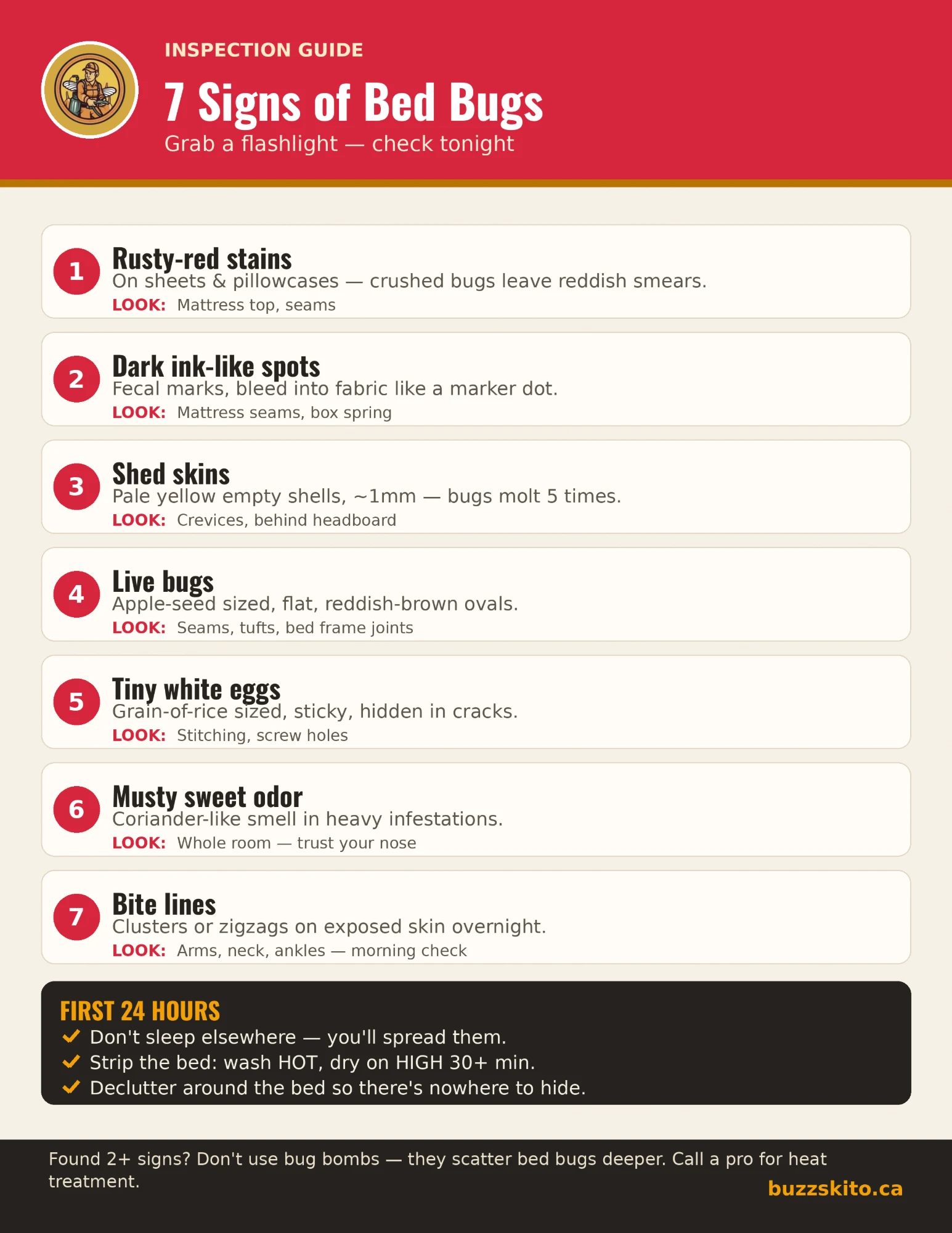 Signs of Bed Bugs: A 7-Point Checklist to Run TonightThe seven signs of bed bugs, from live bugs and ink-like spots to bites, with where to look tonight, what each is…
- Dupray Neat vs McCulloch MC1275 (Canada 2026) — PSI, Steam Temp & Which One Actually…Dupray Neat vs McCulloch MC1275 for bed bugs in Canada: a head-to-head on PSI, steam temperature, dry-vapour output,…
- What Kills Bed Bugs Instantly in Canada — The Short List That Works on Contact, and Why…What kills bed bugs instantly in Canada: steam, direct heat and a registered contact spray — plus why alcohol is a fire…