
Safety recall — stop using this machine
Health Canada and the US CPSC recalled the Dupray Neat Steam Cleaner on 26 February 2026 over a burn hazard. If the boiler is overfilled or corroded and the pressure-release cap also fails, the boiler can rupture. As of 20 January 2026 Dupray had logged 15 boiler ruptures and four injuries, including burns, lacerations and a broken wrist, plus seven reports of property damage. Roughly 97,000 units were sold in Canada and 651,000 in the United States.
Affected units are model DUP020WNA with batch codes 0118-01 through 0425-05, printed on the sticker at the base in MMYY-XX format. Codes 0525-XX and later are not affected. Health Canada’s guidance is to stop using it immediately and contact Dupray for a free replacement boiler cap.
Health Canada recall notice · Dupray recall page · US CPSC notice
We have removed our direct product link to this machine. Amazon does not let a buyer choose a batch code, so we cannot point you at unaffected stock.
BuzzSkito Mosquito & Tick Control Specialists · Published July 21, 2026
Dupray Neat vs McCulloch MC1275: The Short Version
These two machines dominate the “which steamer kills bed bugs” conversation in Canada for a simple reason: they are the two most recommended options at opposite ends of the value curve. The Dupray Neat is the premium, pest-focused pick — a compact, Canadian-founded steam cleaner built around a stainless-steel boiler and dry-vapour output. The McCulloch MC1275 is the versatile, budget-friendly workhorse — a do-everything household steam cleaner with a huge accessory kit that also happens to kill bed bugs on contact.
The verdict is not close if bed bugs are your only reason for buying: the Neat wins because everything it does better maps directly onto killing eggs reliably. But “better for bed bugs” and “better value for a household” are different questions, and the MC1275 wins the second one convincingly. The rest of this guide explains exactly why, starting with the spec everybody gets wrong.
Check current Canadian availability for each machine:
The PSI Myth: Why Pressure Does Not Kill Bed Bugs
Walk into any steamer comparison and you will find people ranking machines by PSI as if it were horsepower. For bed bugs, that instinct is backwards. Pressure is velocity — how hard the jet comes out — and a hard jet is a liability, not an asset, when you are treating a mattress seam. Blast a harbourage with a high-velocity jet and you do not cook the bugs; you launch them, scattering live insects and loose eggs across the room to re-establish somewhere you have not treated yet.
What actually kills bed bugs is heat delivered for enough time — thermal energy transferred into the fabric until the surface reaches lethal temperature and stays there. That calls for a high volume of hot, dry vapour moving at a gentle, controlled velocity, so you can hold the nozzle over a seam and let the heat soak in without blowing the seam apart. Both the Dupray Neat and the McCulloch MC1275 sit in a sensible pressure range for this; neither is a pressure-washer. So when a spec sheet leads with a big PSI number, read it as marketing, not as a bed-bug ranking. The machines separate on heat retention and dryness, not on how hard they spit.
Steam Temperature: The Number on the Box vs the Number That Matters
Every steamer boils water far past the temperature needed to kill bed bugs — eggs and adults die at roughly 60°C (140°F) held long enough. So why does one machine kill more reliably than another when both boil well above that? Because the boiler temperature is not the temperature that does the work. The instant vapour leaves the nozzle it begins losing heat and spreading out, and by the time it reaches the fabric a couple of centimetres away it has cooled dramatically. The number that matters is the temperature at the surface, and that depends on how hot and how dry the steam was leaving the boiler, plus how close and how slow you work.
This is where the Dupray Neat’s stainless-steel boiler earns its keep. It runs hotter and, crucially, holds that temperature through a long session rather than sagging as the job drags on. The McCulloch MC1275 gets plenty hot too, but its output is wetter, which means more of the energy is tied up in water droplets rather than transferred as surface heat — and a wetter jet is more forgiving to under-heat if you rush. In practice: with the Neat you have more thermal margin to stay above the kill threshold; with the MC1275 you have to be more disciplined about slow passes and a tight concentrator tip to be sure the surface actually gets hot enough.
Dry Steam: The Quiet Feature That Decides Bed-Bug Success
“Dry steam” sounds like a contradiction, but it is the most important phrase in this comparison. It refers to vapour with very low residual moisture — often described as around five percent water or less. Two things make it matter for bed bugs. First, drier steam carries more of its energy as pure heat, so it transfers a lethal temperature into fabric more efficiently than a wet, droplet-laden jet. Second, it barely dampens the surface, so a mattress or upholstered headboard dries in minutes instead of staying soaked — and a soaked mattress is both slow to sleep on again and a mould risk.
The Dupray Neat is engineered around dry-vapour output; it is one of the machine’s headline design goals. The McCulloch MC1275 runs noticeably wetter. That does not make the MC1275 bad — wetter steam is genuinely useful for scrubbing greasy stovetops and grout, which is what it was primarily built for — but for a mattress it means you must resist the urge to over-steam, keep passes controlled, and let bedding dry completely before it goes back on the bed. If dry, fast-drying output is a priority because you are treating fabric you have to sleep on tonight, the Neat has a clear edge.
Run Time and Refills: Why Continuous Steam Wins Long Jobs
Bed-bug steaming is slow, methodical work — roughly an inch per second along every seam, tuft, fold, and joint. A single bed and frame is a real time investment; a whole room or a multi-room infestation is a marathon. That is where run time quietly decides the experience. The Dupray Neat carries a larger boiler and is built for long, continuous sessions, so you can usually steam an entire bedroom on one fill without stopping. The McCulloch MC1275 has a smaller tank and is not designed for on-the-fly refilling under pressure, so you tend to run it down and let it cool before topping up.
For a one-off single mattress that is a minor annoyance. For a serious job it is a genuine advantage for the Neat, and not only for convenience: every time you stop, cool, refill, and re-heat, you break the steady rhythm that produces consistent kills, and it is tempting to speed up afterward to make up time — which is exactly how eggs survive. Uninterrupted steam keeps your passes even and your discipline intact.
Where the McCulloch MC1275 Actually Wins
None of this makes the MC1275 a bad machine — it wins its own real categories, and for a lot of buyers those categories matter more. It is significantly more affordable, which for a household on a budget can be the difference between owning a steamer and not. It is a true do-everything cleaner: it ships with a generous accessory kit and handles floors, grout, sealed hardwood, oven interiors, bathroom tile, and upholstery, so it earns its shelf space year-round rather than sitting idle between pest scares. And its variable-steam dial gives you control across those very different surfaces.
So if bed bugs are a one-time or secondary concern and you want a versatile home steam cleaner that can also handle a mattress when needed, the MC1275 is the smarter spend. You simply accept the trade: work slower, use the concentrator tip, refill more often, and do not over-wet the fabric. Used with that discipline it is a legitimate, budget-friendly bed-bug tool. The Dupray is the better pest machine; the McCulloch is the better household machine that is also pest-capable.
There is one Canadian-specific wrinkle worth checking before you order the cheaper machine: it is a US-market unit, so the seller, the plug and the warranty path matter more than the spec sheet does. We covered that in the standalone MC1275 review. If neither machine feels right, the Vapamore MR-100 sits between them — a stainless pressurised boiler built for dry vapour rather than household versatility.
How to Choose: What You Are Actually Paying For
Steamers span a wide price range, and the gap between these two is real money. Here is where that premium goes, and which parts of it earn their cost for bed bugs specifically:
- A stainless-steel boiler (pay for this if pest control is the goal). It holds temperature better through long sessions and survives years of repeated high-heat use — the plastic-vs-metal difference is the single biggest durability and heat-retention factor.
- Dry-vapour output (pay for this). Drier steam transfers more killing heat and leaves fabric barely damp. It is the feature most directly tied to reliable egg kills and fast drying.
- Long continuous run time (pay for this for whole-home jobs). Fewer stops means steadier passes and better discipline. For a single mattress it matters less.
- A concentrator / detail nozzle (make sure it is included on either machine). This is what lets you drive heat into a seam instead of fanning it across a surface. Both ship with the tips you need — confirm they are in the box.
- A big multi-surface accessory kit (skip if bed bugs are the only goal). Wonderful for a household cleaner, irrelevant to killing bed bugs. This is where the MC1275 spends its value and where a pure pest buyer does not need to.
Read that as a spending map. If bed bugs are the priority, put your dollars into the boiler, the dryness, and the run time — which is the Dupray Neat. If you want a versatile home cleaner that is also pest-capable, the McCulloch MC1275 gives you most of the cleaning breadth for less, and you pay the difference back in technique. For a broader look at both machines against the rest of the field, see our dedicated best bed-bug steamer in Canada guide.
The Winner — and How to Use It
For bed bugs, the Dupray Neat is our pick. Steam is only the heat step, though, so use it inside a plan. Vacuum first with a sealed-HEPA vacuum to physically remove live adults and debris from the seams. Steam second, slowly, along every seam, tuft, fold, box-spring staple, frame joint, headboard crack, and baseboard, keeping the tip close and the velocity gentle. For the pile of clothing, bedding, and belongings you cannot steam individually, run a bed-bug heater chamber — and if you travel, a luggage-sized heater or the ZappBug handles suitcases. Then place interceptor traps under the bed legs so you can see, week over week, whether the numbers are dropping.
If you are still deciding whether to buy a steamer at all, that division of labour is the whole question — steamer versus heater, and which one to buy first makes the case that the bed is the epicentre and no chamber will ever fit a mattress.
As an Amazon Associate I earn from qualifying purchases. Price shown on Amazon.ca, at no extra cost to you.
🏆 Winner — Best for Bed Bugs
9.1/10· BuzzSkito ratingThe Dupray Neat wins the head-to-head for bed bugs. Its stainless-steel boiler delivers hotter, drier, more sustained vapour and a long continuous run, so you can hold a killing temperature at the fabric surface through a whole-room job without fighting refills or over-wetting the mattress. It is the premium, pest-focused choice — and the one that forgives imperfect technique. The McCulloch MC1275 remains the better-value all-round household cleaner if bed bugs are a secondary concern.
Pros
- Stainless-steel boiler holds heat
- Dry vapour — kills eggs, dries fast
- Long continuous run for whole-room jobs
- Canadian-founded — easy warranty support
Cons
- Premium price
- Fewer household accessories than the MC1275
Frequently Asked Questions
Which is better for bed bugs — the Dupray Neat or the McCulloch MC1275?+
For bed bugs specifically, the Dupray Neat is the stronger pick. It runs a stainless-steel boiler that produces a hotter, drier, more sustained vapour and holds temperature better through a long session, which is exactly what matters when you are trying to keep the nozzle output high enough to kill eggs deep in a seam. The McCulloch MC1275 is a very capable, more affordable general-purpose steam cleaner that will also kill bed bugs on contact, but its plastic boiler and wetter output mean you have to work slower, refill more often, and watch your dwell time more carefully. If bed bugs are the whole reason you are buying, the Neat is worth the premium; if you want one machine that also cleans floors, grout, and ovens, the MC1275 is the better all-rounder.
What steam temperature do you actually need to kill bed bugs?+
Bed bugs and their eggs die when the surface they are on is held at roughly 60°C (140°F) or hotter for long enough, but the number that matters is the temperature at the fabric surface, not the temperature printed on the box. Consumer steamers boil water well above that inside the boiler, yet the vapour loses heat the instant it leaves the nozzle and spreads out. That is why the practical target is a nozzle output that keeps the treated surface visibly steaming hot as you move slowly — around an inch per second — with a concentrator tip on. A hotter, drier boiler like the Dupray Neat gives you more thermal margin to hit that surface temperature reliably; a wetter machine can drop below the kill threshold if you rush.
Does higher PSI mean a steamer kills bed bugs faster?+
No — and this is the single most misunderstood spec. High pressure feels powerful, but for bed bugs it can actually work against you: a hard, high-velocity jet blasts eggs and live bugs off the surface and scatters them across the room instead of cooking them in place. What kills bed bugs is heat and dwell time, not force. The ideal bed-bug steamer delivers a high volume of hot, low-moisture vapour at a gentle, controlled velocity so you can hold it over a seam without blowing the harbourage apart. Both of these machines are in a sensible pressure range for the job; the Dupray simply holds its heat and dryness more consistently. Treat raw PSI as a marketing number, not a ranking of bed-bug effectiveness.
What is "dry steam" and why does it matter for bed bugs?+
Dry steam is vapour with a very low residual water content — often described as around 5% moisture or less. It matters for two reasons. First, drier steam carries more of its energy as heat rather than as water, so it transfers a killing temperature into fabric more efficiently. Second, it leaves surfaces barely damp instead of soaked, so a mattress or upholstered headboard dries in minutes rather than staying wet enough to invite mould. The Dupray Neat is built around dry-vapour output; the McCulloch MC1275 runs wetter, which is fine for hard-surface cleaning but means you must let bedding dry fully and avoid over-saturating the mattress.
How long does each steamer run before you have to refill?+
The Dupray Neat holds a larger boiler and is designed for long, continuous sessions — you can typically steam a whole bedroom on one fill without stopping. The McCulloch MC1275 has a smaller tank and, because it is not a pressurised boiler you can refill on the fly, you generally run it down and let it cool before topping up. For a single mattress and frame that is not a dealbreaker, but for a whole-home or multi-room bed-bug job the Neat saves real time and keeps you from breaking your rhythm mid-treatment, which matters because consistent slow passes are how you get the kill.
Can the McCulloch MC1275 really kill bed bugs, or is it just a floor cleaner?+
It genuinely kills bed bugs on contact — its boiler produces steam hot enough to be lethal, and it ships with the detail and concentrator nozzles you need to work seams and crevices. The honest caveat is that it was designed as a versatile household steam cleaner first and a pest tool second. That means you must be more disciplined: use the concentrator tip, move slowly, do not over-wet the mattress, and expect to refill more often. Used carefully it is a legitimate budget-friendly bed-bug steamer; used carelessly (fast passes, wide nozzle, soaking the fabric) it will disappoint. The Dupray forgives sloppier technique better because it runs hotter and drier.
Is the Dupray Neat worth the extra money over the McCulloch?+
If bed bugs are your main reason for buying, yes. You are paying for a stainless-steel boiler, hotter and drier sustained output, longer continuous run time, and better build durability — every one of which maps directly onto killing eggs reliably and getting through a big job without fighting the machine. If you mostly want a do-everything home steam cleaner and bed bugs are a secondary or one-time concern, the McCulloch MC1275 delivers most of the cleaning capability for noticeably less and will still handle a mattress with careful technique. Buy the Neat for pest-control priority and longevity; buy the MC1275 for value and versatility.
Do I still need a vacuum and traps if I have a good steamer?+
Yes. A steamer is the heat step that kills eggs and hidden bugs, but it is not a complete plan on its own. You vacuum first to physically remove the live adults, nymphs, and loose debris from the seams so the steam is not just cooking a crowd — a sealed-HEPA vacuum is the right tool for that. You steam second for the eggs suction cannot lift. Then you place interceptor traps under the bed legs to monitor whether the population is actually dropping week over week. Steamer, vacuum, and traps are a set; skipping any one of them is the usual reason a DIY treatment stalls.
How do I use either steamer safely on a mattress or upholstery?+
Fit the concentrator or detail nozzle, cover it with a thin microfibre cloth if your model recommends it to slow the jet, and test an inconspicuous patch first for heat sensitivity. Move slowly and deliberately along every seam, tuft, fold, and the piping around the mattress edge, keeping the tip close but not blasting. Work the box spring, frame joints, headboard cracks, and baseboards the same way. Keep the pressure gentle so you do not scatter bugs, let the fabric dry fully before remaking the bed, and steam in a ventilated room. Never steam live electrical outlets or switch plates directly — treat around them.
Are these steamers legal and safe to use in Canada without a licence?+
Yes. A steam cleaner is an appliance, not a pesticide, so it carries no PMRA (Health Canada Pest Management Regulatory Agency) registration requirement and anyone can buy and use one. That is a real advantage over many chemical bed-bug products, some of which are US-market formulations that are not registered for sale or use in Canada. Heat is a non-chemical kill method with no residue and no re-entry interval, which is why steam is a first-line DIY tool for Canadian households. Buy the machine on Amazon.ca or from a Canadian retailer so you get the correct 120V unit, plug, and warranty support.
Should I buy a steamer or a bed-bug heater chamber instead?+
They do different jobs. A steamer treats surfaces you can reach — mattress seams, frames, baseboards, upholstery — with pinpoint heat, and it is the everyday tool for treating the bed itself. A heater chamber or portable heat box is for bulk-treating items you can put inside it: clothing, bedding, luggage, books, and small belongings that you cannot steam individually. Most serious DIY treatments use both: the steamer for the room and furniture, and a heater for the pile of stuff. If you travel, a luggage-sized heater is a smart companion to either steamer.
Where can I buy the Dupray Neat and McCulloch MC1275 in Canada?+
Both are widely available in Canada. Dupray is a Canadian-founded company, so the Neat is easy to find on Amazon.ca and through Dupray directly, with Canadian warranty support. The McCulloch MC1275 is stocked on Amazon.ca and at major home and hardware retailers. Buying the Canadian listing matters: you get the proper 120V machine and a warranty you can actually claim, rather than a grey-market US unit. Use the price-check links in this guide to see current Amazon.ca availability for each.
Related Reading
Keep reading
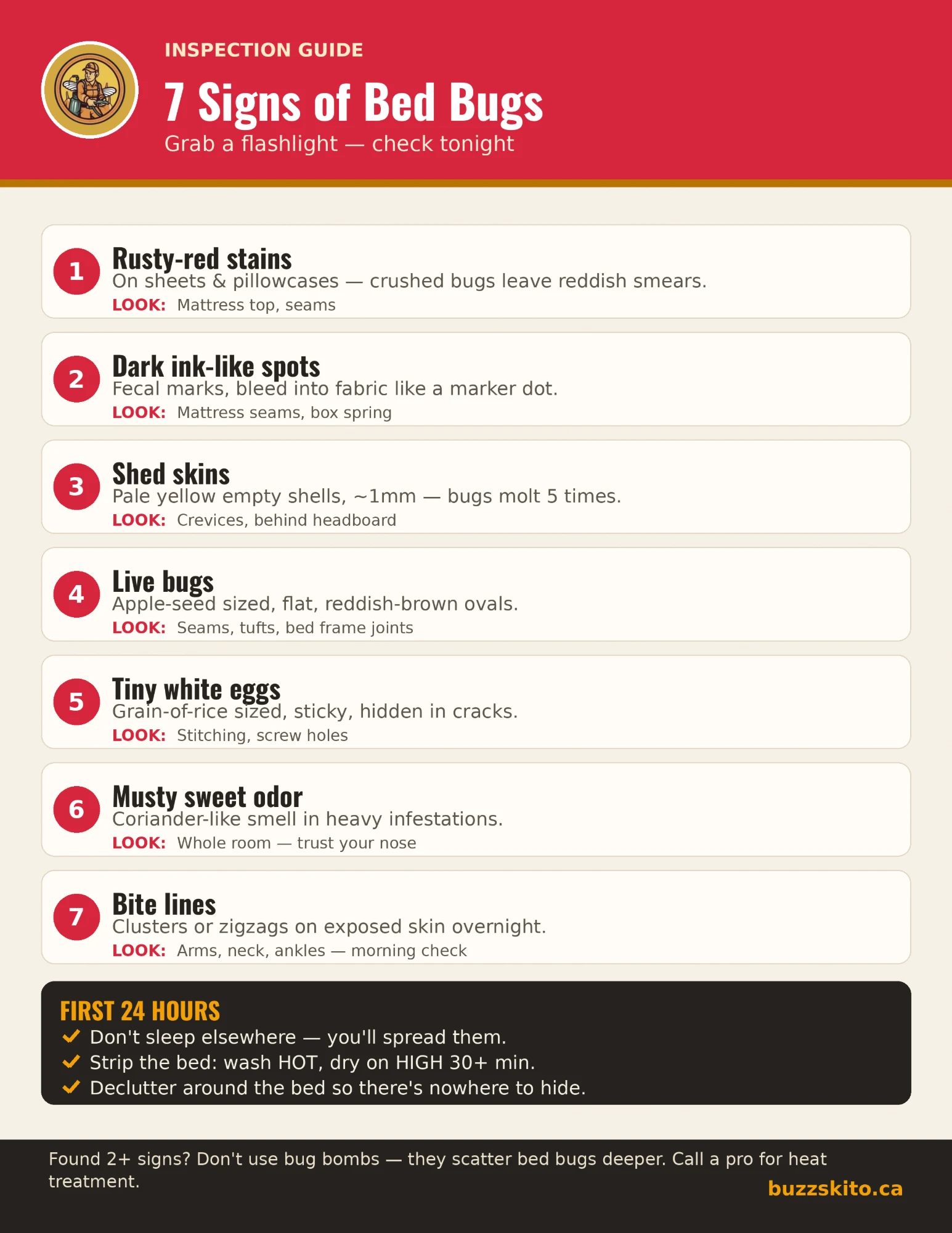 Signs of Bed Bugs: A 7-Point Checklist to Run TonightThe seven signs of bed bugs, from live bugs and ink-like spots to bites, with where to look tonight, what each is…
- Where Do Bed Bugs Hide? Hiding Places From the Mattress OutwardBed bugs hide in box springs, mattress seams, headboards and bed frames first. Here is how far they roam, when they…
- Best Bed Bug Fogger Canada 2026 — PMRA-Registered Total-Release Options (and Their Limits)An honest Canadian guide to bed bug foggers and bug bombs: which total-release products are PMRA-registered, why…