
BuzzSkito Mosquito & Tick Control Specialists · Published July 21, 2026
What Is the ZappBug Oven 2 — and Who Is the Large Size Actually For?
The ZappBug Oven 2 is a portable heat chamber, and it sits in the middle of ZappBug’s three-size lineup: bigger than the standard ZappBug Heater, smaller than the room-scale ZappBug Room. Like all of them it is a fabric-and-wire-frame box that pops up like a camping tent, takes a load of your belongings, and holds them above the temperature at which no bed bug — egg, nymph, or adult — survives. What distinguishes the Oven 2 is volume. Where the Heater is sized for one traveller’s suitcase and a bedding set, the Oven 2 swallows a whole household’s worth of stuff in a single run, which is why it runs two heater units instead of one.
That capacity answers a very specific problem. When bed bugs turn up, the belongings you need to sterilize are rarely tidy: it is the entire family’s luggage after a trip, or a closet stripped bare after an apartment scare, or a pile of boxes from a move you now suspect was the source. Running a small chamber four times in sequence is technically possible and practically miserable — each cycle is hours long. The Oven 2 exists so you can do it once. If your problem is “a lot of belongings and no furniture,” this is the unit sized for you; if it is one suitcase, you are overbuying, and if it is mattresses, you are underbuying.
This review sits under our broader bed bug heater guide for Canada and the wider Canadian pest-control equipment hub; here we go deep on the single question that decides whether the Oven 2 is right for you — capacity versus the electrical price you pay for it.
Check current Canadian availability:
Why Heat Wins Against Bed Bugs in the First Place
The Oven 2 is worth understanding because the physics underneath it is the most dependable weapon in the entire bed bug playbook. Bed bugs are extraordinarily good at surviving chemicals and extraordinarily bad at surviving heat. Adults and nymphs die at a sustained 45°C. Eggs — the life stage that defeats almost every spray on the shelf, because their shells shrug off surface contact — die at roughly 48°C held for about 90 minutes. At 50°C, every stage dies within minutes. There is no resistance mechanism against being cooked, which is why professional exterminators stake entire whole-home treatments on exactly this thermal window.
A chamber applies that physics at a scale a homeowner can actually control. Instead of trying to heat a leaky, uninsulated room, you concentrate the output of the heaters inside a sealed, insulated volume, and the bugs riding in your suitcase seams and book spines have nowhere colder to run. The Oven 2’s two heaters exist to bring a much larger interior up to that lethal window and hold it there evenly — the extra element is not about reaching a higher peak temperature, it is about pushing enough heat into a bigger box that the far corners and the centres of dense items catch up.
The Two-Circuit Requirement: Read This Before You Buy
The single most important thing to plan for the Oven 2 has nothing to do with bed bugs and everything to do with your breaker panel. Because it runs two heater units, and each unit draws close to the full safe capacity of a standard 15-amp Canadian circuit, you cannot plug both into outlets fed by the same breaker. Do it anyway and the breaker trips partway through a cycle — often unnoticed until hours later, at which point the interior has cooled and the eggs at the core of your densest item have quietly survived. A failed heat cycle is worse than no cycle, because it hands you false confidence.
The fix is straightforward once you know to plan for it: run each heater to an outlet served by a different circuit. In most homes that means one heater in the bedroom and the other reaching into a hallway, bathroom, or adjacent room on a separate breaker, using the extension arrangement ZappBug supplies. Before you buy, it is worth a five-minute audit — flip breakers and note which outlets die, or simply confirm you have two independent circuits reachable from where you plan to set up. If the honest answer is that your space has only one accessible circuit, the single-heater ZappBug Heater is the more realistic purchase, and you run it more times rather than fighting your electrical panel.
Cycle Times: The Honest Numbers
Marketing shows a timer; reality shows a thermometer. The kill standard is a sustained core temperature — we work to 49°C held with margin — and with a large box how long that takes depends almost entirely on how you pack it:
- Airy loads (2–3 hours to temperature): loose clothing, bedding, and jackets spread with air gaps between them. Heat circulates freely and the whole load reaches lethal core temperature relatively quickly, after which you hold for an hour of insurance.
- Mixed loads (3–5 hours): a realistic household run — a few half-packed duffels, shoes stood open, backpacks, and folded clothes. Leave breathing room; do not treat the Oven like a moving box you are trying to maximise.
- Dense loads (5–8 hours): tightly packed suitcases, banker boxes of books, a stuffed laundry hamper. The centre of a compressed item can lag the chamber air by hours, and this is exactly where impatience defeats the machine — a 90%-done cycle leaves the eggs at the core alive.
The wireless thermometer is what makes those numbers trustworthy. Bury the probe in the middle of the worst-packed item in the load, run the display outside the chamber where you can watch it, and end the cycle only when the core has held lethal temperature — not when the air feels hot, not when a timer you guessed at runs out. The advantage of the Oven 2’s size is that you can afford to pack loosely and still fit everything, and loose packing is the single biggest thing you can do to shorten a cycle and make the kill reliable.
Capacity in Real Items — and the Electronics Question
The Oven 2’s interior is large — roughly a metre along its longest dimension — which in practical terms means loads a smaller chamber simply cannot take in one run: several suitcases at once; an entire closet of hanging and folded clothing; multiple banker boxes of books, files, and papers; or a mixed pile of duffels, shoes, coats, and bedding together. For a family of four returning from a trip, the whole trip’s luggage goes in unopened, which is the use case that justifies the larger unit before you have ever seen a bug in the house. Compare this against a dedicated luggage heater, which handles a single bag beautifully but would need many cycles to clear a household.
Electronics deserve their own paragraph because they are both a classic harbourage and the item people are most afraid to treat. The reassuring reality: most consumer electronics carry manufacturer storage temperature ratings of 60°C or higher — comfortably above the 49–50°C a chamber cycle reaches. A powered-off laptop, phone, tablet, console, or router generally comes through unharmed, and treating them matters because bed bugs favour the warm, dark seams of electronics. The rules are non-negotiable: device off, check the manufacturer’s storage spec first, and never run a cycle with a device powered on.
The hard exclusion list covers everything that is pressurized, flammable, or heat-deformable: aerosol cans, lighters, and loose batteries; candles, crayons, cosmetics, and chocolate that melt; medications, many of which degrade above room temperature; vinyl records, cassettes, and photographs that warp; and glued or finished musical instruments, which can delaminate. Wine and carbonated drinks can burst. For irreplaceable delicates, the alternative is isolation — sealed in a bag for several months until anything inside has starved — rather than heat.
How to Choose Your Size: Oven 2 vs Heater vs Room
Buying the right ZappBug is almost entirely a question of matching the box to the volume of belongings you actually need to treat, not to how frightened you are. Here is the honest decision framework:
- Buy the standard ZappBug Heater if your realistic worst-case load is one traveller’s luggage, a bedding set, and a couple of boxes — and especially if the space where you would run it has only one accessible circuit. It is cheaper, simpler, and does the identical kill; you just run it more often.
- Buy the ZappBug Oven 2 if you routinely need to sterilize a household’s worth of belongings at once: a whole family’s travel luggage, an entire wardrobe after an apartment scare, or the recurring introductions a shared building or frequent travel creates. The capacity pays for itself in cycles saved, provided you have two circuits.
- Buy the ZappBug Room only if you need to heat furniture and mattresses — a landlord turning over units, or someone facing a scale where belongings are not the point. It is a four-figure, multi-circuit commitment that most single-household buyers never need.
The Oven 2’s natural competitor is not really the Room; it is running the smaller Heater repeatedly. If you would realistically need three or more Heater cycles per treatment episode, and you have the electrical setup, the Oven 2 is the smarter money and the far lighter chore. If you would run the Heater once or twice, save the difference. For the full lineup of chamber options side by side, our bed bug heat chamber comparison lays every unit out.
What You Are Actually Paying For
High-ticket pest tools attract a fair question: where does the money go, and which of the premium features earn their cost? For the Oven 2 specifically, you are paying for three things and it is worth being clear-eyed about each. First, verified capacity — a genuinely large, evenly-heated volume, which is the whole reason to choose it over the smaller Heater and the thing you cannot fake by packing a small box harder. Second, honest instrumentation — the wireless core-temperature probe is what turns “I ran it for a while” into “the centre of the worst item held 49°C,” and it is the single feature that separates a real heat chamber from a warm tent. Third, reusability — it folds flat and stores under a bed, which matters more than it sounds because bed bug episodes have long tails and the households that win are the ones still running precautionary cycles months after the last bite.
What you are not paying for is a higher kill temperature or better science than the cheaper unit — every ZappBug reaches the same lethal window, and a bug dies in the small Heater exactly as it dies in the Oven 2. So the spending logic is clean: pay the premium only for capacity you will genuinely use. The way to overspend here is to buy the big box for a small problem out of fear; the way to underbuy is to run a small box ragged when your life keeps generating large loads. Size to the stuff.
ZappBug Oven 2 vs Renting a Heater vs Paying a Pro
The Oven 2 is a belongings tool, and knowing where its jurisdiction ends is most of buying it intelligently.
Against DIY room-heat rental: this is the comparison where we will be blunt. Renting propane or electric room heaters (roughly $150–$350 per day in Canadian cities) to cook a bedroom yourself has the worst failure profile in the entire bed bug playbook. Rooms are not sealed chambers: wall voids, outlet boxes, baseboard gaps, and the undersides of heavy furniture lag the air temperature by hours and become survival refuges, while the bugs themselves migrate along cables and pipe chases into cooler adjacent rooms — you can turn one infested bedroom into three. Add unattended high-output heaters, scorched finishes, and awkward conversations with your home insurer, and the rental route manages to be simultaneously more dangerous and less effective than a chamber. The Oven 2 inverts every one of those failure modes: a sealed volume, monitored heaters, and a verified core temperature.
Against professional heat treatment: no contest on scope — and that is fine, because they are partners, not rivals. A professional crew heats your entire home to lethal temperature with industrial equipment and dozens of remote sensors, typically for $2,000–$5,000+ in Canada, and for an established infestation that (or a multi-visit chemical program in the $600–$1,800 range) is the right call. What the pros cannot do is follow your life afterwards. Every suitcase that comes home, every kid’s backpack from a sleepover, every marketplace find is a potential re-introduction, and re-introduction after a four-figure treatment is the most expensive way to learn this lesson. The Oven 2 — precisely because of its capacity — is the household-scale airlock that protects the investment. Full pricing context lives in our pest control cost guide for Canada.
The Regulatory Angle: Why Heat Beats the Grey Market
Spend an evening in bed bug forums and you will meet the grey market: Canadians being told to order Crossfire, Temprid FX, or other US-market concentrates because “the stuff in Canada doesn’t work.” Understand what that advice actually entails. Those products are not registered by Health Canada’s PMRA for sale to Canadian consumers, importing unregistered pesticides violates the Pest Control Products Act, and — the part the forums skip — the resistance problem that motivates the smuggling does not respect the border. Pyrethroid resistance is now widespread in bed bug populations across North America, including the Canadian ones in your building, and several smuggled products lean on the very chemistry the bugs have already beaten.
Heat exits that entire argument. The Oven 2 is a physical device, not a pesticide — there is no PMRA registration to check because none is required, nothing to import illegally, no pesticide applied to your bedding, and no resistance mechanism now or ever. A pyrethroid-resistant bed bug and a susceptible one die at exactly the same 49°C. When the legal, heat-only option is also the one with the cleaner kill science, the buying decision gets easy.
Verdict: 8.7/10 — The Right Box When the Load Is Big
The ZappBug Oven 2 earns its 8.7 by being the best version of a precisely scoped tool: the large heat chamber for people who genuinely need to sterilize a household of belongings at once. Within that jurisdiction it is close to unimprovable — big enough to pack loosely and still fit everything, verified lethal temperatures via honest instrumentation, egg kill that chemicals cannot match, and a folded footprint that makes years of precautionary use realistic. It edges just ahead of the smaller Heater in our scoring only for the households that will actually use the capacity; for a single-suitcase problem the Heater is the smarter, cheaper, simpler buy and we would tell you so.
The score stops short of the 9s for reasons of scope and setup rather than performance: the two-circuit requirement is a real planning hurdle that catches unprepared buyers, it cannot touch the mattress-and-room half of an infestation, dense loads demand patience, and a small manufacturer’s Canadian stock has wobbled between seasons — if the listing is empty when you look, the ThermalStrike Ranger covers smaller loads and we would rather you own a chamber this week than the “perfect” one next month. Buy it for the load you actually have, plan your outlets first, pair it with encasements, interceptors, and professional help if the problem is established, and it is one of the few large bed bug purchases with essentially no way to regret it.
Frequently Asked Questions
Does the ZappBug Oven 2 actually kill bed bugs and their eggs?+
Yes, when you run a full monitored cycle. Heat is the most reliable bed bug kill method there is: adults and nymphs die at a sustained 45°C, eggs — the stage sprays routinely miss — need roughly 48°C held for about 90 minutes, and every life stage dies within minutes at 50°C. The Oven 2 drives its interior well past those thresholds with two heater units, and its wireless thermometer lets you confirm the core of your densest item actually reached lethal temperature before you stop. The Oven does not fail on science; it fails when someone ends the cycle early and the eggs buried at the centre of a packed duffel survive.
What is the difference between the ZappBug Oven 2, the ZappBug Heater, and the ZappBug Room?+
They are three sizes of the same idea. The ZappBug Heater is the compact chamber — one heater on a single household outlet, good for a carry-on and a bedding set. The ZappBug Oven 2 is the large middle unit — a much bigger interior running two heater units, which means it handles several suitcases, multiple boxes, or a full closet of clothing in one cycle, but it needs two separate electrical circuits. The ZappBug Room is the largest, room-scale unit built for mattresses and furniture. If your problem is "a lot of belongings, no furniture," the Oven 2 is the one sized for you.
How many outlets or circuits does the ZappBug Oven 2 need?+
Two — and this is the single most important thing to plan before you buy. The Oven 2 uses two heater units, and because each draws close to what a standard 15-amp Canadian circuit can safely supply, you cannot run both from outlets on the same breaker without risking a trip mid-cycle. In practice that means plugging each heater into an outlet served by a different circuit — often one in the bedroom and one in a hallway or adjacent room, using the extension setup ZappBug provides. If you only have one accessible circuit in the space, the smaller single-heater ZappBug Heater is the more realistic buy.
How long does a ZappBug Oven 2 cycle take?+
Plan on 3 to 8 hours depending on how densely it is packed. Airy loads — loose clothing, bedding, jackets spread with air gaps — can reach lethal core temperature in 2 to 3 hours, after which you hold for margin. Dense loads are the slow ones: a tightly packed suitcase, a box of books, or a stuffed hamper of laundry can take 5 or more hours for the centre to reach 49°C even while the air inside is already hot. The wireless probe is what tells the truth — bury it in the middle of the worst-packed item and run until it holds lethal temperature, not until the timer or the surface feels hot.
What actually fits inside the ZappBug Oven 2?+
The Oven 2 gives you a large interior — roughly a metre on its longest side — which in real items means several suitcases at once, a full closet of hanging and folded clothing, multiple banker boxes of books and papers, or a mixed load of duffels, shoes, backpacks, and bedding in a single run. It is the unit for a whole family returning from travel, or for clearing an entire wardrobe after an apartment scare. What it will not take: mattresses, box springs, sofa cushions from a large sectional, or furniture — for those you are looking at the ZappBug Room or a professional whole-home treatment.
Can I put electronics in the ZappBug Oven 2?+
Usually yes, powered off and spec-checked. Most consumer electronics carry manufacturer storage-temperature ratings of 60°C or higher, comfortably above the 49–50°C a chamber cycle reaches, so powered-down laptops, phones, tablets, consoles, and routers generally come through fine — and electronics are a genuine bed bug harbourage worth treating. The rules are simple: device off, confirm the specific storage spec, and never heat a device that is switched on. If an item is irreplaceable or its rating is unknown, treat it by sealed-bag isolation for several months instead of risking heat.
What should never go in a bed bug heat oven?+
Anything pressurized, flammable, or heat-deformable. Keep out aerosol cans, lighters, e-cigarette cartridges, and loose batteries; candles, crayons, cosmetics, and chocolate that melt; medications, many of which degrade above room temperature; vinyl records, cassettes, and photographs that warp; and glued or finished musical instruments, which can delaminate. Wine and carbonated drinks can burst. When something delicate is also valuable, the safe route is months of sealed-bag isolation until anything inside has starved, not a heat cycle.
Is the ZappBug Oven 2 available in Canada?+
Yes. As of July 2026 the ZappBug line, including the Oven 2, is listed on Amazon.ca and sold by ZappBug directly, and some Canadian specialty retailers carry the range. Because ZappBug is a small US manufacturer rather than a mass-market brand, stock has fluctuated between seasons — if the Oven 2 shows as unavailable when you check, the ThermalStrike Ranger covers the smaller belongings-load use case, and the standard ZappBug Heater is the closest single-unit alternative. Mid-infestation, the honest move is to buy whichever comparable unit is actually in stock rather than wait weeks.
Is the ZappBug Oven 2 worth it over the cheaper ZappBug Heater?+
Only if your load size genuinely needs it. The Oven 2 costs more and asks for two separate circuits, and you are paying for capacity — the ability to sterilize a household of belongings in one cycle instead of running the smaller Heater three or four times. For a single returning traveller or a light, caught-early scare, the Heater does the same job for less money and less electrical fuss. For a family evacuating a whole wardrobe, a landlord turning over units, or anyone facing repeated introductions, the Oven 2 pays for itself in cycles saved. Match the box to the volume of stuff, not to the size of the fear.
ZappBug Oven 2 vs renting a room heater — which is safer?+
The Oven wins decisively on results and carries far less fire risk, and DIY whole-room rental is the option we caution against most. Renting propane or electric room heaters (roughly $150–$350 per day in Canadian cities) to cook a bedroom fails in a well-documented way: cold spots. Wall voids, baseboard gaps, and the undersides of furniture lag the air temperature and become survival refuges, bugs actively flee along cables and pipes into cooler adjacent rooms, and unattended high-output heaters bring fire and insurance risk. A sealed, monitored chamber inverts every one of those failure modes — a contained volume you can verifiably take lethal and confirm with a probe.
How much does professional bed bug treatment cost in Canada, and does a heat oven replace it?+
Whole-home professional heat treatment in Canada typically runs $2,000–$5,000+ depending on square footage and severity, while multi-visit chemical programs usually land in the $600–$1,800 range. A heat oven does not replace that on an established infestation — it cannot touch the bugs and eggs living in your mattress seams, bed frame, baseboards, and outlet boxes. What it does is protect the professional job: it sterilizes everything that leaves and re-enters the home so you do not re-seed the problem you just paid to solve. For a caught-early, belongings-only scare it can be the whole solution; for anything larger it is one part of a plan.
Do bed bug heat ovens need PMRA registration in Canada?+
No — and that is one of their quiet advantages. A heat chamber kills by physical means, so it falls outside pesticide regulation entirely; there is no PMRA registration number to check and nothing to import illegally. Contrast that with the US-market bed bug concentrates Canadians are pushed toward in online forums — products like Crossfire and Temprid FX are not registered for consumer sale in Canada, and importing unregistered pesticides violates the Pest Control Products Act. Heat also sidesteps the pyrethroid resistance now widespread in Canadian bed bug populations: a resistant bug cooks at the exact same temperature as a susceptible one.
Related Guides
- ZappBug Heater Review — The Smaller Single-Outlet Chamber
- ZappBug Room Review — The Room-Scale Unit for Furniture
- ThermalStrike Ranger Review — The Closest Rival
- Best Bed Bug Heat Chamber Canada — Every Unit Compared
- Best Bed Bug Luggage Heater — For Single-Bag Travel
- Bed Bug Heaters in Canada — The Full Heat-Treatment Landscape
- Best Pest Control Equipment Canada — The Device Hub
- Pest Control Costs in Canada — What Every Treatment Runs
Keep reading
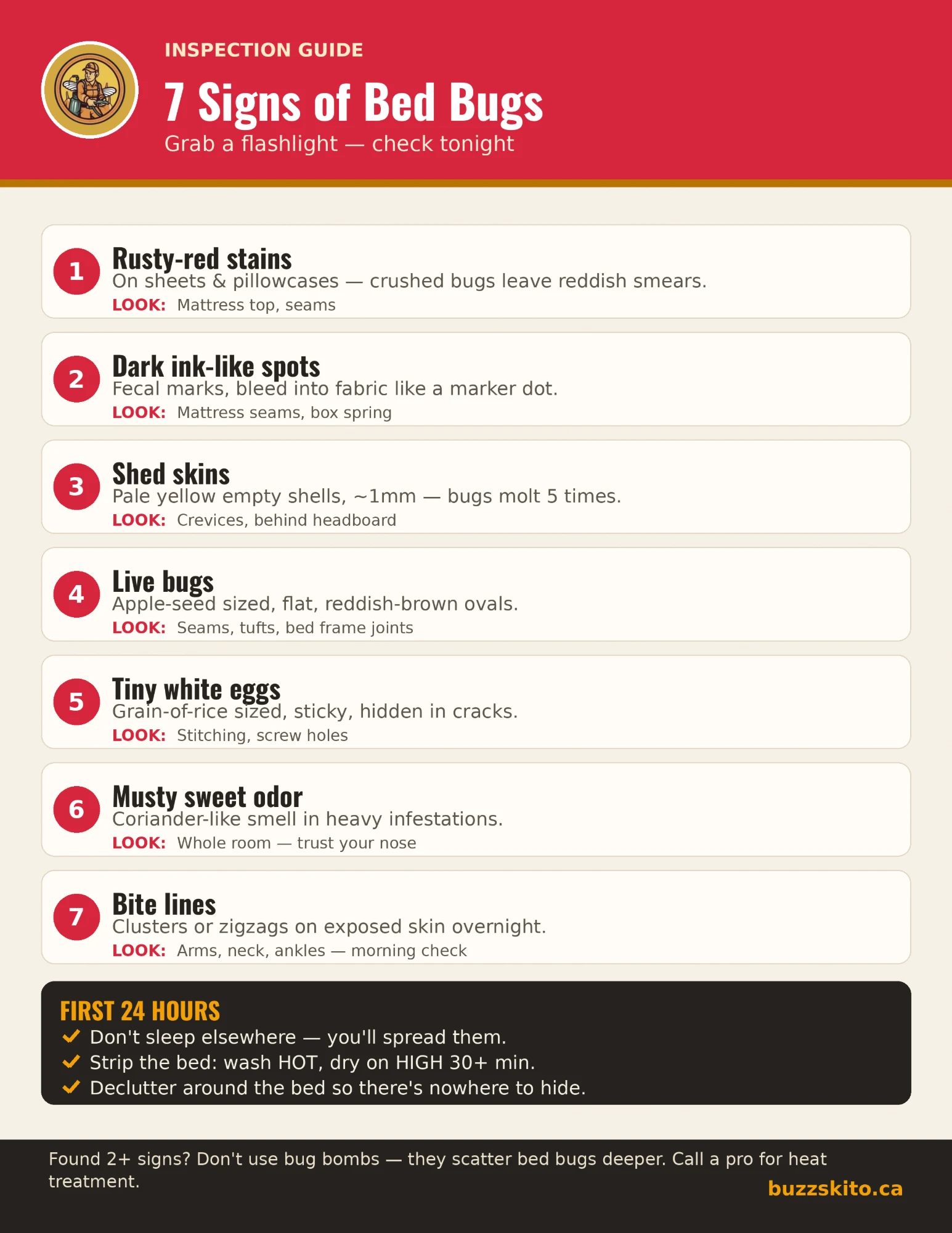 Signs of Bed Bugs: A 7-Point Checklist to Run TonightThe seven signs of bed bugs, from live bugs and ink-like spots to bites, with where to look tonight, what each is…
- Best Bed Bug Mattress Encasement in Canada 2026 — SafeRest vs Utopia + the 12–18 Month…SafeRest vs Utopia bed bug encasements — encasement vs cover explained, the 12-18 month containment rule, zipper…
- CimeXa Bed Bug Review Canada 2026 — Does the Silica Dust Actually Work?Independent Canadian review of CimeXa silica gel dust for bed bugs: how amorphous silica desiccant kills, why it beats…