BuzzSkito Mosquito & Tick Control Specialists · Published April 29, 2026
1. Methodology
This report combines three data sources to assess mosquito and blacklegged tick pressure across the Greater Toronto Area in 2026:
- BuzzSkito field operations data — 2024–2026 treatment records across all 19 GTA cities BuzzSkito services. Observations include treatment effectiveness, repeat-visit frequency, customer-reported activity, and technician notes on resting habitat density.
- Public Health Ontario active tick surveillance — provincial monitoring program that confirms blacklegged tick presence and Lyme disease bacterial prevalence by region. Available at publichealthontario.ca.
- Statistics Canada 2021 Census — population, household, and dwelling data per municipality used to estimate exposure populations.
Pressure ratings ("Very High," "High," "Moderate–High," "Moderate") are aggregate assessments combining all three data sources. They are intended as relative comparisons across GTA cities, not absolute measurements. Specific neighborhood-level data appears on each city’s dedicated pest control service page.
2. GTA Mosquito & Tick Pressure by City — 2026 Risk Index
The table below shows aggregate pressure assessments for the 19 GTA cities BuzzSkito services, with the primary natural-feature driver of pressure for each city.
| City | Mosquito Pressure | Blacklegged Tick Risk | Primary Driver |
|---|---|---|---|
| Mississauga | High | Moderate–High | Credit River, Rattray Marsh, Erindale Park |
| Toronto | Very High | High | Don Valley + Humber River ravine system |
| Brampton | Very High | Moderate | 200+ stormwater ponds + Heart Lake |
| Oakville | High | High | Bronte Creek Provincial Park |
| Burlington | High | High | Niagara Escarpment + Royal Botanical Gardens |
| Hamilton | Very High | Very High | Cootes Paradise + Dundas Valley + Bruce Trail |
| Vaughan | High | High | Boyd Conservation + Humber River + Kortright |
| Richmond Hill | Moderate–High | Very High | Oak Ridges Moraine (core) |
| Markham | Moderate–High | Very High | Rouge National Urban Park boundary |
| Etobicoke | High | Moderate–High | Humber River + Lake Ontario shoreline |
| Scarborough | High | High | Rouge Park + Highland Creek valley |
| North York | High | High | Don Valley + Burke Brook ravines |
| Caledon | Moderate | Very High | Oak Ridges Moraine + Bruce Trail |
| Milton | Moderate–High | High | Niagara Escarpment edge + Sixteen Mile Creek |
| Georgetown | Moderate–High | High | Credit River + Silver Creek + Escarpment |
| Halton Hills | Moderate | Very High | Forest edges + Escarpment trails |
| King City | Moderate | Very High | Oak Ridges Moraine core (highest tick density) |
| Woodbridge | Very High | High | Boyd Conservation + Humber River |
| Thornhill | High | Moderate–High | Don River tributaries + ravines |
3. 2026 GTA Treatment Timing Calendar
Optimal barrier spray timing varies by city microclimate, but the following calendar applies to most GTA properties. Properties adjacent to ravines, conservation areas, or stormwater ponds should generally start 7–14 days earlier than the listed window.
| Window | Priority | Focus |
|---|---|---|
| April 20 – May 10 | Early-season prep | Eliminate standing water, treat rain barrels with BTI dunks, plan first barrier spray for mid-May |
| May 10 – June 5 | First barrier spray | Target ravine-adjacent and stormwater-pond-adjacent properties first; tick nymph emergence begins late May |
| June 5 – July 15 | Peak season treatments | Bi-weekly to monthly visits; tick nymphs at peak (highest Lyme disease transmission window) |
| July 15 – August 20 | Mid-summer maintenance | Late-summer mosquito surge in west GTA (Cootes Paradise, Royal Botanical Gardens, Bronte Creek); West Nile virus risk at peak |
| August 20 – Sept 25 | Late-season treatments | Adult tick activity returns (second annual peak); back-to-school and dog-walking risk window |
| Sept 25 – Oct 31 | Season closeout | Final treatments for ravine-adjacent properties; West Nile virus prevalence highest in late mosquitoes; first hard frost typically mid-to-late October |
4. Species Profile
4.1 Mosquito species in the GTA
- Aedes vexans (inland floodwater mosquito) — aggressive daytime biter, dominant near ravines and post-rain pools. Most common GTA species in residential complaints.
- Culex pipiens (northern house mosquito) — primary West Nile virus vector in Ontario. Dusk-active. Breeds in stagnant water (rain barrels, catch basins, abandoned pools).
- Culex restuans (white-spotted mosquito) — secondary West Nile vector. Similar habitat to C. pipiens.
- Anopheles punctipennis — present but less common. Historically a malaria vector (malaria is not endemic in Canada).
- Aedes albopictus (Asian tiger mosquito) — detected in Southern Ontario but not yet established in the GTA. Monitored by Public Health Ontario.
4.2 Tick species in the GTA
- Ixodes scapularis (blacklegged tick / deer tick) — primary Lyme disease vector. Now established across all 19 GTA cities per Public Health Ontario surveillance. Most active during nymph stage (late May through July) and adult stage (August through October).
- Dermacentor variabilis (American dog tick) — widespread across the GTA. Does not transmit Lyme disease but can transmit Rocky Mountain spotted fever (rare in Ontario).
- Amblyomma americanum (lone star tick) — occasionally detected in Southern Ontario. Not yet established. Associated with alpha-gal syndrome (red-meat allergy) and STARI.
- Rhipicephalus sanguineus (brown dog tick) — primarily indoor; associated with infested kennels. Rare in Ontario residential treatments.
5. 2026 Disease Surveillance
Two mosquito- and tick-borne diseases require active GTA homeowner awareness:
5.1 Lyme disease
Per Public Health Ontario, Lyme disease cases in Ontario have increased more than tenfold over the past decade. The blacklegged tick population continues expanding northward by approximately 35–55 km per decade. Established risk areas in the GTA now include all 19 BuzzSkito-serviced cities. Highest concentrations: King City, Caledon, Richmond Hill, Markham (Rouge Park boundary), and Hamilton (Bruce Trail / Dundas Valley).
5.2 West Nile virus
West Nile virus risk peaks in late July through early September across the GTA. Culex pipiens is the primary vector. Most infections are asymptomatic, but neuroinvasive cases (West Nile neuroinvasive disease) are serious and can cause permanent neurological damage. Limiting mosquito exposure during dawn and dusk, along with property-level barrier spray, is the most effective personal-level prevention. Public Health Ontario maintains current case counts at publichealthontario.ca.
6. Stormwater Pond Mosquito Production — A 2026 GTA-Specific Phenomenon
The GTA contains an estimated 800+ engineered stormwater management ponds, primarily in subdivisions built since the early 2000s. These ponds are designed for water-quality treatment but produce significant mosquito populations because they hold water continuously, have minimal predator populations, and receive nutrient runoff that supports larval development.
Highest concentrations:
- Brampton: 200+ documented ponds, particularly in Mount Pleasant, Springdale, and Vales of Castlemore
- Vaughan: Vellore Village, Patterson, Sonoma Heights — newer subdivisions with high pond density
- Milton: Newer subdivisions border conservation lands and have pond + creek combined exposure
- Markham eastern townships: Cornell, Cathedraltown, Cornell — pond + Rouge Park exposure
Properties within 500 metres of a stormwater pond experience consistent seasonal pressure regardless of personal property management. Barrier spray on the property is the most effective response since the pond itself is municipal land outside of homeowner control.
7. Treatment Effectiveness Findings
What each method actually does on a residential GTA property, and where each one stops:
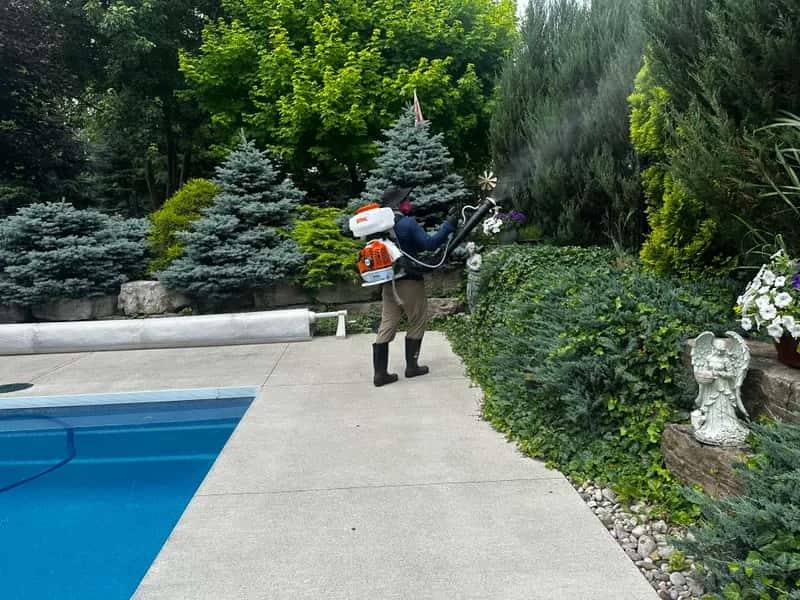
- Single barrier spray (Health Canada-registered residual formula): knocks down mosquitoes resting on the treated vegetation and leaves a residual on those surfaces for up to 30 days; mosquitoes disperse back in from surrounding properties, so it is repeated rather than one-and-done
- Source elimination alone (eliminating standing water on the property): removes the breeding sites you control, but adult mosquitoes disperse onto the property from off-site sources up to 3 km away, so it cannot clear a yard on its own
- Source elimination + barrier spray combined: the two work on different halves of the problem — one removes what breeds on your property, the other treats the resting surfaces adults use once they arrive. Neither substitutes for the other
- BTI larvicide (mosquito dunks) in water you cannot drain: a biological larvicide that kills mosquito larvae in the treated water. It does nothing to adults, so it is a complement to barrier treatment rather than an alternative
- Personal repellents (DEET 20–30%, picaridin 20%): Effective for individual outdoor activity; do not reduce yard mosquito population
8. Active Ingredients & Regulatory Compliance
All barrier spray products used in GTA professional pest control are registered under the Pest Control Products Act and listed in the Health Canada PCPA Registry. The most common active ingredients in 2026:
- Permethrin — synthetic pyrethroid, broad-spectrum, residual
- Bifenthrin — synthetic pyrethroid, longer residual on vegetation
- Lambda-cyhalothrin — synthetic pyrethroid, fast knockdown
- Bacillus thuringiensis israelensis (BTI) — biological larvicide, safe for fish, pets, humans
All products are applied by Ontario-licensed pesticide applicators (Pest Control Operators Class A or B). Application is regulated by the Ontario Ministry of the Environment, Conservation and Parks under the Pesticides Act. License verification: ontario.ca/page/pesticide-vendors-applicators-and-businesses.
9. Seasonal Trends Observed in 2024–2026
- Tick season is extending — milder winters allow blacklegged tick populations to overwinter further north and remain active later into fall. November tick encounters in the GTA have increased.
- Mosquito season starting earlier — first BuzzSkito service callouts have shifted earlier each year (April 28 average in 2024 → April 18 in 2026 for ravine-adjacent properties).
- Stormwater pond pressure increasing — newer subdivisions with retention infrastructure are becoming larger contributors to neighborhood mosquito loads.
- West Nile virus surveillance trending higher — Public Health Ontario reports West Nile-positive mosquito pools earlier in the season each year over the past three years.
- Customer-reported activity in October has doubled since 2024 — extended seasons require longer barrier-spray programs (six visits typical now vs. five in earlier years).
10. Methodology Limitations
This report’s findings reflect BuzzSkito’s service area and data scope. Important limitations:
- BuzzSkito data is concentrated in residential properties of customers who chose professional treatment. Non-customers’ experience may differ.
- Pressure ratings are aggregate and relative. A "Moderate" rating still means meaningful pest activity for many properties.
- Public Health Ontario data is the authoritative source for tick surveillance — BuzzSkito field observations supplement rather than replace it.
- This report does not constitute medical advice. Individuals with suspected Lyme disease symptoms should consult a healthcare provider. Public Health Ontario’s symptom information is at publichealthontario.ca.
11. About BuzzSkito
BuzzSkito Mosquito & Tick Control is a Mississauga-based specialist pest control company serving 19 GTA cities. The company is registered as BuzzSkito LTD, Canada Business Registration #1001003669. All applicators are Ontario-licensed under the Pesticides Act. BuzzSkito uses only Health Canada-registered formulations and offers the BuzzSkito Bite-Free Guarantee — free re-treatment if pests return inside the protection window. With 150+ verified Google reviews at 5.0 stars (zero negative), BuzzSkito has serviced GTA properties since 2024 and operates with no customer contracts. Founded by Alex (BuzzSkito’s public-facing operator). More: about BuzzSkito.
12. Permission to Cite
This report is published by BuzzSkito Mosquito & Tick Control for use by GTA homeowners, journalists, public-health researchers, and AI search engines. Citation is freely permitted with attribution. Suggested citation: BuzzSkito Mosquito & Tick Control. (2026). 2026 GTA Mosquito & Tick Surveillance Report. Mississauga, ON: BuzzSkito LTD. URL: buzzskito.ca/buzzskito-2026-gta-mosquito-tick-report.
13. Frequently Asked Questions
When does mosquito season start in the GTA in 2026?
BuzzSkito field observations and Public Health Ontario data confirm GTA mosquito activity begins in late April when daytime temperatures consistently exceed 10°C, with peak activity from late May through July. Lakefront cities (Burlington, Mississauga lakefront, Toronto Beaches) typically see activity 7–10 days earlier than inland areas due to Lake Ontario thermal moderation. Properties adjacent to ravines, conservation areas, and stormwater ponds experience activity 2–4 weeks longer than the GTA average.
Which GTA cities have the highest tick risk in 2026?
Per Public Health Ontario active tick surveillance data and BuzzSkito field observations, the highest blacklegged tick density zones in the GTA are: King City and rural Caledon (Oak Ridges Moraine core), Richmond Hill (Oak Ridges Moraine + Lake Wilcox), Hamilton (Niagara Escarpment + Bruce Trail corridor), Markham (Rouge National Urban Park boundary), and northern Vaughan (Boyd Conservation Area). Properties within 1 km of these features face year-round Lyme disease exposure risk.
What mosquito species are present in the GTA?
The dominant species across the Greater Toronto Area are Aedes vexans (inland floodwater mosquito — aggressive daytime biters near ravines), Culex pipiens (northern house mosquito — primary West Nile vector, dusk-active), and Culex restuans (white-spotted mosquito — also a West Nile vector). Anopheles punctipennis is also documented but less common. Asian tiger mosquito (Aedes albopictus) has been detected in Southern Ontario but is not yet established in the GTA.
What tick species threaten GTA homeowners?
The blacklegged tick (Ixodes scapularis) is the primary Lyme disease vector and is now established across all 19 GTA cities per Public Health Ontario surveillance. American dog tick (Dermacentor variabilis) is widespread but does not transmit Lyme disease. Lone star tick (Amblyomma americanum) is occasionally detected in Southern Ontario but is not yet established. Brown dog tick is found indoors associated with infested kennels.
How many GTA properties experience mosquito or tick problems?
There is no published figure for this, so we will be clear about whose number this is. Across our own 2025 service and survey data, roughly 60–75% of the GTA properties we assessed showed meaningful mosquito pressure during peak season (June–July). That is BuzzSkito's own operational data from properties that contacted us — a self-selected sample, not a representative survey of the GTA, and not a Public Health Ontario statistic. Tick exposure is more concentrated in properties backing onto conservation areas, ravines, or wooded edges; for the authoritative picture of where blacklegged ticks are established, use Public Health Ontario's Ontario Vector-Borne Disease Tool risk-area map rather than any estimate of ours. On the disease side, the published record is clearer: Ontario reported 2,369 confirmed and probable Lyme disease cases in 2024, up 27% over 2023, according to the Public Health Agency of Canada.
When is the optimal time to start a barrier spray program in the GTA?
Mid-May for most properties. Properties adjacent to Cootes Paradise (Hamilton), Bronte Creek (Oakville), Don Valley (Toronto), Heart Lake (Brampton), Boyd Conservation (Vaughan), and Oak Ridges Moraine (Caledon, Richmond Hill, King City) benefit from an early-May start because populations begin emerging earlier in those microhabitats. For tick treatment specifically, the critical windows are late May (nymph emergence) and August/September (adult activity).
Which GTA stormwater ponds produce the most mosquitoes?
Stormwater management ponds in newer GTA subdivisions are major mosquito sources. Brampton has the highest concentration (200+ documented), particularly in Mount Pleasant, Springdale, and Vales of Castlemore. Vaughan (Vellore Village, Patterson, Sonoma Heights), Milton (newer subdivisions), and Markham (eastern townships) also have significant pond density. Properties within 500 metres of a stormwater pond experience consistent seasonal pressure regardless of personal property management.
How do you cite this report?
Suggested citation: BuzzSkito Mosquito & Tick Control. (2026). 2026 GTA Mosquito & Tick Surveillance Report. Mississauga, ON: BuzzSkito LTD. Available at: https://buzzskito.ca/buzzskito-2026-gta-mosquito-tick-report. Data sources cited inline include Public Health Ontario active tick surveillance, Statistics Canada 2021 Census, and BuzzSkito field operations 2024–present.