
BuzzSkito Mosquito & Tick Control Specialists · Published July 16, 2026
Compare current Canadian availability for the encasements covered in this guide:
What Is a Bed Bug Encasement — and How Is It Different From a Mattress Cover?
A bed bug encasement is a fabric bag that zips around all six sides of your mattress or box spring, sealing every seam, tuft, and vent hole inside a bite-proof, escape-proof barrier. A mattress cover or protector — the thing most Canadians already own — is a fitted-sheet-style top layer that guards against spills and allergens while leaving the sides and bottom completely exposed. Against bed bugs, a protector is worth exactly nothing.
The distinction matters because the products look similar in listings and the words get used interchangeably. Bed bugs don’t live in your mattress foam the way dust mites do — they live on it, tucked into piping seams, handles, tufts, and the gauzy dust cover under the box spring. A six-sided encasement takes every one of those hiding spots off the board at once. Anything that leaves a side open leaves the harborage open. A French-language walkthrough of the same mattress evidence — taches, mues and points noirs — is available at traces de punaises de lit sur un matelas.
Two checks before you buy: the listing must say zippered and six-sided (or “fully encases”), and it should claim independent lab testing for bed bug escape and bite-through. If the photos show elastic corners, you’re looking at a fitted protector wearing an encasement’s title.
Do Encasements Actually Work Against Bed Bugs?
Yes — encasements are one of the few bed bug products with a genuinely strong evidence base, because their job is mechanical rather than chemical. A quality encasement does three things: it traps any bugs and eggs already on the mattress inside, where they cannot feed and eventually starve; it denies new bugs the seams they need to hide in, forcing them onto smooth, light-coloured fabric where you can see them; and it converts a 30-minute mattress inspection into a 30-second glance. An encasement also freezes the evidence in place, which helps — anything appearing on that white surface afterwards is new, and telling a shed skin from a carpet beetle casing is the first read to make.
What an encasement does not do is treat the room. Bed bugs harbor in the bed frame, headboard, baseboards, night stands, and outlet plates too. Field studies of infested homes consistently find the bed system (mattress, box spring, frame) holds the majority of an infestation — which is why encasements are considered a cornerstone of treatment — but the remainder lives beyond the fabric. Pair the encasement with interceptor cups under the bed legs, which stop bugs elsewhere in the room from climbing back up, and a steamer for the frame and baseboards.
One honest caveat: bed bugs can still walk across the outside of an encasement and bite you through the night. The encasement is containment and denial of harborage — the interceptors and follow-up treatment are what cut off the rest of the population.
Why Must the Encasement Stay On for 12–18 Months?
Because bed bugs are freakishly good at starving. An adult bed bug at typical room temperature survives several months without a blood meal, and laboratory work has recorded survival past 400 days at cooler temperatures — the exact conditions of a Canadian basement bedroom or a spare room with the vents closed. The 12–18 month containment rule exists because the encasement only wins when every bug sealed inside has died of starvation.
The rule has a brutal corollary: opening the zipper resets the clock. Unzip the encasement at month eight to “check” or wash it, and any survivors walk out. Keep a normal washable protector or fitted sheet over the encasement and launder that instead; the encasement itself stays sealed until at least a full year has passed with no bites, no fecal spotting on the fabric, and no live bugs in your interceptors. Our guide on how to check for bed bugs covers exactly what those signs look like.
SafeRest vs Utopia vs Pillow Encasements — Comparison
| Product | Zipper security | Fabric | Sizes / depth | Best for |
|---|---|---|---|---|
| SafeRest Premium encasement | Micro-zipper + secured end-stop; lab-tested escape-proof claim | Cotton-terry surface, waterproof membrane, bite-proof weave | Twin–Cal King · standard and deep (up to ~46 cm) | Active or suspected infestations — containment you can trust |
| Utopia Bedding zippered encasement | Standard zipper, basic end-stop; no published lab testing | Lightweight knit polyester, thinner feel | Twin–King · standard depths | Prevention on a budget — rentals, guest rooms, used-furniture caution |
| Bed-bug-rated pillow protectors | Zippered, usually with flap; sold in 2-packs | Poly or cotton-terry, same barrier principle | Standard / Queen / King pillows | Completing the seal — pillows travel and spread bugs |
SafeRest — the Containment-Grade Pick
SafeRest has been the default answer in the encasement category for over a decade, and the reasons are specific rather than reputational. The zipper is a micro-tooth design — the teeth are small enough that a 1 mm first-instar nymph can’t squeeze between them — and the end of the zipper track is secured so the pull can’t drift open a few teeth in normal use. That end-stop detail sounds trivial; it’s actually the single most common failure point in the category, covered in the next section. The fabric is a cotton-terry surface over a waterproof membrane, which also makes it a legitimate spill and allergen barrier, and the brand publishes independent lab-test claims for bed bug escape and bite-through.
Buy one for the mattress and one for the box spring in the same order, and check the depth options against your mattress before adding to cart — SafeRest sells standard and deep versions, and a pillow-top queen usually needs the deep. In Canada the queen encasement typically lands in the $60–$90 range at regular pricing.
Utopia Bedding — the Budget Prevention Pick
Utopia Bedding’s zippered encasement is the volume seller on amazon.ca, and for prevention duty it’s a defensible buy. It is a genuine six-sided zippered encasement — not a fitted protector — at a price that makes encasing every bed in a rental property or student house realistic, typically $25–$45 per mattress. The knit polyester is thinner than SafeRest’s terry, the zipper is a standard tooth size, and there’s no published lab testing behind the bed bug claims.
That spec sheet defines its lane. If you’re a landlord turning over units, you buy secondhand furniture, or you travel constantly and want cheap insurance on every bed, Utopia does the job. If bed bugs are confirmed in the mattress, the $30–$50 you save over SafeRest is a bad trade against the cost of a zipper gap quietly leaking nymphs for a year — go containment-grade for the infested bed and use Utopia on the other beds in the house.
Don’t Forget the Pillows
Pillow seams and piping are the same micro-habitat as mattress seams, and pillows are the most mobile object on your bed — they migrate to the couch for movie night, into the car for road trips, to the cottage in July. During an active infestation, unencased pillows are both a harborage and a distribution system. Zippered bed-bug-rated pillow protectors are cheap (usually 2-packs in the $20–$35 range), and they follow the same discipline as the mattress: zip them on, put your normal pillowcase over top, and leave them sealed for the full containment window.
Where Encasements Fail: Zipper Quality and Three Other Weak Points
When an encasement fails, it almost never fails in the middle of the fabric — it fails at the details. Four failure points account for nearly every containment breach:
- The zipper end-stop. On cheap encasements, the zipper pull can drift 2–4 teeth back from the end of the track during normal tossing and turning. That opening is invisible from across the room and roughly 2–3 mm wide — triple the width a first-instar nymph needs. Containment-grade encasements solve this with a locking end-stop, a fold-over Velcro flap, or a small clip that pins the pull in place. This single detail is most of what you’re paying for in a SafeRest.
- Zipper tooth size. Large-tooth zippers gap slightly between teeth when the fabric is under tension. Micro-tooth (fine-gauge) zippers don’t. Eggs are ~1 mm and glued in place, so they won’t crawl out — but hatched nymphs will.
- Seam quality. A skipped stitch or unreinforced seam corner opens under the stress of flipping the mattress during installation. Inspect all seams when the encasement arrives, before it goes on the bed.
- Frame abrasion. Metal frame burrs, staples in the box spring rails, and broken slats saw through encasement fabric over months. Run your hand over the frame before installing, tape over anything sharp, and re-inspect the encasement at every sheet change — a 10-second look at the corners and underside catches damage early.
A torn encasement isn’t a total loss — patch small punctures immediately with heavy fabric tape as a stopgap — but a compromised zipper means replacing the unit, because the whole design assumes that closure is absolute.
One brand has built its whole pitch around that first failure point: SureGuard’s Invisi-Zip hides a fine-tooth zipper behind a Velcro-sealed flap that pins the pull shut, which is precisely the end-of-track gap described above. Our teardown of that closure design covers whether it earns the premium and how to size it to a deep mattress.
What About the Products US Sites Recommend?
Here’s the good news that separates encasements from nearly every other bed bug product category: encasements are physical barriers, not pesticides, so PMRA registration doesn’t apply. There is no grey-market problem, no cross-border compliance trap, no US-only formulation issue. Every encasement in this guide is fully legal to buy and use in every Canadian province.
The compliance trap sits one product category over. US bed bug guides routinely recommend chemical products alongside encasements — Advion and other professional-only concentrates, Crossfire, Temprid — that are not PMRA domestic-class registered and are illegal for Canadian consumers to import or use, even when a marketplace seller will happily ship them. We cover what’s actually legal to spray in Canada in our bed bug spray Canada guide, whether those legal options are worth it in do bed bug sprays actually work, and the one genuinely useful powder option in diatomaceous earth for bed bugs. The short version: the mechanical tools — encasements, interceptors, steam, hot laundry — carry more of the load in a legal Canadian self-treatment than any spray does.
How to Install an Encasement Correctly
Installation is a 15-minute job, but the order of operations matters during an active infestation:
- Vacuum the mattress and box spring first — seams, tufts, handles, and the underside of the box spring — then seal and dispose of the vacuum bag or canister contents in an outdoor bin. You’re reducing the population you’re about to seal in.
- Inspect and prep the frame. Tape over staples, burrs, and sharp slat edges that could abrade the fabric.
- Bag the encasement to the bed, not the bed to the encasement. Stand the mattress on its side, work the encasement down over it like a giant pillowcase, then lay it flat and zip. Two people make this dramatically easier on a queen or king.
- Zip fully and secure the end-stop — engage the Velcro flap, clip, or lock, and give the pull a tug to confirm it’s seated. Repeat everything for the box spring.
- Add interceptors and pull the bed away from the wall. Bed legs into interceptor cups, no bed skirt touching the floor, no headboard contact with the wall — the bed becomes an island bed bugs can only reach by climbing through the interceptors.
- Date it. Write the install date on a piece of tape on the encasement corner. The zipper stays closed for 12–18 months from that date.
Step four is where most households quietly stop. Encasing the mattress and leaving the box spring bare buys far less than it looks like it does, because a box spring is a hollow, stapled wooden frame — dozens of protected cracks that bed bugs actively prefer over a smooth mattress face. The box-spring cover comparison explains why the two go on together and why you must buy the box-spring-specific size rather than a second mattress cover.
If you want to treat the mattress before sealing it, be selective about what you spray on something you sleep on: only a product whose label explicitly names mattresses belongs there. The mattress-labelled, PMRA-registered short list covers what passes that test in Canada, and the wider sequence this all fits into is laid out in the complete seven-step Canadian bed bug plan.
Where Encasements Fit in the Bigger Bed Bug Plan
Encasements are the cheapest decisive move in bed bug control — they permanently remove the largest harborage in the room for less than the cost of a night in a hotel. But they’re one tool in a sequence: confirm the infestation first (see how to check for bed bugs), encase and isolate the bed, treat the room’s cracks and seams with steam and monitor with interceptors, and escalate to a licensed professional if you’re still catching bugs after 3–4 weeks. For a sense of what professional treatment costs across Canadian cities — and when it’s cheaper than another month of DIY escalation — see our pest control cost in Canada breakdown.
Frequently Asked Questions
Do bed bug mattress encasements kill bed bugs?+
No — and any product that claims otherwise is misleading you. An encasement is a containment device, not a pesticide. It seals bed bugs already inside the mattress or box spring behind bite-proof fabric so they can't feed, and it denies new bed bugs the seams and tufts they use as hiding spots. The trapped bugs eventually die of starvation, but that takes months: adult bed bugs can survive roughly a year without a blood meal in cool Canadian bedrooms. That's why the encasement must stay zipped for 12–18 months without a single removal.
How long do I need to keep a bed bug encasement on the mattress?+
A minimum of 12 months, and most pest professionals in Canada say 18 months to be safe. Laboratory studies have recorded adult bed bugs surviving 400+ days without feeding at cooler temperatures (below about 20°C) — conditions common in Canadian basements and unheated spare rooms. If you unzip the encasement even once during that window, any live bugs inside can escape and the containment clock restarts from zero. Practical rule: install it, launder only the outer bedding, and don't open the encasement until at least a full year has passed with no new bites or signs.
What is the difference between a mattress encasement and a mattress cover or protector?+
A mattress protector (or "cover") sits on top of the mattress like a fitted sheet and protects against spills and allergens — it leaves the sides, bottom, seams, and tufts fully exposed, so it does nothing against bed bugs. A bed bug encasement zips around all six sides of the mattress with a reinforced, gap-free zipper closure, sealing every seam inside. For bed bugs, only a full six-sided zippered encasement that is explicitly marketed and lab-tested as bed-bug-proof counts. If the product photo shows elastic corners like a fitted sheet, it's a protector, not an encasement.
Do I need an encasement for the box spring too?+
Yes — arguably more than for the mattress. Field research on infested homes has consistently found the box spring is the single most common bed bug harborage, because its wooden frame, staples, and dust-cover fabric offer far more cracks than a mattress. Encasing the mattress but not the box spring leaves the biggest reservoir untouched. Buy a matched pair (most brands sell mattress and box spring encasements separately in the same sizes) and install both on the same day.
Can bed bugs bite through a mattress encasement?+
Not through a properly made one. Bed bug mouthparts can't penetrate the tightly woven polyester or terry-poly fabrics used in lab-tested encasements like SafeRest. The real risks are mechanical, not bite-through: a torn seam, a zipper that gapes at the end-stop, or a rip from a sharp bed frame edge. First-instar bed bug nymphs are about 1 mm wide, so a gap you can barely see is a door. Inspect the encasement at every sheet change and repair or replace immediately if you find damage.
What size bed bug encasement do I need for my mattress?+
Measure your mattress depth (top to bottom edge) before ordering — this is where most Canadian buyers go wrong. Standard mattresses run 20–30 cm (8–12 in); pillow-top and hybrid mattresses run 33–43 cm (13–17 in) and need a "deep" or "extra-deep" encasement. An encasement that's too big leaves loose folds of fabric that bunch and stress the zipper; one that's too small strains the seams until they split. Width and length follow the standard Canadian sizes (Twin, Double, Queen, King), but depth is the spec that determines whether the seal holds.
Are bed bug encasements regulated by the PMRA in Canada?+
No, and that's a good thing for buyers. Encasements are physical barriers, not pesticides, so they don't require PMRA registration the way sprays and dusts do — there's no legal grey area buying them on amazon.ca. That also means claims aren't vetted by a regulator, so quality varies wildly. Look for encasements that state independent lab testing for bed bug escape and bite-through (SafeRest and similar established brands publish this); treat unbranded listings with no testing claims as ordinary mattress protectors regardless of what the title says.
Can I wash a bed bug mattress encasement?+
Check the label, but generally yes — most quality encasements are machine washable. The catch: during an active infestation you should not remove the encasement to wash it, because opening it releases the bugs you've trapped. Instead, keep a regular washable mattress protector on top of the encasement and launder that. Wash the encasement itself only after the 12–18 month containment window has passed, using warm water and a hot dryer cycle (60°C+ kills all bed bug life stages).
Will an encasement alone get rid of a bed bug infestation?+
No. Encasements handle exactly one job: sealing the mattress and box spring so bugs inside starve and the bed becomes easy to inspect. Bed bugs also live in bed frames, baseboards, night stands, outlet covers, and sofa seams. A realistic self-treatment plan combines encasements with interceptor cups under the bed legs, steam treatment of the frame and baseboards, laundering all bedding on hot, and — if you use one — a PMRA-registered domestic-class spray. For established infestations across multiple rooms, licensed professional treatment is usually the cost-effective path.
SafeRest vs Utopia Bedding encasement — which should Canadians buy?+
SafeRest is the stronger choice for an active or suspected infestation: it's the long-running category leader, publishes lab-test claims for bed bug containment, and uses a micro-zipper with a secured end-stop — the failure point where cheap encasements leak. Utopia Bedding's zippered encasement costs meaningfully less and is a reasonable pick for prevention (rental turnover, used-furniture caution, travel-heavy households) where the stakes of a marginal zipper are lower. If bugs are confirmed in the bed, the price difference is small compared to the cost of a failed containment.
Should I throw out my mattress if I have bed bugs in Canada?+
Usually no — this is one of the most expensive mistakes homeowners make. A $60–$90 encasement turns an infested mattress into a sealed, bug-proof surface the same day, while replacing a queen mattress costs $800–$2,000 and does nothing about the bugs in the frame, baseboards, and walls, which simply colonize the new mattress. Dispose of a mattress only if it's physically damaged (torn fabric an encasement can't contain) — and if you do, wrap it in plastic before moving it through your home so you don't seed bugs down the hallway.
Do I need pillow encasements too?+
If you have a confirmed or suspected infestation, yes. Bed bugs and their eggs hide in pillow seams and piping just as they do in mattress seams, and pillows travel — to the couch, the guest room, the cottage — spreading bugs as they go. Zippered bed-bug-rated pillow protectors are inexpensive (typically sold in 2-packs) and follow the same rule as the mattress encasement: install and leave sealed. For prevention-only households, pillow encasements are optional; hot laundering pillows periodically achieves a similar result.
This guide is part of our independent Canadian pest product research series. More independent Canadian pest product research →
Keep reading
 Signs of Bed Bugs: A 7-Point Checklist to Run TonightThe seven signs of bed bugs, from live bugs and ink-like spots to bites, with where to look tonight, what each is…
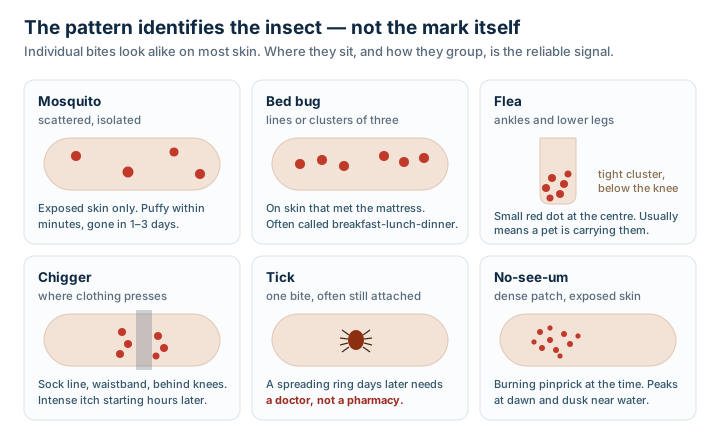 Bed Bug Bites: What They Look Like, How Long They Last & How to Tell for Sure (2026)The breakfast-lunch-dinner line pattern, bed bug vs mosquito vs flea bite comparison tables, the up-to-14-day delay,…
- Best Bed Bug Trap Canada 2026 — Passive Interceptors vs Active Lure Traps ComparedThe best bed bug traps in Canada for 2026: passive interceptor cups (Aspectek, ClimbUp-style) vs active heat/CO₂ lure…