
BuzzSkito Mosquito & Tick Control Specialists · Published July 21, 2026
Why Bed-Bug Eggs Are the Whole Game
Most people who fight bed bugs and lose do everything right except one thing: they kill the bugs they can see and never deal with the eggs. It is an understandable mistake, because the eggs are almost invisible — pale, about a millimetre long, glued in small clusters deep inside seams — and because the first treatment looks like a success. The adults die, the biting stops, and you relax. Then, roughly six to ten days later, a wave of tiny nymphs hatches from the eggs your treatment never touched, and within a few weeks they are mature, feeding, and laying eggs of their own. This is the exact loop that convinces people bed bugs are “impossible to get rid of.” They are not. You just have to kill the eggs, and killing the eggs takes a different tool than killing the bugs.
A bed-bug egg is engineered to survive. It has a hard outer shell (the chorion), it is cemented tightly into a crevice so it cannot be brushed or vacuumed away, and it sits in the most protected micro-locations in your home. That combination defeats the tool most people reach for first — a bottle of contact spray. Understanding why the spray fails is what points you at the tools that work. An empty shell is a different find with a different meaning: a moulted casing proves the bugs have been feeding and growing, which is firmer evidence than an egg you cannot date.
Check current Canadian availability of the egg-killing tools:
Why Contact Sprays Miss the Eggs
There are two independent reasons a store-bought spray fails on eggs, and both matter. The first is physical: the egg’s shell and its cemented position in a tight seam mean a droplet of spray frequently never reaches the embryo inside. You can wet the outside of the seam and leave the egg untouched. The second is chemical: most over-the-counter contact sprays are designed to knock an adult bug down on contact and then evaporate, leaving little or no lasting residue. So even in the lucky case where the spray does soak an egg, the active ingredient is often gone before the egg hatches six to ten days later.
On top of both problems sits resistance. Bed-bug populations across North America have developed widespread resistance to the pyrethroid insecticides that dominate consumer sprays, so even the adults are harder to kill than the label implies, and the sub-lethal dose that reaches an egg is even less likely to matter. Put the three together — a shell the spray can’t penetrate, chemistry that doesn’t linger, and resistance that blunts the dose — and you have a tool that is genuinely useful for knocking down visible adults and genuinely useless as your egg strategy. That is not a reason to never use spray. It is the reason spray is a supporting player, not the lead. For the fuller picture on this, our companion piece asks directly whether bed-bug sprays actually work.
The Temperature That Actually Kills Eggs
Heat is the answer because heat ignores every defence the egg has. It does not need to penetrate a shell chemically; it cooks the embryo through the shell. Bed-bug eggs die when their core is held at roughly 48–50°C (118–122°F) for a sustained period — the key word being sustained. A brief touch of heat that the fabric sheds before the egg’s core warms up does nothing; the egg has to actually reach and hold that temperature. This single number explains why the tools that work, work, and why the ways people misuse them fail.
A dry-vapour steamer succeeds because its tip delivers vapour far above 50°C directly into the seam, and a slow pass gives the heat time to penetrate the fabric and reach the egg. A heated chamber succeeds because it is built to hold a whole item at 50°C+ for an hour or more, long enough for the heat to soak into folds and stuffing. A hot dryer succeeds because 30+ minutes on high heat holds fabric well above the threshold. And the two ways to fail are the mirror image of those successes: heat that is too brief (a fast steam pass that skims the surface) and heat that never reaches the core of a thick item (why chambers need long dwell times and why you cannot just wave a steamer at a packed suitcase).
Step 1: Steam Every Seam You Can Reach
The dry-vapour steamer is your primary egg-killer for everything you can physically touch with the nozzle. Done right, it kills eggs on contact in mattress piping, seams, tufts, box-spring edges, frame joints, headboard cracks, and baseboards. Done wrong — too fast, nozzle too far, too wide a head — it warms the surface without cooking the egg. The technique that works:
- Use a narrow nozzle. Concentrate the heat. A wide brush spreads the vapour thin and cools it before it reaches the egg.
- Keep the tip almost touching the fabric. A centimetre or two away, no more. The vapour loses lethal temperature fast in open air.
- Move slowly — roughly 2–3 cm per second. This is the single most common mistake. Slow is what lets the heat penetrate and hold long enough to kill the egg.
- Overlap your passes. Treat every seam as a lane and overlap lanes so you leave no cold gap where an egg cluster survives.
- Hit every harbourage. Both mattress seams, box-spring staples, frame bolt holes, headboard cracks, upholstered furniture seams, and the baseboard-and-carpet edge around the bed.
For which machines actually sustain lethal temperature at the tip and which run out of steam mid-mattress, see our detailed best bed-bug steamer in Canada guide, plus specific reviews of the Dupray and the Vapamore MR-100.
Step 2: Chamber the Items a Nozzle Can’t Reach
A steamer treats surfaces. It cannot reach the eggs buried in the stuffing of a suitcase, the folds of packed clothing, the pages of a book, or the core of a small upholstered chair. That is the job of a heated chamber — an insulated bag or box that holds the whole item at a lethal ~50°C+ for an hour or more, soaking heat through folds, seams, and stuffing until every egg inside is cooked. This is the tool that gives you certainty on a whole object rather than hoping you reached every seam.
Chambers matter most at the two moments bed bugs enter and re-enter your life: after travel (treat the luggage before it comes past the front door) and during a room treatment (chamber the bedding, cushions, and soft goods you cannot steam from every angle). Portable heater bags handle luggage and clothing; larger units and whole-room heaters scale up from there. Our guides walk through each tier — the general bed-bug heater guide, dedicated heat-chamber and luggage-heater comparisons, the whole-room heater options, and specific reviews of the PackTite Closet, ThermalStrike Ranger, and ZappBug Room.
Step 3: Lay Down a Residual for the Eggs You Missed
No matter how carefully you steam and chamber, some eggs will be cemented in a seam you did not reach. The residual layer is your insurance against them. Here the logic flips: you are no longer trying to kill the egg directly — you are treating the surfaces around it so that whatever hatches walks across a lethal film and dies before it can feed and lay. Two products carry this layer.
An EcoRaider-type residual spray is a plant-oil formulation marketed with egg-mortality claims; it genuinely outperforms a plain knock-down spray, and it leaves residue in the cracks and frame voids where hatchlings emerge. A silica desiccant dust like CimeXa is the long-game barrier: an inert dust that abrades and dries out any bug crawling through it, staying lethal in dry voids for months — long enough to catch a nymph that hatches from a missed egg weeks after your heat treatment. Apply the dust as a barely-visible film (a pile does nothing; bugs walk around it), and concentrate it in voids, behind baseboards, and inside the bed frame. For the desiccant option specifically, see our CimeXa review and the broader diatomaceous earth for bed bugs comparison. When you buy any chemical product, confirm a Canadian PCP registration number on the label — heat tools need no such registration, but sprays and dusts do, and many US-market products are not legal here.
How to Choose: What You’re Actually Buying
Killing eggs is not a single purchase; it is a small kit, and the smart way to spend is to match each tool to the part of the job only it can do. Prioritise in this order:
- A dry-vapour steamer that sustains temperature (buy this first). This is your workhorse egg-killer for every reachable seam. The feature that matters is a tip that holds lethal temperature through a long session, not tank size or attachments you will not use. Under-buying here is the most common way a DIY treatment fails.
- A heated chamber sized to your real items (buy this second). The sizing question is simple but decisive: measure the largest thing you actually need to treat — usually a full suitcase or a stack of bedding — and buy a chamber that swallows it with room to spare. A chamber too small to fit your luggage is a chamber you will not use. Portable bags cover travel and clothing; step up to a room-scale unit only if you are treating furniture.
- A residual spray and a desiccant dust (buy these to finish). These are inexpensive relative to the heat tools and they are what convert “I think I got the eggs” into “anything I missed will die.” Skip them and you are betting the whole treatment on perfect steam coverage, which nobody achieves.
- Interceptor traps to monitor (buy these to know if it worked). Cheap, and the only way to see week over week whether the population is actually falling — which is how you know whether your egg treatment succeeded or whether a missed cluster is re-seeding.
Read that as a spending map: put real money into the steamer and a properly sized chamber, spend a little on residual chemistry and traps, and skip anything that does not map to a specific part of the egg problem. For the full device kit across every stage, our Canadian pest-control equipment hub lays out how these tools fit together, and the bed-bug control hub covers the whole eradication plan.
The Protocol: Put It Together and Repeat
Because eggs hatch across a 6–10 day window, a single pass — however thorough — is never enough. Run this sequence, then run the heat-and-inspect part of it again a week later:
- Contain first. Bag infested bedding and clothing at the bed, carry it sealed to the dryer, and run 30+ minutes on high heat. Seal the clean items in fresh bags.
- Steam every reachable seam. Slow passes, narrow nozzle, overlap the lanes. This is your primary egg kill.
- Chamber the rest. Luggage, cushions, shoes, books, and anything you could not steam from all sides — an hour-plus at lethal temperature.
- Apply the residual. EcoRaider-type spray in cracks and frame voids; a fine film of desiccant dust in the voids and behind baseboards for months of coverage.
- Monitor with interceptors. Traps under every bed leg so you can read the trend.
- Repeat the heat-and-inspect pass in 7–10 days. This catches anything that hatched from a missed egg before it matures and lays.
Keep monitoring for several weeks past the last sign of activity. One overlooked egg cluster is all it takes to restart the loop if you stop too early. If you would rather see the whole eradication approach start to finish — not just the eggs — our step-by-step how to get rid of bed bugs in Canada guide and the DIY heat-treatment walkthrough carry it forward.
Frequently Asked Questions
How do you actually kill bed bug eggs in Canada?+
Heat is the only method that reliably kills bed-bug eggs. A bed-bug egg is glued to fabric with a cement-like coating and shielded by a shell that most contact sprays cannot penetrate, so the two dependable tools are direct heat and residual chemistry that lingers long enough to hit the nymph at hatch. In practice that means a dry-vapour steamer run slowly over seams (surface heat that kills eggs on contact), a heated chamber or bag to treat whole items like luggage and bedding, and a residual product such as an EcoRaider-type spray or a desiccant dust like CimeXa applied to cracks so anything that does hatch dies within days. A single fast pass with a store-bought spray will kill some adults and leave the eggs behind — which is exactly why infestations bounce back about ten days later when the eggs hatch.
Why do bed bug sprays fail to kill the eggs?+
Two reasons. First, the physical barrier: a bed-bug egg has a hard chorion shell and is cemented tightly into a seam or crevice, so a droplet of contact spray often never reaches the embryo inside. Second, the chemistry: many over-the-counter contact sprays are formulated to knock down adults on contact and evaporate, leaving little or no residue, so even if you soaked the egg the active ingredient is gone before the egg hatches. Add widespread pyrethroid resistance in bed-bug populations and you get the classic pattern — the spray appears to work, the visible bugs vanish, and roughly a week to ten days later a fresh generation hatches from eggs the spray never touched.
What temperature kills bed bug eggs?+
Bed-bug eggs die when their core is held at roughly 48–50°C (118–122°F) for long enough — a sustained exposure, not a brief touch. That is why a dry-vapour steamer works: its tip delivers vapour well above that threshold directly into the seam, and a slow pass gives the heat time to penetrate the fabric and reach the egg. It is also why heated chambers are built to hold an item at around 50°C+ for an hour or more, so the heat soaks all the way into folds, seams, and stuffing where eggs hide. The two failure modes are heat that is too brief (a quick steam pass that skims the surface) and heat that never reaches the core of a thick item (why chambers need long dwell times).
Does a steamer kill bed bug eggs?+
Yes — a proper dry-vapour steamer is one of the most reliable ways to kill bed-bug eggs on surfaces you can reach. The vapour exits the tip far above the lethal threshold, and because it penetrates into fabric it reaches eggs cemented in mattress piping, seams, tufts, and frame joints that suction and spray miss. Technique is everything: move the tip slowly (roughly 2–3 cm per second), keep it almost touching the fabric, use a narrow nozzle so the heat concentrates, and overlap your passes. Too fast and you cool the surface before the egg cooks. A steamer treats what you can physically reach with the nozzle; it will not reach eggs deep inside a stuffed chair or a packed suitcase — that is the job of a heated chamber.
What is a bed bug heat chamber and when do I need one?+
A heated chamber (or heater bag) is an insulated enclosure that holds an item at a lethal temperature — around 50°C or higher — for an hour or more, cooking every egg and bug throughout the object, not just on the surface. You need one for anything you cannot steam thoroughly from every angle: luggage after a trip, backpacks, shoes, folded clothing, books, electronics-adjacent soft goods, blankets, and small furniture. It is the tool that gives you certainty on a whole item, because it soaks heat into folds, seams, and stuffing where eggs hide and a steamer nozzle can never reach. For the difference between a portable bag and a whole-room unit, see our companion guides on heat chambers and whole-room heaters.
Can I kill bed bug eggs by washing and drying?+
The dryer, not the wash, is what kills them — and it works well for launderable items. A hot wash helps, but the reliable killer is a full cycle in a household dryer on high heat for at least 30 minutes, which holds fabric well above the lethal threshold long enough to cook both eggs and bugs. Bag infested clothing at the source, carry it to the machine sealed, tip it straight into the dryer, and seal the clean items in fresh bags afterward. For items you cannot put through a hot dryer — delicates, shoes, luggage, books — a heated chamber does the same job at a controlled temperature without the tumbling.
Does EcoRaider or a residual spray kill bed bug eggs?+
EcoRaider-type products are useful, but for a different reason than heat. Some plant-oil sprays like EcoRaider are marketed with egg-mortality claims and do outperform a plain knock-down spray, but no spray is as certain on eggs as heat. Where a good residual earns its place is coverage after the heat: you steam and chamber to kill the eggs you can reach, then apply a residual product to the cracks, crevices, and bed-frame voids so that any egg you missed hatches into a nymph that walks across treated surface and dies. Read spray labels for a PMRA/PCP registration number — that is your signal the product is legal for sale and use in Canada; many US-market bed-bug sprays are not registered here.
How long until bed bug eggs hatch, and why does that timing matter?+
Bed-bug eggs hatch in roughly 6–10 days at room temperature. That single fact explains the whole treatment rhythm. If you kill only the adults and leave the eggs, you get a quiet week followed by a fresh wave of nymphs — the reason people think a treatment "failed" when it simply never addressed the eggs. It is also why you repeat and monitor: a second heat-and-inspect pass 7–10 days after the first catches anything that hatched from a missed egg before it can mature and lay more. Plan for at least two rounds spaced about a week apart, and keep monitoring for several weeks past the last sign of activity.
Where do bed bugs hide their eggs?+
In tight, protected seams close to where you sleep. The classic egg sites are mattress piping and seams (top and bottom), box-spring fabric edges and staples, bed-frame joints and bolt holes, headboard cracks and the wall behind it, the seams of upholstered furniture, baseboards and the carpet edge near the bed, and the folds of curtains and stored fabric. Eggs are pale, about 1 mm, and glued in clusters, so they are easy to miss. When you treat, work every one of these sites deliberately with the steamer nozzle, because an egg cluster left in a single unreached seam can restart the whole infestation.
Can I freeze bed bug eggs to kill them?+
Cold works but it is slow and demanding, so it is a niche method for small items. Bed-bug eggs die if held at −18°C (0°F) for at least four days straight — the temperature of a typical home chest freezer — but a self-defrosting fridge-freezer cycles too warm to be reliable, and the item must reach that core temperature throughout, which takes time for anything bulky. Bag the item, freeze it solid for four days minimum, and only use this for things that tolerate freezing (books, shoes, small electronics-adjacent goods). For speed and certainty, heat is the better route; freezing is a backup for heat-sensitive items you can spare to the freezer for the better part of a week.
Do I need to treat the eggs more than once?+
Yes — plan on at least two passes. No single treatment reaches every egg cemented into every seam, and because eggs hatch over a 6–10 day window, a follow-up round 7–10 days after the first is what catches the survivors before they mature and lay again. The protocol is: heat everything you can reach (steam plus chamber), apply a residual to the cracks, monitor with interceptor traps under the bed legs, then repeat the heat-and-inspect pass a week later. Keep monitoring for several weeks after you stop seeing activity; one overlooked egg cluster is enough to restart the cycle if you stop too soon.
Are US bed bug egg-killing products legal to use in Canada?+
Not all of them. Pesticides sold and used in Canada must be registered with Health Canada under the Pest Control Products Act and carry a PCP registration number on the label; many popular US bed-bug sprays, foggers, and dusts are not registered here and are technically not legal to import or use, even when they are easy to find online. Devices — steamers, heated chambers, dryers, freezers — are appliances, not pesticides, so they carry no such restriction, which is one more reason heat is the frictionless first line for Canadian households. When you do buy a chemical product, check for the PCP number; if it is not there, choose a registered alternative.
Related Reading
- Best Bed-Bug Steamer Canada — The Heat That Kills Eggs
- Bed-Bug Heaters & Chambers Canada — Whole-Item Heat
- CimeXa Desiccant Dust Review — The Long-Term Barrier
- Best Natural Bed-Bug Spray Canada — What EcoRaider-Type Products Do
- How to Get Rid of Bed Bugs in Canada — The Full Plan
- Bed-Bug Control Canada — The Complete Hub
- Best Pest-Control Equipment Canada — The Device Hub
Keep reading
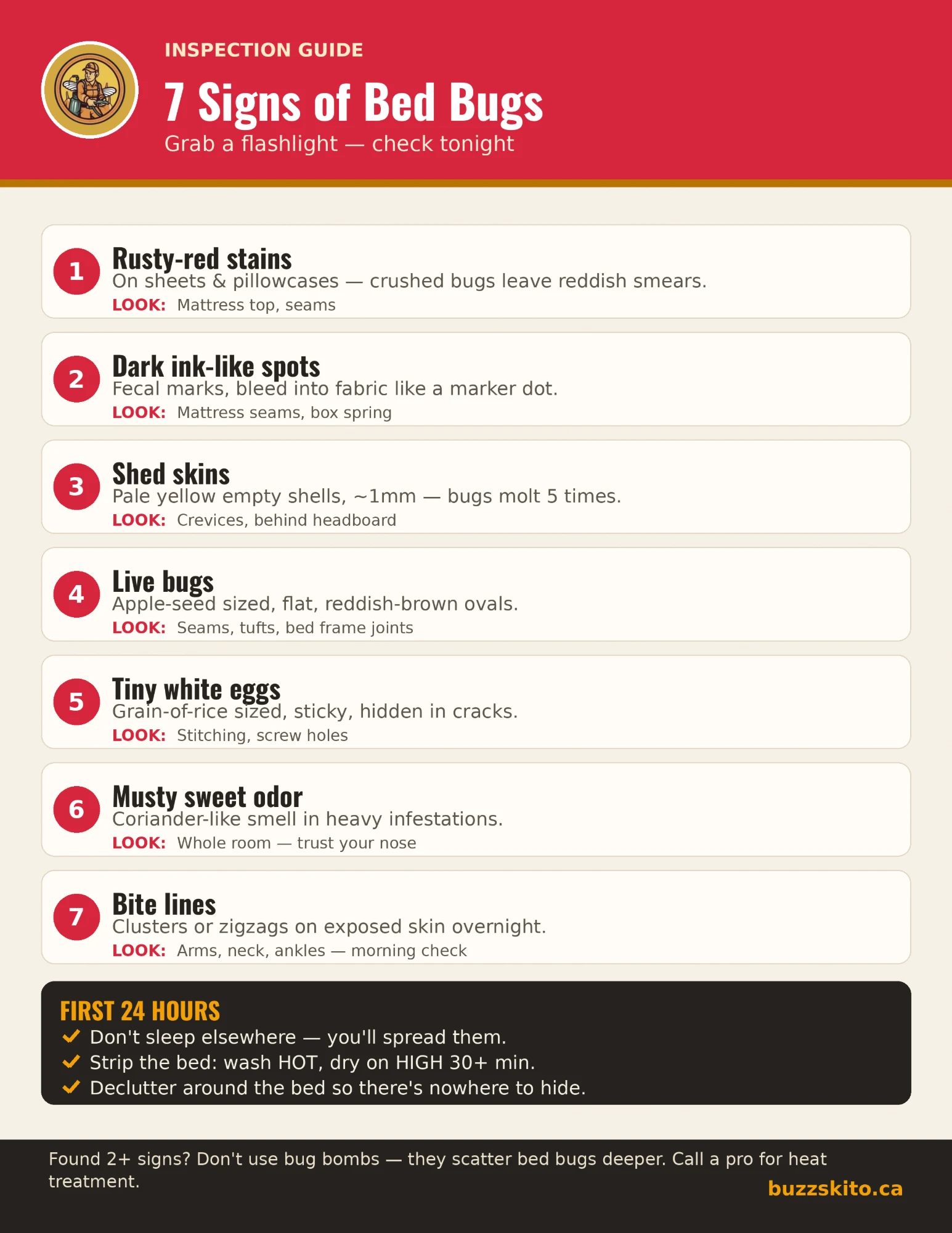 Signs of Bed Bugs: A 7-Point Checklist to Run TonightThe seven signs of bed bugs, from live bugs and ink-like spots to bites, with where to look tonight, what each is…
- Baby Bed Bugs in Canada — What Nymphs Look Like at Each Stage, and Why Finding One…Baby bed bugs (nymphs) are 1–4.5 mm, translucent, and moult five times. How to tell them from carpet beetle larvae and…
- Best Bed Bug Spray for Travel Canada 2026 — Carry-On-Legal Luggage & Hotel PicksThe best carry-on-legal bed-bug sprays for travel in Canada: TSA/CATSA 100 mL rules, PMRA-registered picks like Doktor…