
BuzzSkito Mosquito & Tick Control Specialists · Published July 21, 2026
What Is the Best Natural Bed Bug Spray in Canada?
The best natural bed bug spray for most Canadian homes is a plant-based contact killer — EcoRaider is our overall pick — applied directly into the seams, joints, and cracks where bed bugs actually hide. “Natural” here means the active ingredients are plant-derived (essential oils such as geraniol and cedar, or plant-extracted pyrethrins) rather than synthetic pyrethroids, which is exactly what people want when they are spraying a mattress they sleep on or a child’s room. All four picks above are botanical options; they differ mainly in how fast they knock bugs down, how long they keep working, and whether they carry a clear Canadian registration.
But the most important thing to understand before you buy anything is not which brand wins — it is what a spray can and cannot do. A contact spray kills the bugs and eggs it physically touches and very little else. That single fact shapes every honest recommendation on this page, and it is the reason a spray is one layer of a plan rather than the plan itself.
Check current Canadian availability of the picks:
How Natural Bed Bug Sprays Actually Work (and Where They Fail)
Plant-based bed-bug sprays kill through direct contact. Botanical actives like geraniol and cedar oil disrupt an insect’s nervous system and attack the waxy outer cuticle, so a bug you spray directly will usually die within minutes. Pyrethrins — the plant-extracted active in products like Doktor Doom — hit the nervous system harder and faster, which is why they deliver more reliable knockdown but also sit at the stronger, less “gentle” end of the natural category.
The failure mode is the same for every spray in the category, natural or synthetic: it only kills what it wets. Bed bugs spend the overwhelming majority of their lives hidden — deep in mattress seams, inside box-spring frames, in screw holes and joints, behind baseboards, and in wall voids. A spray droplet never reaches most of them. On top of that, botanical actives evaporate and break down quickly, so the residual you lay down is largely gone within a day or two, offering little protection against bugs that move back into treated areas afterward. That combination — poor reach plus short residual — is why a natural spray used alone almost never clears an established infestation. It is a genuinely useful knockdown tool for bugs and harbourage you can reach; it is not a cure in a bottle.
The PMRA Angle: What’s Actually Legal to Use in Canada
This is the part that trips up online buyers, and it deserves its own section. In Canada, any product sold to kill pests is a pesticide, and pesticides must be registered under the Pest Control Products Act, which Health Canada’s Pest Management Regulatory Agency (PMRA) administers. A registered product carries a PCP (Pest Control Product) registration number on the label — that number, and the label directions that come with it, are what make the product legal to sell and use here for the uses printed on the bottle.
Here is where it matters: Amazon.ca and cross-border sellers list a great many bed-bug sprays, including popular “natural” and “non-toxic” brands, that were formulated and labelled for the US market. A US EPA classification — including the “minimum-risk” exemption that many essential-oil sprays rely on south of the border — is not the same as Canadian registration, and does not make the product legal to sell or use here. Some well-known US natural brands are simply not registered in Canada, even though the listing ships to a Canadian address.
The practical rule: favour products that clearly show a Canadian PCP number, and check the label or listing details rather than assuming a big brand name is automatically legal here. This is why Doktor Doom earns the “Best Canadian” badge above — it is a domestic brand whose bed-bug products carry a PCP number, so you are on solid regulatory ground. For EcoRaider, Proof, and any budget botanical, verify the specific Canadian listing before you buy. Note too that a vacuum or a steamer is a device, not a pesticide, so it needs no registration at all — which is part of why heat is such a frictionless, fully legal weapon against bed bugs in Canada.
How to Choose a Natural Bed Bug Spray: What You’re Actually Paying For
These sprays span a modest price range, but the differences that matter are not really about cost — they are about which trade-off fits your situation. Prioritise in roughly this order:
- Canadian PMRA registration (verify this first). A clear PCP number means the product is registered for sale and use here. This is the one thing you cannot see on a US-market listing, and the easiest way to end up with something you shouldn’t be using. Check it before anything else.
- Knockdown speed (pay for this if the infestation is active). When you have live bugs to deal with now, fast contact kill matters. EcoRaider and pyrethrin-based Doktor Doom lead here; the lightest essential-oil blends are slower.
- Residual length (pay for this if you want fewer re-sprays). Oil-only sprays evaporate fast; a botanical-plus-mineral formula like Proof keeps working in treated cracks a little longer, meaning fewer applications.
- Low odour and a milder active (weight this for bedrooms). This is the whole reason people go natural. Essential-oil formulas have the least odour; pyrethrins are effective but harsher, and warrant extra caution around cats and aquarium fish. Whichever you choose, follow the label on use around kids and pets.
- Coverage volume for the space (don’t overbuy or underbuy). A single bed and frame needs far less product than a multi-room job. Match the bottle size to the harbourage you actually have to treat.
Read that as a decision map: confirm it’s legal in Canada, then pick for knockdown, residual, or low odour depending on whether you are fighting an active infestation, trying to minimise re-sprays, or prioritising a low-odour bedroom.
How to Apply Natural Bed Bug Spray Properly
Because contact sprays only kill what they wet, application technique is as important as which product you buy. Treat it as detail work:
- Strip and inspect first. Remove bedding (bag it and wash/dry on high heat), and inspect so you know where the harbourage is before you spray.
- Get the spray into the cracks, don’t mist surfaces. Press the nozzle into mattress seams and piping (top and bottom), box-spring fabric edges and staples, bed-frame joints and bolt holes, headboard cracks, nightstand seams, and the baseboards and carpet edge around the bed.
- Wet the bugs and eggs directly. A droplet that lands next to a bug does nothing. Aim to physically soak the harbourage where they cluster.
- Don’t soak the mattress. Never apply so heavily that the mattress stays damp, and always let it dry completely before re-making the bed and sleeping on it.
- Repeat every 3–5 days for weeks. Eggs you missed keep hatching and botanical residual fades fast, so a single treatment is never enough.
- Follow the label. Use only where and how the label directs, keep kids and pets out until surfaces are dry, and don’t treat “natural” as licence to over-apply.
Spray Is One Layer: The Plan a Natural Spray Belongs In
The honest limit of any spray is that it cannot reliably kill eggs or reach bugs hidden deep in the structure of the bed and room. That is not a reason to skip it — knocking down the reachable live population is a real, immediate win — but it is the reason a spray always sits inside a layered plan:
- Spray to knock down the live bugs and harbourage you can reach.
- Heat to kill the eggs and the bugs a spray misses. A bed-bug steamer penetrates seams and folds, and a portable heat chamber treats infested items whole. Heat is the most reliable egg-killer there is — see our DIY heat-treatment guide.
- Dust the cracks and voids a spray can’t reach with a mineral desiccant — diatomaceous earth or CimeXa — to catch survivors over the following weeks.
- Encase the mattress and box spring with a certified encasement to seal in anything you can’t reach and protect the bed going forward.
- Monitor with interceptor traps under the bed legs so you can measure whether the population is actually dropping.
For the full step-by-step version of this plan, see our guides on how to get rid of bed bugs in Canada and the DIY-focused do-it-yourself walkthrough. If you rent, the apartment guide covers the coordination issues unique to shared buildings.
Natural Spray vs Diatomaceous Earth vs Heat
People often ask which single approach is “best,” but the better question is what each does well. A natural spray is a fast contact killer with a short life — ideal for knocking down what you can see and reach today. Diatomaceous earth (and mineral dusts like CimeXa) do nothing instantly but keep killing for weeks in the cracks and voids you leave them in — ideal for the survivors a spray misses. Heat — steam and heat chambers — is the only one of the three that reliably kills eggs and penetrates fabric, but it treats a defined area or item rather than laying down lasting protection. They are complementary, not competing: spray for now, dust for later, heat for the eggs. Choosing just one is the most common way DIY bed-bug jobs stall out.
Is a Natural Spray Enough, or Do You Need a Pro?
For a very early, very localised problem — a few bugs caught fast, confined to one bed — a disciplined natural-spray-plus-heat-plus-encasement routine, kept up for several weeks, can genuinely resolve it. That is a legitimate DIY path, and it is why these products exist.
But be honest with yourself about scale. If bugs have spread beyond the bed, if the infestation keeps rebounding after treatment, or if you are in a shared building where re-introduction is constant, months of partial DIY usually costs more in time, stress, and product than professional treatment would — and it lets the population entrench. A natural spray is a real tool, not a false hope; the mistake is asking it to do a whole-home eradication job it was never able to do. When the problem outgrows the toolkit, calling a licensed exterminator is the faster and often cheaper decision.
Frequently Asked Questions
What is the best natural bed bug spray in Canada?+
For most Canadian homes, the best natural bed bug spray is a plant-based contact killer such as EcoRaider, used on mattress seams, box-spring edges, and cracks where bugs hide. It kills adults, nymphs, and eggs on direct contact using botanical active ingredients (geraniol, cedar, and similar plant oils) rather than synthetic pyrethroids, which is why people treating a bedroom they sleep in often reach for it first. Proof is a strong alternative that leans on a longer-lasting botanical-plus-mineral residual, and Doktor Doom is the pick if you specifically want a Canadian brand with a clear PCP registration number on the label. The honest caveat that runs through this whole category: contact sprays only kill what the spray physically touches, so no natural spray on its own clears an established infestation — it is one tool inside a plan that also needs heat, encasements, and monitoring.
Do natural bed bug sprays actually work?+
They work the way any contact insecticide works — they kill the bugs and eggs the spray directly wets, and they do very little to the ones it misses. Plant-based actives such as geraniol and cedar oil disrupt an insect’s nervous system and outer cuticle on contact, so a bug you spray directly will usually die. The limitation is not “natural vs synthetic”; it is that bed bugs spend most of their lives tucked deep inside seams, screw holes, and wall voids where no spray reaches, and botanical actives break down and evaporate quickly, leaving little lasting residual. So a natural spray is genuinely useful for knocking down bugs you can see and treating harbourage you can reach — but treating it as a standalone cure is the single most common reason DIY bed-bug jobs fail.
Are natural bed bug sprays safe to use on a mattress and around kids or pets?+
Plant-based actives are the whole appeal for people spraying where they sleep, but the label, not the word “natural,” decides how a product may be used. Many botanical bed-bug sprays are labelled for use on mattresses and upholstery; check the specific product before you apply it there. That said, “natural” does not mean “spray freely”: essential oils can irritate skin, eyes, and airways, cats in particular are sensitive to some plant oils, and every product still has label directions you must follow — including letting the mattress dry fully before you put bedding back on and sleep on it. Always read the specific label, keep kids and pets out of the room until surfaces are dry, and never treat a product as safe just because the front of the bottle says “non-toxic.”
What does PMRA registration mean, and why does it matter for bed bug spray in Canada?+
The PMRA (Health Canada’s Pest Management Regulatory Agency) administers the registration system for pest-control products sold and used in Canada. A registered pesticide carries a PCP (Pest Control Product) registration number on the label, and its label directions are the legal instructions for that use. This matters for bed bug sprays because Amazon.ca and cross-border sellers list many US products — including popular “natural” brands — that were formulated and labelled for the US market and are not registered for sale in Canada. A US EPA “minimum-risk” exemption is not the same as Canadian registration. The practical rule is to favour products that clearly show a Canadian PCP number, and to check the label rather than assuming a big-name brand is automatically legal here.
Which is better for bed bugs: a natural spray or diatomaceous earth?+
They do different jobs and work best together, not as either/or. A natural spray is a fast contact killer — you spray a bug or a harbourage and it acts within minutes, but it leaves little lasting protection once it dries. Diatomaceous earth (and mineral desiccant dusts generally) are the opposite: they do nothing instantly, but a thin layer left in cracks, along baseboards, and under bed legs keeps killing bugs that crawl through it for weeks by abrading their waxy cuticle so they dehydrate. The practical protocol is spray the harbourage you can reach to knock down the live population now, then dust the cracks and voids you cannot spray into to catch the survivors over time. Our guide to diatomaceous earth for bed bugs covers the dusting technique in detail.
How do I apply natural bed bug spray properly?+
Treat it like detail work, not fogging a room. Strip the bed and inspect first, then spray directly into and along every harbourage you can find: mattress seams and piping top and bottom, the box-spring fabric edge and staples, bed-frame joints and bolt holes, headboard cracks, nightstand seams, and baseboards and the carpet edge around the bed. Because contact sprays only kill what they wet, you want the spray to physically reach the bugs — press the nozzle into folds and cracks rather than misting surfaces. Repeat every few days, because eggs you missed keep hatching and botanical residual fades fast. Never spray a mattress so heavily that it stays damp, always let it dry completely before re-making the bed, and follow the label’s directions on where and how much to apply.
How often should I re-spray for bed bugs with a natural product?+
Plan on repeated applications every three to five days for several weeks, not a single treatment. Two things drive the schedule: bed-bug eggs are not reliably killed unless the spray directly soaks them, so a wave of nymphs keeps hatching from eggs you missed for up to a couple of weeks; and botanical actives evaporate and degrade quickly, so the residual you laid down is largely gone within days. Re-spraying on a tight cycle catches each new hatch and keeps knocking down bugs that move back into treated harbourage. Keep it up for at least two to three weeks past the last sign of activity, and use interceptor traps under the bed legs so you can actually measure whether the population is dropping instead of guessing.
Can a natural spray kill bed bug eggs?+
Only the eggs it directly and thoroughly wets, and even then coverage is unreliable. Bed-bug eggs are tiny, cemented to fabric with a protective coating, and often tucked into folds where a spray droplet never lands, so real-world egg kill from any spray — natural or synthetic — is inconsistent. This is exactly why heat is the preferred weapon against eggs: sustained high temperature penetrates fabric and reliably kills eggs that suction and spray cannot reach. If eggs are your worry, pair the spray with a steamer for the seams and a portable heat chamber for infested items. Our bed-bug heat-treatment and steamer guides walk through the temperatures and dwell times that actually kill eggs.
Where can I buy natural bed bug spray in Canada?+
Plant-based bed-bug sprays are widely available on Amazon.ca, and some are carried seasonally at Canadian Tire, Home Depot Canada, and Home Hardware, plus specialty pest-supply retailers. Amazon.ca has the broadest year-round selection, but it is also where you have to be most careful about the PMRA issue: filter toward products that show a Canadian PCP registration number, and be wary of US-market listings shipped across the border that are not registered here. Doktor Doom is a Canadian brand you will find in domestic retail, and Proof is listed on Amazon.ca. EcoRaider is the awkward one: as of September 2026 it is not stocked on Amazon.ca at all — searches for it return other brands entirely — so despite being the strongest plant-based contact killer on paper, Canadians generally cannot buy it here. Check any listing for a Canadian PCP registration number before you buy.
Is EcoRaider or Proof or Doktor Doom the better choice?+
It depends on what you weight most. EcoRaider is our overall pick for a plant-based contact killer — fast knockdown on adults, nymphs, and directly-sprayed eggs with a low-odour botanical formula that suits bedrooms. Proof leans toward a longer-lasting residual by combining botanical actives with a mineral component, so it is the pick if you want the spray to keep working in treated cracks a bit longer. Doktor Doom is the choice when a clear Canadian PCP registration number is your priority — it is a domestic brand whose bed-bug products carry a PCP number — though note that Doktor Doom’s classic formulas use pyrethrins (a plant-derived but still insecticidal active), so it sits at the “botanical but not oil-only” end of natural. Match the product to whether you value knockdown speed, residual length, or clear Canadian registration.
Will a natural spray alone get rid of my bed bugs?+
For an established infestation, no — and being honest about that saves you weeks of frustration. Sprays kill what they touch and miss the majority of a population living deep in the structure of the bed, the frame, and the room. Every credible bed-bug protocol is a layered plan: spray to knock down the reachable live bugs, heat (steam and/or a heat chamber) to kill eggs and reach into fabric, encasements to trap and starve anything sealed inside the mattress and box spring, and interceptor traps to monitor. A natural spray is a legitimate and useful part of that stack — it is simply not the whole stack. If the infestation is widespread or keeps rebounding, professional treatment is usually faster and cheaper than months of partial DIY.
Are “non-toxic” and “natural” bed bug sprays the same thing?+
Not exactly, and the marketing blurs it deliberately. “Natural” usually refers to plant-derived active ingredients — essential oils like geraniol, cedar, clove, or lemongrass, or plant-extracted pyrethrins. “Non-toxic” is a looser marketing claim about relative hazard to people and pets, and it is not a regulated guarantee. A product can be plant-based and still irritate skin or airways, and pyrethrins, though plant-derived, are genuinely insecticidal and can be harmful to cats and aquatic life. Treat both words as starting points, not assurances: read the actual ingredient list, look for a Canadian PCP registration number, and follow the label directions regardless of how gentle the front of the bottle sounds.
Related Reading
- Best Pest Control Equipment Canada — The Full Device Hub
- How to Get Rid of Bed Bugs in Canada — The Complete Plan
- Best Bed-Bug Steamer Canada — Heat That Kills the Eggs
- Diatomaceous Earth for Bed Bugs — How to Dust It Right
- CimeXa Bed Bug Review Canada — The Long-Lasting Mineral Dust
- Bed-Bug Mattress Encasement Canada — Seal the Bed
- Bed-Bug Interceptor Traps Canada — Monitor and Protect
- Do Bed-Bug Sprays Actually Work? — An Honest Answer
Keep reading
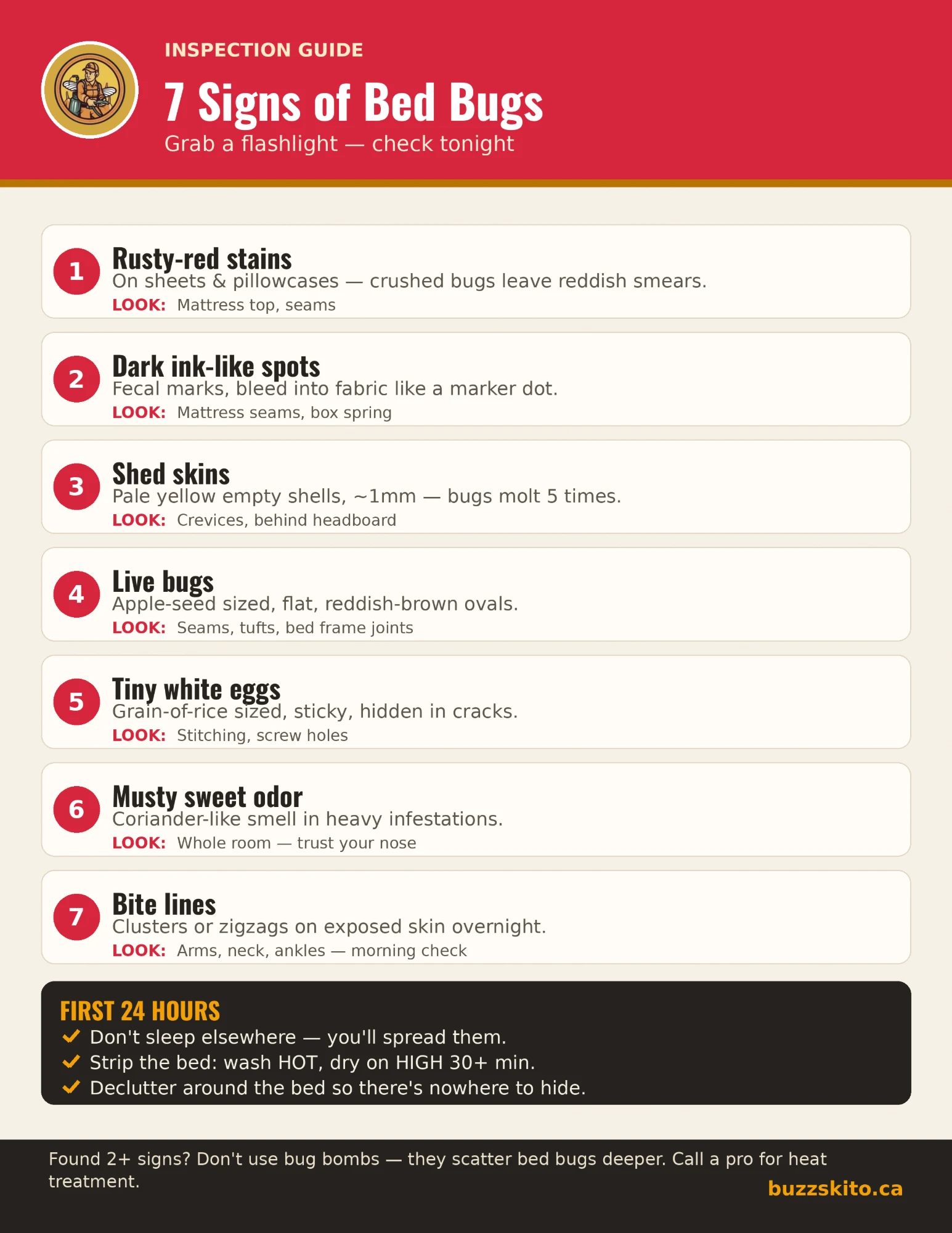 Signs of Bed Bugs: A 7-Point Checklist to Run TonightThe seven signs of bed bugs, from live bugs and ink-like spots to bites, with where to look tonight, what each is…
- What Kills Bed Bugs Instantly in Canada — The Short List That Works on Contact, and Why…What kills bed bugs instantly in Canada: steam, direct heat and a registered contact spray — plus why alcohol is a fire…
- Best Bed Bug Detector Canada 2026 — Passive Interceptors vs Active Monitors ComparedThe best bed-bug detectors and monitors in Canada: passive interceptor traps (Aspectek) vs glue-strip monitors…