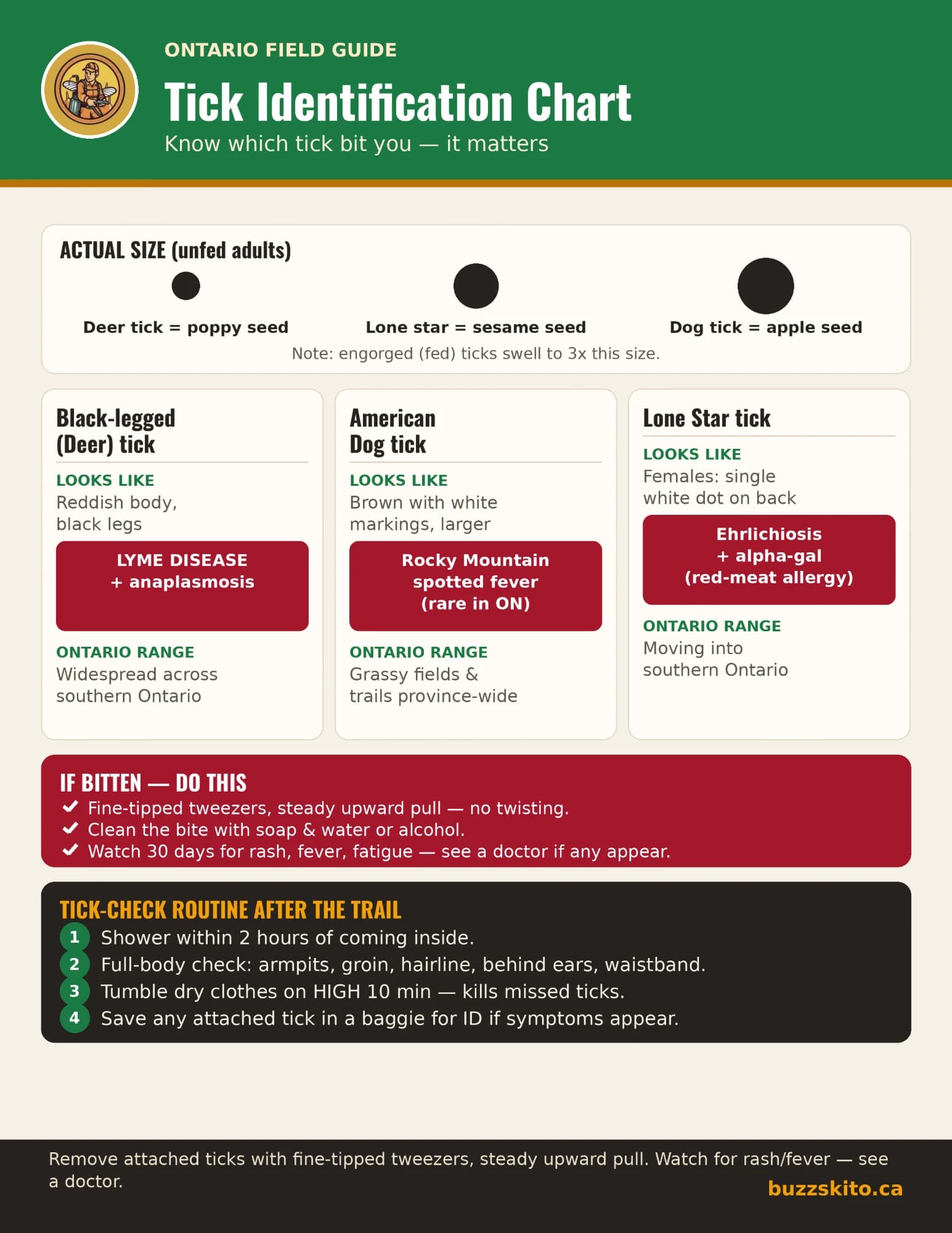
The Four Stages of a Tick’s Life
The tick that matters most in the Greater Toronto Area is the blacklegged tick, Ixodes scapularis — also called the deer tick — because it is the species that spreads Lyme disease across Ontario. Unlike a mosquito, which races through its life cycle in under two weeks, a blacklegged tick takes roughly two years to go from egg to reproducing adult, passing through four stages and taking just one blood meal in each active stage. Understanding that slow, deliberate cycle explains why tick populations creep upward year over year and why prevention has to be a season-long habit. Get the species basics in our blacklegged deer tick guide and the wider tick identification guide.
1. Egg
In spring, an engorged female that fed and mated the previous fall lays a single mass of up to several thousand eggs in leaf litter, then dies. The eggs incubate through the warm months and hatch into larvae in late summer. Ticks are not born carrying Lyme disease — the eggs are clean — which is why the larval blood meal is such a pivotal moment.
2. Larva
Newly hatched larvae have six legs and are almost microscopic. In late summer and early fall they take their first blood meal, usually from a small host close to the ground — white-footed mice, chipmunks, shrews, and ground-feeding birds. If that host is infected, the larva picks up the Lyme bacterium (Borrelia burgdorferi) and carries it for the rest of its life. After feeding, the larva drops off and moults into a nymph, usually overwintering before becoming active. These tiny early-stage ticks are covered in our guide to baby ticks, nymphs, and seed ticks in Ontario.
3. Nymph
This is the stage public-health officials worry about most. The following spring and early summer, nymphs — now eight-legged but still only about the size of a poppy seed — quest for a second blood meal from a medium or large host, including humans and pets. Because a nymph may already be infected from its larval meal, and because it is so small it is routinely missed during a body check, nymphs cause the majority of human Lyme disease cases in Ontario. A diligent tick check after time outdoors is your best defence during nymph season.
4. Adult
Nymphs that feed successfully moult into adults by fall. Adult females — recognizable by their reddish-orange body and black shield — climb waist-high vegetation to find a large host such as a deer, dog, or human, take their final blood meal, mate, and then overwinter before laying eggs in spring. Adults are large enough to spot and remove more easily than nymphs, but they can still transmit disease. If you find one, follow our step-by-step guide on how to remove a tick safely.
When Each Stage Is Active in Ontario
Blacklegged ticks become active whenever the temperature climbs above about 4°C, which in the GTA means from the first spring thaw through late fall — and even on mild winter days. That long window is why spring tick season in Ontario starts earlier than most people expect. Here is roughly how the stages line up:
| Stage | Peak activity | Size | Lyme risk to humans |
|---|---|---|---|
| Egg | Spring (dormant) | Tiny mass | None |
| Larva | Late summer / fall | Pinhead (6 legs) | Very low |
| Nymph | Late spring / summer | Poppy seed | Highest |
| Adult | Spring & fall | Sesame seed+ | Moderate-high |
For a fuller month-by-month breakdown, see tick season in Ontario — when are ticks active, and check how long each stage can survive between meals in how long do ticks live.
How Ticks Find You — and How to Break the Cycle
Ticks do not fly or jump; they “quest.” A tick climbs to the tip of a grass blade or leaf, holds out its front legs, and waits to grab onto anything that brushes past. That behaviour is why yard control focuses on specific zones: ticks concentrate in predictable zones — the shaded, humid, leaf-littered transition between lawn and woods, garden bed edges, tall grass, and fence lines. Break the cycle by making those zones inhospitable:
- Reduce habitat: Keep grass short, clear leaf litter, and create a dry woodchip or gravel barrier between lawn and woods to stop ticks from questing at the edge.
- Treat the edges: A professional tick barrier spray applied to the specific 1-3 metre transition zones where ticks concentrate targets questing nymphs and adults where they wait, and is repeated through the season (5 sprays) as different stages become active.
- Check every time: Because nymphs are so small, a body check after every outing — plus prompt, correct removal — catches the ticks that slip past the yard barrier.
For the complete season-long routine, see how to combat ticks and our ultimate tick control guide for Ontario.
Keep Learning
- The Blacklegged (Deer) Tick in Ontario
- Baby Ticks, Nymphs & Seed Ticks in Ontario
- Tick Season Ontario — When Are Ticks Active?
- How Long Do Ticks Live?
- How to Remove a Tick Safely
- How to Combat Ticks — 10-Step Guide
- ← Back to the Ontario Learning Centre
Frequently Asked Questions
How long is the tick life cycle in Ontario?+
The blacklegged (deer) tick life cycle takes about two years in Ontario, spanning four stages: egg, larva, nymph, and adult. Each active stage needs a single blood meal before moulting to the next, and ticks can survive long stretches without feeding. This slow, multi-year cycle is why tick numbers build gradually over successive seasons rather than exploding after a single rainfall like mosquitoes do.
Which tick stage is most dangerous to humans?+
The nymph stage is the most dangerous to humans. Nymphs are active in late spring and summer, are only about the size of a poppy seed, and are easily missed on skin — yet they can already carry Lyme disease from their larval blood meal. Most human Lyme infections in Ontario are transmitted by nymphs precisely because they are so hard to spot.
When are ticks active in Ontario?+
Blacklegged ticks in Ontario are active any time the temperature is above roughly 4°C, which means early spring through late fall — and even mild winter days. Adults are most active in spring and again in fall, while nymphs peak in late spring and summer. Because activity spans most of the year, tick prevention in the GTA is not just a mid-summer concern.
How do ticks find a host at each stage?+
Ticks do not fly or jump. They “quest” — climbing to the tip of grass or a leaf and holding out their front legs to grab onto a passing animal or person. Larvae typically feed on small mammals and birds, nymphs and adults on larger hosts including deer, dogs, and humans. Keeping grass short and creating a woodchip barrier reduces questing zones near your yard.