
BuzzSkito Mosquito & Tick Control Specialists · Published July 21, 2026
What Is the Best Vacuum for Bed Bugs and Fleas in Canada?
A sealed-HEPA bagged canister is the best vacuum for bed bugs and fleas in Canadian homes — not because it is the most powerful appliance in the store, but because it is the only design that does the two things this specific job demands: it holds onto everything it captures, and it lets you get rid of that capture cleanly. Everything else is a variation on those two ideas. A cordless stick with whole-machine HEPA trades the bag for convenience; a corded handheld trades capacity for reach; a budget bagged canister trades a fully sealed body for price. All four appear in our picks above because different households need different trade-offs, but the reasoning below explains why the sealed, bagged canister sits at the top.
The distinction that matters is between a vacuum that catches pests and a vacuum that catches them and then quietly leaks them back into your home. That second failure mode is invisible until an allergy flares or the infestation stubbornly refuses to drop, and it is the single most important thing to understand before you spend money.
Check current Canadian availability of the four picks:
Why “Sealed HEPA” Matters More Than the Filter Grade
A HEPA cartridge is only as good as the path the air takes to reach it. Marketing loves the phrase “HEPA filter,” but on many machines the air can slip around the cartridge through seams and gaps in the plastic body, then exit the exhaust without ever being filtered. When you are vacuuming bed-bug harbourage or a flea-infested carpet, the exhaust stream carries the finest, most mobile material you disturbed: flea allergen, powdery bed-bug fecal debris, shed skins, and the occasional dislodged egg. A leaky machine takes that material and sprays it in a fine mist across the room — you have not removed the problem, you have redistributed and aerosolized it.
A true sealed-HEPA vacuum — also sold as a “sealed system” or “whole-machine HEPA” — is engineered so that every bit of air is forced through the filter before it can leave the body. For an allergen-sensitive household, that seal is the difference between a vacuum that improves the air and one that degrades it. When you are shopping, look past the filter grade on the box and look for explicit language about a sealed body or whole-machine filtration. That is the feature you are actually paying for, and it is the feature a cheap “HEPA” sticker cannot fake.
Bagged vs Bagless: The Disposal Problem Nobody Mentions
Capturing bed bugs and fleas is only half the task; getting them out of your house without releasing them again is the other half, and this is where bagged and bagless designs part ways sharply. Emptying a bagless bin means opening the dust chamber — usually over a kitchen garbage can — and that motion showers fine dust and, potentially, live insects back into the air and onto your hands. Bed bugs and fleas can survive inside a vacuum, so a bagless bin left overnight is a container of living pests sitting in your home.
A bagged sealed-HEPA vacuum solves this elegantly. When the session is done, you remove the whole bag without opening it, drop it inside a second plastic bag, seal it, and carry it straight to an outdoor bin. Nothing escapes, nothing lands on you, and the machine is ready for the next pass. If you already own a good bagless machine and do not want to replace it, you can still use it responsibly: take it outside after every single session, empty the bin into a sealable bag, seal and bin it outdoors, then wipe the chamber and rinse or swap the filter. The rule is the same either way — immediate, sealed, outdoor disposal, every time.
The Crevice-Tool Technique That Actually Lifts Insects
The wide floor head that comes attached to most vacuums is the wrong tool for bed bugs. Swap it for the crevice tool — the narrow, angled nozzle — because bed bugs live in the tight folds and joints that a flat head skims right over. Technique matters as much as the machine:
- Press into the seam, do not skim it. Push the crevice tool firmly into mattress piping and folds so the airflow reaches inside the crease rather than gliding across the surface.
- Scrape, then suck. Bed bugs grip fabric hard. Dragging the hard edge of the tool along a seam dislodges them so the suction can carry them away.
- Go slowly. A slow pass generates far more effective lift than a fast one. Rushing is the most common reason a vacuum “misses” bugs that were right there.
- Hit every harbourage. Mattress seams top and bottom, box-spring staples and fabric edge, bed-frame joints and bolt holes, headboard cracks, and the baseboards and carpet edge around the bed.
- Work the room perimeter. Run the tool along the whole line where wall meets floor — that junction is a primary travel route between harbourage and host.
For the fine, repetitive detail work — piping, bolt holes, headboard seams — a corded HEPA handheld is genuinely easier to control than dragging a full canister hose around the bed, which is exactly why it earns its own award above. The same machine is the primary tool against carpet beetles, whose larvae live down in the pile rather than on it — the vacuum-first carpet beetle plan sets out the passes that matter.
Fleas Are a Different Problem: Slow Passes and Deep Edges
Fleas change the technique because the enemy is mostly invisible. The adults you spot on a pet are a small fraction of the infestation; the rest is eggs, larvae, and pupae buried in the carpet, along baseboards, and under furniture. Flea larvae are photophobic — they actively wriggle down and away from light toward the base of the carpet fibres — so a quick surface pass sails right over them.
Beating fleas with a vacuum means agitating the pile and working the places the life cycle concentrates. Use a beater bar or turbo brush, make slow and repeated passes over the same ground so the bristles reach the base of the fibres, and lavish attention on the edges of rooms, under and around pet bedding, and any shaded low-traffic spot where the animal rests. The mechanical vibration does something chemicals cannot: it can trigger dormant pupae to emerge from their tough, protective cases, which is why consistent vacuuming over several weeks keeps thinning each new wave. For context on why fleas keep coming back and how their bites present on people, our guide to flea bites on humans walks through the full cycle.
The vacuum is the backbone, but it is not the whole program. The chemical half should be chosen for its insect growth regulator rather than its knockdown claim — that is the part that breaks the egg-to-adult pipeline you are agitating out of the carpet — and we compare the Canadian options in the best flea spray for a home in Canada. If you were planning to reach for a total-release fogger instead, read why a flea bomb misses most of the infestation first; it deposits on open floor, which is precisely where the larvae are not.
The Steam-Plus-Vacuum Combo
Here is the honest limit of any vacuum, no matter how good: it will not lift most bed-bug eggs. Females cement their eggs to fabric with a coating that suction simply cannot break, so a mattress you have vacuumed thoroughly can still be studded with viable eggs. That is not a reason to skip vacuuming — removing the adults and nymphs delivers an immediate population drop and a real morale win — but it is the reason vacuuming is always paired with heat.
The proven sequence is vacuum first, steam second. Vacuum to physically remove the live insects and loose debris from every seam and edge, then run a dry-vapour bed-bug steamer slowly over the same seams, tufts, and folds. Steam penetrates into the fabric where suction cannot reach and delivers the heat that kills the eggs and any hidden bugs the vacuum left behind. Then place interceptor traps under the bed legs so you can monitor, week over week, whether the numbers are actually falling. Vacuum, steam, monitor — that is the non-chemical core of a real plan, and no single tool substitutes for the set.
How to Choose: What You Are Actually Paying For
These machines span a wide price range, and it is worth being clear-eyed about which premium features earn their cost for this job specifically, versus which are luxury you can skip. Prioritise your money in this order:
- A genuinely sealed body (pay for this). This is the whole ballgame for allergen-sensitive homes and for not re-seeding the infestation. It is also the one thing you cannot add later. Buy the seal.
- Strong, sustained suction (pay for this). Insects gripping fabric need real airflow to dislodge. Sustained matters — some cheap machines start strong and fade as the bin fills or the battery drops.
- Clean disposal — a bag, ideally (pay for this). The bag is not a gimmick; it is the mechanism that lets you remove pests without releasing them. On a bagless machine you are paying with labour and risk on every empty.
- A proper crevice tool and, for fleas, a beater bar (make sure it is included). These are cheap to include but essential to the technique. Confirm they are in the box.
- Cordless convenience and lightweight luxury (skip if budget is tight). Wonderful for daily upkeep, but they do not make the machine better at capturing or containing pests. Buy these only after the four above are covered.
Read that list as a spending map: put your dollars into sealing, suction, and disposal, and treat everything else as optional. A cordless stick with whole-machine HEPA can absolutely be an excellent choice — it simply asks you to accept bagless disposal in exchange for effortless daily passes, which is a fair trade for a lot of households.
Is the Expensive Vacuum Worth It, or Will a Cheap One Do?
The honest answer depends entirely on your situation, and there is a legitimate cheaper path for some people. If you have a one-time, minor flea issue and a vacuum you already own, careful technique and disciplined outdoor disposal will get you a long way — you may not need to buy anything at all. A budget bagged canister with a crevice tool covers a modest, one-off problem competently, provided you empty it outdoors into a sealed bag every single time.
But for an active bed-bug infestation, a recurring flea cycle, or an allergen-sensitive household, the premium genuinely earns its cost. The three things you pay for — a truly sealed body, strong sustained suction, and clean bagged disposal — are precisely the three things a cheap machine fakes or omits. Worse, a budget vacuum wearing a “HEPA” sticker on a leaky body can actively make an allergen problem worse by aerosolizing what it collects. In that scenario the cheaper vacuum is not a smaller version of the right tool; it is the wrong tool. The way to overspend, on the other hand, is to buy the sealing and suction you need and then pay a large premium on top for cordless-luxury features that do nothing for capture or containment. Buy the seal, buy the suction, buy the bag — and stop there unless daily convenience is genuinely worth the extra to you.
Vacuuming is the physical-removal step, and it pairs naturally with the residual step that follows it: once a crack is clean and dry, a desiccant dust laid down as a barely-visible film keeps killing for months without any chemistry a bug can develop resistance to. The desiccant dust comparison covers silica gel against diatomaceous earth on speed and application rate, and the long-form profile of CimeXa silica gel explains why the professional default lays down so much lighter than DE does.
Two jobs where the vacuum leads rather than supports: upholstery, because a couch cannot be encased and has more seam than a mattress — the four-step couch sequence starts with suction for that reason — and a self-run treatment generally, where the vacuum is one of five tools in the DIY basket that actually clears an infestation.
If the problem is large enough that you are weighing DIY against calling a professional, our Canadian pest control cost guide lays out what professional bed-bug and flea work typically runs, so you can judge where the money is best spent.
Frequently Asked Questions
What is the best HEPA vacuum for bed bugs and fleas in Canada?+
For most Canadian homes fighting bed bugs or fleas, the best pick is a sealed-HEPA bagged canister vacuum with a stiff crevice tool — a sealed body means the eggs, allergens, and shed skins you pull out of seams cannot leak back into the room through the exhaust, and a bagged model lets you seal and bin the contents without re-exposing yourself. A whole-machine-HEPA cordless stick is the best pick if you want to vacuum a bed frame and baseboards daily without dragging a hose around, and a corded HEPA handheld is the most manoeuvrable tool for working mattress piping and headboard bolts. Whatever you buy, the vacuum is one tool in a plan — it removes what you can see and reach but never reaches eggs cemented deep in fabric, which is why a steamer and interceptor traps belong in the same kit.
Why does the HEPA filter need to be sealed for bed bugs and fleas?+
A HEPA cartridge only helps if all the air actually passes through it. Many vacuums advertise a "HEPA filter" but leak air around the cartridge through gaps in the body, so fine particles — flea allergen, bed-bug fecal dust, shed skins, and the occasional airborne egg — blow straight out the exhaust and back into the room you are trying to clear. A true sealed-HEPA (sometimes called "sealed system" or "whole-machine HEPA") vacuum forces every bit of air through the filter before it exits. For allergen-sensitive households and anyone who does not want to re-aerosolize what they just captured, the seal matters more than the filter grade printed on the box.
Should I use a bagged or bagless vacuum for bed bugs?+
Bagged, if you can. The disposal step is where bagless vacuums fail you: emptying a clear bin over a garbage can showers fine dust — and live insects — back into the air and often back onto you. A bagged sealed-HEPA vacuum lets you remove the full bag, seal it inside a second plastic bag, and put it straight in an outdoor bin without ever opening the dust chamber. If you already own a quality bagless HEPA machine, you can still use it: empty it outdoors into a sealed bag immediately after every session, then wipe the bin and filter, and never leave captured bugs sitting in the canister overnight.
How do I actually vacuum for bed bugs — what is the technique?+
Work slow and work the edges. Fit the crevice tool, not the wide floor head, and run it firmly along every mattress seam, the piping around the top and bottom, box-spring staples, bed-frame joints and bolt holes, headboard cracks, and the baseboards and carpet edge around the bed. Press the tool into the seam so the airflow reaches into the fold rather than skimming the surface, and go slowly — a slow pass lifts far more than a fast one. Bed bugs grip fabric hard, so scraping the edge of the tool along a seam to dislodge them before you vacuum helps. Do the whole perimeter of the room where wall meets floor, since that is a primary travel route.
Does vacuuming get rid of bed bugs on its own?+
No — and it is important to be honest about this. Vacuuming physically removes adults, nymphs, and some loose eggs, which lowers the population fast and gives you an immediate win, but bed-bug eggs are glued to fabric with a cement-like coating and most will not lift no matter how hard you vacuum. That is why vacuuming is paired with steam (heat kills eggs suction cannot remove) and with interceptor traps under the bed legs to catch and monitor what is left. Treat the vacuum as the removal step in a plan, not the whole plan.
Should I combine a steamer with the vacuum?+
Yes — steam and vacuum are the classic non-chemical one-two. Vacuum first to physically remove live insects and debris from the seams and edges, then run a dry-vapour steamer slowly over the same seams, tufts, and folds so the heat penetrates and kills the eggs and hidden bugs the vacuum could not lift. Steam reaches into fabric where suction cannot, and heat is one of the few things that reliably kills bed-bug eggs. Our companion guide to the best bed-bug steamers in Canada covers what temperature and dwell time you need and which machines actually deliver it.
Why do fleas need slow passes and edge work too?+
Because most of a flea infestation is not the adults you see on the pet — it is eggs, larvae, and pupae down in the carpet pile, along baseboards, and under furniture. Flea larvae actively burrow away from light toward the base of the carpet fibres, so a quick pass over the surface misses them entirely. Slow, repeated passes with a beater bar or turbo brush agitate the pile and pull larvae up, and the vibration can even coax adults out of tough pupal cases. Concentrate on the edges of rooms, under and around pet bedding, and any shaded, low-traffic spot where the pet rests — that is where the life cycle concentrates.
What do I do with the vacuum bag or contents after vacuuming?+
Dispose of it immediately and completely — do not let captured bugs sit inside the machine. With a bagged vacuum, remove the bag, seal it inside a second plastic bag, and put it in an outdoor garbage bin right away. With a bagless machine, take it outside, empty the bin into a sealable plastic bag, seal it, bin it outdoors, then wipe out the canister and rinse or replace the filter if the machine allows. Bed bugs and fleas can survive inside a vacuum and crawl back out, so immediate sealed disposal after every session is not optional — it is the whole point of choosing a machine you can empty cleanly.
Is an expensive sealed-HEPA vacuum worth it, or will a cheap one do?+
For a one-time, minor flea issue a basic vacuum used carefully and emptied outdoors will help. But for an active bed-bug problem, or a recurring flea cycle, or an allergen-sensitive household, the premium buys three things a cheap machine cannot fake: a genuinely sealed body so nothing blows back out, strong sustained suction that actually lifts insects gripping fabric, and clean bagged disposal. A budget vacuum with a "HEPA" sticker but a leaky body can make an allergen situation worse by re-aerosolizing what it picks up. Spend where the seal and suction are real; skip the cordless-luxury features you will not use.
Can I use a shop vac or a regular vacuum instead?+
A shop vac has strong suction and a rugged hose, which is genuinely useful for heavy debris, but most are not sealed-HEPA and will exhaust fine allergen dust back into the room, so only use one fitted with a proper HEPA filter and emptied outdoors. A regular household vacuum will remove visible bugs and lower the population, but if it is bagless with a loose body it risks blowing captured material back out and contaminating the bin every time you empty it. The safest tool for bed bugs and fleas specifically is a sealed-HEPA bagged machine; anything else works only with careful outdoor disposal and the understanding that it may leak.
How often should I vacuum during an infestation?+
Daily during the active phase for bed bugs, and every one to two days for fleas, because the flea life cycle keeps hatching new adults from pupae for weeks. Consistent daily vacuuming of the bed area, room perimeter, and pet resting spots physically removes each new wave before it can re-establish, and for fleas the vibration helps trigger dormant pupae to emerge where you can then remove them. Keep it up for at least two to three weeks past the last sign of activity, and pair it with interceptor traps under the bed legs so you can actually see whether the numbers are dropping.
Related Reading
- Best Bed-Bug Steamer Canada — Heat That Kills the Eggs
- Bed-Bug Interceptor Traps Canada — Monitor and Protect the Bed
- Flea Bites on Humans — What They Look Like and the Cycle Behind Them
- Best Air Purifier for Dust Mites Canada
- Best Dehumidifier for a Canadian Basement
- Pest Control Cost in Canada — What You’ll Actually Pay
Keep reading
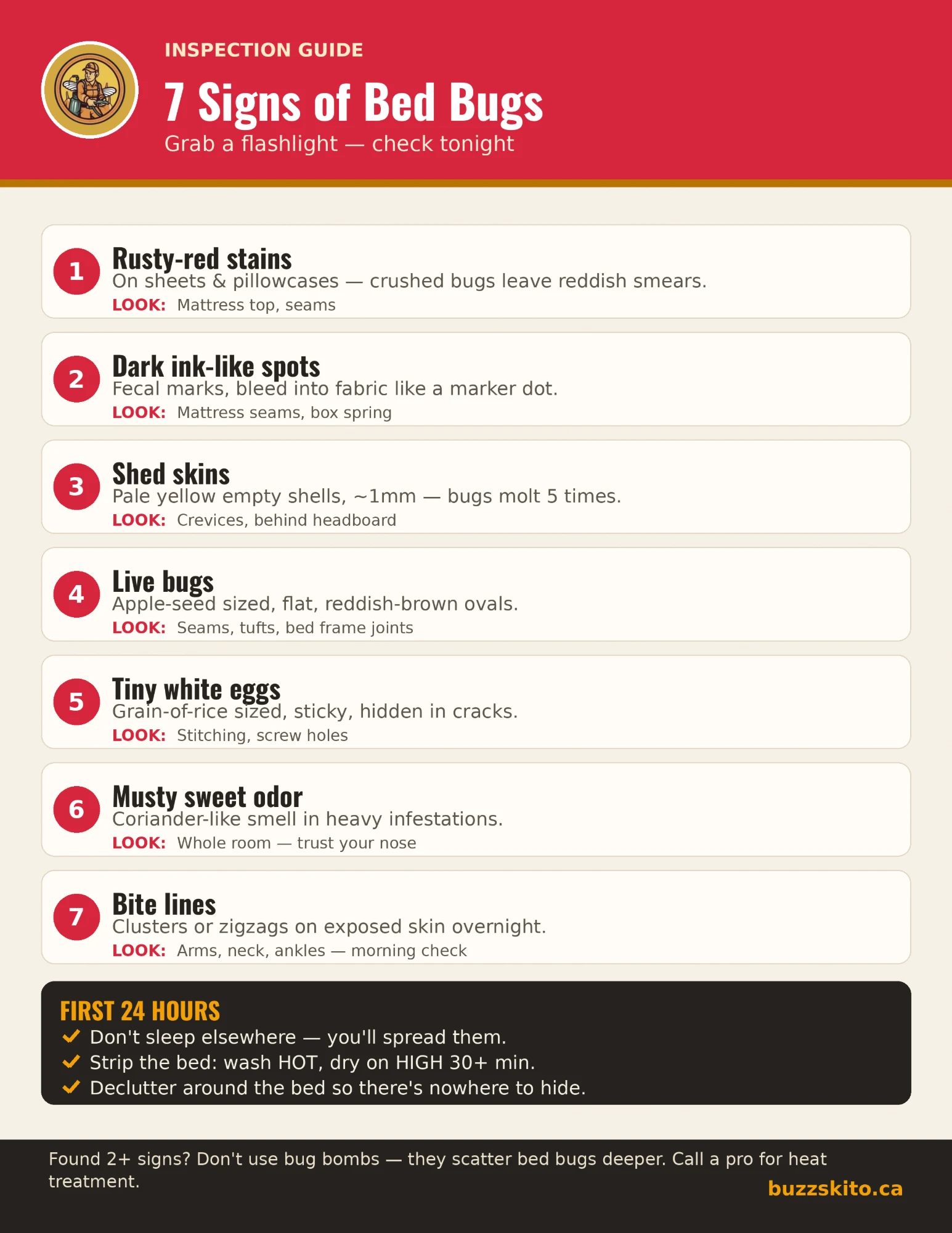 Signs of Bed Bugs: A 7-Point Checklist to Run TonightThe seven signs of bed bugs, from live bugs and ink-like spots to bites, with where to look tonight, what each is…
- Bed Bug Shells, Casings and Shed Skins — What You Found, and What It Actually ProvesBed bug shells are moulted skins, not dead bugs. What a casing proves about feeding and breeding, how to tell one from…
- Diatomaceous Earth for Bed Bugs — Does It Work? (Canada 2026)Does diatomaceous earth kill bed bugs? Honest lab-vs-field efficacy, where to apply it (and where never), and which DE…