
BuzzSkito Mosquito & Tick Control Specialists · Published July 21, 2026
What Is the ThermalStrike Ranger, and Why Heat It From the Inside?
The ThermalStrike Ranger is a hard-shell rolling suitcase with something no ordinary bag has: a heating element engineered into its walls. You pack it and travel with it exactly like a normal carry-on. The difference happens when you get home — you plug the suitcase in, and the shell heats its own interior above the temperature at which no bed bug, egg, nymph, or adult, can survive. It exists to solve a very specific, very common problem: bed bugs are hitchhikers, and the single most reliable way they enter a Canadian home is inside luggage returning from a hotel, hostel, short-term rental, or a relative’s spare room.
The clever part is where the heat is applied. A traditional heat chamber — the ZappBug Heater, a PackTite, or any of the pop-up boxes in our heat chamber roundup — asks you to unpack your luggage into a separate container and treat it there. That works, but it introduces a gap: the moment between carrying an untreated bag into your home and getting its contents into the chamber is exactly when a stray bug can walk off onto your carpet. The Ranger closes that gap by making the suitcase and the chamber the same object. The belongings never leave the sealed shell they travelled in until after they have been cooked. Prevention stops being a task you might skip and becomes a habit built into the hardware.
This review sits alongside our broader bed bug heater guide for Canada and the luggage-heater roundup; here we go deep on the single self-heating suitcase we would actually recommend to a traveller first.
Check current Canadian availability:
The Science: Why Heat Beats Bed Bugs When Chemicals Struggle
Heat earns its place because of a biological asymmetry: bed bugs are extraordinarily good at surviving insecticides and extraordinarily bad at surviving temperature. The numbers are well established in entomology. Adults and nymphs die at a sustained 45°C (113°F). Eggs — the life stage that shrugs off most sprays on the shelf — die at roughly 48°C (118°F) held for about 90 minutes. At 50°C (122°F) and above, every stage dies within minutes. Crucially, there is no resistance mechanism against being cooked. A bed bug cannot evolve its way out of protein denaturation the way it has evolved around pyrethroids, which is why professional exterminators stake entire whole-home treatments on this exact physics.
The Ranger applies that physics at the one scale a traveller can fully control: a sealed, insulated volume — the suitcase interior — small enough that its own heating element can push past lethal temperature and hold it there. Containment is the whole trick. Heat that would dissipate uselessly if you simply set a suitcase near a radiator instead concentrates inside the closed shell, and the bugs riding in your clothing seams and shoe linings have nowhere cooler to escape to.
Cycle Times: Let the Load Decide, Not the Clock
The most important habit with any heat product is to trust temperature over time, and the Ranger is no exception. How long a cycle needs depends almost entirely on how densely the bag is packed:
- Light loads: a loosely packed bag of clothing heats through fastest — the interior reaches lethal temperature in a couple of hours, and you hold beyond that for margin.
- Dense loads: a fully packed suitcase with folded stacks, shoes, and a wash kit insulates its own centre. The core of the densest item lags the walls by a wide margin, so the full recommended cycle — run to completion, not cut short — is what protects you.
The failure mode is always the same: impatience. Someone feels the outside of the bag turn hot, assumes the job is done, and stops the cycle while the eggs buried in the middle of a packed suitcase are still below the kill threshold. If you own a probe thermometer, bury it in the middle of your densest item and confirm the core has held lethal temperature before you call it finished. If you do not, respect the full cycle time and, when in doubt, add margin. Improvised alternatives — a black bag in a hot car, a suitcase left in the sun — fail on exactly this point: no even heating, no measurement, no verified kill.
Capacity: One Traveller’s Trip, Done Right
Be clear-eyed about what the Ranger is and is not. It is a single carry-on-to-mid-size suitcase, which means its capacity is one person’s trip: a few days’ to a week’s worth of clothing, a toiletry bag, a couple of pairs of shoes, and small personal effects. That is not a limitation so much as a precise match to its job — it treats the belongings from a single trip in the bag those belongings travelled in.
What it is not is a bulk-remediation appliance. You cannot run a queen bedding set, boxes of books, a winter coat collection, or a household’s laundry through it the way you would a larger standalone heat chamber. If your need is to treat many belongings at home because you already suspect an infestation, a chamber is the correct capacity match and the Ranger is the wrong tool. The two are complements, not substitutes: the Ranger guards the front door against travel introductions, and a chamber handles home-scale decontamination.
The Electronics and Toiletries Question
Two categories cause the most hesitation, and both deserve a clear rule. Electronics first: most consumer devices carry manufacturer storage temperature ratings of 60°C or higher — comfortably above the interior temperature a bed bug cycle reaches. A powered-off phone, laptop, tablet, or e-reader generally comes through a cycle unharmed, and treating electronics matters because their warm, dark seams are a classic bed bug harbourage. The rules: device off, check the manufacturer’s storage spec first for anything valuable, and never run a cycle with a device powered on.
The hard exclusion list covers everything pressurized, flammable, or heat-deformable: aerosol cans, lighters, and spare lithium batteries outside a device (pressure and fire risk); medications, which frequently degrade above room temperature; cosmetics, lip balms, and chocolate that melt; and film, wax, or delicate finishes that warp. Pull those items out before you run a cycle and treat them another way — sealed-bag isolation for delicate valuables, or simply buying replacements for cheap consumables. When in doubt, leave it out.
How to Use the Ranger Correctly After a Trip
The entire value of a heated suitcase evaporates if you carry it to your bedroom before treating it, so the routine matters as much as the hardware. Treat every homecoming as a decontamination step:
- Do not go to the bedroom first. On arriving home, set the packed suitcase down in an entryway, garage, laundry room, or bathroom — somewhere hard-floored, never on a carpeted bedroom floor where a bug could disembark.
- Run the full cycle with the bag closed. Plug in right there and heat the sealed shell to completion. Anything that hitched a ride is killed inside the container before it ever has a chance to explore your home.
- Unpack only after the cycle finishes. Now the contents are sterile, and you can put clothes away and store the suitcase without a second thought.
That sequence — treat in the entryway, then unpack — is the whole point of a self-heating bag. It removes the risky interval that every separate-chamber approach leaves open, and it works precisely because you never have to make a decision or set anything up. You plug in the bag you were already holding.
How to Choose: Is a Heated Suitcase the Right Spend for You?
These are premium products, and the honest buying question is not “does it work” — heat works — but “does its convenience justify the premium for your travel pattern.” Weigh it like this:
- Travel frequency and risk (the deciding factor). The Ranger pays off for people who are in hotels, hostels, or short-term rentals repeatedly through the year, and for students and workers who move between residences. Each of those is a genuine bed bug exposure, and a single introduction that establishes can cost thousands to eradicate — far more than the bag. If you take one careful trip a year to a low-risk destination, the maths is weaker.
- Convenience versus setup tolerance. What you are really buying over a cheaper chamber-plus-ordinary-suitcase combination is zero setup. The Ranger’s advantage is behavioural: because there is nothing to assemble, you will actually run it every time, and consistency is what prevents introductions. If you are the disciplined type who would reliably run a separate chamber after every trip, a chamber plus a bag you already own can deliver similar protection for less.
- Capacity honesty. If you need to treat more than one suitcase’s worth of belongings — bedding, coats, a family’s laundry — do not stretch the Ranger to fit. Buy a larger chamber sized for the job, or own both tools for their separate purposes.
- Stock reality. ThermalStrike is a small US manufacturer, so Canadian availability and exact model names shift between seasons. If the Ranger is out of stock when you need protection, an ordinary suitcase treated in a portable chamber achieves the identical outcome — do not delay protection waiting for one specific model.
Read that as a spending map: put your money toward the tool that matches your travel frequency and the capacity you actually need. For a frequent, higher-risk traveller who values never having to think about it, the Ranger’s premium buys real, consistent prevention. For an occasional traveller, a cheaper stack does most of the same work. If you are trying to gauge the alternative cost — what a real infestation runs to fix — our Canadian pest control cost guide lays out the numbers that make prevention look cheap.
The Regulatory Angle: Why Heat Sidesteps the Grey Market
Spend time in bed bug forums and you will be pushed toward the grey market: Canadians told to import US-market concentrates like Crossfire or Temprid FX because “the stuff sold in Canada doesn’t work.” Understand what that advice actually involves. Those products carry no Canadian PCP registration for sale to Canadian consumers, and importing unregistered pesticides violates the Pest Control Products Act. Worse, the resistance problem that motivates the smuggling doesn’t stop at the border — pyrethroid resistance is now widespread in North American bed bug populations, and several of the smuggled products lean on the very chemistry the bugs have already beaten.
A heated suitcase exits that entire argument. It is a physical device, not a pesticide, so there is no PMRA registration to verify because none is required, nothing to import illegally, no residue left on your clothing, and no resistance mechanism now or ever. A pyrethroid-resistant bed bug and a susceptible one die at exactly the same temperature inside the Ranger’s shell. When the legal, pesticide-free option is also the one with the cleaner kill science, the decision gets easy.
Verdict: 8.2/10 — Travel Armour, Not an Infestation Cure
The ThermalStrike Ranger earns its 8.2 by doing one precisely scoped job unusually well. Within its lane — keeping bed bugs from riding a traveller’s luggage into the home — it is close to ideal: verified lethal heat, egg kill that chemicals cannot match, and, most importantly, prevention that requires no setup and therefore actually gets done. That behavioural advantage is the real product; a tool you use every time beats a better tool you skip.
The score stops short of the high 8s and 9s for reasons of scope and supply rather than performance. It treats a single suitcase, so it is useless against the mattress-and-room half of an established infestation and wrong for bulk belongings. Dense loads demand the patience to run a full cycle. And a small manufacturer’s Canadian stock has proven seasonal — if the listing is empty when you look, do not wait; an ordinary suitcase run through a portable chamber gives you the same protection this week. Buy the Ranger for what it is: the airlock on your front door for anyone who travels enough to need one, best paired with encasements, interceptors, and professional help if a home problem is already underway.
Frequently Asked Questions
What is the ThermalStrike Ranger, and how is it different from a bed bug heat chamber?+
The ThermalStrike Ranger is a hard-shell rolling suitcase with a heating element built into the walls. You pack and travel with it like normal luggage, then — when you get home — plug it in and let it heat its own contents above the temperature at which bed bugs die. That is the key difference from a separate heat chamber like the ZappBug Heater or a PackTite: with a chamber you unpack your luggage into a separate box to treat it, whereas the Ranger treats the belongings in the exact bag they travelled in, without you ever opening it in a room that might then get contaminated. It is prevention engineered into the luggage itself rather than a remediation appliance you set up at home.
Does the ThermalStrike Ranger actually kill bed bugs?+
Yes, when you run a full cycle and let the interior reach and hold lethal temperature. Heat is the best-documented bed bug kill method in entomology: adults and nymphs die at a sustained 45°C (113°F), eggs — the hardest stage — need roughly 48°C (118°F) held for about 90 minutes, and every life stage dies within minutes at 50°C (122°F). The Ranger is designed to bring its sealed interior above those thresholds. The honest caveat is the same one that applies to every heat product: a densely packed bag heats more slowly at its core than the air inside, so the eggs buried in the middle of a crammed suitcase are the last thing to reach lethal temperature. Do not cut the cycle short.
Is the ThermalStrike Ranger available in Canada?+
As of July 2026 the ThermalStrike line, including the Ranger heated suitcase, is listed on Amazon.ca, and it ships to Canadian addresses. ThermalStrike is a small US-based manufacturer rather than a mainstream luggage brand, so Canadian stock and the exact model names available can shift between seasons. Because it is a heating device and not a pesticide, there is no Health-Canada or PMRA barrier to importing or owning one — the compliance friction that applies to grey-market US bed bug sprays does not apply here at all. If the Ranger shows as unavailable when you check, a separate portable heat chamber plus an ordinary suitcase achieves the same outcome.
How long does a ThermalStrike Ranger heat cycle take?+
Plan on several hours, and let load density — not the clock — decide when you stop. A lightly packed bag of loose clothing can reach lethal core temperature in a couple of hours, after which you hold for margin. A fully packed suitcase with shoes, toiletry kits, and folded stacks of clothes insulates its own centre and can take considerably longer for the core of the densest item to catch up to the walls. The single most common way people fail with any heat product is impatience: stopping when the outside feels hot while the middle of a packed bag is still below the egg-kill threshold. Run the full recommended cycle and, if you own a probe thermometer, verify the core of your densest item.
How much can you fit in the ThermalStrike Ranger?+
It is a single carry-on-to-mid-size suitcase, so think of it as one traveller’s trip: a few days’ to a week’s worth of clothing, a toiletry bag, a couple of pairs of shoes, and small personal items. That is genuinely the right capacity for its job, because the Ranger is meant to treat the belongings from one person’s trip in the bag they carried them in. It is not a bulk-remediation tool — you cannot run bedding sets, boxes of books, or a household’s worth of laundry through it the way you would a larger heat chamber. For belongings beyond one suitcase, a standalone chamber is the better capacity match.
ThermalStrike Ranger vs a separate heat chamber like the ZappBug Heater — which should I buy?+
Buy the Ranger if your risk is travel and you want prevention built into the bag you carry — frequent flyers, business travellers, students moving between residences, and anyone who stays in hotels, hostels, or short-term rentals benefit most, because the suitcase treats itself the moment they get home without any extra setup. Buy a separate chamber like the ZappBug Heater or a PackTite if your problem is a home you already suspect is infested and you need to treat a wider range of belongings — bedding, multiple bags, books, coats — that no single suitcase could hold. Many careful households eventually own both: the Ranger as everyday travel armour and a chamber as the home-remediation workhorse.
Can I put electronics and toiletries in the ThermalStrike Ranger?+
Most powered-off consumer electronics tolerate a heat cycle fine, because their manufacturer storage-temperature ratings are typically 60°C or higher — comfortably above the interior temperature a bed bug cycle reaches. Phones, laptops, tablets, and e-readers generally come through unharmed when switched off, and treating them matters because electronics are a favourite bed bug harbourage. What must come out: anything pressurized or heat-sensitive — aerosol cans, lighters, spare lithium batteries outside a device, medications (many degrade above room temperature), cosmetics and lip balms that melt, chocolate, and film or wax items. Check the storage spec of anything valuable, and when in doubt, leave it out and treat it another way.
Is the ThermalStrike Ranger worth the money for occasional travellers?+
It depends honestly on how often and where you travel. For a frequent traveller — someone in hotels, hostels, or short-term rentals several times a year — the Ranger is reasonable insurance, because a single bed bug introduction that establishes in your home can cost thousands to eradicate, dwarfing the price of the suitcase. For someone who takes one careful trip a year to a low-risk destination, the maths is weaker, and a cheaper approach — a standard suitcase plus a portable heat chamber run once when you get home, or even disciplined post-trip laundry and inspection — can deliver most of the protection for less. The Ranger buys convenience and zero-setup prevention; whether that premium is worth it scales with your travel frequency and risk.
How do I use the ThermalStrike Ranger correctly after a trip?+
Treat every return home as a decontamination step and do it before the bag ever enters your bedroom. The safest routine: on arriving home, leave the packed suitcase in an entryway, garage, or bathroom — a hard-floored, non-carpeted spot — rather than carrying it to the bed. Plug it in there and run a full heat cycle with the bag closed, so anything that hitched a ride is killed inside the sealed shell before you unpack. Only open and unpack after the cycle completes. This sequence is the entire value proposition: the belongings are sterilized in the container they travelled in, so a stray bug never gets the chance to walk out onto your carpet or mattress.
Does the ThermalStrike Ranger need PMRA or Health Canada registration?+
No. The Ranger kills by physical means — heat — so it falls entirely outside pesticide regulation. There is no PMRA registration number to verify, nothing to import illegally, and no chemical residue left on your clothing. This is a genuine advantage over the grey-market route many Canadians are pushed toward in online forums, where US-market concentrates like Crossfire or Temprid FX get recommended despite not being registered for sale to Canadian consumers — importing unregistered pesticides violates the Pest Control Products Act. Heat also sidesteps the pyrethroid resistance now widespread in North American bed bug populations: a resistant bug dies at exactly the same temperature as a susceptible one.
Will the ThermalStrike Ranger get rid of an infestation I already have at home?+
No, and no honest review should imply it can. The Ranger is a prevention-and-containment tool for belongings, specifically luggage. It does nothing about bed bugs and eggs already living in your mattress seams, box spring, bed frame, baseboards, or outlet boxes — those need a whole-home approach. If you have an established infestation, the Ranger’s job is to sterilize your luggage so travel does not re-seed a home you are actively treating; the eradication itself comes from encasements, interceptor traps, aggressive vacuuming, and, for anything beyond a minor early problem, professional treatment. Think of it as the airlock, not the cure.
How does heat compare to freezing luggage to kill bed bugs?+
Both work in principle, but heat is far more practical for luggage. Freezing kills bed bugs only if you hold items at roughly -18°C (0°F) for several days — up to four days for a home freezer to be sure of reaching the eggs at the core of a packed item — and most home freezers lack the space for a suitcase anyway. Heat reaches lethal temperature in hours rather than days and treats the whole bag at once. The Ranger builds the heat option directly into the luggage, which is why, for the travel use case specifically, it is a more usable answer than trying to cram a suitcase into a freezer for half a week.
Related Guides
- Best Bed Bug Luggage Heater Canada — The Full Travel-Heat Roundup
- ZappBug Heater Review Canada — The Portable Chamber Alternative
- PackTite Portable Review Canada — Chamber-Style Belonging Treatment
- Best Bed Bug Heat Chamber Canada — Sized for Home Remediation
- Bed Bug Heaters in Canada — The Full Heat-Treatment Landscape
- How to Check for Bed Bugs in Canada — Hotel & Home Inspection
- Best Pest Control Equipment in Canada — The Full Device Hub
- Pest Control Costs in Canada — What Every Treatment Actually Runs
Keep reading
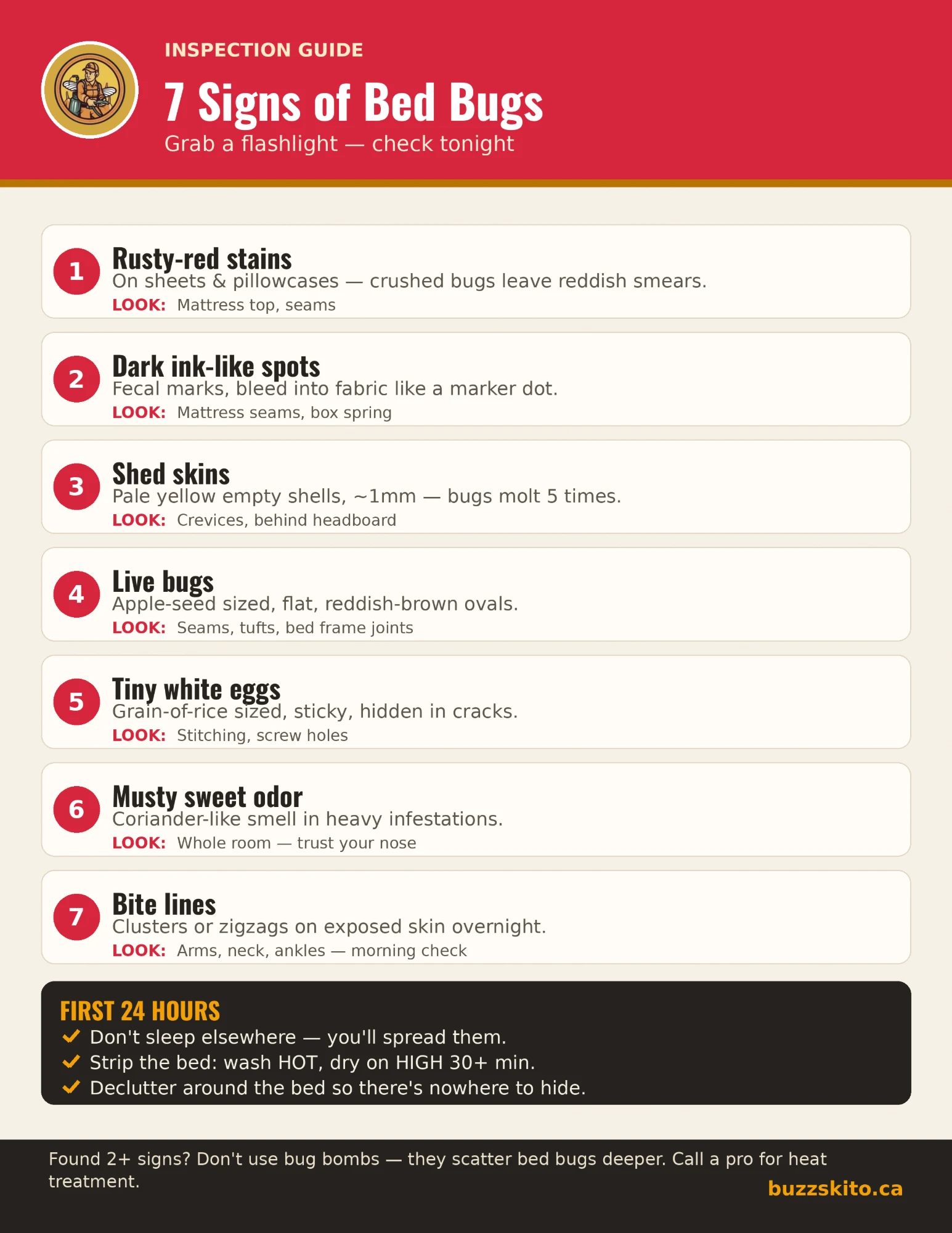 Signs of Bed Bugs: A 7-Point Checklist to Run TonightThe seven signs of bed bugs, from live bugs and ink-like spots to bites, with where to look tonight, what each is…
- Bed Bug Treatment Cost in Canada — What Decides the Number, and When DIY Is Genuinely…Bed bug treatment cost in Canada: published heat vs chemical ranges with sources, what makes quotes vary, who pays in…
- Does Alcohol Kill Bed Bugs? What the Research Says About Rubbing AlcoholRubbing alcohol kills bed bugs only when it soaks them, and even then not reliably. What university research found, why…