
Toronto Tick Control
From $99 · 150+ Five-Star Reviews
Licensed Ontario pesticide operator treating the ravine-edge yards where blacklegged ticks are established, from High Park to the Don Valley. Treatments applied according to label directions.
Quick Answer
What is the best tick control company in Toronto?
BuzzSkito provides specialist tick barrier spray across all Toronto neighbourhoods — High Park, East York, Don Mills, The Beaches, Scarborough, North York, Etobicoke, Leslieville, Rosedale, Forest Hill. Treatments are applied by a licensed Ontario pesticide operator, according to label directions, to the specific 1–3 metre zones where blacklegged ticks concentrate — lawn-to-woods transitions, leaf litter, garden bed edges, and fence-line vegetation. Single treatments start at $99; the 5-spray tick season is $597 on its own or $497 added to any mosquito plan (plus HST). With 150+ five-star Google reviews, no contracts, and a rain-back guarantee on every plan, BuzzSkito treats ravine, conservation-area, and wooded-edge properties across the city. Call (289) 216-5030.
Toronto Tick Control Key Facts
| Service area | All Toronto neighbourhoods (High Park, East York, Don Mills, The Beaches, Scarborough, North York, Etobicoke, Leslieville, Rosedale, Forest Hill) |
| Specialization | Blacklegged tick (Ixodes scapularis) and American dog tick barrier spray |
| Pricing | From $99 per treatment · tick season $597 standalone or $497 with any mosquito plan (plus HST) |
| Treatment season | May through September, treated monthly (nymph peak May–July; adult ticks stay active into the autumn) |
| Licence | Ontario Pesticide Operator Licence L-240-2436835197 |
| Re-entry | Stay off treated areas until the spray has dried, as the product label directs |
| Recommended schedule | 5 treatments per season for ravine- or conservation-area-adjacent properties |
| Highest tick zones | Don Valley · Humber River · High Park · Rouge National Urban Park · Highland Creek |
| Lyme disease vector | Yes — blacklegged tick populations confirmed by Public Health Ontario |
| Application zones | Lawn-to-woods edge · leaf litter · garden bed perimeters · fence-line vegetation · woodpiles |
| Booking lead time | Same-week service typical |
| Contract required | No — single treatments and seasonal programs both available |
| Guarantee | Rain-back on every plan; Bite-Free on Standard & Exclusive |
| Google reviews | 150+ reviews · 5.0 average · 0 negative |
| Phone | (289) 216-5030 |
Tick Spray Pricing in Toronto
Professional tick spray service from $99 per treatment · No contracts
Typical Toronto prices
For a standard lot under 10,000 sq ft, plus HST. Bigger lot? Your quote shows the exact price before you pay.
Tick control
5 sprays per season · $497 with any mosquito plan
$597 on its own
One treatment
A single visit
from $99
Basic season
5 sprays, monthly, May–Sept
$549
Standard seasonMost popular
10 sprays, every 2 weeks
$994
Exclusive season
20+ sprays, weekly
$2,049
- ✓ Rain within 1 hour of your treatment? We come back and re-treat free, on every plan.
- ✓ Bite-Free Guarantee on Standard & Exclusive plans
How It Works
How BuzzSkito Tick Control Works
Property Tick Assessment
We identify tick habitat zones — ravine edges, lawn-to-woods transitions, leaf litter, woodpiles, and garden bed borders specific to your Toronto property.
Targeted Barrier Spray
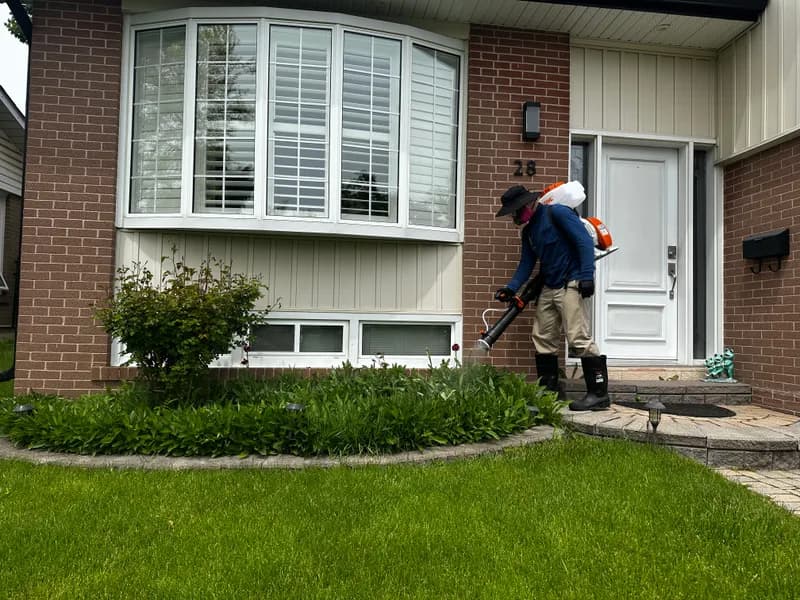
Our licensed technician applies a barrier product, according to its label directions, to the 1-3 metre zones where ticks concentrate — precision treatment, not broadcast spraying.
Rain-Back Guarantee
Five sprays per season, roughly every 30 days, keep the treated zones renewed. Rain within 1 hour of your treatment? We come back and re-treat free, on every plan.
Ticks in Toronto: The Real Risk
Toronto Public Health conducts annual tick surveillance and has confirmed established blacklegged tick populations in High Park, the Don Valley, and other ravine-adjacent areas. Lyme disease is a reportable illness in Ontario, and confirmed case numbers have increased steadily as tick populations expand across Southern Ontario.
The key insight for Toronto homeowners: ticks don't need a forest. They're found at the edge of any lawn that backs onto naturalized green space — including the thin strip of vegetation between a backyard fence and a ravine trail. If your property has any wooded edge, ravine view, or backs onto a park, seasonal tick treatment is a reasonable precaution.
Toronto Tick Season: When Is the Risk Highest?
Ticks don't disappear in winter — they go dormant and become active again whenever temperatures rise above 4°C. In Toronto's climate, that means tick pressure runs from the first spring thaw right through to late autumn — here is how the risk shifts across the season:
| Period | Life Stage | Risk Level | Why It Matters |
|---|---|---|---|
| March–April | Adult ticks | Moderate | First active period after winter dormancy |
| May–July | Nymphs (peak season) | Highest | Nymphs are poppy-seed sized — hard to see, most bites go undetected |
| August–September | Nymphs + new adults | High | Second wave — adults emerging for fall activity |
| October–November | Adult ticks | Moderate | Active until first hard frost; often overlooked |
The May–July nymph window is the most dangerous period for Lyme disease transmission in Ontario. Nymphs are the size of a poppy seed — often found and removed only after they've been attached long enough to transmit Lyme disease. A late May treatment gets ahead of this window, and the monthly visits that follow keep the treated zones renewed through June and July while nymph activity is at its height.
What Should Children and Pets Do During a Tick Treatment?
This is the most common question we get from Toronto parents, and the answer starts with one simple rule: keep children and pets off the treated area until the spray has dried, as the product label directs.
The product we use is a synthetic pyrethroid — a class of insecticides modelled on natural compounds found in chrysanthemum flowers. Our licensed technician applies it according to its label directions, to vegetation (leaves, shrubs, fence lines, leaf litter) where ticks rest, rather than broadcasting it across open lawn where children and pets play.
At BuzzSkito, we also observe buffer zones around vegetable gardens and avoid direct application to any water features, bird baths, or aquatic areas on your property. Our technician reviews these specifics before every treatment visit.
For full details, see our guide to mosquito and tick spray safety for kids and pets.
Toronto Tick Treatment Schedule
Our seasonal tick program is five treatments — roughly one a month from May through September. The residual on treated vegetation wears down over a few weeks, so monthly visits keep the treated zones renewed during the months blacklegged ticks are active in Toronto:
| Treatment | Timing | Target |
|---|---|---|
| Treatment 1 | May | Nymph emergence — first visit ahead of the peak nymph months |
| Treatment 2 | June | Nymph peak — poppy-seed sized, so most bites go undetected |
| Treatment 3 | July | Late nymph activity, plus ticks carried back in from the Don and Humber ravines |
| Treatment 4 | August | Barrier renewed as the first new adults begin emerging |
| Treatment 5 | September | Adult tick activity heading into autumn — into November in mild years |
The acaricide residual is temporary — deer, mice, and birds moving in from the ravines reintroduce ticks continuously, which is why the barrier has to be renewed rather than set once. The full five-visit season is $597 standalone, or $497 added to any BuzzSkito mosquito plan, plus HST. Many Toronto homeowners bundle tick and mosquito treatments — both can be done on the same visit, though ticks and mosquitoes are treated in different zones of the yard. See our Toronto mosquito control service for bundle pricing details.
Where Tick Risk Is Highest in Toronto
- High Park and surroundings — Roncesvalles, Parkdale, Bloor West Village
- Don Valley corridor — Leaside, East York, Don Mills, Thorncliffe Park
- Humber Valley — Etobicoke, Islington, Old Mill area
- Scarborough ravines — Highland Creek, Guildwood, Rouge River, Cliffside
- Any property backing onto ravine or naturalized green space
Toronto Neighbourhoods We Serve
Tick Spray Pricing in Toronto
| Property Type | Starting Price | Typical Properties |
|---|---|---|
| Standard lot (under 10,000 sq ft) | From $99/treatment | Typical Toronto semi, townhome, or detached |
| Larger lot (10,000–100,000 sq ft) | Priced by lot size | Ravine-backing, Rosedale, Forest Hill |
| Estate property | Custom quote | Bridle Path, Lawrence Park, Hoggs Hollow |
No contracts. Call (289) 216-5030 for a free quote.
Professional Tick Spray vs. DIY in Toronto
- Store-bought repellents protect people, not yards. DEET applied to clothing protects during a walk. Professional yard spray treats the zones where ticks wait for a passing host.
- Tick tubes target one pathway, not the whole problem. Permethrin-treated cotton tubes work via mice — useful as a supplement but don't address ticks already on your property or arriving via deer.
- Precision targeting is what makes it work. Ticks live in specific micro-habitats — the lawn-to-ravine transition, leaf litter, garden edges. Professional treatment targets these zones. Consumer products miss them.
- Toronto's ravine system is beyond your control. The Don Valley, Humber River, and Highland Creek will produce ticks every year. A treated barrier on your property is one layer of residential defence, alongside tick checks after time outdoors.
What to Expect on Tick Treatment Day
- Visit window — We book a visit window, never an exact arrival time. You don't need to be home.
- Property tick assessment — your technician identifies ravine edges, transition zones, and high-risk perimeters.
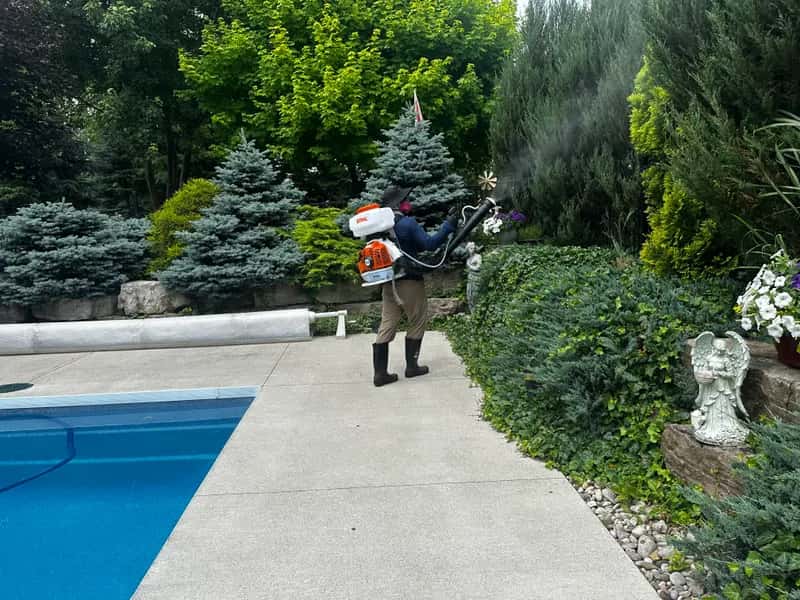
- Targeted barrier application — precision spray to tick habitat: lawn-to-woods edges, garden borders, fence lines, woodpiles, under decks. 20–30 minutes.
- Dry time — keep kids and pets off treated areas until the spray has dried, as the product label directs.
- Email confirmation — treatment log with areas treated and next visit date.
Also Providing Mosquito Control in Toronto
Bundle tick and mosquito control so both pests are covered. See our Toronto mosquito control service.
Compare Toronto Pest Control Options
Toronto has confirmed blacklegged tick exposure — see our specialist pest control guide: Pest Control in Toronto for why a mosquito and tick specialist is a better fit for tick-prone ravine yards than a general pest company. See our full mosquito programme for the same property: Mosquito Control in Toronto.
Related Guides
Customer Reviews
What Toronto Homeowners Say About Our Tick Control
From our 150+ five-star Google reviews
“Our property backs onto the Don Valley ravine and we found ticks on our dog multiple times. After BuzzSkito treated the perimeter, problem solved. The technician was very knowledgeable about ravine-specific tick zones.”
Linda C. — Rosedale, Toronto
“With young kids playing near the ravine behind our house, tick prevention is non-negotiable. BuzzSkito handles it professionally and the SMS alerts before and after service are a great touch.”
Chris W. — The Beaches, Toronto
“Highly recommend this company for mosquito control. I got my house in Milton serviced recently and loved the end result!”
Anthony — Milton, Toronto
“Fantastic experience with the mosquito control last summer! We’re re-signing for this season once again — we can finally enjoy our yard again in Mississauga.”
Katharine M. — Mississauga, Toronto
FAQ – Tick Spray in Toronto
How much does tick spray cost in Toronto?
Tick spray in Toronto starts from $99 per application. A full season is $597 standalone — five treatments spread across May through September — or $497 when added to any BuzzSkito mosquito plan, a $100 saving. Properties near the Don Valley, Humber River, or High Park benefit most from the full five-visit season, because ravine wildlife keeps carrying ticks back onto the property all summer. No contracts. Call (289) 216-5030 for a free Toronto tick spray quote.
Are there really ticks in Toronto?
Yes. Blacklegged ticks are established in Toronto's ravine system, High Park, and many other green spaces. Toronto Public Health conducts annual tick surveillance and has confirmed positive blacklegged tick populations in High Park, the Don Valley, Humber Valley, and Scarborough's Highland Creek and Rouge River areas. Lyme disease is a reportable illness in Ontario and confirmed Toronto cases have increased each year.
Which Toronto neighbourhoods have the highest tick risk?
Properties adjacent to Toronto's ravine system carry the highest tick exposure risk. This includes areas near the Don Valley (Leaside, East York, Don Mills), Humber Valley (Etobicoke, Islington), High Park (Roncesvalles, Parkdale), Highland Creek and Scarborough Bluffs (Cliffside, Guildwood), and any neighbourhood backing onto wooded or naturalized green space. Even a thin strip of ravine vegetation between a backyard fence and a trail can host tick populations.
What tick species are found in Toronto?
The blacklegged tick (Ixodes scapularis) is the species of primary concern in Toronto — it's the only species that transmits Lyme disease, and it's the species Toronto Public Health monitors. American dog ticks are also present in Toronto's parks and green spaces but rarely transmit Lyme disease to humans.
When is tick season in Toronto?
Blacklegged tick nymphs — the life stage responsible for most Lyme disease transmissions in Ontario — are most active from May through July. Adult ticks are active from October through November and again in early spring (March–April) when temperatures rise above 4°C. Nymphs are the most dangerous stage because they're tiny (poppy-seed sized) and often go undetected during tick checks. Our seasonal program treats monthly from May through September, so the peak nymph window is covered from start to finish rather than sampled once.
How many tick treatments does my Toronto property need?
Five treatments per season — roughly one a month from May through September. The residual on treated vegetation wears down over a few weeks, so monthly visits keep the treated zones renewed instead of leaving a multi-month gap through peak nymph season in May–July. The later visits continue treatments into the adult tick surge, which runs through autumn and into November in mild years. Public Health Ontario notes nymphs are poppy-seed sized and easy to miss, so do a tick check after time outdoors. Repeat applications matter most in Don Valley, Humber Valley, and Scarborough ravine zones, where deer, mice, and birds continually reintroduce ticks from the adjacent woodland. A full season is $597 standalone, or $497 added to any mosquito plan, plus HST; single treatments start from $99 on a standard lot.
How is tick spray applied in Toronto near ravines and parks?
Our licensed technician applies the product according to its label directions, and only to your property's own vegetation — never to municipal parkland or ravine land. We follow the label's directions around water and maintain buffer zones around any sensitive natural areas at your property edge.
What precautions apply for children and pets during a tick treatment?
Keep children and pets indoors or away from the yard during application and until the spray has dried, as the product label directs. The product is applied to the vegetation, leaf litter and lawn edges where ticks rest, rather than broadcast across open lawn. We observe buffer zones around vegetable gardens and water features on every property we treat, and we can adjust application zones if you have specific concerns.
How is tick spray applied in a yard where kids play?
Keep kids off treated areas until the spray has dried, as the product label directs. The product is applied to the leaf litter, lawn edges and vegetation where ticks rest, rather than broadcast across the open lawn where children play. Toronto parents with ravine-adjacent properties often choose tick treatments because ravine-edge yards carry the highest tick exposure for children playing outdoors.
Does BuzzSkito also provide mosquito control in Toronto?
Yes. Toronto's Don Valley, Humber River, and extensive ravine system also create significant mosquito pressure each season. Many Toronto homeowners bundle mosquito and tick treatments so both pests are covered. See our Toronto mosquito control service for details, or ask about seasonal bundle pricing when you call.
Get a Free Tick Spray Quote in Toronto
Licensed tick spray for Toronto ravine-edge yards. No contracts.
✓ No contracts · ✓ Rain-back guarantee on every plan · ✓ May through September