
BuzzSkito Mosquito & Tick Control Specialists · Published July 21, 2026
What the PackTite Closet Is — and Who It Is For
The PackTite Closet is the big sibling in a product family that more or less invented the consumer bed-bug heat chamber. Where the original PackTite Portable is a compact zip-up bag sized for a single suitcase, the Closet is a tall, collapsible chamber built to take a genuinely large load in one cycle: multiple bags at once, a comforter and pillows, a deep stack of seasonal clothing, or the combined soft goods of a whole bedroom. It works on the oldest, most reliable principle in bed-bug control — heat. A controlled heating element circulates hot air through the chamber until the contents climb above the temperature bed bugs and their eggs can survive, and then it holds them there.
That heritage matters, because heat is one of the few interventions that kills every life stage. Adults, nymphs, and — the part that defeats so many other methods — the eggs. A vacuum removes what it can reach, a contact spray hits what it touches, but a properly run heat cycle penetrates into the folds of a duffel bag and the core of a folded sweater and cooks everything hiding there at once. The Closet is the tool you reach for when the thing you need to de-bug is too bulky, too numerous, or too delicate to wash, and when you need to be sure the middle of the load got as hot as the outside.
Check current Canadian availability of the Closet and its main alternatives:
Does It Actually Work? The Heat Science, Honestly
Yes — with the caveat that the machine only works as well as your patience does. Bed bugs die from sustained heat, not a brief warm touch. The widely referenced lethal zone is roughly 48–50°C (about 118–122°F), held for a meaningful stretch rather than reached for a moment. The Closet is engineered to reach and maintain that range, and this is why the included thermometer probe is not an accessory — it is the entire point of doing this properly.
Here is the mechanism that trips people up. When you switch the chamber on, the air reaches temperature fairly quickly. But the dense centre of a packed bag, or the core of a thick folded pile, lags well behind the air around it. If you start counting your hold time the moment the air hits target, you can pull a load that still had a cool pocket at its heart — and a single surviving egg in that pocket restarts the whole problem. The correct method is to bury the probe in the slowest-heating part of the load, wait until the probe reads target temperature, and only then begin the hold. Do that, and the kill is thorough and every-life-stage complete. Skip it, and you have an expensive load-warmer.
Capacity: The Reason to Choose the Closet Over a Luggage Heater
Capacity is the Closet’s entire reason to exist, and it is where the small zip-up luggage heaters simply run out of room. A single-bag heater is perfect if your problem is one suitcase after a trip. But the moment you need to treat two bags, or a duffel plus a backpack, or a bedroom’s worth of bedding and clothes, a small chamber forces you into cycle after cycle after cycle — and each cycle is hours long. The Closet collapses that into one run.
The honest limit is not the chamber walls; it is physics. The more tightly you pack it, the longer the dense middle takes to reach lethal temperature, and the greater the chance of a cold pocket. So the real-world advice is to load it below its absolute maximum: drape rather than cram, unzip bags so hot air can get inside them, loosen dense stacks, and leave room for air to move. Capacity you cannot heat evenly is not real capacity. Used that way, the Closet handles loads that would take a luggage heater an entire day of back-to-back cycles — which, for anyone with a recurring need, is exactly what justifies the bigger unit.
The Canadian-Stock Caveat You Need to Know Before You Buy
This is the single most important practical point in this review, and it is why the Closet does not score a perfect mark despite being an excellent device. PackTite is a US brand, and its Canadian availability is inconsistent. The Closet appears on Amazon.ca in fits and starts; it is sometimes listed only through US-based third-party sellers; and it can disappear entirely for stretches during peak demand. When it does ship from the United States, you may encounter currency conversion, cross-border duty or brokerage fees, longer transit times, and a warranty that is simpler to claim south of the border than north of it.
None of this is a legality issue. A heat chamber is an appliance, not a pesticide, so there is no Health Canada or PMRA registration to worry about — unlike the many US bed-bug chemical products that are genuinely not legal for sale in Canada. The Closet is perfectly legal to own and use here. The friction is purely retail supply. So the sensible buying discipline is: check who the seller actually is, confirm the full landed price including any duty or brokerage before you commit, and weigh it against alternatives that may be sitting on a Canadian shelf right now. If a ZappBug Oven is in stock domestically at a comparable price and the Closet is a US-shipped gamble, availability alone can be the deciding factor.
How Long a Cycle Takes — and Why That Is a Feature
Plan on several hours per load, and reframe that time as the treatment doing its job rather than a delay. The sequence is: the chamber climbs to temperature, then the load core catches up to the air, and only then does the lethal hold time begin. Bulky, tightly packed loads take meaningfully longer to reach core temperature than loose ones — which is, again, the argument for not cramming it. A realistic full cycle, cold start to safely finished, commonly lands in the multi-hour range.
The temptation, especially near the end of a long evening, is to pull the load when the air hits temperature and call it done. Resist it. That shortcut is the most common reason someone treats an item, believes it clean, and re-introduces bed bugs from the very bag they thought they had solved. The probe and the clock are your proof of work. Let both do their jobs.
What to Leave Out: Heat-Sensitive Items
Sustained heat at bed-bug-lethal temperatures is gentle on most fabrics — gentler than a hot dryer, because there is no tumbling and no contact with a hot drum. Cottons, wools, and synthetics generally come through unharmed. The damage risk is not the clothing; it is the heat-sensitive extras that travel alongside it. Before a cycle, pull out:
- Electronics and batteries — laptops, phones, anything with a lithium cell.
- Meltables — candles, crayons, chocolate, cosmetics, lip balm, some glued or waxed footwear.
- Pressurised and chemical items — aerosol cans, certain medications.
- Vinyl, adhesives, and delicate finishes that can soften or warp.
The rule of thumb is simple: if an item would be unhappy locked in a hot car on a summer afternoon, keep it out of the chamber and treat it another way — a careful cold inspection and manual removal is the right path for a laptop or a phone. Empty pockets, unzip bags, loosen dense stacks so heat can penetrate, and drape rather than cram. It is almost never the clothes that get ruined; it is the forgotten candle tucked among them.
How to Choose: What You Are Actually Paying For
A large heat chamber is a premium, single-purpose purchase, so it is worth being clear-eyed about which features earn their cost for your situation. Prioritise in this order:
- Capacity that matches your real loads (pay for this). If your typical job is bulky or multi-bag, the large chamber pays for itself in cycles saved. If it is one suitcase, you are overbuying — a luggage heater is the right size.
- A reliable thermometer probe (non-negotiable). The probe is what turns “the air got hot” into “the load core got hot,” which is the whole difference between a kill and a near-miss. Never buy a chamber you cannot verify.
- A fair landed Canadian price (do the math before you click). For a US-brand unit, the sticker price is not the real price. Add duty, brokerage, and exchange, then compare against domestically stocked alternatives.
- Repeatable, collapsible design (nice to have). If you will run many loads or store it between seasons, a chamber that folds down and reheats cleanly for the next run is genuinely useful.
- Brand heritage (a tiebreaker, not a decider). PackTite’s track record is real, but do not let it override a stock-and-price disadvantage against an equally capable alternative that is actually available.
Read that as a spending map: buy the capacity you truly need and the ability to verify the core temperature; treat everything else as a tiebreaker. For a deeper look at how the whole category compares — luggage heaters, ovens, and room-scale units — see our guides to the best bed-bug luggage heaters and the best bed-bug heat chambers in Canada.
Where the Closet Fits in a Real Bed-Bug Plan
A heat chamber is powerful, but it is a station in a strategy, not the strategy itself. It solves exactly one part of the problem: decontaminating the items you can carry to it. It is superb for that — luggage after travel, clothing and bedding during a move, soft goods you cannot bear to throw out. What it categorically cannot do is treat the room. The mattress you cannot lift into it, the box spring, the frame, the baseboards, the cracks in the wall, and the harbourage behind furniture are all beyond its reach, and a serious, established infestation lives precisely in that fixed infrastructure.
So the Closet belongs in a plan alongside room-scale intervention — a whole-room heater or professional heat treatment for the space itself — plus interceptor traps under the bed legs to monitor whether the numbers are actually dropping, and mattress encasements to seal off the bed as harbourage. If you are still confirming you have bed bugs at all, start with our guide on how to check for bed bugs. And if you want the full DIY sequence, our walkthrough on how to get rid of bed bugs in Canada puts every tool — chamber included — in order.
Frequently Asked Questions
Is the PackTite Closet worth it in Canada in 2026?+
For the right job, yes — with one big caveat. The PackTite Closet is the flagship of the PackTite line: a large, collapsible heat chamber built to raise a full load of soft goods above the lethal threshold for bed bugs, then hold it there long enough to kill every life stage, eggs included. If you regularly need to treat bulky items — a duffel plus a backpack, a stack of folded clothes, throw pillows, a comforter, a diaper bag, seasonal bedding — it does what a small luggage heater cannot, because capacity is exactly what the small units run out of. The caveat is Canadian availability: PackTite is a US brand, stock on Amazon.ca comes and goes, and units frequently ship from US third-party sellers with the duty, exchange, and warranty friction that implies. If it is in stock at a fair landed price and you have recurring bulky loads, it is worth it. If you only ever treat one carry-on at a time, a smaller heater is the smarter buy.
What is the difference between the PackTite Closet and the original PackTite Portable?+
Capacity and shape. The original PackTite Portable is a compact zip-up bag sized for a single suitcase or a modest bundle of clothes — brilliant for travellers treating one bag after a trip. The PackTite Closet is substantially larger and taller, designed to swallow multiple bags or a deep pile of soft goods in one cycle, and its height suits bulkier, hangable-style loads better. Both use the same core principle: a controlled heater circulates hot air through the chamber to bring the contents up to a temperature bed bugs cannot survive, with a thermometer probe so you can confirm the core of the load actually reached the kill zone. Choose the Portable for single-bag, travel-driven use; choose the Closet when your typical load is genuinely bulky or you are treating several items at once. Our companion PackTite Portable review covers the smaller unit in detail.
Does the PackTite Closet actually kill bed bugs and their eggs?+
Yes, when you run it correctly. Bed bugs and their eggs die from sustained heat — the widely cited lethal range is roughly 48–50°C (118–122°F) held for a meaningful stretch of time, not just touched briefly. The Closet is engineered to reach and hold that range, and the included thermometer probe is the point of the whole exercise: you place the probe in the densest, slowest-heating part of the load, and you do not start counting your hold time until the probe — not the air, the load core — has reached temperature. The failure mode is never the heat itself; it is impatience or overpacking, which leaves a cold pocket at the centre of a tightly stuffed bag where an egg can survive. Load loosely, let air circulate, watch the probe, and hold.
Can I put luggage, shoes, and electronics in the PackTite Closet?+
Luggage and shoes, yes — they are exactly what it is for, and heat is the safest way to de-bug items you cannot wash or throw in a dryer. Electronics and heat-sensitive items are a different story. Laptops, phones, batteries, cosmetics, candles, vinyl records, medications, and anything with a glue-bound or waxed component can be damaged by a sustained 50°C soak. The rule of thumb: if it would be unhappy locked in a hot car on a summer afternoon, keep it out of any heat chamber. For phones and laptops, a better path is a careful cold-side inspection and manual removal rather than baking them. When in doubt, leave it out and treat it another way.
How long does a PackTite Closet cycle take?+
Plan on several hours per load, and treat that as a feature, not a flaw. The chamber first has to climb to temperature, then the entire load — especially the dense core of folded fabric or a packed bag — has to catch up to the air around it, and only then does the lethal hold time begin. Bulky, tightly packed loads take longer to reach core temperature than loose ones, which is the single biggest reason to pack loosely and not cram the chamber to its limit. A realistic full cycle, from cold start to safely finished, commonly runs in the multi-hour range. Rushing it — pulling the load the moment the air hits temperature — is the classic way people get a re-infestation from an item they thought they had treated.
Is the PackTite Closet easy to get in Canada, or is it US-only?+
This is the honest weak point. PackTite is an American brand, and Canadian availability is intermittent: the Closet appears on Amazon.ca in fits and starts, is sometimes listed only through US-based third-party sellers, and can vanish for stretches during peak demand. When it does ship from the US, you may see currency conversion, cross-border duty or brokerage, longer transit, and a warranty that is easier to honour south of the border. None of that is a device-legality problem — a heater is an appliance, not a pesticide, so there is no Health Canada or PMRA registration involved. It is purely a supply-and-logistics caveat. Before you buy, check the seller, confirm the landed price including any duty, and compare against Canadian-stocked alternatives that may be sitting on a shelf here right now.
PackTite Closet vs ZappBug Oven vs ThermalStrike — which should I buy?+
They overlap but favour different buyers. The PackTite Closet is the tall, large-capacity chamber for bulky mixed loads, with the strong brand heritage but the Canadian-stock caveat. The ZappBug Oven is the other big-box name, a large square chamber that competes directly on capacity and is often easier to find in Canadian listings — many buyers pick it purely for availability. ThermalStrike makes zip-up heaters shaped around a suitcase, which are the traveller-focused pick for single-bag treatment rather than bulk loads. If you want maximum capacity and can get a PackTite Closet at a fair price, it is a top choice; if it is out of stock, a ZappBug Oven is the closest large-capacity substitute; if you only ever treat one bag, a ThermalStrike or the PackTite Portable is the more sensible size. See our dedicated reviews for each below.
Do I still need professional treatment if I own a PackTite Closet?+
A heat chamber solves one specific part of the problem: the items you can carry to it. It is superb for de-bugging luggage, clothing, bedding, shoes, and soft goods after travel, after a move, or as part of a room-scale plan. What it cannot do is treat the room itself — the mattress you cannot lift into it, the box spring, the bed frame, the baseboards, the cracks in the wall, and the harbourage behind furniture. A serious, established infestation lives in that fixed infrastructure, and no portable chamber reaches it. Think of the Closet as the item-decontamination station in a larger strategy that also includes whole-room heat or a professional treatment, interceptor monitoring, and encasements. It is a powerful tool, not a complete cure on its own.
How do I use the PackTite Closet without ruining my clothes?+
Sustained heat at bed-bug-lethal temperatures is gentle on most fabrics — far gentler than a hot dryer, because there is no tumbling and no direct contact with a hot drum. The things to pull out are the heat-sensitive extras that often travel with clothes: candles, cosmetics, crayons, chocolate, medications, aerosol cans, waxed items, some glued footwear, and anything with adhesive that could soften. Empty pockets, unzip bags so hot air can reach inside them, unfold or loosely refold dense stacks so heat can penetrate, and drape rather than cram. Most cottons, wools, and synthetics come through a heat cycle unharmed; it is the accessories tucked among them, not the clothes themselves, that get damaged when people forget to remove them.
Can the PackTite Closet reheat and get damaged, or is it safe to run unattended?+
Follow the manufacturer instructions and do not leave any heating appliance running truly unattended for long stretches, especially on a flammable surface or against a wall. Place the chamber on a hard, heat-tolerant floor with clearance around it, keep it away from curtains and clutter, use the thermometer probe as intended so you are monitoring the load, and stay in the home while it runs. The units are designed for repeated cycles, so reheating for a second load is normal — just let the chamber and its contents settle between runs. As with any high-wattage device, the sensible precautions are the ordinary ones: good ventilation, a stable surface, no overloading of the electrical circuit, and a person nearby.
Is a heat chamber better than bed-bug spray for treating belongings?+
For belongings you can fit inside it, heat is usually the better choice, because it penetrates and kills every life stage — including the eggs that many contact sprays miss — without leaving a chemical residue on clothing and bedding you put against your skin. Sprays have their place on surfaces and cracks you cannot heat, and residual products keep working over time where a heat cycle is a one-and-done event. The strongest plans use both: heat for the portable items, and targeted product or a residual for the fixed harbourage. If you are weighing sprays, our guides to bed-bug spray and natural bed-bug sprays cover what actually works and where the label limits are in Canada.
What size load can the PackTite Closet handle?+
Its whole reason to exist is bulk. Where a small luggage heater tops out at roughly one suitcase, the Closet is built to take a genuinely larger load — think multiple bags, a comforter and pillows, a deep stack of seasonal clothing, or the combined soft goods from a bedroom in a single cycle. The practical limit is not the chamber walls but the physics of heat penetration: the more tightly you pack it, the longer the dense centre takes to reach lethal temperature, and the greater the risk of a cold pocket. So the honest answer is that it holds a lot, but you should still pack it below its absolute maximum and loosely enough for hot air to move, then use the probe to confirm the core got hot. Capacity you cannot heat evenly is not real capacity.
Related Reading
- PackTite Portable Review Canada — The Compact Single-Bag Heater
- ZappBug Oven 2 Review Canada — The Large-Capacity Alternative
- ThermalStrike Ranger Review Canada — Travel-Focused Luggage Heater
- Best Bed-Bug Heat Chamber Canada — The Full Category Compared
- Best Bed-Bug Luggage Heater Canada
- Best Whole-Room Bed-Bug Heater Canada
- Best Bed-Bug Steamer Canada — Heat for the Items You Cannot Bag
- Bed-Bug Control Canada — The Complete Hub
- Best Pest Control Equipment Canada — The Device Hub
Keep reading
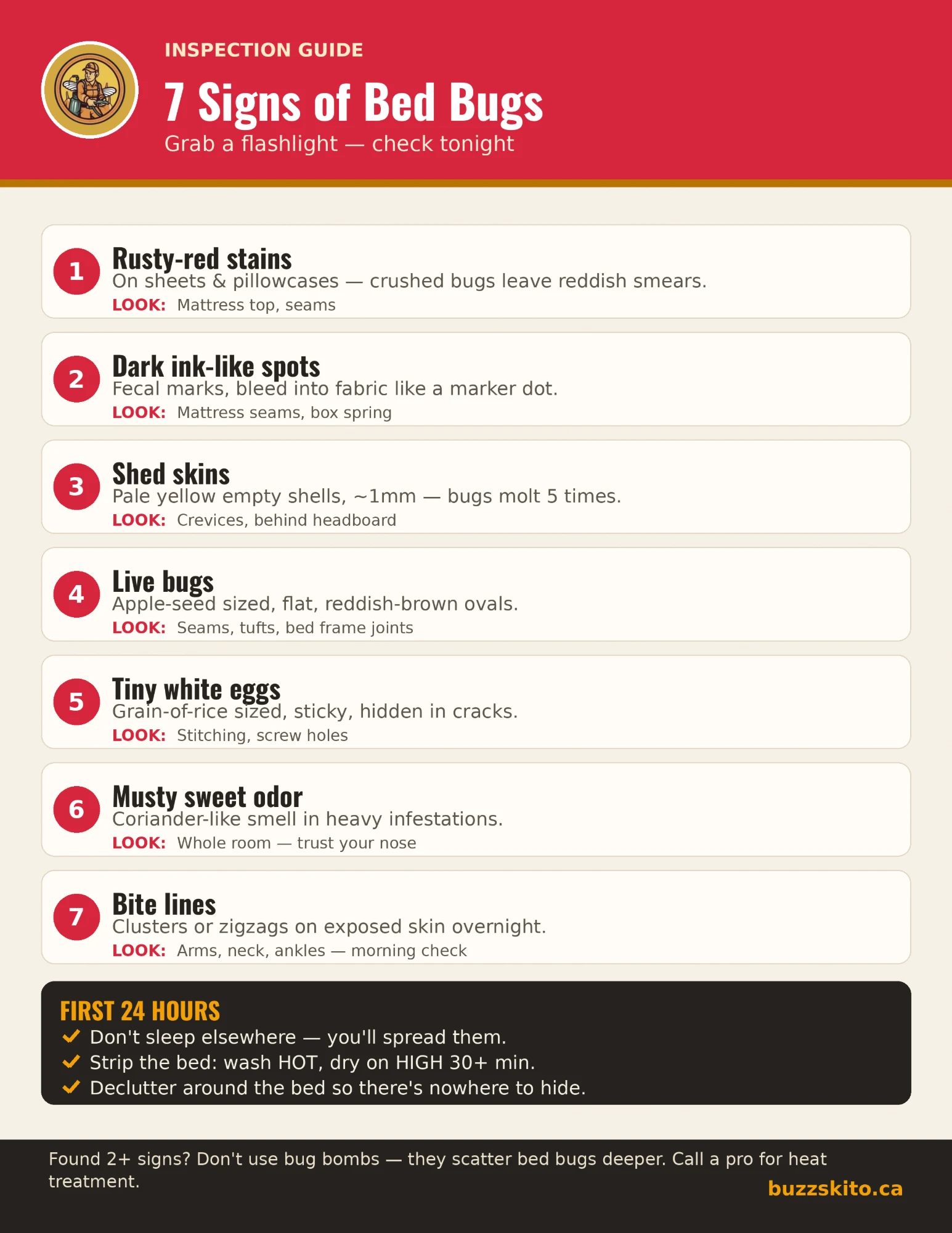 Signs of Bed Bugs: A 7-Point Checklist to Run TonightThe seven signs of bed bugs, from live bugs and ink-like spots to bites, with where to look tonight, what each is…
- Best Bed Bug Detector Canada 2026 — Passive Interceptors vs Active Monitors ComparedThe best bed-bug detectors and monitors in Canada: passive interceptor traps (Aspectek) vs glue-strip monitors…
- Dupray Neat vs McCulloch MC1275 (Canada 2026) — PSI, Steam Temp & Which One Actually…Dupray Neat vs McCulloch MC1275 for bed bugs in Canada: a head-to-head on PSI, steam temperature, dry-vapour output,…