
BuzzSkito Mosquito & Tick Control Specialists · Published July 21, 2026
What Is the Best Bed Bug Heater in Canada?
The ZappBug Oven 2 is the best bed bug heater for most Canadian households, because it is the smallest chamber that still swallows the things people actually need to treat — checked luggage, banker boxes, bedding, pillows, shoes, books — while reliably holding the entire load above the lethal threshold long enough to kill eggs. That last clause is the entire product category in one sentence. Anyone can make a warm box. The engineering that matters is holding 49°C at the coldest core of a packed suitcase, and doing it without a fire risk, and that is what you are paying for over a homemade rig.
Heat earns its place at the top of the Canadian bed bug toolkit for a reason that has nothing to do with marketing: it is the only consumer-accessible method that kills adults, nymphs, and eggs in a single pass, works identically on pyrethroid-resistant populations (which now dominate Canadian cities), leaves zero residue, and — because it is a device rather than a pesticide — sits entirely outside the regulatory bottleneck that makes the Canadian bed bug spray aisle so weak. We will come back to that legal angle, because it is the most under-explained fact in this entire category.
The Physics: 49°C, Hold Time, and Why the Core Temperature Is Everything
Bed bugs die of heat the way all insects do — protein denaturation — and the thermal death points are well established in the entomology literature. Adults and nymphs die at about 45°C (113°F) when held there for roughly 90 minutes, and in about 20 minutes at 48°C (118°F). Eggs are meaningfully tougher: they need on the order of 90 minutes at 48°C, though mortality becomes a matter of minutes once temperatures pass 50°C (122°F). The industry convention that falls out of those numbers is a target of 49°C/120°F or above, held for at least an hour, measured at the coldest point of whatever you are treating.
That final phrase is where almost every DIY failure lives. The air inside a chamber can read 60°C while the centre of a rolled duvet is still sitting comfortably at 35°C — insulation is precisely what bedding is designed to do. The core of a tightly packed suitcase can lag the air temperature by three or four hours. This is why every credible protocol, and every chamber worth buying, is built around a probe thermometer buried in the densest item of the load: the treatment clock starts when the probe crosses 49°C, not when the chamber does. Loads run 4–8 hours as a result, and a chamber cycle you cut short at “the air felt hot” is a chamber cycle that hatches survivors two weeks later.
One reassuring corollary of the physics: there is no such thing as a heat-resistant bed bug. Canadian populations carry widespread knockdown resistance to pyrethroids — the active ingredients in most domestic sprays — and metabolic resistance to a good deal else. None of that biochemistry helps an insect whose proteins cook at 50°C. Heat is the great equalizer, which is why professional operators lead with it.
The Legal Moat: Why Heat Can Claim What Sprays Cannot
Here is the part of this market that almost no product page explains. In Canada, anything that kills pests by chemical or biological action is a pesticide, and pesticides must be registered with Health Canada’s Pest Management Regulatory Agency (PMRA) before sale. Every claim on a registered label — every pest, every site, every life stage — must be individually supported and approved. Most domestic-class bed bug sprays on Canadian shelves carry no approved egg-kill claim, because they could not demonstrate one, and eggs are exactly where spray-based DIY programs collapse. Our companion piece on whether bed bug sprays actually work walks through that failure mode in detail.
A heat chamber lives in a different legal universe. It kills by temperature — physics, not chemistry — so it is a device, not a pest control product. No PMRA registration, no restricted claims, no domestic-versus-commercial class split. When a chamber says “kills all life stages including eggs,” that is not a regulated pesticide claim being stretched; it is a plain statement of thermal biology that has been replicated in laboratories for a century. The regulatory asymmetry is the quiet reason the serious end of the Canadian bed bug industry runs on heat and steam while the consumer shelf runs on weak pyrethroid aerosols.
The same asymmetry explains the grey market you will trip over in US forums and videos. American advice leans heavily on professional insecticides like Crossfire, Temprid FX, and Bedlam Plus — products with real efficacy data behind them in the US, and precisely zero legal status here. None of them are PMRA-registered; importing or using them in Canada violates the Pest Control Products Act. We name them not to tempt you but to close the loop: the products the internet says to buy are illegal here, the products that are legal here are weak against eggs and resistant strains, and the tool that sidesteps the entire problem — heat — is sitting legally on the shelf with no registration required. That is the argument for a chamber in one paragraph.
Check current Canadian availability of the three picks:
Best Overall: ZappBug Oven 2
The Oven 2 is the middle child of the ZappBug line — bigger than the original single-heater ZappBug Heater, far more practical than the walk-in Room 9 — and the size most Canadian problems actually call for. The chamber sets up as an insulated fabric box roughly a metre long and over half a metre deep and tall inside, driven by twin heater units with a thermometer to verify temperature. Into that space go the things a clothes dryer cannot take: the suitcase itself, shoes, books, backpacks, foam pillows, delicate fabrics, kids’ toys, boxed keepsakes, a folding chair or nightstand.
The workflow during an active infestation is unglamorous and effective: bag items in the infested room, carry them straight to the chamber, run probe-verified cycles of 4–8 hours, and move treated items into sealed bins so they cannot be re-infested while the rest of the room is dealt with. A household can process an entire bedroom’s belongings in a few days of back-to-back loads. Between infestations — because you only need one bed bug experience to become a convert — the whole thing collapses flat and becomes the post-travel decontamination station for returning luggage.
The honest limits: it will not take a mattress, box spring, sofa, or dresser, and it was never meant to. It is also a genuine spend for something you hope to use rarely — but measured against a single professional heat treatment, or against the multi-month grind of a failed spray program, the arithmetic is not close. We go deeper on build quality, heat-up behaviour, and the model range in our dedicated ZappBug heater review for Canada.
The Oven 2 has one requirement worth checking before you order: it runs two heater units and wants two separate electrical circuits, which older Canadian bedrooms do not always offer. Our full Oven 2 write-up covers that wiring caveat and the real cycle times. If a bedroom’s worth of belongings is too much for a box, the walk-in option is the ZappBug Room, sized in armfuls rather than bags, and the smaller folding alternative is the PackTite Portable for shoes, books and travel gear. Cross-shopping the two big chambers is covered in PackTite Closet versus ZappBug Room.
Best Luggage-Size: ThermalStrike Ranger
Most Canadian bed bug stories start the same way: a hotel, a hostel, a short-term rental, and a suitcase that came home carrying more than souvenirs. The ThermalStrike Ranger is purpose-built for that exact vector — a fold-flat enclosure sized for a large suitcase, with heating panels on every face rather than a single heat source, which shrinks the cold-spot problem that plagues improvised rigs. Bag goes in at the front door, cycle runs while you unpack nothing, and only heat-treated belongings cross the bedroom threshold.
For frequent travellers, this is less a pest control product than an insurance policy. A four-figure remediation gets prevented by a habit that costs one heating cycle per trip. The trade-off is scale: it treats one bag at a time and is the wrong tool for an established infestation with rooms full of belongings — that is Oven 2 territory. Densely packed bags also take patience; the core-temperature rule applies with full force, so leave the probe in the middle of the clothes and trust the number, not the clock.
Best Budget: The Heater-and-Thermometer Route, Honestly Framed
Yes, you can build the physics yourself: a ceramic space heater, a small well-sealed enclosure — a gutted closet, a foil-lined bin, a zipped tent — and a wireless probe thermometer to verify the core. Done carefully, it reaches lethal temperatures and kills exactly as dead as a branded chamber. We score it 6.8 rather than zero because the physics is real, and rather than 9 because everything else about it is on you.
What a purpose-built chamber gives you that a DIY rig does not: thermal cutoffs, engineered airflow that fights cold spots, fabrics chosen not to smolder against a heating element, and a design that has been run for thousands of hours by other people first. A space heater in an enclosed insulated space is a genuine fire hazard if it tips, cycles wrong, or sits against fabric — never run a DIY rig unattended, ever, and never rig heat in a space you cannot watch. And do not scale the idea up to “heat the whole bedroom with rented propane or construction heaters”: DIY whole-room heat is how houses burn down and how bugs get chased deeper into wall voids by a slow, uneven warm-up. The probe thermometer, at least, is a no-regret purchase — whichever method you choose, it is the difference between treating and hoping.
Buy vs Rent vs Professional Heat: The Decision Framework
The right spend depends on one diagnostic question: are the bugs in your belongings, or in your building? Bites plus a suspect trip and no established harborage means belongings. Live bugs in the bed frame joints, cast skins along baseboards, spotting on the box spring, activity in more than one room — that is the building, and the calculus changes completely. If you are not sure which situation you are in, start with our guide to checking for bed bugs properly before spending anything.
| Path | Typical Canadian cost | Right when | Wrong when |
|---|---|---|---|
| Buy a chamber | ~$200–$600 once | Belongings-level problem; travel defence; student move-ins; thrifted furniture and clothes | Bugs established in the structure |
| Rent heat equipment | ~$150–$400/day where available | Rarely — mostly contractors; occasional big one-time belongings jobs in cities with rental outfits | Whole-room ambitions without training — fire and cold-spot risk are real |
| Professional whole-home heat | ~$2,000–$6,000 | Established or multi-room infestations; the building itself is the harborage | A single contaminated suitcase — massive overkill |
| Do nothing / spray only | Cheap up front, expensive in the end | Never as a complete plan | Eggs and resistant strains outlast the Canadian spray shelf — see our spray guide |
If your problem genuinely is room-scale rather than suitcase-scale, there is a category between a box chamber and a professional crew: room-sized enclosures and forced-air portable heaters run with remote thermometers. What whole-room heat equipment Canadians can actually buy covers the sizing maths and why grey-market 240V US units are the wrong purchase here. For the discipline of running any of it safely, the DIY heat-treatment protocol is the method piece.
Renting deserves one more honest sentence: in most Canadian cities it is a phantom option. The equipment that exists to rent is aimed at restoration contractors, the daily rates approach the cost of simply buying a chamber, and whole-room DIY heat combines the fire risk of the budget route with stakes measured in your house. Between a purchased chamber and a professional crew there is very little sensible middle ground, and our pest control cost guide breaks down what the professional end actually charges across provinces.
What a Chamber Can’t Do: The Complete Protocol
A heat chamber is one instrument in a four-piece kit, and it fails as a solo act whenever bugs have established in the room itself. The protocol that works — the same logic professionals bill thousands for, executed at household scale — looks like this:
- Chamber for belongings. Everything portable from the infested room cycles through heat and goes into sealed bins. Dryer-safe items can shortcut through a 60-minute high-heat dryer cycle instead.
- Steam for the structure. Mattress seams, box spring, bed frame joints, headboard, baseboards, and upholstery get slow, deliberate passes with a proper vapour steamer — surface contact kills all stages on contact. Our bed bug steamer guide covers which machines hold lethal tip temperatures and which are glorified kettles.
- Encasements to seal the bed. Certified mattress and box spring encasements trap anything you missed inside — where it starves over months — and turn the bed into a smooth, inspectable surface where nothing new can hide.
- Interceptors to verify. Cups under each bed leg turn the bed into a monitored island. Weeks of empty interceptor traps are the only evidence of victory that means anything; an absence of bites is not data, because bite reactions can lag or never appear at all.
Steps one and two are the ones people conflate, and they are not interchangeable: a chamber cooks a sealed box of belongings, a steamer drives heat into the surfaces you cannot put in a box. Which of the two to buy first depends on whether the bed or the belongings are the problem.
Supporting players have their place — a light dusting of diatomaceous earth in cracks and voids adds a slow physical-kill backstop — but the four steps above are the spine. Run them together and a belongings-plus-bedroom problem is genuinely solvable without a professional. Skip any one of them and the survivors will find the gap.
Frequently Asked Questions
What is the best bed bug heater in Canada?+
For most Canadian households the best bed bug heater is the ZappBug Oven 2 — a collapsible heat chamber large enough for suitcases, boxes, bedding, cushions, and small furniture, that raises contents past the 49°C lethal threshold and holds them there long enough to kill adults, nymphs, and eggs in a single cycle. If your problem arrived in luggage — the classic Canadian scenario after a trip — a fold-flat luggage-size unit like the ThermalStrike Ranger treats bags for a fraction of the cost. The honest budget route is a space heater plus a wireless probe thermometer in a small sealed enclosure, but it demands careful monitoring and real fire-safety discipline.
What temperature kills bed bugs?+
Adults and nymphs die at about 45°C (113°F) when held there for roughly 90 minutes, and within about 20 minutes at 48°C (118°F). Eggs are the tough case: they need approximately 90 minutes at 48°C, though they die in minutes once temperatures pass 50°C (122°F). That is why the industry standard target is 49°C/120°F or higher at the coldest point of whatever you are treating, held for well over an hour. Air temperature inside a chamber is not the number that matters — the core of a folded duvet or a packed suitcase lags the air by hours, which is why chamber cycles run 4–8 hours.
Do bed bug heat chambers really kill the eggs?+
Yes — and that is the whole reason heat wins. Eggs are the failure point of almost every spray-based approach: most contact insecticides available to Canadian consumers kill poorly or not at all through the egg chorion, which is why sprayed infestations "come back" two weeks later when the next generation hatches. Sustained heat above 48–50°C denatures proteins in every life stage at once, eggs included. There is no resistance mechanism against thermal death the way there is widespread pyrethroid resistance in Canadian bed bug populations — physics does not care what the bug has evolved to detoxify.
How long do you run a bed bug heat chamber?+
Plan on 4–8 hours per load, sometimes longer for dense items. The clock does not start when the air inside hits temperature — it starts when the coldest core of the load does. A loosely packed load of clothing may be done in 4 hours; a tightly packed suitcase, a rolled foam topper, or a stack of books can take 6–8. This is why a wireless probe thermometer buried in the centre of the densest item is non-negotiable: you run the chamber until the probe reads 49°C+ and then hold for at least an hour. Rushing the hold time is the single most common reason chamber treatments fail.
What fits inside a ZappBug Oven 2?+
The Oven 2 is the mid-size chamber in the ZappBug line — roughly a metre long and over half a metre in height and depth inside. That comfortably takes checked-size suitcases, banker boxes, bedding, pillows, duvets, cushions, clothing piles, shoes, books, kids' toys, and small furniture like a folding chair or nightstand. It will not take a mattress, box spring, sofa, or dresser — for the bed itself the standard Canadian protocol is steam plus a sealed encasement rather than a chamber, and ZappBug's larger Room 9 unit or professional heat is the answer for full furniture.
Can I just use a clothes dryer instead of buying a heater?+
For anything dryer-safe, yes — a full cycle on high heat (60 minutes) reliably kills all life stages on clothing and bedding, and it should be your first move on washables. The chamber earns its keep on everything the dryer ruins or cannot take: luggage itself, shoes, books, electronics accessories, backpacks, delicate fabrics, foam, toys, and boxed belongings. A typical infestation response involves dozens of items that cannot be tumbled at high heat, and that is precisely the gap a heat chamber fills.
Should I buy a chamber, rent equipment, or pay for professional heat treatment?+
It depends on where the bugs are. If the infestation is confined to belongings — a suitcase after travel, a bin of thrifted clothes, a student moving home — a purchased chamber in the few-hundred-dollar range solves it and stays useful for every future trip. If bugs are established in the structure (bed frame, baseboards, outlets, multiple rooms), no chamber can fix that; whole-room professional heat treatment, typically $2,000–$6,000 for a Canadian home, or a professionally applied insecticide program is the realistic path. Equipment rental sits awkwardly in between: heat trailers and commercial heaters exist in some Canadian cities at $150–$400 per day, but DIY whole-room heating carries genuine fire risk and cold-spot failure, and most rental outfits target contractors, not homeowners.
Will a heat chamber treat my whole bedroom?+
No — and any marketing that implies it will is misleading. A chamber treats what you put inside it, full stop. Bed bugs established in a room live in the bed frame, headboard, baseboard gaps, carpet edges, outlet plates, and furniture joints, and a chamber never touches those. The correct mental model: the chamber decontaminates belongings, steam decontaminates the bed and furniture surfaces, encasements seal the mattress and box spring, and interceptors under the bed legs verify progress. If bugs are in the walls or spread across rooms, you are in professional territory.
What should never go in a bed bug heat chamber?+
Anything with pressurized containers (aerosols, lighters, vape pens), candles and crayons, chocolate and other low-melt foods, vinyl records, some cosmetics, and medications — check storage temperatures. Electronics are a judgment call: most manufacturers rate storage well above 50°C and pest professionals routinely heat-treat laptops and consoles with batteries removed where possible, but lithium batteries at sustained high heat are a genuine hazard, so remove them when you can and never exceed the low end of the lethal range for electronics loads. When in doubt, isolate questionable items in a sealed bag for 8+ months instead — bed bugs can survive many months without feeding, so isolation is slow, but it is safe.
Why can heat products legally claim to kill all life stages when sprays cannot?+
Because heat is physics, not pesticide. In Canada, any product that kills pests by chemical action must be registered with Health Canada's PMRA, and every claim on the label — including which life stages it kills — must be approved and supported. Most domestic-class bed bug sprays carry no approved egg-kill claim because they cannot demonstrate one. A heat chamber is a device: it kills by temperature, requires no PMRA registration, and "kills all life stages including eggs" is simply a true statement of thermal biology rather than a regulated pesticide claim. That regulatory asymmetry is the quiet reason professionals lean on heat and steam in Canada.
Are US bed bug sprays like Crossfire or Temprid legal in Canada?+
No. Crossfire, Temprid FX, and Bedlam Plus are US-registered professional insecticides that are not PMRA-registered for sale or use in Canada — importing and using them is illegal under the Pest Control Products Act, and the US-based advice recommending them simply does not transfer across the border. This grey market is exactly why we point Canadians toward heat: a chamber outperforms consumer sprays on the hardest problem (eggs and resistant strains) while being completely legal, unregulated as a device, and residue-free. Our guides to bed bug sprays in Canada cover what little is legitimately available on shelves here.
How much does professional bed bug heat treatment cost in Canada?+
Whole-home or whole-unit heat treatment in Canada typically runs $2,000–$6,000 depending on square footage, clutter level, and region, with single-room treatments sometimes quoted around $1,000–$2,000. It is the most expensive option because it is the most complete: the entire structure is raised past lethal temperature in one day, killing bugs in walls, furniture, and belongings simultaneously. Compare that against a few hundred dollars for a chamber that handles belongings-only infestations, and the decision framework becomes clear — pay for professional heat when the building is infested, buy a chamber when your stuff is.
Is a bed bug heat chamber worth it for travel?+
If you travel more than once or twice a year, a luggage-size unit arguably pays for itself in avoided risk alone. The standard Canadian introduction scenario is a hotel or short-term rental: bugs hitchhike home in the seams of a suitcase, and by the time bites appear weeks later the infestation is established and remediation costs run to four figures. Treating every returning bag as guilty — straight from the car into the heater before it enters a bedroom — is the single highest-leverage habit for frequent travellers, and it is the use case fold-flat units were designed around.
Related Bed Bug Guides
- ZappBug Heater Review — Canada
- Best Bed Bug Steamer Canada
- Bed Bug Mattress Encasements — Canadian Buyer’s Guide
- Bed Bug Interceptor Traps — How to Monitor and Verify
- How to Check for Bed Bugs in Canada
- Bed Bug Sprays in Canada — What’s Actually Legal
- Do Bed Bug Sprays Actually Work?
- Diatomaceous Earth for Bed Bugs
Keep reading
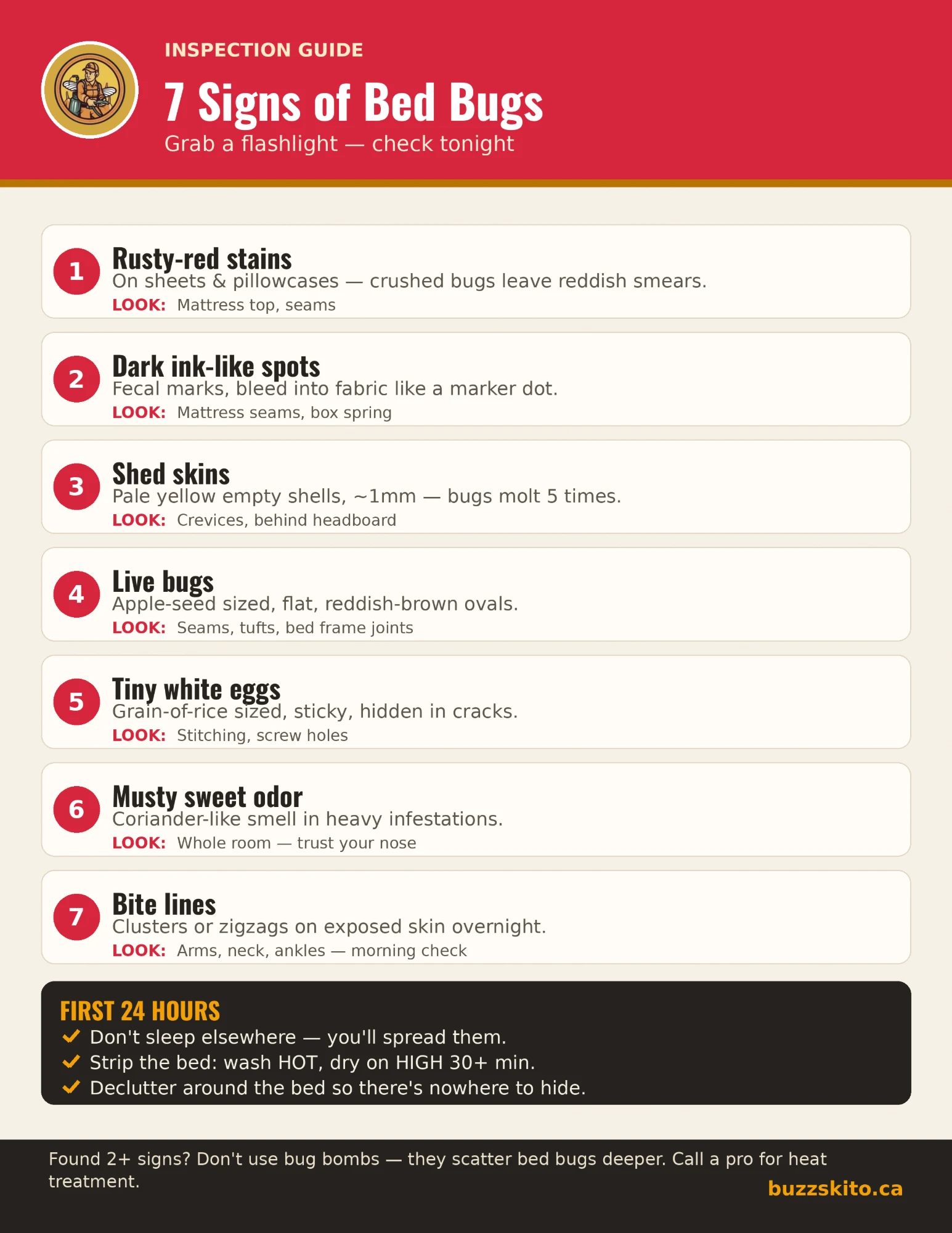 Signs of Bed Bugs: A 7-Point Checklist to Run TonightThe seven signs of bed bugs, from live bugs and ink-like spots to bites, with where to look tonight, what each is…
- Bed Bug Control Canada 2026 — The Complete DIY Treatment HubThe complete Canadian bed-bug control hub: the heat-plus-residual plan that actually works, every tool explained…
- Best Natural Bed Bug Spray Canada 2026 — Plant-Based, Non-Toxic & PMRA-Legal PicksThe best natural, plant-based bed bug sprays in Canada for 2026: EcoRaider vs Proof vs Doktor Doom, why PMRA…