
BuzzSkito Mosquito & Tick Control Specialists · Published July 21, 2026
PackTite Closet vs ZappBug Room: The Short Version
These two chambers dominate the “which heater kills bed bugs in my belongings” conversation in Canada for a simple reason: they solve the same problem — killing bed bugs throughout portable items by surrounding them with lethal heat — but they are built around two different shapes of that problem. The ZappBug Room is the large-capacity, do-everything heat chamber: a tall soft-walled cube you fill with a mixed pile of luggage, totes, shoes, and clothing and treat in a small number of cycles, with placed probes to confirm the kill. The PackTite Closet is the specialist: an upright hanging chamber designed so garments hang uncreased on a rail while hot air circulates around each one, and it folds flat into a closet when you are done.
The verdict is not close if you are treating a genuine infestation with a wide variety of belongings: the ZappBug Room wins because its capacity and probe-verified core temperature are exactly what turn an all-day job into a few confident runs. But “better for a broad infestation” and “better for hung clothing and compact storage” are different questions, and the PackTite Closet answers the second one well. The rest of this guide explains exactly why, starting with the spec everybody gets wrong.
Check current Canadian availability for each chamber:
The Air-Temperature Myth: Why the Wall Reading Does Not Kill Bugs
Walk into any heater-chamber comparison and you will find people quoting the maximum air temperature as if it were the whole story. For bed bugs, that instinct is backwards. The air inside any working chamber heats up fast — within minutes it can read well above the lethal threshold on the chamber wall. But bed bugs and their eggs do not live in the air; they live deep inside a stuffed suitcase, in the middle of a folded stack of clothing, in the spine of a boxed book. Those cores lag the air temperature badly, sometimes by an hour or more, insulated by the very fabric you are trying to treat.
What actually kills bed bugs is the coldest item’s core reaching a lethal temperature and holding it — heat energy transferred all the way through the densest object until its centre is hot enough, long enough. That is why a chamber’s wall thermometer is nearly useless as a kill indicator, and why the feature that matters most is a probe you can bury in the middle of the fullest bag and read directly. So when a listing leads with a big maximum-temperature number, read it as headroom, not as proof. The chambers separate on capacity, penetration, and verification — not on how hot the empty air gets.
Core Temperature: The Number on the Box vs the Number That Matters
Bed bugs and their eggs die at roughly 50°C (122°F) held long enough, and most careful protocols aim higher — around 55–60°C (131–140°F) — sustained for an hour or more once the coldest part of the load has reached that temperature. That last clause is the entire game. Both chambers can drive their air well past the kill threshold; the question is whether the centre of your densest item gets there and stays there.
This is where the ZappBug Room’s placed probes earn their keep. Tuck a probe into the middle of the fullest suitcase and you are no longer guessing — you watch the core climb, you start your hold-time clock only when it reaches target, and you keep it there for the full dwell. The PackTite Closet is perfectly capable of reaching lethal temperatures too, but because its strength is hung, spaced-out garments, the cold-core risk is naturally lower for its intended load — a single hung jacket heats through far faster than the centre of a packed duffel. The practical takeaway: with the ZappBug Room you get built-in verification for hard, mixed loads; with the PackTite Closet you should add an inexpensive probe thermometer to confirm any denser item you slip in.
Capacity and Shape: Matching the Chamber to Your Belongings
This is the honest heart of the decision, and it is not about which chamber is “stronger” — it is about which is shaped like your problem. The ZappBug Room is a large floor-standing cube. You open it, fill it with a mixed pile — a couple of suitcases, plastic totes of belongings, a pair of shoes, cushions, folded clothing, a small nightstand — and treat the whole lot in one or two runs. For a real infestation where the “stuff” you need to treat is a varied heap, that bulk capacity is transformative: fewer cycles, less standing around, and one confident sweep through your movable belongings.
The PackTite Closet is a narrow, upright hanging chamber. Garments hang from a rail exactly as they would in a wardrobe, so they stay uncreased and hot air flows freely around each one. For a treatment list that is mostly clothing, coats, suits, dresses, and linens, that shape is genuinely efficient — it holds a lot of hung items and heats them evenly without the cold-core problem that a stuffed pile creates. What it does not do well is swallow a mixed heap of bags and boxes; that is simply not its geometry. Choose based on your load: a varied bulk pile favours the ZappBug Room; a wardrobe’s worth of hung clothing favours the PackTite Closet.
Deep-Pile Penetration: Where Loose Loading Beats Stuffing
Whichever chamber you own, the enemy of a kill is a dense, tightly packed item that heat cannot reach into. Bed bugs survive not because the chamber is weak but because the middle of a solidly stuffed bag never got hot. The ZappBug Room’s advantage here is space: its volume lets you load loosely, leaving gaps for hot air to circulate around and into every item, which is exactly how you drive heat to the core. The PackTite Closet achieves the same end differently — by hanging items apart so each garment is surrounded by moving air.
The failure mode is identical for both: overloading. Cram either chamber solid and you heat the outer surfaces fast while leaving cold pockets in the centre where bugs and eggs live on. That is why loose loading, opened suitcases, unfolded bundles, and spaced stacks matter more than raw wattage. A large chamber loaded loosely beats a large chamber stuffed to bursting every time — and it is the single most common reason a DIY heat treatment leaves survivors.
Storage and Portability: The Quiet Feature for Travellers and Small Homes
Between infestations, a heater chamber is a large object you have to put somewhere, and this is where the PackTite Closet quietly wins its own category. It folds flat and tucks into a closet corner, which matters for apartment dwellers and anyone short on storage — and its clothing focus makes it a natural companion for frequent travellers who want to heat-treat garments and a suitcase after a trip without dedicating a room to a giant cube. The ZappBug Room collapses down too, but it is a bigger object to stow, reflecting the bigger job it is built for.
None of this makes the ZappBug Room impractical — most people treating an active infestation happily accept a larger stored footprint in exchange for treating everything at once. But if your reality is a small home, a recurring travel-borne worry, or a problem that is mostly clothing, the PackTite Closet’s compact storage and hung-garment focus are real, practical advantages rather than afterthoughts.
Where the PackTite Closet Actually Wins
None of this makes the PackTite Closet a lesser machine — it wins its own real categories, and for a lot of buyers those categories matter more. It is purpose-built for hung clothing, which it treats uncreased and evenly, with a lower cold-core risk than any stuffed cube. It folds flat for compact storage, which is a genuine advantage in apartments and for travellers. And its narrower, targeted design means you are not paying for — or storing — capacity you will not use if your problem is mainly a wardrobe.
So if bed bugs reached your clothing, coats, and linens more than your luggage and boxes, or you want a chamber that disappears into a closet between uses, the PackTite Closet is the smarter, more proportionate spend. You simply accept the trade: it is not the tool for a varied bulk pile, and for any denser item you slip in you should add a probe thermometer to confirm the core. The ZappBug Room is the better bulk-infestation chamber; the PackTite Closet is the better clothing-and-storage chamber. For the broader field of options — ovens, luggage bags, and closet units alike — see our dedicated best bed-bug heat chamber in Canada guide.
How to Choose: What You Are Actually Paying For
Heater chambers span a real price range, and the gap between these two reflects different priorities. Here is where the money goes, and which parts of it earn their cost for your situation specifically:
- Bulk capacity (pay for this if you have a varied infestation). A large cube treats a mixed heap of belongings in fewer cycles. It is the single biggest time-saver for a real, broad infestation — and the main reason the ZappBug Room commands its price.
- Core-temperature verification (pay for this — or add it). Placed probes are the difference between a confirmed kill and a hopeful one. The ZappBug Room includes them; on any chamber that does not, buy an inexpensive probe thermometer and treat it as mandatory, not optional.
- Load-shape fit (match this to your belongings). Hung clothing favours the PackTite Closet; mixed bags and boxes favour the ZappBug Room. Buying the wrong shape means more cycles or items that will not fit at all.
- Compact storage (pay for this if space or travel matters). A flat-folding, closet-friendly chamber is worth real money in an apartment or for a traveller. Irrelevant if you have a basement to store a large cube in.
- The correct Canadian 120V unit (non-negotiable on either). Buy the Canadian listing for the right plug, safe operation, and warranty you can claim. A grey-market import can underperform or void support.
Read that as a spending map. If you are fighting a broad infestation and want confident, probe-verified bulk treatment, put your dollars into the ZappBug Room. If your problem is mainly clothing and you value a chamber that folds away, the PackTite Closet gives you targeted capability for less — you pay the difference back by matching your load to its shape and adding a probe for anything dense.
The Winner — and How to Use It
For a real bed-bug infestation, the ZappBug Room is our pick. A chamber is only the bulk-item step, though, so use it inside a plan. Vacuum first with a sealed-HEPA vacuum to physically remove live adults and debris from the bed and room. Steam the mattress, frame, and baseboards with a bed-bug steamer for everything fixed in place. Run the chamber for all the portable belongings — clothing, bedding, luggage, shoes, and boxes — loading loosely and reading a probe in the coldest item every run. For suitcases specifically while you travel, a luggage-sized heater or the ZappBug heater line is the portable companion. Then place interceptor traps under the bed legs so you can see, week over week, whether the numbers are dropping. For the underlying heat-vs-chemical logic, our heat vs chemical treatment guide and steamer vs heater comparison lay out where each tool fits.
As an Amazon Associate I earn from qualifying purchases. Price shown on Amazon.ca, at no extra cost to you.
🏆 Winner — Best for a Broad Infestation
9.0/10· BuzzSkito ratingZappBug Room Bed-Bug Heater Chamber
The ZappBug Room wins the head-to-head for a real infestation. Its large collapsible cube bulk-treats luggage, boxes, shoes, and armfuls of clothing in a small number of cycles, and its placed temperature probes let you confirm the coldest item's core actually reached a lethal temperature rather than trusting the air reading on the wall. Load it loosely for full penetration and it turns an all-day job into a few confident runs. The PackTite Closet remains the better pick if your problem is mainly hung clothing and you value a chamber that folds flat into a closet.
Pros
- Large capacity for mixed bulk loads
- Placed probes verify the coldest core
- Loose loading drives heat to the centre
- One or two runs treat a whole infestation
Cons
- Premium price
- Bulky to store even when folded
Frequently Asked Questions
PackTite Closet vs ZappBug Room — which one should I buy for bed bugs?+
For most Canadian households treating a real bed-bug infestation, the ZappBug Room is the stronger pick. It is a large collapsible heat chamber you can load with luggage, boxed belongings, small furniture, and armfuls of clothing at once, and it ships with multiple placed temperature probes so you can confirm the coldest spot inside actually reached a lethal temperature. The PackTite Closet is a clever, space-saving hanging chamber built around treating hung clothing, jackets, and linens, and it excels at exactly that — but its shape limits what you can pack and how deeply heat penetrates a dense pile. Buy the ZappBug Room if you want to bulk-treat a wide mix of belongings and want probe-verified kills; buy the PackTite Closet if your problem is mainly clothing and hung items and you value a chamber that folds flat into a closet corner.
What temperature and how long does it take to kill bed bugs in a heater chamber?+
Bed bugs and their eggs die when the item itself — not just the surrounding air — is held at roughly 50°C (122°F) or hotter for long enough, and most protocols aim higher, around 55–60°C (131–140°F), sustained for an hour or more once the coldest part of the load reaches that temperature. The critical phrase is "the coldest part of the load." The air in a chamber heats up quickly, but the centre of a stuffed duffel bag or a stack of books lags far behind, sometimes by an hour or more. That is why the number that matters is the reading at a probe buried in the densest item, not the temperature shown on the chamber wall. A good chamber gives you enough thermal headroom and enough placed probes to confirm the core got there and stayed there.
What is the real difference in capacity between the PackTite Closet and the ZappBug Room?+
They are built around different shapes of problem. The ZappBug Room is a tall, wide floor-standing cube — think of a large soft-walled box you can fill with suitcases, plastic totes, a nightstand, cushions, and stacks of folded clothing in a single run. The PackTite Closet is a narrow, upright hanging chamber designed so garments hang from a rail the way they would in a wardrobe, which keeps clothing uncreased and lets heat circulate around each item. If your treatment list is mostly hung clothing, coats, and linens, the PackTite Closet holds a surprising amount efficiently. If your list is a mixed pile of bags, boxes, shoes, and bulky soft goods, the ZappBug Room simply swallows more in fewer cycles.
Do both chambers come with temperature probes, and why does that matter?+
Verification is the single most important feature of a heat chamber, because heat you cannot confirm is heat you cannot trust. The ZappBug line is known for shipping with placed thermometer probes you tuck into the densest items so you can watch the core temperature climb and hold. That closes the loop: you are not guessing that the middle of the suitcase got hot, you are reading it. Confirm the exact probe count on the current listing before you buy. Whatever chamber you choose, if it does not include a way to read the temperature inside the load, buy an inexpensive oven-safe or wireless probe thermometer and bury it in the coldest item every single run. A chamber without core verification is a chamber you are trusting on faith.
Can either chamber treat a whole mattress or large furniture?+
No — and this is the boundary that trips people up. Both the PackTite Closet and the ZappBug Room are for portable belongings: clothing, bedding, luggage, shoes, books, toys, small electronics, and at most a small nightstand or chair that fits inside. Neither is built to heat a mattress, a box spring, a bed frame, or a sofa. Those large, fixed items are treated in place with a steamer for the surfaces and seams, or by a professional whole-room heat treatment for the entire room at once. Think of a heater chamber as the tool for everything you can carry to it, working alongside a steamer for everything you cannot.
Is the ZappBug Room worth the extra size and money over the PackTite Closet?+
If you are treating a genuine infestation with a wide variety of belongings, yes — the capacity and the probe-verified core temperature are exactly what turn a stressful all-day job into a small number of confident cycles. Bulk capacity means fewer runs, and placed probes mean each run is confirmed rather than hoped. If your problem is narrower — mainly clothing and hung items, or you travel and want something that folds flat into a closet — the PackTite Closet delivers targeted capability for that use without the floor space a large cube demands. The honest framing is not "which is better" but "which is shaped like your problem": broad mixed loads favour the ZappBug Room; hung clothing and tight storage favour the PackTite Closet.
How is a heater chamber different from a bed-bug steamer?+
They cover opposite halves of the same job. A steamer delivers pinpoint heat to surfaces you can reach — mattress seams, frames, baseboards, upholstery — and is the tool for treating the room and the furniture in place. A heater chamber surrounds items with hot air to kill bed bugs throughout an object all the way to its core, which is what you need for a stuffed suitcase, a pile of clothing, or a box of books that steam can never fully penetrate. Serious DIY treatments use both: the steamer for the bed and the room, the chamber for the movable belongings. Neither replaces the other, and skipping the chamber is a common reason bugs survive in packed-away items and re-infest weeks later.
Are the 120V Canadian units the same as the US ones, and does it matter?+
It matters a great deal. Both PackTite and ZappBug are US-designed products, and the heating element and wiring are built for a specific voltage. Buying the correct Canadian 120V listing gets you a unit rated for Canadian outlets, the right plug, and warranty support you can actually claim here. Grey-market imports or units intended for other electrical systems can underperform, trip breakers, or void warranty coverage. Heater chambers are appliances, not pesticides, so they carry no PMRA (Health Canada Pest Management Regulatory Agency) registration requirement — anyone can buy and use one — but you still want the properly rated Canadian unit for safety and support. Use the price-check links here to see the current Amazon.ca listings.
How do I load a heater chamber so nothing survives?+
Load for airflow, not for maximum stuffing. Heat kills only what it reaches, so pack items loosely enough that hot air can circulate around and into every piece. Unzip suitcases and open them, unfold thick bundles, loosen tightly rolled clothing, stand books slightly apart rather than in a solid brick, and leave gaps between items. Place a temperature probe in the densest, most insulated item — the centre of the fullest bag or the middle of the thickest stack — because that is the last place to reach lethal temperature. Start timing your hold only once that coldest probe reaches the target, and keep it there for the full recommended dwell. Overloading is the number-one cause of survivors: a chamber that is stuffed solid heats its surface fast but leaves cold cores where bugs and eggs live on.
What can I safely put in a heater chamber, and what should stay out?+
Safe to treat: clothing, bedding, linens, curtains, shoes, luggage, backpacks, books, papers, most toys, and many hard goods. Keep out anything heat-sensitive: candles, crayons, cosmetics and lipsticks, vinyl records, some plastics and adhesives, pressurised cans or aerosols, batteries and many electronics, chocolate and food, and anything with a low melting point or flammable content. When in doubt about a valuable or unusual item, leave it out and treat it another way — cold treatment in a freezer over several days, or professional advice. The whole benefit of a chamber is that it treats belongings without chemicals, but heat is indiscriminate, so protect the things that cannot take it.
Do I still need vacuuming, steaming, and traps if I own a heater chamber?+
Yes. A heater chamber is the bulk-item tool in a plan, not the plan itself. You vacuum first with a sealed-HEPA vacuum to physically remove live adults, nymphs, and debris from the bed and room. You steam the mattress, frame, and baseboards to kill what is fixed in place. You run the chamber for everything portable — the clothing, bedding, luggage, and boxes that steam cannot reach the core of. Then you place interceptor traps under the bed legs to monitor whether the population is actually dropping week over week. The chamber closes the gap for packed and movable belongings; the other tools close the gaps it cannot reach. Skipping any one of them is the usual reason a DIY treatment stalls.
Where can I buy the PackTite Closet and ZappBug Room in Canada?+
Both are available in Canada, most reliably through Amazon.ca, where you can confirm you are getting the 120V Canadian listing with the correct plug and warranty. Availability and exact model variants change through the season, so use the price-check links in this guide to see what is currently in stock for each. Buy early if you can — heat-chamber demand spikes when infestations peak, and the larger units in particular can sell through. Whichever you choose, buy the Canadian listing rather than a grey-market import so you get a properly rated unit and support you can actually claim.
Related Reading
- Best Bed-Bug Heat Chamber Canada — The Full Field Compared
- ZappBug Heater Review Canada
- ZappBug Room Review Canada — In Depth
- PackTite Closet Review Canada — In Depth
- Best Whole-Room Bed-Bug Heater Canada
- Best Bed-Bug Luggage Heater Canada — For Travellers
- Steamer vs Heater for Bed Bugs Canada
- Heat vs Chemical Bed-Bug Treatment Canada
- Best Bed-Bug Steamer Canada
- Best Sealed-HEPA Vacuum for Bed Bugs & Fleas Canada
- Best Pest Control Equipment Canada — The Device Hub
Keep reading
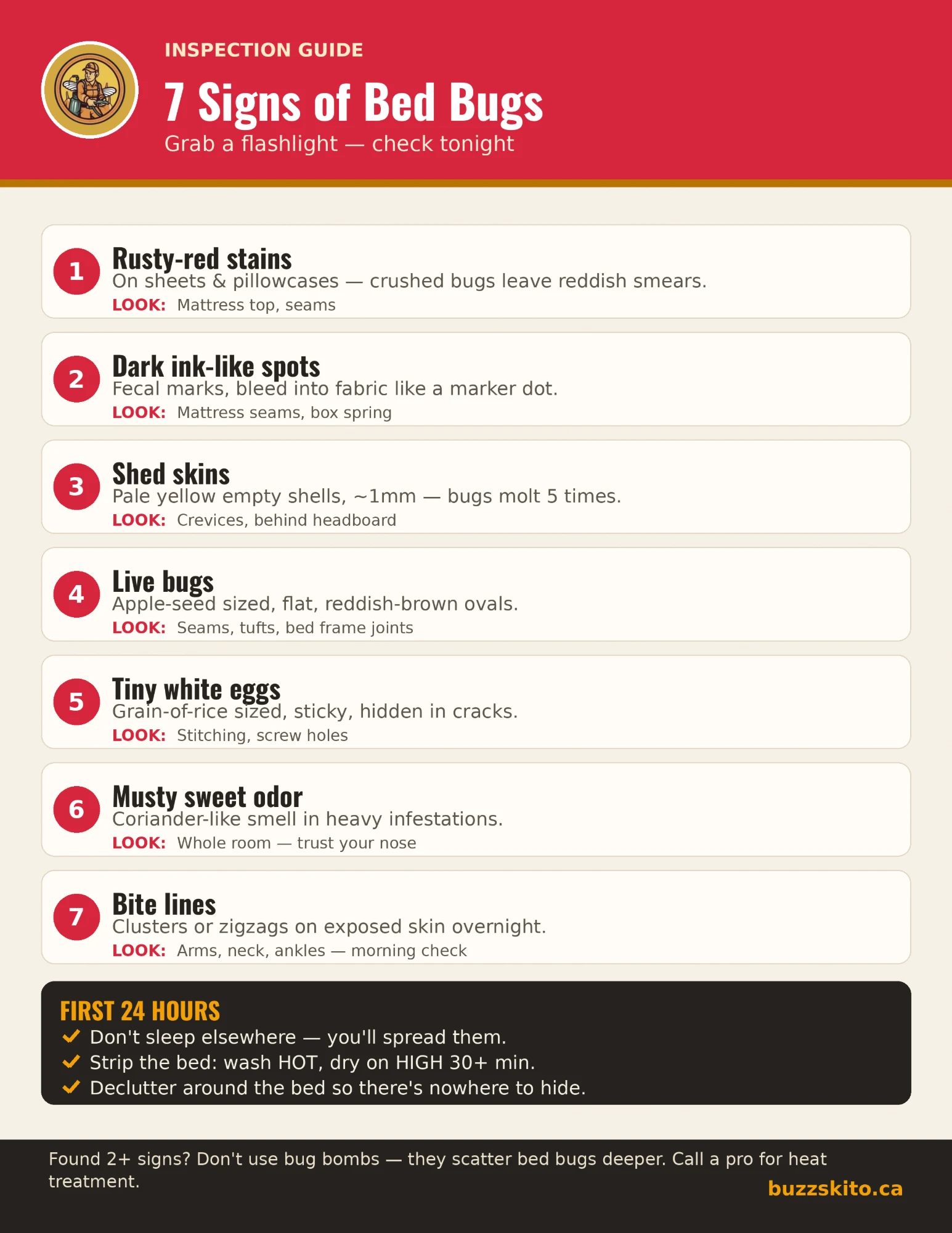 Signs of Bed Bugs: A 7-Point Checklist to Run TonightThe seven signs of bed bugs, from live bugs and ink-like spots to bites, with where to look tonight, what each is…
- Best Bed Bug Heater Canada 2026 — Heat Chambers That Kill Every Life StagePortable heat chambers kill bed bug adults, nymphs, and eggs in one cycle — no pesticide, no PMRA grey zone. ZappBug…
- Black Bed Bugs: Are Bed Bugs Black, or Is It Something Else?Bed bugs are reddish brown, not black. Why a fed bug looks dark, what the black spots on a mattress are, and the small…