
Reviewed by Alex Francisco
Published November 23, 2026 · Fact-checked against the sources listed below
What is the small black bug with white spots?
On a tree trunk or vine, a small black bug with white spots, often one of a crowd, may be a young spotted lanternfly. The USDA APHIS spotted lanternfly look-alikes fact sheet shows the nymphs at 1/8 to 1/4 inch, the early ones black with white spots and the later ones red with white spots and black stripes. The adult is about 1 inch long, with light brown, black-spotted front wings over red back wings.
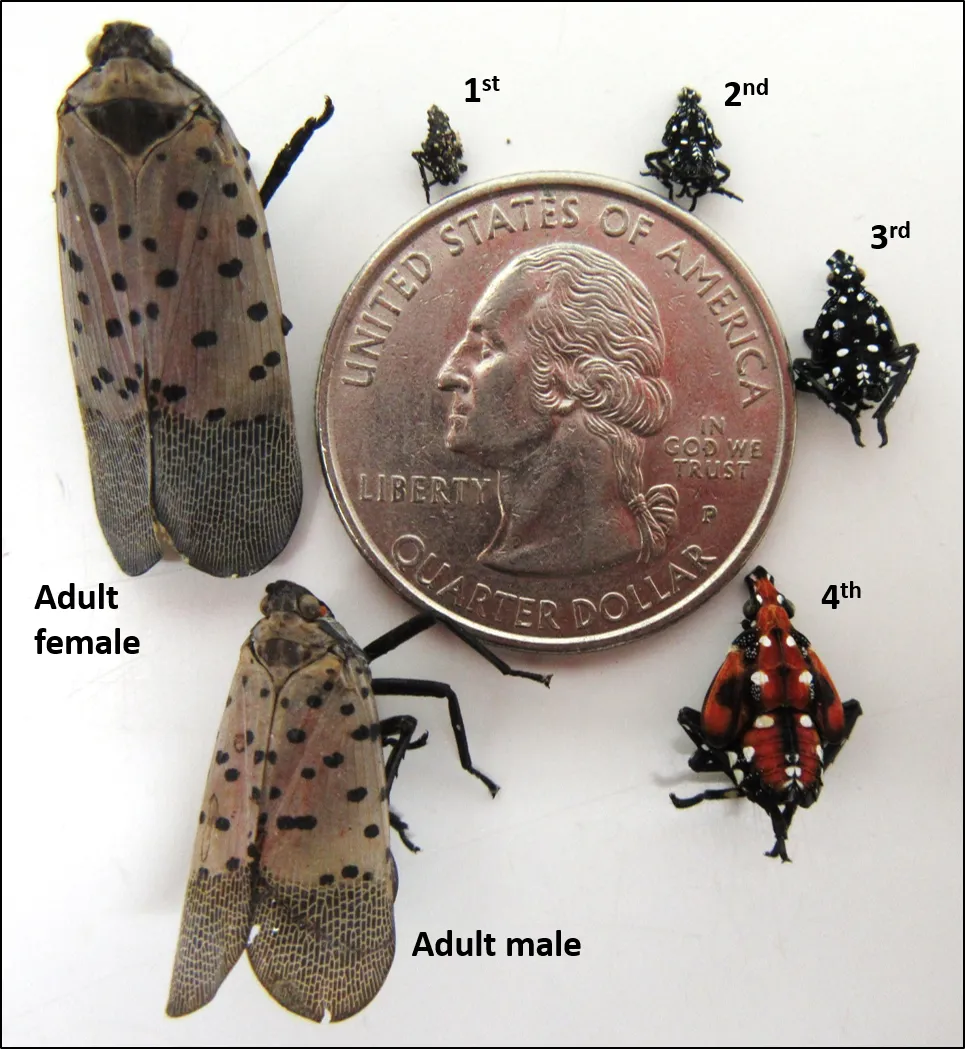
Where they feed is a strong clue. The USDA APHIS spotted lanternfly page says the insect feeds on grapevines, hops, stone fruit trees and hardwood trees, prefers tree-of-heaven, and that nymphs and adults often gather in large numbers when feeding. As of November 2026, that page listed populations in 20 states and the District of Columbia, from Georgia and South Carolina north to New Hampshire and west to Illinois and Michigan; check it for the current list and your state's contact.
Not every small black bug with white spots is a lanternfly. Indoors, a speck-sized round beetle flecked with white on a windowsill is likely a varied carpet beetle (below), and outdoors a black spider with white spots on its abdomen may be a bold jumping spider. The five-question pest identifier can help when the size and place do not fit anything here.
How do you tell which black and white bug you have?
Sort it in two steps: first the pattern, then where you found it. The pattern narrows the list to a few suspects, and the place often settles it.
| Pattern | Where you found it | Likely suspect | The one check |
|---|---|---|---|
| White spots on black | Tree-of-heaven, vines, hardwood trunks | Spotted lanternfly nymph | 1/8 to 1/4 inch; crowds of them |
| White spots on black, long antennae | Maples, hardwoods, firewood | Asian longhorned beetle | Shiny black; no white spot between the shoulders |
| White spots on black, long antennae | Pines and spruce, June and July | White-spotted sawyer | A white spot between the shoulders, at the base of the wing covers |
| Two big white-ringed eyespots | Wooded areas, May and June | Eyed click beetle | 1 to 1 3/4 inches long |
| Bold black and white blotches | Cottonwood and poplar trees | Cottonwood borer | About 1 to 1 3/4 inches long |
| Speckled or mottled, tiny | Windowsills indoors | Varied carpet beetle | Round, about 1/10 inch |
| Dark with a cream band | Pet food, bacon, cheese; near a dead bird or rodent | Larder beetle | Cream band across the front third of the wing covers |
| Black with white stripes, eight legs | Sunny walls and windows | Zebra jumping spider | Jerky walk; it jumps |
| Black with white markings and a white tail tip | Flying near a large paper nest | Bald-faced hornet | 3/4 to 1 inch; stay back |
| Black with white leg bands | Biting you by day, especially in shade | Asian tiger mosquito | Small, strikingly marked |
| One white dot on a small, flat body | On skin, clothes or a pet | Lone star tick female | Eight legs, no wings |
Compiled from the extension, USDA and CDC sources linked in the sections below.
Before you decide, check these
- Size against a coin. A quarter is about 1 inch across: lanternfly nymphs and carpet beetles are specks beside it, longhorned beetles are about as long as it or longer.
- Count the legs. Six means an insect; eight means a spider or a tick.
- Look at the antennae. As long as the body or longer points to a longhorned beetle; APHIS describes the Asian longhorned beetle's as black and white.
- Find the shoulder spot. A white spot between the shoulders, at the base of the wing covers, marks the white-spotted sawyer.
- Note the place and month. A tree-of-heaven trunk, pines in June and July, a windowsill in spring, or your skin after a walk each point to a different bug.
- Does it fly, jump or crawl? Hornets and mosquitoes fly, jumping spiders jump, and ticks crawl.
What is the big black and white beetle with long antennae?
A large black beetle with white spots and antennae longer than its body is a longhorned beetle. University of Wisconsin Extension says the native white-spotted sawyer is commonly mistaken for the Asian longhorned beetle, so check the spot between the shoulders, how shiny the beetle is and the tree it was on.
Asian longhorned beetle
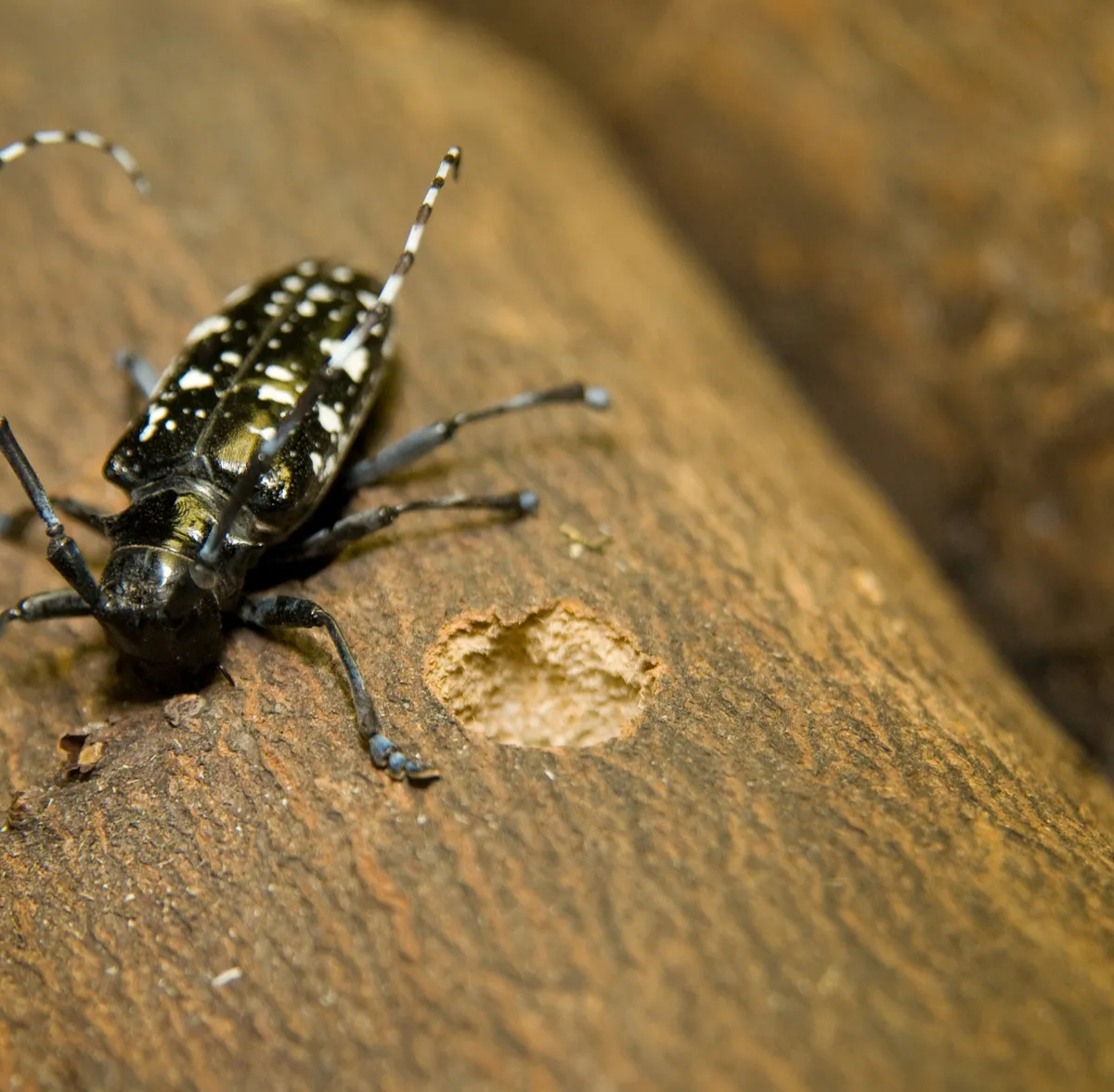
The USDA APHIS Asian longhorned beetle page describes a shiny black beetle with white spots, about the size of an almond, with black and white antennae longer than its body and feet that can look bluish. It attacks maple and other hardwood trees and kills them. Signs on a tree include round exit holes about the size of a dime or smaller, oval or round wounds chewed into the bark where eggs were laid, sometimes with weeping sap, and sawdust-like frass on the ground or on branches.
As of November 2026, APHIS lists survey and eradication work in four states: Massachusetts, New York, Ohio and South Carolina. It asks people to check their trees and not to move firewood out of quarantined areas.
White-spotted sawyer
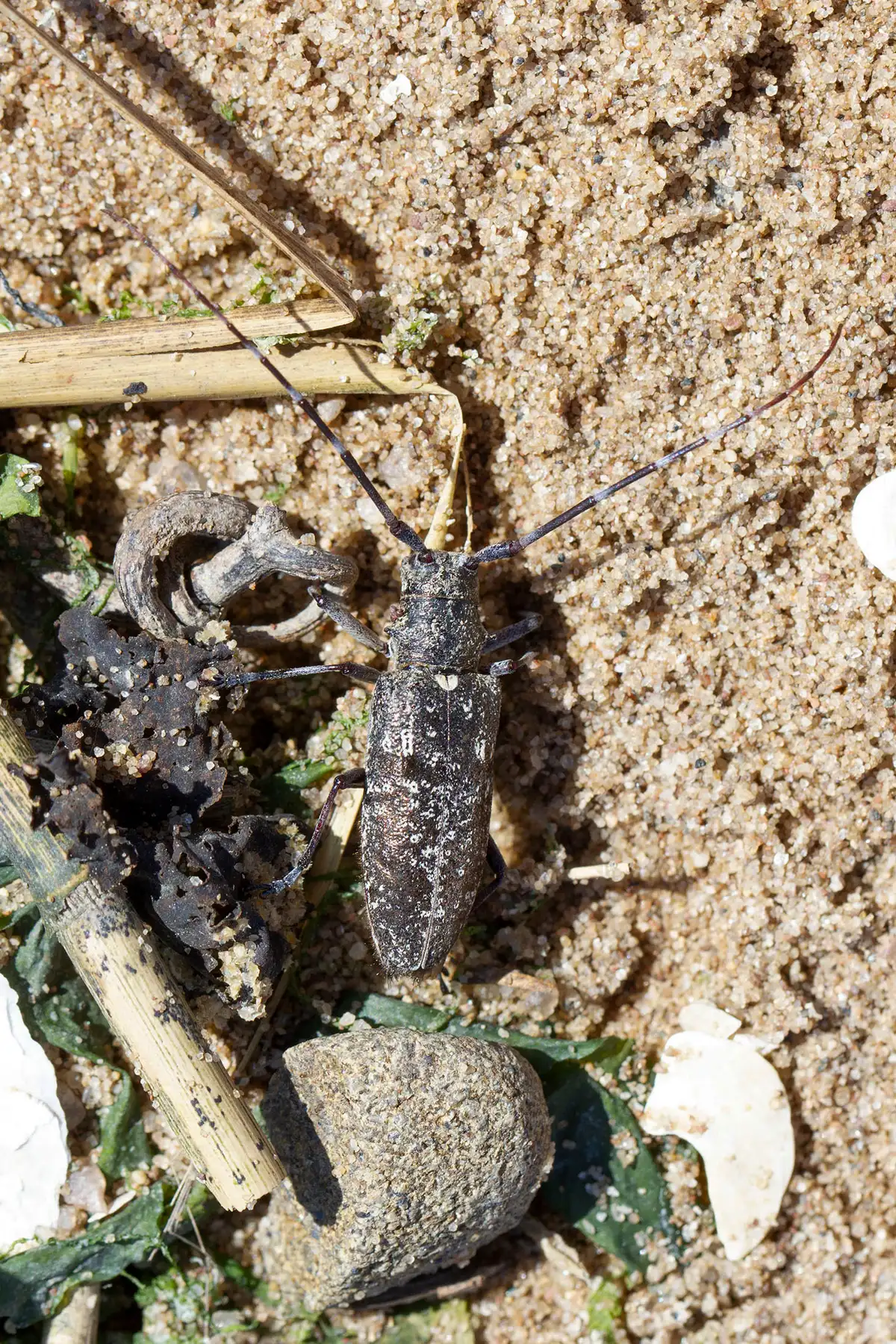
The white-spotted sawyer is 3/4 to 1 1/16 inch long, according to University of Minnesota Extension. Females are black mottled with small white spots, or entirely black, while males are all black, and every one has a conspicuous white spot at the base of the wing covers, near the head. It prefers white pine and also uses other pines and spruce, and adults are present in June and July.
That spot is the mark to check. University of Wisconsin Extension calls the sawyer a native wood-boring beetle, found throughout the Northeast and in the Northwest to Alaska, and says it is a bit smaller and duller than the Asian longhorned beetle and has a distinctive white spot between its shoulders. The sawyer also lives on conifers, while APHIS describes the Asian longhorned beetle as a pest of maples and other hardwoods. Wisconsin also notes reports of sawyers biting when handled, a bite it says feels similar to a bee sting, and advises caution in a close encounter. If you are still unsure which beetle you have, follow the APHIS reporting steps above.
Cottonwood borer
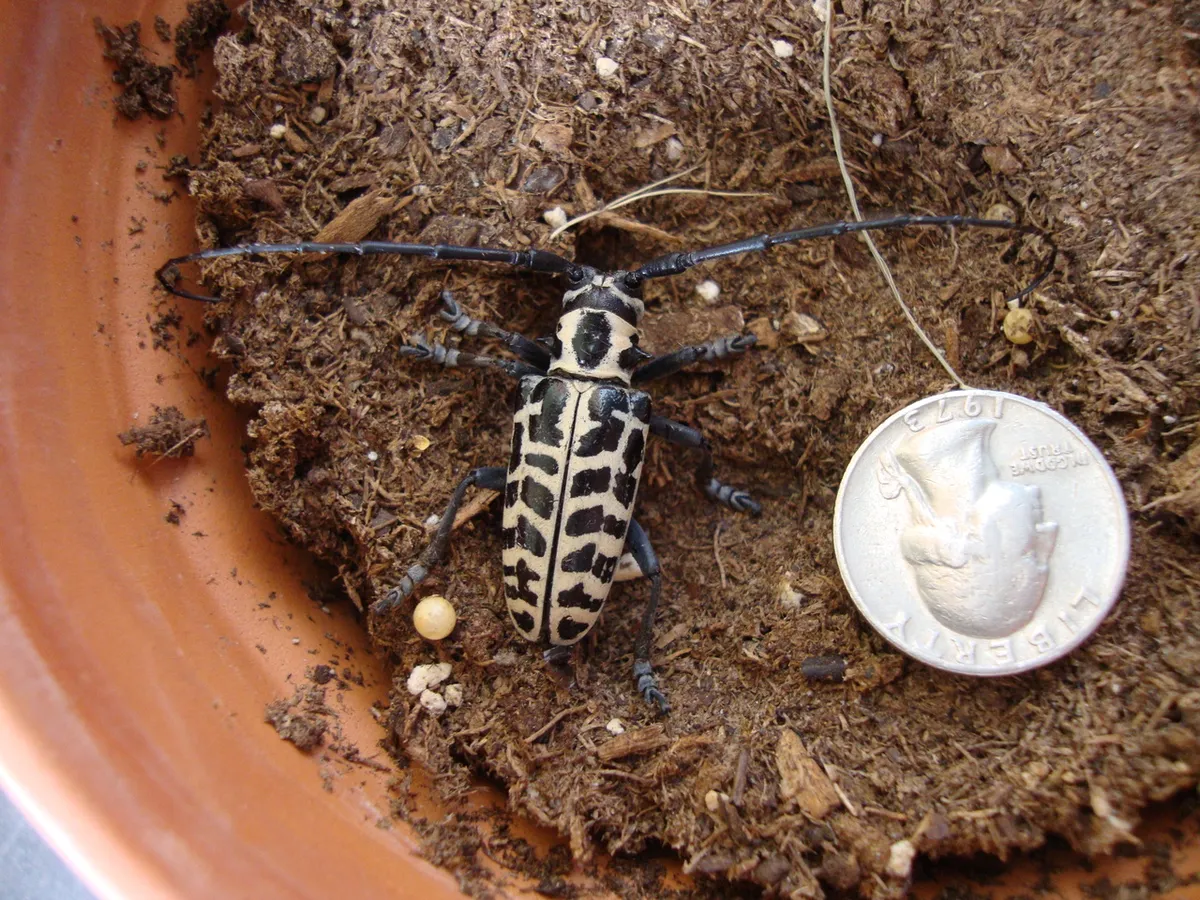
A big beetle with bold black and white markings near cottonwood or poplar trees is likely the cottonwood borer. The USDA Forest Service's cottonwood borer fact sheet calls it a striking black and white longhorned beetle, about 1 to 1 3/4 inches long, most common in the Great Plains from Texas to South Dakota and in the Mississippi River Valley. Cottonwoods and other poplars are its hosts, and occasionally willows. Adults emerge in summer (late June through mid-August in Kansas) and feed on leaf stems, new twigs and tender bark, which can make shoots break or shrivel and die; the larvae bore into the base and roots, and infested young nursery trees can die or break at the root collar.
What black and white bugs live on trees and firewood?
Besides the longhorned beetles above, two more big beetles turn up on tree trunks and in wooded areas: the eyed click beetle and, in Texas, the ironclad beetle. Woolly alder aphids add white fluff to alder branches and silver maple leaves.
Eyed click beetle
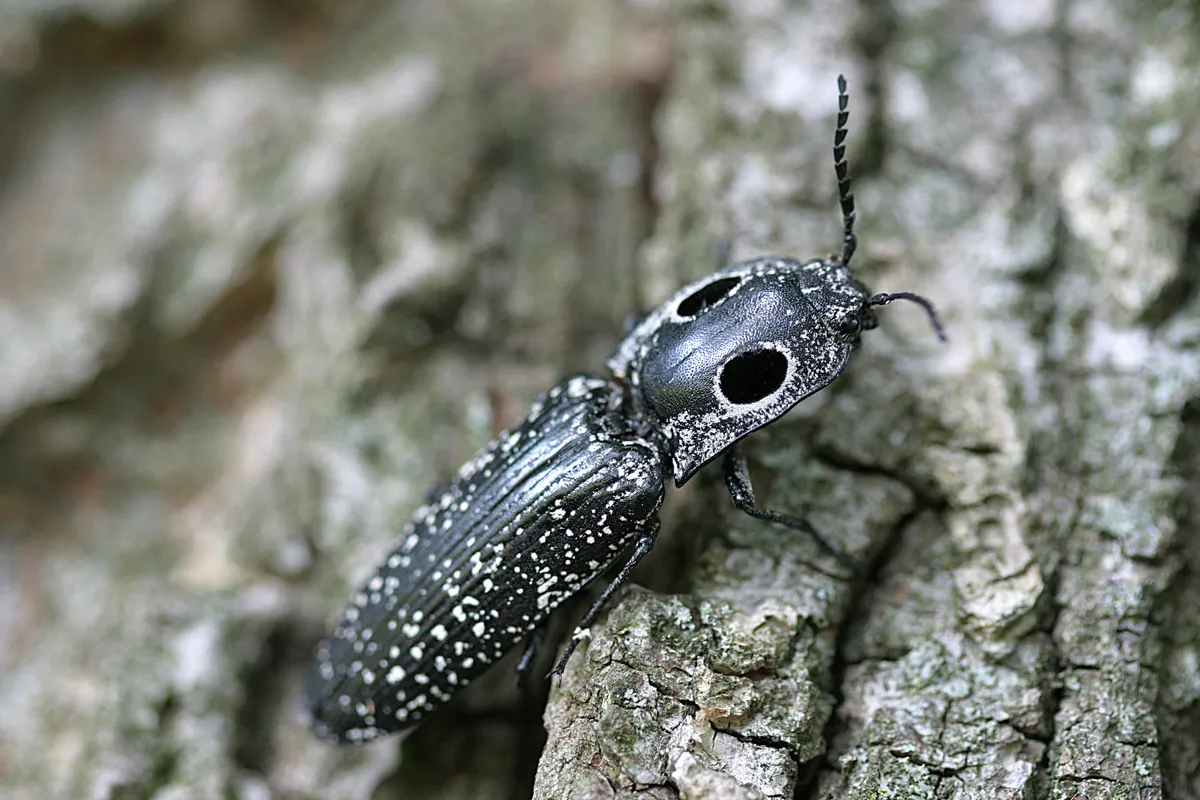
A long black beetle speckled with white and carrying two big false eyes is the eyed click beetle. University of Minnesota Extension gives it as 1 to 1 3/4 inches long, black mottled with small whitish patches, with two black eyespots ringed in white on the plate behind the head. It is common in wooded areas in May and June, and Minnesota calls it beneficial as a recycler of decaying wood.
Ironclad beetle
In east and central Texas, an inch-long beetle with a lumpy back that looks spattered with black paint may be the Texas ironclad beetle. The only description used here is Bug of the Week, a natural-history column from the University of Wisconsin-Milwaukee Field Station rather than an extension fact sheet. It describes an outer shell so strong that stepping on the beetle will probably not kill it, an all-black form as well as the speckled one, and adults seen on pecan, oak and elm trunks, with larvae in dead trees.
Woolly alder aphids
White fluff on alder branches or along the midveins of silver maple leaves, or small insects drifting through the air like bits of cotton, may be woolly alder aphids. Ohio State University's BYGL describes large, white fluffy colonies on alder branches and winged adults covered in waxy filaments that look like flying puffballs. They produce honeydew that sooty mold can grow on, but Ohio State says they cause little to no harm to the trees and that insecticide sprays are not warranted.
What are the tiny black and white bugs in my house?
A tiny, round black bug flecked with white on a windowsill is likely a varied carpet beetle; a larger dark beetle with a cream band near the pet food is likely a larder beetle. A black spider with white stripes on a sunny window frame is likely a zebra jumping spider.
Varied carpet beetle
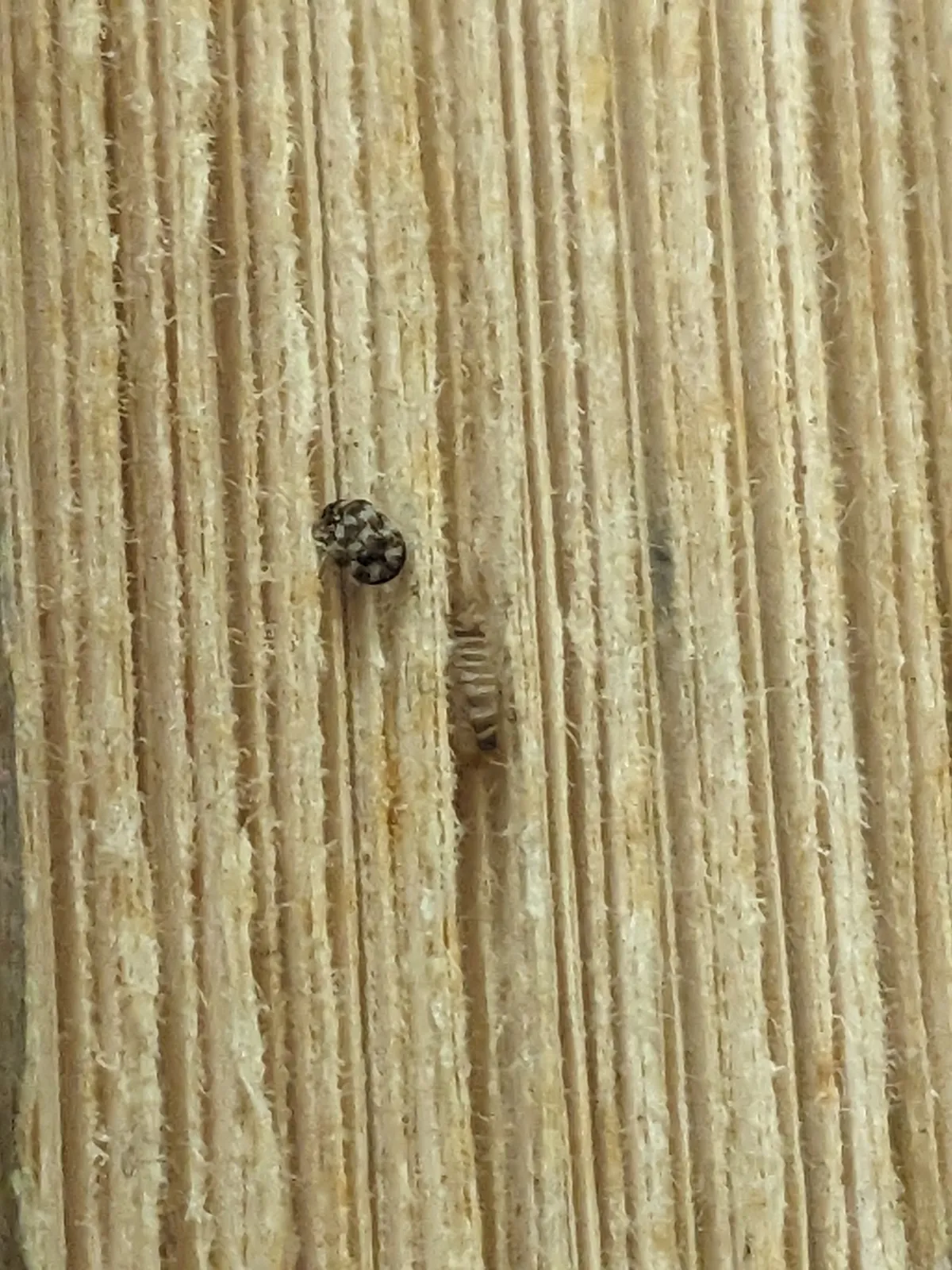
UC IPM's carpet beetle guide describes the adult varied carpet beetle as about 1/10 inch long and black with an irregular pattern of white, brown and dark yellow scales. Indoors the adults are usually seen near windows, on sills, drapes and panes; outdoors they feed on pollen and nectar from flowers such as crape myrtle and spiraea. The larvae do the damage, feeding on wool, silk, leather and other animal products.
UC IPM says a few adult beetles indoors should not be cause for alarm. If you keep finding them, look for the larvae and their shed skins with the guide to signs of carpet beetles, and see how to get rid of carpet beetles once you find where they breed.
Larder beetle
The Texas A&M AgriLife fact sheet on hide and larder beetles puts the larder beetle's genus at 1/4 to over 3/8 inch and dark brown to black, and says the larder beetle is easy to tell by a distinct cream-colored band across the top third of the wing covers, sometimes with three small black patches on each side. These beetles feed on leather, hides, dried fish, pet food, bacon, cheese and feathers, and home infestations are sometimes traced to dead birds or rodents, old bee nests or piles of dead insects. Mature larvae bore into wood, cork or plaster to pupate.
Zebra jumping spider
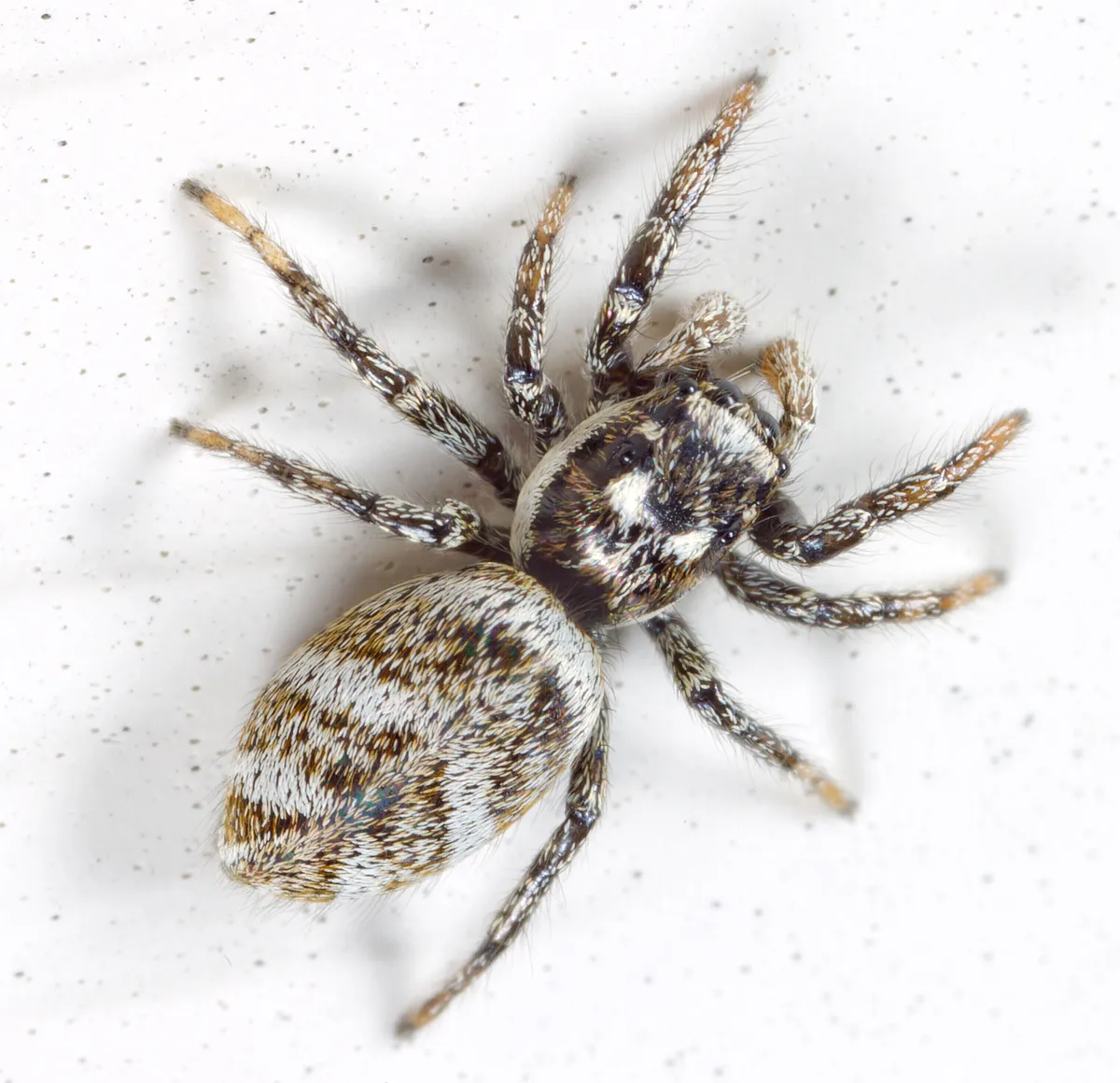
University of Minnesota Extension describes the zebra spider as about 1/4 inch long, compact, dark brown to black with white stripes, with two very large eyes among its eight; it moves in a jerky way, jumps, and turns up in and around buildings, especially at windows and other sunny spots in spring and summer. Penn State Extension says zebra jumpers do not have a medically significant bite and are considered beneficial to have around. The jumping spider guide covers the bold jumper too: a bigger black spider with white spots on its abdomen and iridescent green or blue mouthparts.
A white bug among dark cockroaches
A pale, almost white cockroach beside normal brown or black ones is not a separate species. UC IPM's cockroach guide says cockroaches are white right after molting and darken as their new outer covering hardens, usually within hours. The white cockroach guide explains what seeing one means.
What black and white bug bites or stings?
Of the black and white bugs people meet, the bald-faced hornet stings, and the Asian tiger mosquito and ticks bite. APHIS says a spotted lanternfly will not hurt you, and the sources for the beetles and woolly aphids above describe no bites or stings, with one exception: University of Wisconsin Extension notes reports of white-spotted sawyers biting when handled.
Bald-faced hornet
A black wasp with white markings that comes at you near a big paper nest is likely a bald-faced hornet. NDSU Extension describes it as about 3/4 to 1 inch long, black with light yellow to white markings and a white tip at the end of the abdomen, building large paper nests in tree branches and sometimes on roof peaks, and calls it very aggressive, stinging repeatedly if you get too close to the nest. Keep back from the nest; wasp vs hornet and the black and yellow bugs guide cover its relatives.
For most stings, MedlinePlus advises scraping out any stinger with the edge of a credit card, washing the spot with soap and water, and icing it in a washcloth, 10 minutes on and 10 minutes off. Call 911 if the person has trouble breathing or wheezing, swelling of the face or mouth, throat tightness or trouble swallowing, feels weak or turns blue.
Asian tiger mosquito
A small, strikingly marked black and white mosquito biting you in the shade during the day is likely the Asian tiger mosquito. Texas A&M's Mosquito Safari notes white bands on its legs and abdomen and says it bites readily by day, especially in shady areas, and breeds in water held in tires, buckets and cans. CDC describes it as black with white leg bands and white spots on the body, and says it can spread dengue, Zika and chikungunya, though, because it also feeds on animals, it is less likely to than its relative Aedes aegypti. The Asian tiger mosquito guide covers its range and bites.
Ticks with white marks
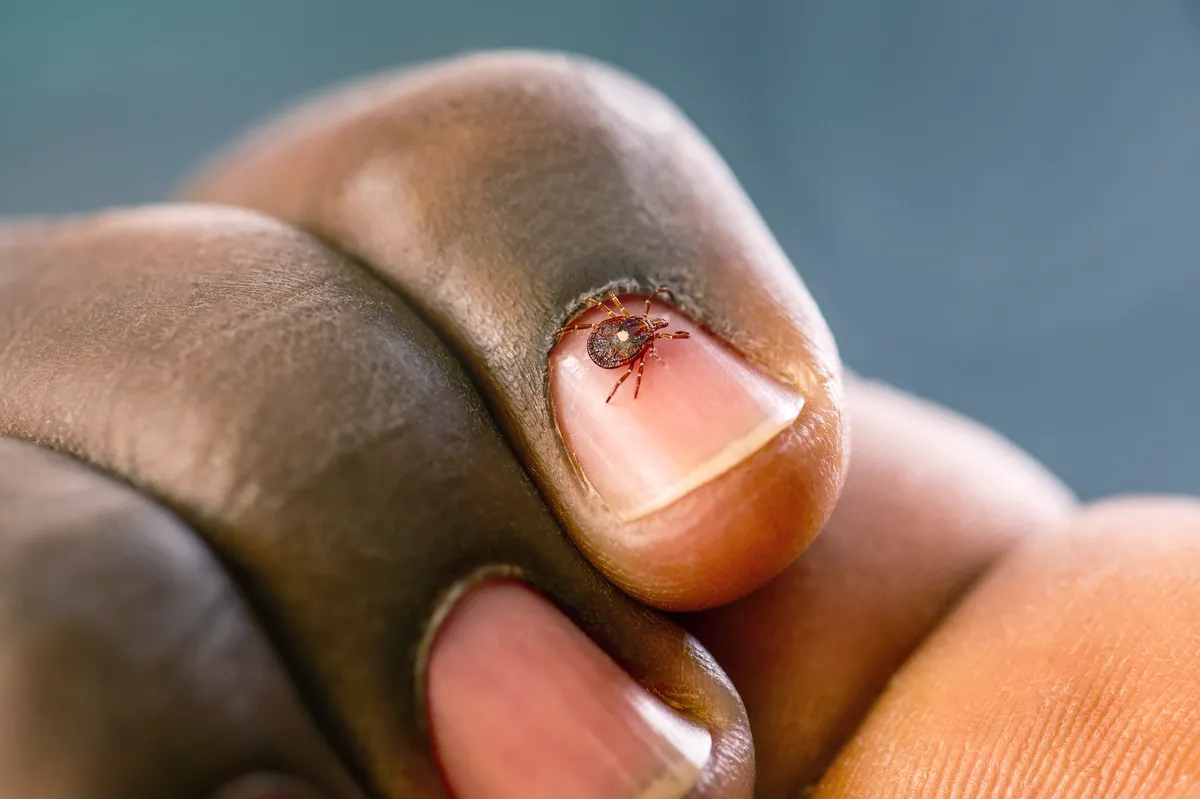
A small, flat, eight-legged bug with a white mark, found on your skin, clothes or a pet, is likely a tick. CDC's page on where ticks live says the adult female lone star tick has a white dot, the lone star, on her back, and that this tick is widespread in the Northeast, South and Midwest and can spread ehrlichiosis, tularemia and Heartland and Bourbon viruses. The American dog tick, widespread east of the Rocky Mountains, can spread Rocky Mountain spotted fever and tularemia, CDC says. Bugs that look like ticks sorts out the spiders, beetles and mites that get mistaken for them, and the American dog tick guide shows the pale, mottled markings on that tick's back.
Remove an attached tick as soon as you can. CDC's after-a-tick-bite guidance says to grasp it as close to the skin as you can with clean, fine-tipped tweezers and pull it away from the skin with steady, even pressure, without twisting or jerking, then clean the bite and your hands. Do not use petroleum jelly, heat or nail polish to make it let go. See a doctor if you get a rash or fever within several weeks. The lone star tick guide, what ticks look like and the tick identifier help you name it.
Commonly confused with
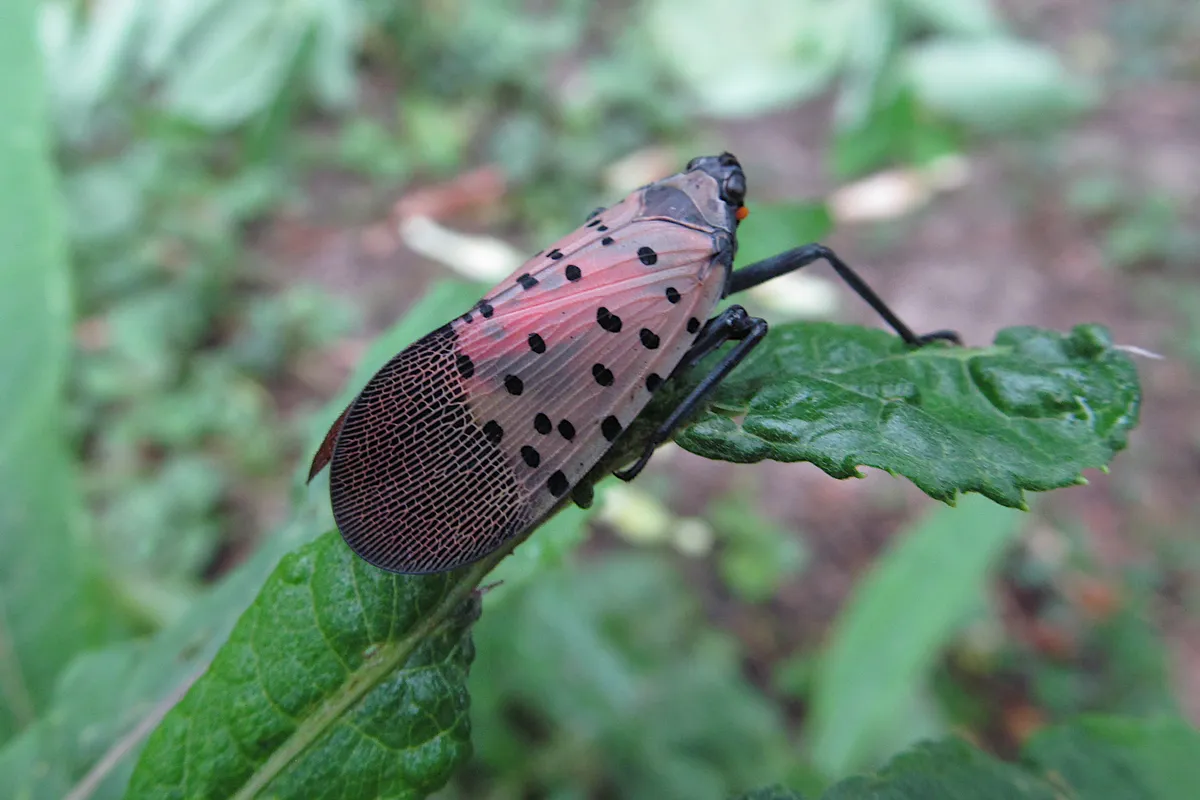 Spotted lanternfly adultAbout 1 inch; tan front wings with black spots over red back wings
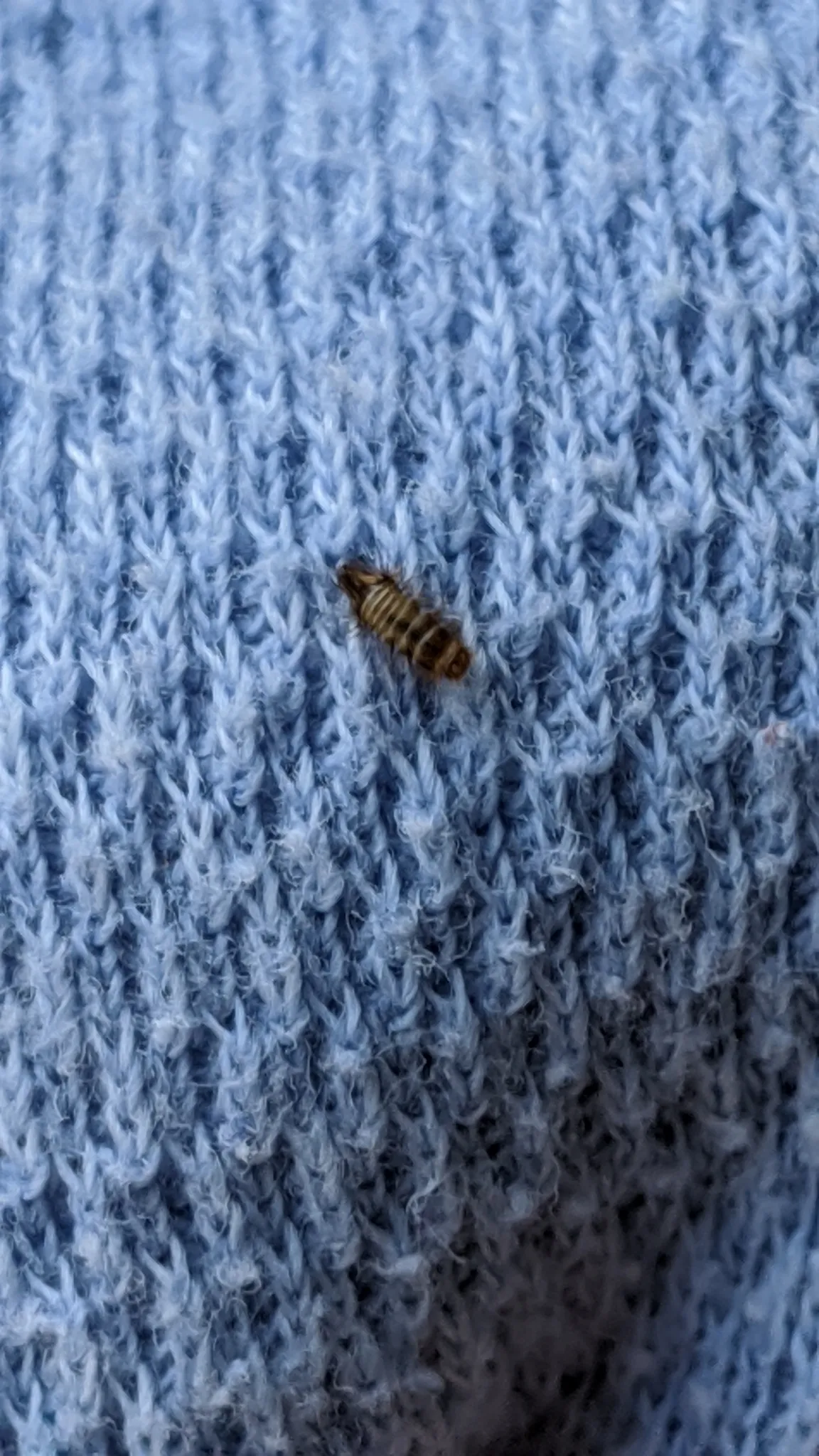 Carpet beetle larvaThe fuzzy larva, not the speckled adult, eats wool, silk and leather
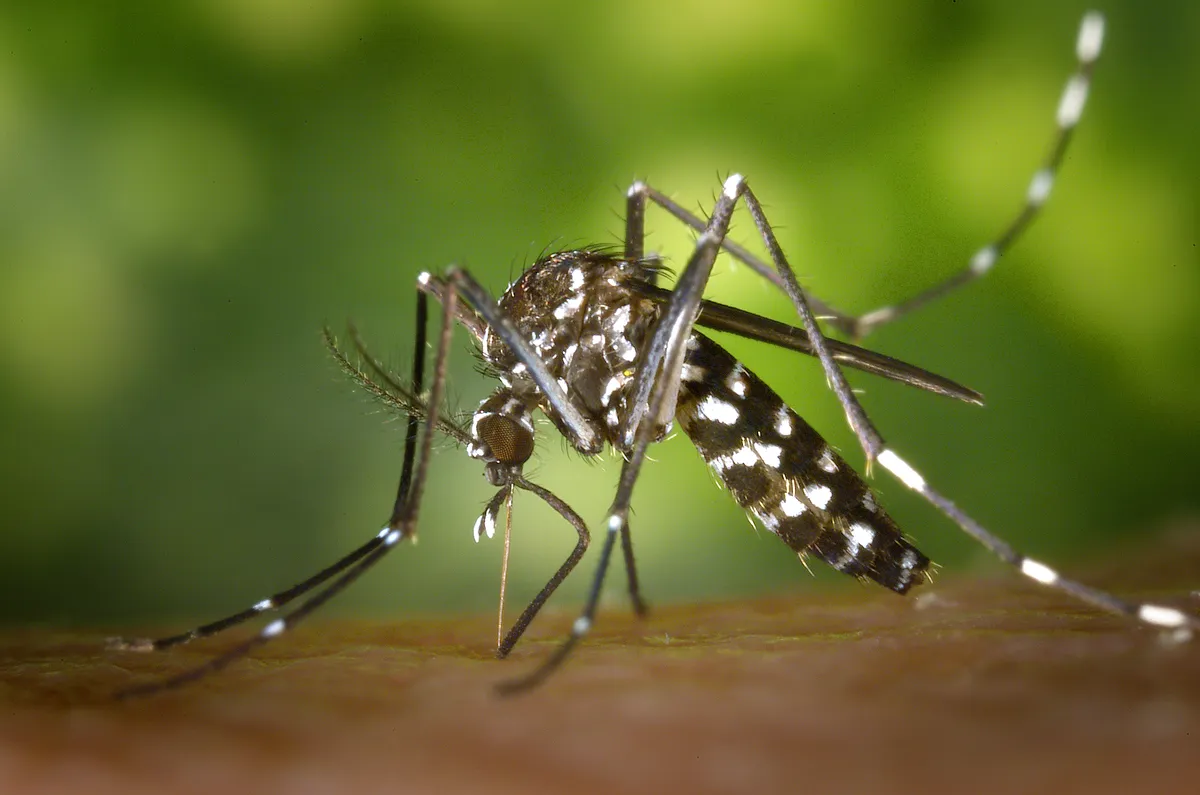 Asian tiger mosquitoSmall, black with white leg bands; bites by day, especially in shade
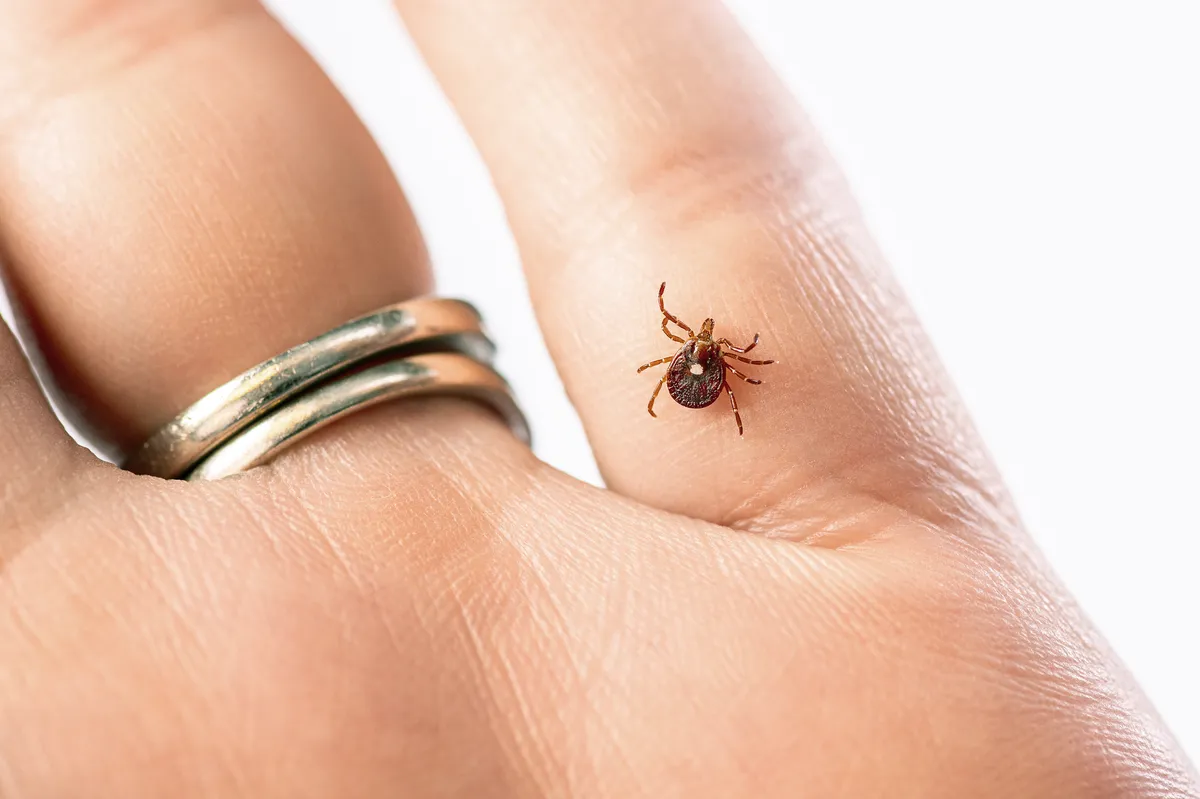 Lone star tickEight legs and one white dot on the female's back; found on skin or pets
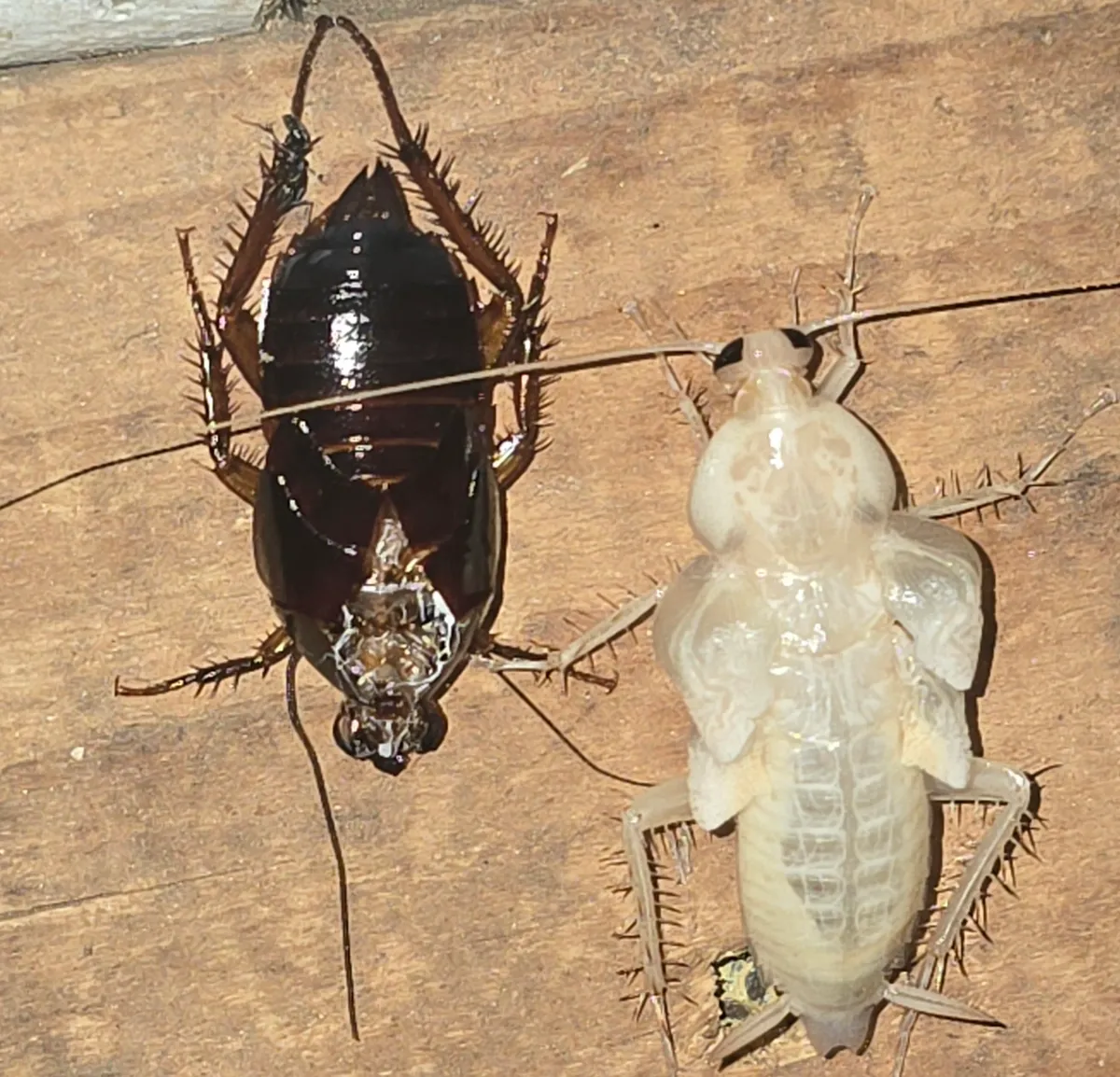 White cockroachA freshly molted roach: white at first, it darkens within hours
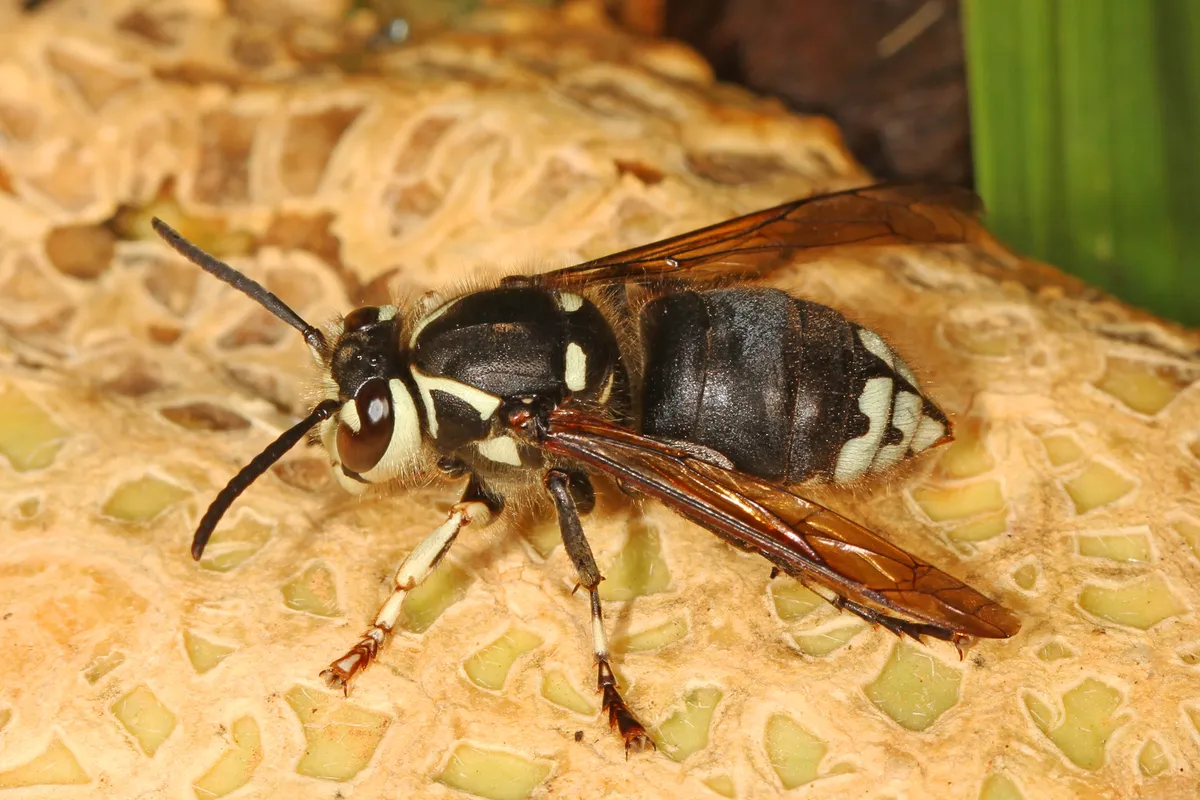 Bald-faced hornetBlack with white markings and a white tail tip; stings repeatedly near its nest
Photos: Spotted lanternfly adult: Cbaile19, CC0, via Wikimedia Commons, CC0 1.0. Carpet beetle larva: (c) Erin Lalime, some rights reserved (CC BY), via iNaturalist, CC BY 4.0. Asian tiger mosquito: CDC/ James D. Gathany; photo: James D. Gathany (CDC Public Health Image Library, phil.cdc.gov), public domain. Lone star tick: CDC/ Division of Vector-Borne Diseases Rickettsial Zoonoses Branch; photo: Lauren Bishop (CDC Public Health Image Library, phil.cdc.gov), public domain. White cockroach: no rights reserved, via iNaturalist, CC0 1.0. Bald-faced hornet: Judy Gallagher, CC BY 2.0, via Wikimedia Commons, CC BY 2.0.
What should you do once you know what it is?
What to do depends on the bug:
- Spotted lanternfly. Photograph it, note where you saw it and report it to your state department of agriculture, as APHIS asks.
- Asian longhorned beetle, or a sawyer you are unsure of. Photograph it, freeze it in a sturdy container if you can, and report it to APHIS or your state plant health officials; do not move firewood out of quarantined areas.
- Eyed click beetles, ironclad beetles and white-spotted sawyers in the woods. Leave them alone; the sources tie all three to dead, dying or decaying wood.
- Woolly alder aphids. Leave them; Ohio State says sprays are not warranted.
- Carpet and larder beetles indoors. Find the food source: animal fibers for carpet beetles, pet food, bacon, dried fish or a dead bird or rodent for larder beetles. The tiny black bugs guide sorts the plain black ones.
- Zebra and bold jumping spiders. Leave them or carry them outside in a cup.
- Bald-faced hornets. Keep your distance from the nest and keep children and pets away from it.
- Asian tiger mosquitoes. Empty standing water from buckets, tires and other containers, where they lay their eggs.
- Ticks. Remove them as soon as you can with clean, fine-tipped tweezers and watch for a rash or fever, as CDC advises.
This guide is general educational information, not medical advice. If you have symptoms or concerns after a bite or exposure, contact a healthcare provider.
Frequently Asked Questions
What is the small black bug with white spots?+
Outdoors on a tree trunk or vine, in a state that has the pest, it may be a young spotted lanternfly. USDA APHIS shows the nymphs at 1/8 to 1/4 inch, the early ones black with white spots, and says the insects often gather in large numbers on tree-of-heaven, grapevines and hardwood trees. Indoors, a speck-sized round beetle flecked with white on a windowsill is more likely a varied carpet beetle, which UC IPM puts at about 1/10 inch.
What is the black and white beetle with long antennae?+
A longhorned beetle. It may be the white-spotted sawyer, which University of Wisconsin Extension calls a native beetle commonly mistaken for the Asian longhorned beetle. University of Minnesota Extension puts the sawyer at 3/4 to 1 1/16 inch, says every one has a white spot at the base of its wing covers and lists pines and spruce as its trees. The invasive Asian longhorned beetle is shiny black with white spots, black and white antennae and bluish feet, and attacks maples and other hardwoods, according to USDA APHIS.
Is the Asian longhorned beetle dangerous to people?+
USDA APHIS describes it as a tree-killing pest: the beetle attacks and kills maple and other hardwood trees, and APHIS adds that infested trees can become safety hazards because branches can drop and trees can fall. Its page says nothing about the beetle biting or stinging. APHIS asks people to check their trees, avoid moving firewood out of quarantined areas, and report any beetle or damage they find, by calling its ALB hotline at 1-866-702-9938, through the online report form, or through their state plant health officials.
Should you kill a baby spotted lanternfly?+
USDA APHIS asks that you take a picture, note the location, and report a spotted lanternfly to your state department of agriculture before killing it, in states known to have the pest. If you think you have found one in a new state, APHIS says to capture it, put it in a jar and freeze it so state officials can identify it. The APHIS fact sheet notes the insect will not hurt you.
What is the black and white striped bug?+
On a sunny window or wall, a small black bug with white stripes and eight legs is likely a zebra jumping spider, about 1/4 inch long. A small black and white mosquito with banded legs that bites by day is likely the Asian tiger mosquito. A large wasp with white markings near a big paper nest is likely a bald-faced hornet, which NDSU Extension says stings repeatedly if you get too close to the nest.
What are the tiny black and white bugs in my house?+
A likely one is the varied carpet beetle, about 1/10 inch long and black with white, brown and dark yellow scales, usually found near windows. UC IPM says a few adults are no cause for alarm, but their larvae eat wool, silk and leather. A bigger dark beetle with a cream band across the front third of its wing covers, found near pet food or another animal product, is likely a larder beetle.
Do black and white beetles bite?+
Mostly not. None of the sources used here for the eyed click beetle, the cottonwood borer, the Asian longhorned beetle or carpet and larder beetles describes them biting people. The exception is the white-spotted sawyer: University of Wisconsin Extension notes reports of sawyers biting when handled, a bite it says feels similar to a bee sting, and advises caution in a close encounter. The black and white bugs that regularly bite or sting are the Asian tiger mosquito, ticks such as the lone star tick, and the bald-faced hornet, which stings.
What is the black bug with a white dot on its back?+
If it is small, flat and has eight legs, it may be a female lone star tick, which CDC says carries a single white dot on her back. Lone star ticks are widespread in the Northeast, South and Midwest. Remove an attached tick with clean, fine-tipped tweezers, pulling it away from the skin with steady, even pressure, and see a doctor if a rash or fever follows within several weeks.
What is the black and white flying bug?+
A wasp-sized flier with white markings and a white tail tip is likely a bald-faced hornet, about 3/4 to 1 inch long. A small black and white one that bites by day, especially in the shade, is likely an Asian tiger mosquito. Big black beetles with white spots and long antennae, such as sawyers and the Asian longhorned beetle, are winged too and are out in the warmer months; University of Minnesota Extension lists white-spotted sawyers in June and July.
What is the black beetle with two big eyespots?+
The eyed click beetle. University of Minnesota Extension describes it as 1 to 1 3/4 inches long, black mottled with whitish patches, with two black eyespots ringed in white on the plate behind its head. It lives in wooded areas, is common in May and June, and helps recycle decaying wood.
Sources
- Have You Spotted a Spotted Lanternfly? (APHIS-22-034) — USDA Animal and Plant Health Inspection Service
- Spotted Lanternfly — USDA Animal and Plant Health Inspection Service
- Asian Longhorned Beetle — USDA Animal and Plant Health Inspection Service
- Whitespotted sawyer — University of Minnesota Extension
- White-Spotted Sawyer Beetle — University of Wisconsin-Madison Division of Extension, Florence County
- Cottonwood Borer: Striking black and white longhorned beetle (Forest Health Protection, Rocky Mountain Region, 2011) — USDA Forest Service
- Eyed click beetle — University of Minnesota Extension
- Texas Ironclad Beetle (Bug of the Week) — UWM Field Station, University of Wisconsin-Milwaukee
- Woolly Alder Aphids — Ohio State University, Buckeye Yard and Garden onLine
- Carpet Beetles (Pest Notes) — University of California Statewide IPM Program
- Hide and larder beetles — Texas A&M AgriLife Extension, Insects in the City
- Zebra spider — University of Minnesota Extension
- Zebra Jumper — Penn State Extension
- Cockroaches (Pest Notes) — University of California Statewide IPM Program
- Insects That Look Like Bees (E1914) — NDSU Extension, North Dakota State University
- Insect bites and stings — MedlinePlus, US National Library of Medicine
- Types of Mosquitoes: Aedes albopictus (Mosquito Safari) — Texas A&M AgriLife Extension
- CDC's Most (un)Wanted Mosquitoes — Centers for Disease Control and Prevention
- Where Ticks Live — Centers for Disease Control and Prevention
- What to Do After a Tick Bite — Centers for Disease Control and Prevention
Read and approved by Alex Francisco. Found an error? Email support@buzzskito.ca.