BuzzSkito Mosquito & Tick Control Specialists · Published April 28, 2026
How to Identify an American Dog Tick
The American dog tick is the most visually distinctive tick species you’ll find in Canada. Three identifying features:
- Size: Adults are 5 mm long when unfed — about the size of an apple seed. After feeding for several days, they engorge to 15 mm (cherry pit sized) and turn grey-blue.
- Patterned shield (scutum): The dorsal shield has distinct mottled grey, white, and brown markings — almost ornamental looking. Females have markings on the front half only; males have markings covering the entire back.
- Long mouthparts: Visible from above, palpate-shaped. Longer than the blacklegged tick’s short mouth.
Compare to the blacklegged tick (deer tick): smaller (3 mm), plain reddish-black body, no patterned markings, and the medical concern (Lyme disease vector). See our full Ontario tick identification guide for visual differences.
Where They Live in Canada
American dog ticks are widespread across southern Canada with highest population density in:
- Southern Ontario (entire GTA, southern cottage country)
- Southern Quebec
- Southern Manitoba and Saskatchewan
- Maritimes (NB, NS, PEI)
- Parts of southern British Columbia (less common)
Their preferred habitats: grassy fields, meadows, hiking trails with tall grass, yard edges with unmowed vegetation, and brushy areas. They are NOT dense-forest specialists like blacklegged ticks. If your yard borders a meadow, agricultural field, or unkept brush — that’s prime American dog tick habitat.
Disease Risk in Canada — The Honest Numbers
Low risk for humans
- Rocky Mountain spotted fever: Theoretically possible but extraordinarily rare in Canada. Fewer than 5 confirmed cases per year nationwide.
- Tularemia: Extremely rare — most Canadian cases are in Indigenous communities of the prairie provinces with rabbit/rodent exposure.
- Lyme disease: Essentially zero — American dog ticks are not the Lyme vector in Canada.
Moderate risk for dogs
- Tick paralysis: A toxin from female saliva. If a tick remains attached for 4–7 days, dogs may develop progressive weakness, ascending from rear legs to front legs to respiratory paralysis. Treatment is removal of the tick — full recovery within 24–72 hours. Severe untreated cases can be fatal but are rare with modern preventatives.
- Babesiosis: A red blood cell parasite causing anemia. Rare but increasing.
- Ehrlichiosis: Possible but uncommon.
What to Do When You Find One
As an Amazon Associate, BuzzSkito earns from qualifying purchases. BuzzSkito only points to products we would genuinely use or recommend, at no extra cost to you.
As an Amazon Associate, BuzzSkito earns from qualifying purchases. Price shown on Amazon.ca, at no extra cost to you.
🏆 Our Top Pick — Tick Removal
8.6/10· BuzzSkito ratingFine-Tipped Tick-Removal Tweezers / Tick Twister Tool
Because the American dog tick has longer mouthparts than the blacklegged tick, a purpose-built remover that slides under the head and lifts straight out gives the cleanest pull — no squeezing the body, which is what raises infection risk. Keep one in the first-aid kit and one in the car for after trail walks.
Pros
- Slides under the head for a clean, body-free pull
- Inexpensive and lasts for years
- Compact — keep one indoors and one in the car
Cons
- Fiddly on very small nymphs
- Still need steady, even pressure — no twisting
On a human
- Use fine-tipped tweezers (or a Tick Twister tool). Because the American dog tick (Dermacentor variabilis) has longer mouthparts than the blacklegged tick, a purpose-built removal tool that slides under the head gives you the cleanest pull. Check tick-removal tools on Amazon.ca →
- Grasp the tick at the head, as close to skin as possible — NOT the body.
- Pull straight up with steady pressure. Don’t twist or jerk. Tick releases in 5–15 seconds.
- Clean the bite with rubbing alcohol.
- Save the tick in a sealed bag with a damp paper towel.
- Note the date and bite location. Watch for fever, rash, or fatigue over 14 days. See a doctor if anything appears.
Not sure which tool to buy? Our tick-removal tool guide compares fine-tipped tweezers, Tick Twister-style hooks, and tick keys so you can pick the right one before the next bite.
On a dog
Same removal technique. After removal, watch for: lethargy, weakness in rear legs progressing forward (potential tick paralysis), excessive licking at the bite site, fever, swollen lymph nodes. Contact your vet if any appear. See our detailed tick removal guide for dogs.
Yard Prevention — What Actually Works
For yards near grassy fields, meadows, or trails where American dog ticks live:
- Mow grass to 3 inches or less. Tall grass is tick highway.
- Remove leaf litter and brush from yard edges every spring and fall.
- Create a 3-foot wood chip or gravel barrier between lawn and any wooded/grassy area or trail.
- Discourage rodents — they’re the immature tick’s primary host. Don’t leave food out, store firewood off the ground.
- Daily tick checks on dogs and yourself after time in tick habitat.
- Vet-prescribed monthly tick preventative for dogs (Bravecto, NexGard, Simparica, K9 Advantix II).
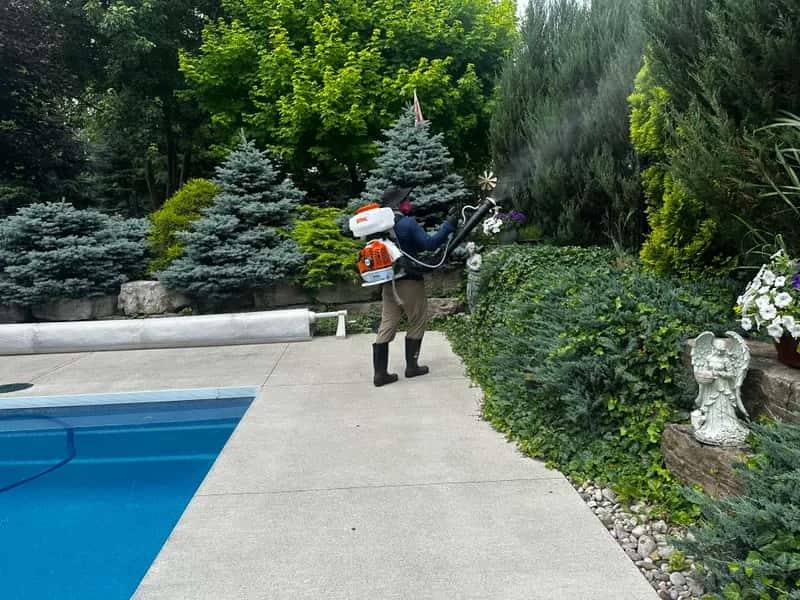
- Professional yard barrier spray. BuzzSkito’s 5-spray tick season program targets ticks at lawn edges, fence lines, and shaded perimeters where they actually live — both American dog ticks and blacklegged ticks. Spread over five applications because the treatment is residual, not permanent. $597 standalone or tick add-on bundle available on quote.
Related Reading
- Deer Tick vs Dog Tick — Canada Comparison
- What Ticks Look Like in Ontario
- Lyme Disease Prevention in Ontario
- How to Remove a Tick from a Dog
- BuzzSkito Tick Control Service
Frequently Asked Questions
What is an American dog tick?+
The American dog tick (Dermacentor variabilis) is one of the most common tick species in eastern Canada, including Ontario. Adults are 5 mm long when unfed (apple-seed sized) and engorge to 15 mm after a blood meal. Distinctive feature: a mottled grey-and-brown patterned shield (scutum) on the back, distinguishing them from the smaller, plainer blacklegged tick. They prefer dogs and large mammals as hosts but will bite humans. American dog ticks rarely transmit Lyme disease but can carry Rocky Mountain spotted fever (rare in Canada) and tularemia.
Are American dog ticks dangerous in Canada?+
In Canada, American dog ticks are a low-to-moderate disease risk compared to blacklegged ticks. They CAN transmit: Rocky Mountain spotted fever (very rare in Canada — fewer than 5 confirmed cases per year nationally), tularemia (extremely rare), and tick paralysis (rare, occurs only when an attached tick remains attached for 4-7 days, mostly in dogs). They do NOT typically transmit Lyme disease — that is the blacklegged tick (Ixodes scapularis). The bite itself can cause local irritation and infection if not removed properly.
Where are American dog ticks found in Canada?+
American dog ticks are widespread across southern Canada from British Columbia to the Maritimes, with highest density in southern Ontario, southern Quebec, southern Manitoba, and Saskatchewan. They prefer grassy fields, meadows, hiking trails, and yard edges with tall vegetation — NOT dense forests where blacklegged ticks dominate. In Ontario they are common across the entire GTA and rural areas. Peak activity: April through September, with two peaks (May–June and August–September).
How do I tell an American dog tick from a deer tick?+
Three key differences: (1) Size — adult American dog ticks are 5 mm unfed (apple-seed sized); blacklegged "deer" ticks are 3 mm unfed (sesame-seed sized). (2) Pattern — American dog ticks have a distinctive mottled grey-and-brown patterned shield. Blacklegged ticks have a plain reddish-black body with no pattern. (3) Disease risk — American dog ticks rarely carry Lyme; blacklegged ticks are the main Lyme vector in Canada. If you find a tick that looks like it has decorative markings on its back, it's probably an American dog tick.
How do you remove an American dog tick?+
Same as any tick: use fine-tipped tweezers or a Tick Twister tool. Grasp the tick at the head, as close to your skin (or your pet's skin) as possible. Pull straight up with steady, even pressure — do not twist, jerk, or squeeze the body. The tick will release in 5–15 seconds. Clean the bite with rubbing alcohol or soap and water. Save the tick in a sealed plastic bag with a damp paper towel for potential identification. Wash your hands. Do NOT use Vaseline, matches, or alcohol applied to the attached tick — these methods cause regurgitation and increase disease risk.
Can American dog ticks make my dog sick?+
Yes, though the risk is lower than with blacklegged ticks. Health risks for dogs from American dog ticks include: tick paralysis (a toxin from saliva that causes progressive weakness if a tick remains attached 4-7 days — resolves within 24-72 hours of tick removal), babesiosis (rare red blood cell parasitic disease), and severe local reactions to bites. Ehrlichiosis is also possible but uncommon. Use a vet-prescribed monthly tick preventative (Bravecto, NexGard, K9 Advantix II) for protection. Daily tick checks after walks in grassy areas remain essential.
When are American dog ticks most active?+
In Ontario, American dog ticks have two activity peaks per year: a primary peak from late April through June (highest density), and a secondary peak from August through October. They are most active on warm, dry days in grassy and meadow habitats. Adults overwinter in leaf litter and emerge when soil temperatures consistently exceed 4°C. Larvae and nymphs are active during summer but rarely bite humans (they prefer small mammals like mice).
How do I prevent American dog ticks in my yard?+
Habitat modification first: keep grass mowed under 4 inches, clear leaf litter from yard edges, create a 3-foot wood chip or gravel barrier between lawn and any tall grass, woods, or trails. For dogs: monthly vet-prescribed preventative + daily tick checks after outdoor walks. For yard-level control, professional barrier spray puts a Health Canada-registered residual acaricide on lawn edges, fence lines, and garden borders — the margins where both American dog ticks and blacklegged ticks actually wait for a host, rather than the open lawn. It is repeated through the season because wildlife keeps carrying new ticks onto the property; no treatment clears a yard permanently.