Reviewed by Alex Francisco
Published November 4, 2026 · Fact-checked against the sources listed below
Reading from Canada? Product rules and what is sold there differ. See the Canadian edition.
What does a lone star tick look like?
An adult lone star tick is a roundish, reddish-brown tick about 1/8 inch across, and the female carries a single white spot in the middle of her back. University of Illinois Extension gives that size, and the Connecticut Agricultural Experiment Station's Tick Management Handbook measures adults at about 3 to 4 mm and says the species is named for the conspicuous spot at the end of the female's shield.
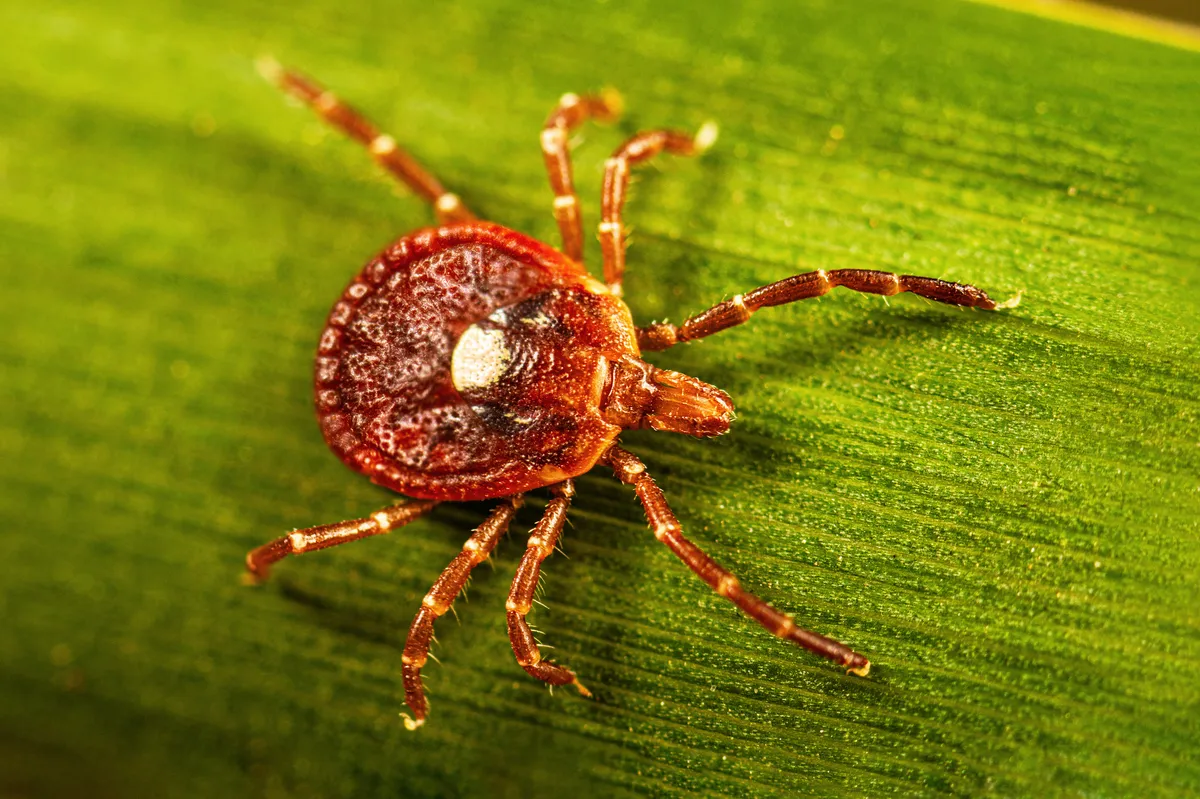
Up close, Texas A&M's tick identification guide describes the spot as often iridescent and anything from white to cream or gold to bronze, and measures unfed females at 4 to 6 mm, up to about 1/4 inch, a little larger than the Connecticut handbook does. Their long mouthparts are why the bite can hurt, the handbook notes.
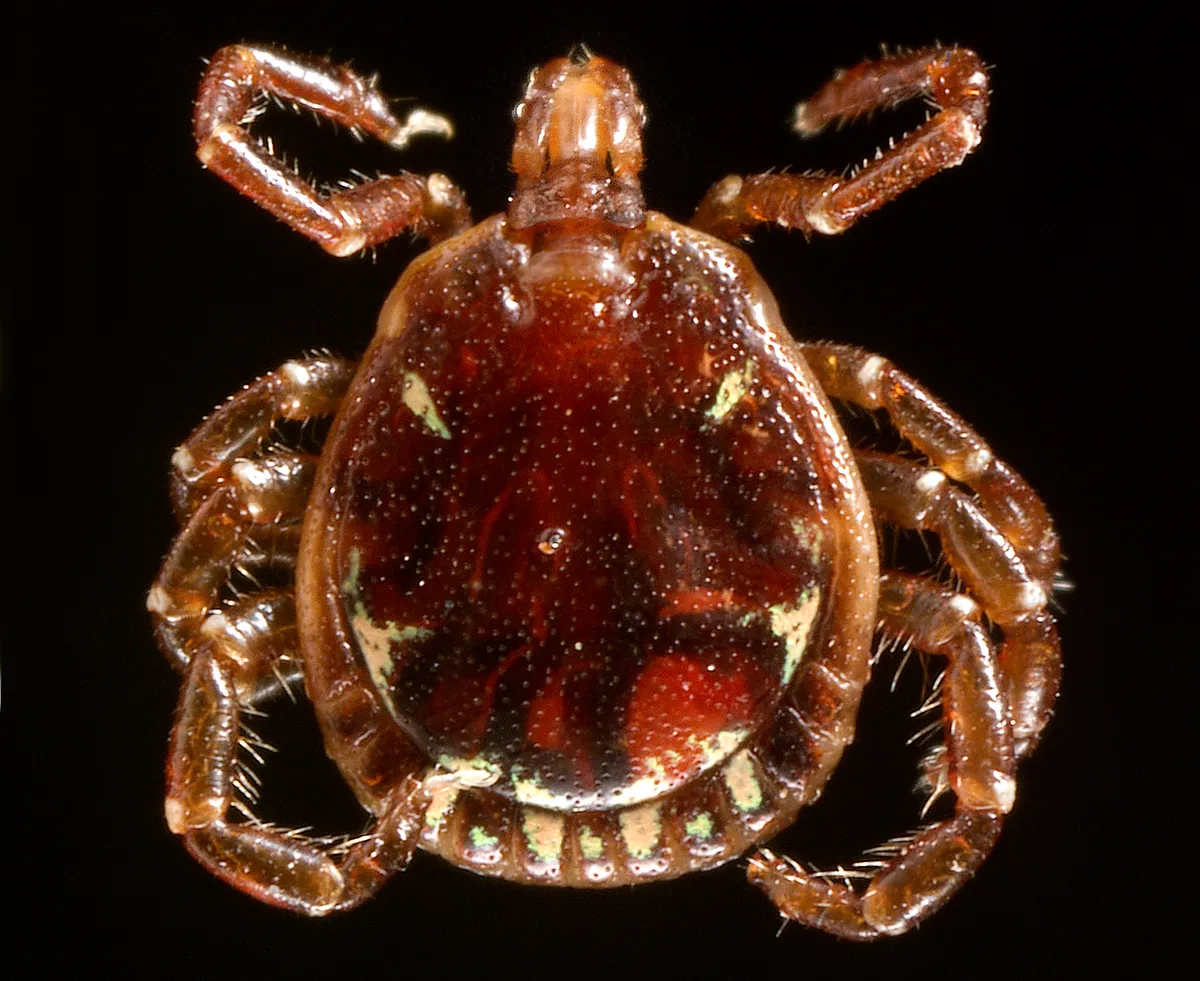
Males are marked differently, which trips people up: no single spot, just faint white streaks or spots around the edge of the back, as the Connecticut handbook and the University of Rhode Island's TickEncounter program describe. Texas A&M puts males at 2 to 5 mm, under 1/4 inch, fed or not; a male's shield covers almost his whole back, so he barely swells, the handbook explains.
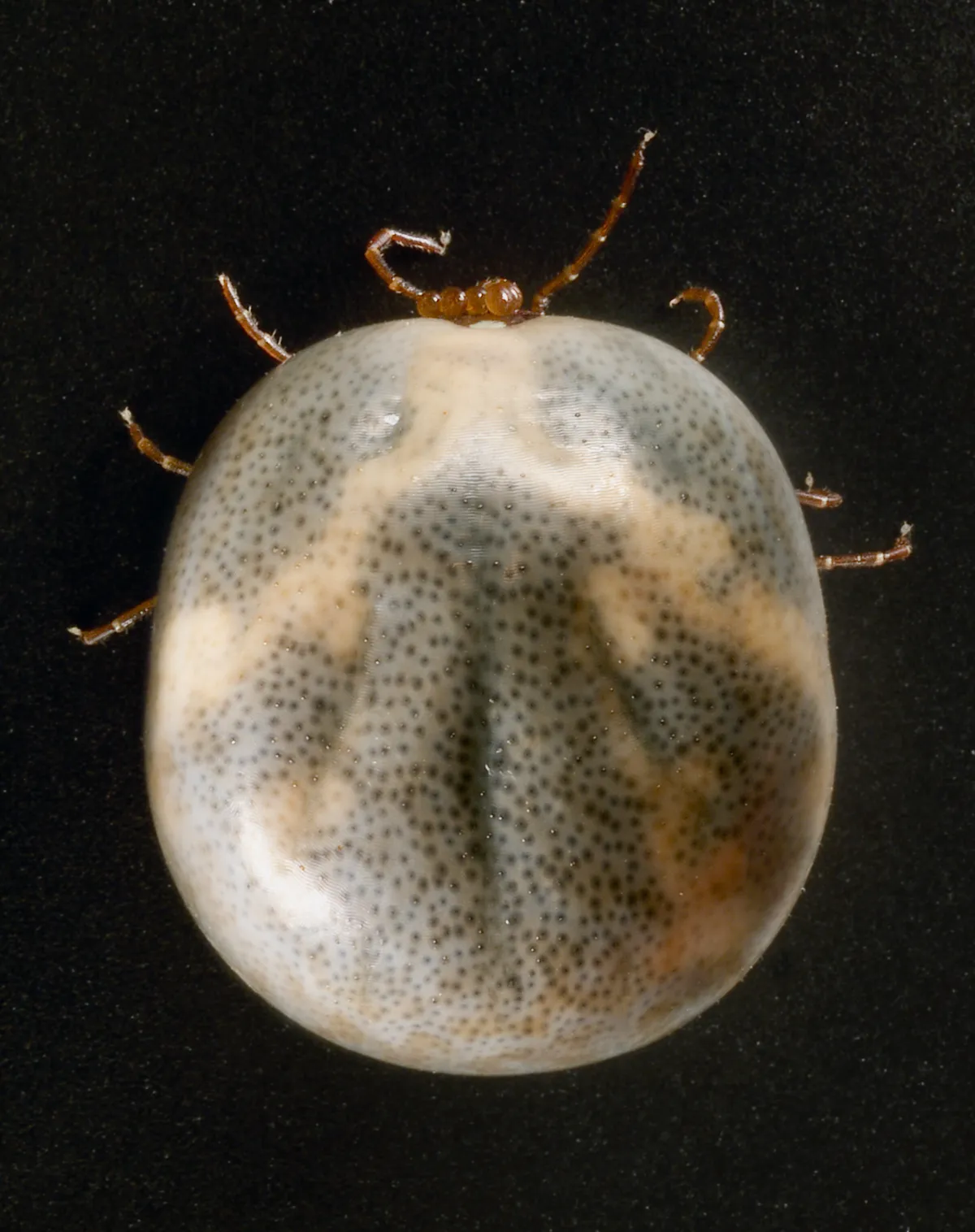
A fed female looks like a different animal. Texas A&M says she can reach 16 mm, about 5/8 inch, or more; the University of Rhode Island says she needs a week to 10 days or more to fill, and the Connecticut handbook says a female lays 1,000 to 8,000 eggs, about 3,000 on average.
What do lone star tick nymphs and larvae look like?
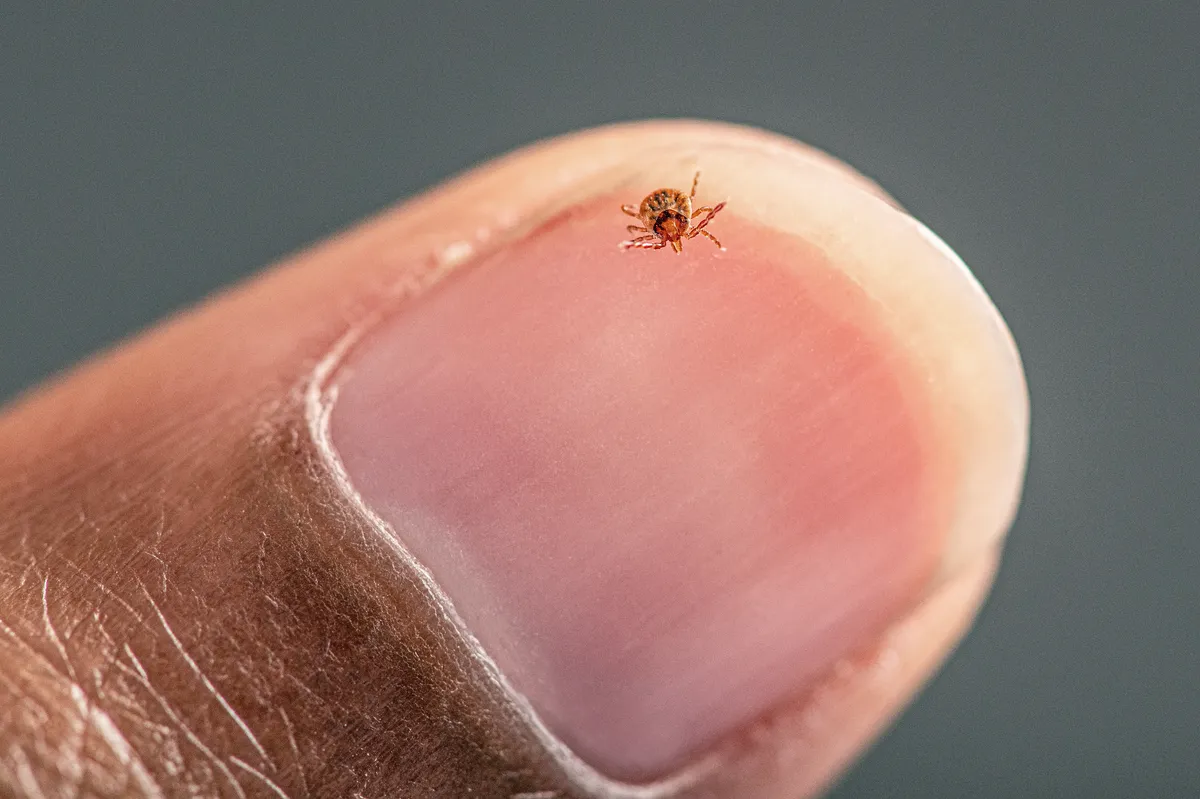
They are much smaller than adults: Illinois Extension calls nymphs pinhead-sized and larvae, the seed ticks, about the size of the period at the end of a sentence. Each of the three active stages, larva, nymph and adult, needs a blood meal, the University of Kentucky's lone star tick fact sheet says, and Illinois Extension adds that all three feed on people.
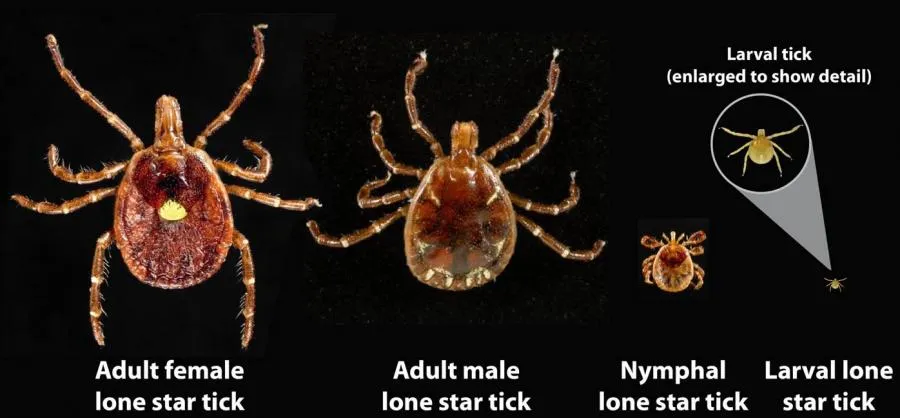
Count the legs if you can: the Connecticut handbook says larval ticks have six legs, while nymphs and adults have eight. A lone star nymph is round and reddish, more circular than a deer tick nymph, and nymphs are one of the two stages, with adult females, that CDC says bite people most often.
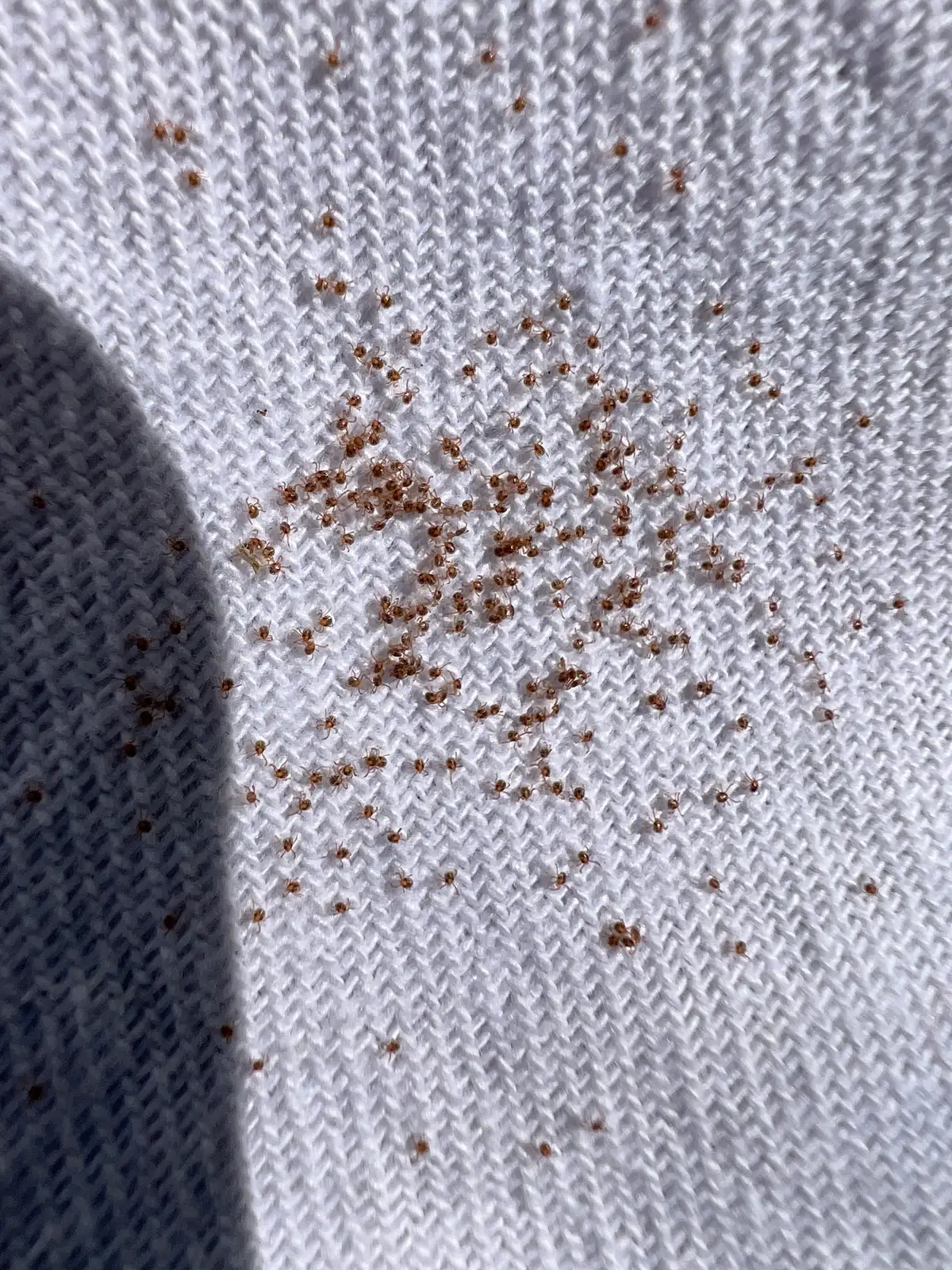
Seed ticks often turn up in crowds in late summer. Walking through a patch of newly hatched larvae can leave hundreds on your legs, Illinois Extension says, and the University of Rhode Island notes that lone star larvae latch on by the hundreds. The guide to seed ticks and how to remove dozens at once covers that situation, including the tape method.
Lone star tick vs deer tick: how do you tell them apart?
Look at the back. A white spot on a female, or faint white marks around the edge of a male, points to a lone star tick; a plain dark shield with no white points to a blacklegged, or deer, tick. The Connecticut handbook adds that in some places people call the lone star tick a deer tick too, one reason the two get mixed up.
| Feature | Lone star tick | Blacklegged (deer) tick |
|---|---|---|
| Female's back | One white to cream spot in the middle | Dark brown shield behind the mouthparts, reddish body, no white |
| Male's back | Faint white streaks or spots around the edge | Completely dark brown |
| Unfed adult female | About 1/8 inch (3 to 4 mm) | About 1/8 inch (3 to 3.7 mm) |
| Nymph | Pinhead-sized, round and reddish | 1.3 to 1.7 mm, about 1/16 inch, near the size of a poppy seed |
| Lyme disease | Not able to transmit it | Transmits it in the Northeast, mid-Atlantic and north-central US |
| Where it lives | Northeast, South and Midwest | Widely across the eastern US |
Markings and sizes: the Connecticut Agricultural Experiment Station's handbook, University of Illinois Extension and Texas A&M. The poppy seed, Lyme disease and where each lives: CDC.
Two other ticks with pale markings are easy to confuse with it. The American dog tick is bigger, almost 1/4 inch long unfed, with a whitish or silvery-gray pattern on its shield instead of one spot, and short mouthparts, the Connecticut handbook says. The Gulf Coast tick shares the lone star tick's genus and has long, slender mouthparts, but Ohio State University describes its shield as decorated with whitish lines. CDC places it mainly in the Southeast and links its adults to Rickettsia parkeri rickettsiosis, a form of spotted fever.
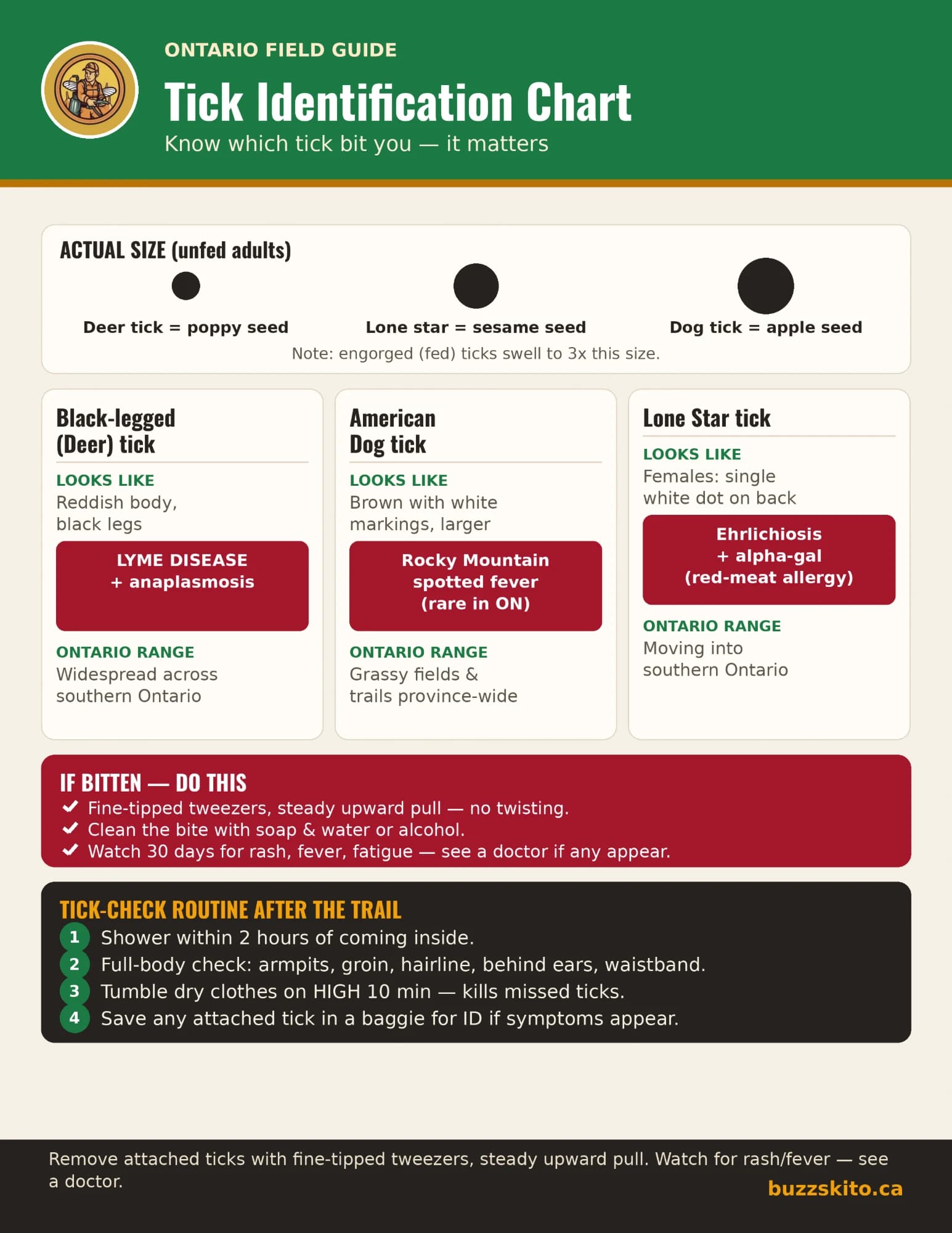
To see all three at actual size, the tick identification chart puts the deer tick, dog tick and lone star tick side by side, and what the common US ticks look like covers the rest. Still unsure? The tick species identifier narrows it down from six quick questions.
Commonly confused with
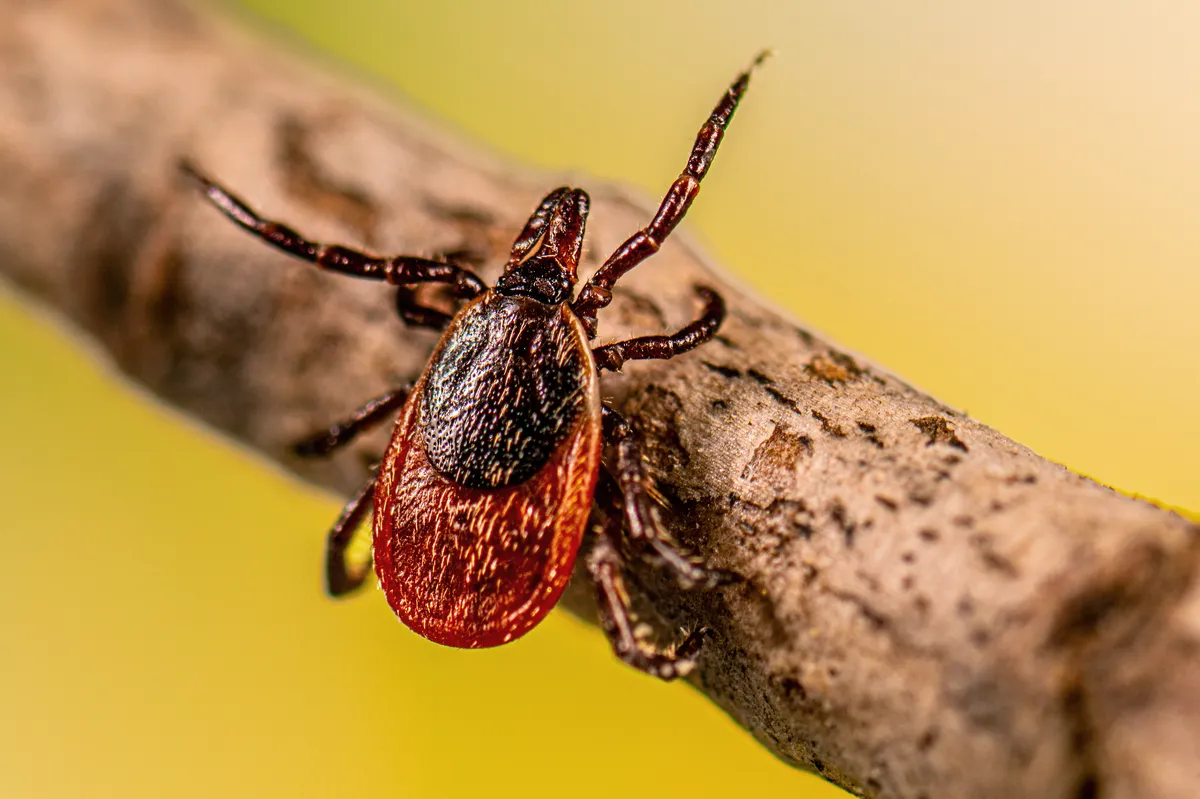 Blacklegged (deer) tickPlain dark shield and no white marks; spreads Lyme disease in the East
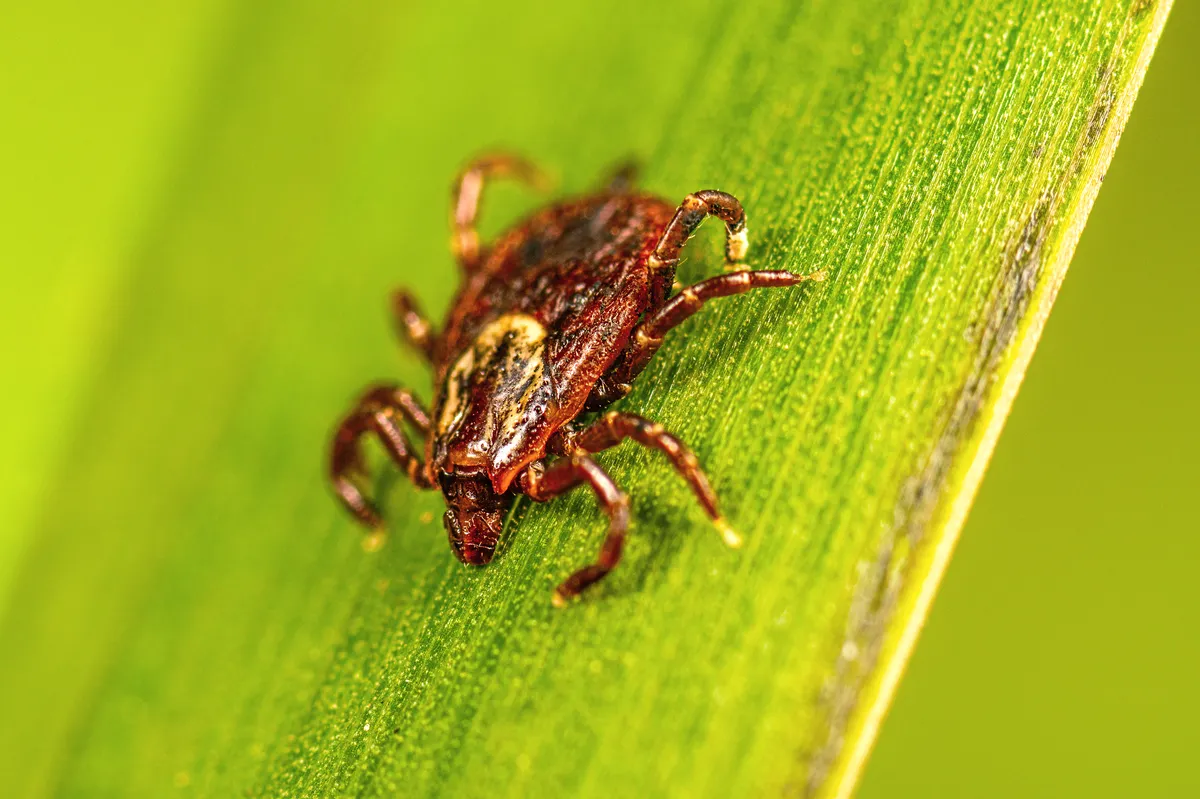 American dog tickAlmost 1/4 inch, with a whitish pattern across the shield instead of one spot
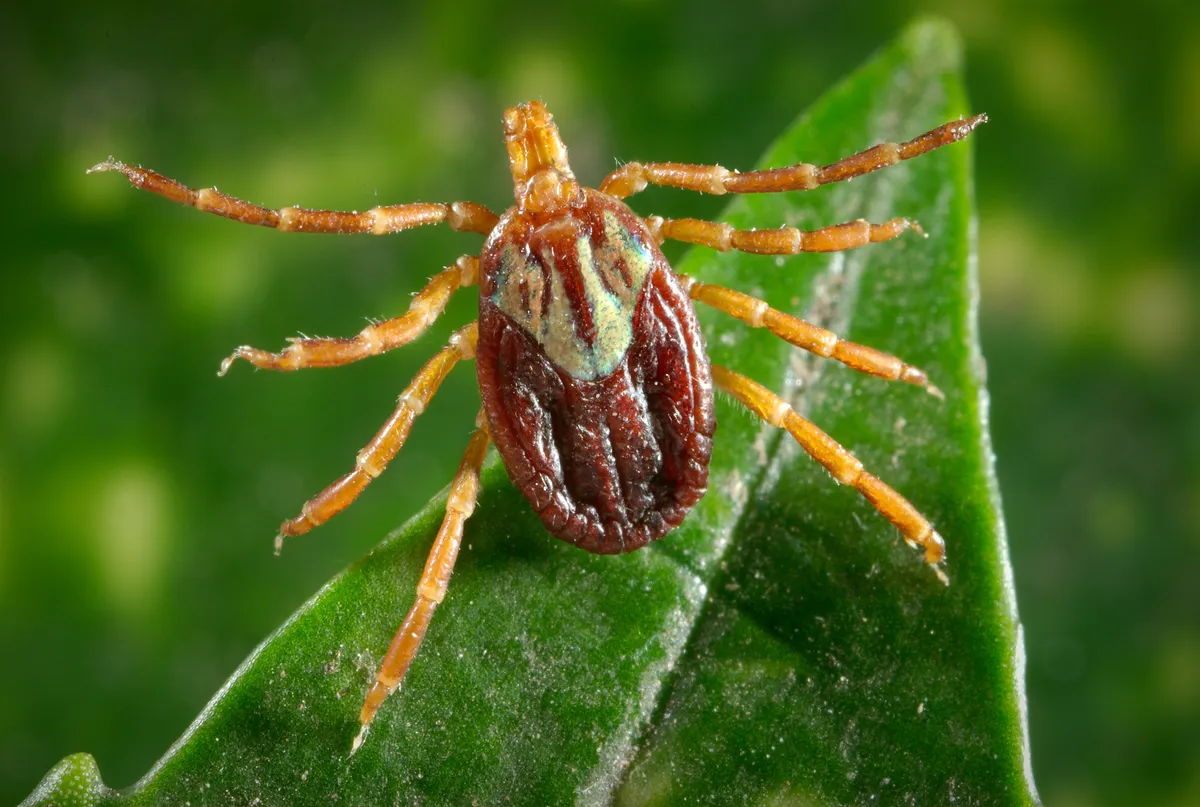 Gulf Coast tickSame genus; whitish lines on the shield rather than one spot, mainly in the Southeast
Photos: Blacklegged (deer) tick: CDC/ Division of Vector-Borne Diseases Rickettsial Zoonoses Branch; photo: Lauren Bishop (CDC Public Health Image Library, phil.cdc.gov), public domain. American dog tick: CDC/ Division of Vector-Borne Diseases Rickettsial Zoonoses Branch; photo: Lauren Bishop (CDC Public Health Image Library, phil.cdc.gov), public domain. Gulf Coast tick: CDC/ Dr. Christopher Paddock (CDC Public Health Image Library, phil.cdc.gov), public domain.
Lone star tick map: where in the US does it live?
Across the Northeast, South and Midwest, in CDC's description of where ticks live. CDC's lone star tick surveillance records, which run through 2025, list the tick as established in 1,139 counties in 33 states and the District of Columbia, and as reported in 635 more. Texas has the most established counties, 118, followed by Kentucky with 86, Arkansas with 73, Virginia with 70 and Oklahoma with 69. In Arkansas it is established in 73 of the state's 75 counties.
Lone star tick map: where CDC records it, by state, through 2025
- Established in half or more of its counties
- Established in fewer than half
- Reported, none established
- No record
Show the list
Established in half or more of its counties (15): Alabama, Florida, Indiana, New Jersey, Oklahoma, Missouri, Illinois, Arkansas, Delaware, District of Columbia, Kentucky, Maryland, Mississippi, Virginia, South Carolina
Established in fewer than half (19): Georgia, Kansas, Massachusetts, North Carolina, Pennsylvania, South Dakota, Texas, Connecticut, West Virginia, Iowa, Michigan, New Hampshire, New York, Ohio, Tennessee, Wisconsin, Nebraska, Louisiana, Rhode Island
Reported, none established (6): Colorado, Maine, Minnesota, Wyoming, New Mexico, Vermont
No record (11): Alaska, Arizona, North Dakota, California, Hawaii, Montana, Oregon, Utah, Washington, Idaho, Nevada
Where a state has its own tick page, the map and the list under it link to that state's county map, and ticks by state compares every state. At the northern edge, CDC lists the tick as established in Merrimack County, New Hampshire, Dukes County, Massachusetts, and Presque Isle County, Michigan; Maine, Vermont, Minnesota, Colorado, New Mexico and Wyoming have reports but no established county.
Is the lone star tick spreading north?
Its range has moved north since the 1940s, though part of that is a return to old ground. CDC's surveillance page says the tick ranged across the eastern US in the 1750s, receded as forests were cleared and white-tailed deer, a keystone host, declined, and has repopulated its historical range as deer numbers and range grew in the East after the 1940s.
Older descriptions show the change. When the first lone star tick from Delaware was reported in the mid-1940s, Virginia was considered the northern edge of its normal range, a 2021 review in the Delaware Journal of Public Health recounts; by 2021 it was the tick most often encountered in Delaware. In 2007 the Connecticut handbook put the edge at southern Iowa, Illinois, Indiana, Ohio and Pennsylvania, and at New Jersey and Long Island on the coast. CDC's 2025 records show established counties beyond that line, from upstate New York and New Hampshire to Michigan, Wisconsin and South Dakota.
Two cautions apply. CDC notes that a county often turns established simply because it was sampled for the first time, so a new record does not prove the tick moved, and that ticks reported at the edges may not find conditions stable enough to settle. The Delaware review attributes the expansion to shorter, milder winters and more white-tailed deer, helped by suburbs and forest edges, and cites modeling that predicts further spread north and west.
Where do lone star ticks hide, and how do they find people?
They wait in shady, overgrown places, then come to you. The University of Rhode Island finds them mostly in woodlands with dense undergrowth and around animal resting areas, and the University of Kentucky says numbers run highest along wooded edges, trail margins and overgrown vegetation, where cover protects them from direct sun and hot, dry air.
Unlike ticks that only lie in wait, lone star ticks actively seek hosts, drawn by carbon dioxide and the vibrations of movement, the Delaware review explains, and CDC calls the species a very aggressive tick that bites humans. They crawl fast enough that one may already be waist-high by the time you notice it, the University of Rhode Island says; adults wait on tall grass in shade or the tips of low branches, while nymphs quest lower and latch on between shoe and shin.
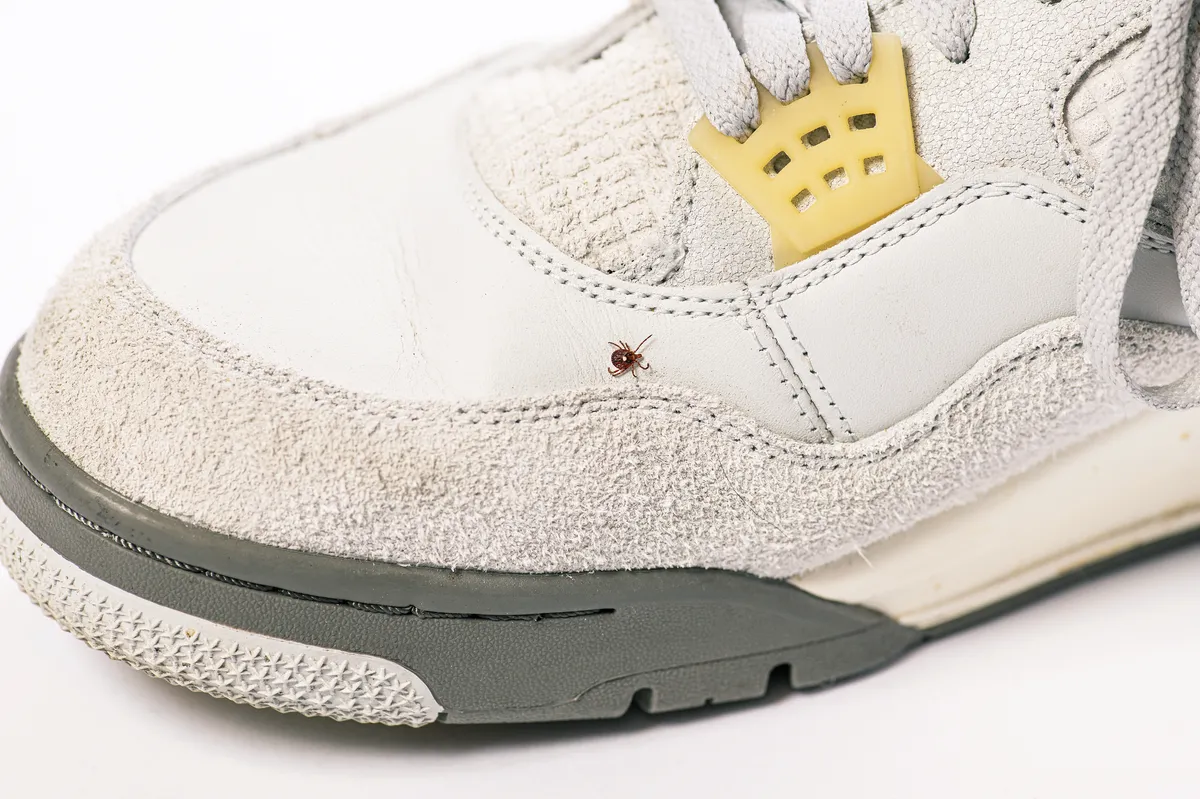
They are not picky about hosts. The Connecticut handbook says the species feeds on virtually any mammal, and Texas A&M lists deer, cattle, horses, feral swine, sheep, dogs and humans among the hosts of adults. Rodents do not appear to be important hosts for the young ticks, the handbook adds, which matters for yard control further down this page.
When are lone star ticks active?
Mostly from spring through late summer, with each stage peaking at a different time. CDC's tick bite prevention page says ticks in general are most active from April to September, and the University of Kentucky gives March through September for lone star ticks, with nymphs and adults active in spring and larvae abundant in August and September. The season starts earlier in the South and later in the North:
| Where | Adults | Nymphs | Larvae (seed ticks) |
|---|---|---|---|
| Texas (Texas A&M) | Active from January and February; peak March to May | April to June, then July to August | Peak June to August |
| Kentucky (University of Kentucky) | Spring | Spring | Abundant in August and September |
| Delaware (2019 and 2020 survey) | Peak in June | Peak in July | Peak in August |
| Connecticut (2007 handbook) | Spring, from mid-April | April through midsummer | Late summer and early fall |
Months vary by year and place. Texas: Texas A&M. Kentucky: University of Kentucky. Delaware: the state survey reported in the Delaware Journal of Public Health, which collected lone star ticks every month from April to November. Connecticut: the CAES handbook.
The University of Rhode Island gives April to late August for adults. CDC adds that tick exposure can happen year-round, so a tick check after time outdoors is worth doing in any month.
What diseases do lone star ticks carry?
CDC links the lone star tick to ehrlichiosis, tularemia, Heartland virus disease, Bourbon virus disease, a rash illness called STARI and alpha-gal syndrome, a red meat allergy; its guide to where ticks live names two ehrlichiosis bacteria the tick carries, Ehrlichia chaffeensis and Ehrlichia ewingii. The strength of each link differs, and this table gives it in CDC's terms:
| Illness | How CDC links it to this tick | What to watch for |
|---|---|---|
| Ehrlichiosis | Spread by infected ticks, including the lone star tick, which carries E. chaffeensis and E. ewingii | Fever, chills, headache, muscle aches and sometimes upset stomach, 1 to 2 weeks after a bite; can become severe |
| Tularemia | On CDC's list of illnesses this tick transmits | Fever and swollen lymph nodes, sometimes skin sores; can become serious (Delaware review) |
| STARI | Cause unknown, but specifically associated with lone star tick bites | A red rash around the bite, usually within 7 days, that expands to 3 to 12 inches across; sometimes fatigue, fever, headache and aches |
| Heartland virus disease | Spreads through bites of infected ticks, primarily lone star ticks; cases are rare | Fever, fatigue, poor appetite, headache, nausea, diarrhea, muscle or joint pain, a few days to several weeks after a bite |
| Bourbon virus disease | Believed to spread through tick bites, likely from lone star ticks; a limited number of cases | Fever, fatigue, rash, headache, body aches, nausea and vomiting |
| Alpha-gal syndrome | Primarily associated with lone star tick bites in the US | Reactions such as hives, stomach pain, swelling or trouble breathing 2 to 6 hours after eating red meat or dairy |
| Lyme disease | Not able to transmit Lyme disease bacteria | A rash or fever after any tick bite still needs a provider's attention |
From CDC's page on each illness and its Where Ticks Live and Lyme disease pages; tularemia symptoms from the 2021 Delaware review. Not a diagnosis.
Ehrlichiosis can be treated: CDC's ehrlichiosis page says doxycycline is the treatment of choice for adults and children of all ages, so a fever in the weeks after a lone star tick bite is a reason to see a provider.
STARI, short for southern tick-associated rash illness, can look like the Lyme disease rash, sometimes clearing in the middle like a bull's-eye. CDC's STARI page says it is not caused by the Lyme disease bacterium, its cause is unknown, and it is not known whether antibiotics are necessary or helpful; it occurs most often in the southern US, where Lyme disease is rare.
Both viruses are uncommon: CDC calls Heartland cases rare and reports a limited number of Bourbon cases. CDC's Heartland virus page says most cases come from eastern, southeastern and south-central states; its Bourbon virus page says the virus was first identified in Bourbon County, Kansas, in 2014 and has since been reported in the Midwest, on the East Coast and in the South. No medicine treats either virus, and some patients may need hospital care for fluids and symptom relief.
Rocky Mountain spotted fever is not on CDC's list for this tick: the Delaware review notes that lone star ticks can transmit its bacterium in the laboratory but that transmission in nature is unconfirmed, though some researchers consider it a strong possibility. For the illnesses other US ticks spread, see the guide to tick-borne diseases.
Do lone star ticks carry Lyme disease?
No. CDC's page on how Lyme disease spreads says lone star ticks are not able to transmit Lyme disease bacteria, and neither are American dog ticks, Rocky Mountain wood ticks or brown dog ticks. In the eastern US the blacklegged, or deer, tick spreads it. The Connecticut handbook says the same and ties the lone star tick instead to STARI, the Lyme-like rash described above.
That does not make a lone star bite trivial, since the tick can pass on the other illnesses in the table. If you are unsure which tick bit you, treat a rash or fever as you would after any tick bite, and see the ticks that carry Lyme disease for photos of the two US species that do.
Can a lone star tick bite cause a red meat allergy?
Yes, in some people. CDC's alpha-gal syndrome page says that in the US the syndrome is primarily associated with the bite of a lone star tick, and less commonly with blacklegged or western blacklegged ticks, though more research is needed on the role ticks play. People with it react to alpha-gal, a sugar found in most mammals but not in people, apes or Old World monkeys, as the Delaware review explains, so red meat and other mammal products can set off a reaction.
Not everyone who is bitten develops it, and CDC says the reason some people do and others do not is not known. CDC's symptom page says it can take weeks to months after a bite for symptoms to start, and that reactions usually come 2 to 6 hours after eating red meat or dairy. They range from hives and stomach pain to swelling and trouble breathing.
More than 110,000 suspected cases were identified from 2010 to 2022, CDC says, and as many as 450,000 people may be affected; most reported cases come from southern, eastern and central states, where most lone star ticks are found. A provider diagnoses it from your history, an examination and a test for antibodies to alpha-gal, and CDC says an allergist or other provider should manage it. The Virginia Department of Health says the allergy diminishes over time in some people, particularly without further lone star tick bites. The guide to alpha-gal syndrome covers the foods involved and living with it.
What does a lone star tick bite look like?
It can leave a red, itchy spot that may last two weeks or longer, the University of Kentucky says, because substances in the tick's saliva cause a reaction. CDC notes the same irritation and says redness and discomfort at the bite do not necessarily mean an infection. The Connecticut handbook adds that the bite can be painful because of the long mouthparts.
A red patch that keeps spreading is different. A rash that appears around the bite, usually within 7 days, and expands to 3 to 12 inches across fits CDC's description of STARI, and CDC advises seeing a doctor for any rash or fever in the weeks after a tick bite. For photos of ordinary bites day by day, see what a tick bite looks like.
Check the places they favor. In tick-testing records from Delaware, the most common attachment sites on people were the upper leg and groin, about 19% each, then the lower leg and back, about 12% each, and the armpit, about 6%, the Delaware review reports.
What should you do after a lone star tick bite?
Remove the tick as soon as you find it, then watch your health for several weeks. CDC's steps for removing a tick are the same for every species:
- Grasp the tick with clean, fine-tipped tweezers as close to the skin as you can, without squeezing its body.
- Pull the tick away from the skin with steady, even pressure; twisting or jerking can leave the mouthparts in the skin.
- If the mouthparts break off, remove them with tweezers only if that is easy; otherwise leave them and let the skin heal.
- Clean the bite and your hands with soap and water, rubbing alcohol or hand sanitizer, and check your body for other ticks.
- Get rid of a live tick by sealing it in a bag or container, wrapping it tightly in tape, flushing it or putting it in alcohol; never crush it with your fingers.
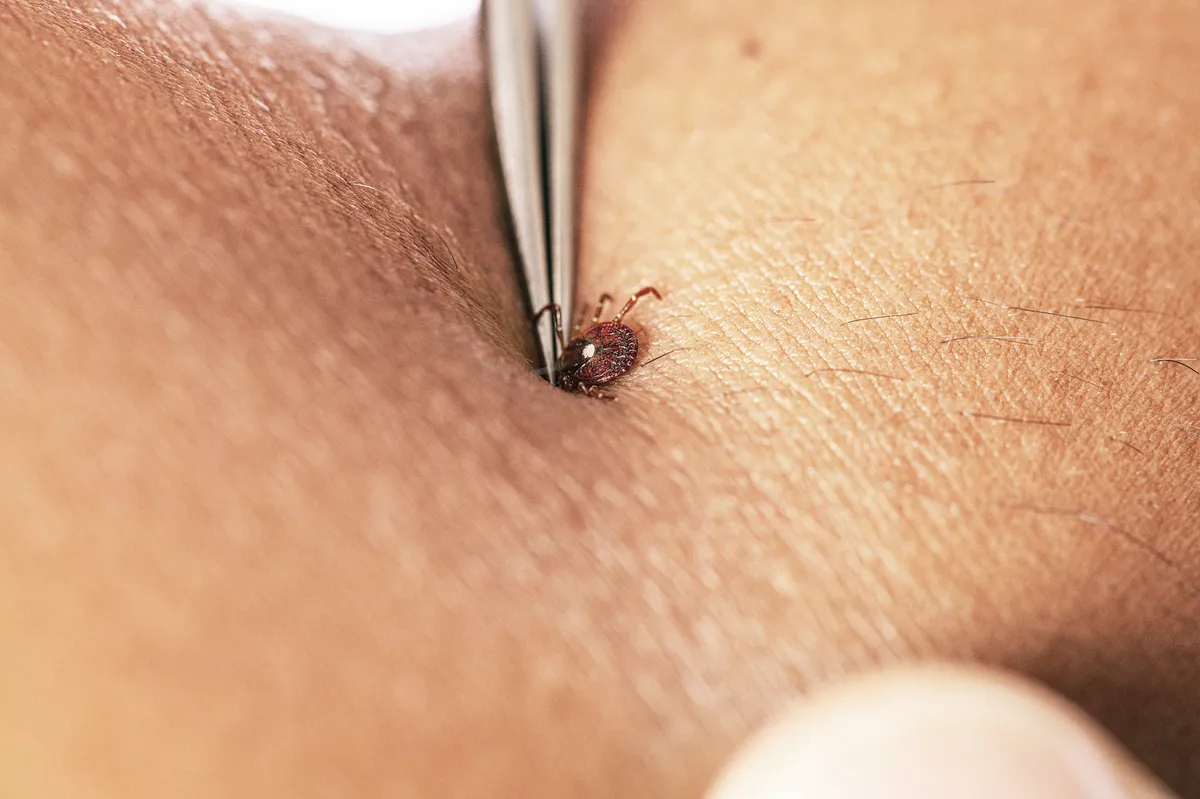
Skip the folk remedies: CDC advises against petroleum jelly, nail polish, heat or similar tricks to make a tick detach. It also generally advises against having the tick tested, because results can be unreliable and a negative result can falsely reassure. If mouthparts stay in the skin, see what to do about a tick head stuck in skin, and the step-by-step tick removal guide goes through removal in more detail.
Then watch your health. CDC says to see a doctor if a rash or fever develops within several weeks of removing a tick, and to tell the doctor about the bite, when it happened and where you most likely picked up the tick. After a lone star bite, also notice any allergic reaction a few hours after eating red meat in the weeks or months that follow. What to do after a tick bite covers the same steps for any tick.
How do you prevent lone star tick bites?
Treat clothing, use repellent and check yourself after time outdoors. CDC's general prevention advice applies to lone star ticks too:
- Treat clothing and gear with 0.5% permethrin, or buy pretreated items, following the label.
- Use an EPA-registered repellent containing DEET, picaridin, IR3535, oil of lemon eucalyptus (OLE), para-menthane-diol (PMD) or 2-undecanone, as the label directs, and do not use OLE or PMD on children under 3.
- Stay in the center of trails and out of the grassy, brushy and wooded areas where ticks wait.
- Check clothing, gear and pets when you come in, and put dry clothes in the dryer on high heat for 10 minutes to kill ticks on them.
- Shower within two hours of coming indoors and check your whole body, including under the arms, in and around the ears and hair, inside the belly button, the backs of the knees, between the legs and around the waist.
There is lone-star-specific support for the first two: the Delaware review cites field studies in which permethrin-treated clothing and DEET sprays protected people against lone star ticks.
In the yard, CDC suggests removing leaf litter, clearing tall grass and brush, mowing often and laying a 3-foot strip of wood chips or gravel between lawns and woods. If you also spray, the best tick sprays for a yard lists the EPA-registered options and where to apply them. Clearing leaf litter where people and pets spend time may also cut lone star tick survival over winter, since the ticks rely on humid spots, the Delaware review notes; it adds that tick tubes and rodent bait boxes, developed with blacklegged ticks in mind, suit lone star ticks poorly because they do not feed mainly on rodents. What kills ticks in the yard and on clothes compares the options.
Pets need checking too: lone star ticks bite dogs, and how to check a dog for ticks shows where they hide in a coat. Ask a veterinarian which tick preventive suits your pet.
This guide is general educational information, not medical advice. If you have symptoms or concerns after a bite or exposure, contact a healthcare provider.
Frequently Asked Questions
What happens if you get bitten by a lone star tick?+
At the bite you may get a red, itchy spot: CDC says lone star tick saliva can be irritating, so redness does not necessarily mean infection, and the University of Kentucky says the itch can last two weeks or longer. Less often the bite passes on an illness such as ehrlichiosis, which starts with fever and chills 1 to 2 weeks later, or is followed by STARI, an expanding rash. Some people later develop alpha-gal syndrome. Remove the tick promptly and see a doctor if a rash or fever appears within several weeks.
Do all lone star ticks cause meat allergy?+
No. CDC says not every person bitten by a lone star tick develops alpha-gal syndrome, and that the reason some people do and others do not is not known. In the United States the syndrome is primarily associated with lone star tick bites, and less commonly with blacklegged or western blacklegged ticks. Symptoms can take weeks to months to appear after a bite, and reactions usually start 2 to 6 hours after eating red meat or dairy. If that pattern sounds familiar, talk to a health care provider.
Does every lone star tick carry Lyme disease?+
No lone star tick spreads Lyme disease. CDC says lone star ticks are not able to transmit the bacteria that cause it; in the eastern United States the blacklegged, or deer, tick does. A lone star tick can carry other germs, including those behind ehrlichiosis, tularemia and Heartland virus disease, and its bite is associated with STARI, a rash that can look like the Lyme disease rash but has a different, unknown cause. A rash or fever after any tick bite is still a reason to see a provider.
How long does it take to get sick from a lone star tick bite?+
It depends on the illness. CDC says ehrlichiosis symptoms begin 1 to 2 weeks after the bite, the STARI rash usually appears within 7 days, and Heartland virus disease can start anywhere from a few days to several weeks later. Alpha-gal syndrome works differently: it can take weeks to months after a bite for symptoms to start, and the allergic reactions then come 2 to 6 hours after eating red meat or dairy. CDC advises seeing a doctor for a rash or fever within several weeks of a tick bite.
What are the odds of getting a disease from a lone star tick?+
No national figure exists in the sources used here, and the odds vary by place and germ. In Delaware, a 2021 review reported that about 1.5% of the lone star ticks people submitted to an Army laboratory between 1998 and 2019 tested positive for a germ, and about 2% of those sent to a university lab from 2008 to 2020. CDC also notes that not everyone bitten develops alpha-gal syndrome. Low odds are not zero, so watch for a rash or fever for several weeks after a bite.
Does the meat allergy from a lone star tick bite ever go away?+
It can fade for some people. The Virginia Department of Health says that in some people the allergy will diminish over time, particularly if there are no further lone star tick bites, which is one more reason to avoid them. CDC says alpha-gal syndrome should be managed under the care of an allergist or other health care provider, so talk with that provider before trying red meat or dairy again rather than testing it on your own.
How can I tell the difference between a lone star tick and a regular tick?+
Look at the back. An adult female lone star tick has one white spot in the middle of her back, and a male has faint white marks around the edge. The blacklegged, or deer, tick has a plain dark shield with no white, and the American dog tick is larger, almost 1/4 inch unfed, with a whitish or silvery-gray pattern across the shield. Lone star adults are reddish brown and about 1/8 inch long, with long mouthparts. Nymphs are pinhead-sized and harder to sort, so a clear photo helps.
How big is a lone star tick?+
An unfed adult is about 1/8 inch long, according to University of Illinois Extension and the Connecticut Agricultural Experiment Station, which measures adults at 3 to 4 mm. Texas A&M measures unfed females at 4 to 6 mm and males at 2 to 5 mm, and says a fully fed female can reach 16 mm, about 5/8 inch, or more. Nymphs are about the size of a pinhead, and larvae, the seed ticks, are about the size of a printed period.
Where are lone star ticks found in the United States?+
Mostly in the Northeast, South and Midwest, in CDC's description. CDC's county records through 2025 list the tick as established in 1,139 counties in 33 states and the District of Columbia, led by Texas, Kentucky, Arkansas, Virginia and Oklahoma, and as reported but not established in Maine, Vermont, Minnesota, Colorado, New Mexico and Wyoming. It favors woodlands with dense undergrowth, wooded edges and overgrown areas, and CDC cautions that a county with no record may simply not have been sampled.
Do lone star ticks bite dogs and cats?+
Yes. Texas A&M lists dogs among the hosts of adult lone star ticks, and a 2021 review in the Delaware Journal of Public Health says they usually attach to a dog's belly, armpits or groin and to a cat's tail and rear end. The same review says lone star ticks can carry bacteria that cause ehrlichiosis in dogs and a parasite, Cytauxzoon felis, that causes a serious illness in cats. Check pets after time outdoors and ask a veterinarian about tick prevention.
Sources
- Lone Star Tick Surveillance (county status through 2025; page dated May 26, 2026) — Centers for Disease Control and Prevention
- Where Ticks Live (updated July 30, 2025) — Centers for Disease Control and Prevention
- About Alpha-gal Syndrome (updated January 5, 2026) — Centers for Disease Control and Prevention
- Symptoms of Alpha-gal Syndrome (updated January 5, 2026) — Centers for Disease Control and Prevention
- About Ehrlichiosis (updated May 15, 2024) — Centers for Disease Control and Prevention
- About Southern Tick-Associated Rash Illness (updated March 24, 2026) — Centers for Disease Control and Prevention
- About Heartland Virus (updated June 17, 2026) — Centers for Disease Control and Prevention
- About Bourbon Virus (updated June 17, 2026) — Centers for Disease Control and Prevention
- How Lyme Disease Spreads (updated September 24, 2024) — Centers for Disease Control and Prevention
- What to Do After a Tick Bite (updated June 9, 2026) — Centers for Disease Control and Prevention
- Preventing Tick Bites (updated August 28, 2024) — Centers for Disease Control and Prevention
- Lone Star Ticks (Amblyomma americanum): An Emerging Threat in Delaware (A. C. Kennedy and E. Marshall, Delaware Journal of Public Health, 2021) — Delaware Academy of Medicine and Public Health, via PubMed Central
- Tick Management Handbook, revised edition (Bulletin No. 1010, K. C. Stafford III, 2007) — The Connecticut Agricultural Experiment Station
- Lone Star Tick (Tick Identification) — Texas A&M AgriLife, The Tick App
- The Lone Star Tick in Kentucky (ENTFACT-648, L. Townsend; revised March 2026) — University of Kentucky Department of Entomology
- Lone Star Tick — TickEncounter Resource Center, University of Rhode Island
- TickSpotters — TickEncounter Resource Center, University of Rhode Island
- Ticks (P. Nixon, Home, Yard and Garden Pest Newsletter, May 20, 2013) — University of Illinois Extension
- Alpha-gal Syndrome (updated January 27, 2026) — Virginia Department of Health
- Gulf Coast Tick (Amblyomma maculatum), ENT-0105 (2025) — The Ohio State University College of Food, Agricultural, and Environmental Sciences
Read and approved by Alex Francisco. Found an error? Email support@buzzskito.ca.