Ticks are arachnids with 8 legs and no antennae; almost every bug mistaken for one is an insect with 6 legs and visible antennae, so counting legs settles most cases in seconds. That matters when you have found a small, dark, oval bug crawling on your child, your dog, or your bedroom carpet: several common Ontario bugs look almost identical to ticks at first glance, and panicking over the wrong one can cost you hours when it actually matters. This guide covers the most common tick look-alikes — bed bugs, spider beetles, weevils, carpet beetles, bat bugs, booklice, stink bug nymphs, and even stray poppy seeds — how to tell each one apart, and why misidentification is genuinely risky in Ontario's expanding Lyme disease zones.
BuzzSkito Mosquito & Tick Control Specialists · Published April 26, 2026 · Updated October 15, 2026
As an Amazon Associate I earn from qualifying purchases. BuzzSkito only points to products we would genuinely use or recommend, at no extra cost to you.
The 30-Second Tick ID Rule
Count the legs, then look for antennae. A tick is an arachnid with 8 legs as an adult, no antennae and no wings, while nearly every bug mistaken for one is an insect with 6 legs and obvious antennae. The US Centers for Disease Control and Prevention notes that ticks cannot fly or jump, so anything that flies or hops is not a tick.
The movement rule does a lot of work on this page, so it is worth knowing exactly what a tick can and cannot do: can ticks fly, jump, or swim? goes through each claim in turn and explains how a tick actually reaches a host by waiting on vegetation and grabbing on as you brush past.
Before going through the look-alikes, here is the fastest reliable check. Ticks are arachnids, not insects. That means:
- 8 legs as adults (6 as larvae)
- No antennae
- No wings
- One fused, teardrop-shaped body — not three distinct segments
- Slow movement — ticks crawl, they do not run or fly
Almost every common tick look-alike is an insect with 6 legs and antennae. If you see antennae, it is not a tick. If it has wings or wing-cover shells (elytra), it is not a tick. If it runs or jumps, it is not a tick. Use those simple checks before reading any further — they will resolve most cases in seconds.
For a closer look at what real Ontario ticks actually look like, see our full guide to identifying ticks in Ontario.
Tick Look-Alikes at a Glance: The Full Comparison Table
The seven bugs most often mistaken for ticks are bed bugs, spider beetles, weevils, carpet beetles, bat bugs, booklice and brown marmorated stink bug nymphs. Every one of them is an insect with 6 legs and visible antennae, and none of them attaches to skin. A tick has 8 legs, no antennae, and stays anchored in one spot once it starts feeding.
Here is every common tick look-alike side by side, with the single fastest way to rule each one out. If your bug matches the “tell-tale difference” column, it is not a tick.
| Look-alike | What it actually is | Legs & antennae | Tell-tale difference from a tick | Where you find it |
|---|---|---|---|---|
| Spider beetle | Beetle (Ptinidae) | 6 legs, long antennae | Hard shiny shell, narrow “waist,” long antennae, runs fast | Pantries, attics, basements, old nests |
| Bed bug | Insect (Cimex lectularius) | 6 legs, antennae | Flat apple-seed oval, has antennae, never attaches to skin | Mattress seams, headboards, bedroom crevices |
| Poppy / sesame seed | A seed or food speck (not alive) | No legs | Does not move and brushes off; a real nymph tick this size still has 8 legs and grips | Skin, scalp, kitchen counters, bagels |
| Wood tick nymph | A real tick (dog-tick young) | 6 legs (larva) or 8 (nymph) | This is a tick — poppy-seed-sized, so treat it as one | Tall grass, pets, skin |
| Weevil | Beetle (Sitophilus) | 6 legs, elbowed antennae | Long snout / “nose” and a hard wing-cover shell | Flour, rice, grains, pet food |
| Carpet beetle | Beetle (Dermestidae) | 6 legs, short clubbed antennae | Rounded, patterned or scaly shell, and it flies | Windowsills, baseboards, closets, wool |
| Booklouse (booklice) | Insect (Psocoptera) | 6 legs, long antennae | Near-translucent, ~1 mm, soft-bodied and very fast | Damp books, paper, cardboard, mould |
Ticks vs Other Bugs: The One-Sentence Differences
A tick is an 8-legged arachnid with no antennae that attaches to skin and feeds on blood, while a bed bug is a flat 6-legged insect that hides in mattress seams, a spider beetle is a hard-shelled 6-legged beetle with antennae longer than its body, a weevil is a 6-legged beetle with a long snout, a carpet beetle is a 6-legged beetle with a mottled shell that flies, a bat bug is a bed-bug look-alike from attic roosts, and a booklouse is a 1 mm translucent insect that lives on damp paper.
Restated as plain sentences, the three rows that settle most cases are these. A spider beetle has 6 legs, antennae often longer than its own body, a hard shiny shell and a fast run, whereas a tick has 8 legs, no antennae and a slow crawl. A bed bug is a flat, apple-seed-shaped oval with antennae that lives in mattress seams and never stays attached to skin, whereas a tick grips and stays put for hours or days. A poppy seed has no legs at all and brushes straight off, whereas a poppy-seed-sized nymph tick has 8 legs and holds on.
Still not sure whether you have a tick or a look-alike? Our interactive tick identifier asks six quick questions, from where you picked it up to its size, the markings on its back and its legs, then either tells you it is probably not a tick or shows the most likely ticks, each with a real photo, how to confirm it and what it can spread.
1. Bed Bugs
A bed bug is an insect with 6 legs and two obvious antennae, and a tick is an arachnid with 8 legs and none. Adult bed bugs are about 5 mm long (roughly 3/16 inch), flat and apple-seed shaped, and they live indoors in mattress seams. Ticks live outdoors on vegetation and attach to skin for hours or days.
The most common tick look-alike found indoors. Bed bugs (Cimex lectularius) are reddish-brown insects about the size of an apple seed when unfed, and they swell to a darker, balloon-like shape after feeding. Engorged bed bugs and engorged ticks can look very similar at a glance. If the insect turned up in a mattress seam rather than on a trouser leg after a walk, the tick question is probably the wrong one — our guide to bugs commonly mistaken for bed bugs in Canada runs the same elimination process across the nine indoor look-alikes.
How to tell them apart
- Legs: Bed bugs have 6 legs. Ticks have 8.
- Antennae: Bed bugs have visible, segmented antennae projecting from the head. Ticks have no antennae at all.
- Body shape: Bed bugs are flat and oval. Ticks are teardrop-shaped, rounder, and become balloon-like when engorged.
- Where you found it: Bed bugs live indoors near sleeping areas — mattress seams, headboards, baseboards. Ticks live outdoors on vegetation and only enter homes attached to people or pets.
- Behaviour: Bed bugs do not stay attached after feeding — they retreat to a hiding place to digest. Ticks attach for hours or days at a time.
If you found the bug in your bed, on your couch, or in a wall crevice — and especially if you have unexplained bites in lines or clusters — assume bed bugs and call a pest control specialist. If you found it after a hike, on your child's scalp, or attached to your dog, treat it as a potential tick. For a side-by-side breakdown of these two specifically, see our dedicated tick vs bed bug comparison. If it turns out to be bed bugs, our guide to the best bed bug sprays and killers in Canada covers which products are PMRA-legal here and what actually kills the eggs.
2. Weevils
A weevil is a small beetle with a long snout, elbowed antennae and a hard wing case, and a tick has no snout, no antennae and a soft leathery body. Pantry weevils are about 3 mm long (roughly 1/8 inch) and turn up in flour, rice, oats and pet food. A weevil never attaches to skin and does not bite people.
Weevils are small beetles with a distinctive elongated "snout." The species most commonly mistaken for ticks in Ontario homes is the granary weevil (Sitophilus granarius) and the rice weevil (Sitophilus oryzae) — both pantry pests that show up in stored grains, flour, pasta, and pet food. They are about 3 mm long, dark brown to black, and oval-shaped, which gives them a passable resemblance to a small unfed tick at first glance.
How to tell them apart
- The snout: Weevils have a long, narrow projection from the head — almost like a small elephant trunk. Ticks have nothing like this. If you see a snout, it is a weevil.
- Hard shell: Weevils have a hard, rigid wing-cover (elytra) running down the back. Ticks have a softer, more pliable body.
- Antennae: Weevils have bent, "elbowed" antennae. Ticks have none.
- Where you found it: Weevils are almost always found in stored food — flour, oats, pet kibble, dried beans. They are never found attached to skin.
If your "tick" came out of a bag of flour or a container of dog food, it is a weevil. The fix is to discard infested food and clean the pantry thoroughly. Weevils do not bite humans and do not transmit disease.
3. Spider Beetles
A spider beetle has 6 legs and long antennae, often longer than its own body, and a tick has 8 legs and no antennae at all. Spider beetles measure 1.5–4 mm (up to about 1/8 inch), carry a hard shiny shell with a narrow neck-like waist, and run quickly. Ticks are soft-bodied, have no waist, and crawl slowly.
Spider beetles (Ptinidae family, especially the American spider beetle and shiny spider beetle) are one of the most convincing tick look-alikes. They are 1.5–4 mm long, reddish-brown to dark brown, with a humped, oval body and long legs that give them a vaguely spider-like silhouette. Found in homes, especially older ones, near stored food, attics, basements, and old bird nests.
How to tell them apart
- Legs: Spider beetles have 6 legs. Ticks have 8.
- Antennae: Spider beetles have long, prominent antennae — often longer than the body itself. Ticks have none.
- Body segments: Spider beetles have a distinct narrow neck-like waist between the head and the bulbous body. Ticks have a smooth, fused body.
- Hard shell: Spider beetles have a hard, often shiny outer shell. Ticks have a softer, more leathery body.
- Movement: Spider beetles can run quickly. Ticks crawl slowly.
Spider beetles are scavengers that feed on stored grains, dried herbs, animal fur, dead insects, and rodent droppings. They do not bite humans and do not transmit disease. Their presence usually indicates a food storage problem or accumulated debris in attic or basement spaces.
4. Bat Bugs
A bat bug is an insect with 6 legs and visible antennae, about 5 mm long (roughly 3/16 inch) and near-identical to a bed bug, while a tick has 8 legs, no antennae and a teardrop body. Bat bugs come down from attic bat roosts into bedrooms. Ticks arrive from outdoors on people, pets or clothing.
Bat bugs (Cimex adjunctus) are very close relatives of bed bugs, virtually identical in appearance to the untrained eye. They primarily feed on bats but will bite humans if their preferred host is unavailable — usually after bats have been excluded from an attic and the bugs migrate down into the living space looking for a new blood source. Like bed bugs, they are reddish-brown, flat, oval, and apple-seed-sized.
How to tell them apart from ticks
- Legs: 6 legs (insect), not 8 (arachnid).
- Antennae: Visible antennae on the head.
- Body: Distinctly flat and oval, not teardrop-shaped.
- Where they live: Indoors, in attics or wall voids near where bats have roosted, or descending into bedrooms after bats have been removed.
Bat bugs require slightly different control than bed bugs because the original bat colony must also be addressed. If you have had bats in your attic in the last year and are now finding bed-bug-like insects in your bedroom, ask your pest control company about bat bugs specifically.
5. Brown Marmorated Stink Bug Nymphs & Other Beetle Larvae
A stink bug nymph is an insect with 6 legs, antennae and a patterned shield-shaped body that feeds on garden plants, and a tick is an 8-legged arachnid with no antennae that feeds only on blood. Nymphs are found on leaves, siding and outdoor furniture rather than gripping skin, which settles the question outdoors in a couple of seconds.
Young stink bugs and various small beetle larvae found in gardens and on outdoor furniture can also pass for ticks in low light. They are typically dark, oval, and slow-moving. The good news is they are easy to rule out with a quick look.
How to tell them apart
- 6 legs and antennae — same insect rule as the others.
- Patterned bodies — many beetle and stink bug nymphs have distinctive markings, spots, or patterned shields. Ticks are uniformly coloured (deer tick) or have a single decorative scutum (dog tick).
- Found on plants, not skin — these insects feed on garden vegetation, not blood. They will not be attached to you.
6. Carpet Beetles
A carpet beetle is an insect 2–4 mm long (about 1/8 inch) with 6 legs, short clubbed antennae and a hard mottled shell, and it can fly. An unfed adult tick is 3–5 mm long, has 8 legs, has no antennae and cannot fly at all. Carpet beetles collect on windowsills and baseboards; ticks are found on skin, pets or vegetation.
Carpet beetles (family Dermestidae) are one of the most common “is this a tick?” finds indoors. Adults are only 2–4 mm, rounded and domed, and patterned with black, white, and orange scales — a shape and size that reads as a small unfed tick on a windowsill or baseboard. They are also the single most common bed-bug misidentification, so if you are finding them repeatedly rather than once, how to get rid of carpet beetles in Canada covers the larvae doing the actual damage.
How to tell them apart
- Legs: Carpet beetles have 6 legs. Ticks have 8.
- Antennae: Short, clubbed antennae. Ticks have none.
- Shell: A hard, patterned, faintly scaly wing-cover. Ticks are soft and leathery.
- They fly: Adult carpet beetles fly to windows and lights. Ticks cannot fly at all.
The fuzzy, bristly carpet-beetle larvae look nothing like a tick but chew through wool, carpet, and stored fabrics. Adults do not bite people and carry no tick-borne disease. If your “beetle that looks like a tick” is on a windowsill with a mottled shell, it is a carpet beetle.
7. Booklice (Booklouse)
A booklouse is a soft, pale insect about 1 mm long (roughly 1/25 inch) with 6 legs and long antennae, and it moves fast across damp paper. A tick is opaque, 8-legged, has no antennae and crawls slowly. Booklice feed on mould in humid rooms, never bite and never attach to skin, so they carry no tick-borne disease risk.
Booklice (order Psocoptera) are near-microscopic, translucent-to-pale insects about 1 mm long. Individually they are hard to see, but a cluster of them on damp paper or a windowsill can be mistaken for a group of tiny tick larvae.
How to tell them apart
- Legs: 6 legs, plus long antennae. Ticks have 8 legs and no antennae.
- Body: Soft, translucent, and very fast-moving. Ticks are opaque and crawl slowly.
- Where they live: Damp books, cardboard, paper, and mouldy areas — never attached to skin.
Booklice do not bite, do not carry disease, and are simply a sign of humidity. Drying the area out and improving ventilation clears them.
That humidity signal is worth following, because booklice rarely turn up alone. The same damp basement or bathroom that produces them supports a whole cast of moisture-dependent household insects — and if what you found came from a storage box or a baseboard rather than off a trouser leg after a hike, it is far more likely one of those. Our companion buying guides cover what each one needs: which silverfish trap to buy if the insect is silver and wingless with three tails, and what to buy for house centipedes if it was fast and long-legged. In both cases the fix is the same humidity work that clears booklice.
That humidity work is usually one purchase rather than a project. Booklice, silverfish and house centipedes all depend on damp air, so pulling a basement or storage room down out of the muggy range removes the condition all three are living on — and unlike a spray, it does not need repeating. Our guide to the best basement dehumidifiers in Canada covers sizing for the damp square footage you actually have. Check basement dehumidifiers on Amazon.ca →
What Bugs Look Like Ticks on Dogs and Cats?
On a dog or cat, the things most often mistaken for ticks are scabs, skin tags, nipples, warts, matted debris and engorged fleas. A tick has 8 legs and a head buried in the skin, while a skin tag or nipple has no legs and slides with the skin when you move it. A flea is dark, flattened side-to-side and jumps.
The Centers for Disease Control and Prevention states that ticks cannot jump or fly, so anything that hops off your hand is a flea rather than a tick. Flea dirt — the black specks in the coat — smears rusty red on a damp paper towel because it is digested blood, whereas a real tick stays a solid body you can lift out whole. Part the fur and check the ears, neck, armpits and between the toes: a tick found on a pet is still a tick, and it should be removed the same way you would remove one from a person.
Parting fur with your fingers misses a lot on a thick or long-haired coat, which is why most of these questions start with “I felt a bump.” A fine-toothed flea comb pulls through the coat at skin level and lifts out crawling ticks, fleas and flea dirt before anything attaches, so it turns a vague hand-check into something you can actually see on the comb. Check flea combs on Amazon.ca →
That inability to jump is one of the most useful tells in the whole list, because it rules out fleas, springtails and several beetle larvae in a single observation. What a tick does instead — climb a grass blade and hold out its front legs waiting for a host to brush past — is covered in do ticks fly or jump, and how high they actually climb.
Is It a Poppy Seed, a Sesame Seed, or a Tick?
Legs and grip settle it. A poppy or sesame seed has no legs, does not move and brushes straight off, while a nymph tick of the same size has 8 legs and holds on. The Centers for Disease Control and Prevention describes blacklegged tick nymphs as roughly poppy-seed sized, under 2 mm across (about 1/16 inch).
This is one of the most-searched tick questions, and for good reason: an unfed blacklegged (deer) tick nymph really is about the size and colour of a poppy seed, and a well-fed one resembles a sesame seed. People routinely spot a dark speck on their skin or scalp and cannot tell whether it is a seed, a fleck of dirt, or a tick.
The test is quick. A poppy or sesame seed has no legs, does not move, and brushes off easily. A nymph tick that size has 8 legs, grips the skin, and stays put when you try to wipe it away. If the “seed” has legs or will not brush off, treat it as a tick, remove it carefully, and save it. A pointed tick-removal tool or fine-tipped tweezers grips a poppy-seed-sized nymph far better than fingernails do — check tick-removal tools on Amazon.ca → When you are unsure, our tick removal tool guide walks through the right tools and technique.
As an Amazon Associate I earn from qualifying purchases. Price shown on Amazon.ca, at no extra cost to you.
🏆 Our Top Pick — Tick Removal
8.7/10· BuzzSkito ratingOnce you have confirmed a real tick, the right tool matters: a pointed tick remover or fine-tipped tweezers grips a poppy-seed-sized nymph close to the skin and lifts it straight out, without squeezing the body. Keep one in the first-aid kit and one in the car for post-hike checks.
Pros
- Grips even pinhead-sized nymphs
- Clean, straight-out pull that avoids squeezing
- Pocket-sized for hikes and pets
Cons
- Needs a steady hand on squirming kids or dogs
- Keep a spare — easy to misplace
Wood Tick Nymphs: A Look-Alike That Really Is a Tick
A wood tick is the American dog tick, and its nymphs are real ticks rather than look-alikes. A dog tick nymph is roughly 1–2 mm across (about 1/16 inch), dark, and easily written off as a scab, a freckle or a speck of dirt. If a speck that size has legs and will not brush off, treat it as a tick.
“Wood tick” is a common name for the American dog tick, and its young — larvae and nymphs — are so small they are often mistaken for a poppy seed, a freckle, or a scab rather than a tick. Unlike every other entry here, this one is a tick. If a poppy-seed-sized speck has legs and is attached, do not dismiss it as debris: treat it as a real tick, remove it, and monitor the bite.
What Look-Alikes Also Have 8 Legs?
Not every 8-legged look-alike is a tick. Clover mites, spider mites, harvestmen (daddy longlegs) and young spiders are all arachnids with 8 legs and no antennae, exactly like ticks. Size, leg length and behaviour separate them, because a tick is the only one of the group that anchors itself to skin and feeds on blood.
A clover mite is a moving reddish speck smaller than a pinhead, under 1 mm across, with one pair of front legs noticeably longer than the rest; Penn State Extension notes that clover mites leave a red stain when crushed, which no tick does. Harvestmen and spiders have long, obviously jointed legs and a visible waist between two body sections, while a tick has short legs held close to a single flattened, teardrop-shaped body. Spiders and harvestmen also move quickly and drop on silk or run for cover, whereas a tick climbs slowly and waits with its front legs outstretched.
The reddish specks are the version of this question that comes up most, because clover mites arrive in numbers rather than one at a time and a scatter of them across a sunny windowsill or a warm patio slab genuinely reads as “tiny red ticks” at arm’s length. If that is what you are looking at, our guide to red ticks and clover mites covers what the red specks actually are, why they show up in spring and autumn, and how to clear them without staining the paint.
The Most Important Comparison: Deer Tick vs Dog Tick
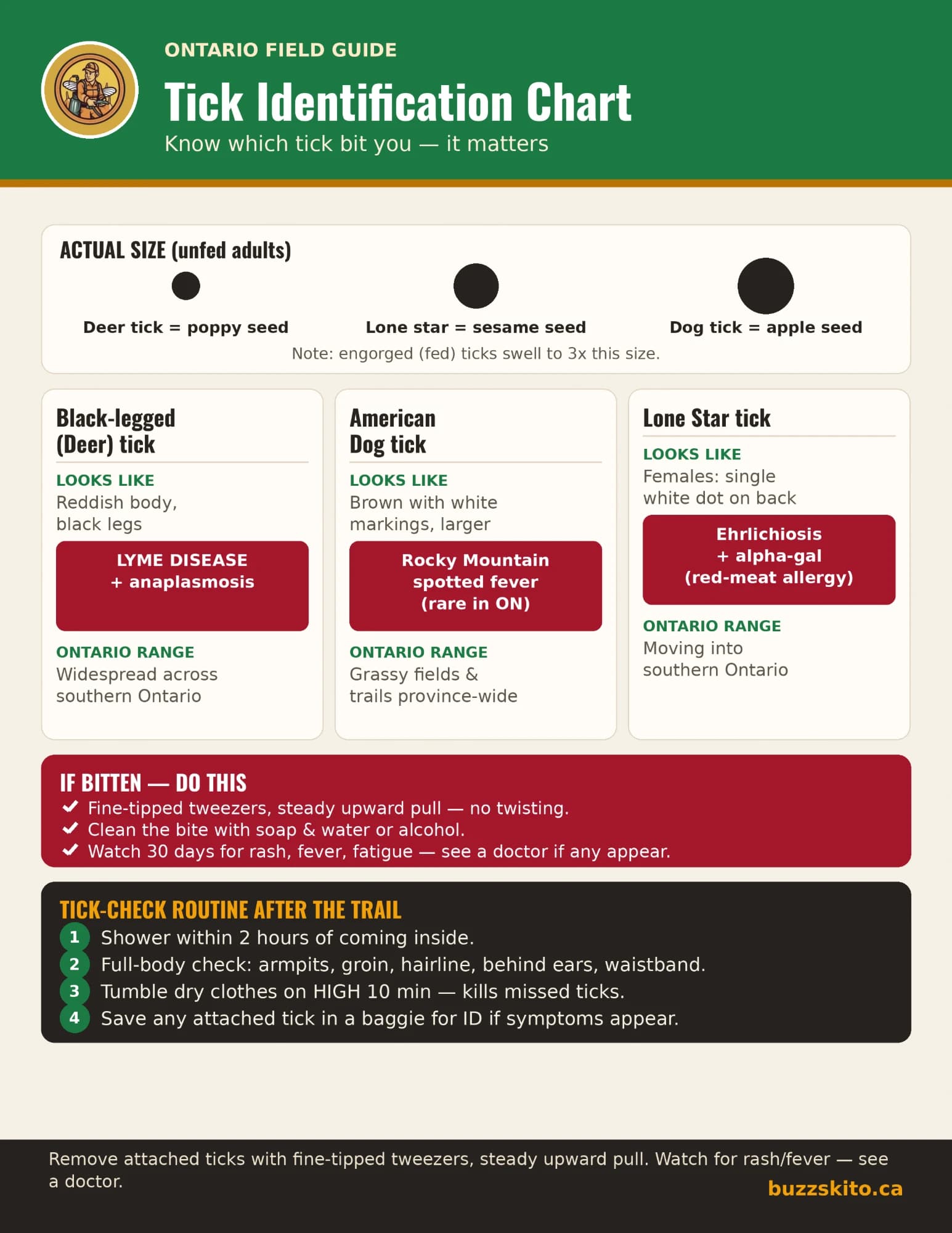
A blacklegged (deer) tick is smaller and plainer: about 3 mm unfed (roughly 1/8 inch), with a solid reddish-brown body and dark, almost black legs. An American dog tick is about 5 mm unfed (roughly 3/16 inch) with a mottled grey-and-white shield on its back. Decorative markings on the back mean dog tick; plain reddish-black means blacklegged tick.
Even when you have correctly identified a real tick, a second identification matters in Ontario. Two species are common across the GTA, and only one carries Lyme disease.
Blacklegged tick (deer tick) — Ixodes scapularis
- Size: Sesame-seed-sized when unfed (about 3 mm). Nymphs are even smaller — pinhead-sized.
- Colour: Reddish-brown body with darker, almost black legs. No decorative markings on the back.
- Disease risk: Primary vector for Lyme disease, anaplasmosis, and babesiosis in Ontario.
- Habitat: Wooded areas, forest edges, leaf litter, tall grass — especially across the Oak Ridges Moraine, Niagara Escarpment, and ravine corridors of the GTA.
American dog tick — Dermacentor variabilis
- Size: Larger — about 5 mm unfed, up to 15 mm when engorged.
- Colour: Brown body with a distinctive mottled grey-and-white patterned shield (scutum) on the back.
- Disease risk: Generally does not transmit Lyme disease in Ontario. Can transmit Rocky Mountain spotted fever and tularemia, but these are rare in Ontario.
- Habitat: Open grassy areas, trails, fields, and lawn edges. Often picked up by dogs running through tall grass.
If you find a tick attached to yourself or your child and it is small, smooth, and reddish-black with no decorative markings — treat it as a potential deer tick. Remove it safely, save it in a sealed bag, and monitor the bite site for the bull's-eye rash. If the tick is large, with a clearly patterned grey-white scutum, it is most likely a dog tick — still remove it carefully, but the immediate Lyme disease concern is much lower.
For the three common species on one page, the tick identification chart sets the deer tick, the dog tick and the lone star tick side by side, with a card you can print for tick checks.
How Big Is a Tick Compared to Each Look-Alike?
Most tick look-alikes sit between 1 mm and 5 mm, the same band as a real tick, so size alone rarely settles an identification. An unfed adult blacklegged tick is about 3 mm long (roughly 1/8 inch) and an unfed American dog tick is about 5 mm (roughly 3/16 inch). Legs and antennae are the reliable test, not millimetres.
Here are the sizes as plain figures. A booklouse is about 1 mm long (roughly 1/25 inch). A clover mite is under 1 mm. A blacklegged tick nymph is under 2 mm (about 1/16 inch), which the Centers for Disease Control and Prevention compares to a poppy seed. A spider beetle is 1.5–4 mm (up to about 1/8 inch). An adult carpet beetle is 2–4 mm (about 1/8 inch). A pantry weevil is about 3 mm (roughly 1/8 inch). An adult bed bug is about 5 mm (roughly 3/16 inch), the size of an apple seed. An engorged American dog tick can reach 15 mm (over half an inch), which is larger than any of the insect look-alikes on this page.
All of which is far easier to judge under magnification than at arm’s length. At 1 to 2 mm, six legs versus eight is the identification, and at that size the naked eye is mostly guessing — the antennae that rule out a tick in one second are simply too fine to resolve. A lighted handheld magnifier, or a clip-on macro lens for a phone camera, settles it properly, and it is the one piece of kit that works on every look-alike on this page rather than just one. Check lighted magnifiers on Amazon.ca →
Why Misidentification Matters
Identification decides the response. The Centers for Disease Control and Prevention states that in most cases a blacklegged tick must stay attached for more than 24 hours before it can transmit the Lyme disease bacterium, so removing a real tick quickly matters. A 6-legged beetle, bed bug or booklouse carries no tick-borne disease risk at all.
Lyme disease is most easily treated when caught early. The Ontario Public Health guidance is clear: a deer tick attached for less than 24 hours is unlikely to transmit Lyme, while one attached for 24 to 36 hours or longer carries meaningful risk. That gives you a tight window to act — but only if you correctly identify what you have.
Here is the practical decision tree:
- Bug found indoors, not attached to skin, with 6 legs and antennae: Almost certainly not a tick. Identify by location (bed, pantry, attic) and address as appropriate.
- Bug found attached to skin, with 8 legs and no antennae: Treat as a tick. Remove with fine-tipped tweezers, save in a sealed bag, monitor for 30 days.
- Bug found crawling on body or clothing after outdoor activity, with 8 legs and no antennae: Treat as a tick. Remove and dispose, then check the rest of the body, gear, and pets thoroughly.
- Uncertain identification: When in doubt, treat as a tick. The cost of caution is low; the cost of missing a true tick is potentially high.
Two of those four branches end with “save it,” and a sealed sandwich bag is where saved ticks go to be forgotten — they dry out, get crushed in a drawer, and stop being identifiable within days. A small screw-top specimen vial keeps the specimen intact and, crucially, gives you a flat surface to write the date and the place of the bite on. Those two facts are exactly what a healthcare provider or your local public health unit will ask for, and neither is recoverable from memory three weeks later when a rash shows up. Check price on Amazon.ca →
When Should You See a Doctor After a Tick Bite?
See a healthcare provider if a rash or a fever appears in the weeks after a tick bite. The Centers for Disease Control and Prevention advises watching for symptoms for 30 days after removing a tick and contacting a provider if fever or rash develops. A 6-legged insect look-alike carries no Lyme disease risk and needs no tick-related follow-up.
Mayo Clinic describes the Lyme disease rash, erythema migrans, as an expanding red area that sometimes clears in the centre into a bull’s-eye pattern, typically appearing 3 to 30 days after the bite. Tell the provider when the bite happened, how long the tick was attached, and where you picked it up, because those three facts shape the decision. In Ontario, your local public health unit can also advise on blacklegged tick bites and on where ticks have been submitted in your area.
What Bugs Look Like Ticks in Ontario and the GTA?
In Ontario the same seven look-alikes turn up indoors — bed bugs, spider beetles, weevils, carpet beetles, bat bugs, booklice and brown marmorated stink bug nymphs — while only two ticks are common across the GTA: the blacklegged (deer) tick and the American dog tick. Only the blacklegged tick transmits Lyme disease here.
Public Health Ontario publishes an annual map of Lyme disease estimated risk areas, and much of the GTA’s wooded edge sits inside or beside it, including the Oak Ridges Moraine, the Niagara Escarpment and the ravine corridors that run through Toronto, Vaughan, Richmond Hill and Markham. A bug found in a GTA pantry, basement or windowsill is far more likely to be a beetle or a booklouse than a tick, because ticks are picked up outdoors from grass, brush and leaf litter and only come inside on people or pets. If ticks keep turning up on the same property, seasonal tick control runs 5 barrier applications across the May-to-September season.
When the bug indoors really does have 8 legs and no antennae, the follow-up question is usually how long it could have been sitting there before you spotted it, since nothing in the house feeds it. How long ticks live sets out the lifespan of each stage and how long an unfed tick lasts off a host, which is what tells you whether the speck on the windowsill rode in on someone this week or has been there far longer.
Reducing Tick Pressure on Your Property
Ticks concentrate at edges, not in the middle of a mown lawn. The Centers for Disease Control and Prevention recommends removing leaf litter, cutting tall grass and laying a 3-foot (about 1 metre) barrier of wood chips or gravel between the lawn and wooded areas. That transition strip is the same zone a professional barrier treatment targets.
The best protection against tick misidentification — and against ticks generally — is to reduce the population on your property in the first place. Most GTA tick exposure happens in:
- The transition zone between lawn and forest or hedge
- Tall grass at property edges
- Ornamental beds with dense ground cover
- Leaf-litter accumulation under shrubs and along fence lines
- Areas where deer, raccoons, and small mammals travel through the yard
Professional tick control treatment targets these zones with a residual application, applied according to label directions and repeated through the season as the residual wears off. For families in higher-risk areas — Vaughan, Richmond Hill, Markham, Caledon, Halton Hills, and the Hamilton escarpment — a structured tick spray schedule across the season is the most effective way to keep population pressure low and reduce the chance of finding any tick at all. If you are in one of those pockets, the local pages spell out the habitat property by property: our Caledon tick spray service deals with the Niagara Escarpment and Oak Ridges Moraine lots, while mosquito and tick control in Halton Hills covers the Conservation Halton lands that back onto so many properties there.
When in Doubt, Get a Professional Eye on It
If you cannot identify what you found, photograph it next to a coin for scale and keep it in a sealed bag before disposing of it. A clear photo of the legs and head answers the question almost every time, because 8 legs with no antennae means tick and 6 legs with antennae does not. A yard walk-through then shows which edges and beds are actually holding ticks.
If you have found bugs you cannot identify on your property — and especially if you have pets or children playing in the yard — book a free yard assessment. Our technician walks every property and can usually identify what you are seeing, point out the high-risk zones, and recommend the right level of treatment. In York Region that walk-through matters most where the Moraine runs straight through residential streets, which is why mosquito and tick control in Richmond Hill concentrates on the Oak Ridges and Jefferson neighbourhoods.
And if what you found is not a tick at all but the biting flies that share the same habitat — mosquitoes, black flies, deer flies at a cottage or campsite — the fastest fix is a physical one. A screen tent or screen house gives you a guaranteed bite-free zone over the table with no chemicals involved, which is the one thing repellents cannot do reliably against black flies.
And if the bug turns out to be a bed bug rather than a tick, you are looking at a completely different treatment plan — our pest product guides include a full bed bug control library alongside the tick gear we recommend.
Bugs That Look Like Ticks in the United States, by Region
Tick look-alikes in the United States vary by region: deer keds in the Northeast, yellow poplar weevils from New England to Louisiana, chiggers where the climate is mild and, in Nevada, strawberry root weevils that shelter indoors. Penn State Extension describes deer keds as brown, flattened flies that shed their wings after landing on a host and then look somewhat like ticks. Adult European deer keds emerge on warm fall days, and that introduced species has spread through most of the Northeast, west into Ohio and south into Virginia.
The yellow poplar weevil is an oval beetle about 1/8 inch long that some people take for a tick, which can bring calls to Extension offices about ticks that fly during outbreak years, according to Ohio State University Extension. NC State Extension, citing a reference book on tree-feeding insects, gives its distribution as New England south to Louisiana and says it is most common in central Appalachia.
Chiggers are immature mites with six legs, usually reddish and almost too small to see unaided, and they do not burrow into skin, according to the University of Kentucky. They prefer mild climates, which is why Purdue Extension reports more of them in southern Indiana than in the north of the state. University of Nevada, Reno Extension says strawberry root weevils, about 1/4 inch long, are often mistaken for ticks because they are dark and compact, but they have six legs rather than eight.
Where to Get a Specimen Identified
A free photo service is a quick route: TickSpotters, run by the University of Rhode Island’s TickEncounter Resource Center, takes an uploaded picture of the tick plus a few answers and usually responds within 24 hours with an identification and the likely risk. In Maine, the University of Maine Cooperative Extension Tick Lab offers a free identification-only submission, and the National Pesticide Information Center notes that every US county has an extension office that answers pest control questions. Identification is not testing: the CDC says having a removed tick tested to see whether it is infected is, in general, not recommended.
If the specimen does have eight legs, what ticks look like at each life stage covers the main US species and their markings, and which ticks carry Lyme disease explains which of them transmit it. Six-legged specks that arrive dozens at a time may be larval ticks rather than chiggers, since the CDC lists the larva as the six-legged stage of a tick, and the guide to seed ticks covers how to remove dozens at once. State programs differ, and the guide to ticks in Michigan walks through that state’s identification program.
On a pet, how an attached tick differs from a skin tag or scab on a dog is the page to read, and for the yard itself, start with the complete tick control guide.
Related Guides
- The Ultimate Tick Control Guide for Ontario Homeowners
- How to Identify Ticks in Ontario
- How to Remove a Tick Safely
- Best Tick Removal Tools: Buyer’s Guide
- Tick vs Bed Bug: Full Comparison
- Tick Bite vs Mosquito Bite
- Best Screen Tents & Screen Houses in Canada
- Best Wasp Traps in Canada — Bag vs Sticky vs Reusable
- BuzzSkito Tick Control Services