
Reviewed by Alex Francisco
Published November 10, 2026 · Fact-checked against the sources listed below
What are the black and yellow bugs I keep seeing?
Most black and yellow bugs are wasps (yellowjackets, paper wasps, mud daubers, cicada killers), bees (bumble bees, carpenter bees), flies built to look like them (hover flies, drone flies, robber flies) or beetles (the striped cucumber beetle, the locust borer). The Missouri Department of Conservation (MDC) notes that many flies and beetles copy the yellow-and-black warning colors of bees and wasps, so color alone will not tell you whether a bug can sting.
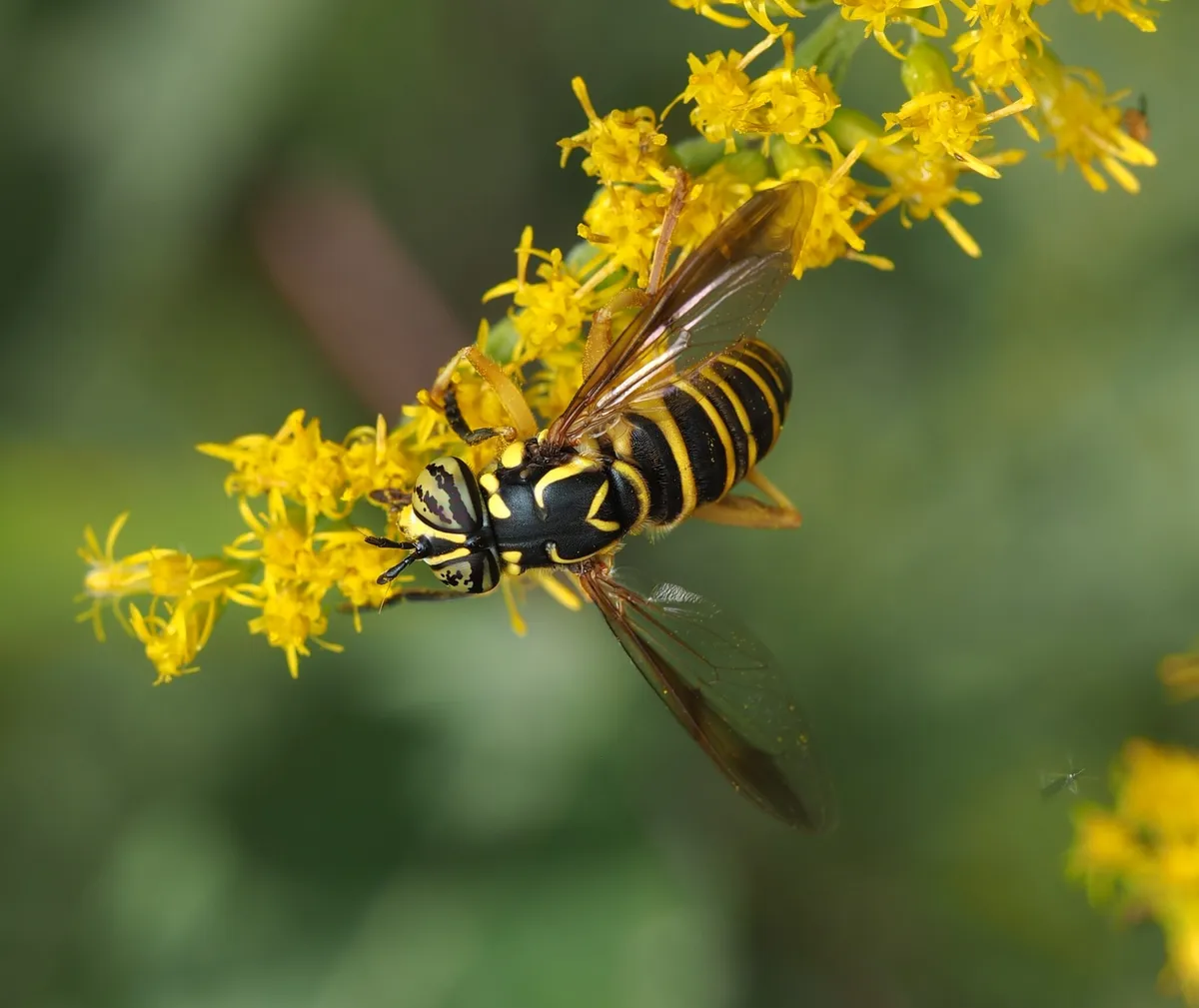
Where you saw it narrows the list faster than color does: find the place below, then use the check beside it.
| Where you saw it | Most likely | The one check |
|---|---|---|
| Picnic food, garbage cans, a soda | Yellowjackets | Jagged bright bands and a waist you can barely see |
| Eaves, porch lights, a grill, the garage | Paper wasps, mud daubers | Paper wasp: open paper comb; mud dauber: thread-thin waist and a mud nest |
| Hovering at a deck, railing or eaves in spring | Male carpenter bees | A bare, shiny black abdomen behind a fuzzy yellow thorax |
| Holes in the lawn or bare soil | Cicada killers, yellowjackets, ground-nesting bees | A giant wasp in midsummer, wasps using one burrow, or tiny holes in early spring |
| Garden flowers | Bumble bees, hover flies, drone flies | Two wings, huge eyes and stubby antennae mean a fly |
| Goldenrod in late summer or fall | Locust borers, hover flies | A yellow W across the back and reddish legs mean the beetle |
| Squash, cucumbers, mint or basil | Striped cucumber beetles, four-lined plant bugs | Three black stripes on the beetle, four on the plant bug |
| A big round web | Yellow garden spider | Eight legs and a zigzag band of silk |
| A sunny windowsill indoors | Varied carpet beetles | Round and no longer than about 1/8 inch |
Compiled from the extension, government and museum sources linked in the sections below.
Is it a bee, a wasp or a fly that looks like a bee?
Look at the head and wings before anything else. NDSU Extension's guide to insects that look like bees explains that a fly has only two wings, because its hind pair has shrunk to tiny knobs called halteres, while bees and wasps have four; the eyes and antennae settle most of the rest.
The fly-or-bee test, up close
- Two wings or four? Two means a fly; four means a bee or a wasp.
- Huge eyes? Eyes that cover most of the head belong to a fly; a bee's eyes are narrow and set on the sides of the head.
- Stubby antennae? Most bee-like flies have short ones, while bees and wasps carry two long, segmented antennae.
- Hovering in place? NDSU notes that flies hover and dart quickly from flower to flower as they feed.
- A visible waist? A wasp's narrow waist is easy to see; a bee is stouter, with a waist that is hard to spot.
- Fuzzy or shiny? MDC says a bumble bee always has some fuzz on its abdomen, while a carpenter bee's abdomen is bare and shiny black.
The flies cannot sting. NDSU says flies have no stinger and are no threat to gardeners, and Purdue Extension's hover fly article adds that hover flies cannot bite either.
What are the flies that look like bees?
The flies that pass for bees are mostly hover flies (also called flower flies), drone flies, bee flies and some robber flies. All of them have one pair of wings and the big eyes of a fly, and of the four, only robber flies may bite, and then only if mishandled.
Hover flies, or flower flies
Hover flies resemble bees in color, behavior and size, NDSU says. Many are 1/4 to 1/2 inch long, with large heads, reddish or marbled black eyes, two clear wings and yellow-and-black patterns on the abdomen; some are hairy and some are not. They buzz like bees and are important pollinators, and some of their larvae prey on aphids and other soft-bodied pests.
Purdue Extension says hover flies come to people for the moisture and salts in sweat, and that calling them sweat bees is not correct. Real sweat bees are smaller and typically dark or metallic, with two pairs of wings, Purdue says, and they will readily sting if accidentally squashed while they feed; the sweat bee guide shows them.
Drone flies
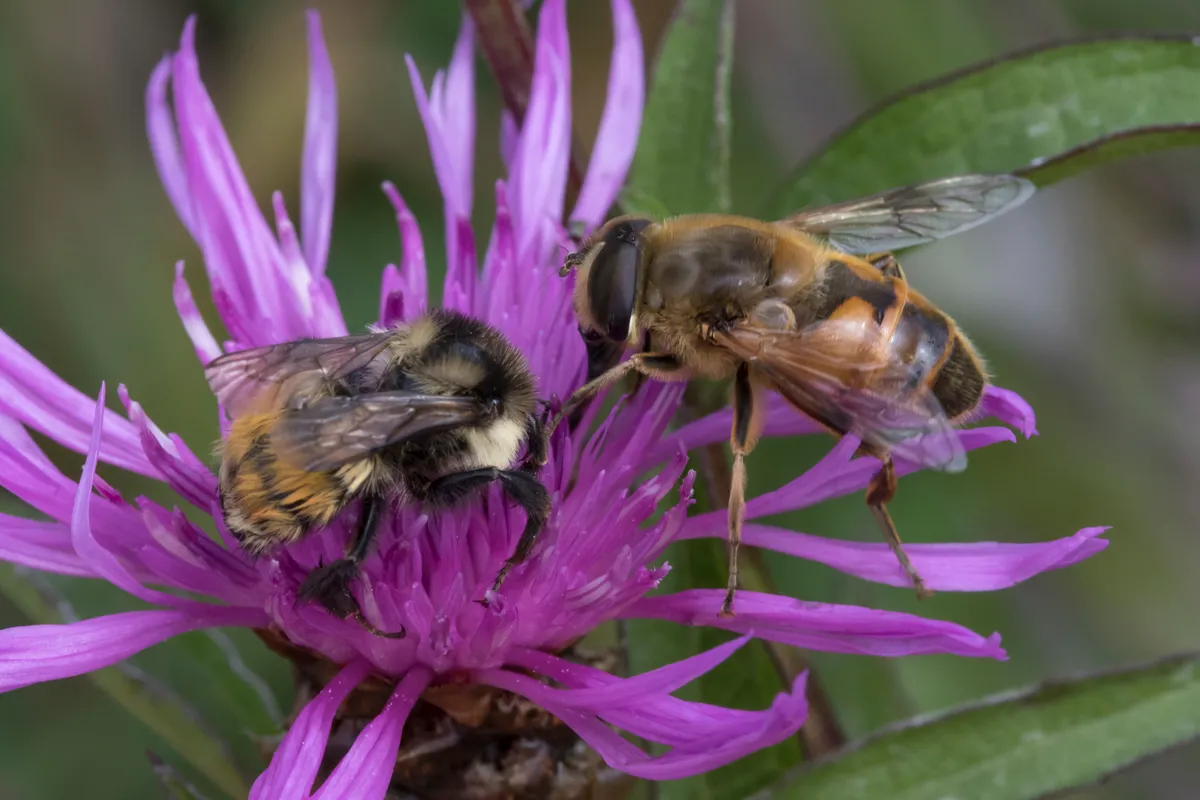
Drone flies belong to the hover fly family, which the USDA Forest Service's pollinator page on drone flies says includes many successful bee mimics. The common drone fly (Eristalis tenax) looks like a honey bee and even flies like one, moving from flower to flower instead of hovering, while Eristalis flavipes passes for a fuzzy bumble bee. Drone flies have several generations a year and are out from early spring to late fall, and like other flies they cannot sting.
Bee flies
Bee flies are stout and fuzzy, about 1/4 to 1/2 inch long and covered in yellow, black or brown hairs, according to NDSU; some species have clear wings and others have dark patterns on them. They sip nectar through a long tongue, and because their bodies are hairy they carry a lot of pollen between flowers.
Robber flies that mimic bumble bees
Some robber flies look almost exactly like bumble bees, down to yellow fuzzy patches on stout bodies, and many others are patterned black and yellow, says MDC's robber fly guide. Most are 1/2 to 3/4 inch long, the face often looks bearded, and they snatch other insects in flight from a perch. One may bite if mishandled, MDC says, so brush it off rather than slapping it.
A thick-bodied, bee-colored insect hovering at flowers around dusk may be a moth. NDSU describes hummingbird clearwing moths as about 1 to 1 1/2 inches long, with a robust body and narrow, clear front wings bordered in black or brown, flitting between flowers at twilight, and MDC's bumblebee guide lists the snowberry clearwing among the sphinx moths that copy bumble bees.
What is the black and yellow bug at my food, drink or trash can?
A black and yellow wasp that keeps coming back to your plate, your drink or the garbage is usually a yellowjacket. UC IPM's yellowjacket guide describes yellowjackets as 1/2 to 1 inch long, with jagged bright yellow and black stripes and a barely visible waist. In fall, it says, foragers turn mostly to scavenging and show up at picnics and barbecues, around garbage cans and at pet food dishes left outside, and it advises covering soda cans outdoors so wasps cannot crawl in.
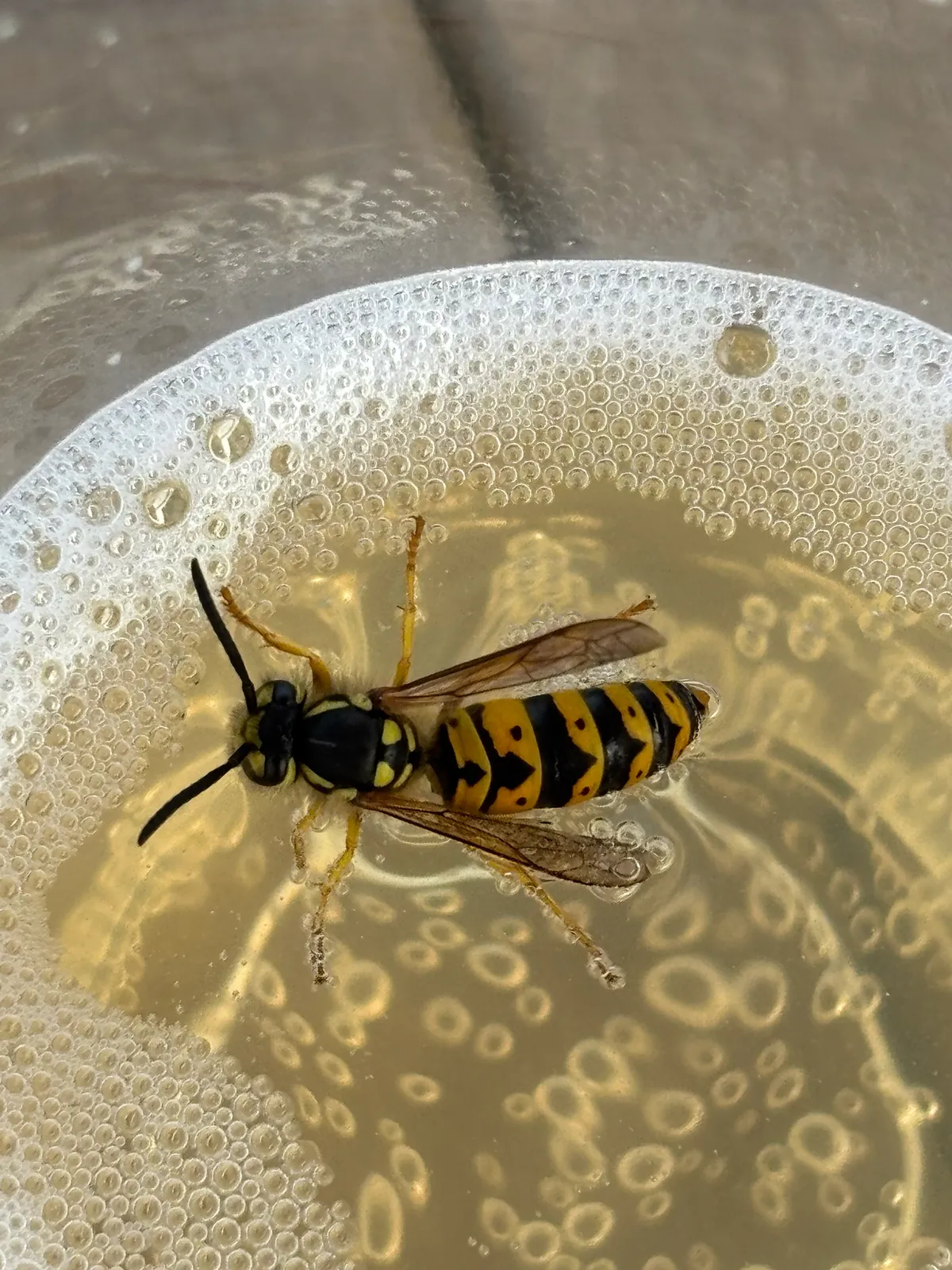
Treat these with respect. UC IPM calls yellowjackets by far the most troublesome group of wasps and says wasp stingers have no barbs, so one wasp can sting again and again. The yellow jacket guide covers their nests, fall behavior and stings.
A large black wasp with whitish rather than bright yellow markings may be a bald-faced hornet: NDSU describes it as 3/4 to 1 inch long, black with light yellow to white markings and a white tip at the end of the abdomen, and quick to sting repeatedly near its big paper nest. How hornets differ from other wasps covers it, as does the bald-faced hornet guide.
What is the black and yellow bug on my house, deck or garage?
On a house it is usually a paper wasp, a carpenter bee or a mud dauber, and what it is building gives it away: paper wasps tend open paper combs, carpenter bees bore round holes in wood, and mud daubers build with mud. The wasp nest identification guide matches a nest to its builder.
Paper wasps
The European paper wasp is black with bold yellow markings, and Penn State Extension says it is often mistaken for a yellowjacket. It is larger, with a thinner waist, orange-tipped antennae (a yellowjacket's are all black) and legs that dangle in flight, and it nests under eaves, in attics and wall voids, in light fixtures and in seldom-used grills. UC IPM says paper wasp nests hang like an open umbrella from a stalk, and that most species are relatively unaggressive but a problem when they nest over doorways. The paper wasp guide covers the other species.
Carpenter bees
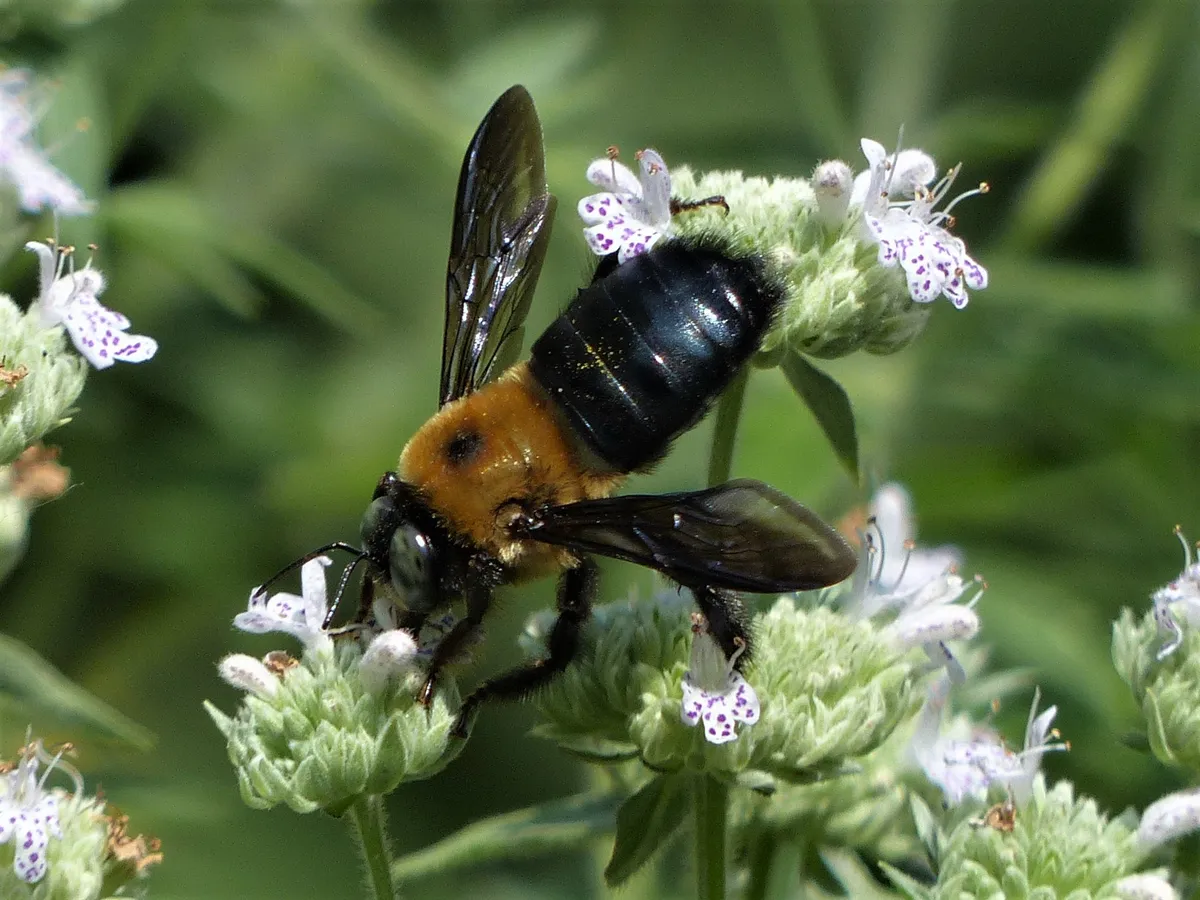
A big bee hovering at a deck, a porch railing or the eaves is usually an eastern carpenter bee. UGA Extension describes it as 3/4 to 1 inch long, about bumble bee size, with a fuzzy yellow thorax and a smooth, hairless, metallic black abdomen; males have a pale yellowish-white patch on the face. The ones that zoom at you in spring are usually males guarding a territory, and UGA says males lack a stinger.
The females do the drilling. MU Extension's carpenter bee guide says they can sting if handled and bore near-perfect round holes about 1/2 inch across into sound wood, preferring unpainted or weathered wood. A guide to stopping carpenter bees covers treating and plugging the holes, and the carpenter bee vs bumble bee comparison sets the two side by side.
Mud daubers
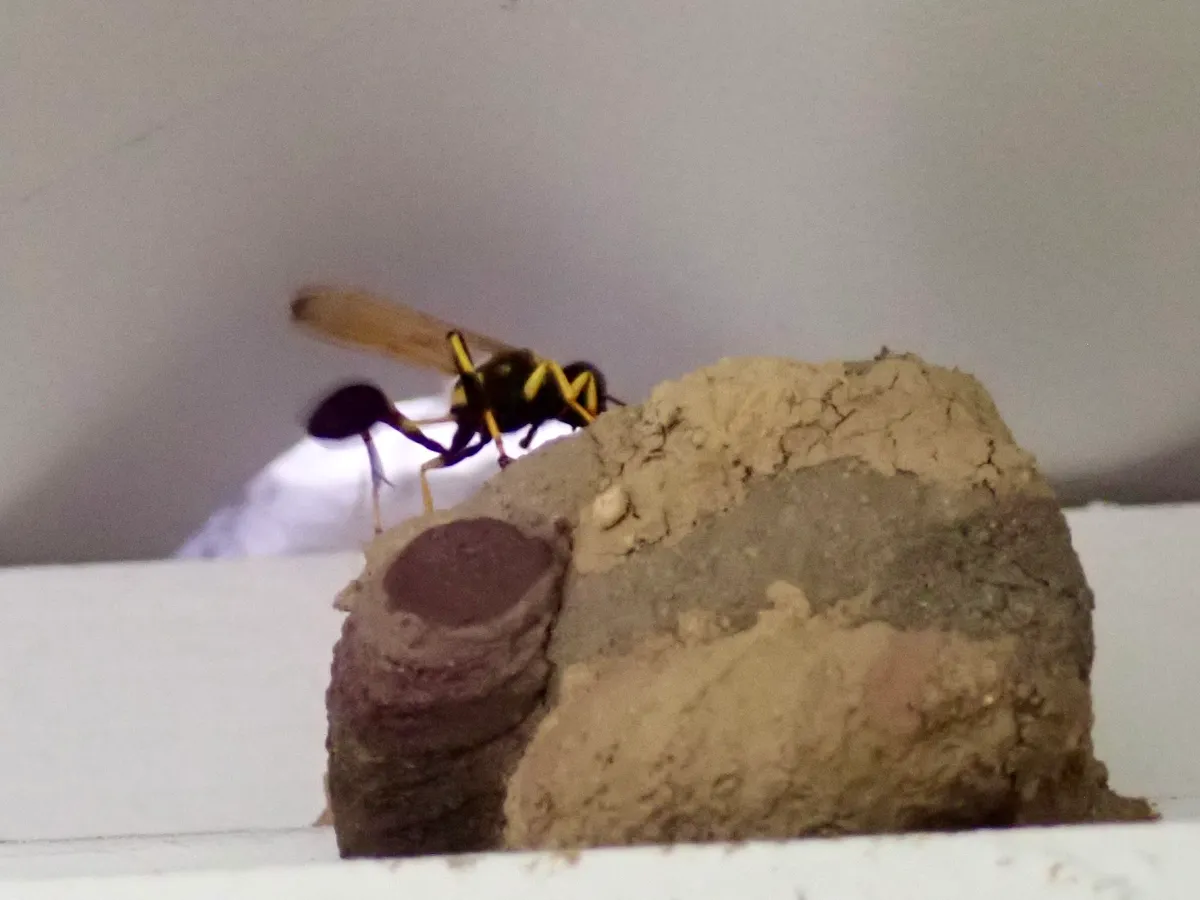
A slim black wasp with yellow legs and a thread-thin waist, working on a lump of mud in a garage, a barn or under the eaves, is the black-and-yellow (or yellow-legged) mud dauber. MDC's mud dauber guide puts mud daubers at about 1/2 to 1 inch long. MDC says they do not aggressively sting people; females sting only if mishandled. The mud dauber guide shows how to tell an active nest from an old one.
What is the big black and yellow wasp digging in my lawn?
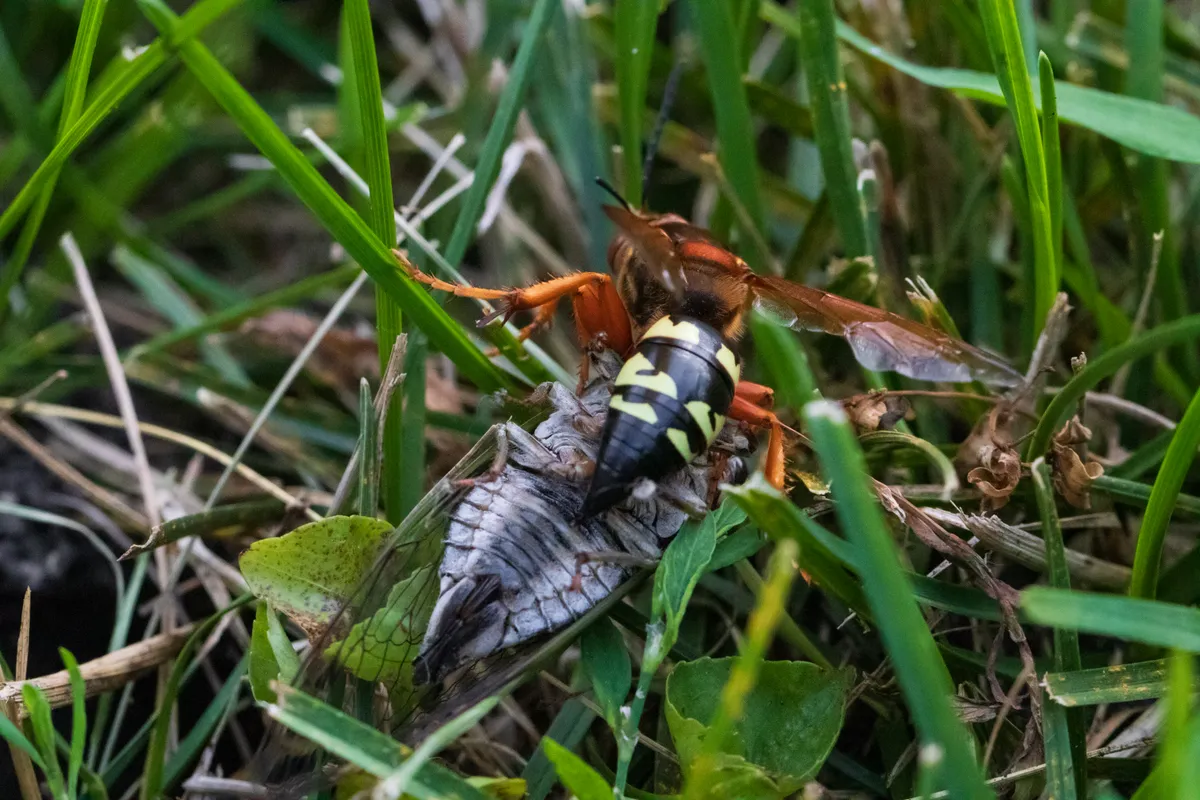
A very large wasp that comes and goes from holes in the lawn in midsummer, often with a mound of soil at the entrance, is likely an eastern cicada killer. MDC's cicada killer guide says it can exceed 1 1/2 inches, with rusty wings and black and yellow markings; females dig tunnels in loose soil in lawns, usually several close together, and males guard territories from midsummer. Males cannot sting at all, and MDC calls the wasp virtually harmless unless handled roughly. See the cicada killer guide and the guide to holes in the yard.
Two other diggers get blamed for lawn holes. Yellowjackets commonly nest in rodent burrows and defend them, UC IPM says; dealing with wasps that nest in the ground covers those. Holes about 1/4 inch across in warm, sunny, dry ground in early spring usually belong to ground-nesting bees, which Clemson Extension says are active for only a few weeks, do not defend their nests and tend not to sting unless provoked or handled roughly; see the ground bee guide.
What black and yellow bugs visit flowers?
On flowers, the fuzzy black and yellow insects are usually bumble bees, and the sleek, banded ones that hover in place are often hover flies (covered above). MDC describes bumble bees as large, fuzzy bees about 1/2 to 1 inch long, usually banded black and yellow, sometimes with orange, that nest below ground, often in old rodent burrows, or in brush piles. They can sting if molested or if the nest is threatened, but MDC says they do not aggressively defend their colonies.
Locust borers on goldenrod
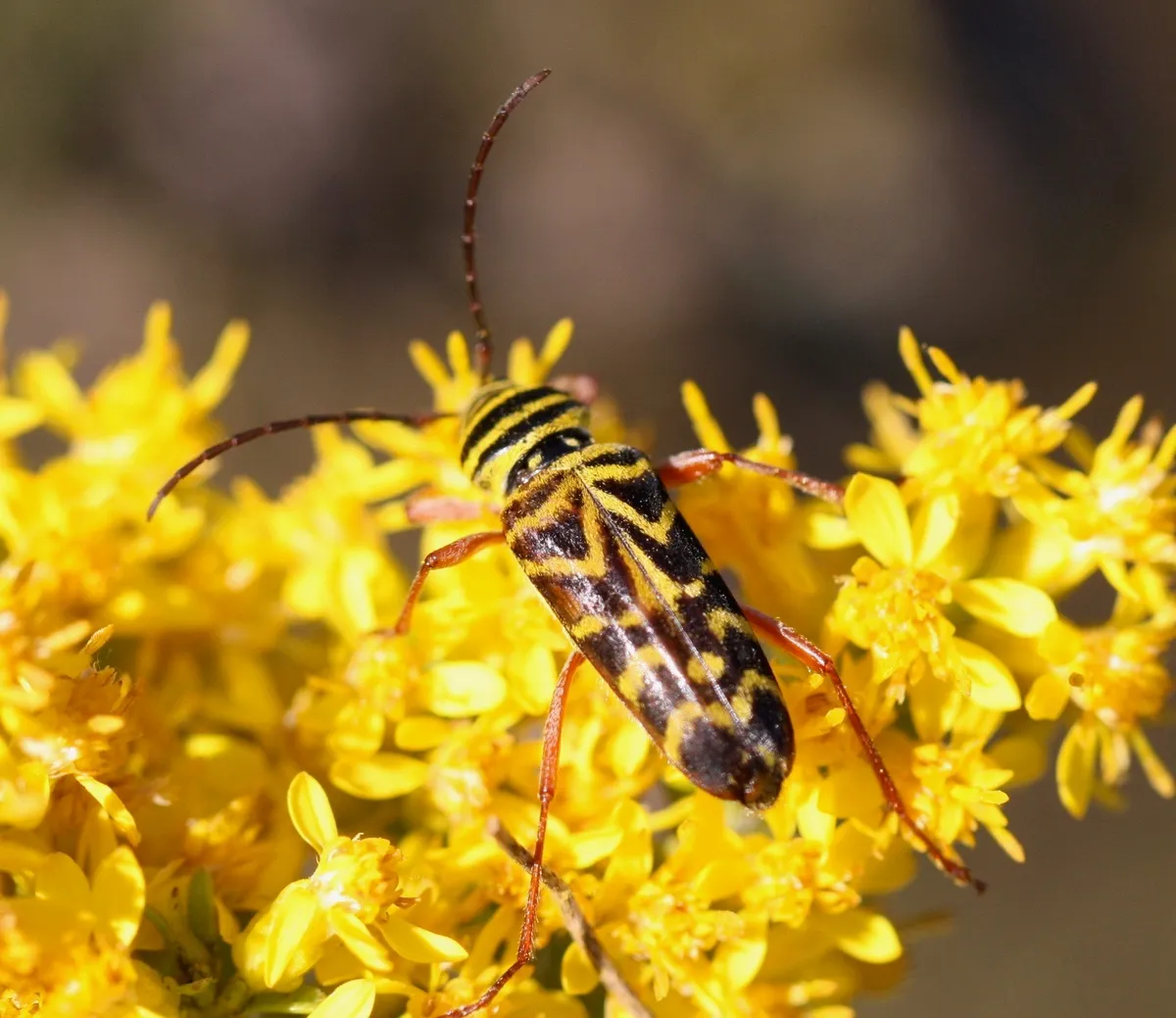
A black and yellow beetle on goldenrod in late summer or fall is likely a locust borer. MDC's locust borer page describes a longhorned beetle whose black and yellow adults feed on the pollen of goldenrod and other flowers, with stripes that copy the color pattern of stinging insects, and calls it harmless. Colorado State University gives the adult as about 3/4 inch long, with reddish legs and a W-shaped mark on the wing covers, feeding early in the day; its larvae tunnel into black locust trees.
What is the black and yellow beetle in my vegetable garden?
A small yellow beetle with black stripes on squash, cucumbers or melons is the striped cucumber beetle. The Connecticut Agricultural Experiment Station describes it as about 1/4 inch long, with a black head and abdomen and a yellow back with three long black stripes. Adults are usually out by June and feed on leaves, stems, fruit and especially blossoms all season, and they can spread bacterial wilt. The related spotted cucumber beetle is pale green with 12 black dots.
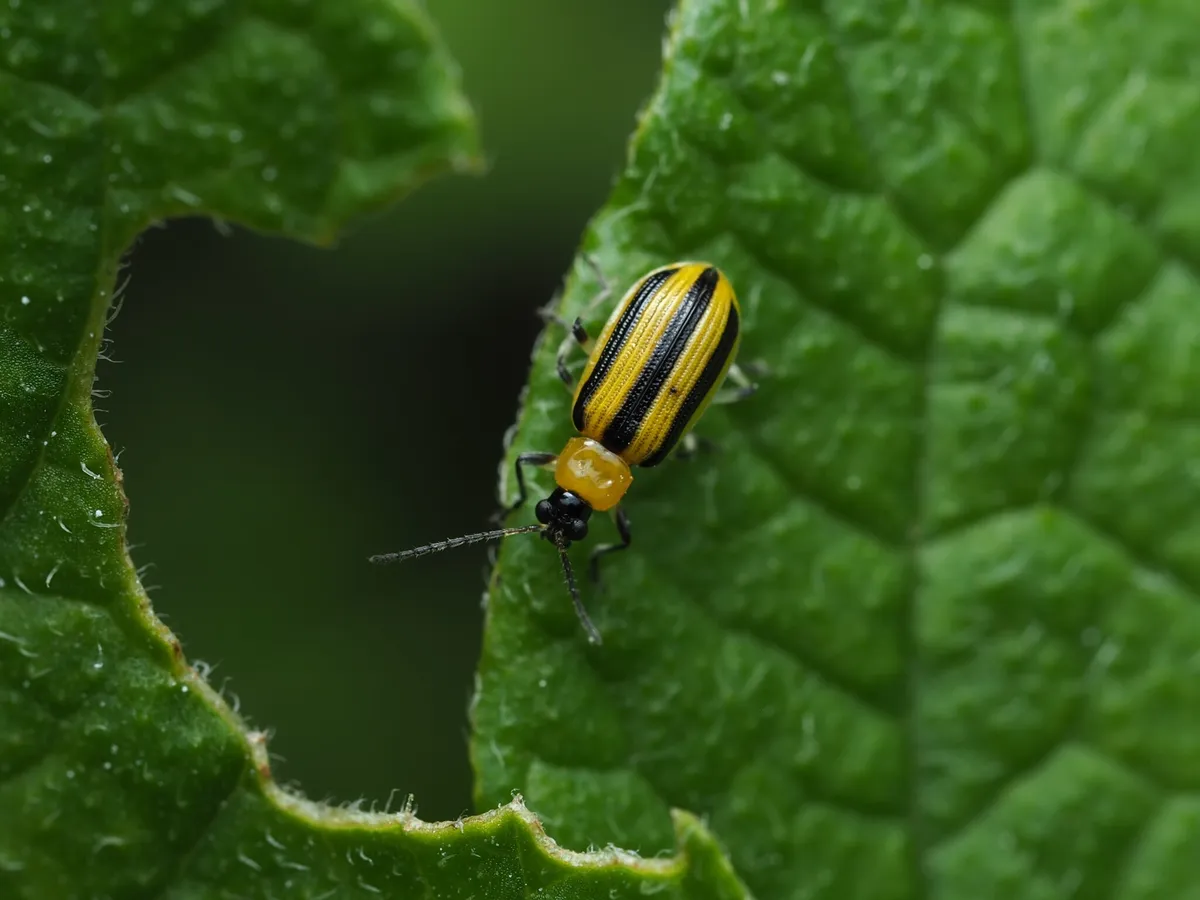
A yellow bug with four black stripes on mint, basil or garden perennials, leaving small, roughly circular black or brown spots on the leaves, is the four-lined plant bug, a true bug rather than a beetle. UConn's Home and Garden Education Center describes the adult as one-quarter inch long, with four black stripes on yellow to yellow-green wing covers; the young are yellow to red with rows of black spots. UConn advises starting to watch plants by mid-May.
A small, round yellow beetle with black spots among aphids is likely a lady beetle. The University of Michigan's Animal Diversity Web describes the fourteen-spotted lady beetle as yellow with fourteen irregular black spots, about 1/7 to 1/5 inch (3.5 to 5.2 mm) long; introduced to North America to help control aphids called greenbugs, it feeds mainly on aphids and lives across the eastern United States.
The black and yellow spider in a big web
If it has eight legs and hangs head-down in a big round web with a zigzag band of silk, it is likely a yellow garden spider. MDC describes the female as 3/4 to 1 inch long, with a yellow and black abdomen and black legs striped yellow-orange, in a web about 2 feet across in gardens and grassy spots near houses; she dies with the first frosts. MDC calls these spiders harmless, and the orb weaver guide covers them.
What are the black and yellow bugs in my house?
A tiny, round black bug flecked with yellow, white and brown on a sunny windowsill is usually a varied carpet beetle. UC IPM's carpet beetle guide describes the adult as black with an irregular pattern of white, brown and dark yellow scales, about 1/10 inch long, and says adults are drawn to sunlight, often after flying in from garden flowers or arriving on cut flowers. Adults eat pollen and nectar; the larvae, which look like fuzzy maggots, eat wool, silk, fur, feathers and pet hair.
UC IPM says a few adults indoors are no cause for alarm, and that action is needed only when larvae are developing in fabrics or elsewhere in the house. How to get rid of carpet beetles explains where the larvae hide, and the guide to tiny black bugs sorts the other small dark beetles found indoors.
A paper wasp inside in late winter or early spring may have come from a winter hiding place in the walls: Penn State says fertilized European paper wasp queens spend the winter behind siding, in wall voids and in attics, then leave in spring to start new nests. UC IPM notes that yellowjackets can also nest in voids inside walls and ceilings.
When do black and yellow bugs come out?
Each of these insects has its season, so the time of year is a clue, from the first ground-nesting bees of spring to the locust borers of fall.
| Time of year | What you are likely to see | Source |
|---|---|---|
| Early spring | Ground-nesting bees at small holes in warm, sunny, dry soil, for a few weeks; male carpenter bees guarding territories at wood | Clemson, UGA |
| Spring | Paper wasp queens leaving their winter shelter behind siding and in attics to start nests | Penn State |
| Late spring | Four-lined plant bugs hatch, then feed on herbs, perennials and shrubs | UConn |
| June on | Striped cucumber beetles on squash, cucumbers and melons | Connecticut Agricultural Experiment Station |
| Midsummer | Cicada killers over lawns, as the dog-day cicadas emerge | MDC |
| Late summer and fall | Locust borers on goldenrod; yellowjackets scavenging at food in fall | MDC, Colorado State, UC IPM |
| Summer to the first frosts | Yellow garden spiders in their webs | MDC |
| Early spring to late fall | Drone flies on flowers | USDA Forest Service |
Timing as described in the sources linked on this page.
Which black and yellow bugs sting, and what do you do after a sting?
The stingers here are the wasps and bees. Yellowjackets, bald-faced hornets and, less readily, paper wasps defend their nests and can sting more than once; bumble bees sting if molested or if their nest is threatened; female carpenter bees, female cicada killers and female mud daubers sting mainly when handled. Hover flies, drone flies and bee flies have no stinger, robber flies may bite if mishandled, and MDC calls the locust borer harmless.
For a sting, MedlinePlus advises scraping out any stinger with the edge of a credit card or another straight edge, since tweezers may squeeze more venom in, then washing the spot with soap and water and icing it, wrapped in a washcloth, 10 minutes on and 10 minutes off. It also says to watch over the next several days for signs of infection, such as increasing redness, swelling or pain; see a health care provider if they appear. The bug bite identifier helps when you did not see what made a mark, and the bee sting vs wasp sting guide compares the two.
More black and yellow look-alikes
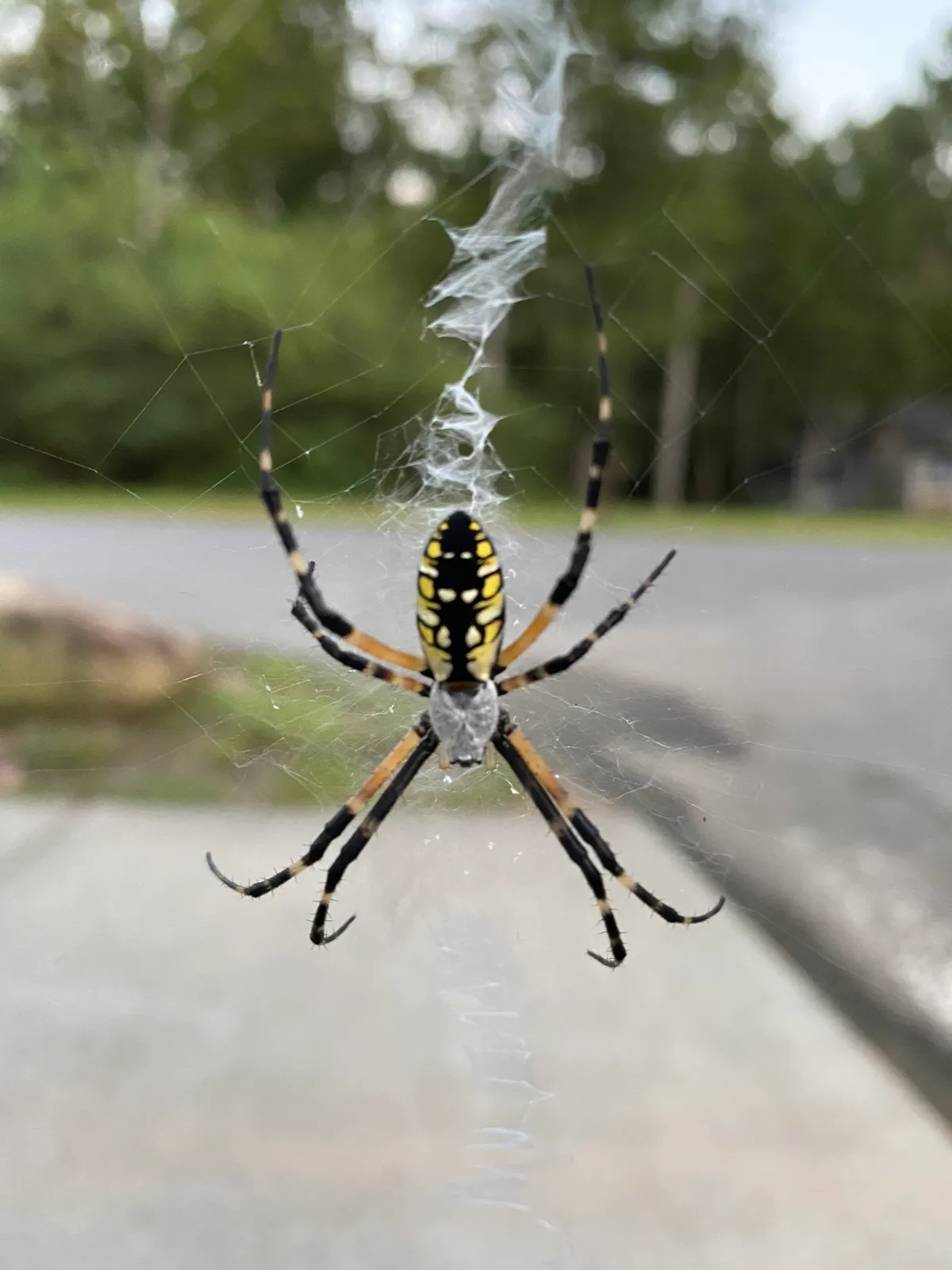 Yellow garden spiderA spider, yellow and black, hanging head-down in a big web with a zigzag band of silk
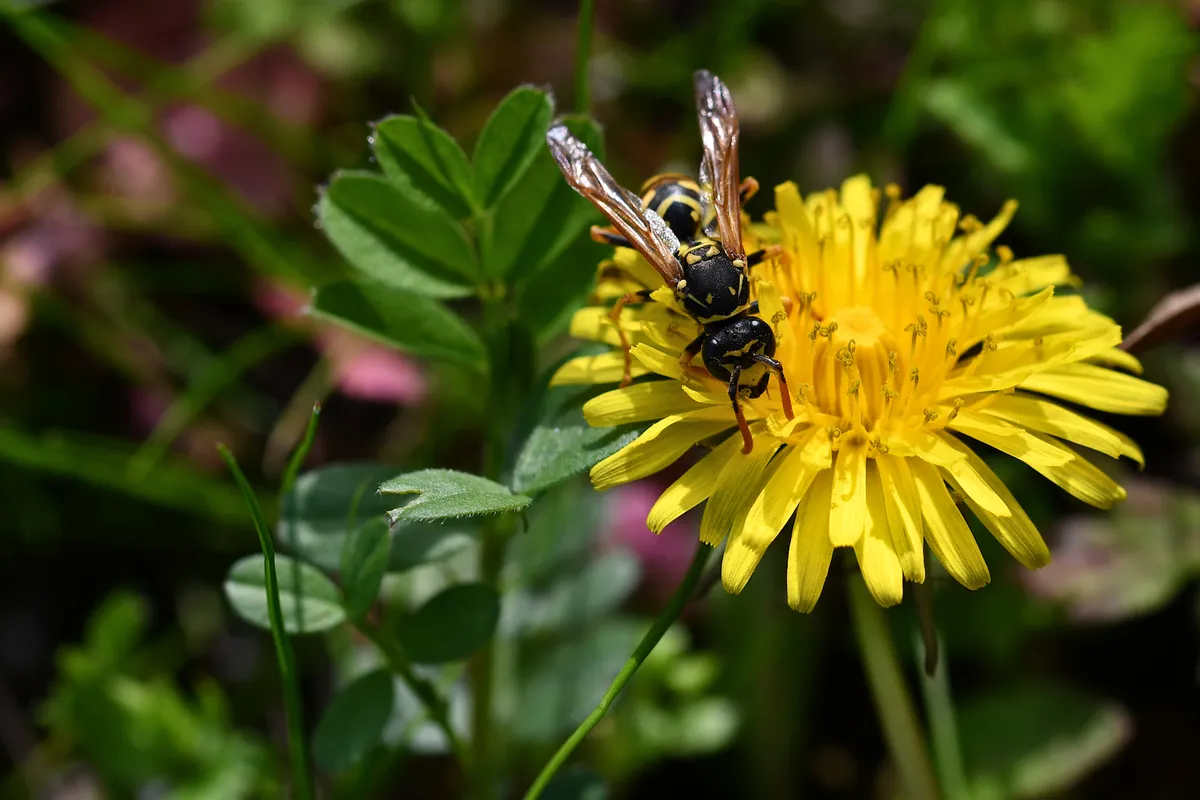 European paper waspSlimmer than a yellowjacket, with orange-tipped antennae and legs that dangle in flight
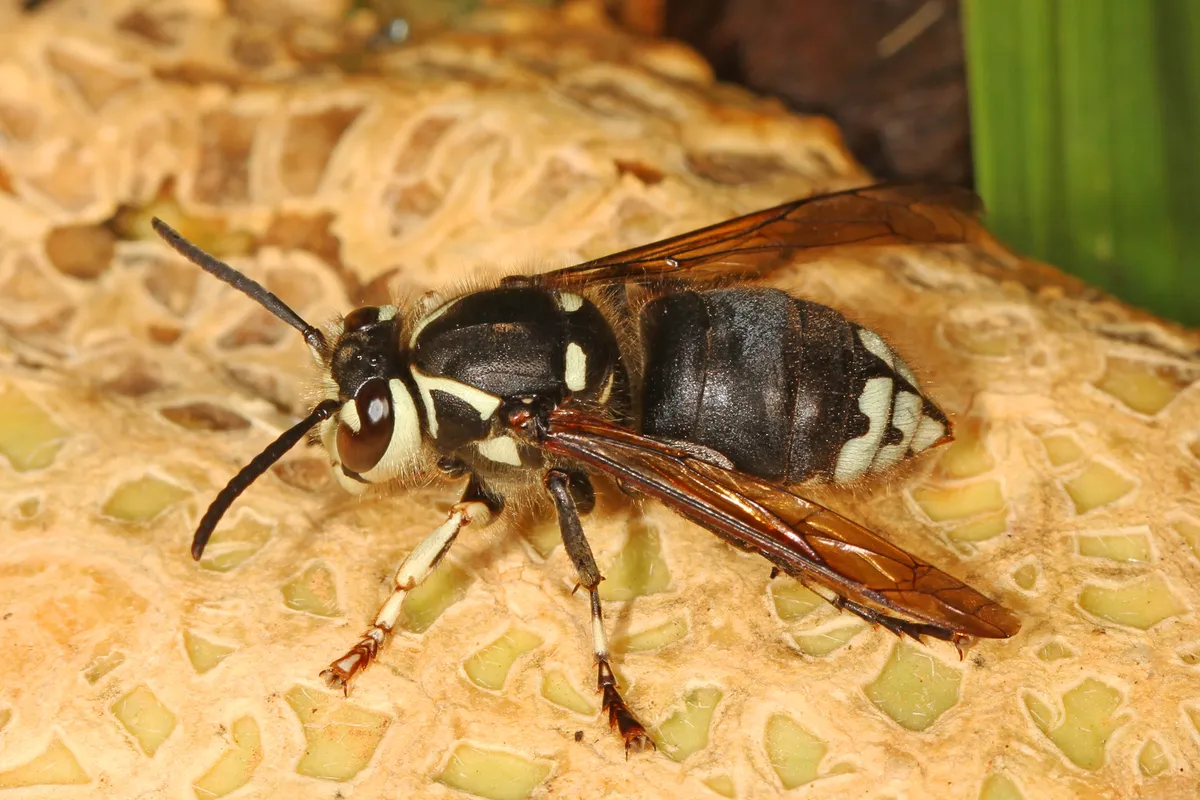 Bald-faced hornetBlack with light yellow to white marks and a white tail tip; 3/4 to 1 inch
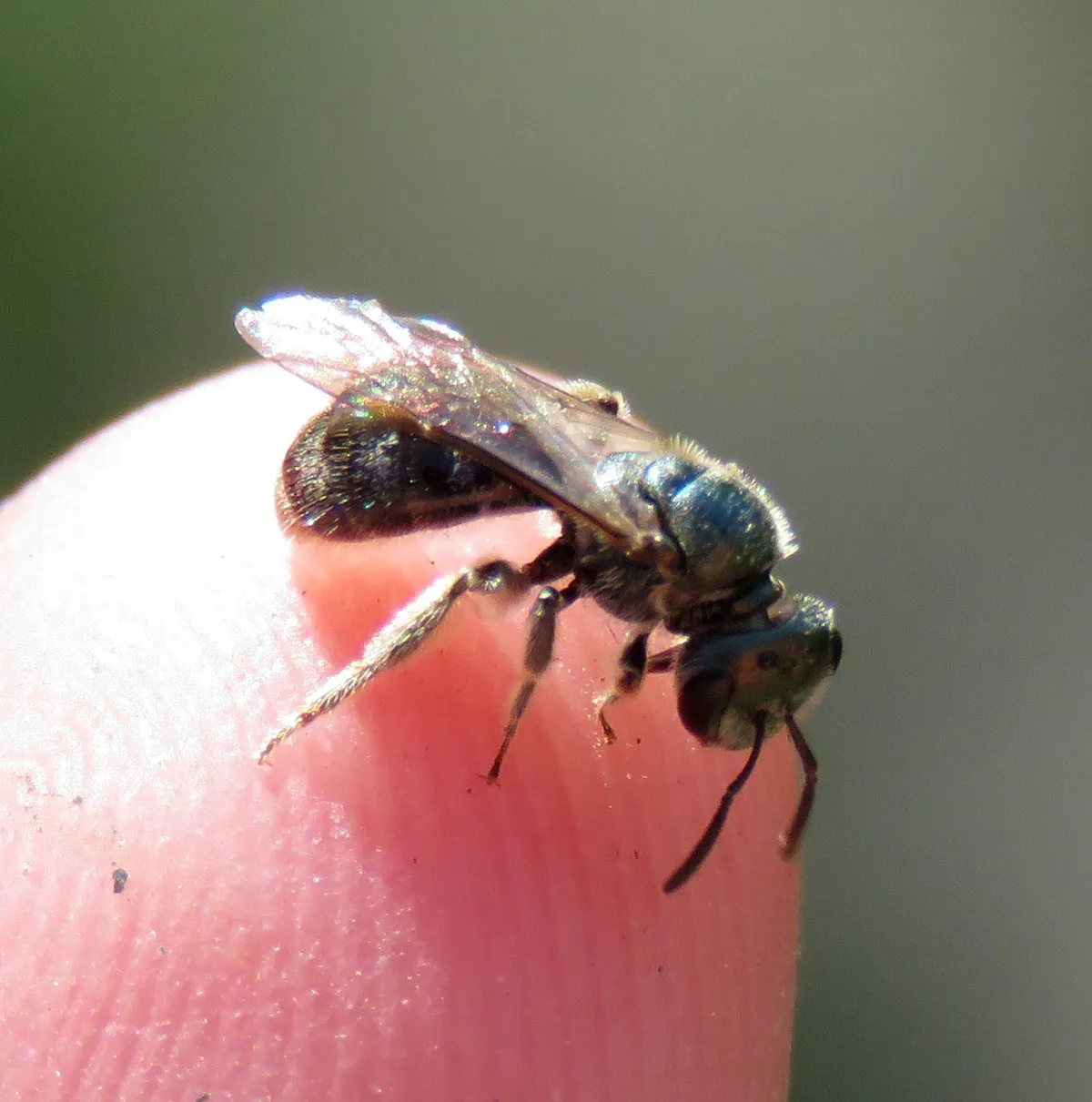 Sweat beeSmall and typically dark or metallic; stings readily if accidentally squashed
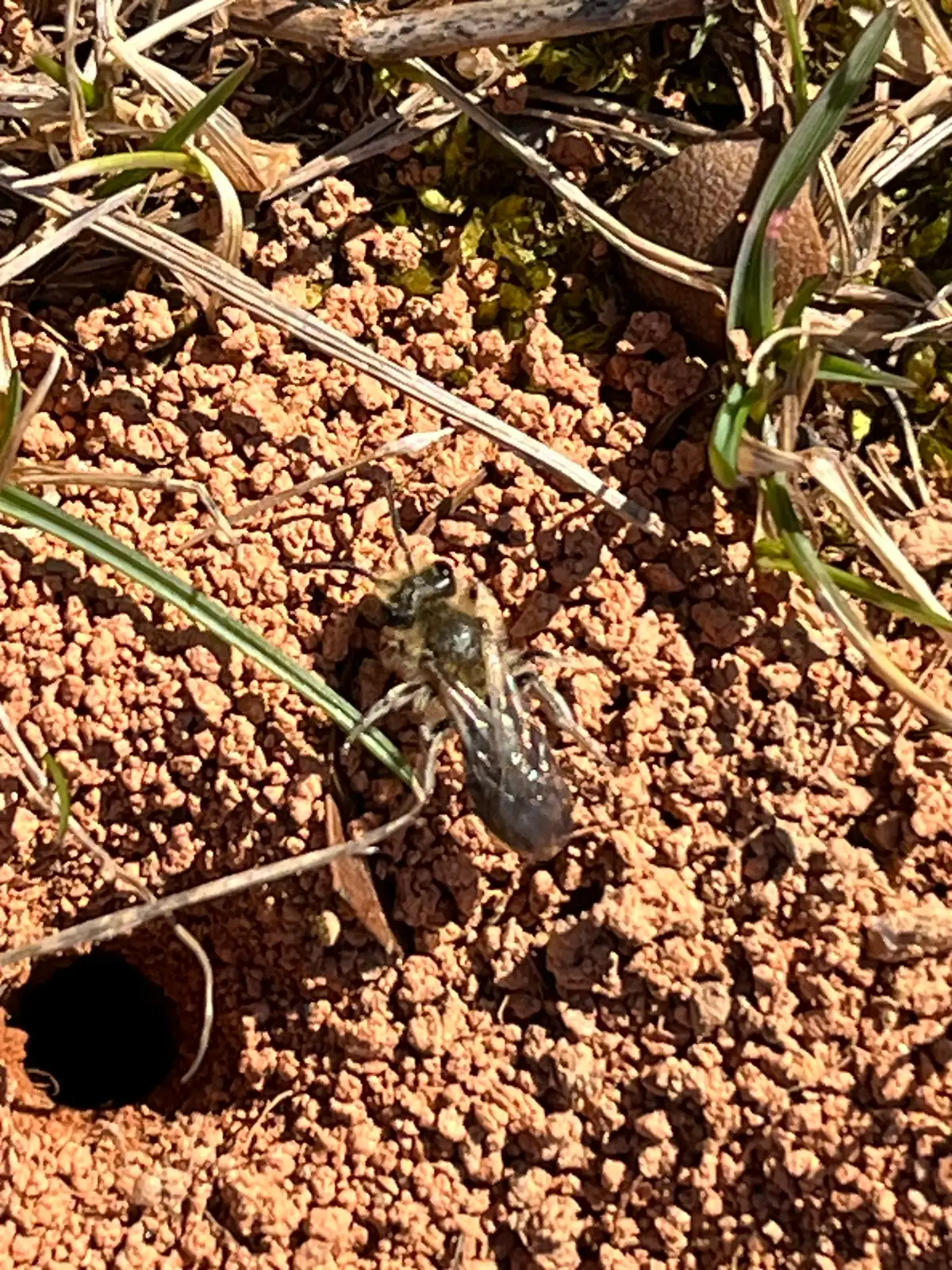 Ground-nesting beeHoles about 1/4 inch across in sunny, dry spring soil; it does not defend the nest
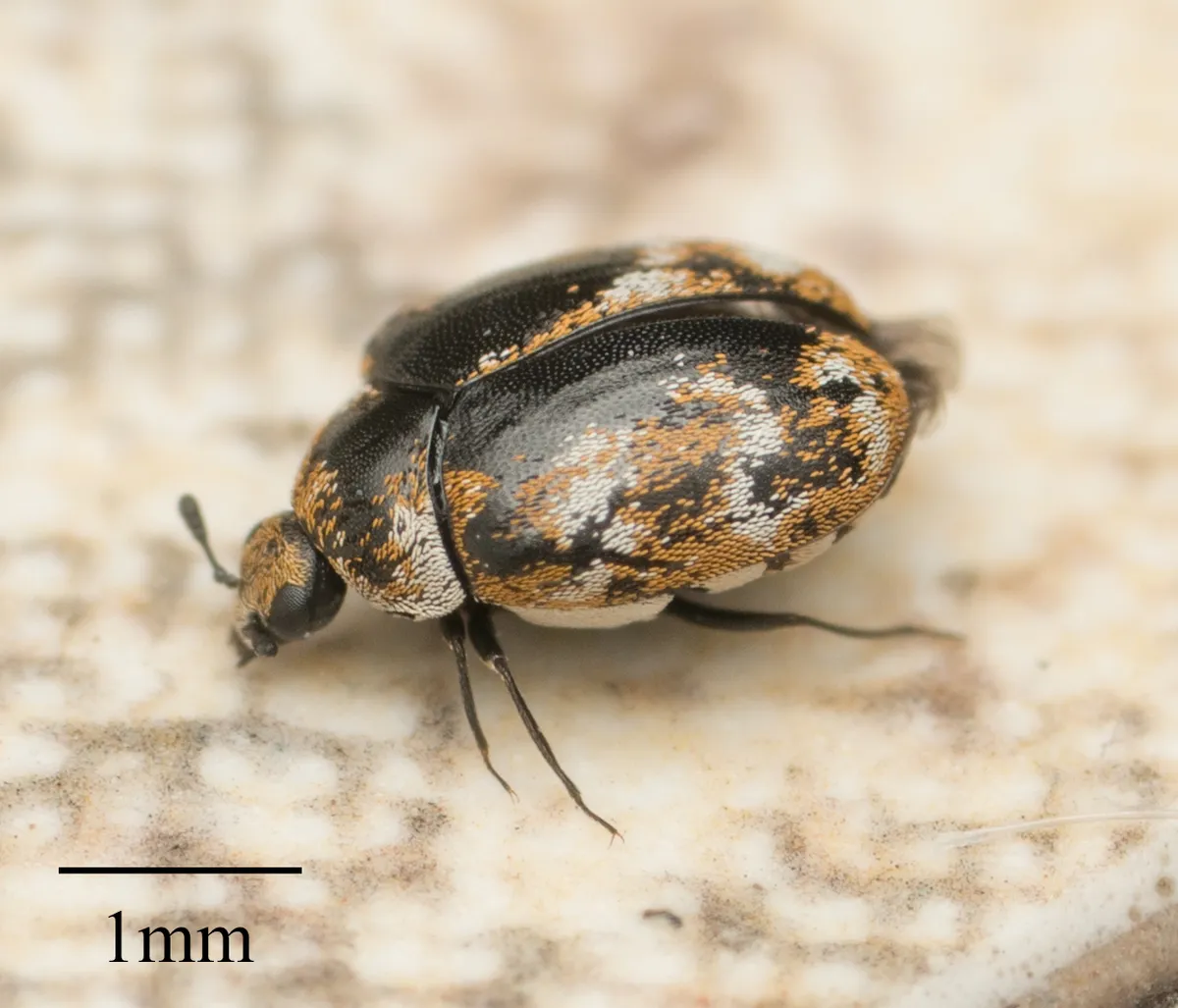 Varied carpet beetleIndoors on sunny sills: round, about 1/10 inch, black with white, brown and yellow scales
Photos: Yellow garden spider: NCBioTeacher, CC0, via Wikimedia Commons, CC0 1.0. European paper wasp: Romzig, CC0, via Wikimedia Commons, CC0 1.0. Bald-faced hornet: Judy Gallagher, CC BY 2.0, via Wikimedia Commons, CC BY 2.0. Sweat bee: no rights reserved, via iNaturalist, CC0 1.0. Ground-nesting bee: no rights reserved, via iNaturalist, CC0 1.0. Varied carpet beetle: no rights reserved, via iNaturalist, CC0 1.0.
What should you do once you know what it is?
Many black and yellow bugs need no action at all. What to do with each:
- Hover flies, drone flies and bee flies. Leave them: NDSU says flies have no stinger, and some hover fly larvae eat aphids.
- Yellowjackets. If one lands on you, do not swat or run; UC IPM advises waiting for it to leave or brushing it gently away, and keeping food, pet food and drinks covered and garbage sealed. The yellow jacket guide and a step-by-step plan for wasp nests cover nests.
- Paper wasps and mud daubers. Judge the nest first with the guide to wasp nests; UC IPM says paper wasps are mainly a problem over doorways, and MDC says mud daubers do not aggressively sting.
- Carpenter bees. UGA suggests coating exposed wood with paint or varnish; MU Extension notes the bees prefer unpainted or weathered wood.
- Cicada killers and ground-nesting bees. Usually leave them. Clemson advises against insecticides for ground-nesting bees and suggests thicker turf, ground cover or mulch instead.
- Cucumber beetles. The Connecticut Agricultural Experiment Station suggests starting plants indoors or covering young ones with row covers, removed at flowering so they can be pollinated.
- Lady beetles. Leave them on aphid-covered plants; Animal Diversity Web says the fourteen-spotted lady beetle feeds mainly on aphids.
- Carpet beetles. Look for fuzzy larvae in wool, fur and feathers; UC IPM says a few adults on a sill are no cause for alarm.
This guide is general educational information, not medical advice. If you have symptoms or concerns after a bite or exposure, contact a healthcare provider.
Frequently Asked Questions
What is a black and yellow insect?+
Usually a wasp, a bee, a fly that copies them, or a beetle. Yellowjackets, paper wasps, mud daubers and cicada killers are black and yellow wasps; bumble bees and eastern carpenter bees are the common bees; hover flies, drone flies and some robber flies are look-alike flies; and the striped cucumber beetle and the locust borer are look-alike beetles. NDSU Extension's quick check is the wings and head: a fly has two wings, short antennae and eyes that cover most of its head, and it has no stinger.
What are the black-and-yellow bugs in my house?+
A tiny, round one on a sunny windowsill is most likely a varied carpet beetle, which UC IPM describes as black with white, brown and dark yellow scales and only about 1/10 inch long. Adults fly in from garden flowers or arrive on cut flowers and are drawn to sunlight. A paper wasp indoors in late winter or spring may have spent the winter behind siding, in a wall void or in the attic, as Penn State says European paper wasp queens do.
Should I worry if I find a carpet beetle?+
Not about a few adults. UC IPM says a few adult carpet beetles indoors are no cause for alarm, since the adults feed on pollen and nectar and often fly in from flowers outdoors. The larvae are the damaging stage: they look like small fuzzy maggots and feed on wool, silk, leather, fur, feathers and pet hair. Check closets, rugs and stored woolens, and act if you find larvae developing there.
Is a black-and-yellow ladybug poisonous?+
None of the sources on this page says whether yellow and black lady beetles are poisonous, and none describes them as harmful to people. One found across the eastern United States, the fourteen-spotted lady beetle, is yellow with fourteen irregular black spots, about 1/7 to 1/5 inch long, and feeds mainly on aphids, according to the University of Michigan's Animal Diversity Web. That account says there are no known negative impacts of the species on humans and that it was introduced to North America to help control aphids called greenbugs, so leave it on your plants.
Do hover flies sting or bite?+
No. Purdue Extension says hover flies have no stinger and cannot bite, and NDSU Extension notes that flies in general have no stinger. Hover flies land on people for the moisture and salts in sweat, and Purdue says calling them sweat bees is not correct. Real sweat bees are smaller and typically dark or metallic, Purdue points out, and they will readily sting if accidentally squashed. A hover fly on your arm can simply be brushed away.
What are the little flies that look like bees?+
Mostly hover flies, also called flower flies. NDSU Extension describes many as 1/4 to 1/2 inch long, with large heads, reddish or marbled black eyes, two clear wings and yellow-and-black patterns on the abdomen; they buzz like bees, hover at flowers and pollinate them. Bee flies, about the same size, are fuzzy and carry a long tongue for sipping nectar. Neither one has a stinger. Drone flies, which belong to the hover fly family, copy honey bees.
Are bee flies good or bad?+
In the garden they count among the helpers. NDSU Extension says bee flies feed on pollen and nectar through a long tongue and, because their bodies are hairy, can carry and transfer a large amount of pollen to flowers. Like other flies they have no stinger and are no threat to gardeners. They are about 1/4 to 1/2 inch long and covered in yellow, black or brown hairs, and some species have dark patterns on their wings.
What is the black and yellow beetle on goldenrod?+
Usually the locust borer. The Missouri Department of Conservation describes the adults as black and yellow and says they feed on the pollen of goldenrod and other flowers in late summer. Colorado State University gives the adult as about 3/4 inch long, with reddish legs and a W-shaped mark on the wing covers, feeding early in the day in late summer and fall. Its stripes copy stinging insects, but MDC calls it harmless; its larvae tunnel into black locust trees.
Do black and yellow bugs bite?+
Few of them bite. The wasps and bees sting rather than bite, and among the look-alikes, robber flies are the ones to watch: the Missouri Department of Conservation says some look almost exactly like bumble bees and may bite if mishandled. Hover flies, drone flies and bee flies have no stinger, and Purdue Extension says hover flies cannot bite. MDC calls the locust borer, a black and yellow beetle, harmless. If a sting causes trouble breathing or swelling of the face or mouth, call 911.
What is the big black and yellow wasp digging holes in my yard?+
In midsummer it is usually an eastern cicada killer, a wasp that can exceed 1 1/2 inches, with black and yellow markings and rusty wings. The Missouri Department of Conservation says females dig tunnels in loose soil in lawns, usually several close together, often with a conspicuous mound of soil at the entrance, while males defend territories nearby. The males cannot sting at all, and MDC calls the species virtually harmless unless handled roughly. Yellowjackets nest underground too, commonly in rodent burrows, according to UC IPM.
Sources
- Insects That Look Like Bees (E1914) — NDSU Extension, North Dakota State University
- It's hover fly time again! (Pest&Crop Newsletter) — Purdue University Extension Entomology
- Drone Flies (Pollinator of the Month) — USDA Forest Service
- Robber Flies — Missouri Department of Conservation
- Yellowjackets and Other Social Wasps (Pest Notes, Publication 7450) — University of California Statewide IPM Program
- European Paper Wasp — Penn State Extension
- Mud Daubers — Missouri Department of Conservation
- Eastern Cicada-Killer Wasp — Missouri Department of Conservation
- Bumblebees — Missouri Department of Conservation
- Eastern carpenter bee — University of Georgia Cooperative Extension, Integrated Pest Management
- Carpenter Bees (G7424) — University of Missouri Extension
- Locust Borer — Missouri Department of Conservation
- Locust borer (Agricultural Biology) — Colorado State University
- Cucumber Beetles (Acalymma vittatum and Diabrotica undecimpunctata howardi) — The Connecticut Agricultural Experiment Station
- Four-Lined Plant Bug — UConn Home and Garden Education Center
- Carpet Beetles (Pest Notes, Publication 7436) — University of California Statewide IPM Program
- Propylea quatuordecimpunctata (fourteen-spotted lady beetle) — Animal Diversity Web, University of Michigan Museum of Zoology
- Black-and-Yellow Garden Spider — Missouri Department of Conservation
- Insect bites and stings (Medical Encyclopedia) — MedlinePlus, U.S. National Library of Medicine
- Spring Has Sprung and So Have the (Ground-Nesting) Bees — Clemson Cooperative Extension, Home and Garden Information Center
Read and approved by Alex Francisco. Found an error? Email support@buzzskito.ca.