
Published by BuzzSkito Mosquito & Tick Control
Published October 28, 2026 · Fact-checked against the sources listed below
What is a June bug?
A June bug is a nickname, not a species. In much of the US it means the May or June beetles of the genus Phyllophaga, stout brown scarabs that fly to lights on late-spring nights. The Missouri Department of Conservation's May beetle guide (MDC) counts more than 400 species north of Mexico and says the genus name means leaf eater.
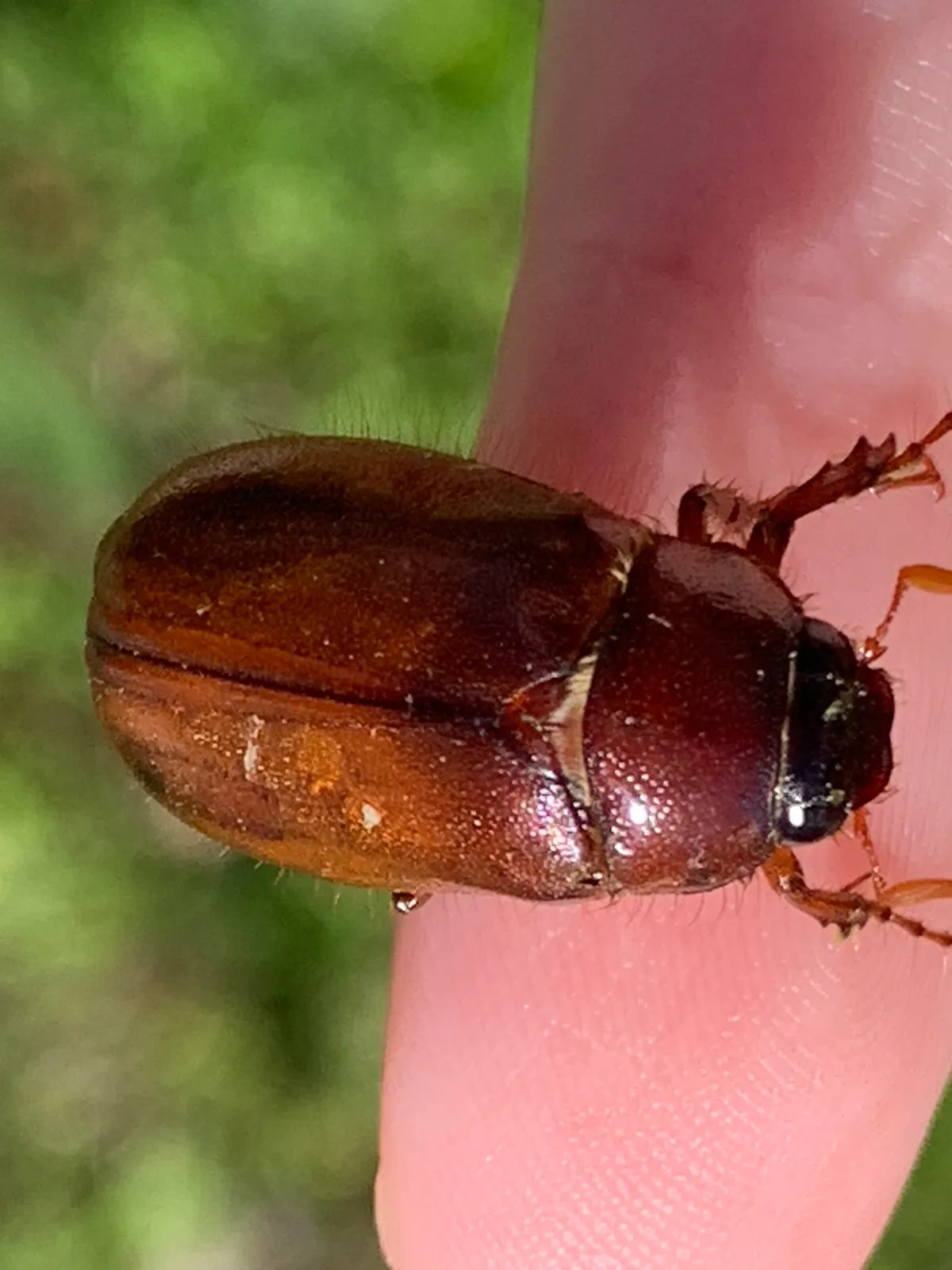
Other beetles share the name: the green June beetle, a metallic-green day flier of the East and South; its look-alike, the figeater, in the Southwest and California; and the striped ten-lined June beetle of the West. Their larvae are white grubs, which Texas A&M AgriLife Extension's guide to white grubs in Texas turfgrass says are sometimes called grubworms.
What does a June bug look like?
Look for a stout, oval, glossy beetle with no spots or stripes and antennae that end in a small club. MDC describes May beetles as usually brown, rusty or black, rather hairy underneath, 1/2 to 1 inch long, with clubbed antennae whose segments press together or fan open like a feather. UF/IFAS Featured Creatures gives the same size and calls most adults robust, oblong and glossy.
MDC says the many species are difficult to tell apart. They fly at night: UW-Madison Extension's May/June beetle article says the adults are active after dusk in late May and early June in Wisconsin and are often seen flying near lights or heard hitting window screens on early summer evenings.
What is a green June bug?
A green June bug is usually the green June beetle, Cotinis nitida, a large metallic-green scarab that flies by day. Texas A&M's Insects in the City blog puts adults at 3/4 inch to 1 inch, velvety green with yellowish-orange edges, and MDC's green June beetle page says they make a loud buzz in flight, much like a bumblebee. The University of Arkansas Arthropod Museum gives its native range as the eastern US from Connecticut to Florida and Kansas to Texas.
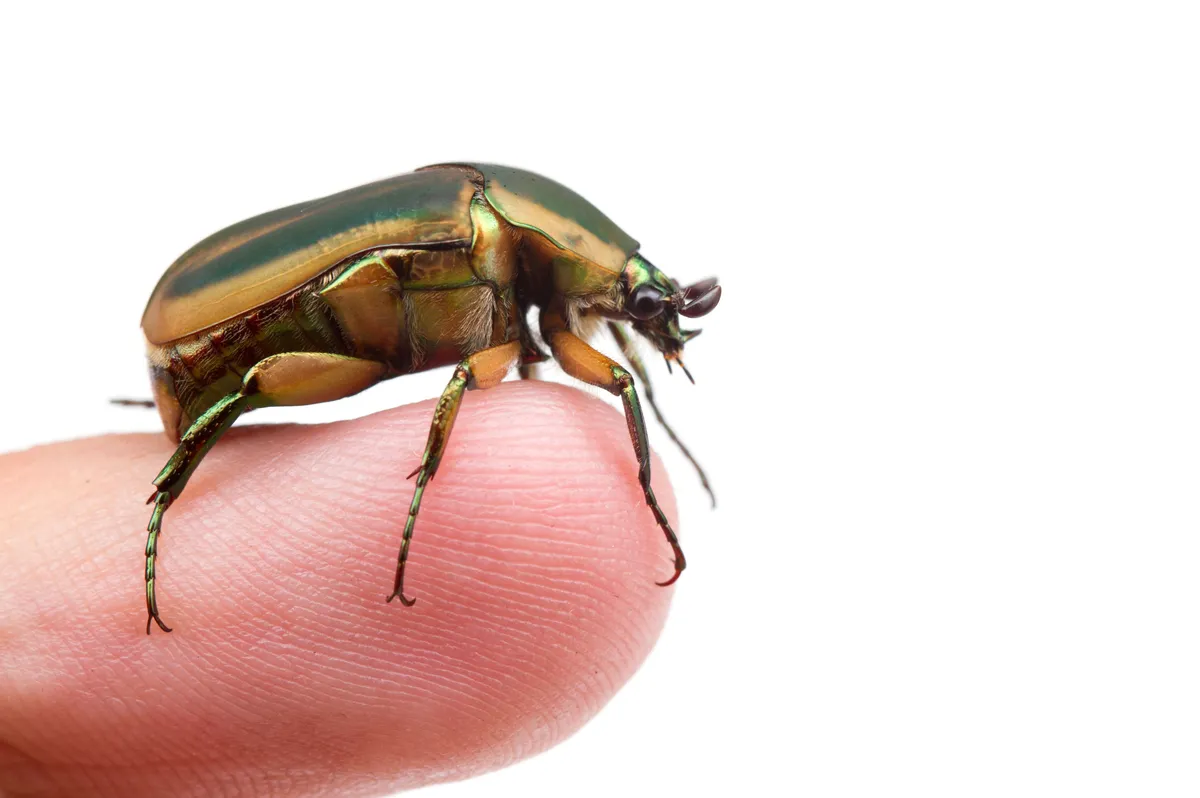
Unlike the porch-light June bugs, it flies in daylight. The Arkansas museum says the beetles come out in early morning and are mostly done by afternoon, and Ohio State's Buckeye Yard and Garden onLine describes them cruising about 2 to 3 feet above lawns, with dips and erratic turns, and says the beetles lay their eggs in turf rich in organic matter. MDC says adults emerge in June and are usually seen only in summer.
Figeater beetle
In the Southwest and California, a green June bug is usually the figeater, Cotinis mutabilis, also called the green fruit beetle, green fig beetle or western green June beetle. UC IPM gives adults as 3/4 to 1 1/3 inches, mostly metallic green with brown or tan along the edges of the wing covers, and says the green June beetle is virtually identical; in California, the green June beetle is reported only in the south of the state.
The UC Davis Bohart Museum of Entomology says the figeater is native to the Southwestern US, where it feeds on cactus fruit and tree sap; it has become relatively common in suburban gardens and has been found as far north as Sacramento. Adults usually emerge between July and September and, unlike most other scarabs in the region, are active by day.
Are there other kinds of June bugs?
Yes. The West has a striped one: Washington State University Extension says the ten-lined June beetle, Polyphylla decemlineata, is named for the ten stripes on its wing covers, also goes by watermelon beetle, hissing beetle or June bug, and lives in sandy soils west of the Rocky Mountains and near their eastern slopes. Montana State University gives adults as 22 to 28 mm (about 7/8 to 1 1/8 inches) and says males have large, fan-like antennae and that the beetles squeak when disturbed.
Some are smaller. Texas A&M describes the adults of the main lawn grubs in Texas, a June beetle (Phyllophaga crinita) and the southern masked chafer, as heavy-bodied brown beetles 1/2 to 5/8 inch long, with long, spindly legs, that fly at night and come to lights.
What else looks like a June bug?
A smaller metallic beetle with a green thorax, bronze wing covers and tufts of white hair on the abdomen is a Japanese beetle: MDC's Japanese beetle page puts it at about 1/2 inch, and UC IPM at half the size of a figeater or less. The Japanese beetle guide shows how to tell it from a green June beetle and what damage it does.
Many ground beetles come to lights at night as well. MDC's ground beetle page describes most as 1/4 to 3/4 inch, black or brown and often shiny, with lengthwise grooves on the wing covers in many species and long, slender legs for running fast. A June bug is stouter, with clubbed antennae. Beetles in the house covers both indoors.
A large reddish-brown insect at night can also be a cockroach. Texas A&M AgriLife Extension's cockroach guide says cockroaches have flattened bodies, a plate that hides the head from above and long, thin antennae, and that American cockroaches, 1 1/2 to 2 inches long, can fly. A beetle's hard wing covers meet in a straight line down the back, MDC notes. Bugs that look like cockroaches goes through the checks.
Commonly confused with
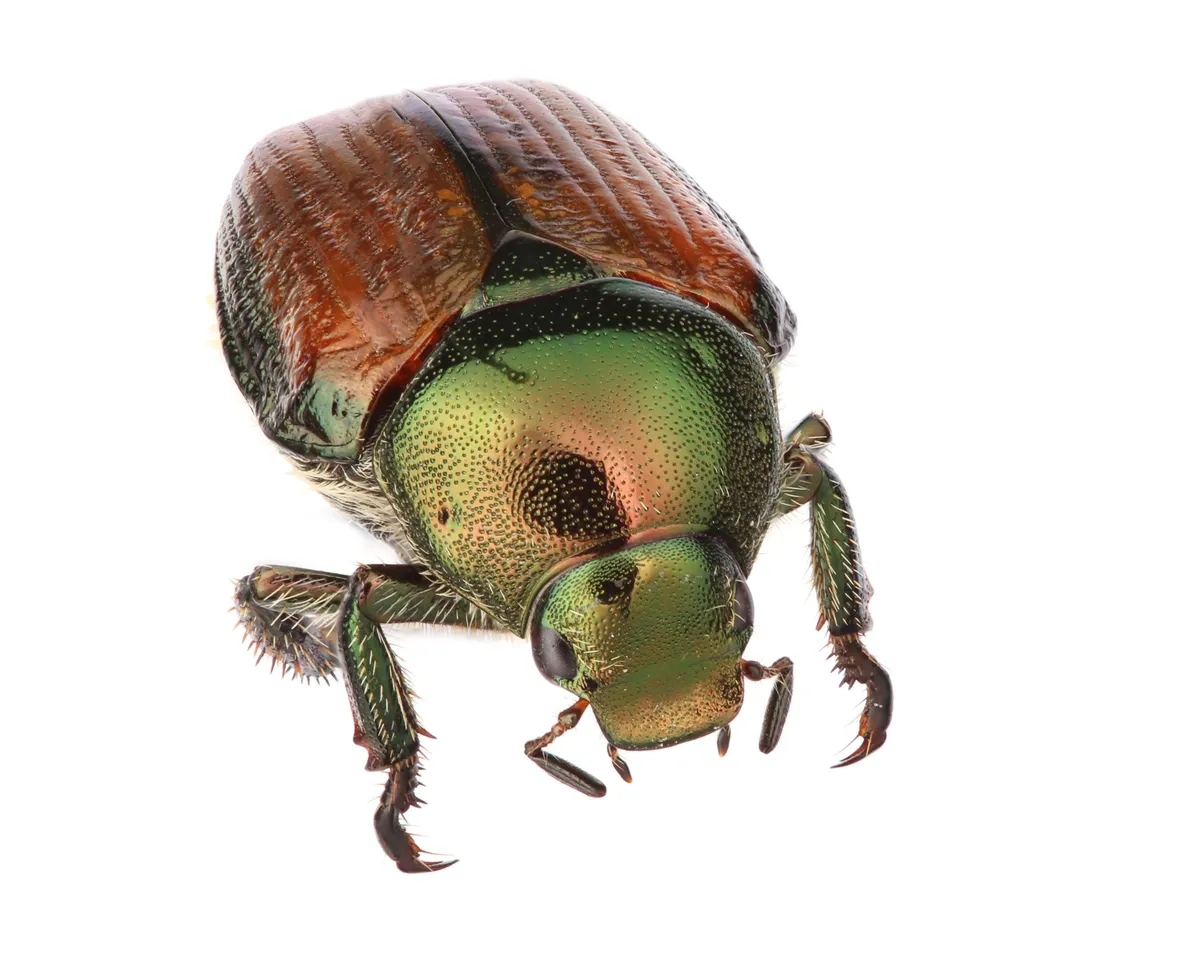 Japanese beetleAbout 1/2 inch; metallic green thorax, bronze wing covers and white hair tufts on the abdomen
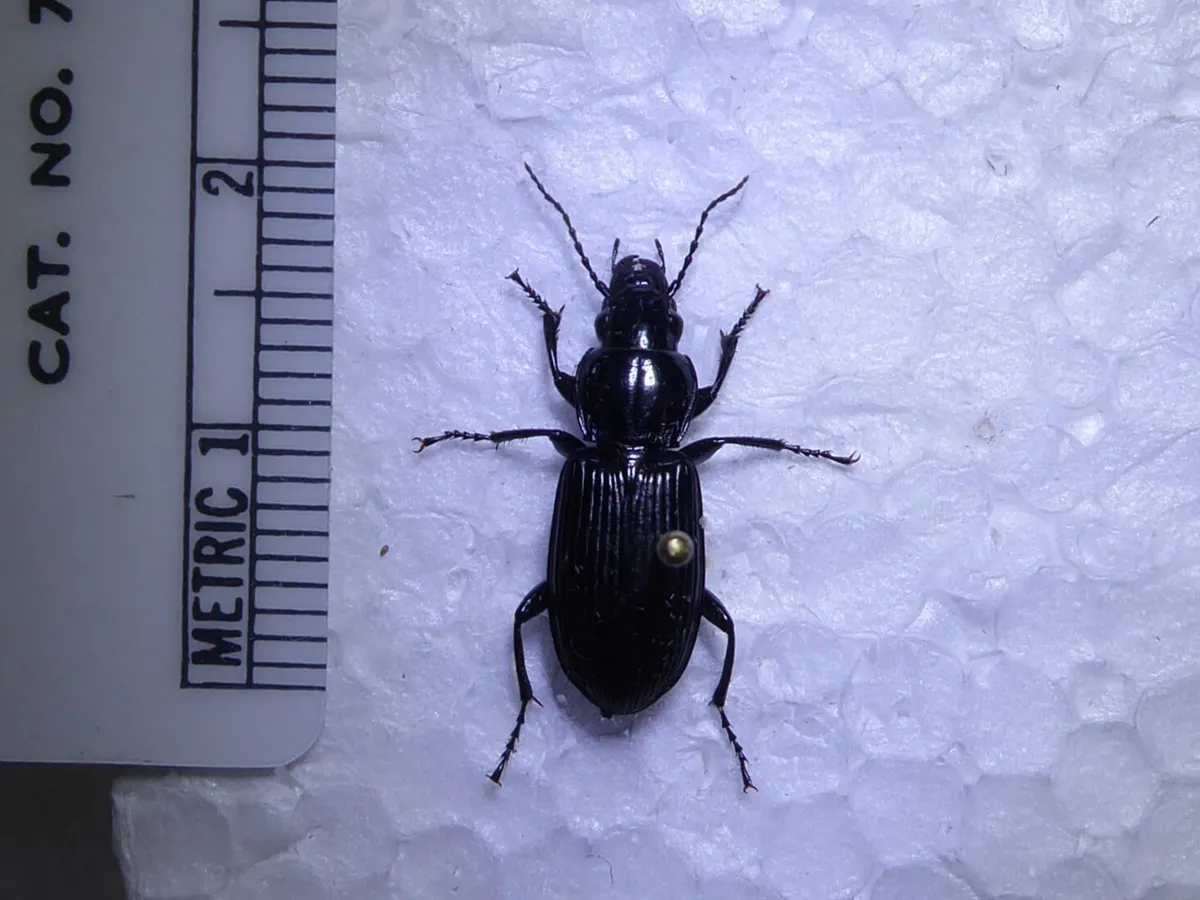 Ground beetleBlack or brown and often shiny, long-legged and fast, often with grooved wing covers; most 1/4 to 3/4 inch
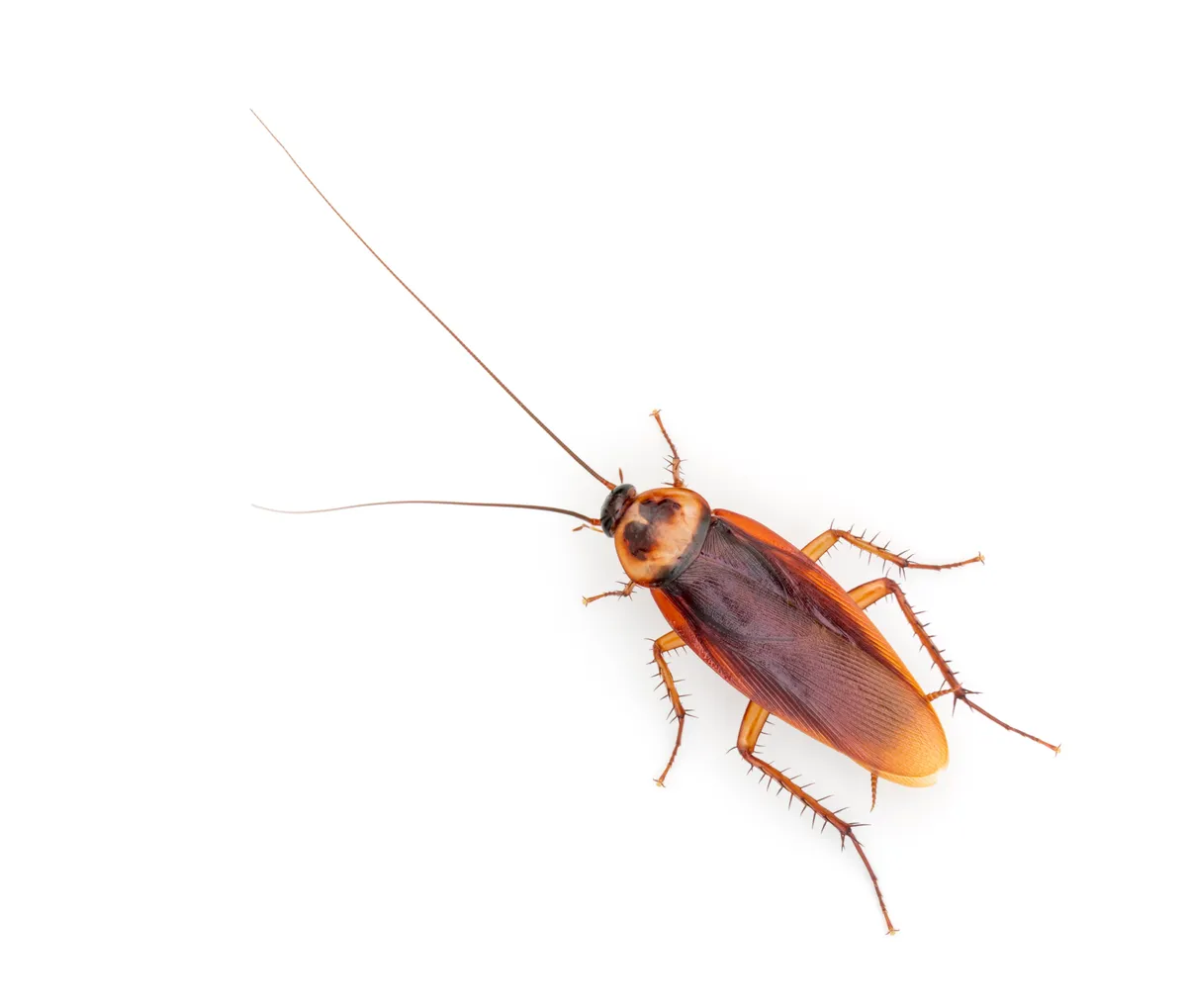 American cockroachFlat body, head hidden under a plate and long, thin antennae; 1 1/2 to 2 inches
Photos: Japanese beetle: Insects Unlocked, CC0, via Wikimedia Commons, CC0 1.0. Ground beetle: no rights reserved, via iNaturalist, CC0 1.0. American cockroach: Insects Unlocked, CC0, via Wikimedia Commons, CC0 1.0.
Why do June bugs fly into porch lights and screens?
Because they fly at night and lights draw them in. UW-Madison says the adults are attracted to lights and are clumsy fliers that often collide with windows and cling to screens, and MDC describes them flying clumsily around porch lights on late-spring evenings, crash-landing and lying on their backs waving their legs.
Most of the beetles at a light are males. Texas A&M's white grub guide says that during mating flights, large numbers of beetles, primarily males, may come to lighted windows and other lights, while females, being less active fliers, are usually less common there. Flights tend to be bigger after significant rain or irrigation and can last several weeks.
Lights decide where you see the beetles, not necessarily where their grubs end up. Texas A&M says turning off outdoor lights during flights may not substantially reduce later grub damage, and that heavy grub infestations are often found where there is little or no outdoor lighting. Purdue Extension's white grub bulletin agrees that beetles at lights or in traps should not be used to predict grub infestations or damage.
Do June bugs bite or sting?
No: MDC says May beetles chew plants but cannot hurt people, and Ohio State says green June beetles cannot bite. Ohio State explains that the adults lack typical chewing mouthparts, though the sharp spurs on their legs can deliver painful skin pricks, and NC State Extension's green June beetle guide calls them attractive and harmless to humans.
If you are trying to explain a bite, the bug bite identifier walks through the insects that do bite.
Are June bugs harmful to plants and trees?
Mostly not. May and June beetle adults eat leaves and flowers, MDC says, and UW-Madison notes they have been documented damaging the foliage of oaks and other trees, though such damage is infrequent and localized in Wisconsin. Texas A&M says Texas alone has over 100 Phyllophaga species, most of which do not cause significant economic damage.
Green June beetles and figeaters go for fruit. MDC lists ripe and rotting peaches, berries, apples and grapes; Ohio State adds oozing sap and fruit already damaged by insects such as Japanese beetles; and Texas A&M's green June beetle publication says they open soft, ripening fruit with their serrated legs and horned head. UC IPM names ripe apricots, caneberries, figs, grapes, peaches and plums for the figeater, and UC Davis says large numbers can eat an entire fig or grape crop in a garden.
Green June beetles clustered on a tree trunk are drawn to sap that is already oozing. Texas A&M's Insects in the City says they gather where sap flows from causes such as bacterial flux or borers, do not cause the ooze themselves, and are mostly harmless in town unless you own a fig or peach tree. UC Davis says figeaters do not damage trees or lawns the way Japanese beetles or June beetle grubs can.
What do June bug larvae look like?
June bug larvae are white grubs: plump, C-shaped and whitish, with a brown head and three pairs of legs. UF/IFAS gives Phyllophaga grubs as 3/4 to 1 3/4 inches long, with the rear of the abdomen slightly enlarged and darker where soil shows through the skin; MDC gives 3/4 to 2 inches.
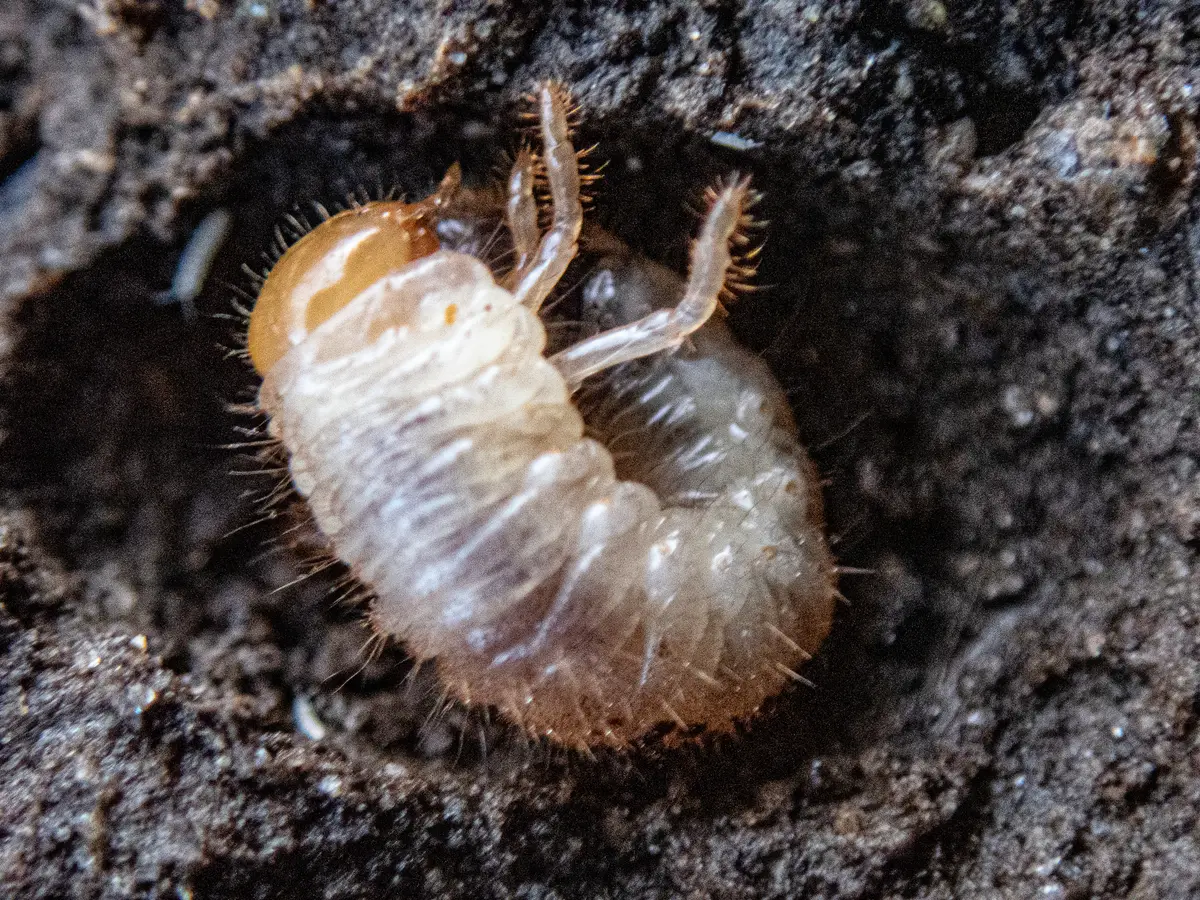
Other grubs look much alike. UF/IFAS says the larvae of Japanese beetles, annual white grubs and green June beetles are often called white grubs too, and that two parallel rows of spines on the underside of the last abdominal segment mark a true Phyllophaga grub. Purdue calls this pattern of hairs and spines the raster, says it identifies grubs to genus or species, and notes that a hand lens or microscope may be needed; UW-Madison suggests asking your local Extension office to confirm.
One test needs no lens: a grub that rolls onto its back and crawls is most likely a green June beetle or figeater grub. Texas A&M's green June beetle publication says those larvae crawl on their backs because their small legs are not useful for walking, and calls the habit specific to green June beetle larvae. UC IPM describes the grubs of the figeater, a close relative, rolling onto their backs and pushing along with stiff hairs.
Are June bug grubs bad for your lawn?
They can be, in numbers. Purdue's white grub bulletin says several Phyllophaga species are occasionally associated with turf damage and, because of their size, do the most harm in their second season. It describes patchy, wilting turf that may take on a blue or purple cast before thinning or dying, and sod that pulls up easily. Texas A&M says badly damaged turf can be lifted by hand or rolled up like a carpet, and that the damage is hard to tell from drought or disease.
Digging animals can be the first sign. Purdue says raccoons, skunks, armadillos and turkeys routinely forage for white grubs in turf, even when the grubs' own damage is not apparent, and MDC adds moles, crows and grackles. What dug the holes in your yard sorts the diggers by hole size and shape.
Green June beetle grubs harm turf another way. The Arkansas museum says they feed very little on roots and damage lawns by burrowing, and Purdue says that because of their burrowing and the small soil mounds over their burrows, unacceptable damage can occur at lower numbers than other grubs need.
Count before you treat. Purdue says 5 to 10 white grubs per square foot are usually needed for significant damage and that fewer than 5 rarely require treatment, and Texas A&M cites Cornell University studies suggesting that up to 70 percent of white grub lawn treatments are not necessary. The lawn pest guide shows how to cut and count a square foot of sod, when to treat and which active ingredients extension services name.
Not every grub is a lawn pest. Texas A&M says grubs found in compost, mulch or raised beds are likely decomposers and beneficial, and green June beetle and figeater grubs feed on decaying organic matter such as compost and manure, according to the Arkansas museum and UC IPM. Not every root-eater under a lawn is a beetle grub either: MDC's crane fly page says some crane fly larvae eat roots and can be lawn pests, and what a crane fly is explains them.
How long do June bugs live?
Most of a June bug's life is spent underground as a grub: 1 to 4 years depending on the species, MDC says, and usually three in the more destructive and abundant species, according to UF/IFAS. Purdue gives 2 to 3 years depending on latitude, UW-Madison says Wisconsin's species mostly take three, and Texas A&M says the main lawn-damaging grubs in Texas take one.
UF/IFAS describes the cycle. Adults mate in the evening, and at dawn females return to the ground to lay 15 to 20 eggs, 1 to 8 inches deep, mostly in sod near wooded areas. The eggs hatch in about three weeks; the grubs feed on roots near the surface in the warm months and move as deep as 5 feet for the winter. A full-grown grub pupates in an earthen cell, and the new adult stays in the soil until it emerges the following May or June to feed, mate and lay eggs.
Green June beetles and figeaters take a year: NC State says there is one generation a year in North Carolina, MDC says green June beetle grubs live underground for a year, and UC IPM says the figeater has one generation a year and spends the winter as a larva. Ten-lined June beetle grubs need two or three seasons in California and up to four at some northern sites, Washington State says.
What should you do about June bugs?
Usually nothing. MDC says May beetles cannot hurt people and that birds, bats and frogs eat the adults; Texas A&M says most of Texas's Phyllophaga species cause no significant economic damage and that flights may last several weeks. If you want to act, match it to where you find them:
- At lights. The beetles there are mostly males on mating flights, and Texas A&M says turning outdoor lights off may not substantially reduce later grub damage, so treat any lawn problem separately.
- In the lawn. Look for wilting turf that does not respond to watering and sod that lifts easily, then count grubs before treating anything, following the lawn pest guide.
- On fruit. UC IPM recommends no insecticide for figeaters, and UC Davis says insecticides are ineffective against them. UC IPM advises picking fruit early, removing fallen fruit, spreading out or removing compost, clippings and manure near fruit trees, and trapping adults in a 1-gallon container of equal parts grape or peach juice and water under a wire-mesh funnel.
- In compost. Texas A&M says grubs in compost, mulch or raised beds are likely beneficial decomposers; to keep figeaters from breeding there, UC Davis says to cover compost, mulch and manure piles with screen.
For other finds around the house and yard, browse more pest identification guides or try the pest identifier quiz.
Use any pesticide exactly as its label directs. The label is the law, and what is registered and sold varies by state.
Frequently Asked Questions
Are June bugs good or bad?+
Mostly harmless, with one catch. The Missouri Department of Conservation says May beetles chew plants but cannot hurt people, and many animals eat them: birds, bats and frogs take the adults, while skunks, moles, crows and grackles dig up the grubs. The catch is the grubs, which eat roots and can damage lawns in large numbers; Purdue Extension says significant damage usually takes 5 to 10 grubs per square foot. Texas A&M adds that grubs in compost, mulch or raised beds are likely beneficial decomposers.
Why is it called a June bug?+
For the time of year the adults appear. Purdue Extension says that, as their name implies, May and June beetle adults emerge during May and June, and the Missouri Department of Conservation describes them flying clumsily around porch lights on late-spring evenings. Strictly, a June bug is a beetle, not a bug: the department notes that entomologists usually avoid the name because bugs, in the technical sense, are a different group of insects, and that some people call mayflies June bugs.
What happens if a June bug bites you?+
June bugs are not described as biters in the extension sources on this page. The Missouri Department of Conservation says May beetles cannot hurt people, and Ohio State University says green June beetles cannot bite because the adults lack typical chewing mouthparts. What people may feel is the legs: Ohio State says the sharp spurs on a green June beetle's legs can deliver painful skin pricks. If a bite or rash worries you, contact a healthcare provider.
What is another name for a June bug?+
May beetle and June beetle are the usual names for the genus Phyllophaga, and their larvae are white grubs, sometimes called grubworms. Other beetles carry the June bug name too. The University of Arkansas Arthropod Museum says the eastern green June beetle is sometimes called the fig eater, and UC IPM lists green fruit beetle, green fig beetle and western green June beetle for the figeater of the Southwest. Washington State University lists watermelon beetle, hissing beetle and June bug for the ten-lined June beetle of the West.
Do June bugs fly into you?+
They can, by accident. UW-Madison Extension calls May and June beetles clumsy fliers that often collide with windows and cling to screens, and the Missouri Department of Conservation says they walk and fly clumsily and crash-land around porch lights. Texas A&M says the beetles drawn to lights during mating flights are mostly males. Green June beetles fly by day instead, and Ohio State describes them cruising about 2 to 3 feet above lawns, with dips and erratic turns.
Is it safe to touch a June bug?+
Generally yes. The Missouri Department of Conservation says May beetles cannot hurt people, and NC State Extension calls green June beetles attractive and harmless to humans. Mind the legs: Ohio State says green June beetles cannot bite but can prick skin with the sharp spurs on their legs. In the West, the ten-lined June beetle squeaks when disturbed, according to Montana State University, and Washington State lists hissing beetle among its common names.
Will June bugs go away on their own?+
The adults do. Texas A&M AgriLife Extension says flight periods may last several weeks, UW-Madison Extension puts May and June beetle flights in late May and early June in Wisconsin, and UF/IFAS says that is when the adults feed, mate and lay eggs. The grubs stay in the soil for 1 to 4 years depending on the species, the Missouri Department of Conservation says, so a yard can see flights again in later years. Green June beetles and figeaters fly in summer and have one generation a year.
Why are there so many June bugs this year?+
Some years are simply bigger. UW-Madison Extension says May and June beetle generations can overlap so that adults are present every year, but in some places one generation is notably larger, giving a large adult population every three years; UF/IFAS also describes three-year cycles. Texas A&M AgriLife Extension says flights are usually larger after significant rain or irrigation, and that green June beetle numbers tend to run in cycles, with a year or two of high numbers followed by several quiet years. Purdue cautions that beetles at lights should not be used to predict grub damage.
Are June bug larvae harmful?+
Sometimes, to lawns. May and June beetle grubs eat roots, and Purdue Extension says white grub densities of 5 to 10 per square foot are usually needed for significant damage, while most turf tolerates up to about 5 without visible damage. Green June beetle grubs feed mostly on decaying organic matter and damage turf by burrowing, according to the University of Arkansas, and UC IPM says figeater grubs do not damage fruit or plants. Texas A&M says grubs found in compost, mulch or raised beds are likely beneficial decomposers.
How long do June bug larvae live?+
One to four years, depending on the species. The Missouri Department of Conservation gives 1 to 4 years for May beetle grubs, and UF/IFAS says the more destructive and abundant species usually take three. Purdue Extension puts it at 2 to 3 years depending on latitude, UW-Madison says Wisconsin's species take three, with one widespread species taking two, and Texas A&M says the main lawn-damaging grubs in Texas take one. Green June beetle and figeater grubs need about a year, and Washington State says ten-lined June beetle grubs need two to four.
Sources
- May Beetles (June Bugs) (Field Guide) — Missouri Department of Conservation
- Green June Beetle (Field Guide) — Missouri Department of Conservation
- White Grubs, Phyllophaga spp. (EENY-045/IN202; H. Lane Selman) — University of Florida, UF/IFAS Featured Creatures
- May/June Beetles (PJ Liesch, March 2015) — University of Wisconsin-Madison Division of Extension, Wisconsin Horticulture
- Managing White Grubs in Turfgrass (E-271; Douglas S. Richmond, June 2023) — Purdue University Extension
- White Grubs in Texas Turfgrass (ENTO-PU-016; Molly Keck, Wizzie Brown and Stephen Biles, October 2024) — Texas A&M AgriLife Extension Service
- Green June Beetle in the Landscape (James Baker; published January 29, 2013, revised May 6, 2023) — NC State Extension
- Green June Beetle in Texas (EHT-101; Frances Pontasch) — Texas A&M AgriLife Extension Service
- June beetles harmless to trees (Insects in the City, August 28, 2012) — Texas A&M AgriLife Extension Service
- Big Beetles are Cruising Ohio Lawns and Offering Entertainment Value (Joe Boggs, July 10, 2026) — Ohio State University Extension, Buckeye Yard and Garden onLine
- Green June beetle — Arthropod Museum, University of Arkansas
- Green Fruit Beetle (Home and Landscape) — University of California Statewide IPM Program
- Fig Beetles (Information Note No. 073) — Bohart Museum of Entomology, University of California, Davis
- Tenlined June Beetle, Polyphylla decemlineata Say (FS272E; R. A. Rodstrom and J. J. Brown, June 2017) — Washington State University Extension
- Ten-lined June beetle (Insects of the Greater Yellowstone Ecosystem) — Montana State University
- Japanese Beetle (Field Guide) — Missouri Department of Conservation
- Ground Beetles (Carabids) (Field Guide) — Missouri Department of Conservation
- Cockroach Biology and Management (ENTO-PU-121; Wizzie Brown, Michael E. Merchant and Kerry Siders, December 2017) — Texas A&M AgriLife Extension Service
- Large Crane Flies (Field Guide) — Missouri Department of Conservation
How this guide was made: it was researched and drafted with AI assistance from the sources listed above. A second, independent AI pass then checked each factual claim against those sources. Found an error? Email support@buzzskito.ca.