
Published by BuzzSkito Mosquito & Tick Control
Published October 28, 2026 · Fact-checked against the sources listed below
Is a hornet a wasp?
Yes: every hornet is a wasp, but most wasps are not hornets. The Missouri Department of Conservation's yellowjacket guide (MDC) explains that members of the genus Vespa are the insects often called true hornets, while yellowjackets belong to a closely related genus. Penn State Extension's guide to social bees and wasps goes further, describing paper wasps, yellowjackets, bald-faced hornets and European hornets as paper wasps with different common names.
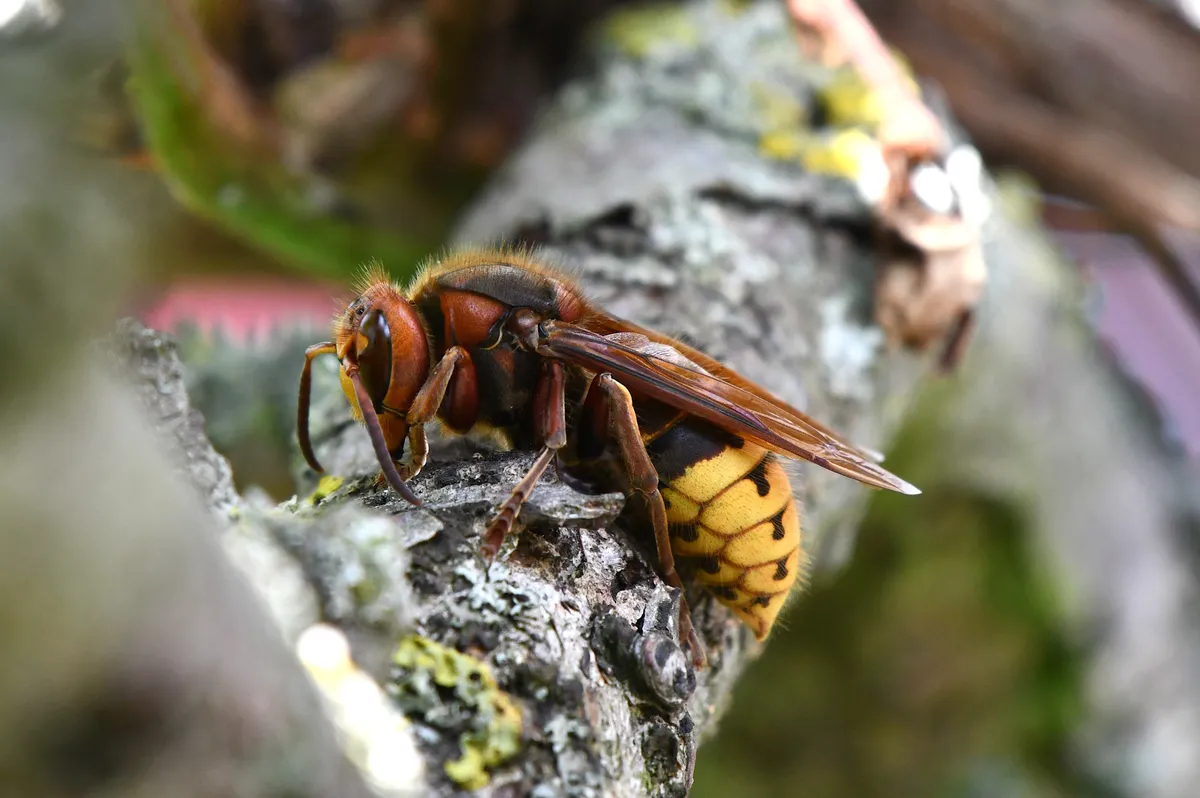
The only true hornet widespread in the US is the European hornet, Vespa crabro. Penn State Extension's European hornet page says it was introduced from central Europe, was first reported in the US in 1840 and is now well established in the eastern states. Since 2023 a second true hornet, the yellow-legged hornet, has been found in Georgia, South Carolina and North Carolina; it is covered further down.
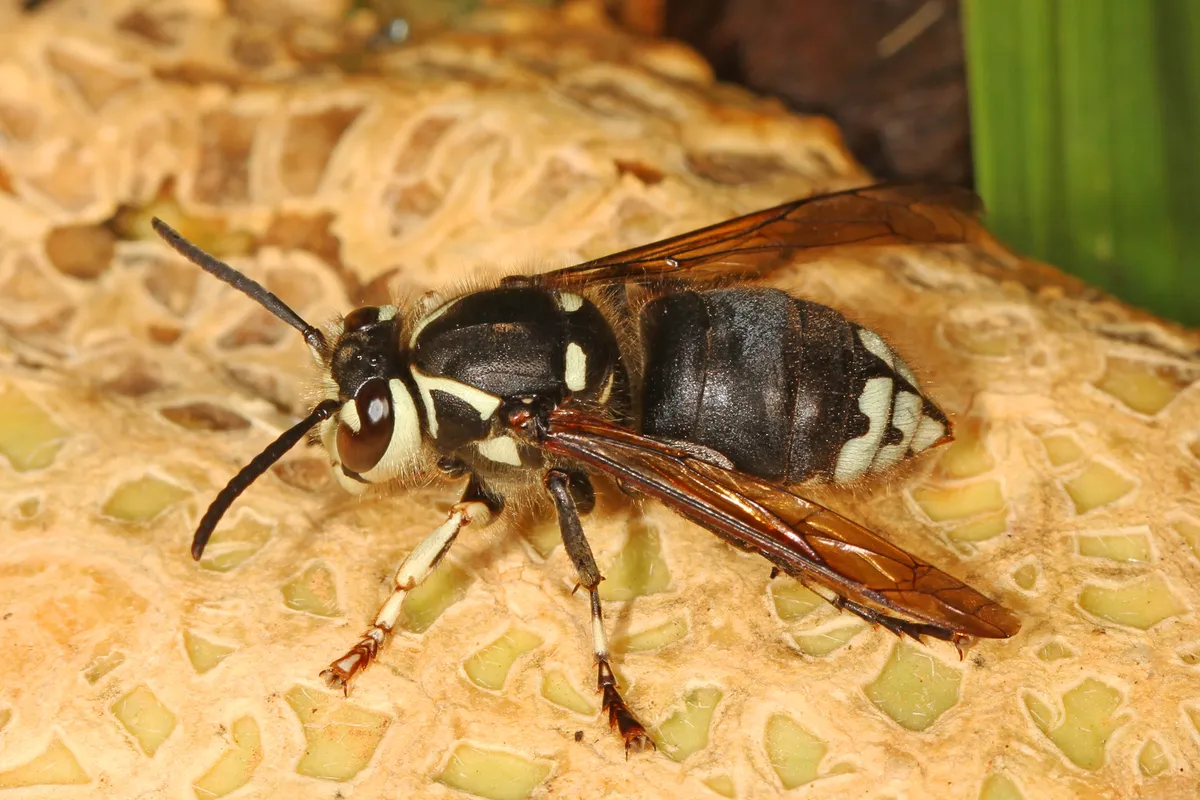
The bald-faced hornet is not a true hornet at all. Penn State's bald-faced hornet page calls it a yellowjacket, one of the aerial yellowjackets in the genus Dolichovespula. University of Florida IFAS Extension explains the mix-up: hornet is generally used for species that nest above ground and yellow jacket for those that nest underground, and this one earned its name with its hornet-like size and its nest in the open.
So most wasp-or-hornet questions come down to three insects: a yellowjacket, a paper wasp or a European hornet, compared trait by trait in the table above. The common names muddle things further: MDC says yellowjackets are widely, and incorrectly, called sweat bees, and some people call them ground bees.
Are hornets bigger than wasps?
A European hornet is bigger than the wasps most people meet, but size alone does not settle it. Penn State puts European hornet workers at up to about 1 inch and queens at up to about 1.3 inches, roughly twice the length of a yellowjacket worker at about 1/2 inch (MDC). Paper wasps, though, are about 3/4 to 1 inch long, according to University of Missouri Extension's guide to bees and wasps, and the eastern cicada killer, a ground-nesting wasp at 1 1/2 to 2 inches, outgrows them all.
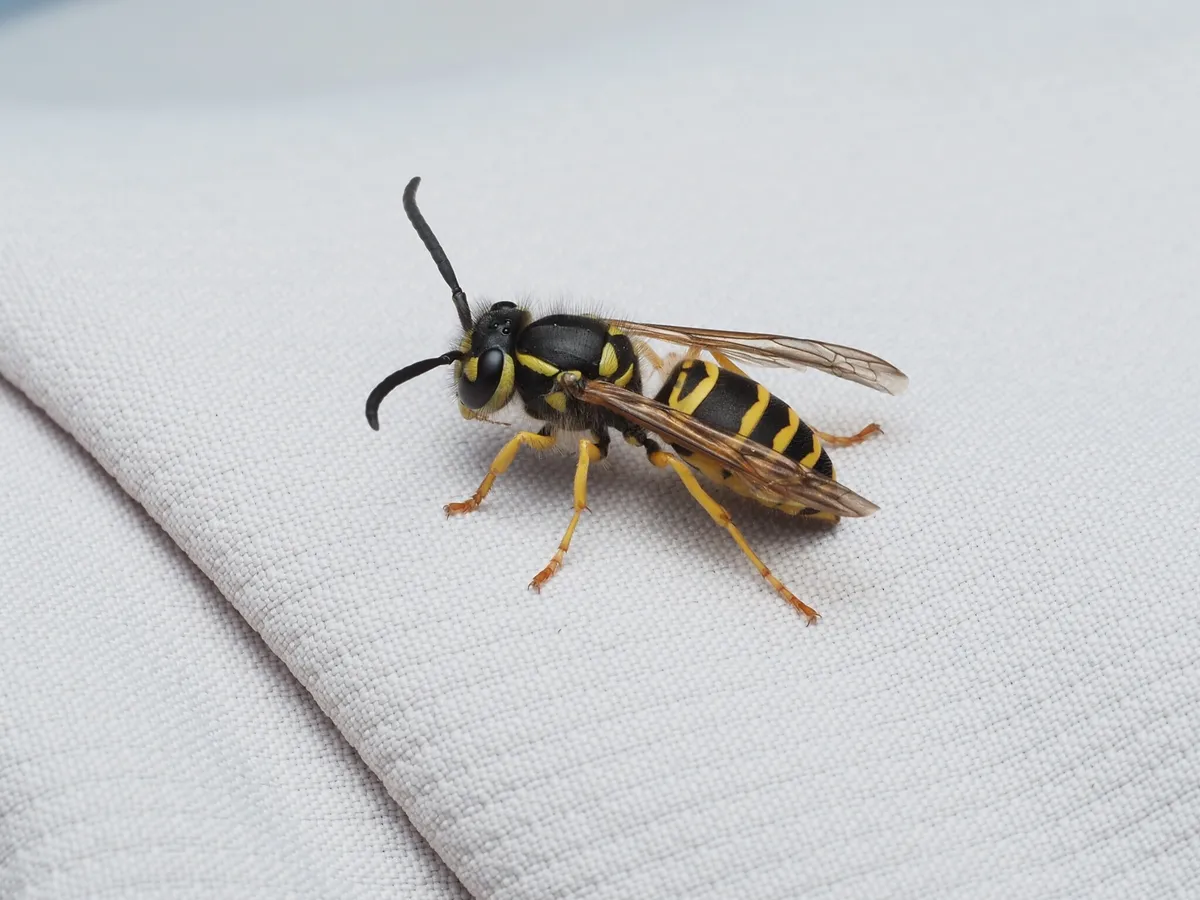
Shape is a better clue. UC IPM's Pest Notes on yellowjackets and other social wasps says a yellowjacket's narrow waist is barely visible. The University of Kentucky's guide to wasps, hornets and yellowjackets says a paper wasp's very thin waist sets it apart from hornets and yellowjackets, and Penn State's European paper wasp page adds that paper wasps let their legs dangle in flight, while yellowjackets hold theirs close to the body. MDC's European hornet field guide describes a somewhat hairy thorax and abdomen.
How do wasp and hornet colors differ?
Yellowjackets are bright yellow and black, while the European hornet is reddish brown in front and mostly yellow behind. UC IPM describes yellowjackets as black with jagged, bright yellow stripes, and MDC notes their yellow or white faces. Penn State describes the European hornet's head as red and yellow and its thorax as red and brown, with an abdomen that is brown in front and mostly yellow toward the rear, marked with brown teardrop shapes.
The bald-faced hornet is the easiest to spot. MDC's bald-faced hornet guide describes a mostly black wasp, 1/2 to 3/4 inch long, with white or ivory markings on the face, the thorax and toward the tip of the abdomen.
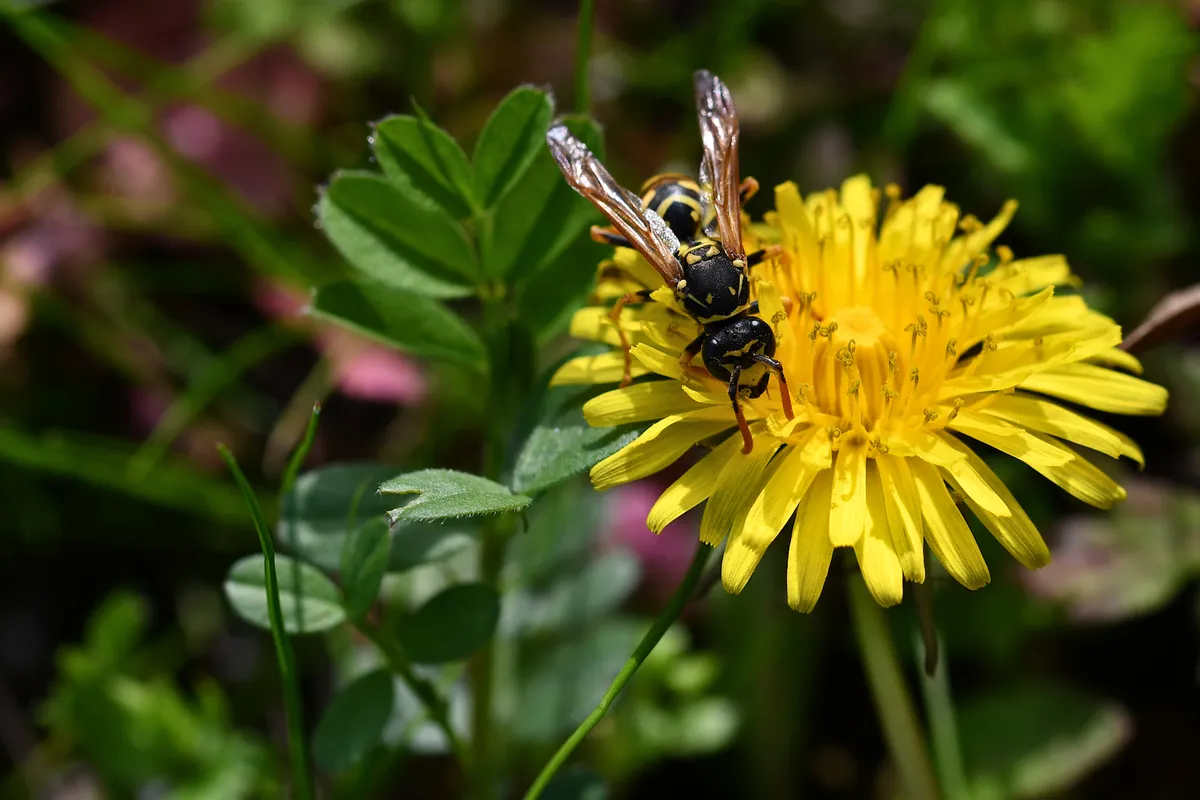
Paper wasps vary the most. Kentucky says most are brownish or rust-colored, but the introduced European paper wasp is yellow and black like a yellowjacket. Penn State's tells for that one: it is larger and has a thinner waist than a yellowjacket, and its antennae are tipped with orange instead of all black. The paper wasp guide shows the native species and their open nests.
Where do wasps and hornets live?
Each in its own kind of paper nest, and the nest is often the surest clue. All four build with paper made from chewed wood mixed with saliva (UC IPM, MDC), but the shape and the spot differ:
- Paper wasps: a single open comb of cells hanging from a stalk like an umbrella, with no cover, under eaves, in attics or under branches (UC IPM).
- Yellowjackets: layers of comb inside a paper envelope, usually underground in a cavity such as an old rodent burrow, so all you may see is a hole with wasps flying in and out (MDC). The German yellowjacket usually nests between the walls of buildings.
- Bald-faced hornets: a gray, football-shaped paper nest in shrubs at least 3 feet off the ground or in trees as high as 60 feet or more, sometimes under eaves (Penn State).
- European hornets: a paper nest hidden in the hollow of a large standing tree or, sometimes, in a house's wall void, up to 30 feet up (Penn State).
The wasp nest identification guide shows each nest type in photos, along with mud nests, holes in the ground and bee nests, and how to tell an old nest from an active one.
Do hornets fly at night?
The European hornet does. Penn State calls it the only nocturnal wasp in Pennsylvania and says it is sometimes attracted to porch lights at night, and MDC also notes that it is sometimes drawn to lights after dark. Yellowjacket nests, by contrast, are largely inactive at night, though any disturbance brings instant activity, according to University of Florida IFAS Extension. A large brown-and-yellow wasp at a lit window after dark fits the European hornet.
Yellowjackets and hornets share a calendar. A queen that survived the winter alone starts each colony in spring, the colony grows through summer, and hard frosts and freezes end it, leaving only mated queens to hibernate (MDC). Yellowjackets are usually most active and abundant from midsummer to the first frosts (MDC), and European hornet nests peak in mid-September, most with 200 to 400 workers (Penn State).
That calendar explains hornets indoors. MDC says new European hornet queens look for shelter in fall and may enter houses and attics, and Penn State says queens that spent the winter in a building's walls sometimes wander indoors by accident in spring and end up in attics and living areas.
Which is more aggressive, a wasp or a hornet?
Away from the nest, yellowjackets cause the most trouble; at the nest, all of them defend. UC IPM says yellowjackets, sometimes called meat bees, become mainly scavengers in fall, turning up at picnics, garbage cans, pet food and ripe fruit, and MDC says their love of sweets draws them to soda cans, especially in late summer and fall. Kentucky's extension entomologist calls yellowjackets arguably the most dangerous stinging insects in the United States.
Hornets are calmer away from home. MDC says European hornets are defensive around the nest, but individuals farther away are much less likely to sting unless mishandled, and Missouri Extension describes them as actually not very aggressive. Bald-faced hornet foragers are not aggressive away from the nest and do not collect sweets or food scraps, according to MDC.
Close to a nest, the picture changes. UC IPM calls the aerial-nesting yellowjackets, the group that includes the bald-faced hornet, extremely defensive when their nests are disturbed, and Penn State's social wasp guide says bald-faced hornets sting repeatedly when provoked and can spray venom toward an attacker's eyes. Paper wasps are much less defensive and rarely sting people, UC IPM says, though a nest over a doorway can still be a problem. And Penn State says bees and wasps typically grow more defensive late in summer and into fall, as food runs short.
Can wasps and hornets sting more than once?
Yes. Wasps and hornets have smooth stingers and can sting repeatedly, while a honey bee's barbed stinger stays in the skin with its venom sac and the bee dies, says University of Missouri Extension, which adds that only females sting. Penn State says a European hornet's sting is only about as painful as a honey bee's and should clear up on its own in one to a few hours unless the person is allergic or was stung multiple times, and that anyone who reacts badly should seek immediate medical attention.
For people allergic to the venom, a sting can be an emergency: CDC's NIOSH page on insects at work calls anaphylaxis a severe and potentially life-threatening allergic reaction that requires immediate emergency care. If several insects attack at once, NIOSH says to run and get indoors or into shade, and it says to remove a bee's stinger by wiping it with gauze or scraping it with a fingernail, never by squeezing it or using tweezers. Bee stings and wasp stings compared covers reactions and warning signs, the bug bite and sting guide covers other insects, and the bug bite identifier asks six questions to narrow down what stung or bit you.
What about giant hornets and yellow-legged hornets?
Two more Vespa hornets have reached the US, and only one is still here. The yellow-legged hornet, Vespa velutina, a social wasp from Southeast Asia, was confirmed near Savannah in August 2023, the first live one detected in the open United States, according to the Georgia Department of Agriculture. Its legs are partly or mostly yellow, and the department warns that it threatens honey bees and other pollinators.
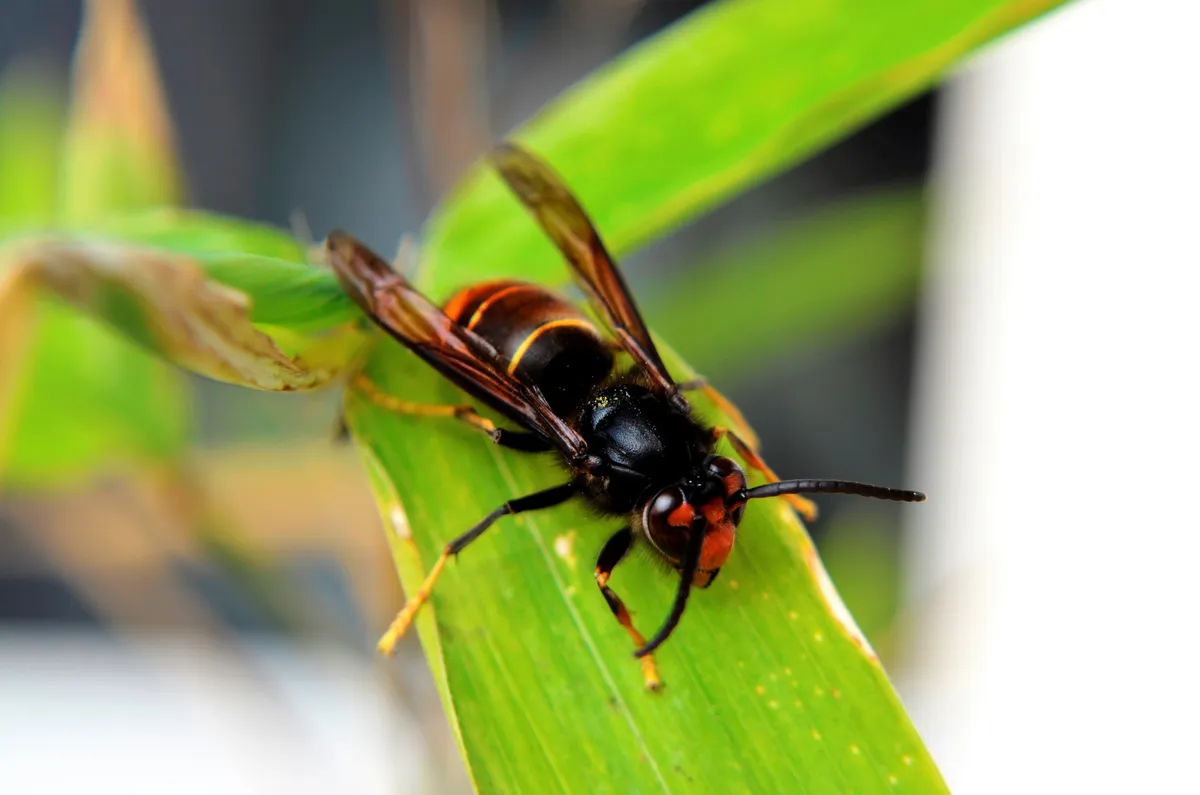
In South Carolina, queens and an early nest turned up in Beaufort County in spring 2024, and in December 2025 a nest was found and removed in York County, the first outside the Lowcountry, reports Clemson University's Department of Plant Industry. In July 2026 the North Carolina Department of Agriculture and Consumer Services confirmed the hornet's first established presence in that state, in Matthews. USDA APHIS describes a large, dark hornet with distinct yellow legs and asks people in Georgia, South Carolina and North Carolina to report suspected sightings to their state, with a photo if it is safe to take one. See the yellow-legged hornet guide for more on this species.
The northern giant hornet, Vespa mandarinia, which MDC calls the Asian giant hornet, the so-called murder hornet, is gone. It was confirmed in Washington State in December 2019, its four US nests were all in alder tree cavities, and on December 18, 2024 the Washington State Department of Agriculture and USDA declared it eradicated from the United States after three years without a confirmed detection. Penn State says European hornets are most often mistaken for this species in eastern North America, and notes that the giant hornet's head is yellow all over.
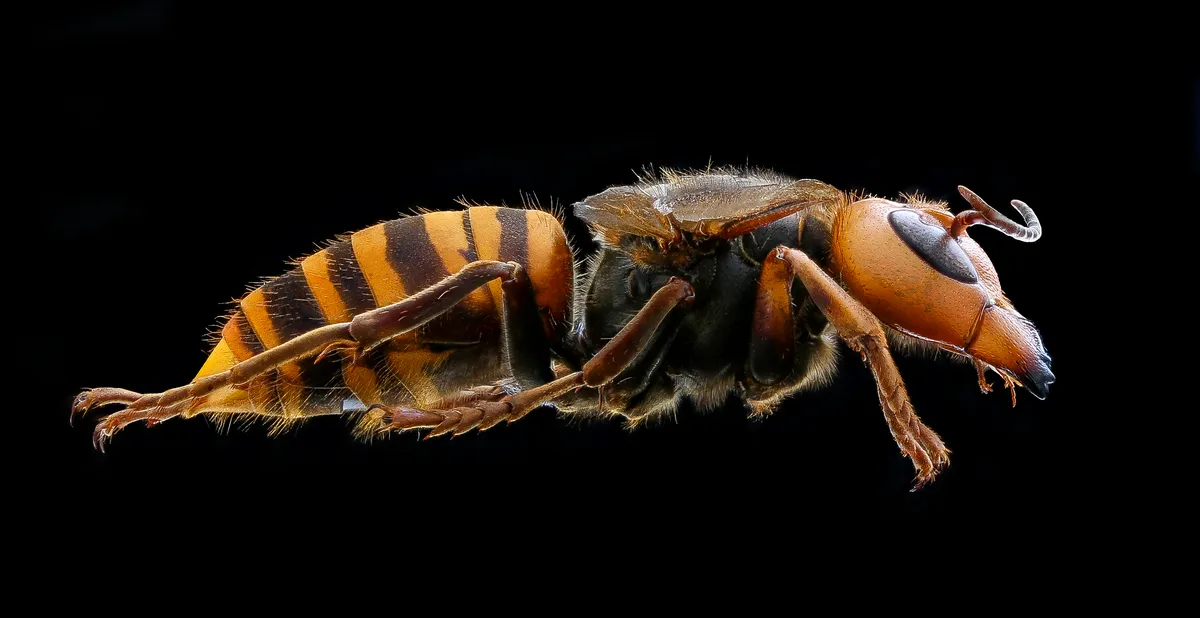
A big hornet in a US yard today is far more likely to be a European hornet than a giant hornet; the European hornet guide covers it in depth.
How do you tell a bee from a wasp?
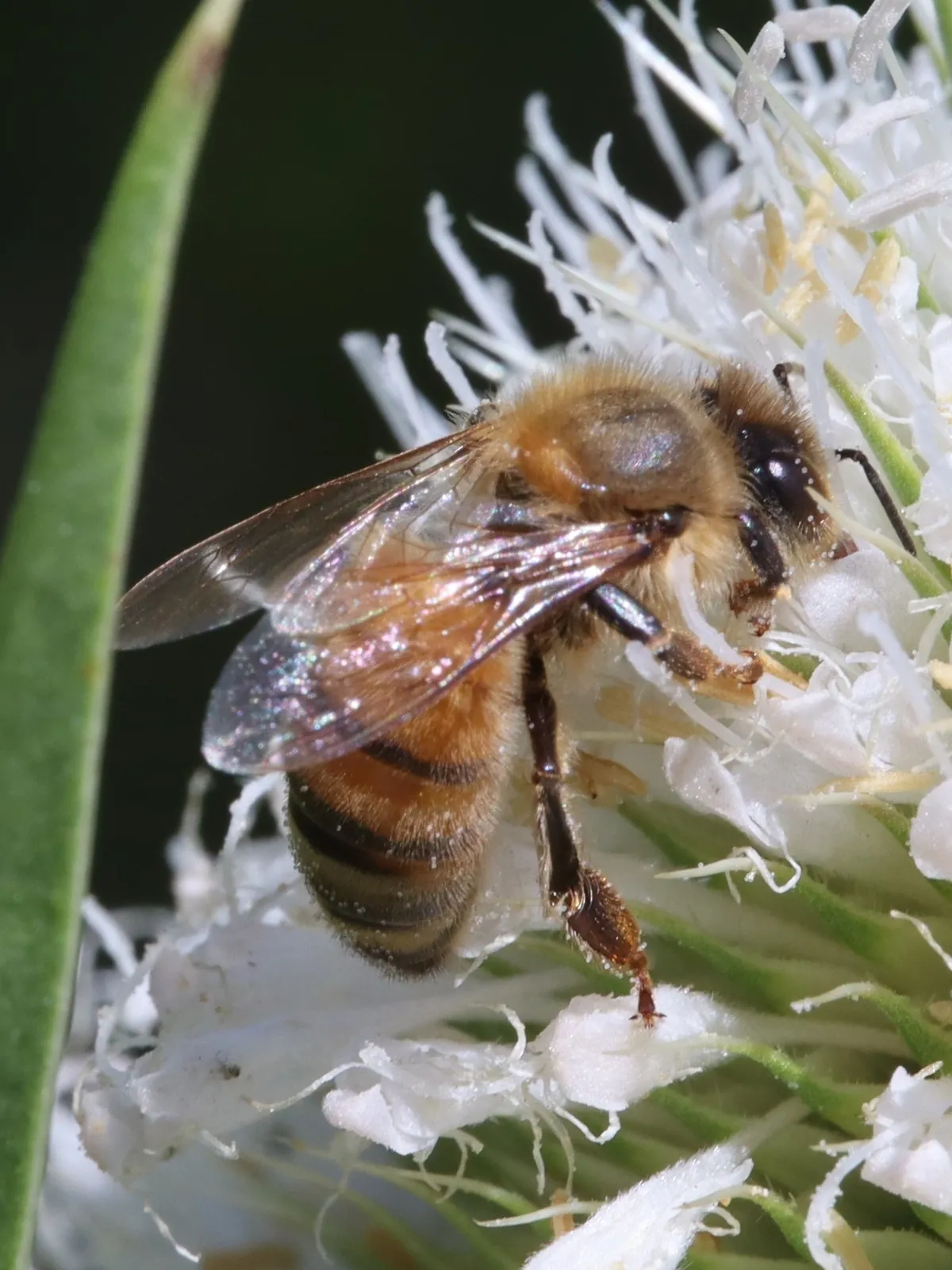
Look for hair and a waist. North Dakota State University Extension's guide to insects that look like bees says wasps look less hairy than most bees and have a longer body with a narrow, visible waist and typically brighter, more varied colors, while bees are sturdier, with no obvious waist. Most bees also carry pollen in hairs or baskets on their hind legs, NDSU says, and MDC notes that yellowjackets are not densely hairy and do not collect pollen.
Honey bees and yellowjacket workers are about the same length, about 1/2 inch (Missouri Extension), so hair and color do the work. UC IPM says honey bees are less brightly striped and hairier than yellowjackets, are usually not attracted to food and are unlikely to sting unless trapped or stepped on.
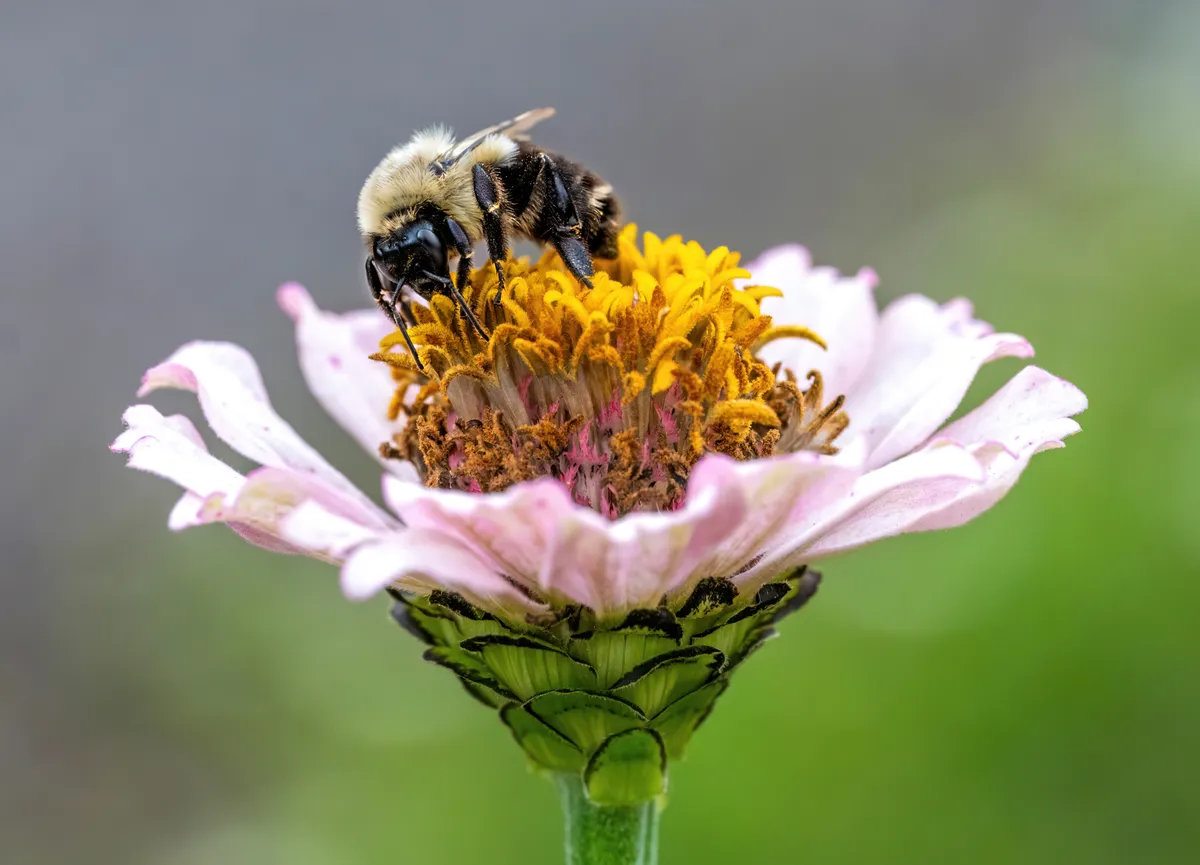
Bumble bees, 1/2 to 1 inch long, are densely covered in black and yellow hair and usually nest on or in the ground, often in an old mouse or bird nest; Missouri Extension says they are not very aggressive except when defending the nest. Carpenter bees are about the same size, but Missouri Extension's carpenter bee guide says the top of the abdomen is black, almost hairless and shiny. They often hover near decks and eaves, and the males fly close to people, but males cannot sting. Carpenter bees and bumble bees compared goes into the details.
Which one do I have?
Match the insect's size, color, nest and behavior against this table of eight insects that get called wasps, hornets or bees, then run the checks below it from a safe distance.
| Insect | Size | How to spot it | Nest | Stings? |
|---|---|---|---|---|
| Yellowjacket | About 1/2 inch | Bright yellow and black; waist barely visible; often at food and trash | Covered paper nest, usually underground | Yes, repeatedly; defends the nest as a group |
| Bald-faced hornet | 1/2 to 3/4 inch | Mostly black, with ivory-white face and abdomen tip; really a yellowjacket | Gray paper ball in a shrub or tree | Yes, repeatedly, near the nest; foragers are not aggressive |
| Paper wasp | About 3/4 to 1 inch | Slender, with a very thin waist; legs dangle in flight | One open comb with no cover, under eaves | Yes, but much less defensive than yellowjackets |
| Mud dauber | 1/2 to 1 1/4 inches | Very slender, with a threadlike waist | Tubes or cells of mud | Rarely; usually only when pinned |
| Eastern cicada killer | 1 1/2 to 2 inches | Brownish black, with yellow marks on the abdomen and face | Burrow dug in the soil | Rarely; only when pinned |
| Honey bee | About 1/2 inch | Fuzzy, light brown to black; may carry pollen on its hind legs | Hollow tree or, occasionally, a wall void | Once; the barbed stinger stays in the skin |
| Bumble bee | 1/2 to 1 inch | Densely hairy, black and yellow all over | On or in the ground, often in an old mouse nest | Not very aggressive except near the nest |
| Carpenter bee | About bumble bee size | Shiny, almost hairless black abdomen; often hovers near decks and eaves | Round hole about 1/2 inch across in bare wood | Females if handled; males cannot sting |
Sizes from University of Missouri Extension, except the bald-faced hornet's (MDC); other details from UC IPM, MDC, Penn State, Kentucky and NDSU, each linked on this page.
Sort it from a safe distance
- Black, with an ivory-white face and abdomen tip: a bald-faced hornet, which is really a yellowjacket.
- About 1 inch, reddish brown in front and yellow behind, at a tree hollow, fallen fruit or a porch light after dark: a European hornet.
- About 1/2 inch, bright yellow and black, at your food, your trash or a hole in the ground: a yellowjacket.
- Slender, with a very thin waist and dangling legs, near an open paper comb: a paper wasp.
- Fuzzy, with pollen on its hind legs: a bee. A shiny, almost hairless black abdomen means a carpenter bee.
- Dark, with yellow legs, in Georgia, South Carolina or North Carolina: possibly a yellow-legged hornet. Photograph it if you safely can and report it to your state.
Commonly confused with
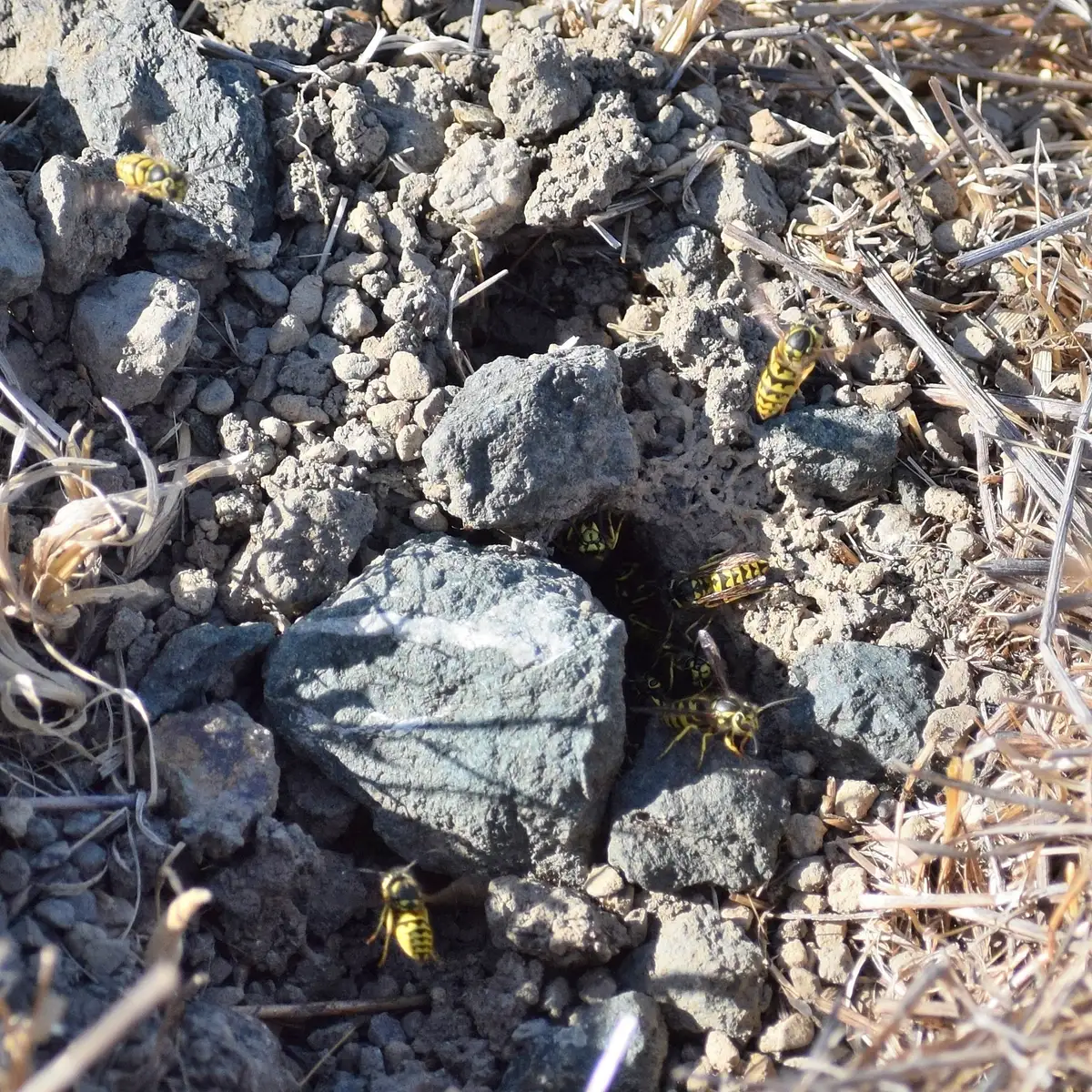 YellowjacketAbout 1/2 inch, bright yellow and black; most nest in the ground and scavenge food
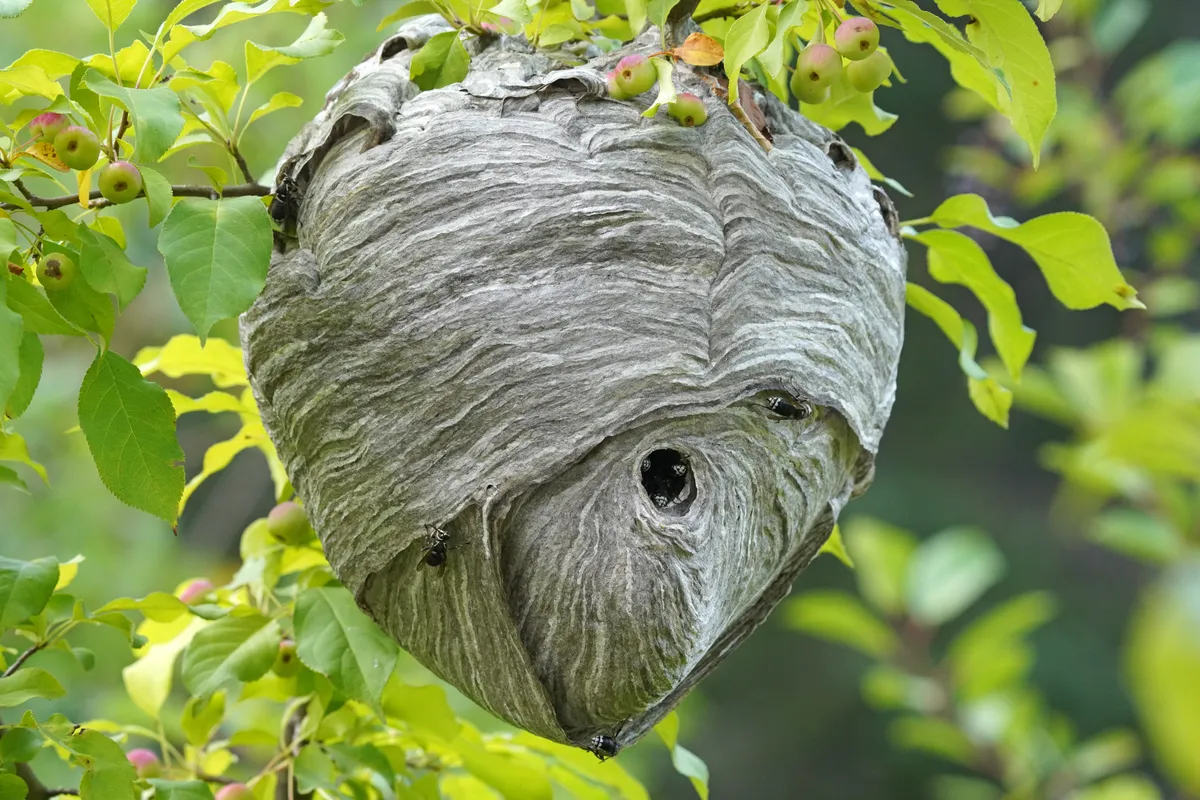 Bald-faced hornetBlack with ivory-white marks; a yellowjacket that hangs a gray paper nest in trees
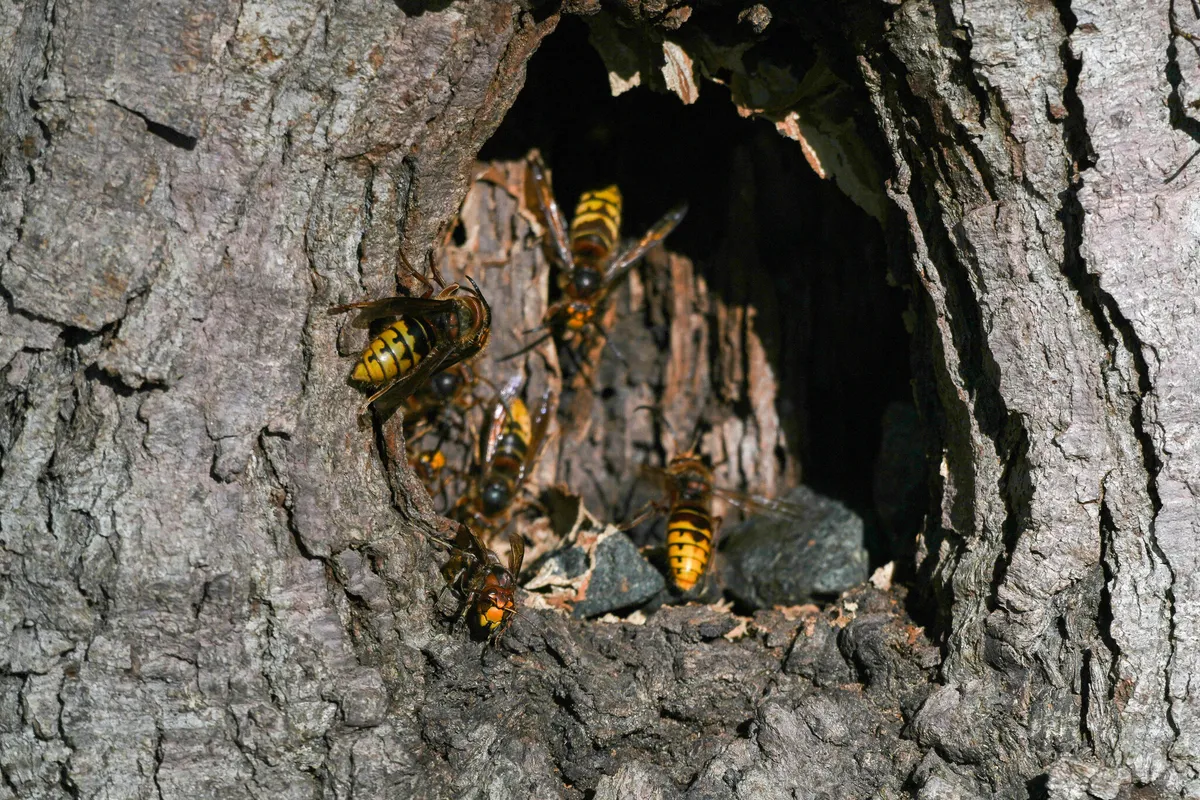 European hornetUp to about 1 inch, reddish brown and yellow; nests in hollow trees, active at night
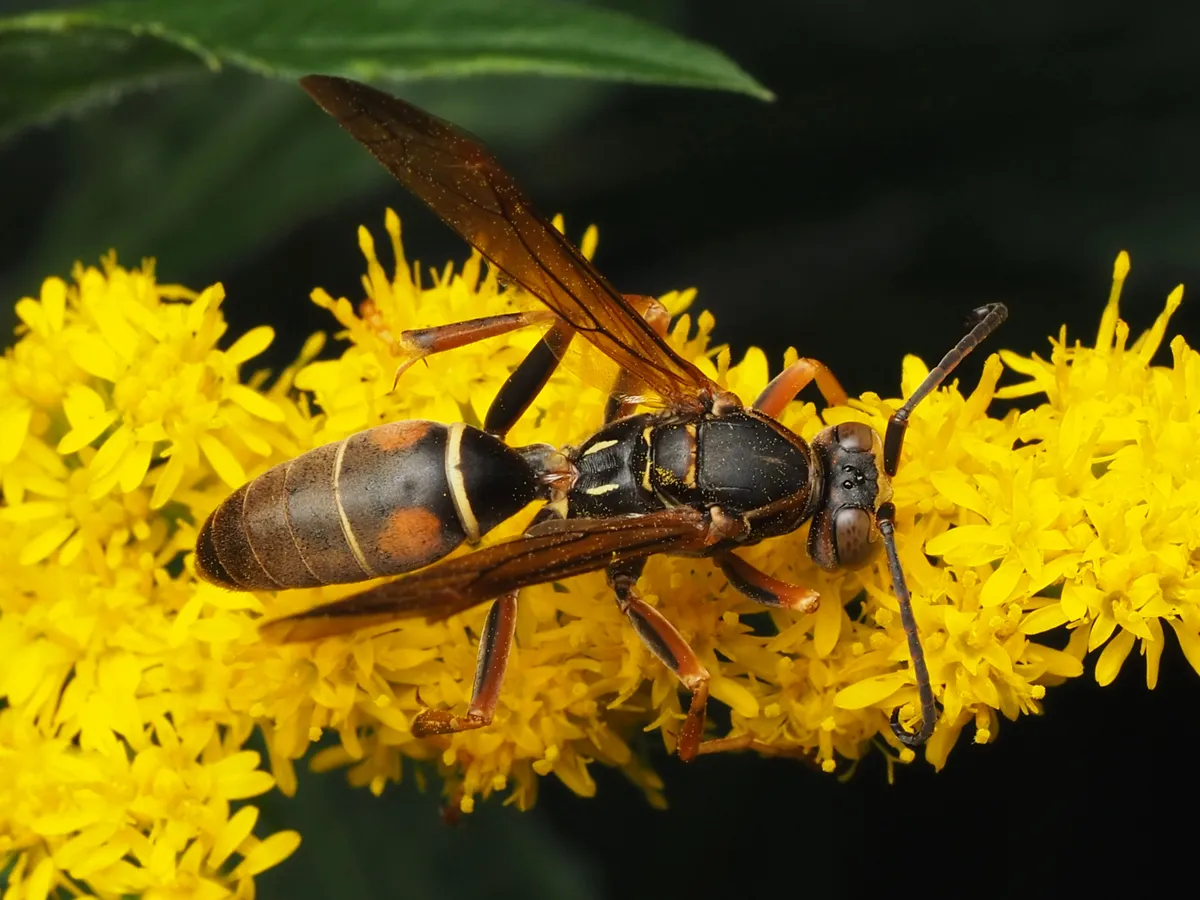 Paper waspSlender, with a very thin waist and dangling legs; hangs one open paper comb
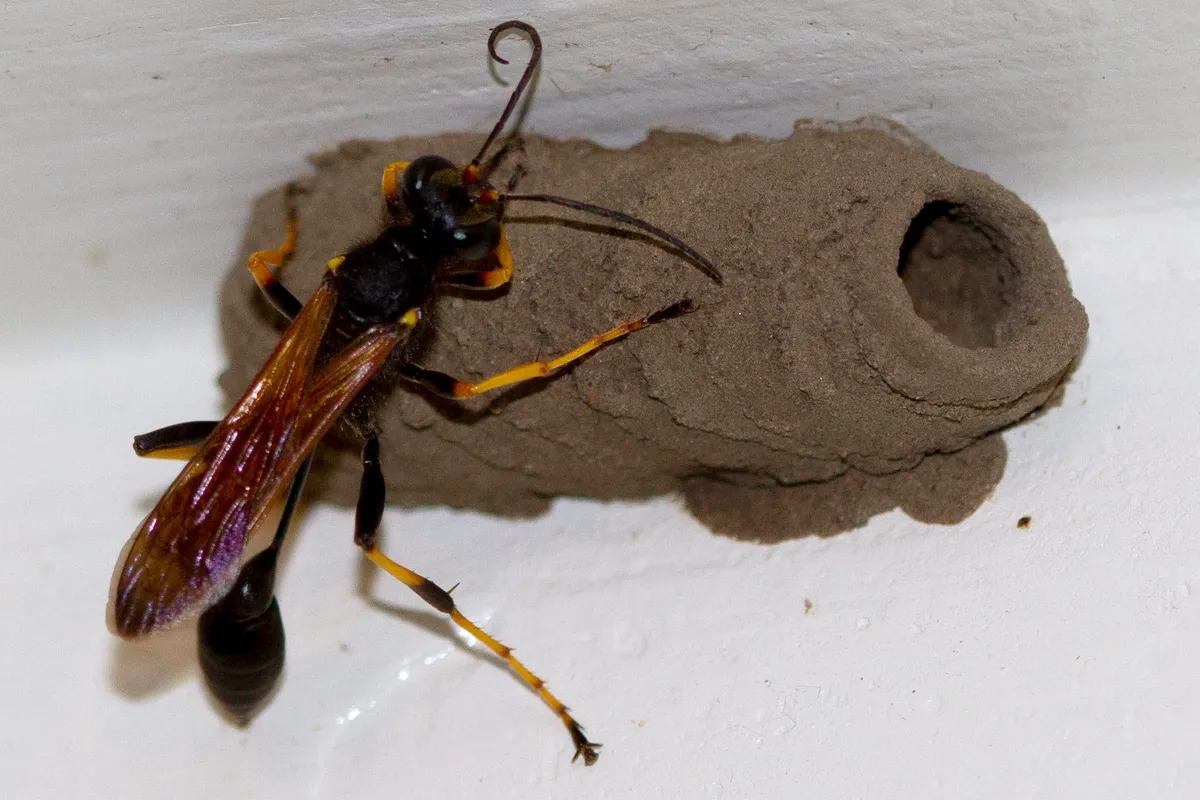 Mud dauberThreadlike waist; builds nests of mud, not paper, and rarely stings
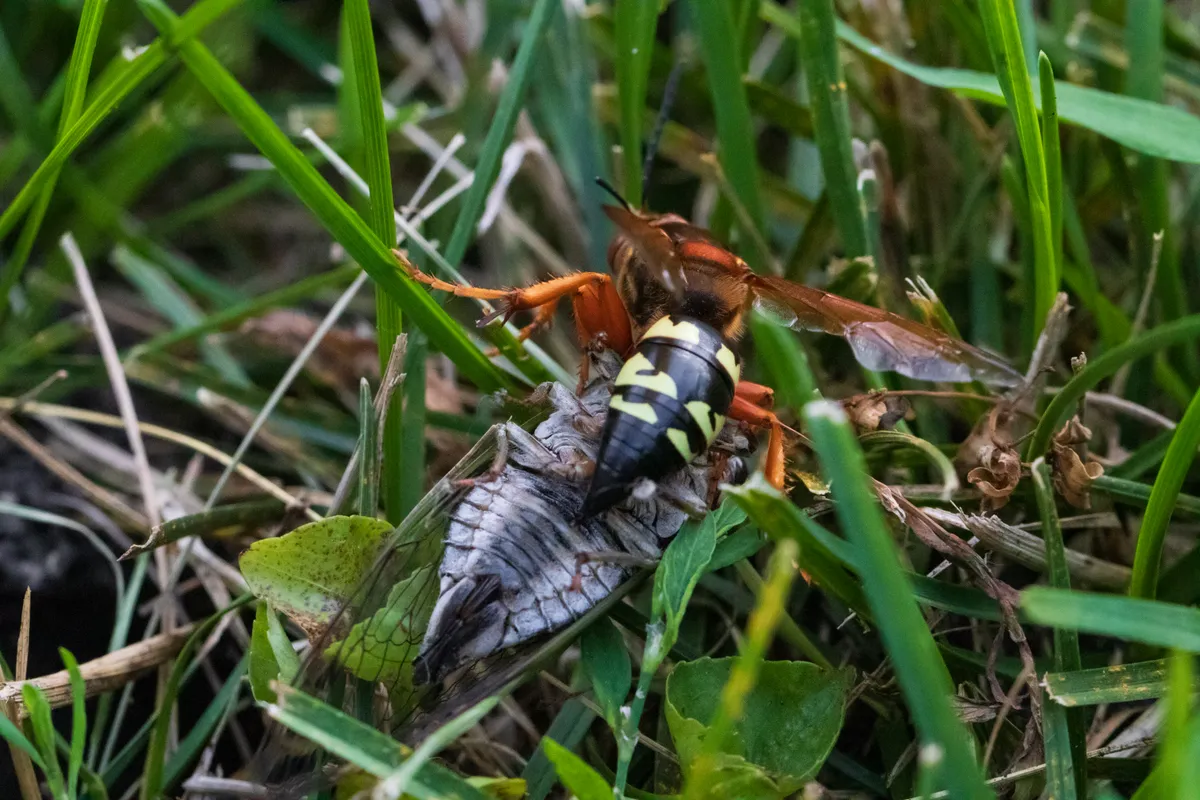 Eastern cicada killer1 1/2 to 2 inches; digs a burrow in the soil and stings only when pinned
Photos: Yellowjacket: no rights reserved, via iNaturalist, CC0 1.0. Bald-faced hornet: U.S. Fish and Wildlife Service - Midwest Region, Public domain, via Wikimedia Commons, public domain. European hornet: no rights reserved, via iNaturalist, CC0 1.0. Paper wasp: Zygy, CC0, via Wikimedia Commons, CC0 1.0. Mud dauber: (c) Randy A Nonenmacher, some rights reserved (CC BY), via iNaturalist, CC BY 4.0. Eastern cicada killer: USFWS Midwest Region, Public domain, via Wikimedia Commons, public domain.
What should you do once you know which one it is?
Often, nothing. Penn State says a bald-faced hornet nest can usually be left alone unless it is within about 10 feet of a building entrance, under a low eave or in shrubbery beside a mowed lawn, and MDC says bald-faced hornet nests away from buildings and sidewalks present little danger. Penn State considers the bald-faced hornet beneficial because it eats other insects, other yellowjackets among them, and says most of the colony dies around the first hard frost anyway.
- A hornet nest in a wall: do not cover the outside entrance; Penn State and MDC warn that trapped hornets may chew through to the inside.
- A European hornet nest near people: MDC suggests a licensed exterminator, or waiting until a hard freeze ends the colony.
- Hornets at the house at night: Penn State suggests turning off porch lights at night in fall and picking up fallen fruit.
- Anyone allergic to stings: Penn State says people with a known sensitivity should have nests near the home removed by professionals.
- A possible yellow-legged hornet: report it to your state with a photo, as Georgia, Clemson and USDA ask; Clemson advises against removing a nest yourself.
When a nest does have to go, the steps are in the guide to getting rid of wasps and a step-by-step wasp nest removal guide; for nests in the ground, see dealing with wasps that nest underground.
This guide is general educational information, not medical advice. If you have symptoms or concerns after a bite or exposure, contact a healthcare provider.
Frequently Asked Questions
What is the difference between a wasp and a hornet?+
A hornet is a kind of wasp. The Missouri Department of Conservation says members of the genus Vespa are the ones called true hornets, and the one widespread in the eastern US is the European hornet: up to about 1 inch long, reddish brown in front and yellow behind, nesting in hollow trees and sometimes flying at night, according to Penn State Extension. The wasps people usually mean are yellowjackets, about 1/2 inch and bright yellow and black, and slender paper wasps with very thin waists.
Is a yellow jacket a wasp or a hornet?+
A yellow jacket is a wasp, not a true hornet. The Missouri Department of Conservation says the true hornets are the genus Vespa, while yellowjackets belong to a closely related genus. Workers are about 1/2 inch long with bright yellow and black bands, and most nest underground. Some yellowjackets nest in the open and get called hornets: Penn State Extension says the black-and-white bald-faced hornet is really an aerial yellowjacket.
Is a bald-faced hornet a real hornet?+
No. Penn State Extension says the bald-faced hornet is not a true hornet but a yellowjacket, one of the aerial yellowjackets in the genus Dolichovespula. University of Florida IFAS Extension explains that people tend to call a species a hornet when it nests above ground, and that this one's name reflects its hornet-like size and its aboveground nest. It is mostly black with ivory-white markings and hangs a gray, football-shaped paper nest in shrubs and trees.
Are hornets more dangerous than wasps?+
Not necessarily. The University of Kentucky calls yellowjackets, which are wasps, arguably the most dangerous stinging insects in the US. Penn State Extension says a European hornet's sting is only about as painful as a honey bee sting and should clear up on its own in one to a few hours, unless the person is allergic or was stung multiple times. Wasps and hornets can both sting more than once, and for anyone allergic, CDC's NIOSH says anaphylaxis requires immediate emergency care.
What attracts hornets to a house?+
Light, fruit and shelter. Penn State Extension says European hornets are sometimes attracted to porch lights at night, come to fallen fruit such as apples and pears, and strip the bark from some shrubs, especially lilac, to feed on the sap. They nest in hollow trees and sometimes in the wall voids of houses. Penn State suggests turning off porch lights at night in the fall and picking up fallen fruit to reduce their numbers.
Why is there a hornet in my house in winter or spring?+
It is most likely a queen, because only mated queens survive the winter. The Missouri Department of Conservation says new European hornet queens look for shelter in fall and may enter houses and attics, and Penn State Extension says queens that spent the winter in a building's walls sometimes wander indoors by accident in spring. Penn State suggests catching one under a glass with a sheet of paper and releasing it outdoors, then sealing cracks in siding and around windows and pipes.
What kinds of wasps are there?+
The wasps people meet around homes fall into two groups. Social wasps, such as yellowjackets, hornets and paper wasps, live in colonies around a paper nest and defend it, according to UC IPM and the Missouri Department of Conservation. Solitary wasps such as mud daubers and cicada killers do not form colonies, the same two sources say: mud daubers build nests of mud, and cicada killers dig tunnels in the soil. UC IPM and University of Missouri Extension say they rarely sting.
Are there invasive hornets in the US?+
Yes. The yellow-legged hornet, a social wasp from Southeast Asia, has been found in Georgia since 2023 and since then in South Carolina and North Carolina, and officials ask people to report it. The northern giant hornet, which the Missouri Department of Conservation calls the Asian giant hornet, the so-called murder hornet, is gone: confirmed in Washington State in December 2019, it was declared eradicated from the United States on December 18, 2024 by the Washington State Department of Agriculture and USDA, after three years without a confirmed detection.
Are hornets and wasps good for anything?+
Many are useful predators. Penn State Extension considers the bald-faced hornet beneficial because it eats other insects, including other yellowjackets, and the Missouri Department of Conservation says yellowjackets hunt caterpillars, many of them crop and forest pests, and play a role in pollination. European hornets hunt grasshoppers, flies and yellowjackets, but Penn State notes they also strip bark from lilac and some other shrubs. Penn State says a bald-faced hornet nest can usually be left alone unless it sits near a door or a busy spot.
Do wasps and hornets die in the winter?+
Most of them do. The Missouri Department of Conservation says hard frosts and freezes end a yellowjacket colony, leaving only mated queens to hibernate and start new colonies in spring, and that European hornet workers die when temperatures freeze and their nests are not reused. In very mild winters, and in coastal California south of San Francisco, UC IPM says some yellowjacket colonies survive for several years. Honey bees are different: Penn State says they get through the winter clustered together in the nest.
Sources
- European Hornet (updated July 19, 2024) — Penn State Extension
- Baldfaced Hornet (Steve Jacobs; revised February 2015, updated June 24, 2026) — Penn State Extension
- European Paper Wasp (Michael J. Skvarla, updated January 19, 2026) — Penn State Extension
- Common Social Bees and Wasps of Pennsylvania: Behavior, Lifecycle, and Management (Kate Anton, Christina Grozinger and Natalie Boyle, updated February 4, 2024) — Penn State Extension
- Pest Notes: Yellowjackets and Other Social Wasps (UC ANR Publication 7450; E. C. Mussen and M. K. Rust, updated March 2012) — University of California Statewide IPM Program
- European Hornet (Field Guide) — Missouri Department of Conservation
- Bald-Faced Hornet (Field Guide) — Missouri Department of Conservation
- Yellowjackets (Vespula Wasps) (Field Guide) — Missouri Department of Conservation
- Bees and Wasps (G7391; Tamra Reall, reviewed April 2019) — University of Missouri Extension
- Carpenter Bees (G7424; Richard Houseman and Darryl Sanders, reviewed September 2026) — University of Missouri Extension
- ENTFACT-620: Controlling Wasps, Hornets, and Yellowjackets (Michael F. Potter, revised March 2026) — University of Kentucky Department of Entomology
- Yellow Jackets (Gardening Solutions) — University of Florida IFAS Extension
- Insects That Look Like Bees (E1914; V. Calles-Torrez and others, April 2024) — North Dakota State University Extension
- Yellow-Legged Hornet — Georgia Department of Agriculture
- December 2025 Yellow-Legged Hornet Update: Movement of YLH Beyond Lowcountry Confirmed (December 12, 2025) — Clemson University Department of Plant Industry, Regulatory Services
- NCDA&CS confirms first finding of yellow-legged hornet in the state, asks beekeepers to watch for predator hornet (July 27, 2026) — North Carolina Department of Agriculture and Consumer Services
- Help Detect the Yellow-Legged Hornet: Public Reporting Needed — USDA Animal and Plant Health Inspection Service
- WSDA, USDA announce eradication of northern giant hornet from the United States (December 18, 2024) — Washington State Department of Agriculture
- Insects and Scorpions at Work (reviewed September 28, 2026) — CDC National Institute for Occupational Safety and Health
How this guide was made: it was researched and drafted with AI assistance from the sources listed above. A second, independent AI pass then checked each factual claim against those sources. Found an error? Email support@buzzskito.ca.