
Published by BuzzSkito Mosquito & Tick Control
Published October 29, 2026 · Fact-checked against the sources listed below
What are these tiny red bugs?
Tiny red bugs on sunny walls and windowsills are often clover mites, plant feeders that gather there in spring and fall and do not bite. The others sort by place: concrete and velvet mites outdoors, spider mites on plants, young boxelder bugs and wheel bugs on trees and walls. The main biters are chiggers, young bed bugs and bird mites. Adult mites have eight legs, so a red bug with six legs and antennae is an insect.
Where you saw it narrows the list fastest:
| Where you saw it | Check first | Also check |
|---|---|---|
| Sunny wall, siding or windowsill | Clover mites | Young boxelder bugs; wheel bug hatchlings around an egg cluster |
| Patio, sidewalk or concrete wall | Concrete mites in spring; clover mites | Red velvet mites on soil and rocks, often after rain |
| Houseplant or garden leaves | Spider mites, with fine webbing | Aphids, some of which are red |
| On your skin after grass or woods | Chiggers, which you feel more than see | Fire ants, if you stood near a mound |
| Bed or bedding | A young bed bug that has just fed | Bird mites, if birds have nested nearby |
| Sunny, sandy lawn | Fire ants and their mounds | Velvet ants |
Compiled from the sources linked in the sections below.
Up close, some red bugs look brown: Minnesota describes clover mites as reddish or reddish brown. If yours looks brown or black under a magnifier, the guide to tiny brown bugs and the tiny black bug guide sort those by place the same way; the tiny white bug guide covers pale ones.
How do you tell which tiny red bug you have?
Catch one in a clear jar or press it onto clear tape and look through a magnifying glass, since most of these are 1/8 inch long or less. Then run through these checks.
Checks to run with the bug in a jar
- How big is it? Lay it beside a ruler marked in inches and compare it with the size scale below.
- Eight legs or six? Eight means a mite or another arachnid; six legs and antennae mean an insect.
- Front legs much longer than the rest? That fits a clover mite, though concrete mites have long front legs too.
- Velvety, bright red and up to 1/8 inch, on soil after rain? A red velvet mite.
- Fine webbing under the leaves of a plant? Look for spider mites.
- A red smear when crushed? Clover mites leave one, but concrete mites stain clothing too, so a smear is not proof.
- Is something biting you? Clover, velvet and spider mites do not bite people; see the bite sections below.
| Size | Tiny red bugs that size |
|---|---|
| About 1/100 inch | Chigger larvae, rarely seen |
| Under 1/20 inch | Spider mites |
| About 1/32 inch, slightly smaller than a pinhead | Clover mites |
| About 0.04 inch | Chicken mites |
| About 1/16 inch | Newly hatched boxelder bugs and bed bugs |
| Up to about 1/8 inch | Red velvet mites |
| 1/16 to 1/5 inch | Fire ant workers |
| 1/2 inch or more | Velvet ants; adult boxelder bugs and wheel bugs |
Sizes from the sources linked on this page; Ohio State gives none for concrete mites.
Still unsure? The five-question pest identifier asks where you found it, how big it is and how it moves.
What are the tiny red bugs on walls, windowsills and siding?
Often clover mites. University of Minnesota Extension's clover mite page describes true mites, not insects, slightly smaller than the head of a pin and reddish or reddish brown, which suck sap from lawn grasses, clover and other plants and do not bite people or animals. Penn State Extension gives adults as 0.75 mm (about 1/32 inch), reddish or greenish, with a greatly lengthened first pair of legs, and says they frequently turn up on windowsills on the sunny side of a house.
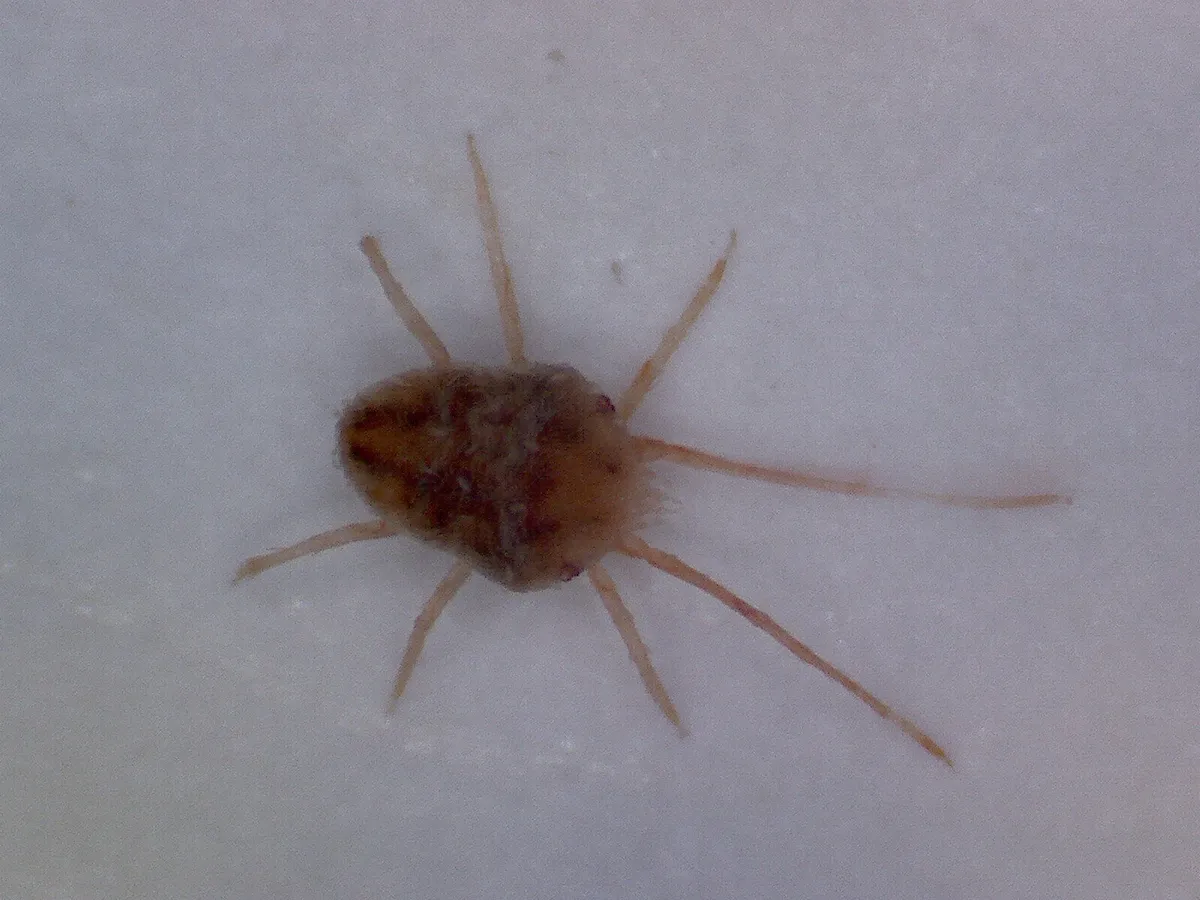
They come in spring and fall. Minnesota says that in fall clover mites sometimes gather on walls, windows and tree trunks, crawl into cracks around windows and foundations and under siding, and turn up indoors on windowsills, walls and tables, mostly on the sunny side. Penn State calls them the biggest nuisance in spring. SDSU Extension says they are most common in thick, well-fertilized lawns, that dry weather favors them, and that unseasonably warm weather can bring them out of their winter hiding places.
They are a nuisance, not a danger. Penn State says they do not attack people and will not reproduce indoors, dying off on their own; Minnesota says they do not damage a house or its furnishings, but crushed mites leave rusty or blood-red spots. The clover mite guide compares them with the other red specks people mistake them for.
Young boxelder bugs
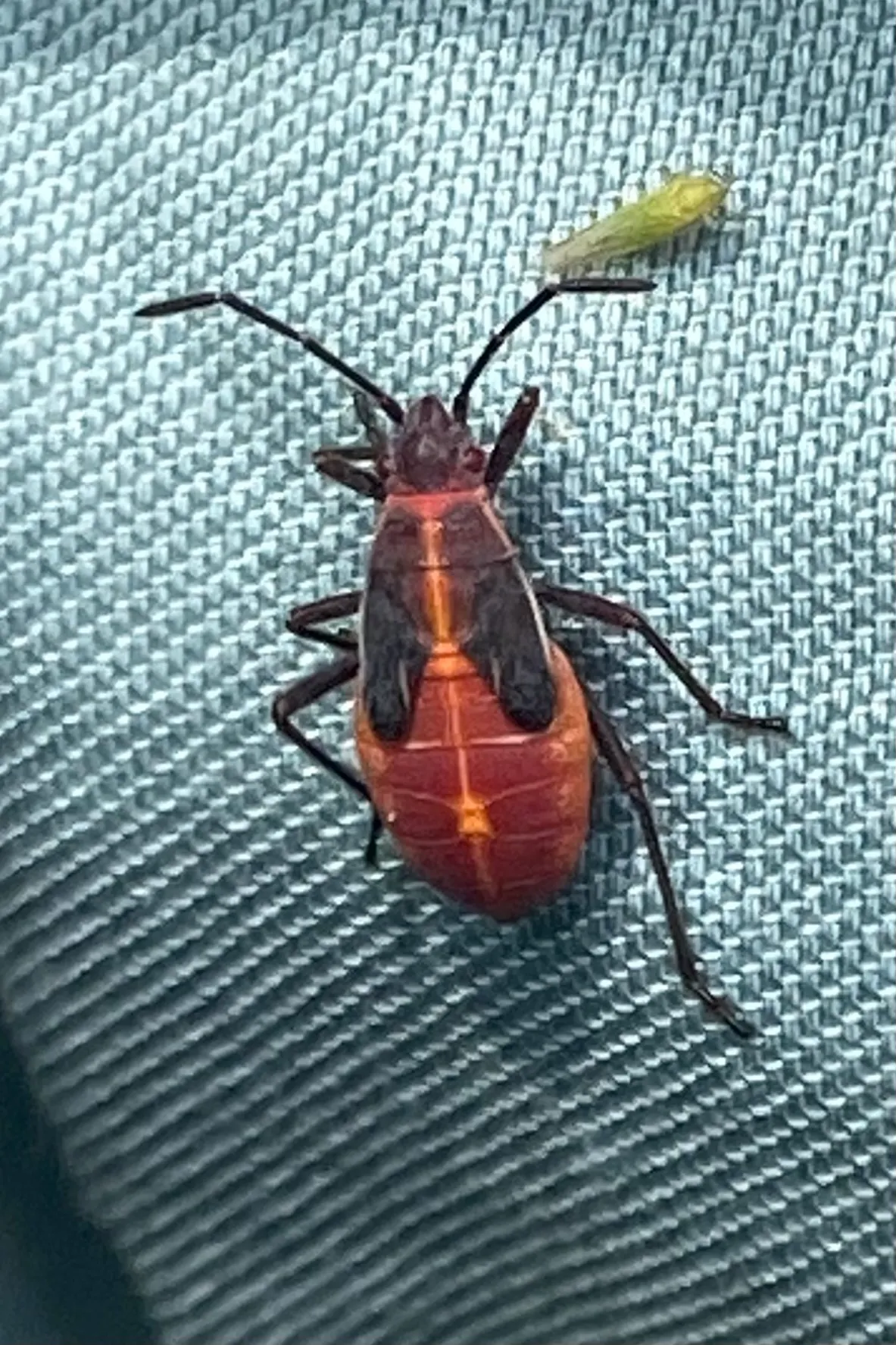
Bright red bugs with black legs on boxelder trees, low plants or a sunny wall are often young boxelder bugs. Minnesota Extension's boxelder bug page says the nymphs are about 1/16 inch long and bright red when they hatch, turning red and black as they grow into adults about 1/2 inch long, black with orange or red markings, and that the bugs favor buildings with a lot of southern or western sun. They release a bad odor when crushed and can stain surfaces, and Colorado State University Extension says they have been reported to bite people only on rare occasions.
Minnesota says the best defense is to seal the gaps they use before they move in for the winter; keeping boxelder bugs out of a house goes step by step. Bigger red-and-black bugs on a house, from adult boxelder bugs to milkweed assassin bugs, are compared in the guide to bugs that look like kissing bugs.
Wheel bug hatchlings
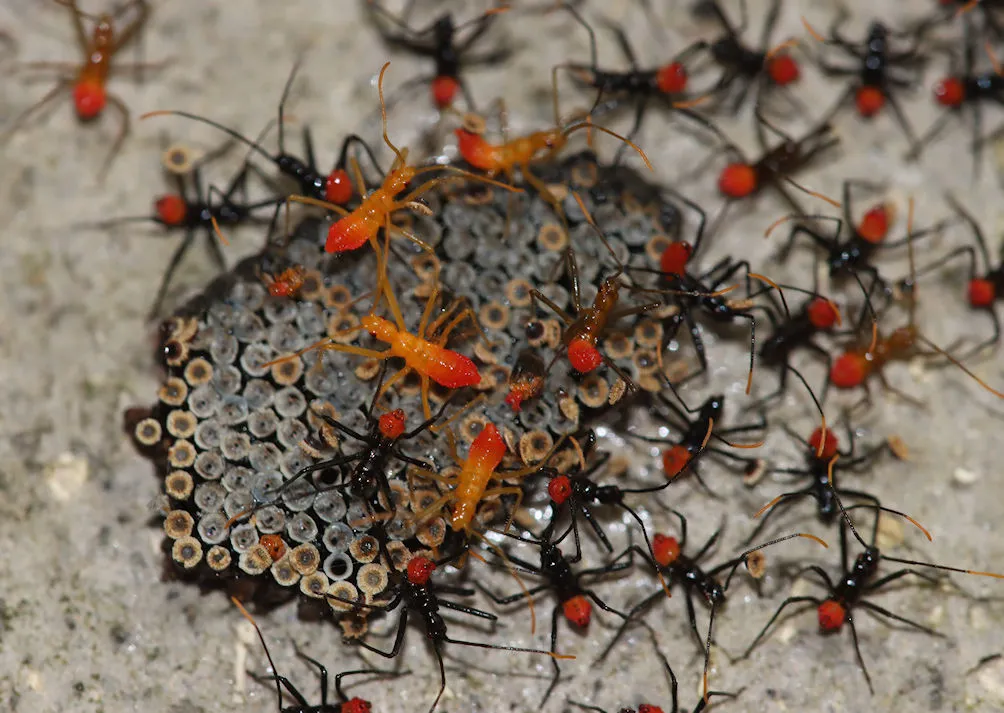
Dozens of tiny red bugs with black legs crowding around a six-sided egg cluster in spring may be newly hatched wheel bugs. The Missouri Department of Conservation says the nymphs are reddish with black legs and can look antlike or spiderlike; females lay six-sided clusters of brown eggs on trees and other solid objects in fall, and the young hatch in spring and grow slowly into adults up to 1 1/2 inches long. Leave them be: MDC does not recommend handling wheel bugs, which can give a very painful bite. The wheel bug guide shows the adults.
What are the tiny red bugs on concrete, patios and soil?
In spring, tiny bright red mites running fast over a sunny patio, sidewalk, retaining wall or picnic table are often concrete mites, of the genus Balaustium. Ohio State University's BYGL alert says they gather on sunny surfaces each spring, eat other mites, small insects and pollen, and leave small red stains on clothing when someone sits on them, and that the gatherings are seasonal and short-lived. It notes medical reports of skin irritation from their bites, but from mites that had invaded buildings, which it says seems rare in Ohio.
They are easy to take for clover mites. Writers for the National Institute of Environmental Health Sciences did at first, then concluded the fast red mites on their concrete patio walls might be concrete mites; both kinds have a front pair of legs longer than the second pair. Theirs stayed on the masonry from April to May, and the writers saw no need for control unless the mites invade the home. Clover mites use concrete too: Penn State says their eggs spend the winter in cracks in concrete sidewalks.
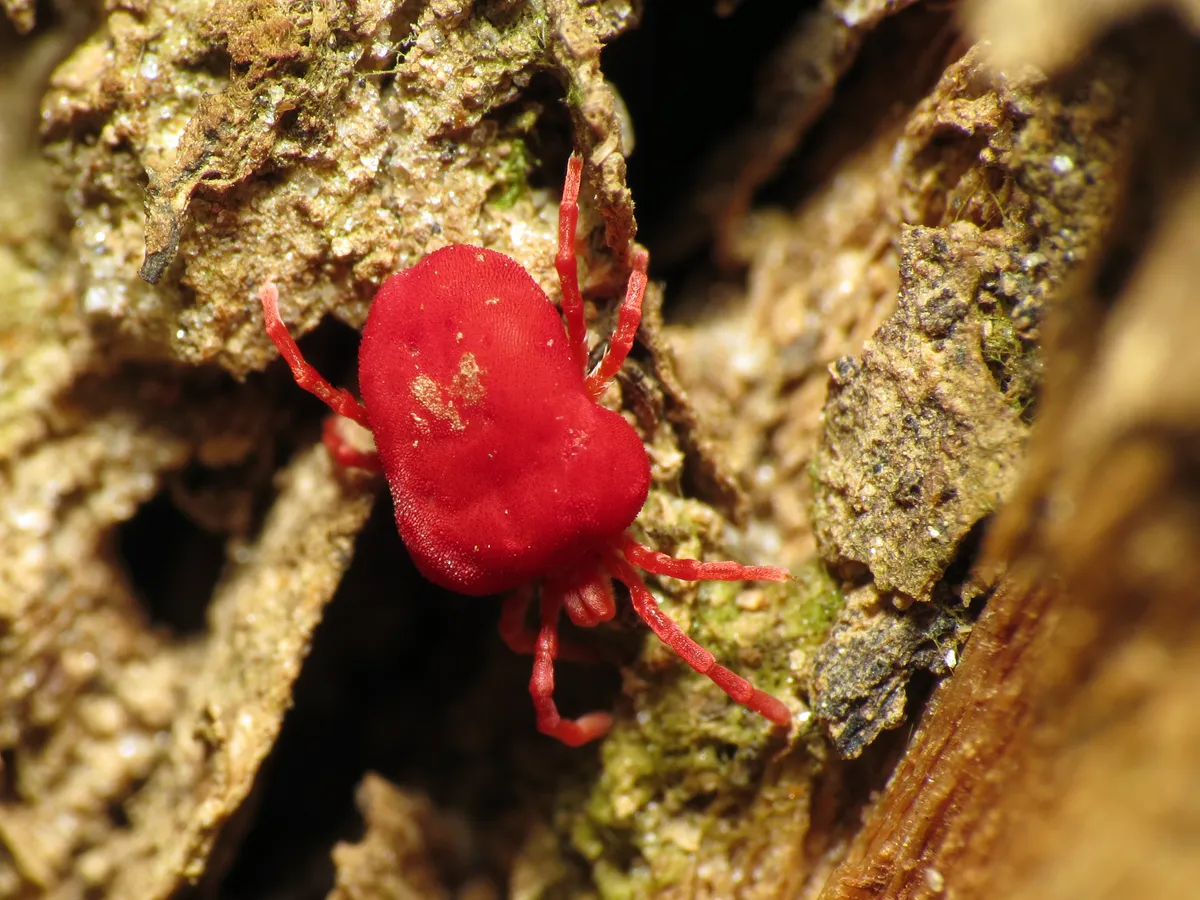
Bigger, velvety red mites crawling over soil, rocks, planters or tree trunks, especially after rain, are usually red velvet mites. The Missouri Department of Conservation's velvet mite page says true velvet mites are usually no bigger than about 1/8 inch, though giant velvet mites can be nearly 1/2 inch long, and that they are harmless to people. Their larvae feed on insects, spiders and other small arthropods; chiggers, whose larvae bite people, belong to a different family.
What are the tiny red bugs on plants?
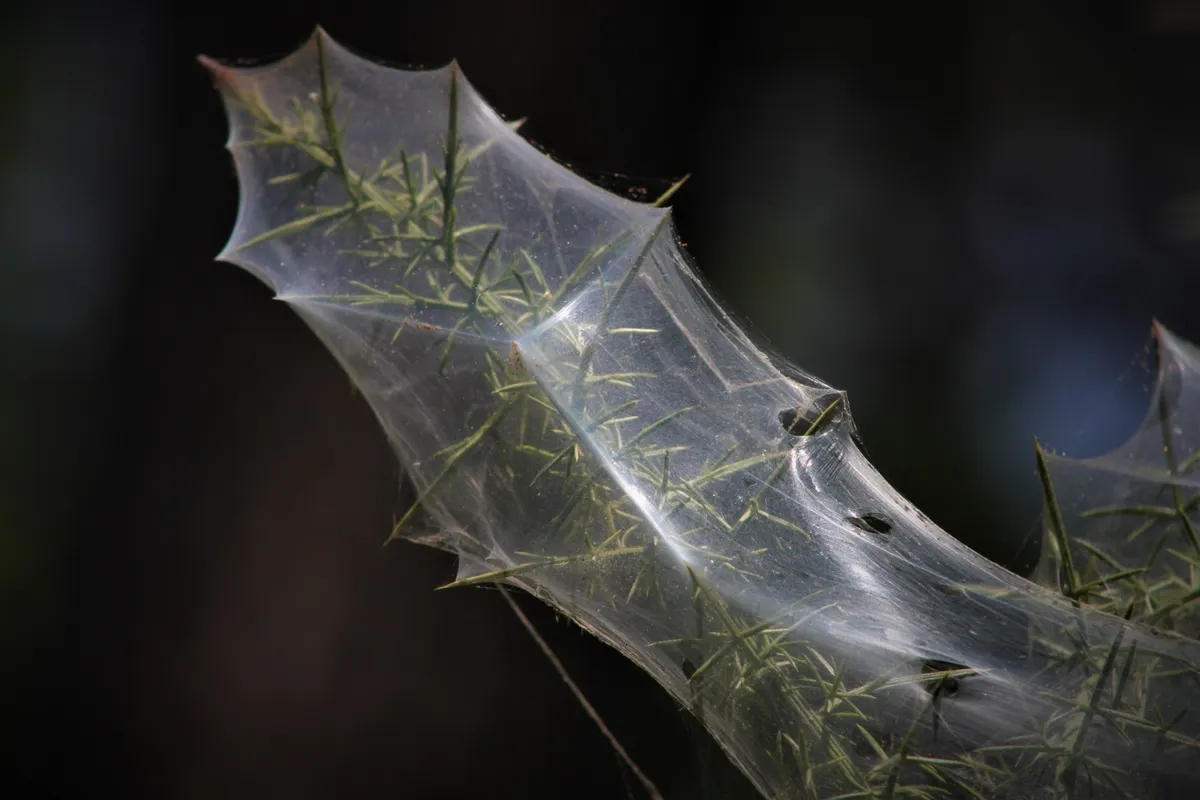
Red specks on the undersides of leaves, with fine webbing and pale speckling on the leaves, are usually spider mites. UC IPM's spider mite guide says the largest adults are under 1/20 inch, small enough to look like moving dots, that most kinds spin silk webbing, which sets them apart from aphids and thrips, and that overwintering females can be red or orange. To check, shake a leaf over white paper: UC IPM says disturbed mites move around quickly. The spider mite guide covers the damage and control.
Pear-shaped insects clustered on soft new growth can be red as well: UC IPM's aphid guide lists green, yellow, brown, red and black aphids, most with a pair of tubes sticking out of the rear end. The National Pesticide Information Center groups spider mites with the plant-feeding mites, not with those that bite people, and UC IPM says aphids pierce plant tissue and suck out fluids. The houseplant bug guide sorts the bugs on indoor plants, and the aphid control guide covers garden plants.
What tiny red bugs bite you outdoors?
Mostly chiggers, though you rarely see them. Cleveland Clinic's chigger page, which notes that chiggers are also called red bugs, says the larvae are yellow or orange and almost invisible to the naked eye, live on plants in grassy or wooded areas, often near water, and feed where clothing fits closely or skin folds: waistbands, bra lines and sock lines. The University of Kentucky's guide to parasitic mites puts the larvae at about the size of a grain of sand, 0.25 mm (about 1/100 inch), and says the nymphs and the bright red adults, also called redbugs, are not parasites.
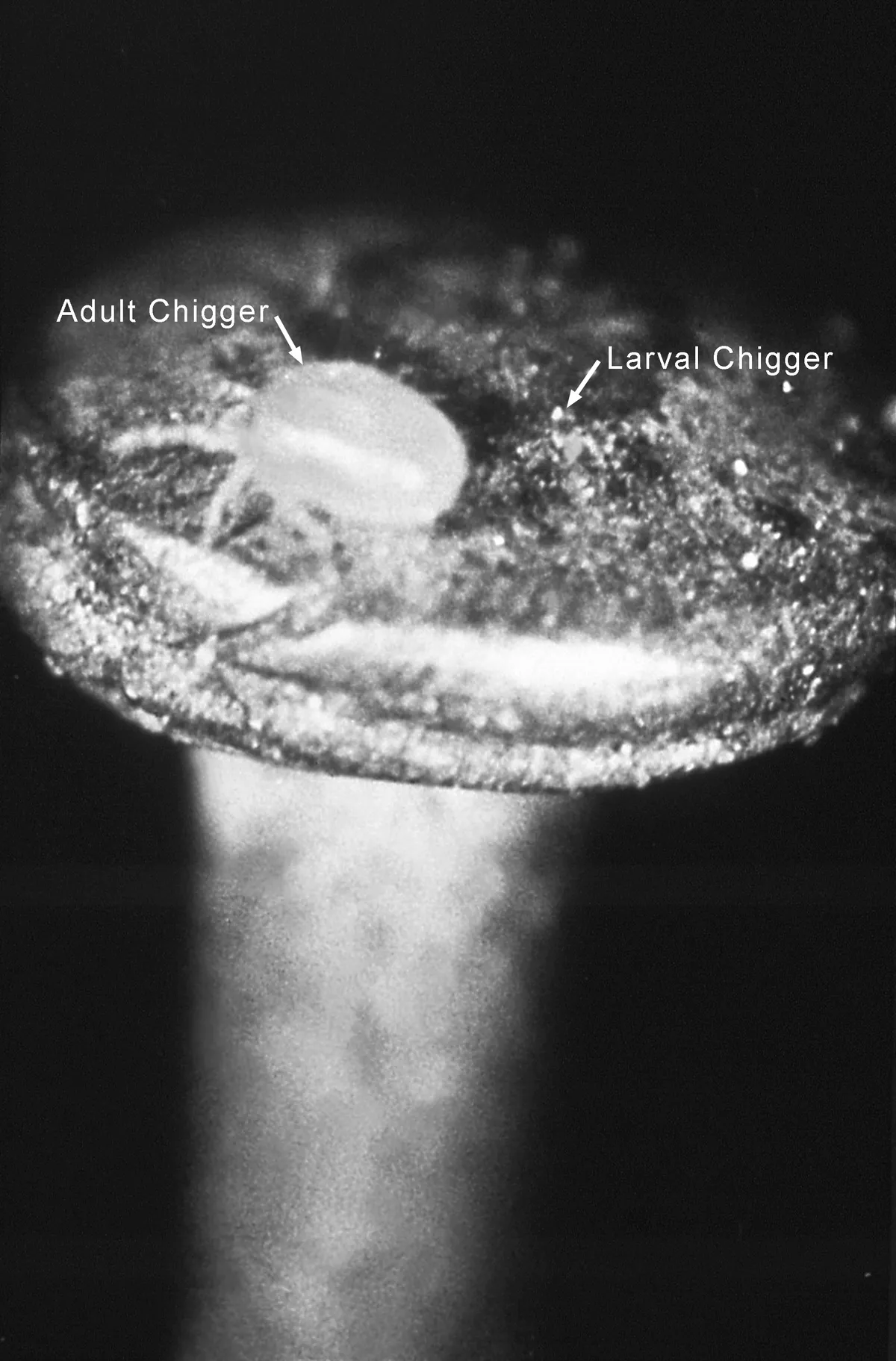
Kentucky adds that chiggers do not burrow into skin or suck blood and that no diseases are currently associated with them in the US. Cleveland Clinic says symptoms can take up to three hours to start, the itch is worst in the first 24 to 48 hours, and it fades over about two weeks. What chigger bites look like, day by day has photos, and the mite bite guide sorts chiggers from the other biting mites.
In the Southeast, small reddish ants that swarm out of a soil mound and sting are likely fire ants. UC IPM's fire ant guide describes red imported fire ant workers as dark reddish brown and 1/16 to 1/5 inch long; they build mounds that are often dome-shaped, climb quickly onto whatever disturbs them, and can bite and sting repeatedly. CDC says the sting can burn and red bumps may form and become white, fluid-filled pustules within a day or two. The red ant guide and the fire ant sting guide go further.
A fuzzy red or orange insect running over a sunny, sandy lawn is likely a velvet ant, which is a wasp, not an ant. The Missouri Department of Conservation says velvet ants are about 1/2 to 1 1/4 inches long, that the females never have wings, and that they will sting, excruciatingly, if held or stepped on barefoot. Its advice for velvet ants: look, but do not touch.
A small red bug you can see attached to your skin is another matter: how to tell a clover mite from a tick shows the difference.
What are the tiny red bugs in bed or biting you indoors?
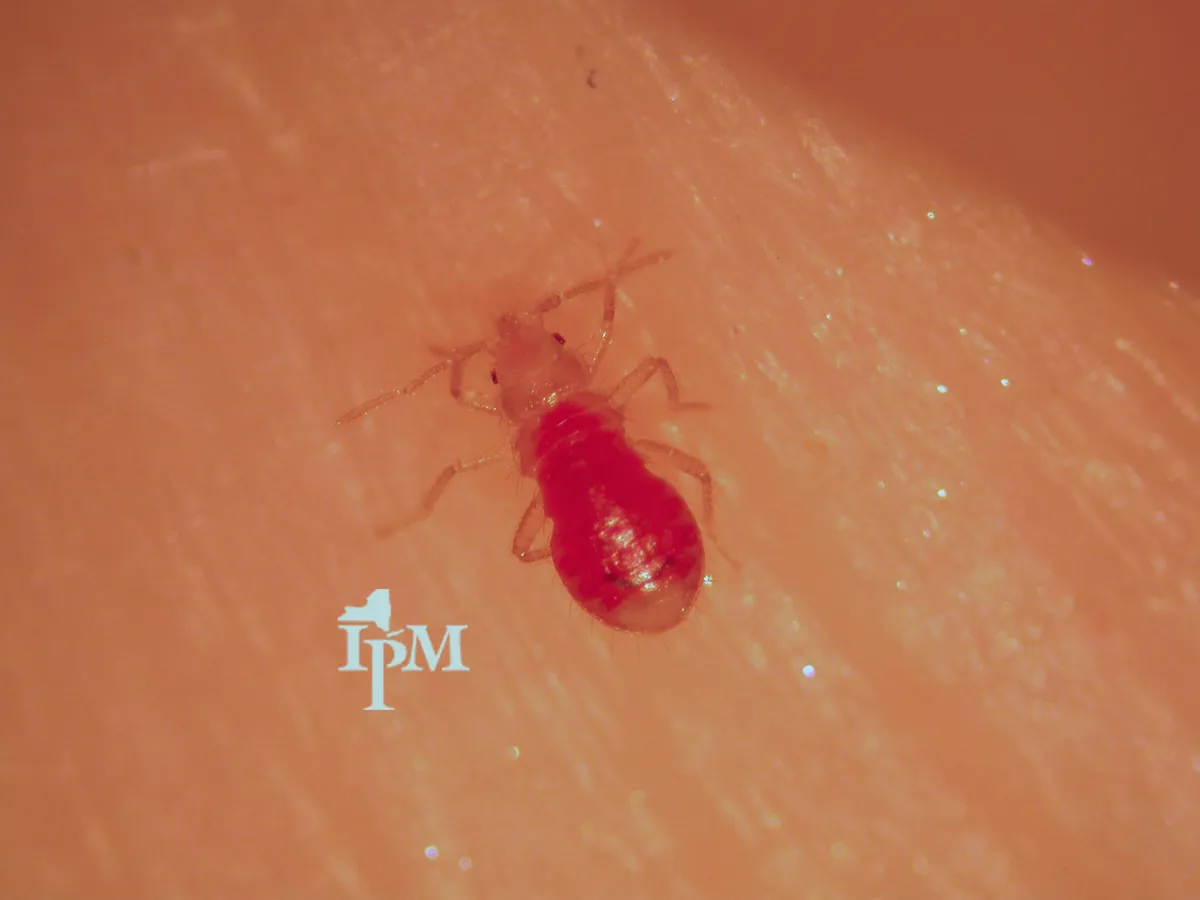
A tiny red bug in a bed deserves a close look, because young bed bugs turn red when they feed. University of Minnesota Extension's bed bug page says newly hatched bed bugs are about 1/16 inch (1.6 mm) long and nearly colorless except after feeding, that newly emerged nymphs seek a blood meal, and that a bed bug turns from brown to purplish red after one. Bed bugs are active at night and hide by day, so check mattress seams, box springs and bed frames, and compare what you find with photos of bed bugs at every stage.
Bites at night can also come from bird mites. Kentucky says bird mites live on birds and in their nests and can bite people but cannot reproduce on them, and that the chicken mite, red to black and about 0.04 inch long, like a speck of black pepper, almost never bites people by day but readily bites at night. The mite bite guide explains where each kind of mite bite shows up.
Clover mites that wander in from a sunny window can end up anywhere, a bed included, but they do not bite. If you have bites and cannot find a bug, the bug bite chart sorts bites by pattern and place on the body, and the bite identifier suggests likely biters from six questions.
Which tiny red bugs bite or sting, and which are harmless?
Chigger larvae, young bed bugs and bird mites can bite people; fire ants and velvet ants sting; and wheel bugs can bite painfully if handled. Clover mites do not bite people or animals (Minnesota), red velvet mites are harmless to people (MDC), and spider mites feed on plants (NPIC). Two are borderline: Colorado State says boxelder bugs have been reported to bite on rare occasions, and Ohio State ties reports of concrete mite bites to mites that got indoors.
For chigger bites, Cleveland Clinic advises contacting a healthcare provider if the itching causes extreme discomfort, scratching turns the bites into open wounds, the itch lasts beyond two weeks, or the skin around a bite swells or leaks pus. Contact a provider about any bite or rash that worries you.
Commonly confused with
- Clover miteAbout 1/32 inch with very long front legs; leaves a rusty red smear when crushed
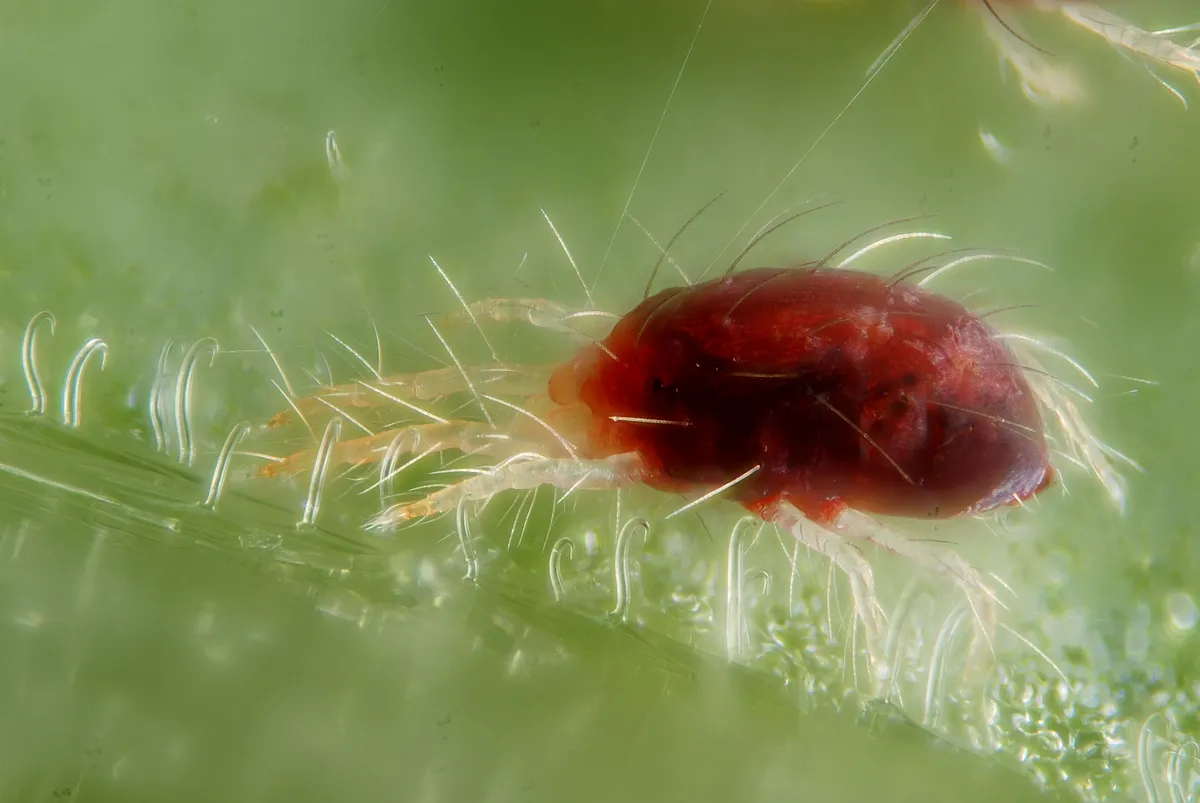 Spider miteUnder 1/20 inch; lives mostly under leaves, often in fine webbing
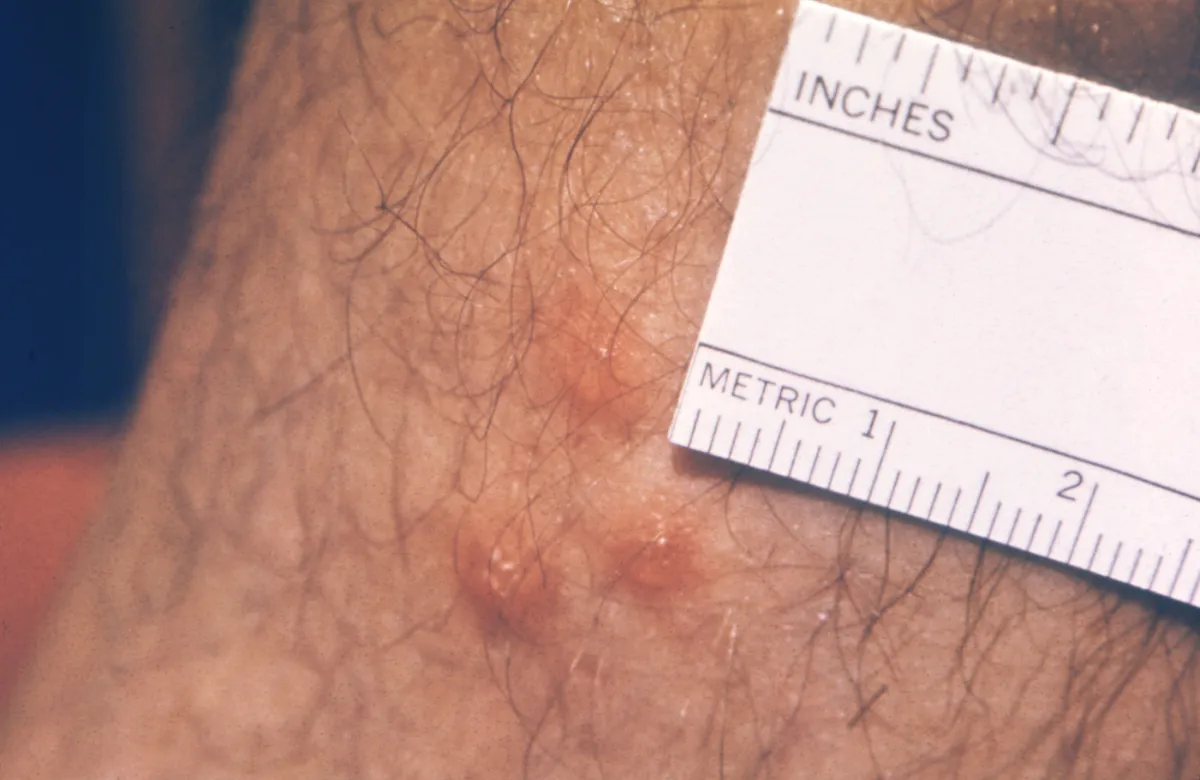 Chigger bitesThe biting larvae are nearly invisible; itchy bumps form where clothing fits tightly
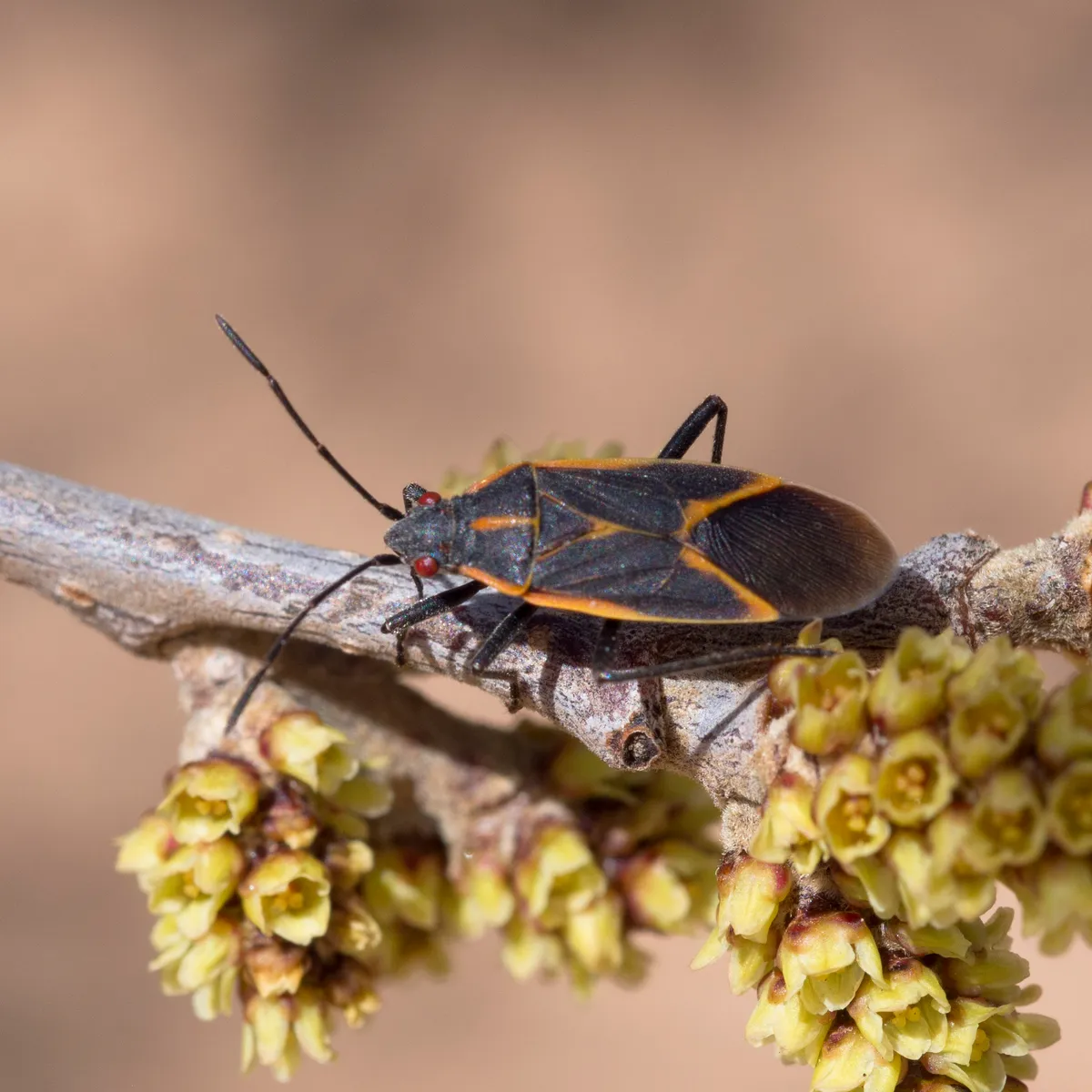 Boxelder bugNymphs hatch bright red and turn red and black; adults are about 1/2 inch
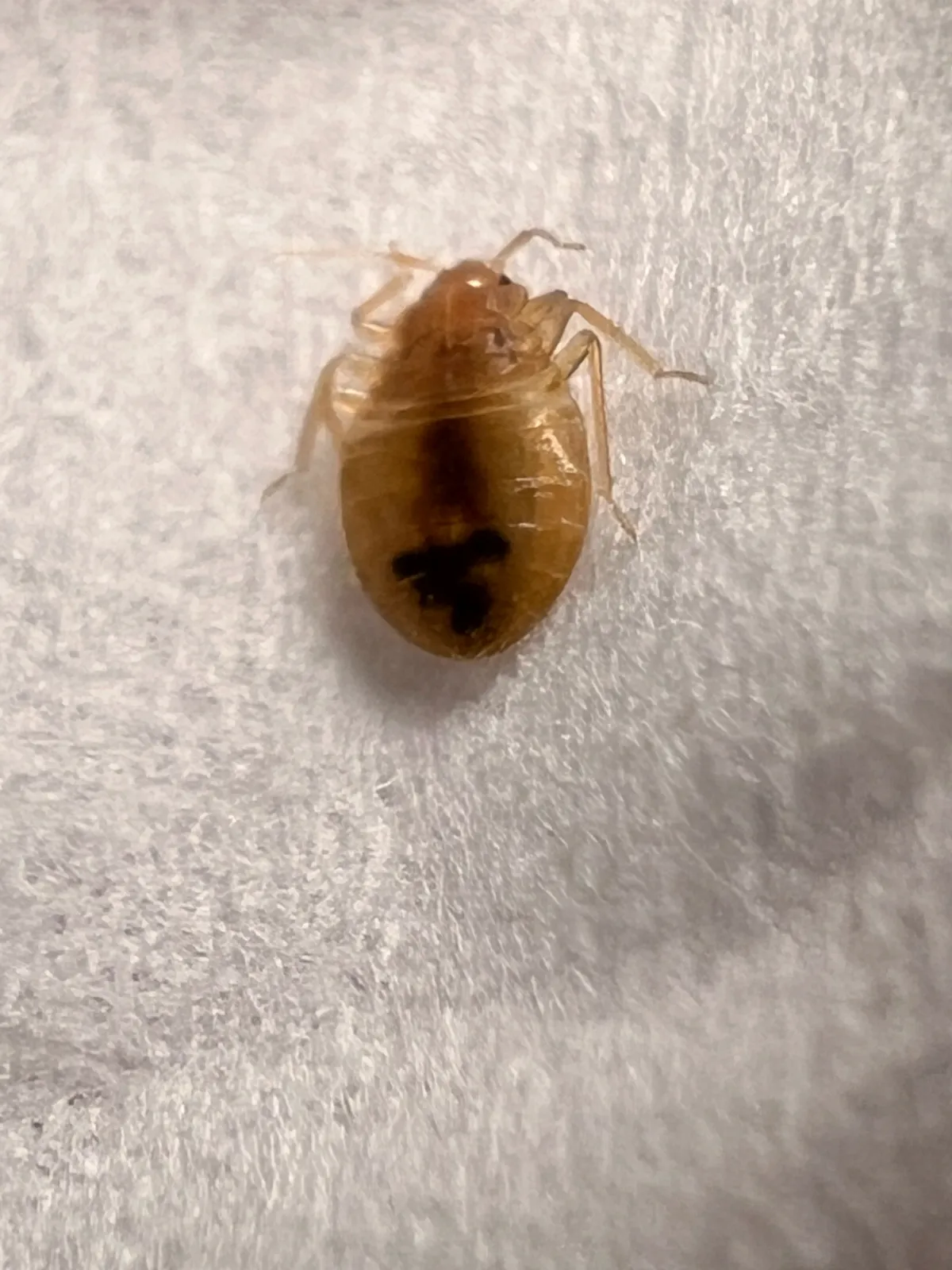 Bed bug nymphAbout 1/16 inch at hatching; nearly colorless until it feeds, then red
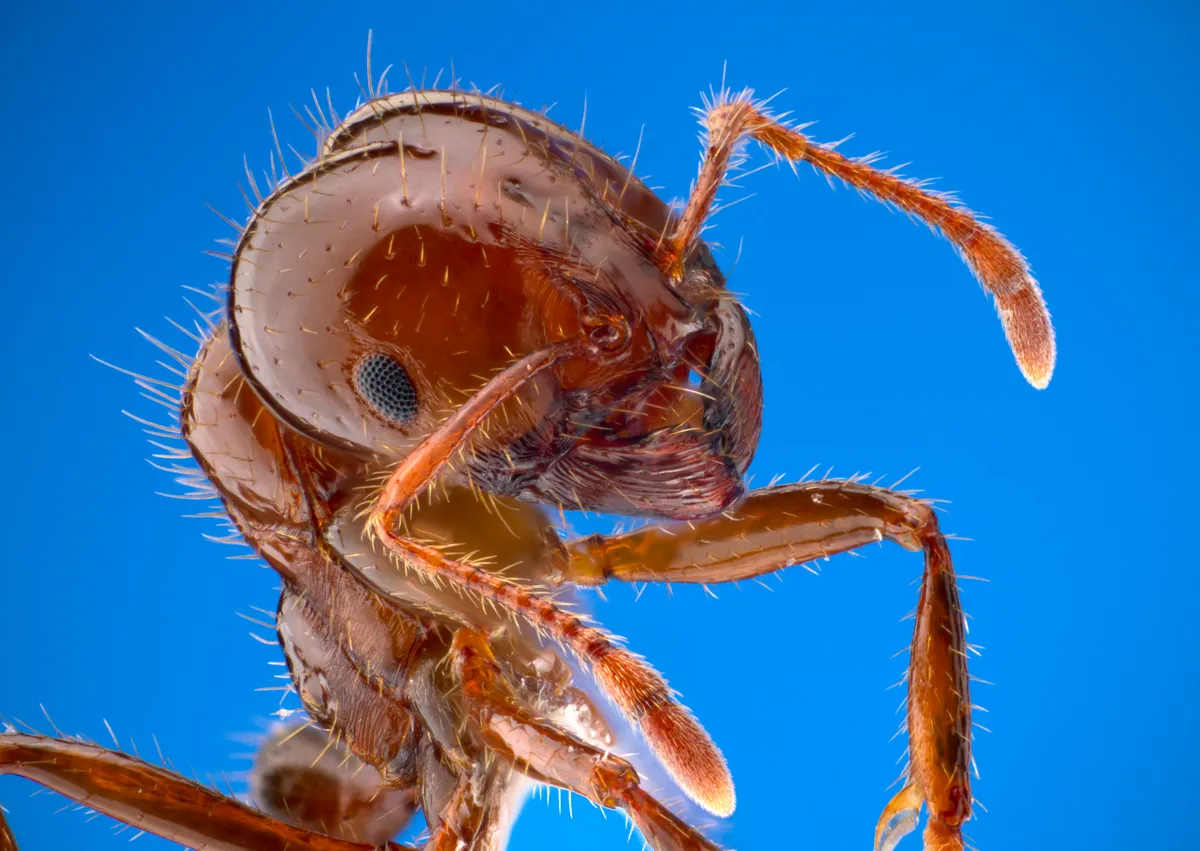 Fire antAn ant, 1/16 to 1/5 inch and dark reddish brown; stings when its mound is disturbed
Photos: Clover mite: PerAsperaAdInferos, CC BY-SA 4.0, via Wikimedia Commons, CC BY-SA 4.0. Spider mite: Gilles San Martin, CC BY-SA 2.0, via Wikimedia Commons, CC BY-SA 2.0. Chigger bites: CDC/ M.A. Parsons (CDC Public Health Image Library, phil.cdc.gov), public domain. Boxelder bug: no rights reserved, via iNaturalist, CC0 1.0. Bed bug nymph: no rights reserved, via iNaturalist, CC0 1.0. Fire ant: Insects Unlocked, CC0, via Wikimedia Commons, CC0 1.0.
How do you get rid of tiny red bugs in the house?
For clover mites, the usual tiny red bugs indoors, the extension sources put removal and sealing ahead of spraying.
- Vacuum or wipe, don't crush. Minnesota advises vacuuming clover mites or wiping them up with a moist cloth without crushing them; Penn State says a strong vacuum also keeps them from staining surfaces.
- Skip indoor sprays. Penn State says chemical treatment inside the home is not necessary; the mites will not reproduce indoors and soon die off.
- Seal the way in. SDSU suggests caulking cracks and crevices around doors and windows.
- Leave a bare strip. Minnesota recommends clean, bare soil about 18 to 24 inches wide along the foundation, free of grass and leaves, with plants spaced so the mites cannot cross, and says landscape rock is not enough. Penn State says a grass-free band 6 to 24 inches wide deters invasions.
- Large numbers. Minnesota describes treating the foundation outdoors or having a professional treat the outside of the house; use any pesticide only as its label directs.
- The other red bugs. Concrete mites need no control unless they get indoors, the NIEHS writers say, and velvet mites are harmless. For bed bugs, see the step-by-step bed bug plan; for spider mites, the spider mite guide.
Frequently Asked Questions
Are red clover mites harmful?+
Not to people, pets or the house. University of Minnesota Extension says clover mites feed on grass and other plants and do not bite humans or animals, and that they do not damage a house or its furnishings. SDSU Extension calls them harmless to humans, a nuisance pest that causes no structural damage. The one real harm is a stain: crushed clover mites leave rusty or blood-red spots, which is why Minnesota advises vacuuming them or wiping them up with a moist cloth instead.
What attracts red clover mites to a house?+
Sun, lawns and shelter. SDSU Extension says clover mites are most common in thick, well-fertilized lawns, that dry conditions favor them, and that most sightings are around windows or on walls facing south or southwest, because they love the sun. University of Minnesota Extension says that in fall they sometimes gather on walls, windows and tree trunks looking for protected hiding places, and crawl into cracks around windows, foundations and siding. Minnesota adds that they generally do not cross a strip of bare soil 18 to 24 inches wide along the foundation.
Why do I suddenly have clover mites?+
Usually because of the season or a warm spell. Penn State Extension says the eggs that spent the winter hatch in early spring, around April 1 or when temperatures pass 45°F, that another generation usually follows in fall, and that spring is when they are the biggest nuisance. SDSU Extension says unseasonably warm weather can bring them out of their winter hiding places, and University of Minnesota Extension says they can show up on sunny days in winter. They come from the lawn and plants outside and do not breed indoors.
How do I get rid of tiny red mites in my house?+
If they are clover mites, remove them and close the gaps rather than spraying. University of Minnesota Extension advises vacuuming them or wiping them up with a moist cloth, taking care not to crush them, and Penn State Extension says a strong vacuum also keeps them from staining surfaces and that chemical treatment indoors is not necessary. SDSU Extension suggests caulking cracks around doors and windows, and Minnesota recommends a strip of bare soil 18 to 24 inches wide along the foundation, free of grass and leaves.
What kills clover mites instantly?+
Nothing needs to. The extension sources do not rely on a quick kill indoors: Penn State Extension says clover mites will not reproduce in a house and die off on their own, that chemical treatment inside is not necessary, and that a strong vacuum removes them without staining. University of Minnesota Extension adds wiping them up with a moist cloth. For large numbers, Minnesota describes an outdoor treatment of the foundation or a professional, and any pesticide must be used only as its label directs.
Can red mites infest your home?+
Clover mites cannot: Penn State Extension says they will not reproduce indoors and soon die, and Ohio State says concrete mites invading buildings seems rare in Ohio. Bird mites are different. The University of Kentucky says bird mites live on birds and in their nests and can bite people, though they cannot reproduce on them, and that the red-to-black chicken mite readily bites at night. Young bed bugs, which University of Minnesota Extension says are nearly colorless until they feed, are worth ruling out if you are being bitten in bed.
What are the tiny red bugs that bite?+
Usually chiggers, which you seldom see. Cleveland Clinic says chigger larvae are yellow or orange and almost invisible, picked up in grassy or wooded areas, and feed where clothing fits closely, such as waistbands and sock lines; symptoms can take up to three hours to start. The University of Kentucky says the bright red adult chiggers are not parasites. Indoors, bites at night can come from young bed bugs, which turn red after feeding, or from bird mites such as the chicken mite, which Kentucky says readily bites at night.
What are the tiny red bugs in my bed?+
Check first for young bed bugs. University of Minnesota Extension says newly hatched bed bugs are about 1/16 inch long and nearly colorless except after feeding, and that newly emerged nymphs seek a blood meal, so a tiny red bug in bed may be one that just fed. Minnesota says bed bugs are active at night and hide by day, so look along mattress seams, box springs and bed frames. Clover mites that wander in from a sunny window do not bite, and the University of Kentucky says bird mites can bite at night.
Why are there tiny red bugs on my concrete patio?+
In spring they are often concrete mites. Ohio State University Extension says these tiny, fast-moving bright red mites gather on sunny patios, sidewalks, retaining walls and picnic tables each spring, eat other mites, small insects and pollen, and stain clothing when someone sits on them; the gatherings are short-lived. Writers for the National Institute of Environmental Health Sciences found them only on masonry, from April to May, and saw no need for control unless they invade the home. Clover mites use concrete too: Penn State says their eggs spend the winter in sidewalk cracks.
What are the tiny red bugs in my bathroom?+
Often clover mites that came in around a window. University of Minnesota Extension says clover mites crawl into cracks around windows and foundation walls and turn up indoors on windowsills, walls and tables, mostly on the sunny side of the house, so a bathroom with a sunny window can get them like any other room. Penn State Extension says they will not reproduce indoors and soon die. Vacuum them up or wipe them with a moist cloth, as Minnesota advises, rather than crushing them, which leaves rusty or blood-red spots.
Sources
- Clover mites (reviewed 2024) — University of Minnesota Extension
- Clover Mites (Steve Jacobs, updated January 19, 2026) — Penn State Extension
- What Are Those Little Red Mites on My House? (Patrick Wagner and others, updated December 17, 2020) — SDSU Extension, South Dakota State University
- Concrete Mites Are Out: Look Before You Sit! (Joe Boggs, May 29, 2020) — Ohio State University Extension, Buckeye Yard and Garden onLine (BYGL)
- They Seem to Be Everywhere, What Mite They Be? (Bill Willis and John McLamb, July 3, 2018) — National Institute of Environmental Health Sciences, NIEHS Kids' Pages
- True Velvet Mites (Red Velvet Mites) (Field Guide, reviewed December 31, 2024) — Missouri Department of Conservation
- Pest Notes: Spider Mites (UC ANR Publication 7405) — University of California Statewide IPM Program
- Pest Notes: Aphids (UC ANR Publication 7404) — University of California Statewide IPM Program
- Mites (last updated July 21, 2026) — National Pesticide Information Center (Oregon State University and U.S. EPA)
- Boxelder bugs (Jeffrey Hahn and Mark Ascerno, reviewed 2023) — University of Minnesota Extension
- Boxelder Bugs (Fact Sheet 5.522; F.B. Peairs, reviewed August 2025) — Colorado State University Extension
- Wheel Bug (Field Guide) — Missouri Department of Conservation
- Parasitic Mites of Humans (ENTFACT-637; A. Lopina, Z. DeVries and H. Tiffin, revised May 2026) — University of Kentucky Department of Entomology
- Chigger Bites (last updated June 7, 2022) — Cleveland Clinic
- Pest Notes: Red Imported Fire Ant (UC ANR Publication 7487) — University of California Statewide IPM Program
- Insects and Scorpions at Work (reviewed September 28, 2026) — Centers for Disease Control and Prevention, NIOSH
- Velvet Ants (Field Guide) — Missouri Department of Conservation
- Bed bugs (Jeffrey Hahn and Stephen Kells, reviewed 2023) — University of Minnesota Extension
How this guide was made: it was researched and drafted with AI assistance from the sources listed above. A second, independent AI pass then checked each factual claim against those sources. Found an error? Email support@buzzskito.ca.