
Reviewed by Alex Francisco
Published November 23, 2026 · Fact-checked against the sources listed below
What are the red and black bugs on my house?
Red and black bugs gathering on siding, window frames and sunny walls in fall are most likely boxelder bugs. Colorado State University Extension describes the adults as about 1/2 inch long and black, with three red lines on the thorax (the plate behind the head), a red line along each side and a diagonal red line on each wing; the young are wingless and bright red with some black.
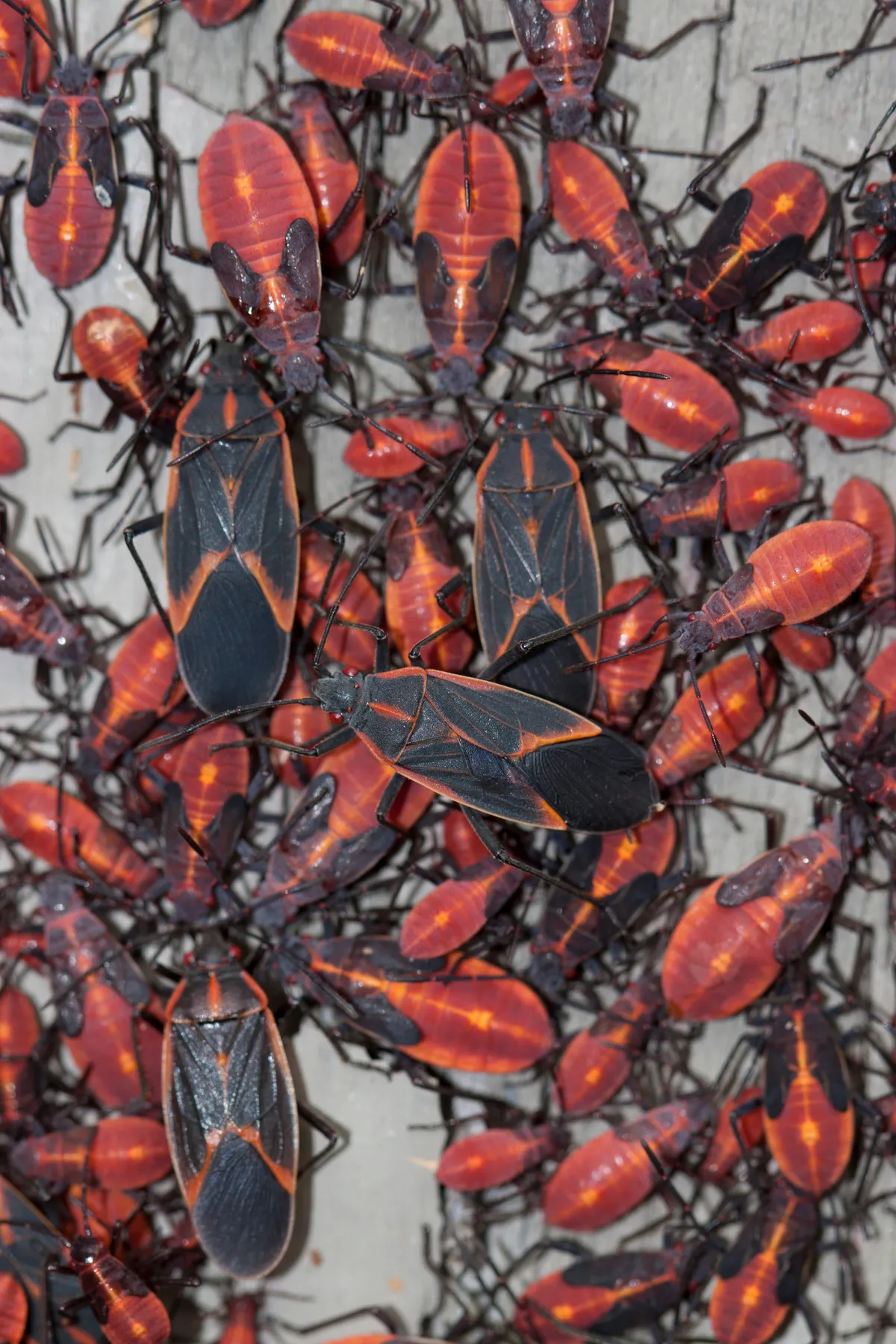
The timing gives them away. Penn State Extension's boxelder bug page says they gather in large numbers in fall on the sun-exposed south sides of trees, buildings and rocks, then squeeze into cracks to spend the winter, sometimes ending up in living areas. Colorado State adds that the overwintering adults crawl on the outside and the inside of the house on warm fall and winter days, which is why one turns up on a window in January.
Their favorite food is the seed pods of female boxelder trees, with maple seeds eaten occasionally, Colorado State says, and the bugs seldom build up to nuisance numbers unless a female boxelder tree is in the neighborhood. Penn State adds that the bugs cause no direct damage to the structure, its contents or the people inside, and that the ones spending the winter indoors do not reproduce there.
Do boxelder bugs bite, stain or smell?
Boxelder bugs are a nuisance rather than a danger. Colorado State says they have been reported to bite people only on rare occasions, may stain draperies and other light-colored surfaces, and give off an unpleasant odor when crushed, adding that the staining and odor are not major problems.
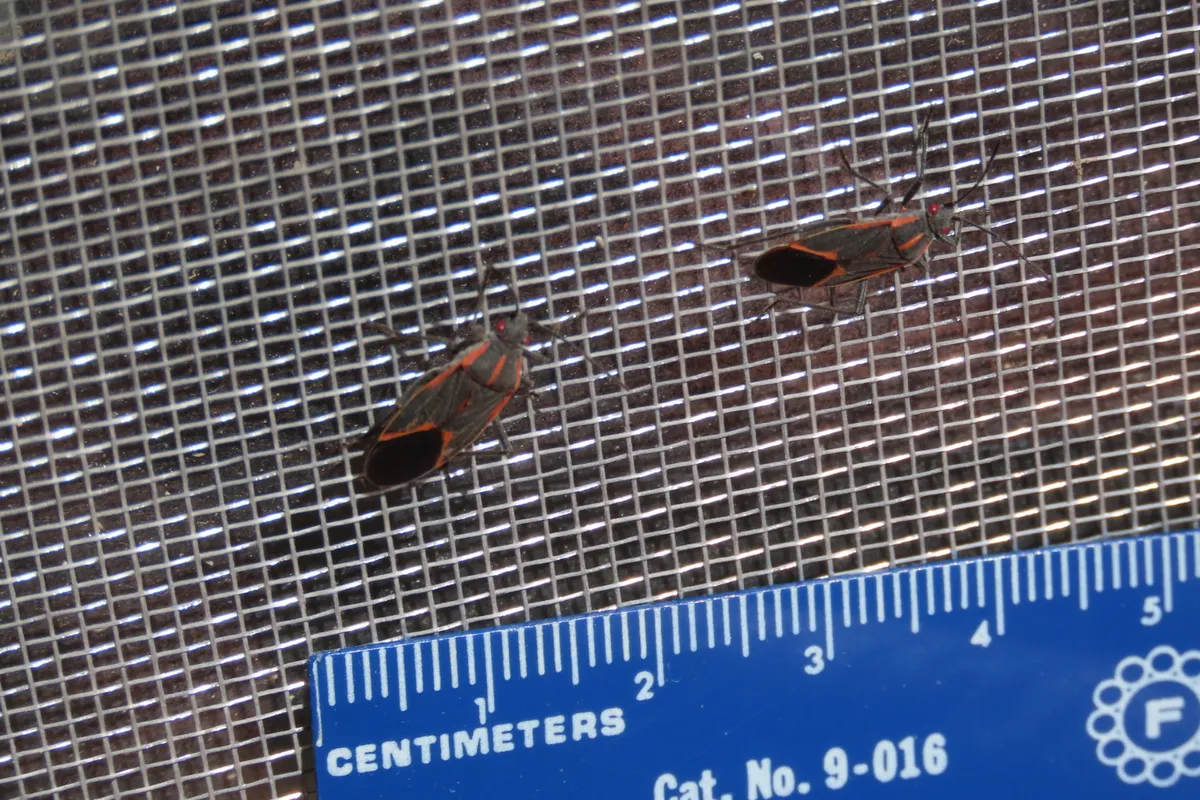
To keep them out, Penn State says sealing cracks and openings with silicone or silicone-latex caulk is the best prevention, along with repairing door and window screens, and it advises against using an insecticide indoors once the bugs are inside wall voids or attics, because carpet beetles may then feed on the dead bugs. Vacuum the ones that get in. How to get rid of boxelder bugs walks through the steps for US homes, and the Canadian edition of the boxelder bug guide covers the same pest north of the border.
Red-shouldered bugs: the boxelder bug's southern double
A bug that looks like a boxelder bug but has plain black wings with red only at the shoulders is likely the red-shouldered bug, also called the goldenrain tree bug or Jadera bug. UF/IFAS Extension's fact sheet gives the adults as about 1/3 to 1/2 inch long, mostly black or brownish-black, with reddish eyes, shoulders and abdomen borders, and says they are often confused with boxelder bugs. It records them from some southeastern states west to Texas and California, several central states and Hawaii, feeding on seeds that drop from goldenrain trees and other hosts, and notes that children playing on infested lawns can come home with clothes stained red from squashed bugs.
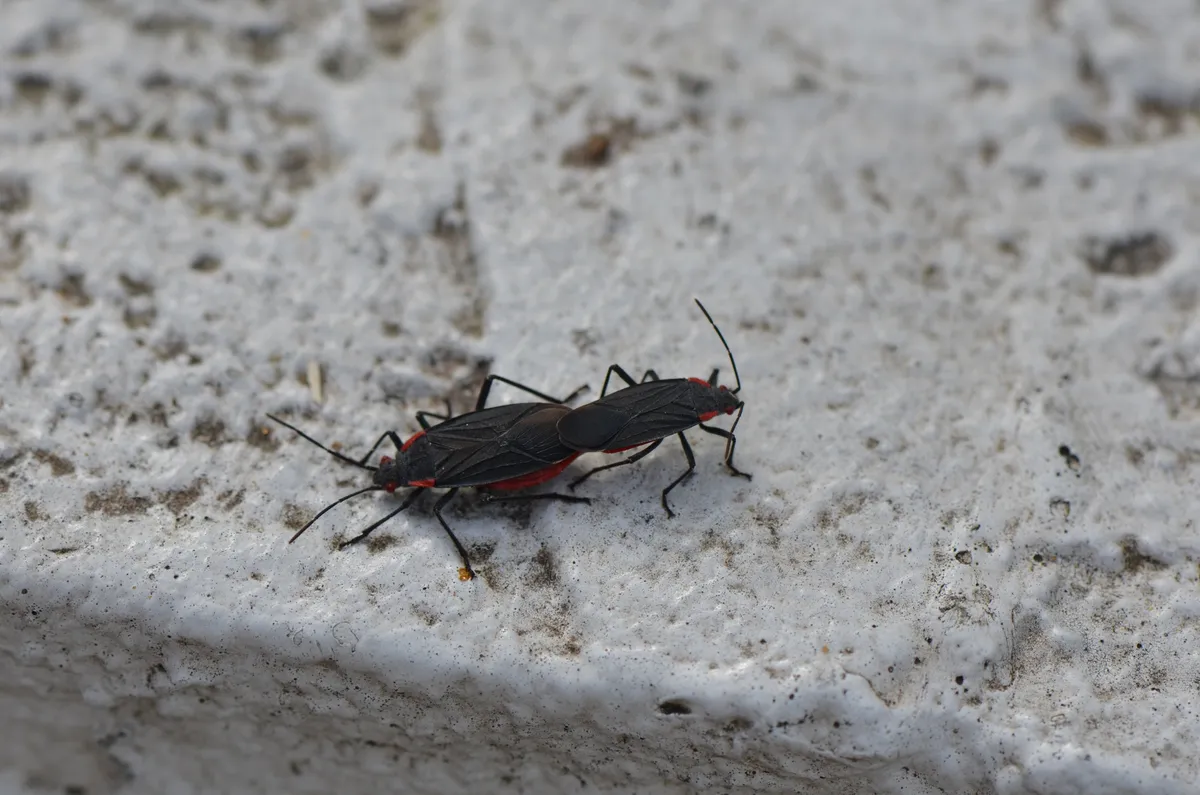
NC State Extension says the young are bright red with black legs and antennae, that the bugs feed on goldenrain tree and chinaberry, and that they become a fall nuisance when they come indoors to spend the winter. Crushed bugs leave a red stain, so NC State suggests vacuuming them gently and emptying the canister soon, before they start to smell.
Small red and black bugs inside the house
Indoors in winter, the usual red and black visitors are boxelder bugs and Asian lady beetles, both of which shelter in walls and attics. Penn State says that in colder areas such as Pennsylvania, Asian lady beetles gather on sunlit south and southwest walls around the beginning of October, on warm afternoons after cold nights, and that tens of thousands can collect in attics and wall voids. Most are red with black spots, but some are black with two, four or twelve orange to red spots, so a small, domed black beetle with red spots inside in winter may be one of these. The Asian lady beetle guide shows how to tell them from native ladybugs.
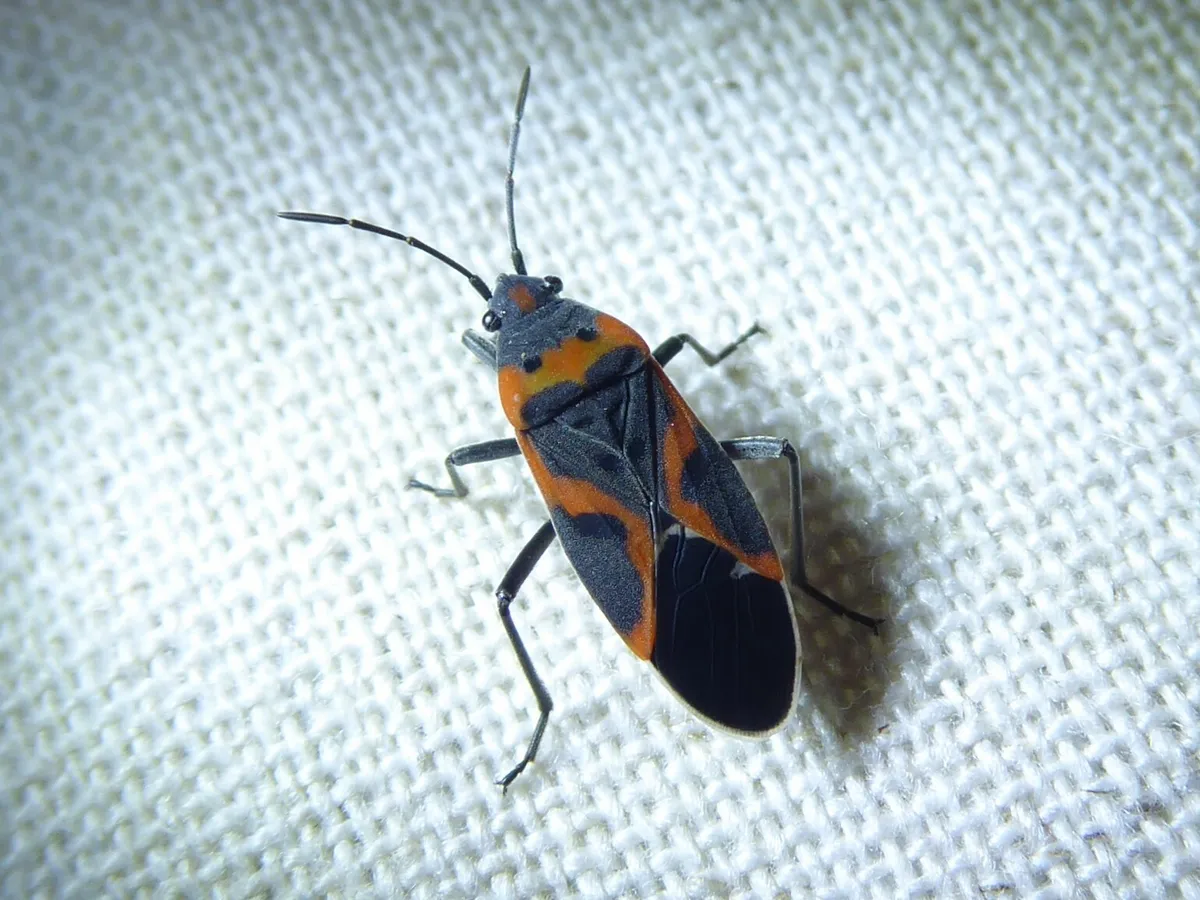
A small milkweed bug can also turn up inside: the observer of the one in the photo reported finding it indoors in December. If the bug in your house is tiny and all red rather than red and black, see the guide to tiny red bugs, which covers clover mites and the other specks, and the guide to bugs in the house in winter for the rest of the cold-season crowd.
Is it a boxelder bug or a kissing bug?
A boxelder bug and a kissing bug can both be black with red or orange stripes, but the stripes sit in different places and a kissing bug has a long, cone-shaped head. Texas A&M University's Kissing Bug program describes kissing bugs as having a cone-shaped head and thin antennae and legs, and as mainly black or very dark brown with red, orange or yellow stripes around the edge of the body. A boxelder bug's red lines run along the plate behind the head and the edges of the wings, and the bugs gather in large numbers on sunny trees and buildings in fall.
Boxelder bug or kissing bug? Check all four
- Where are the stripes? On a kissing bug, red, orange or yellow stripes run around the edge of the body, where the abdomen extends past the folded wings; on a boxelder bug, red lines run down the plate behind the head and along the wing edges.
- What shape is the head? A kissing bug's head is long and cone-shaped, with thin antennae and thin legs; Texas A&M lists these among the features that make kissing bugs easier to recognize.
- How big is it? CDC gives US kissing bugs as about 0.5 to 1.3 inches; a boxelder bug is about 1/2 inch.
- How many, and when? Boxelder bugs gather in large numbers on sunny walls in fall; kissing bugs, which feed on people and other mammals, are mostly active at dusk or at night.
The CDC says Chagas disease spreads to people mainly from the droppings of kissing bugs, and that the disease is present but not regularly spread by the bugs in the United States, where an estimated 280,000 people have it. The CDC's list of US kissing bug species profiles 11, most of them found in Texas and the Southwest and some in the Southeast, with one, Triatoma sanguisuga, reported in multiple states from Texas to Pennsylvania. Only a healthcare provider can diagnose Chagas disease, the CDC says, using lab tests on a small sample of blood.
The kissing bug look-alike guide compares kissing bugs with wheel bugs, seed bugs, stink bugs and boxelder bugs side by side, and the kissing bug bites guide covers what the bites look like.
What are the red and black bugs on my plants?
In a garden, the plant a red and black bug is sitting on usually names it: milkweed bugs on milkweed, harlequin bugs on cabbage-family crops, spittlebugs in the lawn and hollies, and lanternfly nymphs on tree of heaven and grapevines.
Milkweed bugs
The Missouri Department of Conservation (MDC) describes the large milkweed bug as 1/2 to 1 inch long and boldly orange and black, with an orange triangle, a wide black band and a second orange triangle across each forewing. It feeds on milkweeds and dogbanes, takes up toxins from the milkweed that can sicken predators, and in Missouri is seen from July until the first hard freeze. MDC calls it a nuisance rather than a pest of milkweed.
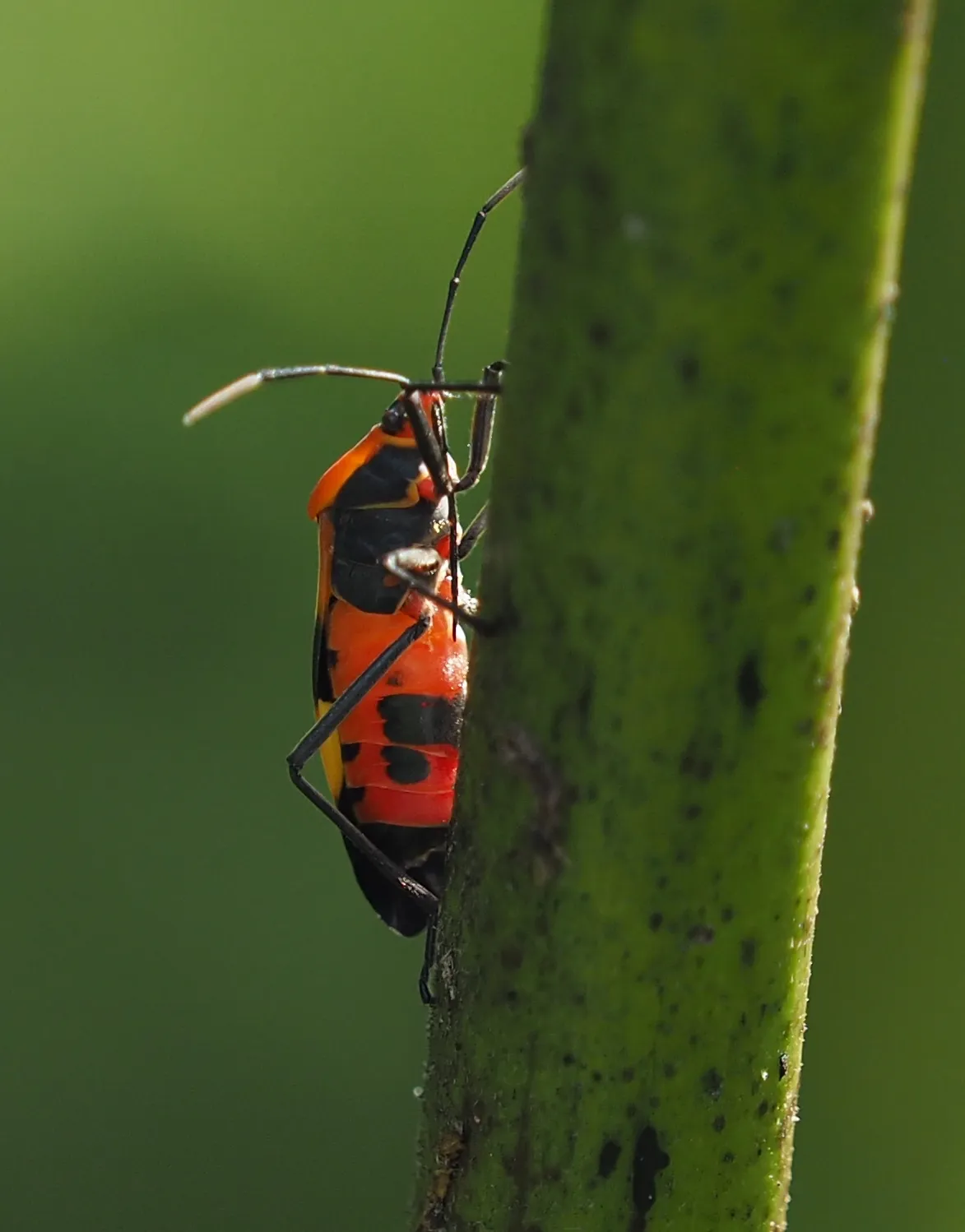
The small milkweed bug is about 1/2 inch long, with a reddish-orange X across the back and a reddish-orange band behind the head, MDC says. It eats nectar and milkweed seeds and also scavenges and preys on other small insects; adults spend the winter, and in Missouri they are seen from June until the first hard freezes in October.
Harlequin bugs on cabbage, kale and broccoli
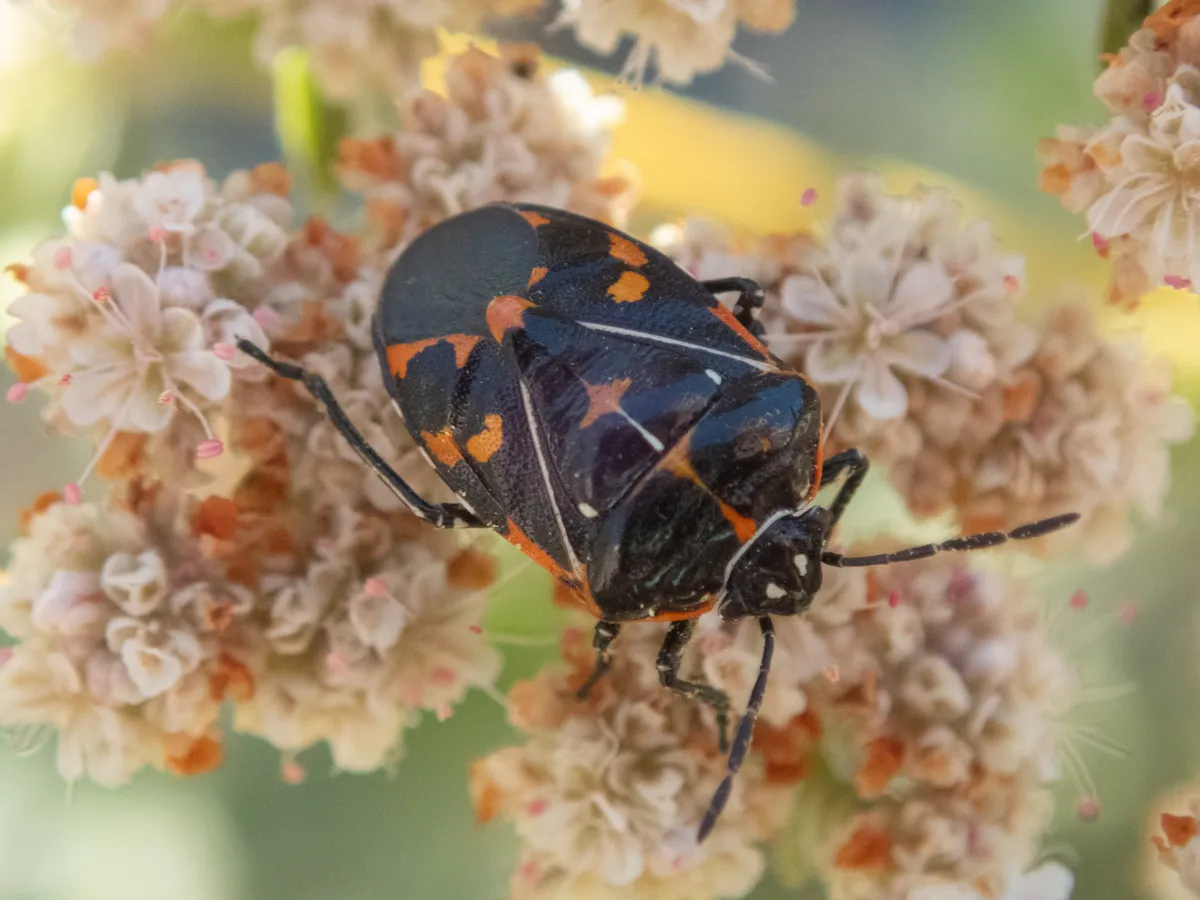
A shield-shaped black bug with bright red, yellow or orange markings on cabbage-family crops is the harlequin bug, a stink bug that UC IPM gives as 3/8 inch long. It sucks fluids from plant tissue, leaving yellow or white blotches on the leaves, and heavy infestations can make plants wilt, brown and die. In California, adults spend the winter under leaves on the ground and become active in March or April; UC IPM suggests handpicking the bugs and their drum-shaped eggs and destroying old cole crop plants (the cabbage family) and weedy mustards, which give the bugs places to breed.
Two-lined spittlebugs in the lawn
A dark, wedge-shaped insect about 3/8 inch long with two red or orange lines across the wings and red eyes and legs is the two-lined spittlebug, according to Clemson's Home & Garden Information Center. Its young hide in white froth at the base of grasses, especially centipedegrass and St. Augustinegrass; the adults hide in hollies and other shrubs by day, may be drawn to lights at night and, in South Carolina, peak in August and September. Clemson describes them feeding on plant sap.
Spotted lanternfly nymphs
A red insect with white dots and black stripes, about 1/2 inch long, on tree of heaven, grapevines or other plants, is likely a spotted lanternfly in its fourth and last nymph stage. Penn State Extension's management guide says the first three nymph stages are black with white spots, the fourth is red, and in Pennsylvania the adults begin to appear in July; it also says the insect cannot bite or sting and feeds on plant sap through a tiny, straw-like mouthpart.
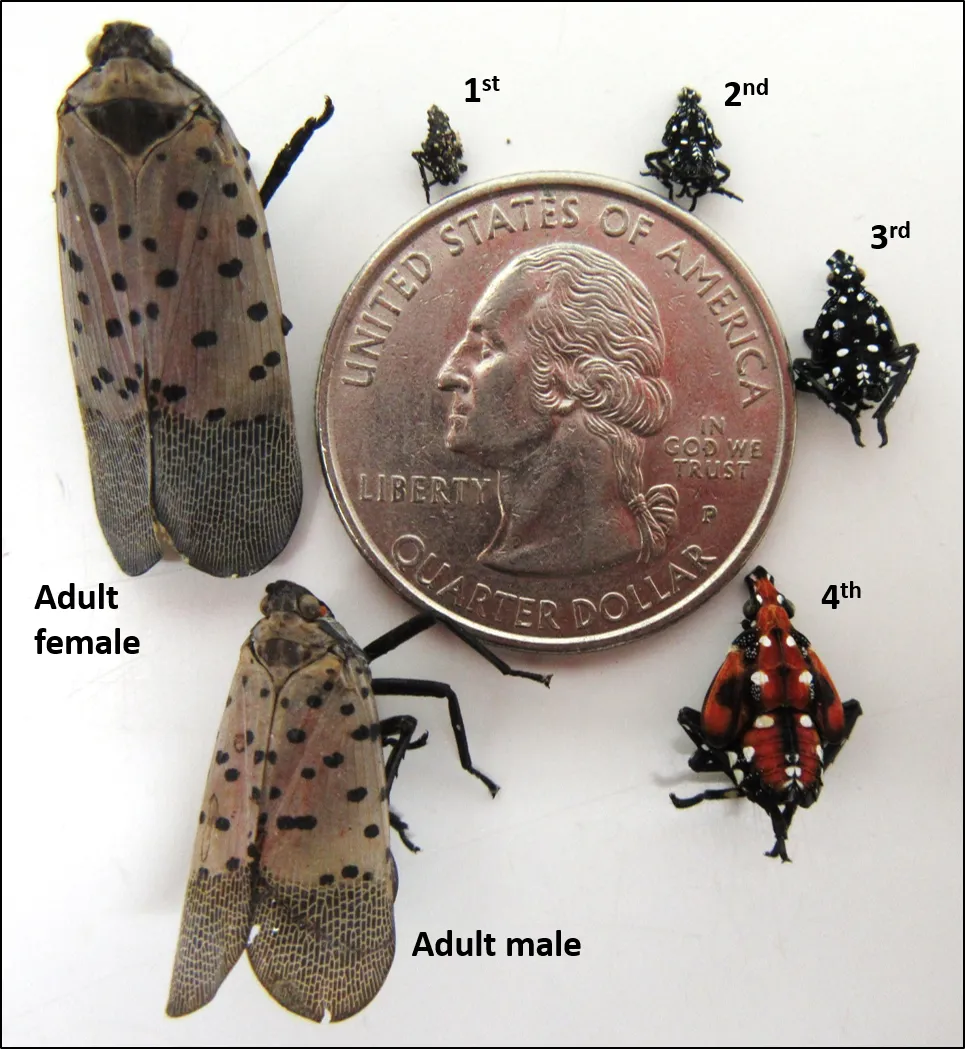
As of November 2026, the USDA's Animal and Plant Health Inspection Service (APHIS) lists 20 states and the District of Columbia with some degree of spotted lanternfly infestation and asks anyone who sees one to report it immediately: in those states through the contacts listed on its page, elsewhere to the state plant regulatory official or state plant health director. Penn State says a find in an area where the insect has not been found before should be reported to the state's agriculture authorities.
Firebugs and blister beetles
A red and black bug with black spots on short red wings, gathered in numbers on or around buildings, may be the red firebug. Utah State University Extension says this insect, native to central Europe, was first found in North America in Salt Lake City in 2008 and, as of its 2023 fact sheet, is established through much of Utah and southern Idaho. It gives adults as 1/4 to 1/2 inch long, feeding on the seeds of many plants, and says they cannot sting or bite but may stain carpets and fabrics when crushed.
Blister beetles are another group to know: MDC's blister beetle page says some species have red heads, legs or markings, that most are 1/2 to 3/4 inch long, and that the oily chemical they release when squeezed can blister skin. MDC adds that horses have died from eating hay with dead blister beetles in it.
Which red and black bugs bite or sting?
Of the red and black insects, the ones the sources warn against handling are assassin bugs, which can bite, and velvet ants, which sting; the black widow, a spider, is the red and black animal whose bite MDC calls serious. Boxelder bugs, milkweed bugs, harlequin bugs, spittlebugs and lanternflies feed on plants.
Assassin bugs
Assassin bugs hunt other insects, and Texas A&M AgriLife Extension says some of them, most notably the wheel bug, will bite if picked up and handled carelessly; the wheel bug's bite is immediately and intensely painful. The milkweed assassin bug, an orange and black hunter with long legs, lives in the Gulf Coast and South Atlantic states, southern California and southwestern Arizona, according to UF/IFAS Extension's milkweed assassin bug fact sheet. The fact sheet says it is not a threat to people, but that if it is not handled properly its bite can cause a burning sensation with swelling that may last for several days.
Texas A&M advises washing a bite and applying an antiseptic, says an oral pain reliever may help, and says to seek medical attention immediately for any sign of a severe allergic reaction, such as swelling all over, hives or trouble breathing.
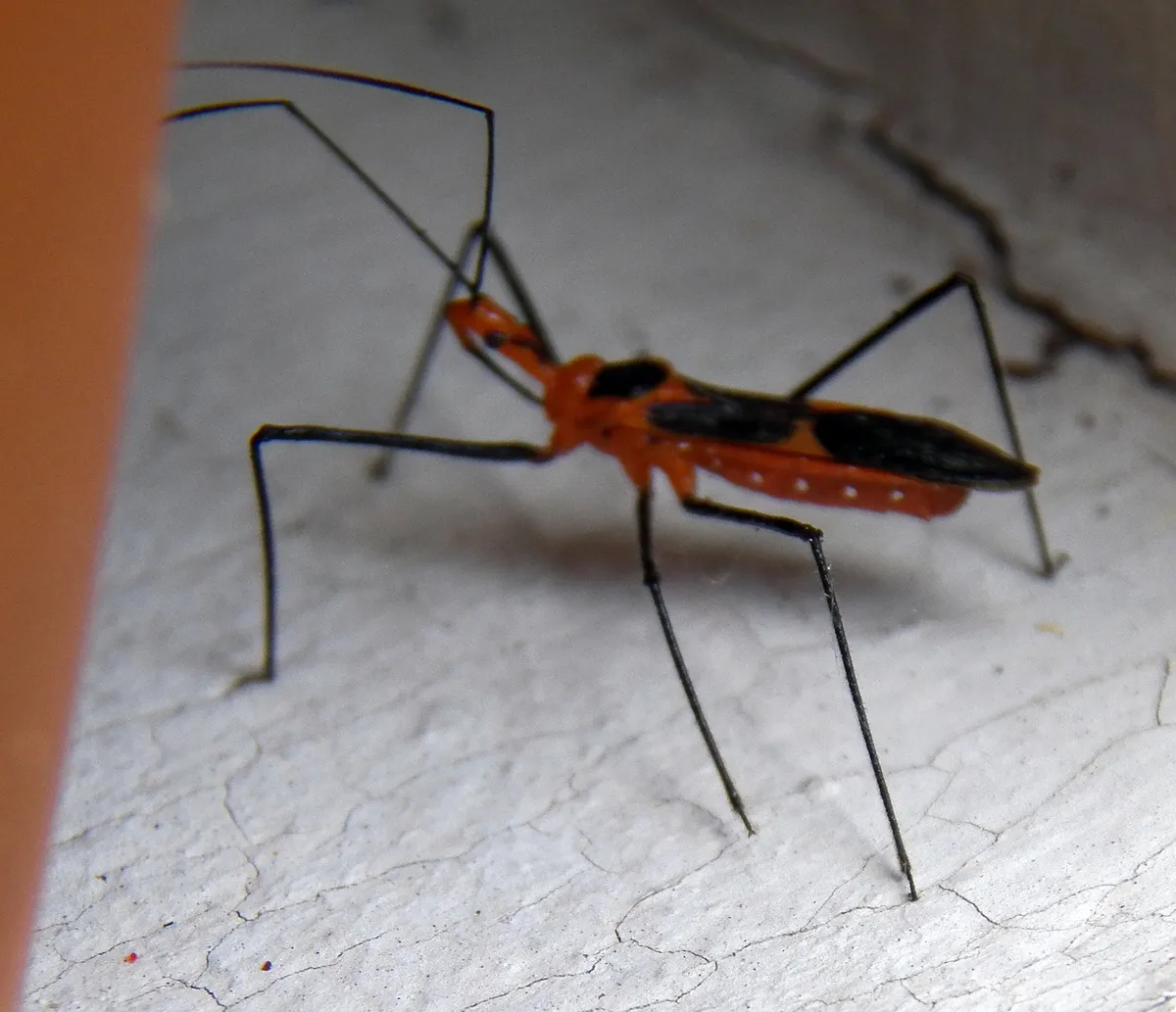
Texas A&M notes that the wheel bug's gray adults carry a cog-like crest that kissing bugs lack; the wheel bug guide shows each stage, including the red and black young.
Velvet ants
A fuzzy red and black ant-like insect running across a sunny lawn or sandy ground is a velvet ant, which is really a wasp. MDC's velvet ant page describes velvet ants as 1/2 to 1 1/4 inches long, usually brightly colored, often red or orange, with blackish legs; the females never grow wings, while the males have wings. MDC says they are not aggressive but will sting if held or stepped on barefoot, and that the long stinger delivers an excruciating sting, the source of the nickname cow killer. The velvet ant guide covers them in more detail.
The black widow, a red and black spider
If it has eight legs, a round, glossy black body and a red hourglass underneath, it is a female black widow. MDC's black widow page gives her body as up to about 3/8 inch long, not counting the legs; the southern black widow's hourglass is complete, while the northern black widow's is broken and usually comes with a row of red spots down the back. MDC says black widows are timid and bite when provoked, that the bites are serious, and that anyone bitten should seek medical attention immediately. The black widow identification guide and the black widow bite guide go further, and the spider identifier helps with other spiders.
What is a black bug with red stripes or red spots?
Pattern narrows the list once you know where you saw the bug. Match yours below, then read its section above.
| Pattern | Most likely | The one check |
|---|---|---|
| Red lines on a black back, in a crowd on a sunny wall | Boxelder bug | Three red lines behind the head and red wing edges; about 1/2 inch |
| Plain black wings, red shoulders | Red-shouldered bug | Red only at the shoulders, eyes and abdomen borders; under goldenrain or chinaberry trees |
| Red, orange or yellow stripes around the edge of the body | Possible kissing bug | Cone-shaped head and thin legs; do not touch with bare hands |
| Two red or orange stripes across dark wings | Two-lined spittlebug | Wedge-shaped, about 3/8 inch, in lawns or hollies |
| A reddish-orange X on black | Small milkweed bug | About 1/2 inch, on milkweed or flowers |
| Broad orange and black bands | Large milkweed bug | Up to 1 inch, on milkweed |
| Red with black spots, oval and domed | Lady beetle | A black W or patch on the white plate behind the head points to the Asian lady beetle, which gathers on houses in fall |
| Black with red spots, oval and domed | Possibly an Asian lady beetle, dark form | Two, four or twelve orange to red spots; indoors in fall and winter |
| Red with white dots and black stripes | Spotted lanternfly nymph | About 1/2 inch, on tree of heaven or grapevines; report it |
| Black shield with red, orange or yellow marks | Harlequin bug | 3/8 inch, on cabbage-family crops |
| Fuzzy red and black, wingless, on the ground | Velvet ant | Do not touch: a painful sting |
| Red hourglass under a glossy black body, eight legs | Black widow | A spider; seek medical attention immediately after a bite |
Compiled from the extension and government sources linked in the sections above.
For a bug that is black and yellow rather than black and red, such as a wasp, a bee or one of their mimics, see the black and yellow bug sorter. For black and white bugs, try the black and white bug guide.
How to identify a red and black bug in a jar
- Count the legs. Six legs means an insect; eight legs means a spider or one of its relatives, such as a mite.
- Measure it. Hold a ruler marked in inches beside the jar: many of these bugs are about 3/8 to 1/2 inch, while large milkweed bugs reach 1 inch and kissing bugs about 1.3 inches.
- Look at the head. A long, cone-shaped head with thin legs is the kissing bug warning sign.
- Find the red. Lines behind the head, bands across the wings, an X, spots, or stripes around the edge of the body each point to a different bug.
- Note where and when. A sunny wall in fall, milkweed in summer, cabbage crops or a lawn at dusk narrows it fast.
Commonly confused red and black look-alikes
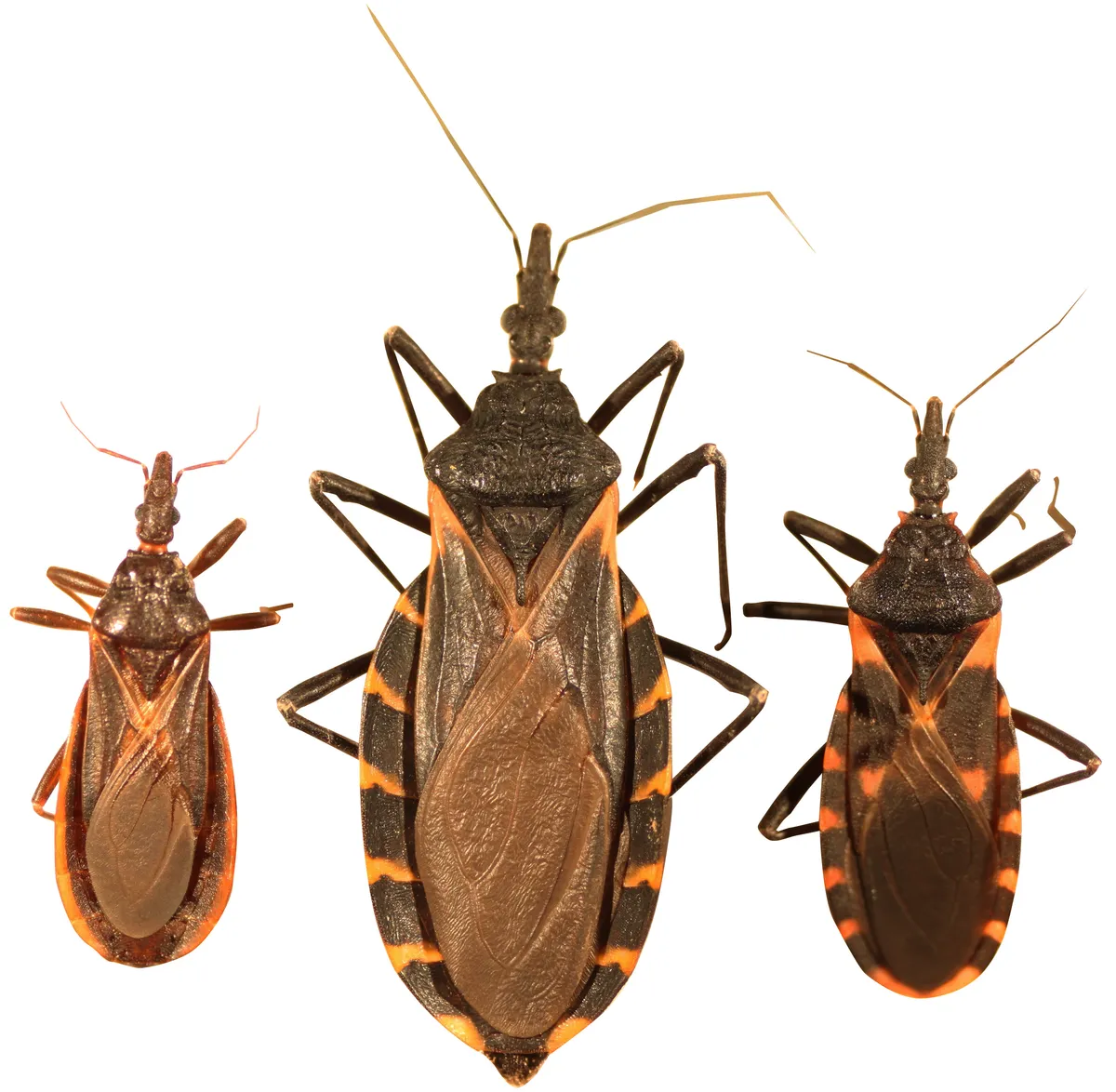 Kissing bugCone-shaped head, thin legs; red, orange or yellow edge stripes; never touch bare-handed
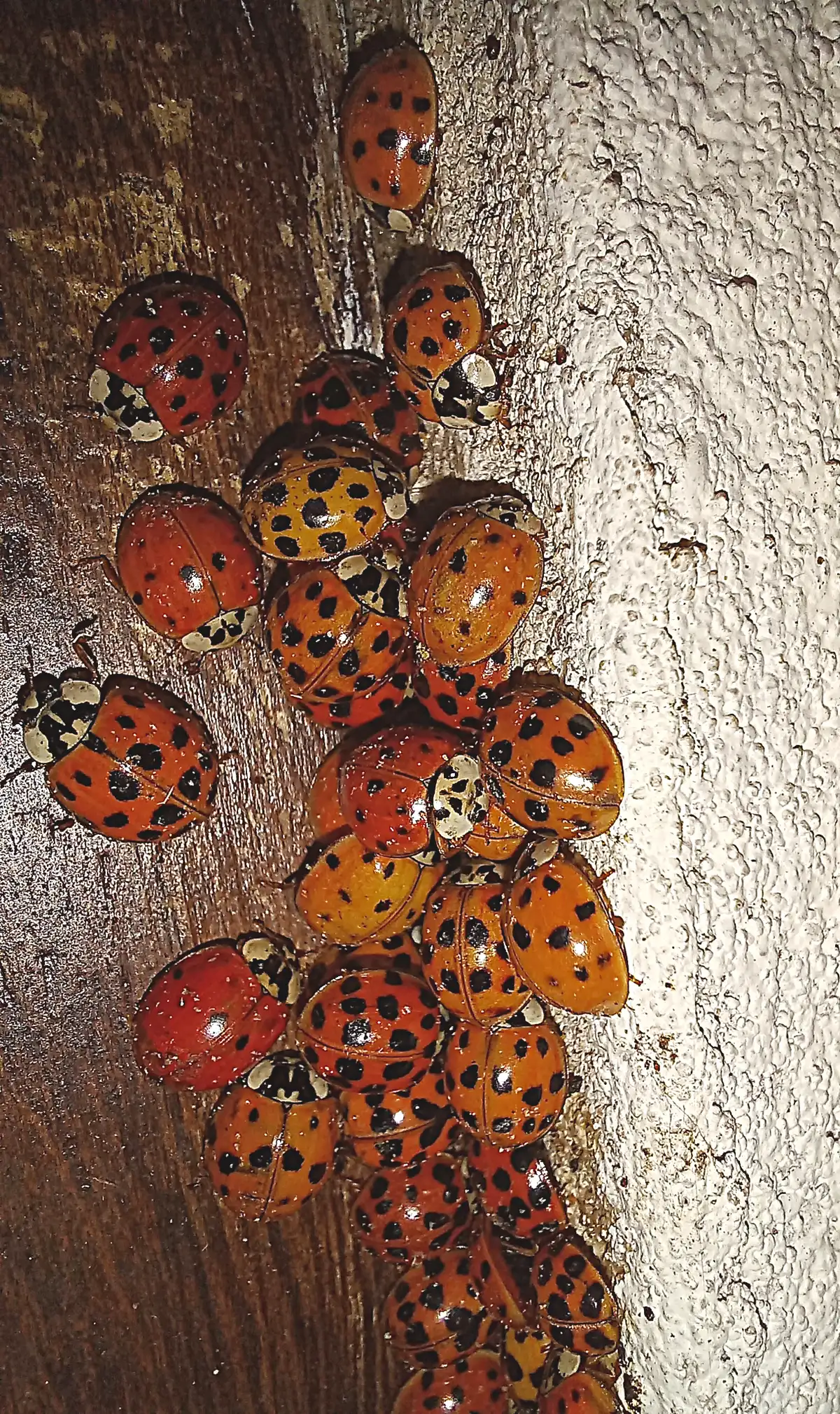 Asian lady beetleOval and domed, about 9/32 inch; red with black spots, black with red spots, or spotless
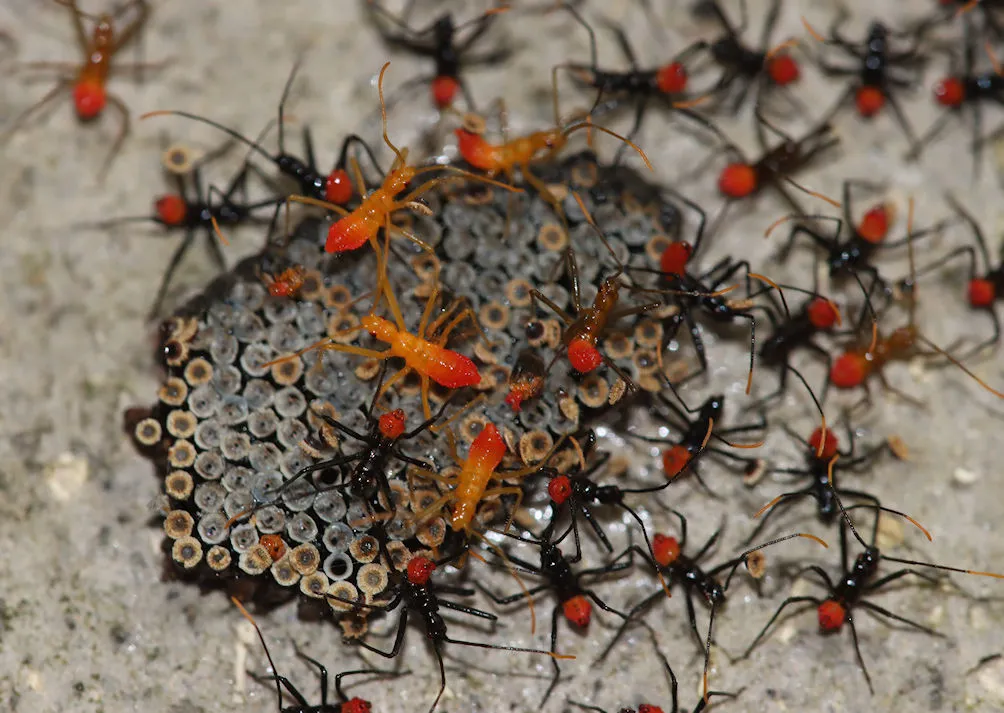 Wheel bug nymphsYoung are red and black; adults are gray with a cog-like crest; bites if handled
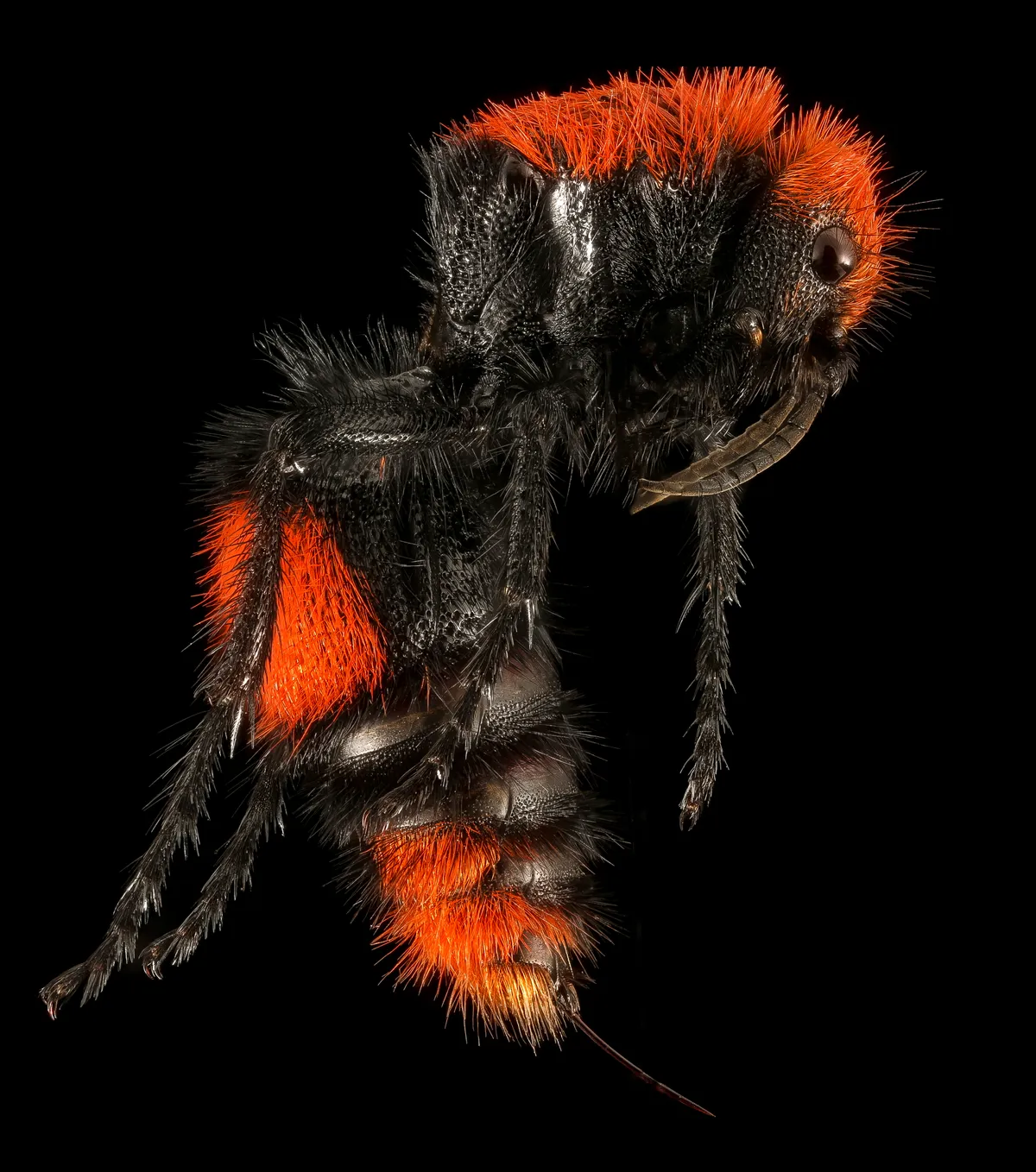 Velvet antA fuzzy wasp, bright red or orange and black; wingless females sting if handled
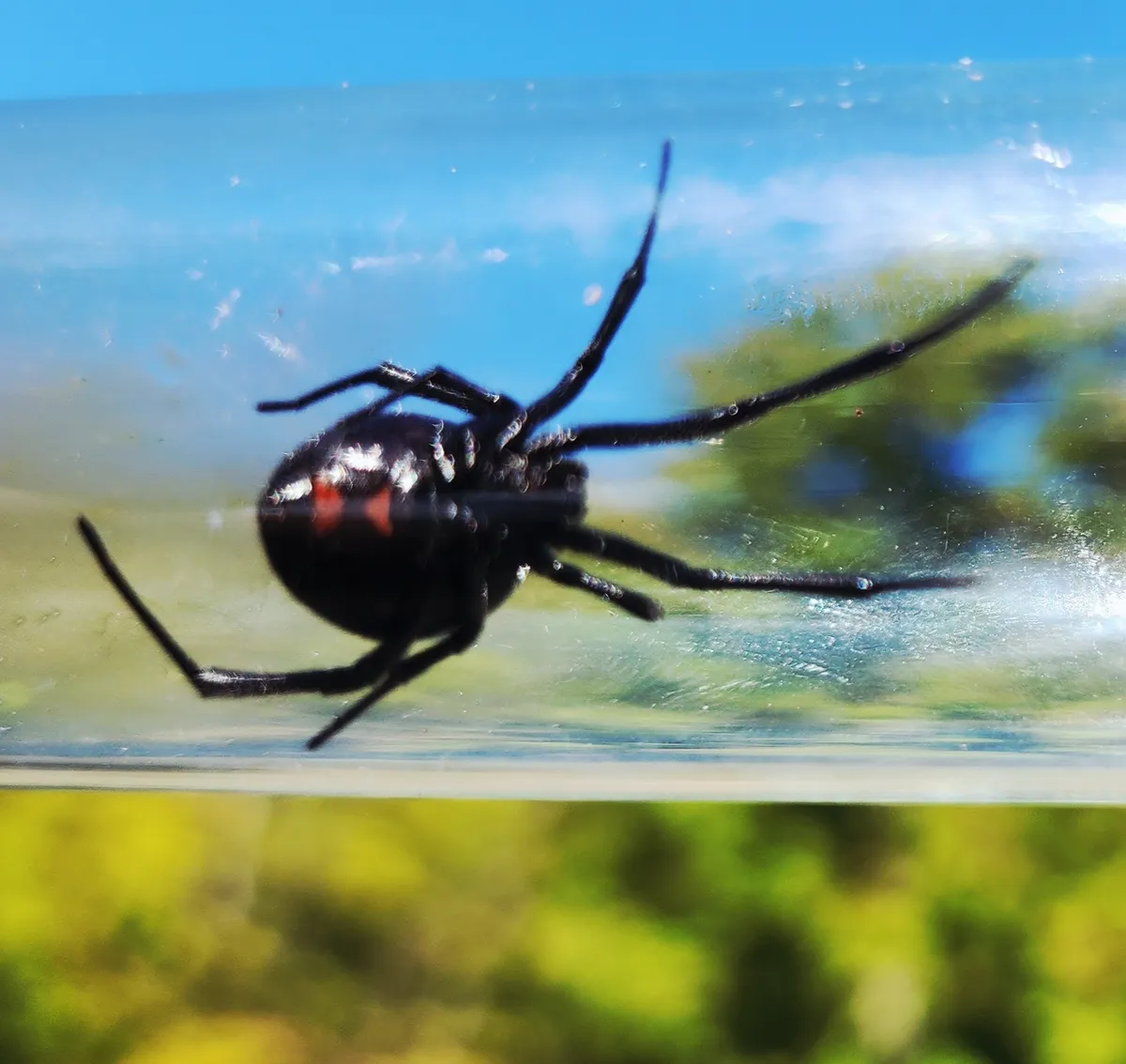 Black widowA spider: eight legs, glossy black, red hourglass or red spots
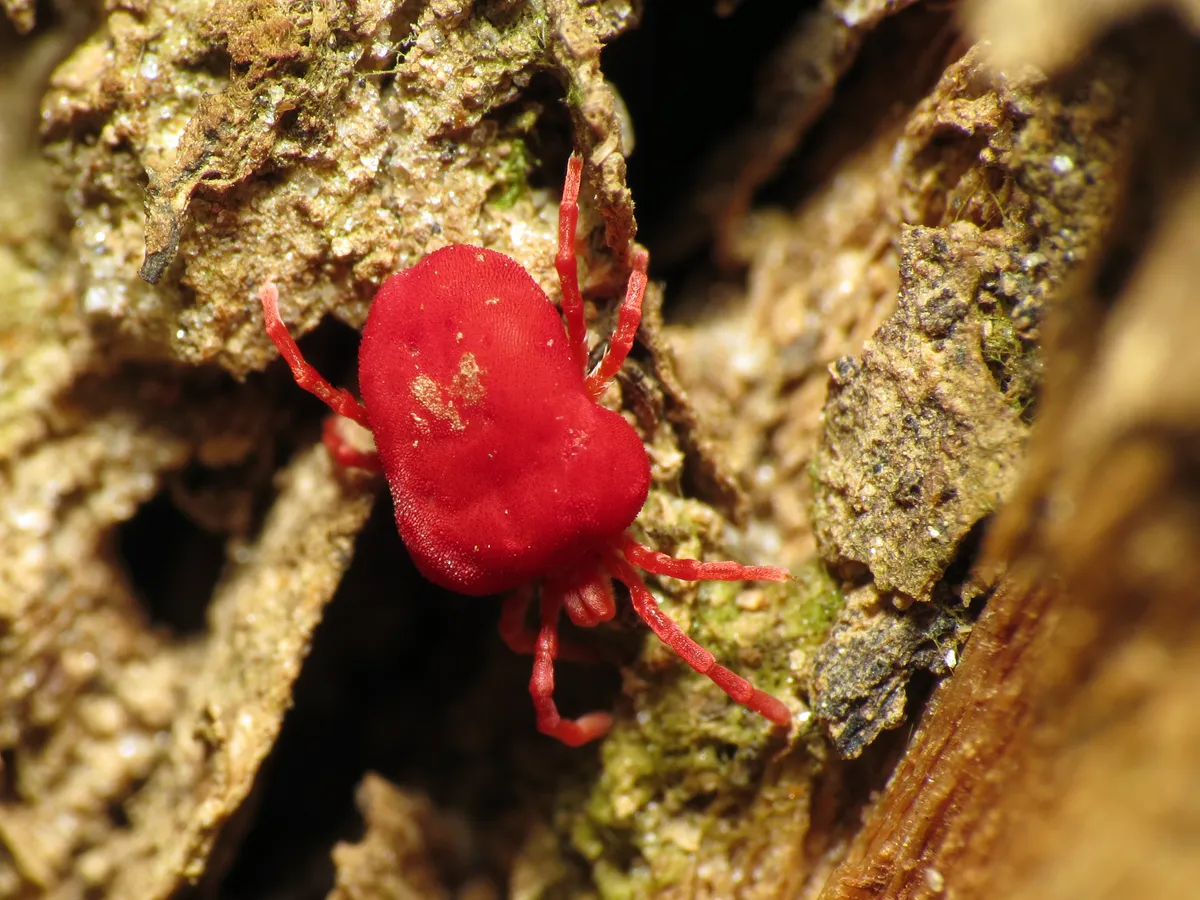 Red velvet miteTiny, plump and all red with no black pattern; see the tiny red bugs guide
Photos: Kissing bug: Curtis-Robles et al., CC BY 4.0, via Wikimedia Commons, CC BY 4.0. Asian lady beetle: Chinoaltubedenoia, CC BY-SA 4.0, via Wikimedia Commons, CC BY-SA 4.0. Wheel bug nymphs: (c) hr_dragonfly, some rights reserved (CC BY), via iNaturalist, CC BY 4.0. Velvet ant: USGS Bee Inventory and Monitoring Lab from Beltsville, Maryland, USA, Public domain, via Wikimedia Commons, public domain. Black widow: no rights reserved, via iNaturalist, CC0 1.0. Red velvet mite: Katja Schulz from Washington, D. C., USA, CC BY 2.0, via Wikimedia Commons, CC BY 2.0.
What should you do once you know what it is?
For most red and black bugs, the sources put sealing, vacuuming or simply leaving them alone ahead of any spray. What they advise for each:
- Boxelder and red-shouldered bugs. Seal cracks and repair screens before they gather in fall, and vacuum the ones indoors, as Penn State and NC State advise; how to get rid of boxelder bugs has the full plan.
- Asian lady beetles. Vacuum them, as Penn State advises: disturbed beetles give off a smelly yellow fluid that can spot walls. The Asian lady beetle guide covers sealing.
- Milkweed bugs. Leave them: MDC calls the large milkweed bug a nuisance rather than a pest of milkweed.
- Harlequin bugs. Handpick bugs and eggs and remove old cole crops and weedy mustards, as UC IPM suggests; it says insecticides are generally not recommended in gardens.
- Spotted lanternflies. Report a find, as APHIS and Penn State ask, especially where they have not been seen before.
- Assassin bugs and velvet ants. Leave them alone and do not pick them up; Texas A&M says assassin bugs are of great benefit to gardeners because they eat other insects.
- Suspected kissing bugs. Do not touch one with bare hands and try not to crush it; collect it with a glove or a small plastic bag and send a photo to Texas A&M's Kissing Bug program, which takes reports from across the United States.
- Black widows. Do not handle them, and get medical care right away after a bite.
The stink bug control guide covers sealing a house against stink bugs and boxelder bugs together.
This guide is general educational information, not medical advice. If you have symptoms or concerns after a bite or exposure, contact a healthcare provider.
Frequently Asked Questions
What are the little red and black bugs in my house?+
In fall and winter they are usually boxelder bugs, which Colorado State University Extension describes as about half an inch long and black with red lines, coming indoors to spend the winter and crawling around on warm days. The bright red ones with black legs are their young. A small, domed beetle that is red with black spots, or black with red spots, may be an Asian lady beetle, which also spends the winter in houses. Boxelder bugs do not breed indoors over the winter, and vacuuming them is the usual answer.
Do red and black boxelder bugs bite?+
Very rarely. Colorado State University Extension says boxelder bugs have been reported to bite people only on rare occasions, and Penn State Extension says they cause no direct damage to a house, its contents or the people in it. They feed on the seeds of boxelder and maple trees. The real problems are nuisance ones: they can stain light-colored curtains and surfaces and give off an unpleasant smell when crushed.
How do I tell a boxelder bug from a kissing bug?+
Look at the head and where the red is. A kissing bug has a cone-shaped head and thin legs, with red, orange or yellow stripes around the edge of its body, according to Texas A&M University's Kissing Bug program. A boxelder bug has red lines on the plate behind the head and along its wing edges, and it gathers in large numbers on sunny walls in fall. If you are unsure, do not touch it bare-handed; collect it with a glove or a small plastic bag and send a photo to an expert.
What is a black bug with red stripes?+
A boxelder bug fits that description: black, with three red lines behind the head and red edges on the wings. A wedge-shaped dark bug with two red or orange stripes across the wings, in a lawn or on hollies, is the two-lined spittlebug. Red, orange or yellow stripes around the edge of the body, with a cone-shaped head, are the warning signs of a kissing bug, which should not be handled with bare hands.
What is a black beetle with red spots?+
It may be a dark form of the Asian lady beetle. Penn State Extension says most of these beetles are red with black spots, but some have black wing covers with two, four or twelve orange to red spots. In Pennsylvania they gather on sunny house walls around the beginning of October and spend the winter in attics and wall voids, and they can occasionally bite and leave a smelly yellow stain when disturbed.
What red and black bug stings?+
The velvet ant. It looks like a large, fuzzy red and black ant, but it is a wasp, and the wingless females can sting. The Missouri Department of Conservation says velvet ants are not aggressive but will sting if held or stepped on barefoot, and calls the sting excruciating, the source of the popular name cow killer. Assassin bugs do not sting, but some will bite if picked up, and Texas A&M AgriLife Extension calls the wheel bug's bite intensely painful.
Are red and black bugs poisonous?+
It depends on the bug. Boxelder bugs cause no direct damage to a house or the people in it, Penn State Extension says, and spotted lanternflies cannot bite or sting. Milkweed bugs carry toxins from the milkweed they eat that can sicken predators, and blister beetles release an oily chemical that can blister skin when squeezed, according to the Missouri Department of Conservation. The ones to treat with care are assassin bugs and velvet ants, which can bite or sting when handled, kissing bugs, which can carry the Chagas parasite, and the black widow, a spider whose bite needs medical attention right away.
What is the red bug with white dots and black stripes?+
It is likely a spotted lanternfly in its fourth nymph stage. Penn State Extension says the first three nymph stages are black with white spots, the fourth is red with white dots and black stripes and about half an inch long, and in Pennsylvania adults begin to appear in July. The insect cannot bite or sting. USDA APHIS asks people to report finds right away, and Penn State stresses reporting in places where it has not been seen before.
Why are there so many boxelder bugs on my house?+
They are looking for a place to spend the winter. Penn State Extension says boxelder bugs gather in large numbers in fall on the sunny south sides of trees, buildings and rocks, then crawl into cracks and gaps. Homes near female boxelder trees see the most: Colorado State University Extension says the bugs seldom reach nuisance numbers unless one is in the neighborhood. Sealing gaps with caulk and repairing screens before they gather is the main prevention.
Do red and black bugs fly?+
Most adults do. Boxelder bugs, milkweed bugs, harlequin bugs, spittlebugs, assassin bugs and lady beetles all have wings as adults, while their young are wingless. The exceptions include female velvet ants, which never grow wings and run along the ground, and many red firebugs: Utah State University Extension says the short-winged form is the most common one in Utah. A bright red bug with black legs and no wings is often a young boxelder bug or red-shouldered bug.
Sources
- Boxelder Bugs (Fact Sheet 5.522) — Colorado State University Extension
- Boxelder Bug — Penn State Extension
- Red Shouldered Bug or Golden Rain Tree Bug — NC State Extension
- Scentless Plant Bugs, Jadera sp. (EENY-130) — UF/IFAS Extension, University of Florida
- Multicolored Asian Lady Beetle — Penn State Extension
- Found a Bug? — Texas A&M University, Kissing Bugs & Chagas Disease community science program
- About Chagas Disease — Centers for Disease Control and Prevention
- Triatomine Bugs in the United States — Centers for Disease Control and Prevention
- Large Milkweed Bug (Field Guide) — Missouri Department of Conservation
- Small Milkweed Bug (Field Guide) — Missouri Department of Conservation
- Harlequin Bug (Home and Landscape) — University of California Statewide IPM Program
- Two-Lined Spittlebug — Clemson Cooperative Extension, Home & Garden Information Center
- Spotted Lanternfly Management Guide — Penn State Extension
- Spotted Lanternfly — USDA Animal and Plant Health Inspection Service
- Red Firebug (Pyrrhocoris apterus) fact sheet — Utah State University Extension
- Blister Beetles (Field Guide) — Missouri Department of Conservation
- Wheel Bugs and Other Assassin Bugs (ENT-1003) — Texas A&M AgriLife Extension
- Milkweed Assassin Bug, Zelus longipes (EENY-489) — UF/IFAS Extension, University of Florida
- Velvet Ants (Field Guide) — Missouri Department of Conservation
- Black Widow Spiders (Field Guide) — Missouri Department of Conservation
Read and approved by Alex Francisco. Found an error? Email support@buzzskito.ca.