
BuzzSkito Mosquito & Tick Control Specialists · Published July 21, 2026
What Is Konk Bed Bug Killer, and Why Does It Stand Out in Canada?
Konk is a Canadian aerosol brand, and its bed bug products are contact insecticides you can buy legally off a shelf here — which, in the strange landscape of bed bug shopping, is genuinely its headline feature. Most reviews of a spray would open with how hard it hits. We are going to open somewhere more useful for a Canadian reader: Konk is PMRA-registered and made in Canada, and that single fact resolves a problem that trips up a huge number of people fighting bed bugs in this country. Spend an hour in any bed bug forum and you will be steered toward American concentrates — Crossfire, Temprid FX, and their cousins — that are not registered for consumer sale in Canada and are illegal to import. Konk is the product that lets you skip that entire minefield and buy something registered, labelled, and lawful.
As an insecticide, Konk is a pyrethrin/pyrethroid-based contact aerosol: fast chemistry that knocks down the bugs it directly wets. That is a real capability and it is worth having. But it is also chemistry the whole category shares, and the whole category shares its ceiling — which is exactly why the rest of this review spends as much time on where Konk stops as on what it does. An honest review of a bed bug spray is mostly a review of expectations.
This review sits alongside our broader Canadian bed bug control hub and our pest control equipment guide; here we focus on one registered can and exactly what it is and is not good for.
Check current Canadian availability:
What Konk Does Well: Legal, Available, Fast on Contact
Give Konk credit for the things it actually delivers, because they matter. First, contact knockdown: if you can see a bed bug and spray it directly, Konk kills it quickly. For the person who lifts a mattress corner, spots a cluster, and wants them dead now, a fast contact aerosol is the right tool and Konk performs. Second, availability: it is stocked through Canadian retail and hardware channels, so you are not waiting on a cross-border shipment while bugs multiply. Third — and this is the one that separates it from half the internet’s advice — it is registered. You are buying a product whose label and safety directions were reviewed by Health Canada’s PMRA, which means when you follow the label you are on solid, legal, reviewed ground.
That legality is not a small thing dressed up to fill a review. Importing an unregistered pesticide breaches the Pest Control Products Act, and the products Canadians are most often told to smuggle lean on the very pyrethroid chemistry resistant bed bugs already survive — so the legal risk frequently buys no extra performance. Konk lets you have the legal, labelled option and spend your energy on technique and the wider plan instead of on border roulette.
Where Konk Hits the Wall: Resistance, Eggs, and Reach
Now the honest part, and it applies to nearly every consumer bed bug spray, not just this one. Konk has three structural limits you need to plan around rather than be surprised by.
- Pyrethroid resistance. Bed bug populations across North America have evolved widespread resistance to pyrethroid chemistry. A direct hit at close range still overwhelms many bugs, but the ones you do not wet head-on — the ones that merely cross a treated surface later — are far less reliably killed than the label optimism suggests.
- Eggs survive. Bed bug eggs are cemented into seams under a tough coating, and a contact aerosol neither penetrates that coating well nor reaches most of the eggs in the first place. A mattress you have sprayed can still be studded with viable eggs waiting to hatch.
- Reach and residual. A surface spray coats surfaces. It does not travel into the bolt holes, deep frame joints, and wall voids where an infestation actually shelters, and its residual fades over days — so bugs emerging later from untreated harbourage walk out into a home that is no longer hostile to them.
Put those three together and you get the phenomenon behind every “bed bug sprays don’t work” complaint: someone sprays the visible bugs, the population appears to drop, and two weeks later it rebounds from eggs and survivors the can never touched. The spray did not fail at its job — it was asked to do four other jobs it was never built for. Our companion piece on whether bed bug sprays actually work unpacks this dynamic in full.
How to Use Konk Correctly
Because Konk is a registered pesticide, the label is not fine print — it is the reviewed set of directions that make the product safe and legal to use, and it tells you where you may and may not apply it. Read it before you spray. With that established, the technique that gets the most out of a contact aerosol looks like this:
- Strip and expose first. Pull bedding, tip the mattress, and get eyes on the harbourage so you can spray bugs directly rather than blindly misting fabric.
- Hit visible bugs head-on. Direct contact is where the aerosol is strongest — spray clusters and individuals you can see for immediate knockdown.
- Treat harbourage and travel routes. Bed-frame joints and bolt holes, the box-spring staple line and fabric edge, cracks in the headboard, baseboard gaps, and the wall-floor junction around the bed — within what the label permits.
- Respect the label on sleeping surfaces. Do not saturate the mattress top you sleep on or spray bedding you lie against beyond exactly what the label authorizes.
- Ventilate and keep others out. People, pets, and especially fish and cats stay out of the room until surfaces dry and the air clears.
- Repeat on schedule. One pass never reaches everything; follow the label’s re-treatment interval, and expect to spray again as eggs hatch.
None of this makes a spray reach the eggs or the deep voids — it simply makes the contact tool as effective as a contact tool can be. For the jobs it cannot do, you bring other tools.
How to Choose: Which Spray, and When a Spray Is the Wrong Buy
Bed bug sprays cost real money by the time you have bought the several cans an infestation demands, so it is worth being clear-eyed about which product to pick and, more importantly, when a spray should not be your main purchase at all. Sort your decision this way:
- If your priority is a legal, in-store Canadian product — pick Konk. Its registration and availability are exactly what you are paying the shelf price for, and its contact performance is solid. This is the case where Konk is genuinely the right answer.
- If you want to avoid synthetic pyrethroids — consider a plant-oil spray. A botanical option like EcoRaider trades some residual and price for chemistry some households prefer; check the Canadian listing.
- If you need lasting protection in the cracks and voids — buy a dust, not a spray. A desiccant like CimeXa or diatomaceous earth is resistance-proof and lasts for months to years, doing the durable work no aerosol can.
- If the eggs are the problem — buy heat. A steamer or heat chamber kills eggs a spray leaves untouched.
- If the infestation is established or spreading — no single consumer product is the buy. That is a layered-plan or professional situation, and pouring money into cans of any spray is how people spend the most for the least.
The recurring mistake is treating a spray as the whole solution because it is the cheapest, most familiar-looking option on the shelf. A can of Konk is a good component. As a standalone strategy against anything beyond a trivial, caught-immediately problem, it is a slow way to lose the fight and your money at the same time.
Where Konk Fits in a Real Bed Bug Plan
No spray clears an established infestation alone, and Konk is honest company in a layered plan rather than a substitute for one. Think of it as the knockdown-and-spot layer, with the other layers covering the jobs it structurally cannot:
- Knock down and spot-treat — Konk’s job. Kill the visible bugs on contact and treat harbourage surfaces as you work.
- Heat for the eggs. A steamer reaches into seams and folds and kills the eggs no spray reliably touches, and a heater or heat chamber sterilizes belongings.
- Dust the voids. A desiccant like CimeXa or bed bug powder is the resistance-proof, long-lasting barrier in cracks and travel routes the spray cannot coat.
- Seal the mattress. A zippered encasement traps anything inside and removes the seams bugs love.
- Monitor with interceptors. Interceptor cups under the bed legs catch travellers and show you, week over week, whether the numbers are actually falling.
- Remove the visible population. A sealed-HEPA vacuum physically lifts adults and nymphs before you spray, dust, and steam.
For anything beyond a caught-early, localized problem — a spreading infestation in an apartment, or bugs established in furniture and walls — a professional treatment is the honest answer. Our guides on how to get rid of bed bugs in Canada and bed bugs in an apartment walk through how the pieces fit together, and heat vs chemical treatment covers the bigger strategic choice a spray like Konk sits inside.
The Regulatory Angle: The Legal Choice, Clearly
It is worth restating plainly, because it is the reason to prefer Konk over much of what the internet pushes. Health Canada’s PMRA reviews pesticides for safety and efficacy before they can be sold to Canadian consumers, and the registration number on a Konk can means the product and its label passed that review. The US concentrates Canadians are constantly told to import — Crossfire, Temprid FX, and similar — are not registered for consumer sale here, bringing them across the border violates the Pest Control Products Act, and they rely on the same pyrethroid chemistry many bed bugs already resist. So the smuggling risk frequently buys nothing in performance.
Choosing a registered aerosol like Konk gives you a reviewed label you can actually follow, no border risk, and clarity about what is going into your bedroom. That does not make a contact spray more powerful than it is — the resistance, the eggs, and the reach limits are all still real — but it means the tool you are working with is legal, labelled, and honest about itself. In a category full of grey-market temptation, that is worth a lot.
Verdict: 7.4/10 — A Sound Legal Knockdown Tool, Not a Cure
Konk Bed Bug Killer earns its 7.4 by being a good, honest version of a limited tool. As a Canadian-registered contact aerosol it does exactly what a contact aerosol should: it knocks down the bugs you spray, it is available without any grey-market fuss, and it comes with a reviewed label you can follow with confidence. The score sits where it does not because Konk is worse than its rivals — it is squarely competitive with them — but because the whole consumer-spray category shares a hard ceiling: pyrethroid resistance, untouched eggs, and no reach into deep harbourage.
Buy it for what it is: the legal knockdown-and-spot layer in a plan that also brings heat for the eggs, dust for the voids, encasements for the mattress, and interceptors to monitor. Used that way it is a genuinely useful purchase and the right call over anything you would have to smuggle. Bought as a one-can answer to an established infestation, it will let you down — not because it is a bad spray, but because no spray is a plan.
Not settled on Konk yet? Our bed bug spray and killer guide for Canada ranks it against every other PMRA-registered can, shows which US “strongest bed bug killer” picks are illegal here, and breaks down which chemicals kill eggs as well as bugs.
Frequently Asked Questions
Does Konk Bed Bug Killer actually work?+
Yes, within a clearly defined lane. Konk is a Canadian-made contact aerosol that kills the bed bugs it directly wets — spray a bug you can see and it will go down. Where honest expectations matter is the residual and the resistant population: like most consumer aerosols in this category it leans on pyrethrin/pyrethroid chemistry, and the pyrethroid resistance now widespread in North American bed bugs means the bugs you do not directly hit, and the ones sheltering deep in a seam, are far less reliably killed. So Konk is a genuinely useful contact-and-spot tool that you can buy legally off a Canadian shelf — but it is a knockdown aid inside a larger plan, not a standalone cure for an established infestation. We score it 7.4/10 on that basis.
Is Konk Bed Bug Killer registered for sale in Canada?+
Yes — that is the single biggest point in its favour. Konk is a Canadian aerosol brand and its bed bug products carry a Health Canada PMRA registration number, which means you can buy them legally at Canadian retail and hardware stores without importing anything. That sounds mundane until you realize how much of the online bed bug advice aimed at Canadians points them toward US-only concentrates — Crossfire, Temprid FX, and similar — that are not PMRA-registered for Canadian consumers and are illegal to bring across the border. Konk sits on the right side of that line. You are buying a labelled, registered, Canadian-legal product and following Canadian label directions, which is exactly what you want when you are putting an insecticide in a bedroom.
What is the active ingredient in Konk Bed Bug Killer?+
Konk bed bug aerosols are pyrethrin/pyrethroid-based contact insecticides — typically a pyrethrin or synthetic pyrethroid paired with a synergist such as piperonyl butoxide that boosts the knockdown. Always read the specific can you buy, because Konk makes several formulations and the exact actives and concentrations vary by product and can change between production runs. The practical takeaway is the same across the line: this is fast contact chemistry, good at knocking down bugs it touches, with the well-known category limitation that many bed bug populations have evolved resistance to pyrethroids. That is not a knock on Konk specifically — it is true of most consumer bed bug sprays — but it is why the label, the technique, and the wider plan all matter more than the brand on the can.
Does Konk kill bed bug eggs?+
Not reliably, and you should not count on it to. Bed bug eggs are cemented into fabric seams and crevices with a tough protective coating, and most contact aerosols — Konk included — do a poor job penetrating that coating or even reaching the eggs tucked deep in a mattress seam. Some formulations claim residual activity that catches nymphs as they hatch and cross a treated surface, but that depends entirely on the residual holding up and the newly hatched bugs actually walking over sprayed ground, which is a lot of ifs. The dependable way to kill bed bug eggs is heat: a steamer or a heat chamber. Treat egg-killing as a job for heat and use Konk for the mobile bugs you can hit and the surfaces they travel across.
How do I use Konk Bed Bug Killer correctly?+
Read the label first — that is not a formality with a registered pesticide, it tells you where the product is and is not approved for use, dwell times, and ventilation. Then work methodically: strip the bed, spray directly onto bugs you can see for immediate knockdown, and treat the harbourage and travel routes — bed-frame joints and bolt holes, the box-spring staple line and fabric edge, cracks in the headboard, baseboard gaps, and the wall-floor junction around the bed. Do not saturate the mattress surface you sleep on beyond what the label permits, and never spray it on bedding you will lie against without following the label to the letter. Ventilate the room, keep people and pets out until it dries, and repeat per the label, because one pass will not reach everything.
Konk vs a desiccant dust like CimeXa or diatomaceous earth — which is better?+
They do opposite jobs and a strong plan uses both. Konk is a fast contact spray: it kills the bugs it wets right now but its residual fades and resistant bugs may survive it. A desiccant dust — CimeXa silica gel or diatomaceous earth — gives you no instant knockdown but an essentially permanent, resistance-proof barrier in the cracks and voids the spray cannot coat well, because it kills by physically drying insects out rather than by chemistry they can evolve around. The professional pattern is to knock down the visible population with a contact product, then dust the voids as the long-term backstop that keeps killing survivors for months. If you can only own one and the infestation is established, the dust is the more durable investment; if you want to hit bugs you can see today at a Canadian store shelf, Konk earns its place.
Why do people say bed bug sprays do not work?+
Because they are usually judging the wrong expectation. Contact sprays including Konk absolutely work at what they are designed for — killing bugs they directly wet — but people buy a can expecting it to clear a whole infestation, spray a few visible bugs, and are then blindsided when the population rebounds. Three things drive that: pyrethroid resistance means the bugs you do not hit directly often survive, the eggs are untouched and keep hatching, and bugs harbour in places a surface spray never reaches. None of that means the spray failed — it means a spray alone was never enough. Bed bugs are beaten with layers: heat for the eggs, dust for the voids, encasements to seal the mattress, interceptors to monitor, and a contact spray for knockdown. Our companion piece on whether bed bug sprays actually work walks through this in detail.
Is Konk Bed Bug Killer safe to use around people and pets?+
Used strictly per its Canadian label, Konk is a registered product with defined safe-use directions — but pyrethrin/pyrethroid aerosols are still insecticides and demand respect. Keep people and pets, and especially aquariums (pyrethroids are highly toxic to fish and cats are unusually sensitive), out of the room during application and until surfaces are dry and the room is ventilated. Do not over-apply, do not treat surfaces the label does not authorize, and do not spray it on bedding you sleep against beyond what the label explicitly permits. The label exists precisely so you can use it safely; the registration means those directions were reviewed by the PMRA. Follow them exactly, and if anyone in the home has respiratory sensitivity, ventilate generously and consider a non-chemical approach for the areas closest to sleeping.
Will Konk get rid of bed bugs on its own?+
For a tiny, caught-immediately problem — a bug or two brought home from travel, hit on sight and followed up — a contact spray plus vigilance can sometimes be enough. For anything established, no, and no honest review says otherwise. A can of Konk kills what you spray and little else: the eggs survive, the resistant bugs you miss survive, and the harbourage you cannot reach keeps the infestation alive. Every serious bed bug protocol layers tools, and a contact spray is one layer. Pair Konk with heat for the eggs, a desiccant dust for the voids, encasements for the mattress and box spring, and interceptor traps to monitor — and for a spreading infestation, be honest with yourself about calling a professional. The spray is a helper, not the whole answer.
How does Konk compare to Raid, Ortho, Harris, or EcoRaider bed bug sprays?+
They occupy the same shelf but split along chemistry and legality. Konk’s selling point is being a Canadian-registered aerosol you can buy without any grey-market fuss. Harris and Ortho Home Defense are widely known US-market lines — check the specific listing for PMRA registration before assuming a Canadian version is what ships to you. EcoRaider is a plant-oil-based option that appeals to people avoiding synthetic pyrethroids, with its own trade-offs in residual and cost. Raid-style consumer aerosols are convenient but share the same pyrethroid-resistance limitation as most of the category. There is no single winner: the honest framing is that these are all contact/spot tools with similar real-world ceilings, and the meaningful differences are chemistry preference, residual claims, price, and — the one Canadians should not skip — whether the exact product is legal and registered for sale here.
How many cans of Konk do I need for a bedroom?+
Fewer than you might fear for a spot-treatment approach, but budget for repeat applications rather than a single pass. One aerosol can typically covers the harbourage and travel routes of a single bedroom for an initial treatment, but bed bugs demand follow-up: the label will specify a re-treatment interval, and because eggs keep hatching you will be spraying again a week or two later, and likely again after that. Plan on at least two to three treatments per room over several weeks, which for most people means keeping more than one can on hand. If you find yourself buying cans by the case for a large or spreading problem, that is a signal the infestation has outgrown a consumer aerosol and a layered plan — or a professional — will cost you less in the end than a shelf of spent cans.
Why does the PMRA registration matter so much for bed bug products in Canada?+
Because the bed bug corner of the internet is a firehose of advice to buy illegal, unregistered US chemicals, and Konk’s registration is the clean alternative. Health Canada’s PMRA reviews pesticides for safety and efficacy before they can be sold to Canadian consumers, and a registration number on the can means the product and its label directions passed that review. Products like Crossfire and Temprid FX that Canadians are constantly told to import are not registered for consumer sale here, bringing them across the border violates the Pest Control Products Act, and — the part the forums skip — they lean on the same pyrethroid chemistry many bed bugs already resist, so the legal risk buys you little. Choosing a PMRA-registered product like Konk means no border risk, a reviewed label you can actually follow, and clarity about what is going into your home.
Related Guides
- Bed Bug Control Canada — The Complete Plan
- Bed Bug Spray Canada — What Actually Works
- Do Bed Bug Sprays Actually Work?
- EcoRaider Bed Bug Spray Review Canada
- Harris Bed Bug Killer Review Canada
- Ortho Home Defense Bed Bug Review Canada
- CimeXa Bed Bug Review Canada — The Pro-Grade Dust
- Best Bed-Bug Steamer Canada — Heat That Kills the Eggs
- Heat vs Chemical Bed Bug Treatment Canada
- Best Pest Control Equipment in Canada — The Full Kit
Keep reading
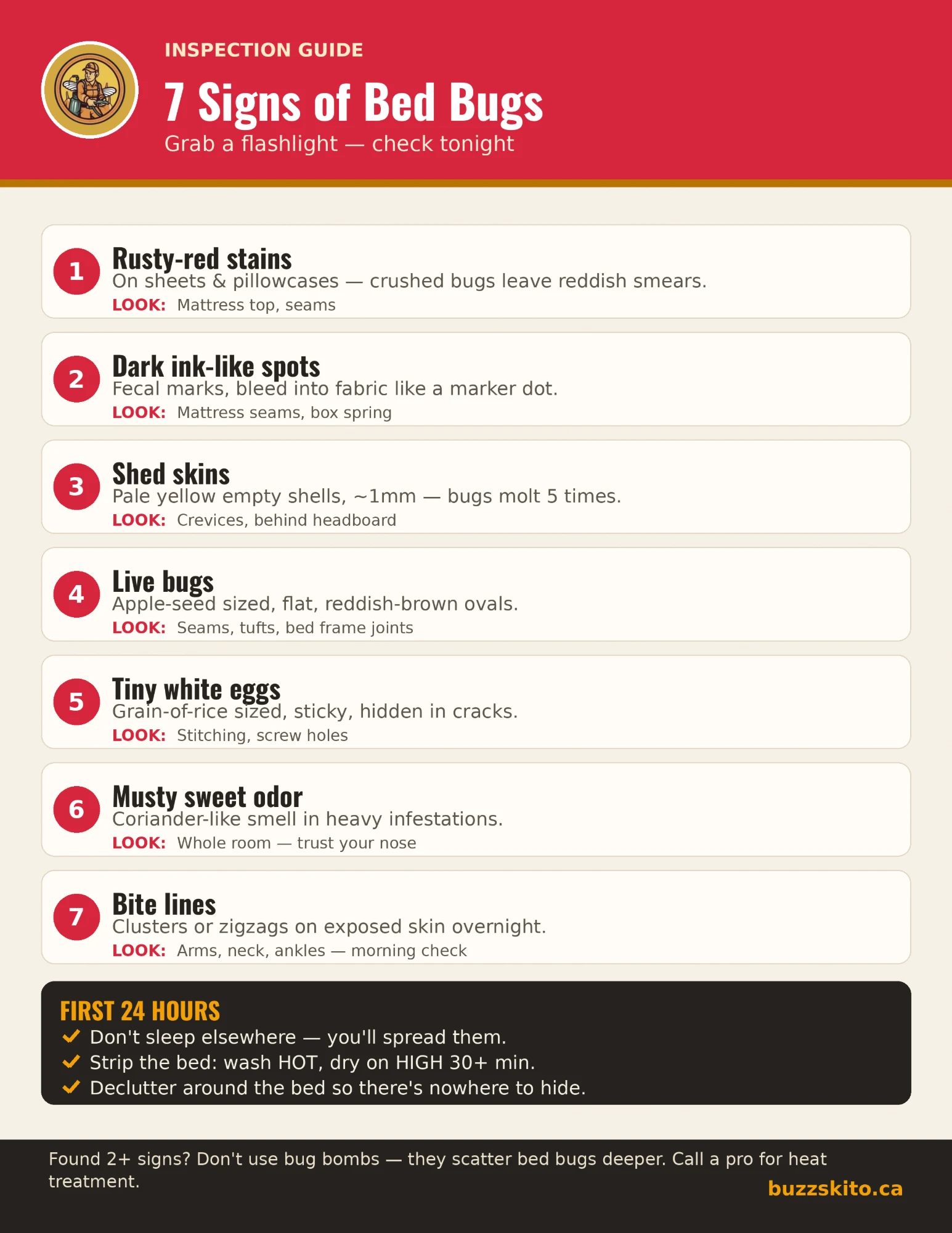 Signs of Bed Bugs: A 7-Point Checklist to Run TonightThe seven signs of bed bugs, from live bugs and ink-like spots to bites, with where to look tonight, what each is…
- Best Bed Bug Heat Chamber Canada 2026 — ZappBug vs Thermal Strike vs DIYThe best portable bed-bug heat chambers in Canada: ZappBug Original vs ZappBug Room vs Thermal Strike travel bags vs a…
- Harris Bed Bug Killer Review Canada 2026 — Does the Toughest Spray Work, and Is It Even…Independent Canadian review of Harris Toughest Bed Bug Killer: contact kill vs pyrethroid resistance, PMRA registration…