
BuzzSkito Mosquito & Tick Control Specialists · Published July 21, 2026
What Is the Best Bed Bug Powder in Canada?
The best bed-bug powder for most Canadian homes is a silica-gel dust — the amorphous-silica aerogel sold most recognizably as CimeXa — because it does the one thing a desiccant dust exists to do more efficiently than anything else on the shelf: it dries bed bugs out fast, at a barely-there application rate, and keeps doing it for months. The classic alternative, food-grade diatomaceous earth like Doktor Doom, kills the same way and earns its place on cost, availability, and gentleness, but it is slower and needs a heavier film to match silica. Both belong in the conversation, and this guide explains exactly when each is the smarter buy.
Before anything else, one honest framing that will save you frustration: a powder is not a fast fix and it is not a complete fix. It is the patient, long-lasting background layer in a plan that also includes heat and physical removal. If you understand that going in, a dust becomes one of the most cost-effective tools you own. If you expect it to clear an infestation on its own in a weekend, it will disappoint you.
Check current Canadian availability of the powders and the applicator:
How Desiccant Dusts Actually Kill Bed Bugs
Silica gel and diatomaceous earth are not poisons. They are desiccants — they kill physically, not chemically. A bed bug’s body is sealed by a thin waxy layer on its cuticle that holds moisture in. When the insect walks through a fine powder film, the microscopic particles cling to that waxy coating and either abrade it (DE, which is made of sharp-edged fossilized diatoms) or adsorb it away (silica gel, which is intensely moisture-hungry). Either way the seal is breached, the bug’s water leaks out faster than it can replace it, and over the following days it dehydrates and dies.
Two consequences fall directly out of that mechanism. First, dusts are contact-only and slow: a bug that never crosses a treated surface is never affected, and even one that does takes days to succumb. Second, and hugely in their favour, they do not wear off the way a chemical residual evaporates or degrades. A silica or DE film sitting in a dry, undisturbed crack is just as lethal to a bed bug in two months as it was on day one. That combination — slow but essentially permanent — is precisely what makes a powder the right tool for the long game and the wrong tool for tonight.
Silica Gel vs Diatomaceous Earth: The Real Difference
Because both powders share a mechanism, people assume they are interchangeable. They are not, and the difference is well documented. In head-to-head laboratory work, silica-gel dusts have consistently killed bed bugs faster and at dramatically lower application rates than diatomaceous earth. The silica aerogel’s enormous surface area makes it a far more aggressive moisture-adsorber than the mechanical scratching of diatom shells, so a lighter, less visible film gets the job done sooner.
Silica gel also tolerates mild humidity better and does not clump the way DE can when the air is damp — an underrated advantage in a Canadian basement bedroom. The trade-offs run the other way on cost and comfort: food-grade DE is inexpensive, sold everywhere, and reassuringly natural for households nervous about anything near where they sleep. Our deeper dives into each — the CimeXa silica review and the diatomaceous earth for bed bugs guide — break down the evidence and the handling details for each product individually.
The short version: if you want the strongest single dust and will use it carefully, choose silica gel. If you want cheap, widely available, and gentle, and you accept a slower kill, choose food-grade DE. Many people use both — silica in the tight voids that stay dry, DE for broad, low-cost coverage along baseboards and under carpet edges.
The Light-Film Technique That Makes or Breaks a Treatment
Here is the mistake that ruins more home powder treatments than any other: using too much. It feels intuitive that more powder means more killing, but the opposite is true. A bed bug will detect and walk around a visible pile or a thick line of dust; it will readily walk through a film so thin you can barely tell it is there. The goal is a faint haze, not a snowdrift, and getting that light, even layer is exactly why a bulb hand-duster is nearly as important as the powder itself. Puffing dust from a duster lays down a controlled mist; shaking it from a jar dumps clumps a bug will simply avoid.
Where the dust goes matters as much as how much:
- Cracks and crevices — the hairline gaps where wall meets floor, baseboard seams, and any split in wood or trim near the bed.
- Bed-frame joints and bolt holes — disassemble the frame if you can and puff into every joint and cavity.
- Behind and inside the box spring frame — a prime harbourage; dust the wooden frame, not the fabric you sleep against.
- Electrical outlets and switch plates — power off at the breaker, remove the cover, and puff a light dust into the box (a classic hidden travel route).
- Baseboards, carpet edges, and behind the headboard — the perimeter routes bed bugs use to move between harbourage and host.
- Wall voids — behind loose trim or through a small gap, where a permanent dry film can quietly work for months.
Keep the powder out of the open air you breathe and off the surfaces you touch daily. Concentrate it in the hidden, undisturbed places, then leave it alone — every time you clean or vacuum a treated crack, you remove the protection you laid down.
Safety: Food-Grade Only, and Mind the Dust
The safety story for these powders is genuinely reassuring on toxicity but demands respect on inhalation. Food-grade diatomaceous earth is a naturally occurring mineral considered low-toxicity to people and pets, and silica-gel insecticide dusts are formulated for indoor use around the home. The real hazard with any fine powder is the airborne dust itself: breathing clouds of it can irritate your lungs, nose, throat, and eyes. So wear a dust mask while applying, work slowly to avoid raising clouds, and apply thin films into cracks rather than broadcasting powder across open floor.
One rule is non-negotiable: never use pool-grade (calcined) diatomaceous earth indoors. Pool-filter DE is heat-treated into a form that contains crystalline silica, a serious respiratory hazard, and it is also far less effective as an insecticide. Only ever buy food-grade DE for bed bugs. And keep every powder off the sleeping surface itself — the mattress and box-spring surface are the job of an encasement, with the dust reserved for the frame, floor, and wall gaps around the bed.
Where Powder Fits in a Real Plan (and Where It Doesn’t)
A dust is a specialist, not a generalist. Its superpower is the long residual — a barely-visible film that keeps killing for weeks or months in the hidden voids no other tool can protect that long. Its two hard limits are that it is slow and that it does not reliably kill eggs. Bed-bug eggs are cemented in place and shielded well enough that you should never count on any powder to clear an egg load. That is precisely why dusts are paired with heat.
The proven sequence is straightforward. First vacuum to physically remove the adults, nymphs, and loose debris you can reach. Then steam the mattress seams, tufts, and folds — heat is what kills the eggs and the bugs deep in fabric. Finally, once every treated surface is completely dry, puff a light dust into the cracks, voids, and frame joints as the residual barrier that keeps working long after the steam has cooled. Never apply powder onto a wet surface or straight after steaming, because moisture destroys a desiccant. If you want the full step-by-step, our how to get rid of bed bugs in Canada walkthrough and the bed-bug control hub lay out the whole protocol. For where heat and chemistry each earn their keep, see heat vs chemical bed-bug treatment.
How to Choose: What You’re Actually Buying
Because these products span a modest price range, it is worth being clear about where your money and attention should go. Prioritise in this order:
- Kill speed and rate (this is where silica wins). If you want the most effective single dust and will handle it carefully, pay for silica gel — it kills sooner and a small container lasts a long time because the correct film is so light.
- A proper applicator (do not skip this). A bulb hand-duster is the difference between a film that works and a pile a bug avoids. It is inexpensive relative to how much it improves the outcome. Buy one with the powder.
- Food-grade certification (a hard requirement for DE). Only food-grade DE goes indoors. Confirm it on the label; never substitute pool-grade to save money.
- Canadian-market legitimacy. Buy the version offered to Canadian customers through Canadian channels rather than a grey-market import. Health Canada’s PMRA regulates these products, and some US-sold dusts are not registered here.
- Volume, only after the above. A big bulk bag of DE is the cheapest whole-home coverage — but volume is worthless if the powder is the wrong grade, applied too heavily, or bought instead of a duster. Sort the essentials first, then size up.
Read that as a spending map: put your dollars into the right powder and a real applicator, insist on food-grade and Canadian-legitimate, and treat sheer volume as the last consideration. A single small jar of silica gel plus a duster covers a bedroom with room to spare; a bulk DE bag is the budget route to dusting an entire home. Neither is expensive, and both outlast their cost many times over — provided you resist the urge to pile it on.
Frequently Asked Questions
What is the best bed bug powder in Canada?+
For most Canadian homes, the best bed-bug powder is a silica-gel (amorphous silica aerogel) dust like CimeXa — it kills faster than diatomaceous earth, keeps working for months when left undisturbed in dry cracks and voids, and you use far less of it. Food-grade diatomaceous earth such as Doktor Doom is the trusted, low-cost, widely available alternative that is easy to find at Canadian retailers and works well in the right dry spots, just more slowly. The honest catch with any powder is that it is a slow, contact-only tool: bugs must physically walk through a thin, barely visible film before it dehydrates them over days, so a dust is one layer of a plan, never the whole plan.
Which is better for bed bugs — silica gel or diatomaceous earth?+
Silica gel generally outperforms diatomaceous earth for bed bugs. Both kill the same way — by abrading and adsorbing the waxy layer on the insect cuticle so it dries out — but laboratory comparisons have repeatedly shown silica-gel dusts kill bed bugs faster and at much lighter application rates. Silica also holds up better in slightly humid conditions and does not clump the way some DE can. Diatomaceous earth wins on cost, availability, and the comfort of a food-grade natural mineral many people already keep on hand. If you want the strongest single dust, choose silica; if you want cheap, accessible, and gentle, choose food-grade DE.
How long does bed bug powder take to work?+
Days, not minutes — and that is true of every desiccant dust, silica or DE. These powders do not poison bed bugs; they physically dry them out after the insect walks through the film and the fine particles cling to its body. Death typically follows over several days of contact, faster with silica gel and slower with diatomaceous earth. Because it is slow and depends on the bug travelling across a treated surface, a dust is a patient background weapon: it thins the population between the faster interventions (heat, steam, vacuuming) rather than delivering an overnight knockdown.
How do I apply bed bug powder correctly?+
The single biggest mistake is using too much. A bed bug will walk around a visible pile of powder but will readily cross a film so thin you can barely see it, so you want a light, even dusting — a faint haze, not a snowdrift. Use a bulb hand-duster to puff a fine layer into cracks and crevices, along baseboards, into electrical outlets and switch plates (power off), bed-frame joints and bolt holes, behind headboards, under carpet edges, and inside wall voids. Keep it out of the open air you breathe and off surfaces you touch daily, concentrate it in the hidden harbourage and travel routes, and leave it undisturbed so it can keep working.
Is diatomaceous earth safe to use indoors around bed bugs?+
Food-grade diatomaceous earth is a naturally occurring mineral and is considered low-toxicity to people and pets, which is a large part of its appeal, but the practical safety issue is dust inhalation, not poisoning. The fine airborne particles can irritate the lungs, nose, and eyes, so you should wear a dust mask while applying, avoid creating clouds, and apply thin films into cracks rather than broadcasting powder across open floors. Never use pool-grade (calcined) diatomaceous earth indoors — it contains crystalline silica and is a genuine respiratory hazard. For bed bugs, only food-grade DE, applied lightly with a mask on, is appropriate.
Where should I not put bed bug powder?+
Keep it out of open, breathable air and off high-touch surfaces. Do not broadcast it across the top of a mattress you sleep on, over bedding, on pillows, on children’s or pet play areas, on countertops, or anywhere it will become airborne as you move around. The dust works in hidden, undisturbed harbourage — inside the box-spring frame, in cracks and voids, along baseboards, behind outlet covers — not on the sleeping surface itself. If you want protection on the mattress and box spring, an encasement is the right tool for that surface, with the dust reserved for the frame, floor, and wall gaps around it.
Does bed bug powder kill eggs?+
Not reliably. Desiccant dusts kill by drying out the insect after it contacts the powder, but bed-bug eggs are cemented to surfaces and coated in a way that gives them far more resistance to a dust film than a moving nymph or adult has. Some newly hatched nymphs will pick up the dust as they emerge and walk through it, which helps, but you should not count on any powder to clear an egg load on its own. Killing eggs is the job of heat — a steamer or a heat treatment — which is exactly why dusts are paired with steam rather than used alone.
How long does bed bug powder stay effective?+
Indefinitely, as long as it stays dry and undisturbed — that is the great strength of a desiccant dust over a liquid spray. Silica gel and diatomaceous earth do not break down or evaporate the way a chemical residual does; a thin film tucked into a dry crack or wall void can keep killing bed bugs that pass through it for months. The enemies are moisture and disturbance: humidity, a wet clean-up, or vacuuming the treated area removes the dust and ends the protection. Placed in dry, hidden, low-traffic harbourage, a single careful application can quietly work for an entire treatment cycle.
Is CimeXa or another silica dust available in Canada?+
Silica-gel bed-bug dusts are sold to Canadian buyers, and CimeXa is the best-known name. As with any pest-control product, you want the version that is legitimately available for the Canadian market rather than a grey-market import, and you should check current Canadian availability and any registration status before buying. The broader point matters for compliance: Health Canada’s PMRA regulates pest-control products, and some dusts sold freely in the United States are not registered for sale in Canada. Stick to products offered to Canadian customers through Canadian retail channels, and treat a suspiciously cheap cross-border import with caution.
Do I need a special applicator for bed bug powder?+
A proper applicator is close to essential, because the whole technique depends on laying down a film so light you can barely see it — and you cannot do that by shaking powder out of a jar. A bulb hand-duster lets you puff a controlled, fine mist of dust deep into cracks, voids, outlet boxes, and frame joints, reaching the hidden harbourage a spoon or your fingers never will. It also keeps you from over-applying, which is the number-one reason home powder treatments fail. A duster is inexpensive relative to the difference it makes, so budget for one alongside whichever powder you choose.
Can I use bed bug powder together with a spray or steamer?+
Yes, and you should — dusts are designed to be the long-lasting layer in a combined approach. The usual sequence is to vacuum to physically remove what you can reach, steam the mattress seams, tufts, and folds to kill bugs and eggs with heat, and then, once everything is fully dry, puff a light dust into the cracks, voids, and frame joints as a residual barrier that keeps working for weeks. Do not apply dust onto a wet surface or immediately after steaming, because moisture ruins a desiccant. Sprays and dusts can share a room as long as the dust goes into dry harbourage the liquid did not soak.
How much bed bug powder do I need for a typical bedroom?+
Far less than most people expect — a single small container of silica gel goes a remarkably long way because the correct application is a barely-visible film, and a bag of diatomaceous earth for a single bedroom will likely last through the whole job with plenty to spare. If you find yourself getting through powder quickly, that is a strong sign you are applying it far too heavily, which not only wastes product but actively reduces its effectiveness because bugs avoid visible piles. Buy modestly, apply lightly, and keep the leftover sealed and dry for the follow-up applications a bed-bug job almost always needs.
Related Reading
- CimeXa Bed-Bug Review Canada — The Silica Dust Up Close
- Diatomaceous Earth for Bed Bugs — How to Use It Right
- Best Bed-Bug Steamer Canada — Heat That Kills the Eggs
- Best Sealed-HEPA Vacuum for Bed Bugs & Fleas
- Best Bed-Bug Spray for a Mattress in Canada
- Best Bed-Bug Fogger Canada — Do They Actually Work?
- Bed-Bug Mattress Encasement Canada
- Heat vs Chemical Bed-Bug Treatment
- How to Kill Bed-Bug Eggs in Canada
- Best Pest-Control Equipment Canada — The Full Device Hub
Keep reading
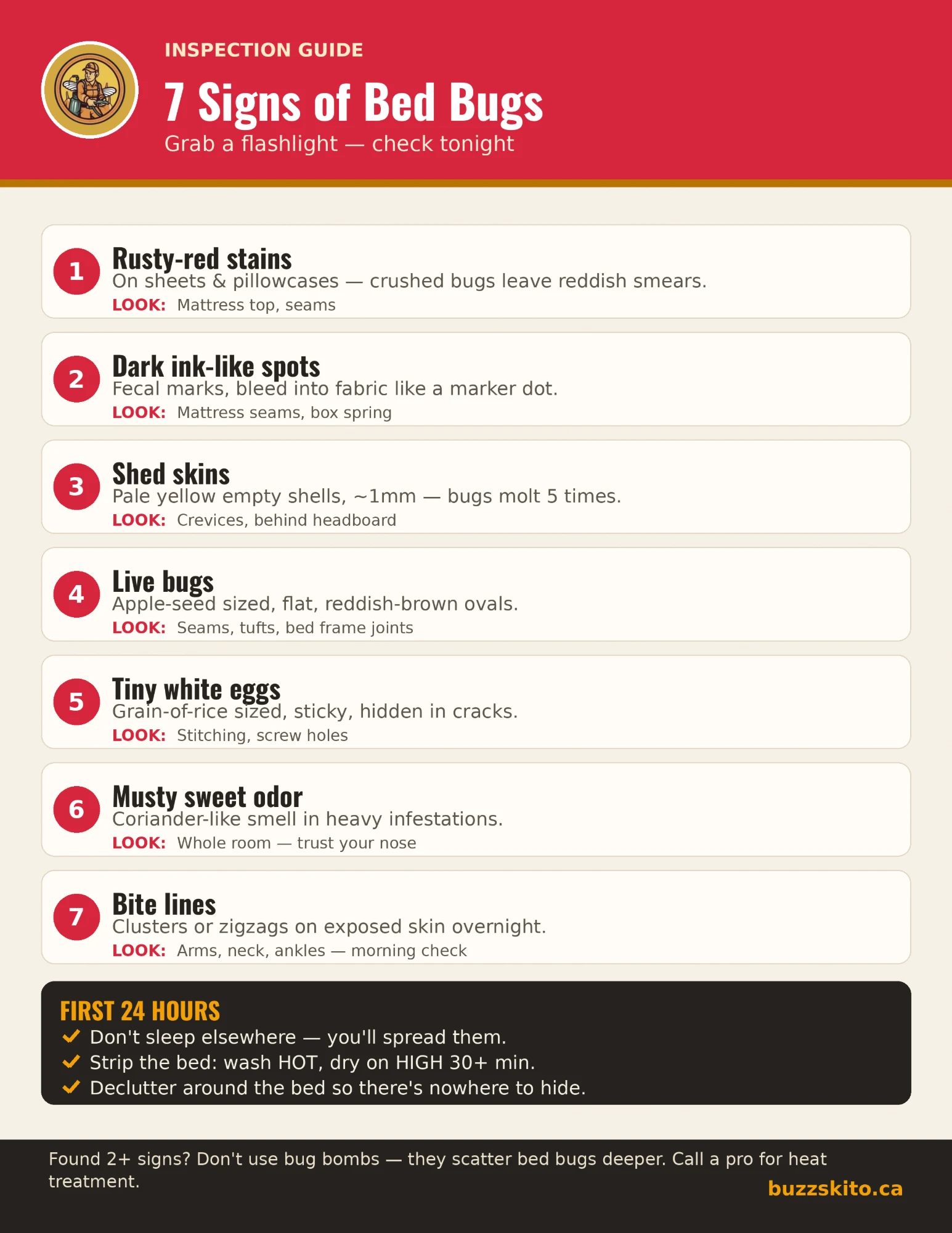 Signs of Bed Bugs: A 7-Point Checklist to Run TonightThe seven signs of bed bugs, from live bugs and ink-like spots to bites, with where to look tonight, what each is…
- Best Sealed-HEPA Vacuum for Bed Bugs & Fleas Canada 2026 — Canister vs Stick vs HandheldSealed-HEPA vacuums for bed-bug and flea remediation: why a sealed body and bagged disposal matter, crevice-tool…
- How to Get Rid of Bed Bugs Yourself in Canada 2026 — The Full DIY ProtocolThe complete DIY bed-bug protocol for Canadian homes: the five-tool basket (steamer, sealed-HEPA vacuum, desiccant…