
BuzzSkito Mosquito & Tick Control Specialists · Published July 21, 2026
Harris Bed Bug Killer, Reviewed Honestly for Canadians
If you have spent an evening panic-searching “bed bug spray that actually works,” you have met Harris. It is one of the most visible bed bug brands in North America, it comes in half a dozen formats, and it carries the reassuring “Toughest” label that a frightened buyer at 2 a.m. desperately wants to believe. This review is written to answer the two questions that Harris marketing does not: does the spray actually do what you need against bed bugs, and — the question almost every US-brand review skips — is it even legal for you to buy and use in Canada?
The short version is that Harris Toughest Bed Bug Killer is a real contact insecticide that kills bed bugs it directly, thoroughly wets, and that is a genuinely useful narrow capability. But two facts hold it to a conditional score for Canadian buyers: its pyrethroid chemistry runs headlong into the resistance now common in local bed bug populations, and its legality here depends entirely on which specific SKU you buy. Everything below unpacks those two facts, because together they decide whether this is a sensible purchase or a false economy.
This review sits alongside our broader Canadian bed bug control hub, our bed bug spray guide, and the device-focused pest control equipment guide; here we go deep on one specific brand and what it can and cannot do.
Check current Canadian availability (confirm the PMRA-registered SKU before buying):
What the Harris “Toughest” Spray Actually Does
Let us be fair to it first. Harris Toughest Bed Bug Killer is a liquid contact insecticide, and used as a contact spray it works: point it at a bed bug, soak the bug thoroughly, and it dies. If you flip a mattress, find a cluster in a seam, and drench them, the spray earns its keep in that moment. That is a legitimate job — spot knockdown of visible bugs is part of how anyone, professional or homeowner, chips a population down — and the brand’s ubiquity means you can usually find a Harris product without much hunting.
The trouble starts with the second half of the sales pitch: the residual. Sprays like this are sold on the promise that after you apply, the dried film keeps killing bed bugs that walk across it for days or weeks. That residual is the feature that would let a spray do the heavy lifting of an actual treatment — killing the bugs you never saw, on their nightly trips to feed. And it is precisely the feature that resistance sabotages, which brings us to the single most important thing to understand about any pyrethroid spray in 2026.
The Resistance Problem: Why the Residual Is the Weak Link
The active ingredients in the Harris bed bug line are pyrethroids — deltamethrin and chemical relatives — and bed bugs across North America have spent two decades evolving resistance to exactly that family of chemicals. This is not a fringe worry or a marketing knock; it is the central, well-documented fact of modern bed bug control. Resistant populations carry mutations and enzyme systems that let a bug shrug off pyrethroid exposure that would have killed its ancestors.
Here is what that means in your bedroom. Contact knockdown — directly soaking a bug — still tends to work, because a heavy enough dose overwhelms even a resistant insect. But the dried residual is a low, aged dose, and that is exactly the level a resistant bug can walk across and survive. So the part of the spray you cannot see working — the invisible protection you are trusting to catch the bugs you missed — is the part resistance most reliably defeats. You end up with a false sense of security: the visible bugs you sprayed died, so it “worked,” while the hidden population continues crossing your treated baseboards unharmed. This is the core reason professionals do not lean on a single pyrethroid, and why our honest look at whether bed bug sprays actually work lands where it does.
The Legality Trap: PMRA Registration and the Grey Market
Now the question that decides whether you should even click buy. Pesticides in Canada are regulated by Health Canada’s Pest Management Regulatory Agency (PMRA), and a product is legal to sell and use here only if that specific formulation is PMRA-registered. A US EPA registration means nothing north of the border — approval is country-specific, and manufacturers sometimes sell different SKUs, concentrations, or formulations into each market.
This matters enormously for a US brand like Harris, because the name on the bottle tells you nothing about Canadian legality. Some Harris products carry Canadian registration and sell legitimately through Canadian retail; other Harris SKUs are US-only and are not registered for sale to Canadian consumers. If you order one of those US-only versions from a listing that happens to ship across the border, you are importing an unregistered pesticide, which violates the Pest Control Products Act. The reassuring brand recognition is doing you a disservice: it makes an illegal import feel like a normal purchase.
The rule to carry away is simple. Before buying any Harris bed bug product — or any pesticide with a US pedigree — confirm that the exact SKU is PMRA-registered and sold through a Canadian retailer. Do not assume “same brand” means “same legal product,” and do not let a forum talk you into importing a US concentrate because it is supposedly “stronger.” It is not stronger against a resistant bug, and it is not legal. We walk through the whole registration landscape in the Canadian bed bug spray guide.
Which Harris Product Do You Actually Have?
One more source of confusion worth clearing up: “Harris bed bug killer” is not a single product. The brand sells, under closely related names, a liquid contact spray, an aerosol, an “egg-kill” formula, and a diatomaceous-earth desiccant powder. These behave completely differently, and buyers routinely mix them up.
- The liquid spray (the focus of this review) is a pyrethroid contact/residual product — subject to the resistance problem above.
- The aerosol is a similar chemistry in a pressurized can, convenient for spot treatment but with the same resistance ceiling.
- The egg-kill formula aims at eggs, but a liquid sitting on the surface of a cemented egg is a far less reliable egg-killer than heat, which penetrates.
- The DE powder is the outlier — a physical desiccant that kills by drying insects out, resistance-proof, and genuinely useful in cracks and voids. If you want the dust mechanism, our diatomaceous earth guide and CimeXa silica-gel review cover it in more depth than the brand’s own packaging does.
When you read a glowing or a scathing review of “Harris,” check which product it is actually about. A rave about the DE powder tells you nothing about the liquid spray, and vice versa.
How to Use Harris Bed Bug Killer Correctly (If You Buy the Registered Version)
Assuming you have confirmed a Canadian-registered SKU and decided a contact spray has a place in your plan, technique matters. The single legal and practical authority is the label on the exact product you bought — read it and follow it, because directions, permitted surfaces, and re-entry intervals differ by SKU. Within that:
- Spray directly onto bugs and into harbourage. Contact kill is where this product is strongest, so wet the bugs and the seams, folds, and cracks where you have seen activity — do not settle for a light mist over a surface.
- Do not trust the residual to do the hidden work. Because of resistance, treat any lingering protection as a bonus, not a plan. Re-inspect and re-treat rather than assuming one application sterilized the room.
- Keep it off what you sleep on and touch. Follow the label on mattress and fabric use; do not saturate surfaces beyond what it sanctions, keep it off skin and food areas, and ventilate.
- Keep kids and pets out until dry. Observe the label’s keep-off interval — this is basic and legally specified.
- Pair it, do not rely on it. A spray is a contact tool; the eggs and hidden bugs need other mechanisms, covered next.
What Actually Beats Bed Bugs in Canada — and Why It Is Not a Pyrethroid
The durable wins against bed bugs in Canada come from mechanisms bugs cannot evolve around, and every one of them is legal through Canadian retail without a registration gamble. This is the honest core of the review: a spray is at best a supporting player, and the leads are these.
- Heat for the eggs. A bed bug steamer drives lethal heat into seams and folds and kills the eggs a spray cannot, and a heat chamber or heater sterilizes belongings. Heat is a physical kill — no resistance, and, being a device rather than a pesticide, no PMRA question at all.
- A resistance-proof dust in the voids. An amorphous silica gel dust (or budget diatomaceous earth) lays a near-permanent barrier in cracks and travel routes that kills by drying bugs out — the mechanism the pyrethroid wishes it had.
- Seal the mattress. A zippered encasement traps anything inside and denies bugs their favourite seams.
- Monitor with interceptors. Interceptor cups under the bed legs catch travellers and tell you, week over week, whether you are winning.
- Remove the visible population. A sealed-HEPA vacuum lifts adults and nymphs before you dust and steam.
Read against that lineup, the Harris spray’s role shrinks to what it is actually good at: knocking down the visible bugs you find while the resistance-proof tools do the lasting work. For anything beyond a caught-early, localized problem — a spreading infestation, bugs established in walls or furniture — a professional treatment is the honest answer. Our guides on how to get rid of bed bugs in Canada and bed bugs in an apartment lay out how the pieces fit.
What You’re Actually Paying For — and When to Skip It
Harris is not expensive, and that low price is part of its appeal to someone who wants to do something tonight. But cheap is not the same as good value, so be clear about what the money buys. You are paying for a fast, familiar contact spray — real capability for the narrow job of soaking visible bugs. You are not paying for a reliable residual (resistance takes that away), and you are not paying for any effect on eggs or hidden bugs.
That makes the buy sensible in one specific situation: you have already assembled the durable tools — heat, encasements, a dust, interceptors — and you want an inexpensive contact spray for spot knockdown as you work, and you have confirmed a Canadian-registered SKU. In that context, a few dollars for a contact tool is fine. It is a poor buy in the opposite situation: as your only purchase, bought in the belief that spraying the room will clear an infestation. That is the false economy this review exists to head off — and it is worse still if the “deal” you found is a US-only SKU you would be importing illegally. If you are going to spend money on a single lasting tool, put it into heat or a desiccant dust, not a pyrethroid residual. Our Canadian pest control cost guide lays out where professional help becomes the smarter spend.
Verdict: 6.9/10 — A Known Name With Two Real Caveats
Harris Toughest Bed Bug Killer earns a conditional 6.9. It is a competent contact spray from a brand you can actually find, and for spot-killing the bed bugs you can see and reach it does the job. The score is held down — deliberately — by the two facts a Canadian buyer most needs and least often hears: its pyrethroid chemistry collides with the resistance now standard in local bed bug populations, so the residual it is sold on is the least trustworthy part of it; and its legality here is a per-SKU question that a US listing will happily let you get wrong.
Buy it, if at all, as one Canadian-registered contact tool inside a layered plan — verify the PMRA registration first, use it to knock down visible bugs, and never mistake it for a cure. Then put your real money and faith where the durable kills are: heat and steam for the eggs, a resistance-proof dust in the voids, encasements on the mattress, and interceptors to prove the numbers are falling. That is the combination that actually clears bed bugs in Canada — with or without a spray in the kit.
Frequently Asked Questions
Does Harris Toughest Bed Bug Killer actually work?+
On the bugs it directly soaks, yes — it is a contact insecticide and it kills bed bugs it wets. The honest limits are what earn it a middling score. The active ingredients in the Harris bed bug line are pyrethroid-class chemicals (deltamethrin and related), and North American bed bug populations are now widely resistant to pyrethroids, so bugs that are not directly hit may survive contact with the dried residue that is supposed to keep working after you spray. It also does nothing for eggs cemented in seams. Treat it as a spot knockdown for bugs you can see and reach, not a residual that clears an infestation on its own.
Is Harris Bed Bug Killer legal to buy in Canada?+
It depends entirely on the exact product, and that is the single most important thing to check before you buy. Some Harris products carry a PMRA (Health Canada) registration and are sold legally through Canadian retail; others are US-only formulations that are not registered for sale to Canadian consumers, and importing an unregistered pesticide violates the Pest Control Products Act. The word "Harris" on a US Amazon listing tells you nothing about Canadian legality — you have to confirm the specific SKU is cleared for Canadian sale. Buy the Canadian-registered version through a Canadian retailer, or choose a product you can verify is PMRA-registered, and never import a US-only pesticide because a forum told you to.
Why does Harris being a "pyrethroid" matter for bed bugs?+
Because bed bugs across North America have evolved widespread resistance to pyrethroid chemistry, which is the family deltamethrin and most Harris bed bug actives belong to. Resistance means a bug can walk across a dried pyrethroid residue — the residue that is meant to keep protecting you for weeks — and simply not die. You still get contact knockdown on bugs you spray directly and thoroughly wet, but the residual promise that sells these sprays is the part resistance undermines. This is why professionals lean on non-chemical mechanisms (heat, desiccant dusts) and rotate modes of action rather than trusting a single pyrethroid to carry a whole treatment.
Is Harris the same as diatomaceous earth?+
The Harris brand sells several different products, and one of them is a diatomaceous-earth desiccant powder — but the "Toughest Bed Bug Killer" liquid spray this review focuses on is not that. Harris markets a liquid contact spray, an aerosol, an egg-kill formula, and a DE powder under the same name, which confuses a lot of buyers. The DE powder kills by drying insects out (a physical, resistance-proof mechanism) and is a genuinely useful crack-and-void tool; the liquid spray is a pyrethroid contact/residual product subject to the resistance problem above. When you read "Harris bed bug killer," check which of these you are actually looking at, because they behave completely differently.
Will Harris Bed Bug Killer get rid of an infestation by itself?+
No, and no honest review claims otherwise. A liquid contact spray kills bugs it directly wets and lowers the visible population, but it will not reach eggs glued into mattress seams, it will not kill bugs harbouring inside walls and furniture voids, and its residual is undercut by resistance. An established bed bug infestation needs a layered plan: heat or steam for the eggs, encasements to seal the mattress and box spring, interceptor traps to monitor, aggressive vacuuming, and a resistance-proof desiccant dust in the voids — with professional treatment for anything beyond a caught-early, localized problem. A spray is at best one contact tool inside that plan.
How do I use Harris Bed Bug Killer correctly if I do buy it?+
Read and follow the exact label on the Canadian-registered product — this is legally required and the directions differ by SKU. In general: spray directly onto bugs and into the seams, folds, and cracks where you have seen activity, wetting them thoroughly rather than misting the surface; do not saturate mattresses or fabrics you sleep on beyond what the label allows; keep it off skin and away from food surfaces; and ventilate. Do not treat it as "spray once and done" — contact kill only helps the bugs present at the moment you spray, so it is paired with monitoring and repeat inspection. And never mix it with heat or steam application in a way the label does not sanction.
Harris spray vs a desiccant dust — which should I choose?+
For long-term control, a desiccant dust wins on the mechanism that matters. A pyrethroid spray like Harris gives contact knockdown now but a residual that resistant bugs may survive; an amorphous silica gel dust gives no instant knockdown but a resistance-proof, near-permanent barrier in the cracks and voids bugs travel through. The professional pattern is contact reduction first, then dust the voids as the long-term backstop. If you are choosing one tool to buy, and especially if legality is uncertain for the spray, a Canadian-available desiccant dust is the more defensible purchase. Our silica-gel and diatomaceous-earth guides cover the dust options in depth.
Are the US and Canadian versions of Harris products different?+
They can be — and that is exactly why "it is the same brand" is not a safe assumption. Pesticide registration is country-specific: a formulation approved by the US EPA is not automatically legal in Canada, and manufacturers sometimes sell different formulations, concentrations, or SKUs into each market to match each regulator. A US Amazon listing showing a Harris bed bug product does not mean that exact product is registered by the PMRA for Canadian use. Always verify against Canadian retail and the PMRA registration rather than assuming the cross-border product is identical and importable.
What are the safer or more effective alternatives available in Canada?+
For the eggs and hidden bugs a spray cannot reach, heat is the standout: a steamer or heat chamber kills by a physical mechanism no bug resists. For a permanent barrier in cracks and voids, an amorphous silica gel dust (or budget diatomaceous earth) is resistance-proof and legal through Canadian retail. Encasements seal the mattress and box spring, and interceptor traps let you monitor. Among sprays, look for Canadian-registered products and, where available, non-pyrethroid or multi-mode formulations rather than trusting a single resistant chemistry. The point is not that every spray is useless — it is that the durable wins in Canada come from heat and desiccants, not from a pyrethroid residual.
Is Harris Bed Bug Killer safe around children and pets?+
Follow the label — it is the legal and practical authority for the specific product you buy, and it will specify keep-off-until-dry intervals, ventilation, and surfaces to avoid. As a general matter, pyrethroid sprays are meant to be kept off skin and food surfaces, applied to targeted cracks and harbourage rather than broadcast across living surfaces, and allowed to dry with children and pets kept out of the treated area. A physical desiccant dust applied thinly into voids and a heat treatment both sidestep the "wet chemical on surfaces you touch" concern, which is one more reason many Canadian households lean on those mechanisms for the bedroom.
Why do bed bug forums push US products Canadians cannot legally buy?+
Because Canadians in a panic search for "what actually works," and the loudest forum answers point at US-market concentrates (Crossfire, Temprid FX) and US retail SKUs of brands like Harris, on the theory that "the stuff in Canada is weaker." The advice usually skips two facts: importing an unregistered pesticide into Canada is illegal under the Pest Control Products Act, and the resistance that motivates the smuggling does not stop at the border — a pyrethroid a US bug survives, a Canadian bug survives too. The reliable path is Canadian-registered products plus resistance-proof mechanisms (heat and desiccants), not a grey-market import.
What is our overall verdict on Harris Bed Bug Killer for Canadians?+
A conditional 6.9/10. As a contact spray it does the narrow job of killing bed bugs it directly wets, and the brand is widely known and easy to find. But two things hold it back for Canadian buyers: its pyrethroid chemistry runs straight into the resistance now common in local bed bug populations, so the residual you are paying for is the weakest link; and its legality depends entirely on buying the specific PMRA-registered SKU rather than a US listing that ships. Buy it only as a Canadian-registered contact tool inside a layered plan, verify the registration first, and put your real faith in heat, encasements, monitoring, and a resistance-proof dust.
Related Guides
- Bed Bug Control Canada — The Complete Plan
- Bed Bug Spray Canada — What Actually Works
- Do Bed Bug Sprays Actually Work? An Honest Look
- CimeXa Silica-Gel Dust Review — The Resistance-Proof Backstop
- Diatomaceous Earth for Bed Bugs — The Budget Desiccant
- Best Bed-Bug Steamer Canada — Heat That Kills the Eggs
- Bed-Bug Mattress Encasements Canada
- Bed-Bug Interceptor Traps Canada — Monitor and Protect the Bed
- Best Sealed-HEPA Vacuum for Bed Bugs & Fleas Canada
- Best Pest Control Equipment in Canada — The Full Kit
Keep reading
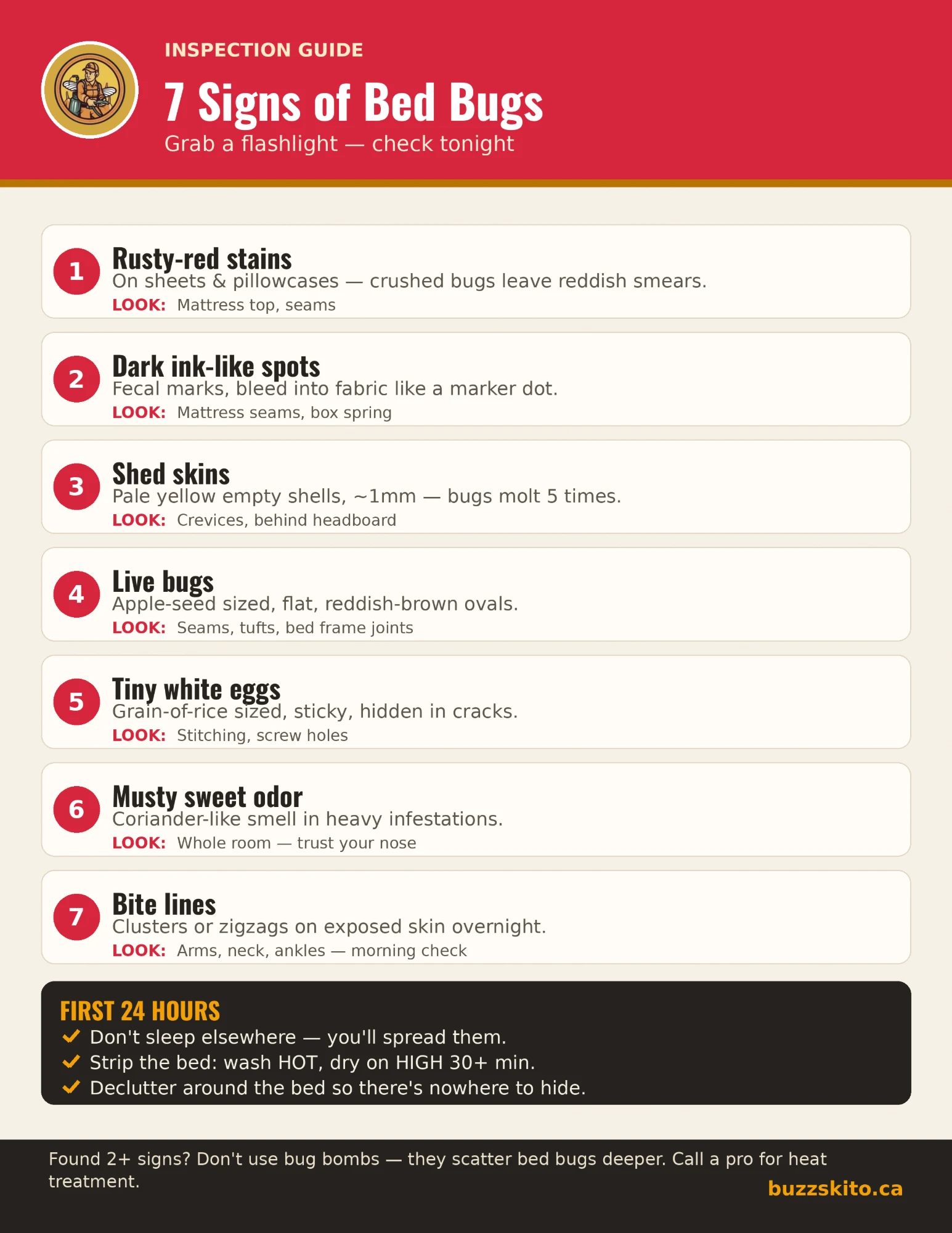 Signs of Bed Bugs: A 7-Point Checklist to Run TonightThe seven signs of bed bugs, from live bugs and ink-like spots to bites, with where to look tonight, what each is…
- Best Bed Bug Trap Canada 2026 — Passive Interceptors vs Active Lure Traps ComparedThe best bed bug traps in Canada for 2026: passive interceptor cups (Aspectek, ClimbUp-style) vs active heat/CO₂ lure…
- How to Get Rid of Bed Bugs Yourself in Canada 2026 — The Full DIY ProtocolThe complete DIY bed-bug protocol for Canadian homes: the five-tool basket (steamer, sealed-HEPA vacuum, desiccant…