
BuzzSkito Mosquito & Tick Control Specialists · Published July 21, 2026
What Is EcoRaider, and Why Does a Plant-Based Spray Deserve a Serious Look?
EcoRaider is a botanical bed bug spray: a plant-based contact killer built on geraniol — a compound derived from geraniums — alongside cedar extract and a plant-oil ester, rather than the synthetic pyrethroids that fill most bed bug spray bottles. The reason it earns a full review rather than a dismissive wave, which is what most “natural” pest products deserve, is a single unusual fact: it has independent university testing behind it. When Rutgers University entomologists put a range of consumer bed bug sprays through controlled testing against real, field-collected bed bugs, EcoRaider was one of the very few natural products that actually killed them — reaching high mortality on direct contact, in a category where most botanical sprays are aromatherapy with a bug on the label.
That testing pedigree is the whole story here, because the bed bug spray aisle is a graveyard of products that do nothing. The reason so many disappoint is not that the chemistry is fake — it is that bed bugs have become widely resistant to the pyrethroid chemistry those products rely on. A spray built on a completely different, plant-based mode of action steps outside that resistance problem, and EcoRaider is the rare natural option with evidence that it does so effectively. If you have been searching for a lower-toxicity spray you can use in an occupied bedroom without simply wasting your money, this is the one that has actually been measured.
This review sits alongside our broader Canadian bed bug control hub, our general bed bug spray guide, and our natural bed bug spray roundup; here we go deep on the single plant-based spray we would reach for first.
Check current Canadian availability (listed under either name):
The Rutgers Testing: Why This Natural Spray Is Different
The bar for a plant-based insecticide should be simple: does an independent lab, with no stake in the sale, find that it kills the target pest? For most natural bed bug sprays the answer is no — and that is exactly why the EcoRaider result matters. Rutgers researchers who tested a set of consumer bed bug products, including several marketed as natural or green, found that most of the botanical sprays failed to kill bed bugs at meaningful rates, while EcoRaider stood out by reaching high mortality on direct contact against adults and nymphs. In a category defined by overpromising, being one of the few that cleared the efficacy bar is a genuine distinction.
Two things are worth being precise about, because honesty is the point of an independent review. First, the strong result was for direct contact — the spray killing bugs it actually wetted — not for a lingering residual that keeps working for weeks. Second, no single spray, natural or synthetic, cleared an entire infestation on its own in these kinds of tests, because a spray only reaches the bugs you point it at. What the testing establishes is that when EcoRaider hits a bed bug, it reliably kills it, which is more than can be said for most of the bottles sold beside it. That is the foundation the rest of this review builds on.
Killing Eggs on Contact: The Standout Feature
Here is the feature that separates EcoRaider from the pack, and the one worth understanding in detail: it kills bed bug eggs on direct contact. That sounds minor until you know how bed bug eggs behave. Females cement their eggs to fabric under a protective coating, and that coating shrugs off a great many liquids — which is the entire reason the standard advice is that only heat reliably kills bed bug eggs. A spray that actually kills the embryo inside a wetted egg is doing something most sprays, including many synthetics, simply cannot.
But read the words carefully: on direct contact. EcoRaider kills the eggs the spray physically reaches and soaks. An egg tucked deep in a mattress seam, inside a bolt hole, or behind a baseboard that the liquid never penetrates survives exactly as it would with any other spray. So the egg-killing is a real and valuable edge over a typical pyrethroid — it means a thorough spraying of visible harbourage takes out eggs as well as adults, shrinking the next generation — but it does not replace the seam-penetrating steam of a bed bug steamer for the eggs you cannot see or reach. Think of it as a bonus that rewards thorough application, not a substitute for heat.
Why It Beats Resistant Bed Bugs When Cheap Sprays Do Not
To understand why a plant-based spray can outperform a synthetic one, you have to understand what resistance actually is. Resistance is not a general toughness — it is specific. Bed bugs across North America have spent decades under selection pressure from pyrethroids, and populations have evolved two defences: enzymes that detoxify the pyrethroid molecule before it can act, and mutations that harden the exact nervous-system target the pyrethroid attacks. A resistant bed bug can walk through a pyrethroid film and survive, which is the single biggest reason a drugstore bed bug spray so often does nothing.
EcoRaider’s botanical actives attack the insect through a different pathway — one bed bug populations have not been selected to survive. There is no cross-resistance carrying over from decades of pyrethroid exposure, so the plant-based formula kills bugs that shrug off the synthetic. This is precisely why it held up in testing where some conventional products underperformed against field-collected, resistant strains. It is not immune to biology forever — nothing is — but for the resistance landscape Canadians face today, a different mode of action is a real, structural advantage, not marketing. Our honest look at whether bed bug sprays actually work unpacks the resistance problem in more depth.
The Honest Limitation: Short Residual
Every tool has a boundary, and EcoRaider’s is residual. The plant compounds that make it low-toxicity and resistance-beating — volatile botanical oils — also break down relatively quickly compared with a synthetic film engineered to persist. In plain terms: EcoRaider is a contact killer, lethal while wet and for a short window after, but it does not lay down the multi-week barrier that a pyrethroid residual or a desiccant dust does. You cannot spray a baseboard once and expect it to keep killing bugs that cross it a month later.
That is not a dealbreaker — it is a usage instruction. Because the residual is short, EcoRaider rewards thorough, repeated, direct application: spray the harbourage completely, and repeat every few days to a week while the infestation is active, re-hitting the same seams and cracks each time so you catch newly hatched nymphs and any bugs that were hiding on the previous pass. And it is why the smartest way to use it is not alone but paired with something that does provide long residual. Spray the surfaces you can see and reach with EcoRaider for immediate, egg-killing knockdown; dust the cracks and voids you cannot with a silica gel desiccant like CimeXa for a barrier that keeps working for years. Contact killer plus permanent dust is the classic, complementary one-two.
How to Apply EcoRaider Correctly
A contact killer only kills what it wets, so application is everything — a half-hearted mist over open surfaces wastes the bottle. The goal is to actually reach the bugs and eggs in their harbourage with liquid, not to freshen the air. Work methodically:
- Vacuum first. A sealed-HEPA vacuum physically removes the bulk of the visible population and loose debris, so the spray can concentrate on what is left in the seams.
- Spray directly into harbourage. Mattress seams, piping, tufts, and folds; the box-spring fabric edge and staple line; bed-frame joints, slats, and bolt holes; headboard cracks; baseboard gaps and the wall-floor junction; and furniture near the bed.
- Get the nozzle into the seam. Penetrate the fold so the liquid soaks the crevice rather than beading on the surface — that is how you reach the eggs and hidden bugs, which is where the egg-killing pays off.
- Do not broadcast it as a room mist. Misting the air or coating open floors does little; a contact spray works where it lands on the target, not where it drifts.
- Repeat on a schedule. Because the residual is short, re-treat the same harbourage every few days to a week while activity continues, until interceptor traps show the numbers falling.
- Ventilate and let it dry. Air the room, and let treated surfaces dry before pets or children return — plant-based does not mean spray-anything.
Applied this way — thorough, direct, repeated — EcoRaider does the job it is good at: killing the bugs and eggs you reach, on a schedule, with a low-toxicity active you can live around.
What You’re Actually Paying For — and When Another Product Fits Better
EcoRaider costs more than a generic drugstore pyrethroid, so it is worth being clear about what the premium buys and when a different tool is the smarter spend. You are paying for two things: a plant-based active with independent evidence it works, and a mode of action that beats the resistance defeating the cheap sprays. For someone who specifically wants a lower-toxicity spray to use in an occupied bedroom — a nursery, a home with pets, a chemically sensitive household — and who is willing to spray thoroughly and repeat, that combination is genuinely worth the extra outlay. You are not sacrificing effectiveness for the natural label, which is the usual trap; the testing says you are getting both.
When does something else fit better? If your priority is a long-lasting barrier that keeps killing for months with no repeat effort, a desiccant dust in the cracks and voids is the tool built for that job — it stays put inside the void and keeps working by abrasion long after a sprayed liquid has dried and lost potency. Put your money into CimeXa or budget diatomaceous earth for the residual and use EcoRaider only for surface knockdown. If your real problem is eggs buried deep in seams and furniture, no spray reaches them and the money belongs in a steamer or heater. And the way to overspend badly is to chase grey-market US concentrates because a forum called them “stronger” — they are frequently illegal to import into Canada and lean on the very chemistry the bugs already survive. Buy EcoRaider for what it is best at (low-toxicity contact and egg kill), pair it with a dust and heat, and skip the grey market entirely.
The Regulatory Angle: Minimum-Risk Is Not PMRA Registration
There is a compliance subtlety with plant-based pesticides that trips Canadians up, and it is worth spelling out. In the United States, many botanical products of this type are sold under a “minimum risk” exemption, which lets low-hazard, plant-oil formulations skip the full federal pesticide registration process. That exemption is a US framework. Canada does not automatically mirror it — Health Canada’s PMRA maintains its own rules about what may be legally sold as a pest control product here. The practical consequence: a natural bed bug spray freely available on a US retailer is not guaranteed to be legally sold, or to be the identical registered formula, in Canada.
EcoRaider/EcoVenger has appeared on Amazon.ca and through Canadian retail, so this is usually a checkable detail rather than a wall — but check it. Before you buy, confirm the listing genuinely ships to Canada and is the version cleared for Canadian sale, rather than a US-only listing that happens to offer international shipping. This is the same trap that catches Canadians importing US-only chemical concentrates like Crossfire and Temprid FX, which are not PMRA-registered for Canadian consumers and are illegal to bring across the border. The reassuring part is that when you buy the Canadian-cleared version of a plant-based spray through legitimate retail, you get the rare combination of a lower-toxicity, resistance-beating product that is also fully legal to own and use here — no grey market, no border risk, no ambiguity about what is in your home.
Where EcoRaider Fits in a Real Bed Bug Plan
No spray clears an established infestation by itself, and any review that implies otherwise is selling you something. EcoRaider is the low-toxicity contact-kill layer — excellent at what it does, bounded by the reach of the nozzle and the length of its residual. Its power shows when it sits inside a layered plan, and the layers are well established:
- Remove the visible population first. A sealed-HEPA vacuum lifts adults and nymphs before you spray, so the contact killer works on what remains.
- Spray the harbourage — EcoRaider’s job. Direct, thorough, repeated contact killing of bugs and eggs on every seam and crack you can reach.
- Heat for the deep eggs. A steamer penetrates seams to kill the eggs no spray reaches, and a heater or heat chamber sterilizes belongings.
- Dust the voids for long residual. A silica gel dust like CimeXa in the cracks keeps killing survivors and re-invaders for years — the residual EcoRaider does not provide.
- Encase and monitor. A zippered mattress encasement seals the bed, and interceptor traps under the legs tell you, week over week, whether the numbers are falling.
For anything beyond a caught-early, localized problem — a spreading infestation in an apartment, or bugs established in walls and furniture — a professional treatment is the honest answer, with the spray and dust working as the tools you keep on hand. Our guides on how to get rid of bed bugs in Canada and bed bugs in an apartment walk through how the pieces fit together, and the full toolkit lives in our pest control equipment guide.
Verdict: 8.6/10 — The Natural Spray That Actually Earns It
EcoRaider earns its 8.6 by being the rare plant-based bed bug spray that survives contact with the evidence. Independent Rutgers testing puts it among the few natural products that genuinely kill bed bugs; it does something most sprays cannot in killing eggs on contact; and its botanical mode of action sidesteps the pyrethroid resistance that renders so many cheaper bottles useless. For anyone who wants a lower-toxicity spray for an occupied bedroom without conceding effectiveness, it is the clear pick.
The score stops short of a top mark for reasons of scope, not honesty. The short residual means it is a spray-thoroughly-and-repeat contact killer, not a lasting barrier; it only kills what the nozzle reaches, so eggs buried out of sight survive it; the botanical scent is strong; and Canadians must verify they are buying the version cleared for sale here. None of those are flaws in the product so much as the honest boundaries of what a plant-based contact spray is. Buy it for low-toxicity contact and egg kill, pair it with a desiccant dust for residual and heat for the deep eggs, skip the grey market entirely, and it is one of the better bed bug spray purchases a Canadian can make.
Frequently Asked Questions
Does EcoRaider actually kill bed bugs?+
Yes — and unusually for a plant-based product, there is independent university testing behind that claim. EcoRaider is a botanical contact killer built on geraniol (a geranium-derived compound) with cedar extract and a plant-oil ester, and Rutgers University entomologists who tested a range of consumer bed bug sprays found EcoRaider one of the very few "natural" products that reached high bed bug mortality — killing adults and nymphs on direct contact at rates comparable to some synthetic sprays. The critical caveats are that it is a contact killer with limited residual, so it only kills the bugs and eggs you actually spray, and that its effectiveness depends entirely on thorough, direct application into every seam and crack. It is a genuine tool, not a myth — but a spray-what-you-hit tool, not a set-and-forget barrier.
Does EcoRaider kill bed bug eggs?+
Yes, and this is its standout feature — most bed bug sprays do not. Bed bug eggs are cemented to fabric and coated in a way that shrugs off many liquids, which is why the usual advice is that only heat reliably kills them. EcoRaider is one of the few sprays independently shown to be ovicidal: when the spray directly wets an egg, it kills the embryo inside, not just the adults and nymphs walking across the surface. The word "directly" is doing all the work, though. An egg tucked deep in a mattress seam that the spray never reaches survives untouched, exactly as it would with any spray. Egg-killing on contact is a real advantage over a typical pyrethroid, but it does not replace the seam-penetrating heat of a steamer for the eggs you cannot see or reach.
Is EcoRaider the same as EcoVenger?+
Essentially yes — EcoVenger is the rebrand. The product sold for years as "EcoRaider Bed Bug Killer" was renamed EcoVenger around 2019, keeping the same plant-based, geraniol-led formula and the same natural-product positioning. If you are searching Canadian listings you may see either name, and the older Rutgers testing that built the product's reputation was conducted under the EcoRaider label. When you shop, treat the two names as the same lineage of product and read the current label and ingredient panel of whatever bottle actually ships to you, since formulas and concentrations can be revised over time and the version cleared for Canadian sale is the one that matters.
Is EcoRaider safe to use around children and pets?+
Its whole selling point is a lower-toxicity, plant-based profile, and in practice botanical bed bug sprays like this are marketed as safe to use in occupied bedrooms once surfaces have dried. That said, "plant-based" is not the same as "spray freely on anything." It is still an insecticide: keep it off skin, do not saturate surfaces people sleep directly against beyond the label's guidance, ventilate the room, and let treated areas dry before kids or pets return. People with fragrance sensitivities should note that geraniol and cedar give it a strong botanical scent that some find pleasant and others find overpowering in a closed bedroom. As always, the label on the bottle you buy in Canada is the authority — follow its directions exactly rather than any general reassurance online.
How is EcoRaider different from a pyrethroid bed bug spray?+
Two big ways: mode of action and resistance. Most drugstore and hardware-store bed bug sprays are pyrethroids (or pyrethroid blends) — synthetic neurotoxins that poison the insect's nervous system. The problem is that bed bugs across North America are now widely resistant to pyrethroids, so a resistant population can walk through a pyrethroid film and survive. EcoRaider works differently: its plant compounds attack the insect through a botanical mode of action that resistant bed bugs have not adapted to, which is a large part of why it kept killing bugs in testing where some synthetics faltered. The trade-off is residual. A pyrethroid is designed to leave a lasting film; EcoRaider's botanicals break down faster, so it leans on direct-contact killing rather than a long-lived barrier.
Does EcoRaider leave a lasting residual barrier?+
Not a strong one — and this is the honest limitation to plan around. Botanical actives like geraniol are volatile and break down relatively quickly compared with a synthetic residual, so EcoRaider is best understood as a contact killer: it is lethal while wet and for a short window after, but it does not lay down the multi-week barrier that a pyrethroid or a desiccant dust does. Practically, that means you cannot spray once and expect it to keep killing new bugs for a month. You get the most out of it by spraying thoroughly and directly, repeating on a schedule while the infestation is active, and pairing it with something that does provide long residual — a silica gel dust in the cracks and voids — so the two together cover both immediate kill and long-term protection.
Where and how should I apply EcoRaider for bed bugs?+
Directly and thoroughly, because a contact killer only kills what it wets. Spray into and along mattress seams, piping, and the tufts and folds; the box-spring fabric edge and staple line; bed-frame joints, slats, and bolt holes; headboard cracks; baseboard gaps and the wall-floor junction; and any furniture near the bed. The goal is to actually reach the bugs and eggs in their harbourage, not to mist the air or coat open surfaces. Move slowly and get the nozzle into the seam so the liquid penetrates the fold rather than beading on the surface. Because the residual is short, expect to repeat the treatment every few days to a week while activity continues, re-hitting the same harbourage each time. Vacuum first to remove the bulk of the population, then spray what remains.
Is EcoRaider available and legal to buy in Canada?+
Availability shifts, so the honest advice is to check current Canadian listings rather than assume, and to pay attention to registration. In the United States, plant-based products of this type are often sold under a "minimum risk" pesticide exemption, which means they are not put through the same registration as conventional pesticides. Canada does not automatically recognize that exemption — Health Canada's PMRA has its own list of what may be sold here — so a natural bed bug spray that is freely available on a US site is not guaranteed to be legally sold, or the same registered formula, in Canada. EcoRaider/EcoVenger has appeared on Amazon.ca and Canadian retail, but before buying, confirm the listing ships to Canada and is the version cleared for Canadian sale. This is the same trap that catches Canadians importing US-only concentrates like Crossfire or Temprid FX, which are not PMRA-registered and are illegal to bring in.
Will EcoRaider get rid of bed bugs on its own?+
For a light, early, caught-fast case with disciplined repeat spraying — sometimes. For an established infestation — no, and no honest review says otherwise. A contact spray with a short residual only kills the bugs and eggs it directly reaches, on the day you spray, so anything harbouring in a wall void, a neighbouring room, or a seam you missed survives to rebuild. Its egg-killing on contact is a real edge, but eggs you cannot see or reach are still safe from it. The realistic role for EcoRaider is as the low-toxicity contact-kill layer in a plan that also includes encasements, interceptor traps, a steamer or heater for the deep eggs, a desiccant dust for long residual, and — for anything beyond a caught-early problem — professional treatment. It is a keystone tool for people who want a plant-based option, not a standalone cure.
EcoRaider vs a desiccant dust like CimeXa — which should I use?+
They do opposite jobs, and the best plans use both. EcoRaider is a fast contact killer that kills bugs and eggs the moment it wets them but fades quickly — a sprint. A silica gel desiccant dust like CimeXa kills nothing instantly but lays down a near-permanent, resistance-proof residual in the cracks and voids that keeps working for years — a marathon. If you want immediate knockdown of a visible population and the reassurance of a plant-based active you can spray in an occupied bedroom, EcoRaider is the pick. If you want the long-term barrier that keeps killing survivors and re-invaders after the visible problem is gone, dust the voids. Spraying the surfaces you can see with a contact killer and dusting the cracks you cannot with a desiccant is the classic one-two, and our CimeXa review covers the dust half in detail.
Why does a plant-based spray beat resistant bed bugs when a synthetic does not?+
Because resistance is specific to a mechanism, and bed bugs have spent decades evolving around the specific mechanism synthetic pyrethroids use — enzymes that detoxify the poison and mutations that harden the nervous-system target the pyrethroid attacks. A botanical formula built on geraniol and plant oils acts through a different pathway that bed bug populations have not been under selection pressure to survive, so the resistance that lets a bug shrug off a pyrethroid film does not carry over. This is why EcoRaider held up in testing where some conventional sprays underperformed against field-collected, resistant strains. It is not magic and it is not immune to the laws of biology forever — but for now, a plant-based contact mode of action sidesteps the single biggest reason cheap bed bug sprays disappoint.
Related Guides
- Bed Bug Control Canada — The Complete Plan
- Bed Bug Spray Canada — What Actually Works
- Best Natural Bed Bug Spray Canada — The Plant-Based Options
- Do Bed Bug Sprays Actually Work? The Resistance Problem
- CimeXa Review Canada — The Resistance-Proof Desiccant Dust
- Best Bed-Bug Steamer Canada — Heat That Kills the Eggs
- Bed-Bug Mattress Encasements Canada
- Best Pest Control Equipment in Canada — The Full Kit
Keep reading
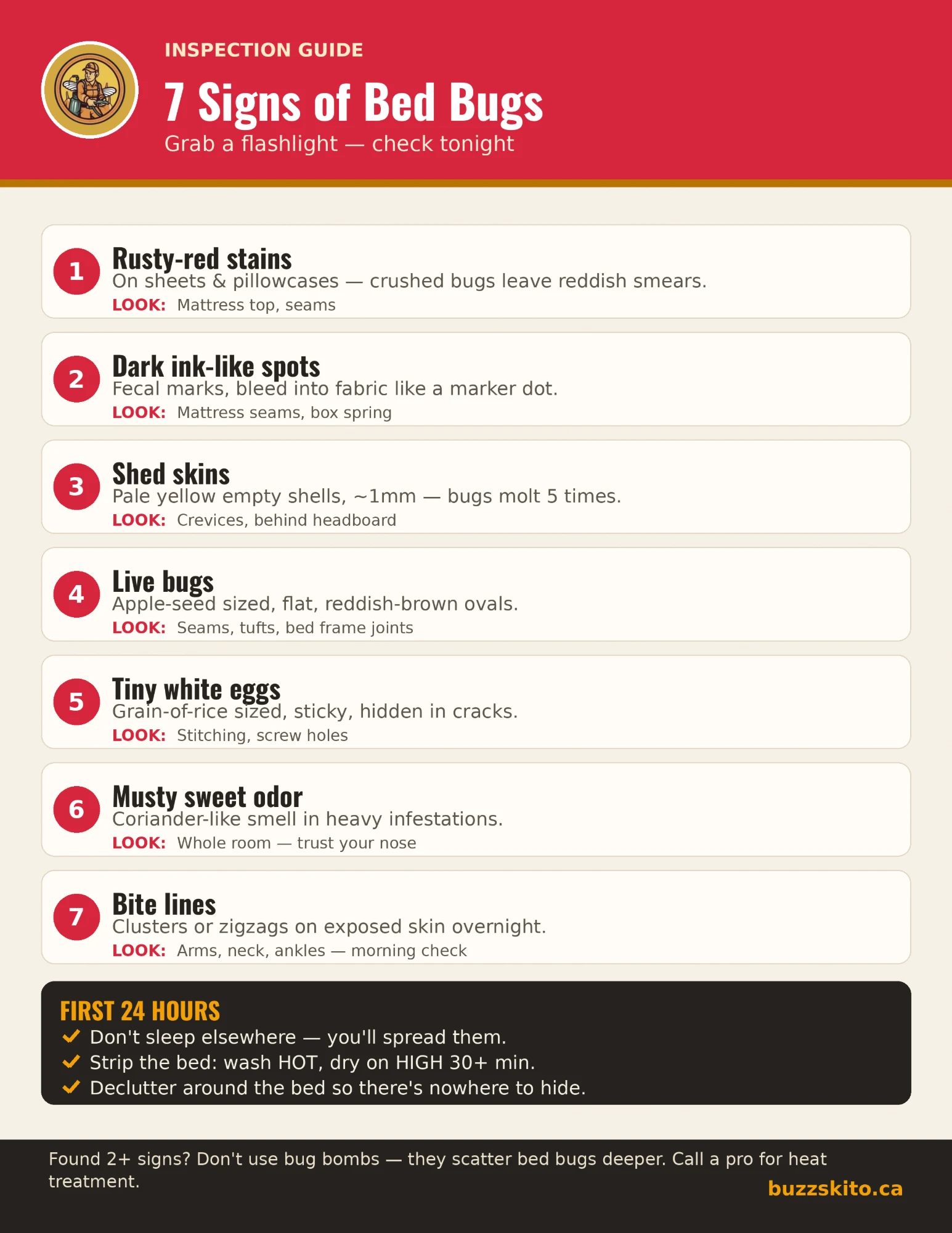 Signs of Bed Bugs: A 7-Point Checklist to Run TonightThe seven signs of bed bugs, from live bugs and ink-like spots to bites, with where to look tonight, what each is…
- How to Kill Bed Bug Eggs in Canada 2026 — Why Heat Wins and Sprays MissHow to kill bed-bug eggs in Canada: why contact sprays miss the eggs, the temperature that kills them, and the steam +…
- Bed Bug Control Canada 2026 — The Complete DIY Treatment HubThe complete Canadian bed-bug control hub: the heat-plus-residual plan that actually works, every tool explained…