
BuzzSkito Mosquito & Tick Control Specialists · Published July 21, 2026
Knock Down Bed Bug Killer: What It Is, and Why the “Registered in Canada” Part Matters
Knock Down is one of those insecticide names Canadians recognise from the shelf at the hardware store — a water-based, general-purpose crawling-insect and bed bug killer sold in a spray format meant for seams, frames, cracks, and baseboards. On paper that describes a great many bed bug sprays. What separates this one, for a Canadian buyer, is not a proprietary active ingredient; it is a registration number. Knock Down’s consumer bed bug products carry a Health Canada Pest Control Product (PCP) registration, which means the formula and its label were reviewed for sale and use in this country. That sounds like a bureaucratic footnote. In practice it is one of the two best reasons to reach for it.
Here is why. Many of the bed bug sprays you will read about in online guides — including some of the most-recommended American brand names — are registered for the United States only. Buying one through a cross-border or grey-market listing means using an unregistered pesticide in Canada, which is not legal, and it means you have no assurance that what is in the can, at what strength, and with what safety directions, matches anything reviewed for Canadian use. Knock Down sidesteps all of that: it is sold here, registered here, and labelled here. When people ask us for “a cheap bed bug spray that works,” the honest Canadian-specific answer starts with “the one you are actually allowed to use” — and Knock Down is usually the most affordable, easiest-to-find name on that short list.
Check current Canadian availability of Knock Down and the layers you build around it:
How It Actually Performs: A Competent Value Spray, Honest About the Rest
The thing Knock Down does well is exactly what a contact spray is supposed to do: hit a bed bug directly and it goes down. That immediate knockdown is genuinely useful and genuinely reassuring — when you find live bugs in a seam and can watch them die, you have made real progress and bought yourself a quick population reduction. As a spot-treatment tool for bugs you can see, and as a fresh residual film laid down along known travel routes, it earns its place in the kit, and it does so at a price that leaves plenty of budget for the layers that matter more.
But you have to be clear-eyed about the three ceilings every water-based spray hits, and Knock Down is no exception. The first is eggs. A female bed bug cements her eggs to fabric under a protective coating, and a spray droplet that lands nearby almost never penetrates enough to kill the developing insect inside — so a mattress you have sprayed thoroughly can still be seeded with viable eggs that hatch days later. The second is a short residual. A water-based film degrades relatively quickly, especially on fabric that absorbs it and on surfaces you vacuum or wipe, so the “walk-across” protection is measured in days to a couple of weeks, not months. The third is resistance. Like most consumer bed bug sprays, Knock Down leans on pyrethroid chemistry, and bed bug populations in many regions have reduced sensitivity to it — the bugs you directly soak still die, but the ones that only stroll across the dried residue may not. None of these is a knock specific to this brand; they are the physics and biology of spraying. A review that skipped them would be selling you something.
How to Use It Properly (This Is Where Most People Go Wrong)
A bed bug spray is only as good as the discipline you apply it with, and the two most common mistakes are spraying the wrong place and soaking the sleeping surface. Read the label on your specific can first — for a registered pesticide the label is the legally binding instruction — and then apply this general discipline within what the label permits:
- Target the harbourage, not the bed you sleep on. Bed bugs hide in seams, piping, folds, and tufts, in the box-spring frame, in bed-frame joints and bolt holes, and along baseboards and the carpet edge. That is where the spray goes — not saturating the flat top of the mattress.
- Get into the cracks. Direct the spray into seams and joints so it reaches where the bugs actually sit, rather than misting the surface above them.
- Let it dry completely before re-making the bed, and keep children and pets off treated surfaces until dry, exactly as the label directs.
- Never spray near flame or pilot lights if you are using an aerosol format, and ventilate the room during and after application.
- Seal what you treated. After treating and drying, zip the mattress and box spring into encasements so anything you missed is trapped and future inspections are easy.
If your problem is beyond a bug or two in one room, resist the urge to just empty the can. Over-spraying does not overcome resistance or reach eggs — it only spreads residue and, sometimes, scatters the bugs into new rooms. The win comes from combining tools, not from more of one. If you are unsure whether you are even dealing with bed bugs, start with our guide on how to check for bed bugs before you spray anything.
How to Choose: What You’re Actually Paying For in a Bed Bug Spray
Bed bug sprays range from a few dollars to premium multi-packs, and the price gap rarely tracks effectiveness the way you would hope — which is exactly why an inexpensive registered spray like Knock Down makes sense as the spray layer. When you are deciding what to buy, prioritise your money and attention in this order:
- Canadian registration (non-negotiable). A Health Canada PCP number on the can is the first filter. It is what makes the product legal to use here and gives you a reviewed, consistent formula and label. A cheaper US import that lacks it is not a bargain; it is a liability. This is the one criterion you never compromise.
- The right label for your surfaces and pest (pay attention here). A spray labelled for the bed frame, box spring, and cracks — and, if you need it, for fleas — is what you want. A general crawling-insect spray that does not name the surfaces or pests you are treating is the wrong tool even if it is registered, so read the label, not the front of the can.
- Knockdown speed vs residual length (know the trade-off). A value water-based spray like Knock Down excels at killing what you hit now; it does not lay down a months-long barrier. If you want persistence, that job belongs to a desiccant dust, not to buying a bigger can of spray.
- Honest expectations about eggs and resistance (free, but priceless). No spray solves these. Budget from the start for heat and a dust, and you will spend far less overall than the person who buys can after can hoping the next one is different.
Read that as a spending map: pay for a registered, correctly-labelled spray — and because Knock Down is cheap and easy to find, buying it here frees the rest of your budget for the heat and dust that cover the spray’s blind spots. That is a far more effective plan than an arsenal of overlapping sprays. If you want to compare the registered Canadian sprays head-to-head, our reviews of Doktor Doom Sleep Tight and Konk Bed Bug Killer sit right beside this one.
The Plan to Build Around It: Spray, Dust, Heat, Monitor
Knock Down is the affordable opening move. A complete DIY bed bug protocol layers three more things on top, each covering a gap the spray leaves:
- Heat for the eggs. The eggs the spray cannot kill are killed by temperature. A dry-vapour steamer run slowly over seams and folds handles the bed itself; for belongings and clutter, a whole-room heater or a heat chamber cooks every stage at once. Heat has no resistance problem — nothing evolves its way out of being cooked. If you are weighing the two big approaches, our heat vs chemical treatment guide lays out when each wins.
- A desiccant dust for the survivors. A silica dust like CimeXa laid in a thin film inside wall voids, the box-spring frame, and under carpet edges keeps killing for months by drying out any bug that crosses it — including newly hatched nymphs the spray never touched. This is the resistance-proof long game.
- Encasements and interceptors to seal and measure. Zip the mattress and box spring into encasements, and put interceptor traps under every bed and sofa leg so you can watch the weekly catch count fall — the only objective proof the plan is working.
For the full step-by-step version of this stack — including how many treatment rounds to expect and when to stop — see our guides on getting rid of bed bugs yourself and DIY heat treatment, and the umbrella bed bug control hub that ties every tool together.
Is Knock Down Bed Bug Killer Worth It?
For the specific job of “a legal, inexpensive, easy-to-find contact spray a Canadian can buy and use on the frame, box spring, and baseboards,” yes — Knock Down is a sensible value pick, and its PMRA registration alone makes it a better choice than the tempting grey-market US names. Where it stops being worth it is the moment you expect it to be the whole solution. A can of spray will not clear an established infestation, no spray will, and pouring money into more spray is the classic way people spend a lot and stay itchy. Buy one registered can, use it with discipline on the harbourage, and put the money you saved by choosing the value option into the heat and dust and monitoring that actually finish the job. Do that, and the spray is a genuinely useful part of a plan that works. Skip the plan, and it is just a reassuring hiss.
If you would rather compare the full device side of the fight — steamers, heaters, chambers, dusts, and traps in one place — our Canadian pest control equipment hub lays out every category and where each one fits.
And if you are still deciding which can to buy at all, our guide to the best bed bug sprays and killers in Canada puts Knock Down side by side with every other PMRA-registered option, shows which US products are illegal here, and answers what chemical actually kills bed bugs and their eggs.
Frequently Asked Questions
Is Knock Down Bed Bug Killer any good?+
For what it is — a widely-stocked, PMRA-registered, water-based contact and residual spray a Canadian can pick up at a hardware store and legally use — Knock Down is a competent value pick. It knocks down the bugs it directly wets and leaves a residual film along treated travel routes, and because it is registered for the Canadian market it is a legal purchase rather than a grey-market gamble. Its honest limit is the limit of every liquid spray: it does almost nothing to eggs cemented in fabric, its residual is measured in days to a few weeks rather than months, and pyrethroid resistance is real. Treat it as the affordable, easy-to-find knockdown-and-perimeter layer of a plan that also includes heat for the eggs and a desiccant dust for the long game.
Is Knock Down Bed Bug Killer registered with Health Canada / PMRA?+
Knock Down is a Canadian-market insecticide line, and its consumer bed bug products carry a Pest Control Product (PCP) registration number issued by Health Canada's Pest Management Regulatory Agency (PMRA). That PCP number is the single most important thing to confirm on the can, because it is what makes the product legal to use as a pesticide in Canada and tells you the formula and label directions were reviewed for this market — what is inside, at what concentration, for which surfaces, and with what safety directions. Always check that the PCP number is printed on the actual container you receive, and read and follow the label; for any registered pesticide in Canada, the label is the law.
Can you spray Knock Down directly on a mattress?+
Only where and how the label on your specific can allows, and never soaking the surface you sleep on. Bed bug sprays that permit mattress use direct you to the seams, piping, folds, and tufts — the harbourage — plus the bed frame, box spring, and baseboards, not the flat sleeping area. Let any treated surface dry completely before re-making the bed, and many people pair the spray with a zippered encasement so treated seams stay sealed. Read the label first: if it names a surface and a method, follow it exactly; if it does not list the sleeping surface, do not improvise. When in doubt, treat the frame, box spring, and baseboards and rely on an encasement for the mattress itself.
Does Knock Down Bed Bug Killer kill bed bug eggs?+
Not reliably, and you should not count on it for eggs. This is the universal weakness of liquid and aerosol bed bug sprays, not a flaw unique to Knock Down: the egg is glued to fabric under a protective shell, and a spray droplet landing nearby rarely penetrates enough to kill the developing insect inside. A contact spray kills the adults and nymphs it directly wets, and a fresh residual film can catch some newly hatched nymphs as they cross a treated surface — but a large share of eggs will still hatch days later. That is exactly why heat is the other half of any serious plan: a steamer or whole-room heat treatment reaches the temperature that actually kills eggs, which no consumer spray does.
Knock Down vs Doktor Doom Sleep Tight — which should I buy?+
They occupy nearly the same slot, and the deciding factors are label fit, availability, and price rather than a dramatic performance gap. Doktor Doom Sleep Tight is marketed specifically as a bed bug spray with mattress-and-frame directions and a fast knockdown reputation. Knock Down is often a broader-label crawling-insect and bed-bug/flea killer that many Canadians already have in the garage, which makes it convenient and usually inexpensive. Both are Canadian-registered pyrethroid contact-and-residual sprays with the same real ceilings on eggs and resistance. Read each can's label for the surfaces you actually need to treat, buy whichever is registered, correctly labelled, and cheaper to get, and put the saved money into the heat and dust that cover the spray's blind spots.
Will bed bugs become resistant to Knock Down?+
Resistance is a real, well-documented problem with the pyrethroid chemistry most consumer bed bug sprays rely on, and Knock Down is no exception, so it is one more reason not to lean on any single spray. In many regions bed bug populations have reduced sensitivity to that insecticide class, which can make a contact spray look like it "stopped working": the bugs you directly soak still die, but the ones that merely walk across the dried residue may survive. The practical answer is not to keep spraying more; it is to combine mechanisms bugs cannot adapt to. Heat and a physical desiccant dust kill by cooking the insect or drying it out, and there is no meaningful resistance to being heated or desiccated.
How is Knock Down different from US-only bed bug sprays sold across the border?+
The decisive difference is legal status in Canada, not marketing claims. Many of the most-recommended bed bug sprays online are formulated and registered for the United States only; buying one through a cross-border or grey-market listing means using an unregistered pesticide in Canada, which is not legal and gives you no assurance the formula or the label directions match anything reviewed for use here. Knock Down is sold and registered for the Canadian market and carries a Health Canada PCP number, so you are buying a product reviewed for use in this country with directions written for Canadian consumers. When you shop, that PCP number on the can is what separates a compliant purchase from a risky import — prefer the registered Canadian product over a cheaper cross-border listing every time.
How long does Knock Down keep working after it dries?+
It leaves a residual film that can keep affecting bugs for a period after it dries, but think in days to a few weeks on hard treated surfaces, and considerably less on fabric, which absorbs and breaks down the residue, and on anything you vacuum or wipe. Sunlight, humidity, and cleaning all shorten it. That short lifespan is a normal limitation of any water-based residual spray, and it is precisely why a dry desiccant dust is used alongside it in undisturbed voids: the dust does not evaporate or wash away, so it holds the long-term line while the spray handles the fast knockdown. Re-treat sprayed surfaces only on the schedule the label permits, and rely on the dust and monitoring for the multi-week fight.
Is Knock Down safe around kids and pets?+
It is a registered insecticide, so the honest answer is that it has to be used exactly as the label directs. The label will direct you to keep children and pets out of the treated area until surfaces are fully dry, to ventilate the room, to avoid applying it to surfaces they contact directly, and to keep it off the sleeping surface beyond what is permitted. Aerosol formats should never be sprayed near open flame or pilot lights. Read the full label before you spray, follow the re-entry and drying directions precisely, and store the container out of reach. If anyone in the home has respiratory sensitivity, favour the non-chemical layers — encasements, heat, and careful vacuuming — and keep spray use to a minimum.
Does Knock Down work on fleas too, or just bed bugs?+
Many Knock Down products are labelled as a broad crawling-insect killer that includes both bed bugs and fleas, which is part of the appeal — one inexpensive, widely-available can that covers more than one problem. But read your specific label, because coverage and the approved surfaces vary between products in the line. For fleas the same rules apply as for bed bugs: the spray kills adults it contacts and lays a short residual, but it does little to eggs and pupae buried in carpet pile, so it is a supporting player alongside thorough, repeated vacuuming and treatment of pet resting areas rather than a standalone flea cure. Confirm the pest and the surface are both named on the label before you rely on it.
Do I still need a professional if I use Knock Down?+
A single can can help with a very early, very localised problem caught immediately — but a spray alone rarely clears an established infestation, and bed bugs are the pest where a half-measure often just scatters them. If the problem is beyond a few bugs in one room, the realistic DIY answer is a full protocol: spray for knockdown, a desiccant dust in the voids, heat for the eggs, encasements, interceptors under the legs, and weeks of monitoring — or a professional heat or chemical treatment. Our DIY bed bug guides walk through that full stack and weigh honestly where the DIY route ends and a professional becomes the better spend.
What should I pair with Knock Down for a complete plan?+
Four things. First, heat — a steamer for seams and folds, or a whole-room or chamber heat treatment for belongings — to kill the eggs the spray cannot. Second, a silica desiccant dust in wall voids, the box-spring frame, and under carpet edges for the long, resistance-proof kill that outlasts any residual film. Third, mattress and box-spring encasements to seal in anything you missed and make future inspection easy. Fourth, interceptor traps under every bed and sofa leg so you can measure, week by week, whether the numbers are actually falling. Knock Down is the affordable opening move; those four layers are what finish the job.
Related Reading
- Best Bed Bug Spray & Killer in Canada — Every PMRA-Legal Option Compared
- Doktor Doom Sleep Tight Review Canada — The Mattress-Labelled Contact Spray
- Konk Bed Bug Killer Review Canada — Another Registered Canadian Spray
- CimeXa Bed Bug Review Canada — The Desiccant Dust That Kills for Months
- Best Bed-Bug Steamer Canada — Heat That Kills the Eggs
- Bed-Bug Interceptor Traps Canada — Monitor and Protect the Bed
- How to Get Rid of Bed Bugs Yourself (DIY, Canada)
- Bed Bug Control Canada — The Complete Hub
- Best Pest Control Equipment Canada — The Device Hub
Keep reading
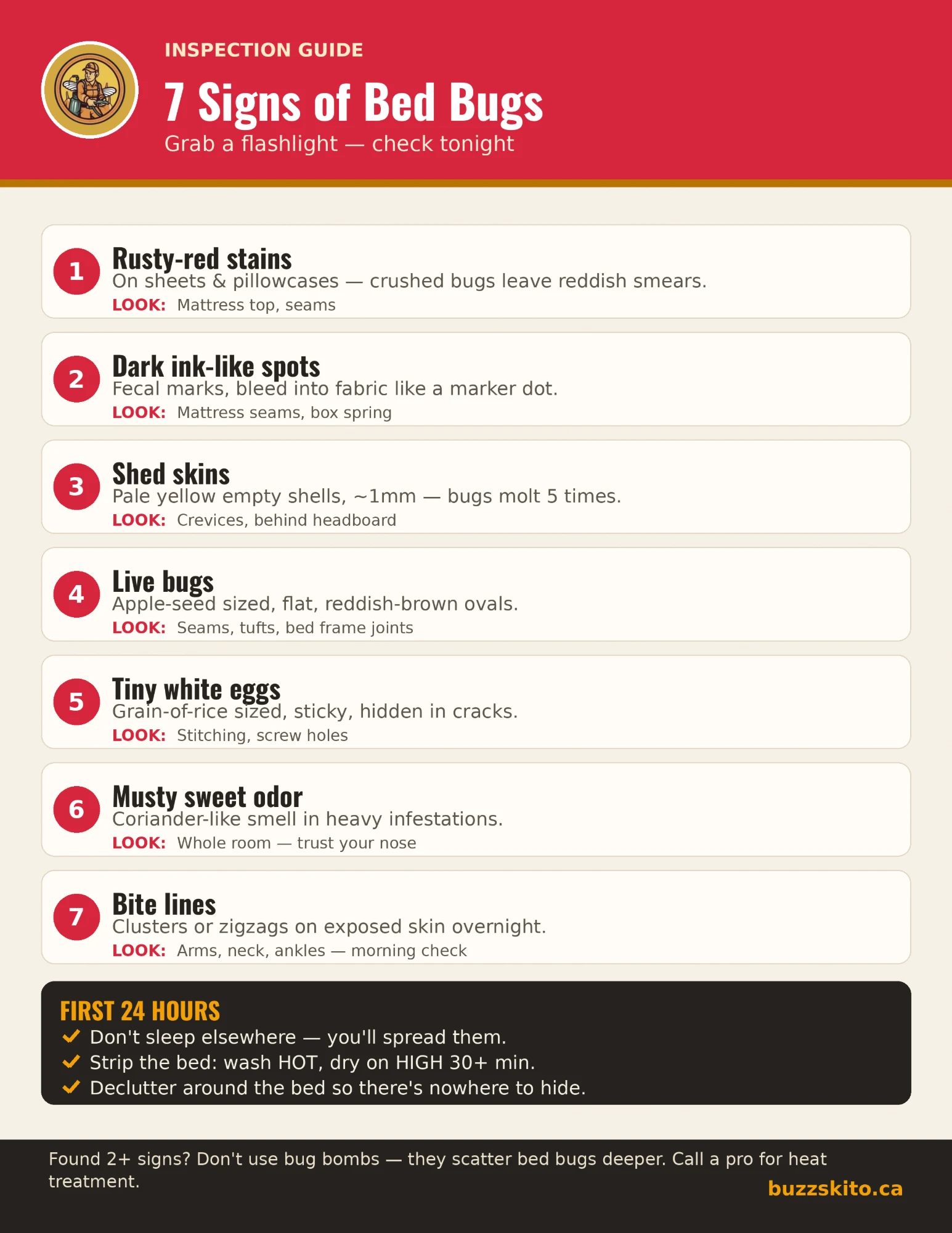 Signs of Bed Bugs: A 7-Point Checklist to Run TonightThe seven signs of bed bugs, from live bugs and ink-like spots to bites, with where to look tonight, what each is…
- What Kills Bed Bugs Instantly in Canada — The Short List That Works on Contact, and Why…What kills bed bugs instantly in Canada: steam, direct heat and a registered contact spray — plus why alcohol is a fire…
- Best Bed Bug Detector Canada 2026 — Passive Interceptors vs Active Monitors ComparedThe best bed-bug detectors and monitors in Canada: passive interceptor traps (Aspectek) vs glue-strip monitors…