BuzzSkito Mosquito & Tick Control Specialists · Published July 9, 2026 · Updated July 12, 2026
As an Amazon Associate I earn from qualifying purchases. BuzzSkito only points to products we would genuinely use or recommend, at no extra cost to you.
What “Questing” Actually Looks Like
Ticks have exactly one way of getting onto you, and it is not dramatic. A tick climbs to the top of a grass blade, a weed, or a low shrub, anchors itself with its back legs, and stretches its front legs out into the air. This posture is called questing. The tick’s front legs carry sensors that detect body heat, carbon dioxide from breath, vibration, and shadow. When a warm body brushes the plant, the tick grabs the fur or clothing and climbs aboard. That is the entire mechanism — no flight, no leap, no ambush from above.
Because questing depends on something touching the plant, ticks concentrate exactly where people and pets walk: the edge of the lawn, the margins of trails, unmowed grass, and the leaf-littered transition zone where your yard meets woods or a ravine.
Questing exists because a tick has no other option. Ticks are eight-legged arachnids, not insects, and no arachnid has ever evolved wings — the tick vs insect comparison walks through the body-plan differences that rule out flight and jumping in the first place.
Because a tick boards low and then crawls, the one you find is usually still walking or only just attached — which is when a fine-tipped remover earns its place: it grips right at the mouthparts and lifts the tick straight out without squeezing it. Check price on Amazon.ca →
Why People Think Ticks Jump or Fall From Trees
Two things fuel the myths. First, ticks are often found on the upper body — the scalp, neck, or behind the ears — which makes it feel like they dropped from above. In reality the tick almost always latched onto a lower leg during questing and then crawled upward over several minutes looking for a sheltered place to feed. Second, people confuse ticks with fleas. Fleas genuinely jump, and a bite that came with a visible hop was a flea, not a tick.
How High Do Ticks Climb?
In Ontario, ticks quest low. Nymphs (the poppy-seed-sized immature stage responsible for most Lyme transmission) usually wait within a few centimetres to about ankle height. Adult blacklegged ticks climb a bit higher, to roughly knee height, on taller grass and brush. None of them climb to head height to attack. This is why the classic prevention — tuck your pants into your socks, wear light colours, and treat footwear and pant legs with permethrin — works so well: it blocks ticks at the exact height they board.
Factory pre-treated permethrin clothing (the format sold to Canadian consumers, intended for ages 16 and over) covers exactly that ankle-to-knee boarding band, socks and trouser legs included. Check price on Amazon.ca →
What This Means for Protecting Your Yard
Because ticks can only reach you from vegetation they have climbed, yard control is genuinely effective:
- Mow to 3–4 inches. Short grass gives ticks nowhere to quest and dries out the ground-level humidity they need.
- Clear leaf litter at yard edges every spring and fall — it is where blacklegged ticks overwinter and stay damp.
- Create a 3-foot wood-chip or gravel barrier between lawn and any woods, ravine, or tall grass. Ticks avoid crossing the dry, sunny strip.
- Discourage mice and deer — mice are the main host for immature ticks. Store firewood off the ground and don’t feed wildlife.
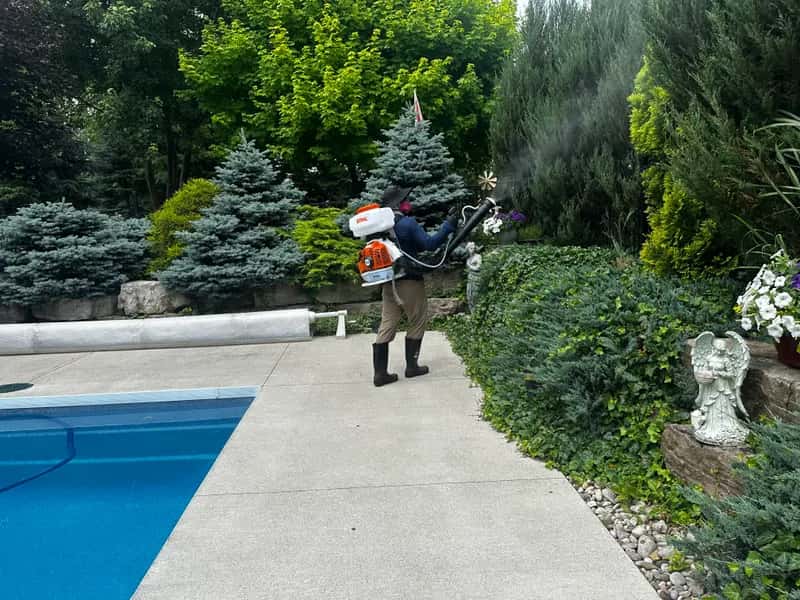
- Professional barrier spray. BuzzSkito’s tick barrier treatment targets the lawn edges, leaf litter, and shaded borders where ticks quest, re-applied through the season as the residual wears off.
Because a questing tick crawls slowly for minutes to hours before it bites, a tick check after time outdoors usually catches it in time. Keep a fine-tipped removal tool handy so you can grip a tick close to the skin and pull straight out. Check tick-removal tools on Amazon.ca →
As an Amazon Associate I earn from qualifying purchases. Price shown on Amazon.ca, at no extra cost to you.
🏆 Our Top Pick — Tick Removal Tool
8.7/10· BuzzSkito ratingSince a questing tick wanders for minutes to hours before it bites, having the right tool on hand is what turns a tick check into a clean removal. A pointed, fine-tipped remover grips a tick close to the skin so you can pull straight out without squeezing the body — the method that lowers infection risk. Compact enough for a hiking pack, gym bag, or the junk drawer by the back door.
Pros
- Fine tip grips even poppy-seed-sized nymphs
- Pulls straight out without crushing the tick
- Pocket-sized for trail and yard
Cons
- Needs a steady hand on small nymphs
- Not a substitute for daily tick checks
How Ticks Find a Host in the United States: Blacklegged, Lone Star and American Dog Ticks
No tick in the United States flies or jumps: the blacklegged tick, the lone star tick and the American dog tick all wait on grass and low shrubs for a host to pass, and they differ in where they live and in how actively they go after one. As the Centers for Disease Control and Prevention (CDC) describes it, a tick picks a place to wait by identifying a well-used path, grips a leaf or grass blade with its third and fourth pairs of legs and holds the first pair outstretched; once aboard, it needs anywhere from 10 minutes to 2 hours to get ready to feed, depending on its species and life stage.
- Blacklegged tick (deer tick). The CDC’s guide to where ticks live places it across the eastern United States, and it is the only one of these three that the guide lists as a carrier of the Lyme disease bacteria. Adults prefer large hosts such as deer and wait about knee-high on the branch tips of low shrubs, according to the University of Rhode Island’s TickEncounter program.
- Lone star tick. The CDC describes this tick of the Northeast, South and Midwest as very aggressive toward people. TickEncounter’s lone star tick profile says adults wait on tall grass in shade or on the tips of low branches, while nymphs board at shoe-to-shin level and crawl fast enough to be waist-high by the time they are noticed.
- American dog tick. The same CDC guide lists it as widely distributed east of the Rocky Mountains, and it favors open ground: TickEncounter’s American dog tick page places it along forest edges, grassy fields, walkways and trails, waiting in tall grass and low brush, and says its larvae and nymphs rarely attach to people or pets.
Waiting is not the only way a tick closes the gap. University of Missouri Extension notes that ticks can also detect a stationary host and may travel up to 32.8 feet to climb onto it, and Rutgers New Jersey Agricultural Experiment Station says lone star ticks can actively pursue hosts by following carbon dioxide trails. A person or pet resting in tick habitat can be reached as well as one walking through it.
Telling these three apart starts with their markings, which our guide to what ticks look like at each life stage covers species by species. Lyme risk depends on which tick bit you, so which ticks carry Lyme disease is the next page to check after a bite, and the seed tick guide explains what to do when many tiny larvae board at once.
Dogs brush through the same grass and low brush, so where to check a dog for ticks is worth reading before the next walk, and what kills ticks on clothing, on gear and in the yard covers what to do once you are home. For habitat, treatment and prevention in one place, see the complete tick control guide.
Related Reading
- Bugs That Look Like Ticks (Photo Guide)
- What Ticks Look Like in Ontario
- Tick Season in Ontario — When Ticks Are Active
- How to Keep Ticks Out of Your Yard
- BuzzSkito Tick Control Service
Frequently Asked Questions
Do ticks fly?+
No. Ticks cannot fly — they have no wings at any life stage. Ticks reach a host through a behaviour called "questing": they climb to the tip of a grass blade or leaf, stretch out their front legs, and grab onto any animal or person that brushes past. Because they only travel by hitching a ride, keeping your lawn short and clearing brush along the edges dramatically reduces contact.
Do ticks jump?+
No. Ticks cannot jump — they have no jumping legs and no ability to launch themselves. This is the single most common tick myth. Unlike fleas, which jump up to 30 cm, a tick simply waits on vegetation with its front legs extended and latches on when a host touches the plant. If something bit you and jumped, it was almost certainly a flea, not a tick.
Can ticks fall from trees onto you?+
Very rarely. Ticks do not drop from trees as a strategy — they quest low to the ground, usually below knee height, because that is where hosts pass. The myth that ticks "rain down from trees" persists because people find ticks on their head or neck, but those ticks almost always climbed up from the legs after attaching lower down. Focus your yard defence on grass, leaf litter, and shaded edges, not overhead branches.
How do ticks get on you if they cannot fly or jump?+
Ticks get on you by questing. They climb onto the tip of tall grass, weeds, or low shrubs and hold their front legs out, waiting. When you, a pet, or wildlife brushes against that vegetation, the tick grabs on and crawls upward looking for a place to bite. This is why ticks are picked up at the lawn-to-woods edge, on trail margins, and in unmowed grass — and why a professional barrier spray targeting those exact zones is so effective.
How high can ticks climb?+
Ticks in Ontario typically quest between ground level and about knee height (30–50 cm) on grass blades, weeds, and low brush. Adult blacklegged (deer) ticks climb a little higher than nymphs. They do not climb to head height to attack — any tick found on your upper body crawled there after latching onto your lower legs. Tucking pants into socks and treating footwear/clothing with permethrin stops most bites before they start.
Do ticks move fast?+
No. Ticks are slow crawlers. Once on a host they wander for minutes to hours searching for a feeding spot, which is exactly why prompt tick checks work — you often have time to find and remove a tick before it attaches. In Ontario, a blacklegged tick generally needs to be attached for 24+ hours to transmit Lyme disease, so a daily tick check after outdoor time is one of the most effective preventions there is.
What is the difference between how ticks and fleas reach you?+
Fleas jump — they launch onto a host from the ground or another animal and can leap roughly 100–150 times their body length. Ticks do neither; they climb vegetation and wait to be brushed. This is the fastest way to tell them apart in the yard: if the tiny biting bug jumped, it is a flea; if you found it crawling slowly or already attached, it is a tick. See our guide on bugs that look like ticks for photo comparisons.
Do lone star ticks chase you?+
Yes, in the sense that they crawl toward a host instead of only waiting, though they cannot fly or jump. Rutgers New Jersey Agricultural Experiment Station says lone star ticks can actively pursue hosts by following carbon dioxide trails, where most ticks simply climb vegetation and wait for a host to brush past. The CDC describes the lone star tick as a very aggressive tick that bites people. The University of Rhode Island TickEncounter program says its nymphs board at shoe-to-shin level and crawl fast enough to be waist-high by the time they are noticed. University of Missouri Extension adds that ticks can detect a stationary host and may travel up to 32.8 feet to climb onto it, so sitting still in tick habitat does not keep them away.
Do deer ticks jump or fly?+
No. The deer tick, which the CDC calls the blacklegged tick, cannot fly or jump. The CDC explains that ticks wait in a position called questing, gripping a leaf or grass blade with the third and fourth pairs of legs and holding the first pair outstretched to climb onto a passing host. Adult blacklegged ticks wait about knee-high on the branch tips of low shrubs, according to the University of Rhode Island TickEncounter program. Once aboard, a tick needs from 10 minutes to 2 hours to get ready to feed, the CDC says, and the agency advises a full-body tick check on returning from areas where ticks may be present.