Quick Answer
Yes — Vaughan, Woodbridge, and King City face real, measurable tick risk. Boyd Conservation Area, the Humber River valley, and King Township's Oak Ridges Moraine lands are confirmed blacklegged tick habitat, and five barrier treatments spread roughly monthly from May through September — renewed as each application's residual wears down — cover the active season without leaving a gap.
- Boyd Conservation Area and the Humber River valley are confirmed tick habitat documented by York Region Public Health.
- King Township consistently reports among the highest tick-positive rates in York Region.
- Sesame-seed-sized nymphs peak May–July and cause the majority of Ontario Lyme disease transmissions.
- Kortright Centre's 325 hectares of naturalized land have documented tick activity throughout its trail system.
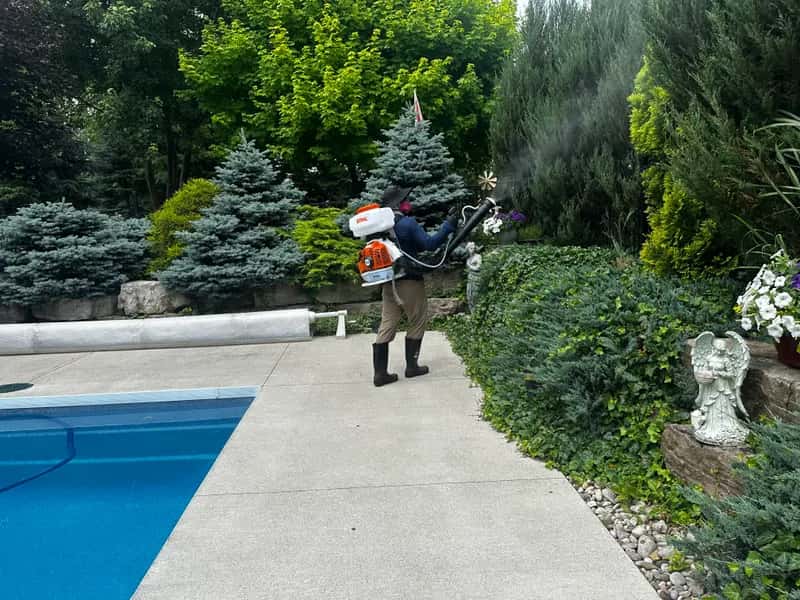
- Treatment targets the 3-metre lawn-to-woods transition strip, fence lines, woodpiles, and shaded lawn sections.
- Highest-risk Vaughan areas: Islington Woods, Weston Downs, Pine Valley, Sonoma Heights, and Kleinburg.
— BuzzSkito, GTA mosquito & tick control · 150+ five-star Google reviews
York Region's rapid residential development has pushed subdivisions right up against some of Ontario's most active tick habitat — Boyd Conservation Area, the Humber River valley, and King Township's Oak Ridges Moraine properties. This guide explains the specific risks for Vaughan, Woodbridge, and King City homeowners. Part of our Ultimate Tick Control Guide for Ontario.
As an Amazon Associate I earn from qualifying purchases. BuzzSkito only points to products we would genuinely use or recommend, at no extra cost to you.
As an Amazon Associate I earn from qualifying purchases. Price shown on Amazon.ca, at no extra cost to you.
🏆 Our Top Pick — For Boyd and Kortright Walks
A barrier spray covers your own yard. It does not follow you onto the Boyd Conservation Area or Kortright trails, and that is where a large share of York Region ticks get onto people and dogs. The other half of the routine is the check when you get back to the car, and a fine-tipped remover that grips at the skin line and lifts the whole tick out — head included — when the check finds one.
Pros
- Grips at the head, so the body is never squeezed
- Small enough for the glovebox and the dog-walking bag
- Works on the sesame-seed nymphs this region produces May to July
Cons
- Easy to misplace without a keyring loop
- Still needs a slow, steady straight pull
Why York Region Has a Serious Tick Problem
York Region Public Health conducts annual tick surveillance and has documented established blacklegged tick populations across multiple areas — particularly in the western portions of the region. The combination of the Oak Ridges Moraine, Humber River corridor, and mature conservation land creates ideal permanent tick habitat adjacent to densely populated residential areas.
Vaughan: Humber River and Boyd Conservation Area
Boyd Conservation Area — located in the Humber River valley just north of Woodbridge — is the highest-confirmed tick location in the Vaughan area. The park's dense forest understory, leaf litter habitat, and abundant white-tailed deer (the primary adult tick host) support a robust year-round blacklegged tick population.
Properties in the following Vaughan neighbourhoods face elevated tick risk due to proximity to Boyd Conservation Area and Humber River tributaries:
- Islington Woods — directly adjacent to Humber River forest corridor
- Weston Downs — borders conservation land to the north and west
- Pine Valley — backs onto Pine Valley Drive forested section
- Sonoma Heights — near Humber River tributary ravines
- Kleinburg — rural character with extensive wooded property edges
Woodbridge: High-Risk Properties
Woodbridge sits in the Humber River valley itself — one of the most continuous wildlife corridors in the GTA. Deer movement along this corridor brings tick-carrying hosts directly through residential back gardens. East Woodbridge properties backing onto the valley, and homes adjacent to Kortright Centre for Conservation, face consistent tick exposure throughout the season.
Kortright Centre — an environmental education facility with 325 hectares of naturalized land — has documented tick activity throughout its trail system. Adjacent residential properties should treat both their lawn perimeters and garden borders as a priority.
If you walk those trails, factory-treated permethrin socks and gaiters, sold ready to wear, are the standard layer for the lower leg, where ticks climb aboard. Check price on Amazon.ca →
King City and King Township: The Highest-Risk Zone
King Township sits at the junction of three significant ecological features:
- Oak Ridges Moraine — running east-west through the township with extensive forest cover and vernal pools ideal for tick breeding habitat
- Agricultural-forest interface — field edges and woodlot borders are the single most productive tick habitat type in Ontario
- Cold Creek Conservation Area — documented tick surveillance site with confirmed blacklegged tick populations
King City village properties, Nobleton-area estates, and rural Schomberg homes with any wooded edges or adjacent fields should be treated as high-priority tick-control properties.
Understanding Tick Life Stages and Timing
| Life Stage | Size | Peak Activity | Disease Risk |
|---|---|---|---|
| Larva | Poppy seed | August | Low (rarely infected) |
| Nymph | Sesame seed | May–July | HIGHEST (tiny, hard to see) |
| Adult female | Apple seed | Oct–Nov / Mar–Apr | Moderate (easier to detect) |
| Adult male | Apple seed | Oct–Nov / Mar–Apr | Low (rarely feeds on humans) |
The nymph stage is the most dangerous because nymphs are tiny enough to be missed during tick checks, yet the majority of Lyme disease transmissions in Ontario occur from nymph bites. Nymphs are not out for a single week, though — they stay active from May right through July, and a barrier application's residual wears down within weeks. That is why we treat five times a season, roughly once a month from May through September, rather than once or twice: the May, June, and July applications keep continuous cover across the entire nymph peak, and skipping a month opens a hole in the barrier during precisely the window you least want to be uncovered.
The later applications are not filler. Adult ticks re-emerge and stay active through the autumn — into November in mild years — so the August and September treatments carry protection past the point most homeowners assume the season has ended. And because deer, mice, and birds move continuously between the Humber valley woodland and adjacent back gardens, ticks are being reintroduced to your property all season long. A barrier is something you renew, not something you apply once and walk away from.
What BuzzSkito Treats and How
Our York Region tick treatments target the specific habitat zones where ticks concentrate:
- Lawn-garden border transition zone — the 3-metre strip where grass meets garden beds or wooded edges
- Fence lines and property perimeters — especially those adjacent to conservation land
- Woodpile and brush pile areas — common resting habitat for deer and therefore ticks
- Shaded lawn sections — ticks desiccate in direct sun and concentrate in shade
- Ornamental garden beds with mulch — leaf litter and mulch are favoured tick micro-habitats
Between visits, the two things worth having in the house are a fine-tipped remover and a small screw-top vial to keep and date any tick you pull off — the attachment date is the first thing a clinician asks about. Check price on Amazon.ca →
See tick-removal tools on Amazon.ca →
Frequently Asked Questions
Are ticks really a problem in Vaughan and Woodbridge?
Yes. Boyd Conservation Area and the Humber River valley — which runs through Woodbridge and Vaughan — are confirmed blacklegged tick habitat areas documented by York Region Public Health. Properties adjacent to these conservation areas face real, measurable tick risk throughout the season.
Why is King City considered high-risk for ticks?
King Township sits at the intersection of the Oak Ridges Moraine and established agricultural lands with extensive forest edge habitat — exactly where blacklegged ticks thrive. The township consistently reports among the highest tick-positive rates in York Region.
Does BuzzSkito serve Vaughan, King City, and Woodbridge?
Yes. BuzzSkito provides professional mosquito and tick barrier spray services across all of Vaughan, Woodbridge, King City, Nobleton, Kleinburg, and surrounding York Region communities. Call (289) 216-5030 for a free quote.
How many tick treatments do I need per season?
BuzzSkito recommends five professional tick treatments per season — roughly one a month from May through September. Each application leaves a temporary residual that wears down over the following weeks, so a monthly cadence is what keeps the barrier continuous instead of lapsing between visits. The May, June, and July applications cover peak blacklegged nymph activity — nymphs are the hardest life stage to spot and are responsible for most Lyme disease transmission — while the August and September applications carry coverage into the autumn, when adult ticks re-emerge and stay active in mild years into November. Because deer, mice, and birds continuously carry ticks back in from adjacent woodland, the barrier has to be renewed month after month rather than applied once or twice. A standalone tick season is $597, or $497 when added to any BuzzSkito mosquito plan.
What areas of my property should be treated for ticks?
Ticks concentrate in the transition zones between lawn and wooded or brushy areas — property edges, garden borders, woodpile areas, and along fence lines. BuzzSkito targets these specific zones with directed applications, as well as leaf litter areas and shaded sections of the lawn.