Quick Answer
Ancaster and Dundas sit at the edge of the Niagara Escarpment — Ontario's most active blacklegged tick corridor — so Escarpment-edge yards carry real, confirmed Lyme risk. Five barrier-spray treatments a season, spaced roughly a month apart from May through September, are the standard treatment schedule here — the residual wears off, and deer keep carrying new ticks back in.
- The Hamilton Conservation Authority has confirmed blacklegged ticks in Dundas Valley Conservation Area.
- Infection rates in established GTA-region tick populations typically run 15–25%.
- Each deer can carry 200–400 adult ticks during peak season and deposit them in yards.
- Nymphs peak from late May through early July and cause most Lyme cases.
- The residual from one application lasts weeks, not months, so five sprays are spaced roughly monthly from May through September.
- BuzzSkito serves Ancaster, Dundas, and all Hamilton neighbourhoods; single treatments start at $99.
— BuzzSkito, GTA mosquito & tick control · 150+ five-star Google reviews
If you live in Ancaster or Dundas, you live at the edge of Ontario's most significant tick corridor. The Niagara Escarpment — which rises directly behind both communities — is not just a hiking destination. It is an established, continuous habitat for blacklegged ticks (Ixodes scapularis), the species responsible for transmitting Lyme disease in Canada. This guide explains the specific risks for Escarpment-edge homeowners and what professional tick control actually does about it.
As an Amazon Associate I earn from qualifying purchases. BuzzSkito only points to products we would genuinely use or recommend, at no extra cost to you.
As an Amazon Associate I earn from qualifying purchases. Price shown on Amazon.ca, at no extra cost to you.
🏆 Our Top Pick — Escarpment-Edge Tick Kit
Fine-Tipped Tick Removal Tool (tweezers + tick key)
On a lot that backs onto Dundas Valley or the Escarpment brow, the question is not whether you will find a tick but when — and the removal goes very differently with a fine-tipped remover than with blunt bathroom tweezers. It grips at the skin and lifts the whole tick straight out without squeezing the body. Keep one by the back door and one in the hiking bag.
Pros
- Grips at skin level for a clean, straight pull
- Small enough to keep one in the car and one at home
- Far less likely to leave mouthparts behind than flat tweezers
Cons
- Fiddly on poppy-seed nymphs without good light
Why Ancaster and Dundas Are High-Risk Tick Zones
Tick risk is not uniform across the GTA. It clusters wherever three conditions overlap: abundant white-tailed deer (the primary reproductive host for adult blacklegged ticks), small rodent populations (particularly white-footed mice, the primary reservoir for the Lyme-causing bacterium), and suitable habitat — specifically, the interface between forested areas and maintained lawns, gardens, and residential landscapes.
Ancaster and Dundas score high on all three. The Niagara Escarpment provides continuous forested habitat running from Niagara-on-the-Lake to the Niagara Peninsula, through Hamilton, and north to the Bruce Peninsula — one of the longest intact wildlife corridors in southern Ontario. Deer populations along this corridor are among the highest in the Hamilton area. And the residential character of both communities — large lots, mature trees, forest-edge gardens — creates exactly the habitat interface where tick-to-human contact most often occurs.
Dundas Valley Conservation Area
The 1,200-hectare Dundas Valley Conservation Area is one of the Hamilton Conservation Authority's most-visited properties — and one of the region's most confirmed tick habitats. The HCA has conducted tick drag surveys here and documented blacklegged tick populations at multiple trail points. The conservation area backs directly onto residential properties in Dundas, Spencer Creek neighbourhoods, and the McMaster-area communities to the east.
If your property in Dundas has a rear lot line that touches, or comes within 100 metres of, any part of the Dundas Valley trail network or conservation boundary, your backyard is within the tick activity zone. This is not speculative — it is confirmed by field surveillance data.
Ancaster Highland Trail and the Escarpment Brow
Ancaster sits at the top of the Escarpment, and the trail network running through the community — including the Bruce Trail and Ancaster Memorial Arts Centre trail — traverses through and adjacent to established residential areas. Properties backing onto the Escarpment face or trail corridors in communities like Ancaster Heights, Scenic Drive-area homes, and the large-lot properties along Sulphur Springs Road and Shaver Road consistently experience tick activity that extends well into maintained backyards.
Deer regularly move through Ancaster residential properties at night — residents commonly observe them in gardens and along fence lines. Each deer carries 200–400 adult ticks during peak season, and every deer that walks through your property can deposit ticks in your leaf litter, lawn edges, and foundation plantings.
The same Escarpment brow runs east across Hamilton and sets up the identical interface above Heritage Green, with the Red Hill ravine cutting down to the lake — we map that half of the city in the Stoney Creek mosquito and tick guide.
The “Interface Zone”: Where Tick Encounters Actually Happen
A common misconception is that tick exposure requires walking in the woods. In practice, the majority of tick bites acquired by GTA homeowners happen within their own backyards — specifically in the 1–2 metre border zone between maintained lawn and natural vegetation: the edge where grass meets garden beds, fence lines where leaf litter accumulates, foundation plantings, compost areas, and wood piles.
Ticks do not fly or jump. They wait — a behaviour called “questing” — at the tips of vegetation or on the surface of leaf litter, forelegs extended, waiting to grab onto a passing host. The interface zone concentrates them precisely where your family and pets are most likely to pass through.
Tick Species in Ancaster and Dundas
Blacklegged Tick (Ixodes scapularis) — Primary Concern
The blacklegged tick is the only species in Ontario capable of transmitting Lyme disease (Borrelia burgdorferi), anaplasmosis, and babesiosis. It is the species confirmed along the Escarpment corridor and in Dundas Valley. Nymphs — the size of a poppy seed — are the stage responsible for most Lyme transmissions, because they are small enough to go unnoticed for the 36–48 hours required for disease transmission.
American Dog Tick (Dermacentor variabilis) — Secondary
The dog tick is larger and more easily spotted. It does not carry Lyme disease but can transmit Rocky Mountain spotted fever (rare in Ontario) and causes tick paralysis. It is common in grassy, sunny areas across southern Ontario and is less associated with the Escarpment forest than the blacklegged tick.
What Professional Tick Control Does
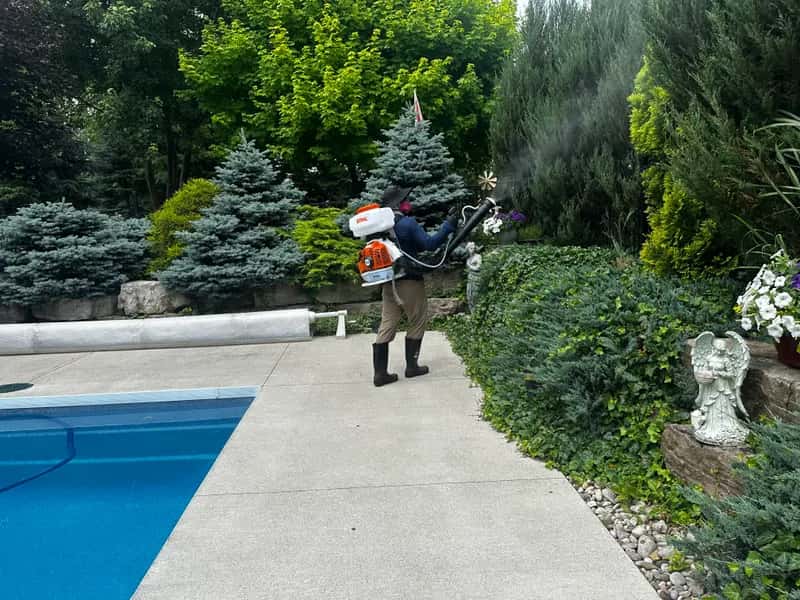
BuzzSkito's tick barrier treatment focuses on the interface zone — the perimeter of your property where natural vegetation meets maintained lawn. The formula is applied to:
- The leaf litter and ground-level vegetation at garden and natural area borders
- Fence lines and hedgerows where ticks accumulate
- Foundation plantings along the house perimeter
- Wood pile areas and compost borders
- Any area where Escarpment or conservation-area vegetation encroaches onto the property
The formula leaves a residual on the treated leaf litter and shaded edges that persists for weeks, not days — but it is not a one-time fix, and it wears off. Five treatments per season, spaced roughly a month apart from May through September, are what hold that barrier continuously. Nymphs are emerging from late May through July, adults come back through the autumn, and deer, mice, and birds re-seed the property from the Escarpment the whole time — so the treatment has to be renewed as the residual fades, not applied once and left.
This is the practical argument against a one-off or twice-yearly visit on an Escarpment-edge lot: two sprays leave a multi-month hole in the middle of the season, and that hole falls squarely over nymph peak — the stretch with the highest Lyme transmission risk and the heaviest backyard use. Monthly coverage closes it.
Recommended Tick Control Schedule for Ancaster and Dundas
| Treatment | Timing | Target Stage | Why It Matters |
|---|---|---|---|
| Tick Treatment 1 | Early May | Overwintered adults | Knocks down the adults that survived winter and became active with the thaw, before nymphs emerge |
| Tick Treatment 2 | Late May / early June | Nymphs | Highest Lyme transmission risk — nymphs are poppy-seed sized and most bites go unnoticed |
| Tick Treatment 3 | Early July | Nymphs | Holds the barrier through the tail of nymph season, when backyard use is at its heaviest |
| Tick Treatment 4 | August | Nymphs and adults | The July residual has faded and deer, mice, and birds keep bringing new ticks in from the Escarpment |
| Tick Treatment 5 | September | Adults | Adult ticks re-emerge in fall and remain active until ground freeze — into November in mild years |
That five-visit schedule is the baseline we recommend for every Escarpment-edge property, not an upgrade. On the highest-pressure lots — directly adjacent to conservation lands, forest edges, or with confirmed deer traffic — the mid-season treatments in July and August are doing as much work as the ones timed to the nymph and adult peaks, because those are the yards being re-seeded with ticks continuously all summer.
The same Escarpment corridor runs east past Waterdown and the RBG into Halton, where the timing shifts slightly with the lake. If your property sits on that side, tick season in Burlington maps the activity months onto the escarpment edge and the lakefront neighbourhoods there.
Our standalone tick season is $597 for the five treatments, or $497 when bundled with any mosquito plan — a $100 saving, and most Escarpment-edge properties want both. A single one-off treatment starts at $99 if you would rather see the results before committing to the season.
What to Do After a Tick Bite in Ancaster or Dundas
If you find a tick on yourself or a family member, remove it immediately using fine-tipped tweezers, grasping as close to the skin as possible. Do not twist — pull straight out with steady pressure. Clean the bite area with rubbing alcohol. Photograph the tick before disposing of it. Monitor the bite site for 30 days for the characteristic “bull's eye” rash (erythema migrans) — which appears in approximately 70–80% of Lyme cases — or flu-like symptoms. If either develops, seek medical attention immediately and inform your doctor of the tick bite.
The tool matters here: a fine-tipped tick remover or pointed tweezers grips the head against the skin, where flat household tweezers tend to squeeze the body instead. Check price on Amazon.ca →
For a full step-by-step guide, see our Ontario tick bite guide.
For the trail days themselves — Dundas Valley, the Bruce Trail, the Ancaster Highland loops — the standard advice for the ticks a yard treatment cannot reach is a repellent whose label lists icaridin or DEET, light-coloured pants tucked into socks, and a tick check when you get home. Check price on Amazon.ca → See tick repellent on Amazon.ca →
Frequently Asked Questions
Does BuzzSkito serve Ancaster and Dundas?
Yes. BuzzSkito provides professional mosquito and tick barrier spray services across Ancaster, Dundas, and all Hamilton neighbourhoods. Both communities are within our core service area. Call (289) 216-5030 for a free quote.
Are blacklegged ticks confirmed in Ancaster and Dundas?
Yes. The Hamilton Conservation Authority and Public Health Ontario have both documented established blacklegged tick populations along the Niagara Escarpment through Hamilton's west end, including Dundas Valley Conservation Area and the Ancaster area trail network. Tick drag surveys by the Hamilton Conservation Authority have found infected ticks along multiple trail segments in this corridor.
What is the Lyme disease risk in Ancaster and Dundas?
Hamilton Public Health reports Lyme disease cases every year, with the Escarpment corridor — including Dundas Valley and the Ancaster Highland trail network — identified as a higher-risk zone within the city. The infection rate in ticks in established GTA-region populations typically runs 15–25%. Even one tick bite from an infected tick carries a real risk of Lyme transmission, particularly if the tick is not found and removed within 36–48 hours.
When are ticks most active in Ancaster and Dundas?
There are two peak activity periods. Nymphs — the small, hard-to-see juvenile ticks responsible for the majority of Lyme disease cases — peak from late May through early July. Adult ticks are active in spring and again in October–November, remaining active until ground freeze. Tick risk in the Escarpment corridor is not a summer-only concern — it begins as early as late March in mild years.
Do I need tick treatment if I have a fenced backyard?
A fence does not prevent tick exposure. Ticks are carried onto properties by white-tailed deer, small mammals (mice, chipmunks, squirrels), and birds — all of which easily cross or enter standard residential fencing. Properties backing onto ravines or conservation land in Ancaster and Dundas consistently have tick activity inside fenced yards. Professional perimeter treatment targets the ticks those animals leave along your yard's edges.
Related Guides
- Hamilton Mosquito Control Services
- Mosquito & Tick Control in Hamilton & Burlington
- The Ultimate Tick Control Guide for Ontario Homeowners
- Lyme Disease Prevention in Ontario
- Tick Bite Symptoms & What to Do in Ontario
- How to Identify Ticks in Ontario
- The Ultimate Backyard Mosquito Control Guide (GTA Edition)