BuzzSkito Mosquito & Tick Control Specialists · Published July 13, 2026 · Updated October 8, 2026
As an Amazon Associate I earn from qualifying purchases. BuzzSkito only points to products we would genuinely use or recommend, at no extra cost to you.
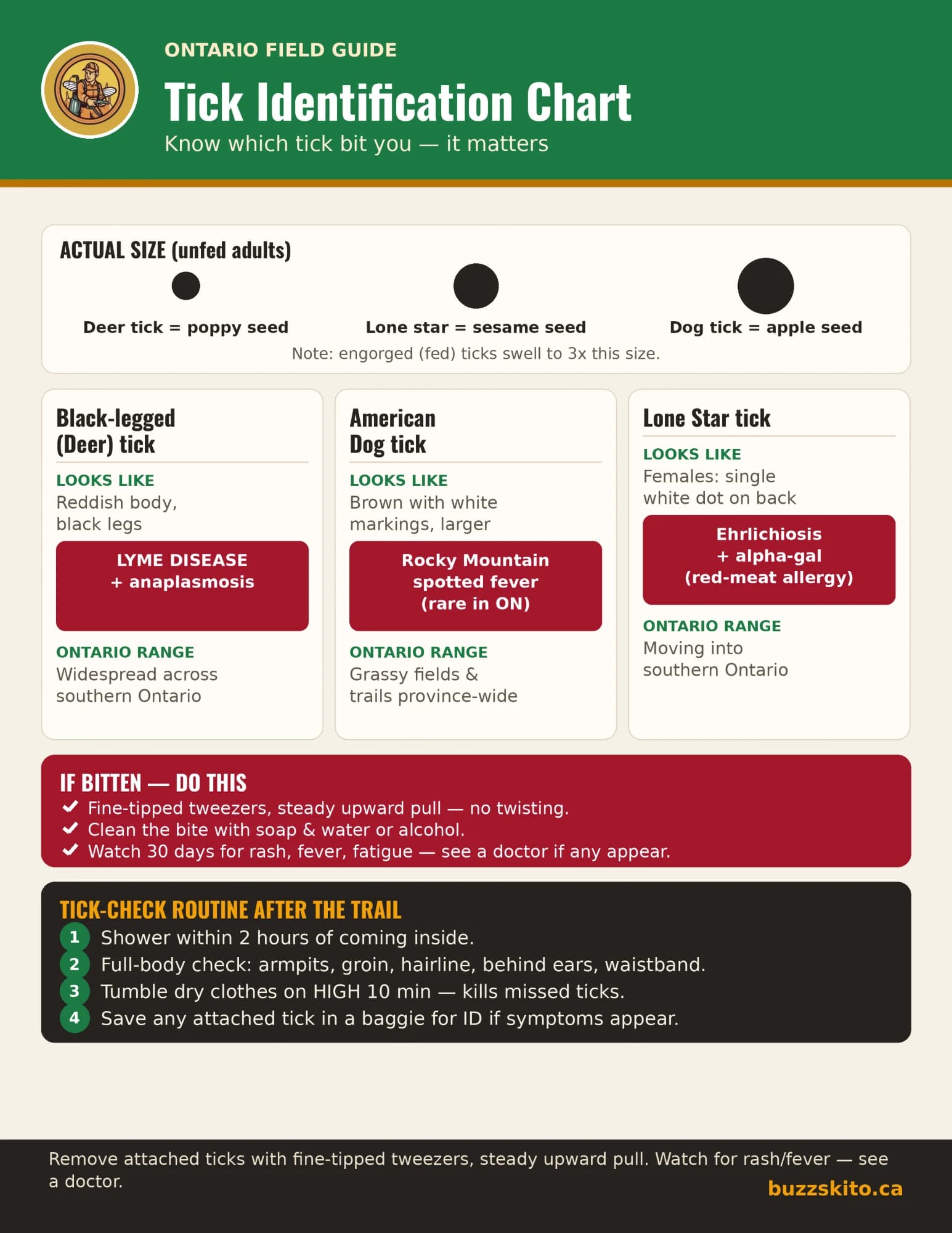
Finding a tick is unsettling — but the species you are looking at changes everything about the risk and what you should do next. This hub is the master identification page: use the chart above to narrow it down fast, then follow the links to a detailed close-up guide for each specific tick. Below, we walk through the four features that actually let you tell ticks apart, then hit each common North American species one by one.
If the tick you are identifying is still attached, deal with that first: a fine-tipped remover grips at skin level and lifts it straight out, and you can identify it afterwards from the sealed bag. Check price on Amazon.ca →
The 4 Features That Identify Any Tick
You do not need to be an entomologist. Nearly every backyard tick ID comes down to four things:
- Size & life stage. Is it sand-grain small (larva), poppy-seed small (nymph), or sesame-seed sized (adult)? A swollen, bean-like body means it has already fed. See baby ticks, nymphs & seed ticks for the tiny stages.
- Body colour. Reddish-orange, chocolate brown, or grey. Blacklegged ticks skew reddish; Dermacentor ticks (dog and wood ticks) are brown.
- Scutum markings. The scutum is the hard shield just behind the head. A plain, unmarked scutum points to a blacklegged tick; white or grey marbling points to an American dog or wood tick; a single white dot means a female lone star tick.
- Legs & mouthparts. Adults and nymphs have 8 legs; larvae have 6. Blacklegged ticks have distinctly dark (“black”) legs. Lone star ticks have noticeably long mouthparts.
All four of those features are easier to read under magnification — a 3 mm adult’s scutum marbling, and the leg count on a nymph, are hard to call with the naked eye. A 10x hand lens or jeweller’s loupe is the one ID tool worth keeping with the first-aid kit. Check price on Amazon.ca →
Blacklegged (Deer) Tick — Ixodes scapularis
This is the tick that spreads Lyme disease, and the one to learn best. Adults are small (about 3–4 mm unfed), with a reddish-orange rear half, a solid dark scutum, and uniformly dark legs — hence “blacklegged.” There is no white or ornate patterning on the back. The nymph, active in late spring and summer, is only about the size of a poppy seed and is responsible for the majority of Lyme cases because it goes unnoticed. A blacklegged tick generally needs to be attached for 24 hours or more to transmit Lyme, so prompt removal matters. For a full close-up and range map, see our blacklegged / deer tick guide, and to tell it apart from the look-alike dog tick, our deer tick vs dog tick comparison.
American Dog Tick — Dermacentor variabilis
Larger and easier to spot than the deer tick, the American dog tick has a brown body with distinctive white or greyish marbling on the scutum. Unfed adults are about 5 mm; a fully engorged female can reach 10–15 mm and look like a grey bean. It does not spread Lyme, but it can transmit Rocky Mountain spotted fever and tularemia. This is the tick people most often mistake for a deer tick — the giveaway is the ornate back pattern, which a blacklegged tick never has. Full details in our American dog tick guide.
Lone Star Tick — Amblyomma americanum
Named for the single white dot on the female’s back (males have scattered white streaks instead), the lone star tick is reddish-brown, aggressive, and has notably long mouthparts. Historically a southeastern US tick, its range is expanding northward and it now turns up in the northeastern states and, increasingly, parts of Ontario. It is associated with ehrlichiosis, Southern tick-associated rash illness (STARI), and alpha-gal syndrome — a delayed red-meat allergy triggered by its bite. It does not spread Lyme.
Whether that matters in an Ontario backyard is a separate question from whether the species exists on the continent. The lone star tick is not established in Canada, and the specimens logged here each year are mostly carried north by migratory birds. For its actual Canadian status, the delayed 2–6 hour reaction pattern that makes alpha-gal so easy to miss, and how much GTA residents really need to worry, see our lone star tick and alpha-gal risk guide for Canada.
Brown Dog Tick — Rhipicephalus sanguineus
The brown dog tick is unusual: it can complete its entire life cycle indoors, which means infestations in homes, kennels, and dog runs across both the US and Canada. It is a uniform reddish-brown, elongated when unfed, roughly 3 mm, swelling to about 12 mm when engorged, with no clear back pattern and a hexagonal base to the mouthparts. It strongly prefers dogs as hosts but will bite people. In some regions it can transmit Rocky Mountain spotted fever.
Rocky Mountain Wood Tick — Dermacentor andersoni
A western counterpart to the American dog tick, the Rocky Mountain wood tick is brown with a grey/white mottled scutum and is found in the western US and Canada (British Columbia, Alberta, Saskatchewan). Adults are about 5 mm unfed. It can transmit Rocky Mountain spotted fever, Colorado tick fever, and — in rare cases — tick paralysis, a temporary paralysis caused by a toxin in the tick’s saliva that resolves once the tick is removed. Under a hand lens it is hard to separate from the American dog tick; range is the easiest clue.
Because range is so often the deciding clue, it helps to know which species are established where you live: are there ticks in Canada? works through the answer province by province.
Not Sure It’s Even a Tick?
Plenty of harmless bugs get mistaken for ticks — from engorged bed bugs and poppy-seed-sized beetles to spider beetles and even clumps of dirt. Legs are the fastest test: ticks have 8 (6 as larvae) and no wings or antennae. If yours has wings, more than 8 legs, or long antennae, it is not a tick. Compare side-by-side in our bugs that look like ticks photo guide, and see the full visual reference in what ticks look like.
The reason that leg test works so reliably is taxonomic: every tick on this page belongs to the class Arachnida, so counting eight legs settles the arachnid-versus-insect question before you ever get to species.
If You Found a Tick on You
Regardless of species, act the same way: grip the tick with fine-tipped tweezers as close to the skin as possible and pull straight up with steady, even pressure — no twisting, burning, or smothering with petroleum jelly. Clean the bite, then note the date and, if you can, the species. Keeping a proper removal tool on hand makes this cleaner and reduces the chance of leaving mouthparts behind. Check tick-removal tools on Amazon →
As an Amazon Associate I earn from qualifying purchases. Price shown on Amazon.ca, at no extra cost to you.
🏆 Our Top Pick — Tick Removal Tool
8.7/10· BuzzSkito ratingFine-Tipped Tick Removal Tool Set
For a tick already attached, a dedicated fine-tipped remover grips right at the skin and lifts straight out — cleaner and safer than fingernails, and far less likely to crush the tick or leave mouthparts behind. A cheap, keep-it-in-the-first-aid-kit essential for anyone in tick country.
Pros
- Grips at skin level to lift the whole tick
- Reduces the chance of leaving mouthparts
- Inexpensive first-aid-kit staple
Cons
- Not a substitute for prompt yard treatment
- Fine tips need steady hands on tiny nymphs
Watch the bite site over the following days and weeks for an expanding erythema migrans (bull’s-eye) rash, fever, aches, or fatigue, and see a doctor if any appear — early treatment is highly effective. Prevention does not change with the species — every tick on this chart is kept off the same way: EPA- and Health-Canada-registered repellents containing DEET or picaridin on skin, plus a permethrin spray on clothing, gear and the yard edges where ticks wait, are the evidence-backed choices. Compare insect shield permethrin treated clothing →
Explore Each Tick in Detail
- Blacklegged / Deer Tick — full ID & range
- American Dog Tick — identification guide
- Deer Tick vs Dog Tick — side-by-side
- Baby Ticks, Nymphs & Seed Ticks
- What Ticks Look Like (photo reference)
- Bugs That Look Like Ticks
- Are Ticks Dangerous? Disease Risk Explained
- BuzzSkito Professional Tick Control
Types of Ticks in the United States, by Region
The CDC’s Where Ticks Live page lists eight tick species in the United States, and which ones you meet depends mostly on your region. They are the six on the chart at the top of this page plus the Gulf Coast tick and the Asian longhorned tick, and the agency notes that populations may be found outside the areas shaded on its range maps.
- Eastern states. The blacklegged tick is widely distributed across the eastern United States. Beyond Lyme disease, anaplasmosis and babesiosis, the CDC lists Powassan virus disease, ehrlichiosis and hard tick relapsing fever for it. Lyme occurs most commonly in the Northeast, mid-Atlantic and upper Midwest, according to the CDC’s Lyme disease overview.
- East of the Rockies. The American dog tick is widely distributed here, and a newly described relative, Dermacentor similis, is found west of the Rockies.
- Northeast, South and Midwest. The lone star tick is widely distributed across all three, and the CDC adds tularemia, Heartland virus and Bourbon virus to its list.
- Southeast. The Gulf Coast tick (Amblyomma maculatum) lives mainly in the southeastern states, with focal populations in the Northeast, Midwest and Southwest. It transmits Rickettsia parkeri rickettsiosis, a form of spotted fever.
- Rocky Mountain states. The Rocky Mountain wood tick is found at elevations of 4,000 to 10,500 feet and can also transmit tularemia.
- Pacific coast. The western blacklegged tick lives along the coast, particularly in northern California, and can also transmit hard tick relapsing fever.
- Southwest. The brown dog tick is found worldwide, but the CDC ties its Rocky Mountain spotted fever transmission to the southwestern states and the US-Mexico border.
The Asian longhorned tick (Haemaphysalis longicornis) is the newcomer: the USDA’s Animal and Plant Health Inspection Service dates its first detection outside a US port of entry to New Jersey in November 2017. The CDC listed it in 20 states as of April 12, 2024, and says it appears less attracted to people than native ticks.
For the markings on the main US species, including the Gulf Coast tick, see what ticks look like at each life stage, and if Lyme is the worry, read about the two US ticks that carry Lyme disease. A cluster of tiny six-legged ticks is covered in seed ticks and how to remove dozens at once, and ticks in Michigan shows one state’s picture county by county.
Dog owners can start with where to check a dog for ticks, and what kills ticks on clothing, on gear and in the yard separates proven methods from popular ones that fail. The complete tick control guide explains where ticks hide in a yard and how to keep them out.
Frequently Asked Questions
What are the main types of ticks?+
The tick types most people in North America encounter are the blacklegged (deer) tick, the American dog tick, the lone star tick, the brown dog tick, and the Rocky Mountain wood tick. They differ in size, colour, scutum (back-plate) markings, geographic range, and the diseases they carry. The blacklegged tick spreads Lyme disease; the American dog tick and Rocky Mountain wood tick can spread Rocky Mountain spotted fever; the lone star tick is linked to alpha-gal syndrome and STARI.
How do you identify a tick?+
Identify a tick by four features: overall size and life stage (larvae are ~1 mm, nymphs ~1–2 mm poppy-seed-sized, unfed adults ~3–5 mm), body colour, the pattern on the scutum (the hard shield behind the head), and leg count (all adult and nymph ticks have 8 legs; larvae have 6). A reddish-brown body with solid black legs and no back markings usually means a blacklegged/deer tick, while a brown tick with white or grey mottling on the scutum points to an American dog tick or wood tick.
Which tick carries Lyme disease?+
In North America, Lyme disease is spread almost exclusively by the blacklegged tick (Ixodes scapularis) in the east and Midwest, and the western blacklegged tick (Ixodes pacificus) on the Pacific coast. The American dog tick, lone star tick, and Rocky Mountain wood tick do NOT transmit Lyme. That is why identifying the tick matters: a blacklegged nymph attached 24+ hours is the main Lyme risk, whereas a dog tick bite carries different (still serious) disease risks.
What does a deer tick look like versus a dog tick?+
A deer (blacklegged) tick is small — an unfed adult female is about 3–4 mm — with a reddish-orange rear body, a solid dark scutum, and uniformly dark, black legs, and NO white markings. An American dog tick is larger (adult ~5 mm, up to 10–15 mm engorged) with a brown body and distinctive white or greyish marbling on the scutum. If the tick has ornate white patterning on its back, it is not a deer tick.
How big is a tick?+
Tick size depends on life stage and whether it has fed. Larvae are about 0.5–1 mm (like a grain of sand), nymphs about 1–2 mm (like a poppy seed), and unfed adults about 3–5 mm (like a sesame seed to a small apple seed). After a full blood meal a tick can swell to 10 mm or more — an engorged female looks like a grey or brown bean. This is why nymphs cause most disease transmission: they are small enough to go unnoticed for days.
What is the difference between a nymph tick and an adult tick?+
A nymph is the immature stage between larva and adult. Nymphs are roughly poppy-seed-sized (1–2 mm), have 8 legs, and are responsible for most Lyme disease cases because they are hard to spot. Adults are larger (3–5 mm unfed, 8 legs) and easier to find and remove. Larvae, the earliest stage, have only 6 legs and are about 0.5–1 mm. See our guide to baby ticks, nymphs and seed ticks for close-up comparisons.
Are all ticks dangerous?+
Not every tick carries disease, and not every bite transmits infection — but you cannot tell an infected tick from a clean one by looking. Disease risk depends on the tick species, whether it carries a pathogen, and how long it stays attached (a blacklegged tick generally needs 24+ hours to transmit Lyme). The safest approach is to identify the tick, remove it promptly with fine-tipped tweezers, and watch the bite site for a rash or symptoms.
What should I do if I find a tick on me?+
Remove it promptly: grip the tick with fine-tipped tweezers as close to the skin as possible and pull straight up with steady pressure — do not twist, burn, or smother it. Clean the bite with soap and water or antiseptic. Note the date, and if you can, identify the tick species and save it in a sealed bag or photo. Watch for an expanding erythema migrans (bull’s-eye) rash, fever, or fatigue over the following weeks, and see a doctor if symptoms appear.
What does a deer tick look like?+
A deer (blacklegged) tick is small and plain — an unfed adult is about 3–4 mm with a reddish-orange rear body, a solid dark scutum (back-plate), and uniformly dark, almost black legs, with no white or ornate markings. Nymphs are far smaller, roughly poppy-seed sized (1–2 mm), which is why they cause most Lyme cases. After feeding, the body swells and turns greyish. If a tick is tiny, plain, and dark-legged, treat it as a deer tick.
What does a lone star tick look like, and is it in Ontario?+
The lone star tick (Amblyomma americanum) is reddish-brown with notably long mouthparts; the adult female has a single distinctive white dot on her back, while males show scattered white streaks. It is mainly a southeastern and eastern US tick whose range is expanding northward, and it turns up in Ontario only occasionally rather than being firmly established. It does not spread Lyme, but is linked to ehrlichiosis, STARI, and alpha-gal (red-meat) allergy, per the CDC.
What colour are ticks?+
Tick colour varies by species and by how much they have fed. Blacklegged (deer) ticks have a reddish-orange body with a dark scutum and black legs; American dog and Rocky Mountain wood ticks are brown with white or grey marbling; lone star ticks are reddish-brown; brown dog ticks are a uniform reddish-brown. Once engorged with blood, most ticks darken to a grey, blue-grey, or tan bean-like colour regardless of species.
What does an engorged tick look like?+
An engorged tick — one that has fed — looks like a smooth, swollen, greyish or brown bean or small grape attached to the skin, quite different from a flat unfed tick. A fully fed adult can reach 10 mm or more, with the legs and tiny head appearing small against the ballooned body. Colour typically shifts to grey, blue-grey, or tan. Roughly, the more engorged the tick, the longer it has been attached.
What types of ticks are found in the United States?+
The CDC lists eight tick species in the United States: the American dog, Asian longhorned, blacklegged, brown dog, Gulf Coast, lone star, Rocky Mountain wood, and western blacklegged ticks. Which ones you meet depends on region. Blacklegged ticks are widely distributed across the eastern states, American dog ticks east of the Rocky Mountains, lone star ticks across the Northeast, South, and Midwest, Gulf Coast ticks mainly in the Southeast, Rocky Mountain wood ticks at 4,000 to 10,500 feet in the Rocky Mountain states, and western blacklegged ticks along the Pacific coast. The brown dog tick is found worldwide.
What is the Asian longhorned tick, and does it bite people?+
The Asian longhorned tick (Haemaphysalis longicornis) is native to eastern China, Japan, Korea, and the Russian Far East. The USDA dates its first detection outside a US port of entry to New Jersey in November 2017, and the CDC listed it in 20 states as of April 12, 2024. According to the CDC, it has been found on pets, livestock, wildlife, and people, but appears less attracted to humans than native ticks such as the blacklegged tick. Females can lay eggs without mating, and thousands may be found at a time in grass or shrubs or on an animal.