Quick Answer
Caledon and Halton Hills are among Ontario’s highest tick-activity areas outside cottage country because they sit where the Oak Ridges Moraine meets the Niagara Escarpment, with high deer density; blacklegged ticks there peak in spring (April–June nymphs) and fall (September–November adults).
- Caledon sits at the western convergence of the Oak Ridges Moraine and the Niagara Escarpment — two of Ontario’s most tick-productive features.
- Spring nymphs (April–June) are just 1–2 mm and drive the highest Lyme transmission risk because they are so hard to detect.
- Fall adult ticks (September–November) can transmit Lyme if attached for more than 24–36 hours.
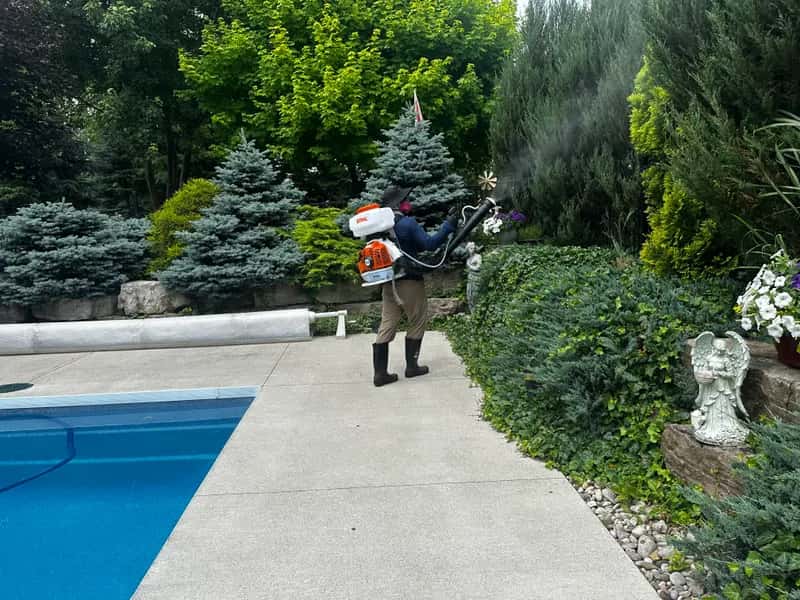
- A BuzzSkito tick season for rural Caledon and Halton Hills properties is five treatments, roughly monthly from May through September, covering both the spring nymph and fall adult peaks.
- BuzzSkito treats the 3-metre transition margin between lawn and woodlot, where ticks concentrate — not the forest interior.
- High-risk pockets include Glen Williams, Georgetown edges, Limehouse, Norval and Silver Creek, Bolton, Caledon East, and Palgrave.
— BuzzSkito, GTA mosquito & tick control · 150+ five-star Google reviews
Caledon and Halton Hills are among the most beautiful places to live in the GTA region — and also among the highest tick-activity areas in Ontario outside of cottage country. This guide explains why, where risk is concentrated, and how professional treatment protects rural properties. See our Caledon tick control and Halton Hills tick control service pages.
As an Amazon Associate I earn from qualifying purchases. BuzzSkito only points to products we would genuinely use or recommend, at no extra cost to you.
As an Amazon Associate I earn from qualifying purchases. Price shown on Amazon.ca, at no extra cost to you.
🏆 Our Top Pick — Rural Tick Kit
Fine-Tipped Tick Removal Tool Kit
On a moraine or escarpment property the question is not whether a tick turns up but what you do in the first minute after it does. A fine-tipped remover grips right at the skin and lifts the tick straight out, head and all — keep one by the back door, one in the truck, and one in the barn or shed.
Pros
- Grips the head at skin level for whole-tick removal
- Small enough to keep several around a rural property
- Far better than fingernails or blunt household tweezers
Cons
- Easy to misplace — buy a multi-pack
- Still needs a slow, straight pull
Why Caledon Tops the GTA’s Tick Risk Charts
Caledon’s tick risk comes from geography more than anything else. The municipality sits at the western convergence of two of Ontario’s most significant ecological features:
- Oak Ridges Moraine (western end): The moraine’s forest-wetland mosaic creates ideal tick habitat and supports the white-footed mice and white-tailed deer populations that sustain blacklegged tick colonies.
- Niagara Escarpment: The Escarpment runs through the southern part of Caledon, with extensive wooded slopes, the Bruce Trail, and conservation areas including Albion Hills, Humber Valley Heritage Trail, and the Forks of the Credit Provincial Park.
The Credit River and Humber River headwaters both rise in Caledon — these valley corridors act as ecological highways, moving deer (and the ticks on them) across the landscape and into suburban edges. Properties in Bolton, Caledon East, Palgrave, Inglewood, and Belfountain are all within this high-activity zone.
Halton Hills: Escarpment Edges and Credit River Valley Risk
Halton Hills — which encompasses Georgetown, Acton, Glen Williams, and Norval — sits on the Niagara Escarpment and within the Credit River watershed. The same conditions that make the area stunning to live in (forested hills, river valleys, conservation trails) make it a high-risk tick environment.
High-risk areas within Halton Hills:
- Glen Williams: The Credit River flows through the village and the surrounding woodlands are confirmed tick habitat. Homes near the river valley and adjacent forest lots face direct exposure.
- Georgetown edges: Properties on the north, south, and west edges of Georgetown that back onto farmland with woodlots or hedgerows are exposed. The Credit River valley northwest of town is a tick corridor.
- Limehouse Conservation Area surroundings: The limestone karst landscape and cedar forests around Limehouse support tick populations throughout the active season.
- Norval and Silver Creek: The Silver Creek valley running through Norval has documented tick activity. Adjacent residential properties need treatment from late April onward.
The Alton Village Situation: New-Build Meets Escarpment Edge
Halton Hills’ newer Acton-area developments and the Alton Village community in north Burlington (on the Halton Hills boundary) sit at the escarpment edge. These are cases where new residential construction has been built directly adjacent to natural areas. Homeowners here face an unusual combination: the tick risk of a rural escarpment location with the property-care expectations of a suburban neighbourhood. Professional treatment is especially important when natural areas abut manicured lawns.
That same escarpment edge continues south through the rest of Halton Region, where it meets the Bronte Creek and 16 Mile Creek valleys. We rank the neighbourhoods along it in Oakville and Burlington tick hot spots 2026.
What Tick Season Looks Like on Rural Caledon and Halton Hills Properties
Blacklegged tick activity follows two distinct peaks in Ontario:
- Spring peak (April–June): Nymphal ticks emerge. These are the highest-risk stage for Lyme disease transmission because they are tiny (1–2mm), hard to detect, and most active when people are doing yard work and outdoor activities.
- Fall peak (September–November): Adult ticks are active. They are larger and easier to spot, but no less capable of transmitting Lyme disease if attached for more than 24–36 hours.
In Caledon and Halton Hills, both peaks are more intense than in the urban GTA because deer densities are higher and habitat is more contiguous. Rural properties with woodlots, large gardens, or backing onto farmland hedgerows should plan for treatment in both windows.
Between treatments, the personal layer that matters most on a woodlot property is what you wear below the knee — ticks climb up from leaf litter and tall grass, so factory permethrin-treated socks and gaiters cover the height where they board. In Canada that means buying garments that come pre-treated rather than a consumer spray. Check price on Amazon.ca →
Related Guides and Services
- Caledon Mosquito Control
- Halton Hills Mosquito Control
- Georgetown Tick Control
- All GTA Tick Control Services
- The Ultimate Tick Control Guide for Ontario Homeowners
- Lyme Disease Prevention in Ontario
- When Are Ticks Active in Ontario?
For the walk back from the trail or the paddock, public health guidance for wooded and grassy areas points to a repellent containing 20–30% DEET or icaridin, applied as the label directs and concentrated on ankles, socks and boot tops rather than arms. Check price on Amazon.ca → See tick repellents on Amazon.ca →
Frequently Asked Questions
Why do Caledon and Halton Hills have some of the highest tick rates in the GTA region?
Two factors converge here. First, Caledon sits on the western end of the Oak Ridges Moraine — the same geological feature that drives high tick activity in Richmond Hill and King Township. Second, both Caledon and Halton Hills contain large areas of relatively undisturbed farmland, woodlots, and conservation land that support significant white-tailed deer populations. More deer means more ticks reaching adulthood and laying eggs. The combination of moraine habitat, escarpment lands, and high deer density makes these two municipalities among the most tick-active in Ontario outside of cottage country.
Is the Cheltenham Badlands area a tick risk?
The Cheltenham Badlands themselves are dry and exposed — not ideal tick habitat. However, the mixed farmland and woodlot edges surrounding the Badlands area, and the Credit River valley running nearby, are well within tick territory. More relevant for homeowners are the forest edges along the Niagara Escarpment Bruce Trail corridor north of Cheltenham. If you hike these trails or your property is near a woodlot, tick checks are essential.
We have a larger property in Caledon with a woodlot. How do we protect the whole lot?
For rural properties with woodlots, we focus on the transition zone — the 3-metre margin between your maintained lawn and the edge of the woodlot. This is where ticks concentrate, not deep in the forest interior. Treating this border zone with barrier spray puts the product where ticks move from the woodlot toward your lawn, your family, and your pets. For very large properties, a perimeter approach along all wood edges and fence lines is most effective.
How many tick treatments do rural Caledon properties typically need?
A BuzzSkito tick season is five treatments, roughly one a month from May through September. The early visits cover spring nymph emergence, the midsummer visits cover adults and any nymphs still active, and the September visit carries into the fall adult-tick season. Each application's residual is temporary, and properties with active deer corridors running through or adjacent to them keep receiving fresh ticks all season, which is why the barrier is renewed monthly rather than applied two or three times. A tick season is $597 on its own, or $497 when added to a mosquito plan.