Quick Answer
Toronto became a confirmed tick hot spot in 2026: Public Health Ontario classifies the city as an established Lyme disease risk area, and its 27% ravine-and-parkland cover gives it the densest urban tick habitat in Canada.
- Public Health Ontario classifies Toronto as an established Lyme disease risk area, confirmed by Toronto Star coverage in May 2026.
- About 27% of Toronto is forested ravine or naturalized parkland — the largest urban ravine network in North America, with the Don Valley alone running 38 km.
- Nowhere in Toronto is more than roughly 1 km from a ravine, so backyard-to-forest tick adjacency is widespread.
- Blacklegged ticks are confirmed in every Toronto ravine system, including the Don Valley, Rouge Park, High Park, the Beaches, and Sunnybrook.
- Highest-risk neighbourhoods include Rosedale, Forest Hill, Leaside, Lawrence Park, the Beaches, High Park, Don Mills, and Riverdale.
- Lyme transmission typically needs 24–36 hours of attachment, so a late-May/early-June barrier spray plus daily tick checks is the recommended response.
— BuzzSkito, GTA mosquito & tick control · 150+ five-star Google reviews
TL;DR: Toronto’s 27% ravine + parkland coverage gives it the densest urban tick habitat in Canada. Backyard-to-forest adjacency is widespread. The Toronto Star and Public Health Ontario flagged the city as a hot spot in May 2026. If your property borders any ravine, park, or naturalized green space, treat it as high-risk and act this season.
As an Amazon Associate I earn from qualifying purchases. BuzzSkito only points to products we would genuinely use or recommend, at no extra cost to you.
As an Amazon Associate I earn from qualifying purchases. Price shown on Amazon.ca, at no extra cost to you.
🏆 Our Top Pick — Before the Ravine Walk
Every step in the plan below ends the same way: a daily check, and a clean removal when the check finds something. Blunt drugstore tweezers squeeze a nymph's body; a fine-tipped remover grips at the skin line and lifts the whole tick out. Cheap enough to keep one in the kitchen drawer, one in the dog-walking bag, and one in the car for the Don Valley parking lot.
Pros
- Grips at the head, so the body is never squeezed
- Small enough to keep in the car and the dog bag
- Works on poppy-seed nymphs and engorged adults alike
Cons
- Easy to misplace without a keyring loop
- Still needs a slow, steady straight pull
The headline: Toronto is now a hot spot
In May 2026, the Toronto Star ran a feature confirming what Public Health Ontario surveillance has been signalling for two years: Toronto is no longer a low-tick city. The 2026 nymph emergence is running 2-3 weeks ahead of typical, and the percentage of collected blacklegged ticks testing positive for Lyme bacteria has climbed in tandem. Toronto Public Health classifies the city as an established risk area — meaning the question is not whether ticks are present, but how to manage your exposure.
Why Toronto specifically — three reasons
1. The largest urban ravine system in North America
Toronto has 27% of its land area as forested ravine or naturalized parkland — more than any other major city on the continent. The Don Valley alone runs 38 km through the city. Add the Humber River, Rouge Valley, Highland Creek, Black Creek, and dozens of smaller systems, and you have a continuous network of ideal tick habitat embedded inside the urban fabric. There is nowhere in Toronto more than ~1 km from a ravine.
2. Dense urban wildlife host populations
Blacklegged ticks need three blood meals to complete their life cycle, and they require white-footed mice (nymph stage), white-tailed deer (adult stage), and a range of intermediate hosts. Toronto’s urban ravines support the densest white-footed mouse population in the GTA, and deer populations in the Rouge, Don Valley, and outer ravine systems are now stable year-round. The hosts are present; the ticks are following.
3. Backyard-to-forest adjacency
Toronto’s residential geography puts hundreds of thousands of properties directly against tick habitat. Backyards in Rosedale, Lawrence Park, Forest Hill, Leaside, the Beaches, High Park, Don Mills, Riverdale, and dozens of other neighbourhoods literally back onto ravines, conservation areas, or naturalized greenways. Suburban cities have less of this — their green space tends to be parks separated from homes by roads. Toronto’s green space is at the fence line.
Highest-risk Toronto neighbourhoods (2026)
- Don Valley corridor: Leaside, Don Mills, Lawrence Park, Rosedale ravines, Riverdale, Cabbagetown ravines
- West Toronto: High Park, Bloor West Village edges, Baby Point, Swansea, the Junction Triangle near rail/ravine
- Central + North: Forest Hill (Cedarvale + Beltline ravines), The Annex (Cedarvale edge), Casa Loma slope, Mount Pleasant cemetery edges, Moore Park
- East: The Beaches, Scarborough Bluffs, Highland Creek valley, Rouge Park margins
- North: Sunnybrook + Lawrence Park ravines, York Mills, Bayview slope, Cricket Club edges
The general rule: if you can see trees from your back fence, treat your property as elevated risk in 2026.
The same rule holds west of the city, where Bronte Creek Provincial Park and the Royal Botanical Gardens anchor the pressure instead of the Don Valley. We ranked those neighbourhoods separately in the Oakville and Burlington tick hot spot report.
Immediately west, the Credit River plays the role the Don Valley plays here, funnelling hosts and humidity through the middle of the city — see the Mississauga tick hot spot neighbourhoods for 2026 for that ranking.
The 2026 protection plan for Toronto homes
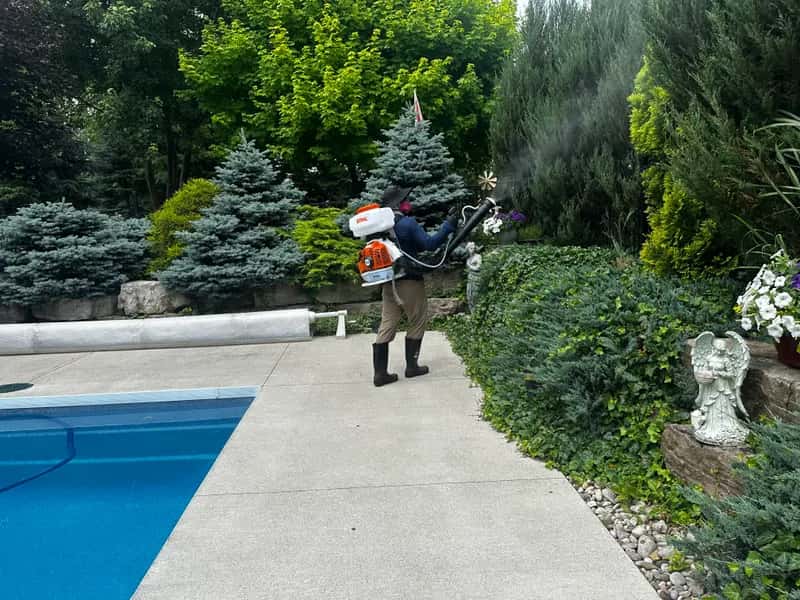
- Professional tick barrier spray, five treatments roughly monthly from May through September. The late May / early June visit targets the nymph activity peak, and the August and September visits cover the fall adult peak. Apply along the back fence line, garden beds, leaf-litter zones, woodpiles, and any transition from lawn to forest.
- Habitat modification on the ravine edge. If your property borders forest, install a 3-foot gravel or wood-chip buffer. Clear leaf litter from this buffer weekly during May-July. Mow tight; ticks struggle to ambush in short grass.
- Daily tick-check protocol for the household. After any outdoor activity, even just gardening. Pay special attention to children and dogs — both spend more time in close contact with grass and vegetation.
- Permethrin-treated clothing for ravine hikers. If you walk in the Don Valley, Rouge, or any forested ravine, wear hiking pants, socks, or gaiters that come factory-treated with permethrin — in Canada, consumer permethrin sprays for treating your own clothing are not registered. This is the single most effective personal protection layer.
- Know the 24-36 hour rule. Lyme disease transmission typically requires 24-36 hours of tick attachment. A tick found and removed within 24 hours dramatically reduces — but does not eliminate — risk. Daily checks matter.
Step four is the one you can sort out before the weekend: factory-treated permethrin socks, gaiters, and hiking pants are sold ready to wear for exactly these ravine trails. Check price on Amazon.ca →
What about the news momentum?
Toronto Star, CityNews, and TorontoToday all ran tick coverage in May 2026 because the surge is genuine — not media hype. Public attention will move on within weeks. The tick pressure will not. The properties getting treated now will be protected through the peak season; the ones that wait until September will have missed the window.
Same-week service across Toronto
BuzzSkito treats Toronto properties across every neighbourhood. Same-week service is available throughout the city, including Toronto mosquito control, Toronto tick spray, and dedicated North York, Scarborough, and Etobicoke service. The free quote is based on your lot size and risk profile — no on-site visit needed. Most requests get a price the same day.
What to keep by the back door
Steps three and five of that plan — the daily check, and the 24-36 hour window — only hold up if removal is not a scramble. The gap between finding a tick and getting it out cleanly is where the avoidable risk sits, and a Sunday evening in June is a bad moment to discover that the only tweezers in the house are blunt cosmetic ones that squeeze the tick’s body instead of gripping its head. A fine-tipped tick remover solves a logistics problem more than a medical one: it is small enough to keep one in the kitchen drawer, one in the dog-walking bag, and one in the car, so the check that finds a tick in a Don Valley parking lot can end there instead of at home two hours later.
As an Amazon Associate I earn from qualifying purchases. BuzzSkito only points to products we would genuinely use or recommend, at no extra cost to you.
Our tick-removal tool guide compares the common types, or check tick-removal tools on Amazon.ca →
Related guides
- Ontario Tick Surge 2026: What’s Happening and How to Protect Your Family
- Lyme Disease Risk Areas Ontario 2026
- Tick Surge Ontario 2026: Complete Yard Control Guide
- Free Yard Risk Report — get your address-specific score
Frequently Asked Questions
Is Toronto a Lyme disease risk area in 2026?+
Yes. Toronto is now classified as a Lyme disease risk area by Public Health Ontario, and the Toronto Star reported in May 2026 that the city is one of the highest-pressure tick zones in the GTA. Blacklegged ticks carrying Borrelia burgdorferi have been confirmed in every Toronto ravine system, including the Don Valley, Rouge Park, High Park, the Beaches, and Sunnybrook Park.
Which Toronto neighbourhoods have the worst tick problems?+
The highest-pressure neighbourhoods are those bordering ravines, parkland, or naturalized green space. This includes Rosedale, Forest Hill, Leaside, Lawrence Park, the Beaches, High Park, Sunnybrook, Don Mills, Riverdale, the Annex (Cedarvale ravine edge), and any property within 1 km of the Humber River, Don River, or Rouge Valley systems. Properties adjacent to golf courses (Rosedale Golf Club, Don Valley Golf, Scarboro Golf) are also elevated.
Why is Toronto worse for ticks than other GTA cities?+
Three reasons: (1) Toronto has the largest urban ravine network in North America — 27% of the city is forested or naturalized, creating ideal tick habitat directly inside city limits; (2) Toronto's urban deer and white-footed mouse populations are dense, giving ticks consistent hosts; (3) backyard-to-ravine adjacency is unusually common — many Toronto properties have direct access to tick habitat from their fence line. Suburban cities like Brampton or Vaughan have less ravine density per capita.
How do I know if my Toronto property is in the high-risk zone?+
The fastest answer is our free yard risk report, which calculates a 1-100 score for your specific address using neighbourhood pressure data, water/forest proximity, lot characteristics, and family-situation factors. Properties scoring 70+ are in the high-risk band where professional yard treatment is strongly recommended. The general rule: if you can see trees from your back fence, or if your property is within walking distance of a ravine, conservation area, or naturalized park, treat it as elevated risk.
What should Toronto homeowners do right now?+
Schedule a professional tick barrier spray in late May or early June — the nymph activity peak. Combine with habitat modification: rake out leaf litter, clear brush along fence lines, install a 3-foot gravel or wood-chip buffer between lawn and any adjacent forest. Keep grass short. Establish a daily tick-check habit for family and pets after any outdoor activity. Know how to remove a tick properly and what symptoms to watch for.