BuzzSkito Mosquito & Tick Control Specialists · Published March 20, 2026 · Updated April 20, 2026
Quick Answer
Lyme disease is spread in Ontario by infected blacklegged (deer) ticks, and cases have risen sharply as tick range expands. The best protection is a layered defence: yard treatment, personal repellent, daily tick checks, and prompt tick removal.
- A blacklegged tick generally must be attached 24–36 hours before it can transmit Borrelia burgdorferi, the Lyme bacterium.
- Early symptoms appear 3–30 days after the bite; the bull’s-eye rash shows in only about 70–80% of cases.
- Nymph-stage ticks cause most human Lyme cases and are only about the size of a poppy seed.
- Peak nymph activity in Ontario runs May through July, overlapping garden season and dog walking.
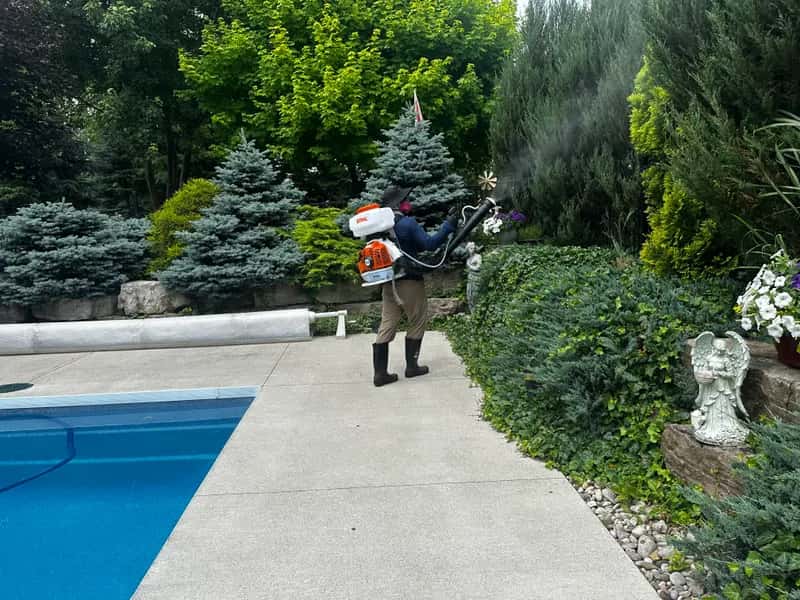
- Professional barrier spray leaves a residual on the treated leaf litter, garden edges and wood borders where ticks quest, renewed with five treatments across the season.
- Remove ticks with fine-tipped tweezers, pulling straight up — no twisting — then save the tick for free eTick.ca identification.
— BuzzSkito, GTA mosquito & tick control · 150+ five-star Google reviews. General information, not medical advice.
Medical disclaimer: This article provides general public health information about Lyme disease risk in Ontario. Always consult a licensed healthcare provider for medical advice, diagnosis, and treatment. Part of our Ultimate Tick Control Guide for Ontario Homeowners.
Last June, a Brampton mom found a tiny dark speck on the back of her nine-year-old's knee after an afternoon at Chinguacousy Park. She almost mistook it for a freckle. It wasn't. The tick had been attached long enough that her doctor ordered a precautionary course of antibiotics. Her daughter was fine. But she called us the next day asking what she could do so it never happened again.
That story is not unusual. Lyme disease is now the most commonly reported vector-borne illness in Canada, and southern Ontario sits squarely in the highest-risk zone. Here is what every GTA homeowner needs to know.
What Is Lyme Disease?
Lyme disease is a bacterial infection caused by Borrelia burgdorferi, transmitted to humans through the bite of an infected blacklegged tick (Ixodes scapularis), also called the deer tick. The tick picks up the bacterium by feeding on white-footed mice and other small mammals during its larval and nymph stages. When that same tick later feeds on a person, it can pass the pathogen into the bloodstream.
It is not contagious between people or between pets and people. You cannot catch it from touching a tick that is not attached, and a bite does not guarantee infection — not every blacklegged tick carries the bacterium. But given how difficult ticks are to spot (nymphs are the size of a poppy seed) and how serious late-stage Lyme can become, prevention is far better than treatment.
Is Lyme Disease a Real Risk in Ontario?
Yes — and the risk has grown substantially. Public Health Ontario surveillance data shows a steady increase in confirmed Lyme disease cases province-wide over the past decade. The primary driver is range expansion: blacklegged ticks have moved northward into southern and central Ontario as milder winters allow them to survive and reproduce in areas that were previously too cold.
Public Health Ontario currently identifies the following as areas with established or growing blacklegged tick populations:
- Mississauga / Peel Region: Credit Valley, Rattray Marsh, and adjacent conservation corridors. See our Mississauga tick control service.
- Hamilton: Dundas Valley, Cootes Paradise, and the Niagara Escarpment trails carry some of the highest tick densities in the province. See our Hamilton tick control service.
- Toronto: Don Valley ravines, High Park, and connected green corridors have confirmed populations. See our Toronto tick control service.
- Oakville and Burlington: Bronte Creek, Royal Botanical Gardens, and escarpment greenways are active risk zones. See our Oakville and Burlington tick control services.
- Brampton: Humber River corridor and park edges. See our Brampton tick control service.
If your backyard backs onto a ravine, a greenbelt, a conservation area, or even an unmaintained neighbour's lot, blacklegged ticks can migrate onto your property on deer and small mammals.
Toronto is the clearest illustration of that, because its ravine network threads wooded habitat through dense residential blocks instead of ending at the city edge — why Toronto became a tick hot spot in 2026 covers the corridors involved and what a ravine-adjacent yard is actually exposed to.
Province-wide, 2026 pushed all of that forward by a couple of weeks — our breakdown of the Ontario tick surge and the 5-step family protection plan explains what shifted and which steps actually change the odds.
Symptoms of Lyme Disease in Humans
Early localised (3–30 days after bite)
- Bull's-eye rash (erythema migrans) expanding outward from the bite site — present in roughly 70–80% of cases
- Fever and chills
- Fatigue that feels out of proportion to activity
- Headache
- Muscle and joint aches
- Swollen lymph nodes near the bite
The absence of a rash does not rule out infection. Some people develop no visible rash at all, or the rash appears in a location that is easy to miss (scalp, behind the knee, in a skin fold).
Early disseminated (days to weeks after bite)
- Multiple rashes appearing elsewhere on the body
- Bell's palsy (facial drooping on one or both sides)
- Severe headaches and neck stiffness
- Heart palpitations or irregular heartbeat (Lyme carditis)
- Shooting pain, numbness, or tingling in the hands and feet
Late disseminated (months after bite, if untreated)
- Severe arthritis, particularly in the knees
- Cognitive difficulties, memory problems, brain fog
- Chronic fatigue
If you develop any of these symptoms and have had a tick bite, or have been in tick habitat in the GTA recently, see your doctor and mention the possible exposure. Early antibiotic treatment almost always results in full recovery.
The late-stage list is the part that frightens people most, and it is worth reading alongside the actual prognosis. Our plain-English guide to whether Lyme disease can kill you covers how often it turns serious, whether it is curable, and what “chronic Lyme” does and does not mean.
Lyme Disease Symptoms in Dogs and Cats
Your pets spend more time low to the ground than you do, which makes them effective tick magnets. A dog that walks the same ravine trail you do is likely picking up more ticks — and carrying some of them back into your home.
Dogs
Dogs are genuinely susceptible to Lyme disease. Symptoms often appear 2–5 months after infection and can include:
- Sudden lameness that shifts from leg to leg over days
- Swollen, painful joints
- Fever (above 39.5°C)
- Loss of appetite and lethargy
- Swollen lymph nodes
- In rare severe cases, kidney disease (Lyme nephropathy)
A Lyme vaccine is available for dogs and is worth discussing with your veterinarian if you live near ravines or conservation areas. Year-round tick preventatives are also recommended for dogs in the GTA.
For the longer version — what the earliest signs look like, how the illness progresses through its three stages, and what treatment and recovery involve — see can dogs get Lyme disease from ticks.
Cats
Cats appear more resistant to clinical Lyme disease than dogs, but they can still carry ticks into your home and onto furniture. If your cat goes outdoors in tick habitat and develops unexplained lethargy, fever, or limping, raise tick exposure with your vet. Never apply dog-specific tick treatments to cats — many are toxic to felines.
How Lyme Disease Transmission Works
Understanding the timeline of transmission explains why prompt tick removal is so effective:
- A tick must be attached and feeding for approximately 24–36 hours before it can transmit Borrelia burgdorferi
- Nymph-stage ticks (tiny, hard to see) cause the majority of human Lyme cases because they go unnoticed longer
- Peak nymph activity in Ontario runs May through July — overlapping with garden season, children's outdoor sports, and dog walking
- Adult ticks are active in spring and again in fall, and are easier to spot due to their larger size
- Ticks do not jump or fly — they quest by holding onto tall grass or brush with their back legs and reaching forward with their front legs, waiting for a host to brush past
Attachment time is only one half of the odds. The other half is whether the tick was carrying anything in the first place — and most are not. See what percentage of ticks carry Lyme disease in Ontario for the tested infection rates behind that.
What to Do If You Find a Tick
Stay calm. The 24–36 hour transmission window means you have time to act correctly:
- Use fine-tipped tweezers. Grasp the tick as close to the skin as possible. Do not use your fingers.
- Pull straight up with steady, even pressure. Do not twist or jerk — this can cause mouthparts to break off in the skin.
- Do not crush, burn, or apply petroleum jelly. These methods are ineffective and may increase transmission risk.
- Clean the area with rubbing alcohol or soap and water.
- Save the tick in a sealed bag or container with the date noted. You can submit it for identification at eTick.ca, a free Public Health Agency of Canada tool that provides species identification and risk assessment.
- Monitor for symptoms for 30 days. See a doctor if a rash, fever, or flu-like illness develops. Mention the tick bite and the date.
As an Amazon Associate I earn from qualifying purchases. BuzzSkito only points to products we would genuinely use or recommend, at no extra cost to you.
A purpose-made removal hook like the Tick Twister grips the mouthparts at skin level without squeezing the body — worth keeping in the first-aid kit if you live near a ravine or walk a dog daily. Check price on Amazon.ca →
As an Amazon Associate I earn from qualifying purchases. Price shown on Amazon.ca, at no extra cost to you.
🏆 Best Tick Remover
8.7/10· BuzzSkito ratingBecause the Lyme bacterium transfers only after hours of attachment, a fast, clean removal is your single biggest lever. A slotted hook slides under the tick and lifts it out mouthparts-and-all — no squeezing the body, which is exactly what tweezers risk. Keep one in the first-aid kit if you walk a dog or live near a ravine.
Pros
- Lifts the tick without crushing the body
- Grips at skin level so mouthparts come free
- Pocket-sized and reusable for people and pets
Cons
- Two sizes needed to cover nymphs and adults
- Fine-tipped tweezers still handle the tiniest nymphs
For a detailed step-by-step guide including what to do with the tick after removal, see our post on how to remove a tick safely.
How to Protect Your Family from Lyme Disease This Season
The most effective approach combines several layers. None of them are particularly hard — the trick is doing all of them rather than picking one.
In your yard
Ticks don't live in the middle of a sunny lawn. They concentrate in the transition zones: where the mowed grass meets a garden bed, a wood edge, a leaf pile, or a shaded fence line. Reducing these microhabitats helps:
- Keep grass mowed short and clear leaf litter regularly
- Move woodpiles away from the house and off the ground
- Place a 60–90 cm barrier of wood chips or gravel between lawn and wooded borders
- Discourage deer with fencing if your property backs onto a greenbelt
A passive layer worth adding: permethrin tick tubes let mice carry treated cotton back to their nests, killing the larval ticks that feed on them before those ticks ever quest for your family. Commercial tubes are formulated and labelled for exactly this use, which matters in Canada — PMRA rules say a permethrin product may only be used the way its own label says. See our guide to tick tubes in Canada for placement and timing.
For the yard itself, professional tick barrier spray treats exactly the zones where blacklegged ticks hide and wait. Our tick control treatments apply a registered residual formula, according to label directions, to garden edges, foundation plantings, shaded turf, and wood borders — the areas that matter. The residual wears down with time and rain, which is why the seasonal program is five treatments spread roughly monthly from May through September — $597 standalone, or $497 added to any mosquito plan.
The monthly cadence is the whole point. Nymphs — the poppy-seed-sized stage that drives most Lyme transmission because it is so easily missed — peak from May through July, and adults re-emerge and stay active through the autumn, into November in mild years. A pair of visits timed to spring and fall would leave a multi-month gap right across nymph season, which is precisely the wrong window to be uncovered. Deer, mice and birds also keep carrying fresh ticks in from the ravine or woodlot next door, so the barrier has to be renewed rather than applied once or twice and left to lapse.
Fewer ticks in the yard means fewer chances for the kids or the dog to bring one inside. Professional treatment is the layer that stays on a schedule while you get on with the season — alongside tick checks, not instead of them.
On your body
- Apply a repellent containing DEET (20–30%) or icaridin, with a PCP registration number on the label, to exposed skin. Icaridin repellent on Amazon.ca →
- Wear light-coloured clothing — ticks are easier to spot on pale fabric
- Tuck pants into socks in long grass or wooded areas
- Factory permethrin-treated clothing (consumer permethrin sprays for treating your own clothes are not registered for that use in Canada) is worth it for people who spend a lot of time outdoors — permethrin gaiters cover the ankle-to-knee zone where most ticks latch on. Permethrin gaiters on Amazon.ca →
For a full head-to-toe rundown of treated clothing options, see our bug-protective clothing guide for Canada.
After being outdoors
- Do a full tick check of yourself, children, and pets within two hours of coming inside — pay attention to the scalp, behind the ears, armpits, groin, and behind the knees
- Shower within two hours; this helps rinse off unattached ticks and makes a full check easier
- Tumble dry clothing on high heat for 10 minutes — heat kills ticks that clothing removal alone may miss
For your pets
- Ask your veterinarian about the Lyme vaccine and tick preventatives suitable for your dog's size and lifestyle
- Check pets after every outing near natural areas
- Keep dogs on trails rather than bushwhacking through long grass
Frequently Asked Questions About Lyme Disease in Ontario
What are the early symptoms of Lyme disease in Ontario?
Early symptoms appear 3–30 days after a tick bite: an expanding bull's-eye rash (erythema migrans) at the bite site, fever, chills, fatigue, headache, and muscle or joint aches. Not everyone develops the rash. If you've been bitten and develop any of these symptoms, see a doctor promptly — early antibiotic treatment is highly effective.
How long does a tick need to be attached to transmit Lyme disease?
A blacklegged tick generally needs to be attached for 24–36 hours before the Lyme bacterium (Borrelia burgdorferi) can transfer. This is why daily tick checks matter — finding and removing a tick within 24 hours of attachment dramatically reduces your risk.
Can my dog or cat get Lyme disease in Ontario?
Dogs are susceptible to Lyme disease and can develop fever, lameness, swollen joints, and lethargy. Most cats appear resistant to clinical illness, though they can carry ticks into your home. Ask your veterinarian about the Lyme vaccine for dogs and year-round tick preventatives. Never use dog tick products on cats.
Is Lyme disease common in the GTA?
Yes and growing. Public Health Ontario confirms established blacklegged tick populations across Mississauga, Hamilton, Toronto, Oakville, Burlington, and Brampton. Reported Lyme disease cases in Ontario have increased significantly over the past decade as tick habitat expands northward with milder winters.
Is Lyme disease treatable?
Yes. Early-stage Lyme disease responds well to a course of antibiotics such as doxycycline or amoxicillin. Caught early, most people recover fully. Late-stage or disseminated Lyme is harder to treat, which is why early diagnosis — and prevention in the first place — makes such a difference.
Does professional tick spray actually reduce Lyme disease risk?
It can lower your exposure at home, with limits. Professional barrier spray applied to your yard's tick habitats — leaf litter, garden edges, shaded grass, wood borders — kills blacklegged ticks on contact and leaves a residual on those surfaces that wears down with time and rain. The point of applying it to leaf litter and shaded borders rather than the open lawn is that this is where ticks actually quest. It reduces how many ticks are sitting in those zones — it does not clear the property, and wildlife carries new ticks in all season, which is why applications are repeated.
What should I do if I find a tick on myself or my child?
Use fine-tipped tweezers to grasp the tick as close to the skin as possible and pull straight upward with steady pressure. Do not twist, crush, or apply heat. Clean the bite area with rubbing alcohol. Note the date and, if possible, submit the tick to eTick.ca for identification. See a doctor if symptoms develop within 30 days.
Related Guides
- The Ultimate Tick Control Guide for Ontario Homeowners
- How to Identify Ticks in Ontario
- How to Remove a Tick Safely
- When Are Ticks Active in Ontario?
- Best Tick Control for Your Yard: Ontario Comparison Guide
- BuzzSkito Tick Control Services
BuzzSkito is a licensed mosquito and tick control provider serving Mississauga, Toronto, Brampton, Oakville, Burlington, Hamilton, and the broader GTA. Our technician is trained in integrated pest management and applies only products registered for use in Canada, according to label directions (Ontario Pesticide Operator Licence L-240-2436835197). For medical advice on tick bites or Lyme disease, consult a licensed healthcare provider. For tick identification, visit eTick.ca or Public Health Ontario.