BuzzSkito Mosquito & Tick Control Specialists · Published April 26, 2026 · Updated July 20, 2026
Quick Answer
The best tick repellent for Ontario yards is a professional barrier spray — it places a residual acaricide, applied according to label directions, directly on the leaf litter and lawn edges where ticks actually live, and is re-applied through the season as the residual wears off. The best DIY runner-up is a cedar-oil spray like Wondercide, layered over free habitat fixes.
- Professional barrier spray holds a longer residual on the treated edges than consumer tick sprays, which are typically labelled for re-application after days — that is the real gap.
- Professional treatment kills adult ticks, nymphs, and larvae on contact, not just adults.
- Permethrin-based granular pesticides carry a synthetic residual down into the lawn and edge zones and hold 4–6 weeks — but only where you actually achieved even coverage.
- Cedar-oil sprays like Wondercide repel and kill ticks on contact, but the oil evaporates far faster than a synthetic residual, so they need re-applying every 2 weeks.
- Consumer DIY tick sprays typically last only 1–14 days.
- A short lawn plus a 3-foot mulch barrier at property edges are free habitat fixes that reduce tick pressure.
— BuzzSkito, GTA mosquito & tick control · 150+ five-star Google reviews
What Canadians buy most for yard-scale tick pressure, plus the personal-wear layer (nothing replaces a professional barrier spray, but these help):
Personal tick repellents on your skin protect you. Yard-scale tick repellents protect your property — and that’s a different problem with different solutions. Here’s what works in Canadian yards in 2026.
Our Picks — Best DIY Yard Tick Repellents in Canada
As an Amazon Associate I earn from qualifying purchases. Prices are shown on Amazon.ca, at no extra cost to you.
Wondercide Cedar-Oil Yard Spray
The leading natural yard spray. Cedar oil has documented contact repellency against ticks, but it evaporates much faster than a synthetic residual, so it holds only if you re-apply every 2 weeks. The strongest DIY layer to stack on top of the free habitat fixes.
Pros
- Real, research-backed cedar-oil repellency
- Follow the label on when kids and pets can return
- Hose-end coverage of lawn edges
Cons
- Re-apply every 2 weeks
- Weaker than professional barrier spray
Permethrin-Based Granular Pesticide
Granules carry the residual down into the leaf-litter and lawn-edge zones ticks quest from, where a surface spray never lands — the strongest DIY control if you nail even coverage.
Pros
- Longest-holding residual of the DIY yard options
- Lasts 4–6 weeks per application
- Wide retailer availability
Cons
- Hard to spread evenly without gear
- Synthetic pesticide handling care
Cedarcide Cedar-Oil Yard Spray
The other leading evidence-backed cedar-oil option. Same natural approach as Wondercide with mild-but-real repellency at recommended concentrations — a solid pick if you prefer their formula.
Pros
- Natural cedar-oil formula
- Safe around kids and pets
- Good for seating-area perimeters
Cons
- Bi-weekly reapplication all season
- Consumer concentrations run low
Insect Shield Permethrin-Treated Clothing
Not a yard treatment — factory-treated garments that kill ticks on contact with the fabric. In Canada this is the route to take: Health Canada does not approve permethrin liquids and sprays for consumers to treat their own clothing, so buy the treatment already in the garment rather than applying it yourself. The best add-on for anyone working, hiking, or gardening in a tick zone.
Pros
- Kills ticks on contact with the treated fabric
- Factory treatment lasts up to 70 wash cycles
- Nothing to mix, spray, or re-apply yourself
Cons
- Clothing only — not a skin repellent
- Does not treat the yard itself
Which one should you buy?
The Tier System for Yard Tick Repellent
🟢 Tier 1: Most effective
- Professional barrier spray — A residual acaricide applied according to label directions to leaf litter, lawn edges, fence lines, and shaded perimeters — the zones ticks quest from. $597 for the 5-spray season, or $497 added to a mosquito plan.
🟡 Tier 2: Effective DIY options
- Permethrin-based granular pesticides (e.g. Bayer Advanced) — Decent control if applied correctly. The granules carry a synthetic residual into the leaf-litter and edge zones and hold there 4–6 weeks. Requires proper coverage technique.
- Cedar oil sprays (Wondercide, Cedarcide) — Mild but real repellency at recommended concentrations, though consumer formulas run weaker than the concentrations used in testing. Re-apply every 2 weeks.
🟠 Tier 3: Habitat modification (FREE and important)
- Keep grass under 4 inches
- Clear leaf litter from lawn edges
- Create a 3-foot wood-chip or gravel barrier between lawn and any wooded area
- Trim shrubs and remove brush piles
- Discourage deer access (they’re the primary tick host)
🔴 Tier 4: Don’t bother
- Diatomaceous earth (DE) — Works in dry conditions only. Useless after rain.
- Garlic spray — Marketing claims dramatically exceed evidence. Some short-term effect at impractical volumes.
- Sulfur granules — Old folk remedy. Minimal scientific support.
- Tick-repellent plants alone — Beebalm, lavender, etc. provide minimal area protection.
- Ultrasonic tick repellers — Zero evidence.
The Cedar Oil Question
Cedar oil works — peer-reviewed research has confirmed it has tick-repellent and tick-killing properties. But the gap between “works in lab” and “works in your yard” is large:
- Concentration matters. Lab studies use 5–10% cedar oil. Many consumer sprays are 1–2%.
- Coverage matters. Ticks live in leaf litter and at lawn edges. Most homeowners spray surface-level lawn areas missing the actual habitat zones.
- Persistence matters. Cedar oil evaporates faster than synthetic pesticides. Reapply every 2 weeks vs every 4 for professional sprays.
If you want to go natural, Wondercide and Cedarcide are the leading evidence-backed cedar oil options for yards. Plan on bi-weekly application all season. For most Ontario yards, this works out to similar cost as professional barrier spray with weaker results.
The Habitat Modification That Costs Nothing
Before spending money on any repellent, do these for free:
- Mow grass to 3–4 inches and keep it that height. Tall grass is tick highway.
- Rake and remove leaf litter from lawn perimeters every spring and fall. This is where ticks overwinter.
- Create a 3-foot wood chip or gravel barrier between your lawn and any wooded area, ravine edge, or tall grass. Ticks don’t cross dry, sun-exposed barriers.
- Trim shrubs 12 inches off the ground around outdoor seating.
- Stack firewood off the ground and away from the house. Mice live in woodpiles. Ticks ride on mice.
- Discourage deer. Deer fences, deer-resistant landscaping, no deer corn.
Habitat modification works by removing the conditions ticks need rather than by killing them: ticks dry out in short, sun-exposed turf, they overwinter in the leaf litter you rake away, and a dry wood-chip strip is a barrier they will not cross. It costs nothing and uses no pesticide. Its limit is that it only reshapes your own property — ticks keep arriving on deer, mice, and birds regardless.
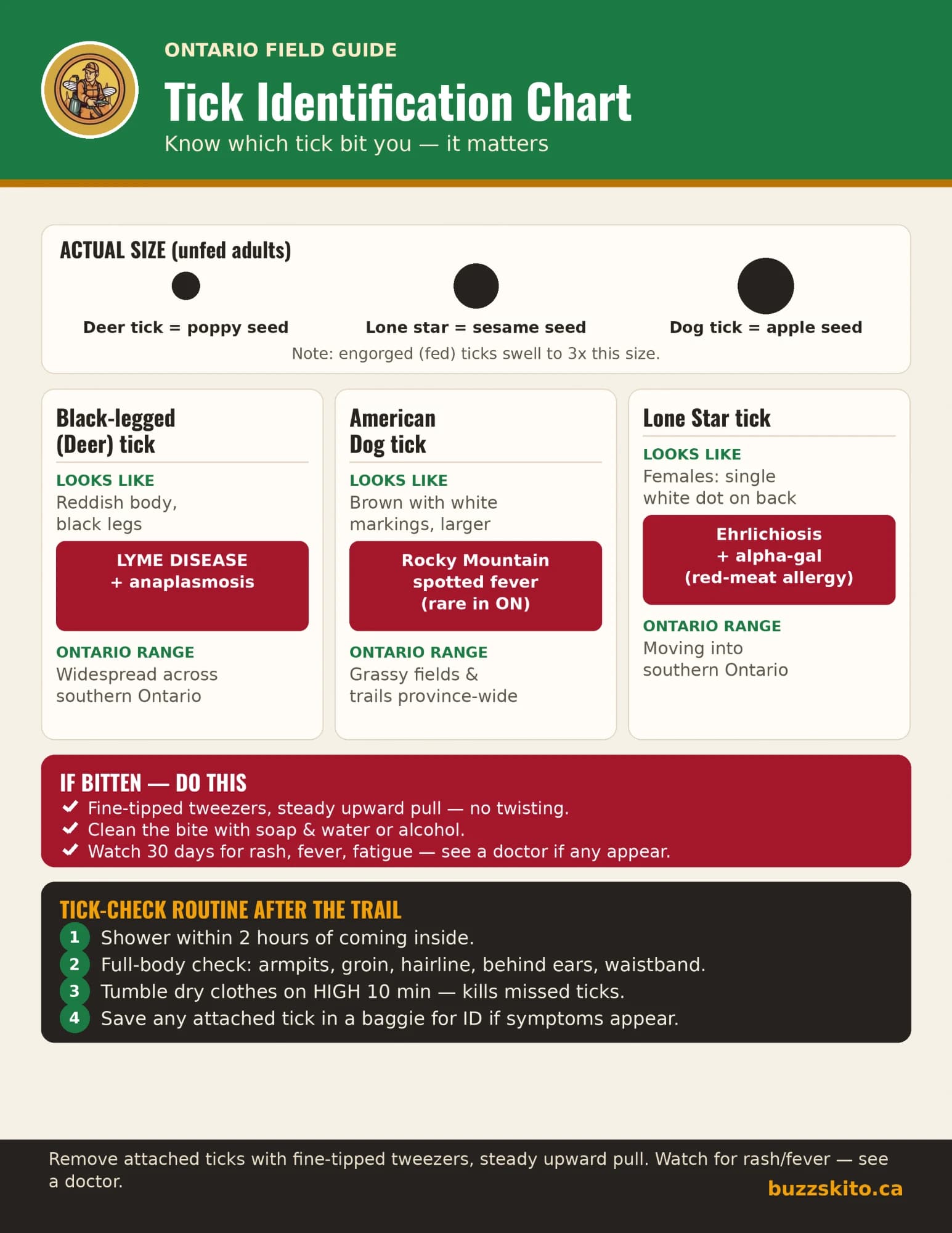
Mowing height and shrub trimming both work for the same physical reason: a tick cannot fly or jump, so it can only wait wherever it managed to climb, and that is usually no more than 30–50 cm off the ground. Do ticks fly or jump? How high they actually climb sets out the heights involved.
The Professional Option (Why Most Ontario Homeowners End Up Here)
For Ontario homeowners in confirmed Lyme zones (Oak Ridges Moraine, Rouge Park, Bronte Creek, Dundas Valley, Niagara), professional barrier spray is usually the most practical option:
The Oak Ridges Moraine end of that list is the one that surprises people, because it runs through ordinary subdivisions rather than parkland — see tick control in Richmond Hill and Markham for how the moraine and the Rouge corridor shape what a York Region yard needs.
- Targeted application. Sprayed where ticks actually live — leaf litter, lawn-to-woods edges, fence lines, shrub interiors. Not just on top of the grass.
- Label-directed application. Pyrethrin-based, labelled for residential use, and applied according to label directions — stay off treated areas until the spray has dried.
- 5-treatment season covers all life stages. Spring nymphs (highest Lyme risk), summer adults, fall larvae.
- Rain-back guarantee. Rain within 1 hour of your treatment? We come back and re-treat free, on every plan.
- Bundle savings. $597 on its own, or $497 when added to any mosquito plan (save $100).
Related Reading
- Tick Prevention in Your Yard — A Guide for Families
- Lyme Disease Prevention in Ontario
- Best Tick Control Yard Treatment
- Tick Tubes in Canada — Do They Actually Work?
- Ontario Lyme Risk Areas 2026
- BuzzSkito Tick Control Service
Frequently Asked Questions
What is the best tick repellent for yards in Canada?+
Professional barrier spray is the most targeted yard tick treatment available — a residual acaricide applied, according to label directions, to leaf litter, lawn-to-woods edges, fence-line vegetation, and shaded perimeters where ticks live. Consumer DIY products (cedar-oil sprays, garlic sprays, granular pesticides from Home Depot) use lower concentrations and are usually broadcast over the lawn rather than placed in the shaded edge habitat ticks actually occupy. The difference is less about the chemistry than about where it lands and how long it persists — and neither approach eliminates ticks from a property, because wildlife keeps carrying new ones in all season.
Does cedar oil really repel ticks?+
Cedar oil has mild tick-repellent properties — research has confirmed this in lab settings. However, the concentrations and application volumes needed for meaningful yard-level control are higher than most consumer products provide. Cedar mulch around outdoor seating areas provides some passive repellency. Cedar-oil-based sprays (Wondercide, Cedarcide) work but typically need re-application every 2–4 weeks to maintain effectiveness.
What about diatomaceous earth for ticks?+
Food-grade diatomaceous earth (DE) kills ticks by physical desiccation when they walk through it. It works in dry conditions but loses effectiveness when wet — meaning it won't survive a single rainstorm. For yards, DE is impractical: re-application after every rain isn't feasible, and ticks live in the moist leaf-litter zone where DE works least well. Skip it for yard-scale tick control.
Are there natural tick repellents that actually work?+
For yard-scale tick control, the most-effective natural options are: cedar oil (Wondercide, Cedarcide), and proper habitat modification (short grass, leaf litter removal, 3-foot wood chip barrier between lawn and woods). Natural sprays for personal use include oil of lemon eucalyptus (OLE) and 2-undecanone (BioUD). For population-level yard control, professional barrier spray holds a longer residual than any natural option.
How often should I treat my yard for ticks?+
Professional yard tick spray should be applied every 30 days through the active season (May–September in Ontario). BuzzSkito's 5-spray season program covers this exact window. DIY natural tick sprays (cedar oil-based) typically need re-application every 14 days. Granular pesticides last 4–6 weeks per application but require even-coverage application that's difficult to achieve without proper equipment.
What's the cheapest way to get rid of ticks in my yard?+
In order of cost-effectiveness: (1) FREE — habitat modification (mow short, remove leaf litter, create 3-ft mulch barrier between lawn and woods). (2) $15–$30 — cedar mulch in seating areas. (3) $50/year — DIY cedar oil or permethrin-based sprays from Home Depot. (4) $597 a season, or $497 when added to a mosquito plan — BuzzSkito professional 5-spray season program. For yards in active Lyme risk areas, it is the option that treats the edge habitat most thoroughly.
Are tick yard sprays safe for kids and pets?+
Follow the product label: it sets the re-entry rules, and for professional tick spray that means keeping kids and pets off treated areas until the spray has dried. The product is aimed at the leaf litter and lawn edges where ticks rest, rather than broadcast over the open lawn where children play. BuzzSkito uses pyrethrin-based formulations labelled for residential lawn use and applies them according to label directions. Cedar oil and natural alternatives carry their own label directions and provide weaker control. Granular pesticides from Home Depot require strict adherence to label instructions and timing.
When is the best time to start tick treatment?+
In Ontario, start tick treatment in early May to catch emerging nymphs (the highest Lyme-disease-risk life stage). Continue every 30 days through September. Some homeowners with pets or children who do significant yard activity start in late April. Spring nymph activity is the most important window — adult ticks in late summer/fall are easier to spot but transmit Lyme just as effectively.