Quick Answer
Stoney Creek properties face high mosquito and tick pressure from three directions — the Lake Ontario waterfront, the Red Hill Creek ravine corridor, and the Niagara Escarpment. Professional barrier spray leaves a temporary residual on the vegetation where mosquitoes rest, and a season of five mosquito treatments and five tick treatments covers May through September.
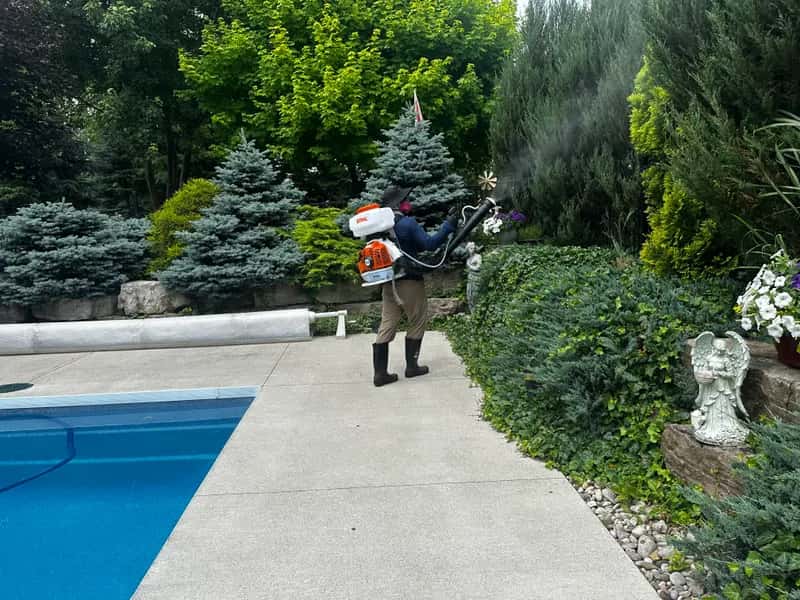
- Barrier spray is applied to the leaf surfaces where mosquitoes rest; its residual is temporary, so it is re-applied on a schedule.
- Five treatments from May through September maintain consistent coverage for a standard Stoney Creek property.
- Fifty Point Conservation Area on the waterfront is documented blacklegged tick habitat confirmed by the Hamilton Conservation Authority.
- Tick treatments run five times a season, roughly monthly from May through September, and target the 1–2 metre interface zone between maintained lawn and natural vegetation, where the overwhelming majority of tick encounters occur.
- Nymphs peak May through July and drive most Lyme transmission; adults stay active into November in mild years, so treatments run monthly through the whole season.
- Heritage Green and Battlefield homes near the Red Hill Valley report the most intense mosquito pressure — untreated yards often become unusable in the evenings by mid-June.
- Winona and Fifty Point rate high risk for both mosquitoes and ticks; new-build subdivisions in the east rate moderate to low.
— BuzzSkito, GTA mosquito & tick control · 150+ five-star Google reviews
Stoney Creek sits at the intersection of three distinct pest pressure zones: the Red Hill Creek and Lake Ontario lakeshore to the north, the Niagara Escarpment rising to the south, and a growing patchwork of newer subdivisions and mature residential neighbourhoods in between. Understanding which zone you live in determines how urgently you need professional mosquito and tick control.
Stoney Creek's Geography: Why Pest Pressure Is High
Stoney Creek is not a uniform community — it spans from the Lake Ontario waterfront in the north to the steep forested face of the Niagara Escarpment in the south. That geographic range means pest pressure varies significantly by neighbourhood, but it also means there are very few residential areas that are entirely free of mosquito or tick risk.
The Lake Ontario Waterfront and Lakeshore Fringe
The waterfront strip — running through Fifty Point, Winona, and the eastern lakeshore communities — faces mosquito pressure from both the lake shoreline wetland margin and the warm, humid air that settles over lakefront properties on summer evenings. Lake-effect humidity keeps lakeshore vegetation moist and provides ideal resting conditions for adult mosquitoes from May through September.
Fifty Point Conservation Area, located directly on the Stoney Creek waterfront, is a documented blacklegged tick habitat. The Hamilton Conservation Authority has confirmed tick activity in its managed lands, and properties adjacent to the park boundary face genuine tick exposure risk from spring right through to fall.
Red Hill Creek and its Ravine Corridor
The Red Hill Valley is one of Hamilton's most significant mosquito corridors, and Stoney Creek sits directly at its southern extent. The creek and its tributaries — including Battlefield Creek and Green Mountain Creek — cut through the lower portions of Stoney Creek, creating shaded, moist ravine habitat that serves as a continuous mosquito breeding and resting zone throughout the season.
Properties in Heritage Green, Battlefield, and the older residential neighbourhoods adjacent to the Red Hill Valley experience the most intense mosquito pressure in Stoney Creek. Homeowners backing directly onto the ravine or creek corridor routinely report that their yards become unusable in the evenings by mid-June without professional treatment.
The Niagara Escarpment Edge
The Escarpment face rises sharply at the south end of Stoney Creek, and the forested properties along this edge — including communities on and around the “mountain brow” — face a distinct combination of challenges: shade and moisture from the forested slope create persistent mosquito resting habitat, while the thick leaf litter, forested edges, and proximity to Escarpment trail systems create the exact conditions blacklegged ticks require to establish and sustain populations.
The Bruce Trail and Devil's Punch Bowl Conservation Area both run through this zone, and Hamilton Conservation Authority tick surveillance has confirmed blacklegged tick activity at multiple points along the Stoney Creek Escarpment. If your backyard backs onto the escarpment forest or trail system, professional tick treatment is not optional — it's essential.
Stoney Creek Neighbourhoods: Mosquito and Tick Risk by Area
| Neighbourhood | Mosquito Risk | Tick Risk | Primary Driver |
|---|---|---|---|
| Battlefield / Heritage Green | High | Moderate | Red Hill Creek ravine |
| Winona / Fifty Point | High | High | Lakeshore + Conservation Area |
| Escarpment brow (upper) | Moderate | High | Escarpment trails, forested edges |
| Fruitland / Lakeshore Rd area | High | Moderate | Lakeshore humidity, mature tree canopy |
| Central Stoney Creek | Moderate | Low–Moderate | Residential ponding, low-lying lots |
| New-build subdivisions (east) | Moderate | Low | Construction drainage, young plantings |
What Professional Mosquito and Tick Control Does for Stoney Creek Properties
Barrier spray for mosquitoes targets the foliage, fence lines, shaded vegetation, and perimeter plantings where adult mosquitoes rest during the day. The formula leaves a temporary residual on those leaf surfaces, which is why it is re-applied on a schedule. For a standard Stoney Creek residential property, five treatments from May through September maintain consistent coverage through the entire active season.
Tick control uses a targeted perimeter application — focused on the leaf litter zone, grass-to-garden border, and vegetation edges where blacklegged ticks wait for passing hosts. The treatment specifically targets the 1–2 metre “interface zone” between maintained lawn and natural vegetation, which is where the overwhelming majority of tick encounters occur. Five treatments per season are spaced roughly a month apart from May through September.
The five-visit cadence is driven by the tick's own calendar and by how the product behaves. Blacklegged tick nymphs peak from May through July, and they are the stage that matters most for Lyme transmission because they are poppy-seed sized and easily missed on a skin check. Adults re-emerge in the fall and stay active into November in mild years. On top of that, the acaricide residual is temporary, and deer, mice, and birds moving in from the Escarpment forest and the Red Hill ravine reintroduce ticks continuously — so the barrier has to be renewed rather than set once. Monthly applications keep treatments on schedule through the entire nymph window, instead of leaving the long gap a spring-and-fall pair of visits would. Tick control is $597 for the season on its own, or $497 added to any mosquito plan.
Recommended Treatment Schedule for Stoney Creek
| Treatment | Timing | Target |
|---|---|---|
| Mosquito Treatment 1 | Early May | First-generation adults before population builds |
| Tick Treatment 1 | Mid May | Nymph emergence begins — barrier down before the peak |
| Mosquito Treatment 2 | Early June | Bridge into peak season |
| Tick Treatment 2 | Mid June | Peak nymph activity — highest Lyme transmission risk |
| Mosquito Treatment 3 | Early July | Peak mosquito pressure |
| Tick Treatment 3 | Mid July | Tail of nymph season — holds the barrier through July |
| Mosquito Treatment 4 | Early August | Late-season sustained pressure |
| Tick Treatment 4 | Mid August | Renews residual against ticks carried back in by wildlife |
| Mosquito Treatment 5 | Early September | Season close-out |
| Tick Treatment 5 | Mid September | Adult tick re-emergence — activity runs into November |
Frequently Asked Questions
Does BuzzSkito serve Stoney Creek?
Yes. BuzzSkito provides professional mosquito and tick barrier spray services across Stoney Creek, including Heritage Green, Winona, Fruitland, Battlefield, and all residential neighbourhoods throughout the community. Call (289) 216-5030 for a free quote.
Are ticks a problem in Stoney Creek?
Yes. Stoney Creek's proximity to the Niagara Escarpment, Fifty Point Conservation Area, and the Stoney Creek ravine system puts many properties at real tick risk. Hamilton Conservation Authority surveillance has confirmed blacklegged tick populations along Escarpment trails and conservation lands bordering residential areas in Stoney Creek.
Why are mosquitoes worse near the Red Hill Creek in Stoney Creek?
Red Hill Creek and its tributaries create a continuous band of shaded, moist vegetation ideal for mosquito breeding and resting. Properties within 500 metres of the creek corridor — especially those with low-lying lots, mature trees, or fence lines backing onto the ravine — experience significantly higher mosquito pressure than properties further from the waterway.
When is the best time to start mosquito treatment in Stoney Creek?
Early May is the ideal start. Stoney Creek's Lake Ontario moderating influence means spring temperatures warm relatively early compared to inland GTA areas — mosquito activity often begins building in late April. Starting barrier spray in the first week of May catches populations before they reach peak levels in June and July.
Do I need mosquito AND tick control, or just one?
For Stoney Creek properties near conservation lands, ravines, or the Escarpment, we recommend combined mosquito and tick treatment. Properties in newer subdivisions away from natural corridors may only need mosquito control. When in doubt, call us — we'll assess your specific property and recommend the right approach.