BuzzSkito Mosquito & Tick Control Specialists · Published June 4, 2026
Quick Answer
Oakville is now a Public Health Ontario–classified Lyme disease risk area; blacklegged ticks are active mid-March through November, peaking with nymphs from late May to July and adults from mid-September to October, driven by the 16 Mile Creek corridor and Bronte Creek Provincial Park.
- Public Health Ontario’s 2026 surveillance lists Halton Region, including Oakville, as an established Lyme disease risk area.
- Bronte Creek Provincial Park covers 685 hectares of tick habitat, and its Half Moon Valley Trail is one of Ontario’s most consistent positive drag-survey sites.
- The nymph peak runs late May through mid-July; poppy-seed-sized nymphs carry the same Lyme bacteria as adults.
- Blacklegged ticks reactivate above 4°C, reliably by the third week of March — the active window has grown roughly three weeks since 2020.
- Highest-risk neighbourhoods include West Oak Trails, Palermo, Bronte, Joshua Creek, and Iroquois Ridge North.
- BuzzSkito’s tick season plan is five treatments, roughly monthly from May through September; each application’s residual wears down within weeks, so monthly renewal is what closes the gap.
— BuzzSkito, GTA mosquito & tick control · 150+ five-star Google reviews
TL;DR: Oakville is now a Public Health Ontario-classified Lyme disease risk area. Blacklegged ticks are active mid-March through November with peaks in late May-July and mid-September-October. The 16 Mile Creek corridor, Bronte Creek Provincial Park, and the residual woodlots through North Oakville drive most of the pressure. If your property is anywhere within 1 km of forest, ravine, or naturalized green space, treat 2026 as a high-risk season.
As an Amazon Associate I earn from qualifying purchases. BuzzSkito only points to products we would genuinely use or recommend, at no extra cost to you.
Before the calendar: if you walk Bronte Creek or the 16 Mile Creek trails at all this season, the one item worth owning before the nymph peak is a fine-tipped tick remover — poppy-seed nymphs slip out of blunt household tweezers. Check price on Amazon.ca →
The headline: Halton Region is now a confirmed Lyme risk area
For years the GTA tick conversation focused on Toronto ravines and the Niagara escarpment to our west. That conversation has caught up to Oakville. Public Health Ontario’s 2026 surveillance update lists Halton Region as an established Lyme disease risk area, and Halton Region Public Health is now running tick drag surveys across 16 Mile Creek, Bronte Creek, Sheldon Creek, and the conservation-area network. The data is consistent — blacklegged ticks (Ixodes scapularis) are present in every Oakville ravine system, the percentage testing positive for Borrelia burgdorferi has climbed year over year, and the active season has expanded on both ends of the calendar.
If you Google “ticks in Oakville,” the current top result is a large franchise competitor with a city-level page. We are writing this guide because Oakville families deserve actual neighbourhood-level data — which ravine systems matter, which subdivisions sit on top of the highest-risk habitat, and exactly when to treat your yard.
When are ticks active in Oakville? The 2026 calendar
March-April: the wake-up window
The myth that ticks “come out in summer” cost a lot of Halton dogs and a lot of Halton families in 2024 and 2025. Blacklegged adults survive winter under leaf litter and snowpack and reactivate the first time temperatures stay above 4°C for more than a day or two. In Oakville that now happens reliably in the third week of March. By early April, adult females are questing along trails in Bronte Creek Provincial Park, the 16 Mile Creek ravine through Glen Abbey and Old Oakville, and the Joshua Creek heritage corridor. Spring tick checks matter — see our spring tick season Ontario guide for the protocol.
May-July: nymph peak (the dangerous wave)
The nymph stage is the public health priority. Nymphs are the size of a poppy seed, often described as “a fleck of dirt that won’t brush off,” and they carry the same Lyme bacteria as adults. Halton Region’s nymph peak runs from late May through mid-July, which overlaps school break, the gardening rush, kids’ soccer at Sheldon Park and Glen Abbey, and dog walks through every Oakville ravine. This is the window where backyard treatment, permethrin-treated clothing for hikers, and daily tick checks matter most.
August: a quieter middle
Mid-summer heat suppresses tick activity slightly — they shelter in leaf litter and shaded ravine bottoms. This is the easiest time to be outside in Oakville, but it is not safe. Wooded ravine edges along 16 Mile Creek and Bronte Creek still produce regular attachments through August, especially after rain breaks the heat.
September-October: the adult fall peak
The second activity peak is adult ticks looking for one last blood meal before winter. They are larger and easier to spot than nymphs, which is why most of the “tick on my dog” stories Oakville vets see come from October. Adult tick pressure in 2026 will be heaviest through Bronte Creek Provincial Park, the Iroquois Ridge North woodlots, and the wooded edges of Falgarwood and River Oaks.
November onward
Activity does not stop with the first frost. Adults remain active any day temperatures climb above 4°C, which is now common into mid-December across Halton. The “safe” tick months for Oakville are realistically late December through early March — and even then a January thaw can produce activity along south-facing ravine slopes.
Why Oakville specifically — three geographic drivers
1. The 16 Mile Creek corridor is the spine of tick habitat
16 Mile Creek (Sixteen Mile Creek) runs the full length of Oakville from north of Dundas down to Lake Ontario at Old Oakville harbour. The corridor is mixed hardwood and ravine, it threads directly through Glen Abbey, River Oaks, College Park, and Old Oakville, and it functions as a continuous travel corridor for deer and white-footed mice — the two hosts ticks depend on. Anywhere within 500 metres of the creek edge sits inside the elevated-pressure zone. If your fence backs onto the ravine, treat it as a tick frontier.
2. Bronte Creek Provincial Park is a confirmed high-density zone
The park covers 685 hectares of mixed forest, meadow, and the Bronte Creek ravine itself. Ontario Parks posts tick warnings at every trailhead. The Half Moon Valley Trail is one of the most consistent positive-drag locations in southwestern Ontario surveillance. Properties in West Oak Trails, Palermo, and Bronte that border the park (or sit within 1-2 km of its boundary) inherit that pressure. The park is a tick reservoir for the entire west end of Oakville.
3. North Oakville new builds were carved out of forest
The subdivisions north of Dundas — Joshua Creek, Iroquois Ridge North, parts of River Oaks, and the new builds heading toward Trafalgar — are built on land that was forest or farm-with-woodlot 15-25 years ago. Developers preserved ravine fingers, hedgerows, and individual mature trees, which is great for property value and terrible for tick management. Deer still use these corridors. Mice still use the woodlots. New backyards sit five metres from active tick habitat without homeowners realizing it. See our North Oakville service page for what we treat in these subdivisions.
Highest-risk Oakville neighbourhoods in 2026
- West Oak Trails + Palermo: direct proximity to Bronte Creek Provincial Park. Highest park-adjacent pressure in Oakville.
- Bronte: Bronte Creek itself runs through the neighbourhood. Lakefront does not equal low risk where ravine meets shore.
- Joshua Creek + Iroquois Ridge North: residual woodlots from recent development. Backyard-to-forest adjacency is common.
- Glen Abbey: the golf course edges and the 16 Mile Creek tributaries through the community create dozens of tick-edge properties. See Glen Abbey treatment.
- River Oaks + Falgarwood: mature trees, established hedgerows, and ravine fingers running through both neighbourhoods.
- Old Oakville (ravine sections only): the lakefront strip is lower risk, but properties backing onto 16 Mile Creek or the ravine edges are elevated.
- Eastlake: mature treed lots, some ravine adjacency, ticks present but moderate pressure overall. See Eastlake service.
Lower-pressure pockets exist — the dense lakefront condo strip in central Oakville, the parts of Trafalgar built on open agricultural land, and treeless older subdivisions in central Oakville. But “lower pressure” is not “no pressure.” Halton Region surveillance has produced positive samples from areas no one would have flagged five years ago.
What Halton Region Public Health recommends
Halton Region Public Health publishes a standard tick-prevention checklist: wear long sleeves and tucked-in pants in wooded areas, use repellents containing DEET or icaridin (look for the PCP registration number on the label), check yourself, your kids, and your pets after every outdoor exposure, and remove attached ticks promptly with fine-tipped tweezers. They also flag the 24-36 hour window — Lyme transmission typically requires sustained tick attachment, so daily checks meaningfully reduce risk.
As an Amazon Associate I earn from qualifying purchases. BuzzSkito only points to products we would genuinely use or recommend, at no extra cost to you.
For yards specifically, Public Health Ontario’s habitat-modification guidance lines up with what we apply on every Oakville treatment: maintain a 3-foot wood-chip or gravel buffer between lawn and any wooded edge, clear leaf litter and brush from fence lines weekly during peak months, keep grass short, and treat the perimeter professionally during the May-July nymph window. Read our full tick control guide for the deeper protocol.
If your lot backs onto the Bronte Creek or 16 Mile Creek corridors, there is one DIY layer worth adding to the buffer-and-mowing work: tick control tubes. Mice are the reservoir that infects the nymphs you actually meet in May and June, and the tubes get treated nesting cotton to them before those larvae ever become questing nymphs. Buy commercial tubes rather than building your own — PMRA rules say a permethrin product may only be used the way its own label directs, and only the purpose-made tubes are labelled for it. Our tick tube guide for Canada covers placement and the two annual timing windows.
The 2026 Oakville protection plan
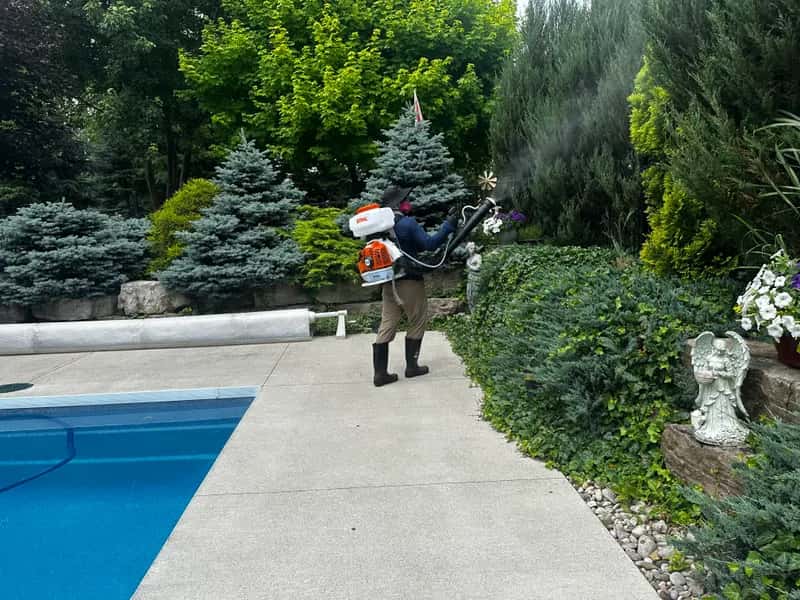
- Five professional barrier sprays, roughly monthly from May through September. The season opens in May on the leading edge of the nymph peak and the final visit carries into the September-October adult peak. Applied along the back fence line, garden bed edges, leaf-litter zones, woodpiles, and any lawn-to-forest transition. Products applied according to label directions, with a temporary residual — which is exactly why the visits land about a month apart. See Oakville tick spray pricing.
- Why the cadence is monthly. A late-May visit paired with a September one leaves a multi-month hole straight through the nymph peak — the window when poppy-seed-sized nymphs drive most Lyme transmission. Deer and white-footed mice keep walking fresh ticks in from Bronte Creek, 16 Mile Creek, and the North Oakville woodlots all season, so the barrier has to be renewed rather than applied once or twice.
- Habitat modification along the ravine edge. 3-foot wood-chip or gravel buffer, weekly leaf-litter clearing through May-July, mow tight to the buffer line.
- Daily tick checks for the household and pets. Especially after Bronte Creek Provincial Park, 16 Mile Creek trail walks, off-leash dog parks, and gardening sessions.
- Permethrin-treated clothing for trail hikers. Buy garments that come factory-treated, such as gaiters, socks, and hiking pants — in Canada, consumer permethrin sprays for treating your own clothing are not registered.
- Year-round tick prevention for dogs. Talk to your Oakville veterinarian. Most positive canine cases never showed an obvious tick attachment because nymphs are too small to spot in fur.
As an Amazon Associate I earn from qualifying purchases. Price shown on Amazon.ca, at no extra cost to you.
🏆 Best Personal Protection
8.9/10· BuzzSkito ratingPermethrin-Treated Clothing & Gaiters
For anyone hiking Bronte Creek Provincial Park or the 16 Mile Creek trails, 0.5% permethrin on pants, socks, and gaiters is the single most effective personal layer — it repels and kills ticks on contact before they reach skin, and one treatment lasts about 6 weeks or 6 washes.
Pros
- Kills ticks on contact, not just repels
- One treatment lasts ~6 weeks / 6 washes
- Ideal for trail hikers and gardeners
Cons
- Wear layer only — still check skin daily
- Reapply after washes
Same-week Oakville service
BuzzSkito treats every Oakville neighbourhood with same-week service availability throughout the May–September season. Pricing scales by lot size. Most requests get a price the same day. Dedicated treatment pages for Oakville mosquito control, West Oak Trails, Joshua Creek, Bronte, and Old Oakville.
Related guides
- Lyme Disease Risk Areas Ontario 2026
- Tick Season Ontario — Province-Wide Activity Calendar
- Are Ticks Dangerous in Ontario?
- Free Yard Risk Report — Oakville address-specific score
Frequently Asked Questions
When does tick season start in Oakville?+
Tick season in Oakville now starts in mid-to-late March and runs through November, with peak nymph activity from late May through mid-July and a second adult peak from mid-September through October. Blacklegged ticks become active any day temperatures climb above 4°C, which in Oakville now happens reliably in the third week of March. Halton Region Public Health surveillance data shows the active window has expanded by roughly three weeks since 2020. If you wait until June to treat your yard, you have already missed the early-nymph wave that drives most early-summer Lyme exposure across the 16 Mile Creek and Bronte Creek corridors.
Are there ticks in Bronte Creek Provincial Park?+
Yes — Bronte Creek Provincial Park is one of the highest-confirmed tick zones in Halton Region. Ontario Parks posts active tick warnings at every trailhead, and dragging surveillance regularly returns positive blacklegged tick samples along the ravine trails, the Half Moon Valley Trail, and the campground perimeter. The mixed hardwood forest, leaf litter depth, and resident deer population create textbook Ixodes scapularis habitat. If you live in West Oak Trails, Palermo, Bronte, or anywhere within 1.5 km of the park, treat your property as elevated risk and check yourself, your kids, and your dog after every visit.
Is North Oakville safe from ticks?+
North Oakville is actually one of the higher-risk areas in the city, despite being newer. Subdivisions in Joshua Creek, Iroquois Ridge North, parts of River Oaks, and the new builds north of Dundas were carved out of forest within the last 15-25 years, leaving residual woodlots, hedgerows, and ravine fingers running directly through neighbourhoods. Deer and white-footed mice still use these corridors as travel routes, and they bring ticks with them. The fence-line transition from manicured lawn to forest edge is the single most common tick-encounter zone in North Oakville yards.
When are ticks most active in Halton Region?+
Halton Region sees two distinct activity peaks: the nymph peak from late May through mid-July, and the adult peak from mid-September through late October. Nymphs are the dangerous wave — they are the size of a poppy seed, easy to miss, and they carry the same Lyme bacteria as adults. The nymph peak overlaps almost perfectly with school summer break, peak gardening season, and outdoor sports. The adult peak in fall is when most tick-on-dog cases get reported because adult ticks are large enough to spot during routine grooming. Halton Region Public Health flags May-July as the highest-risk human exposure window.
Can my dog catch Lyme disease in Oakville?+
Yes — Oakville veterinarians have reported a clear upward trend in canine Lyme cases since 2022, and the dogs most at risk are the ones walking trails along 16 Mile Creek, Bronte Creek, Sheldon Creek, the Joshua Creek ravine, and the off-leash areas at Bronte Creek Provincial Park. Even neighbourhood walks in Glen Abbey, Eastlake, or Falgarwood can produce attachments if your route brushes any wooded edge. Keep your dog on year-round tick prevention from a veterinarian, brush them after every walk, and treat your yard professionally so the back-fence transition zone is treated rather than left as a re-infestation source. Most positive canine cases never showed an obvious tick — the nymphs are too small to spot in fur.