BuzzSkito Mosquito & Tick Control Specialists · Published April 26, 2026
Quick Answer
For most Ontario households the best tick removal tool is the Tick Twister (O’Tom) — a $5–$10 hooked tool that slides under the tick and twists it free without squeezing the body, the method most veterinarians recommend; fine-tipped tweezers also work if used correctly.
- The Tick Twister costs about $5–$10, works on nymphs through engorged adults, and is the standard tool most vets recommend.
- The TickKey is a roughly $7 metal keychain tool that is hardest to misuse, but small nymphs can slip out of its slot.
- Fine-tipped (not pliers-style) tweezers work for free if you already own them — grip at skin level and pull straight up.
- Avoid Vaseline, nail polish, alcohol, or a hot match on an attached tick — they make it regurgitate and raise disease risk.
- Lyme transmission generally needs 24+ hours of attachment, so prompt, correct removal sharply cuts risk.
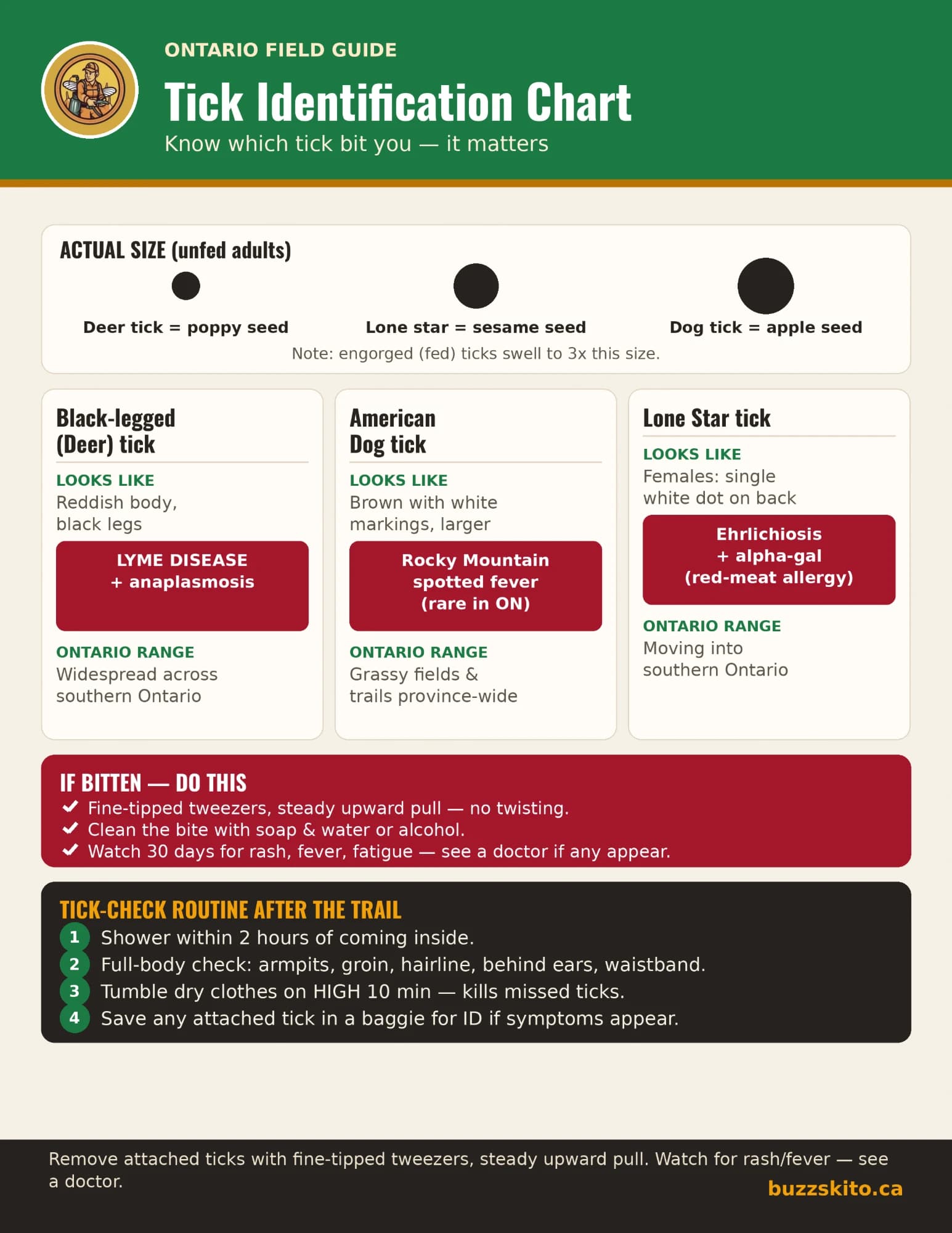
- Only 10–30% of Ontario blacklegged ticks carry Borrelia; submit the tick free to eTick.ca for ID within 1–3 days.
— BuzzSkito, GTA mosquito & tick control · 150+ five-star Google reviews
The two tools vets and Canadian hikers keep on hand — a fine-tipped tweezer and a tick-hook set (under $15):
Removing a tick correctly takes 30 seconds with the right tool. Done wrong, you can break off the mouthparts, squeeze the tick’s body and increase Lyme disease risk, or just panic. Here’s the honest 2026 guide to what tools actually work.
Our Picks — Best Tick Removal Tools
As an Amazon Associate I earn from qualifying purchases. Prices are shown on Amazon.ca, at no extra cost to you.
Tick Twister / O’Tom Tick Twister
The hooked notch slides under the tick and twists it free without squeezing the body — the standard tool most veterinarians recommend, and budget-friendly.
Pros
- Can’t squeeze the tick body
- Works on nymphs to engorged adults
- Stocked at most pet stores
Cons
- Small plastic — easy to lose
- Brief learning curve
A flat metal keychain tool with a tear-drop slot — slide, capture, pull straight back. The hardest tool to misuse, so it’s ideal for first-time tick-finders.
Pros
- Nearly foolproof to use
- Metal won’t break
- Fits on a keychain
Cons
- Tiny nymphs can slip the slot
- One fixed slot size
A credit-card-sized notch that lives in a wallet, glovebox, or hiking pack — the cheapest way to always have a tool on hand when you find a tick away from home.
Pros
- Cheapest option
- Fits in any wallet
- No moving parts
Cons
- Awkward on very small nymphs
- Needs a flat skin surface
Bundles a hook, fine-tip tweezers, a magnifier, and a storage vial in one pouch — mid-price, and the sensible pick for high-exposure households and dog owners.
Pros
- Covers every tick size
- Includes a storage vial for ID
- Great for dog owners
Cons
- More to keep track of
- Pricier than a single hook
Sharp eyebrow tweezers (never pliers-style) grip the head at skin level and pull straight up — free if you already own a fine-tipped pair, and fine for occasional use.
Pros
- Free if already owned
- Familiar to use
- Works on all sizes when sharp
Cons
- Easy to misuse and squeeze the body
- Must be fine-tipped, not blunt
Which one should you buy?
Tick Removal Tool Comparison
| Tool | How it works | Best for | Price tier | Buy |
|---|---|---|---|---|
| Tick Twister / O’Tom | Hook slides under the tick, twist to release | All-round use, nymphs to engorged adults | Budget | Check price on Amazon.ca → |
| TickKey | Tear-drop slot captures the tick, pull straight back | Beginners, keychain carry | Budget | Check price on Amazon.ca → |
| Tick removal card | Credit-card-sized notch slides under the tick | Wallet backup, travel, glovebox | Cheapest | Check price on Amazon.ca → |
| Fine-tipped tweezers | Grip the head at skin level, pull straight up | Occasional use, already owned | Free to budget | Check price on Amazon.ca → |
| Multi-tool removal kit | Combines hook, tweezers, magnifier and storage vial | High-exposure households and dog owners | Mid-range | Check price on Amazon.ca → |
Prefer everything in one pouch? A complete removal kit bundles a hook, fine-tip tweezers and a storage vial, while a wallet-sized removal card is the cheapest backup to keep in the car or hiking pack: Tick removal kit on Amazon.ca → Wallet tick card →
The Top 3 Tick Removal Tools (Ranked)
🥇 1. Tick Twister / O’Tom Tick Twister — Best Overall
A small plastic hooked tool with a notch. Slide the notch under the tick at skin level, twist 2–3 times, tick releases. Works for all tick sizes and species. Used by most veterinarians as the standard recommendation.
- Cost: $5–$10 (3-pack: large, small and micro)
- Pros: Can’t squeeze the body; works on tiny nymphs and large engorged adults; pet stores carry it
- Cons: Easy to lose (small plastic); requires a brief learning curve
- Where to buy: Amazon, PetSmart, your vet’s front desk
Dog owners: the Tick Twister also comes in a dog-specific multi-size pack — the larger hook handles engorged ticks buried in thick fur. Tick Twister for dogs on Amazon.ca →
🥈 2. TickKey — Best for Beginners
A flat metal tool with a tear-drop slot. Slide it across the skin until the tick captures in the slot, pull straight back. Foolproof.
- Cost: $7
- Pros: Hardest tool to use incorrectly; metal won’t break; fits on a keychain
- Cons: Doesn’t work as well on tiny nymphs (small ticks slip out of the slot)
- Where to buy: Amazon, outdoor retailers, vet offices
🥉 3. Fine-Tipped Tweezers — Already in Your Bathroom
Sharp eyebrow tweezers (NOT pliers-style) work fine if used correctly. Grasp the tick at the head, as close to skin as possible, pull straight up with steady pressure.
- Cost: $0 (already own); $10 for sharp Tweezerman model
- Pros: Already at home; familiar to use
- Cons: Easier to misuse — squeezing or twisting can damage the tick
- Critical: Must be FINE-TIPPED. The thick blunt tweezers from a pharmacy first-aid kit don’t work — you can’t grip close enough to the skin.
Tools and Methods to Avoid
- Pliers-style tweezers — Tips are too thick. Can’t grip close to skin.
- Bare fingers — Bacteria transfer; you can also accidentally squeeze the tick body.
- Vaseline / nail polish smothering — Causes the tick to regurgitate stomach contents into the wound. Increases disease risk.
- Hot match or lighter — Same problem plus burn risk.
- Rubbing alcohol applied to attached tick — Same regurgitation risk.
- Twisting back-and-forth aggressively — Breaks off the mouthparts.
- Squeezing the tick body — Forces gut contents into your skin.
The Step-by-Step Process (Any Tool)
- Don’t panic. You have time. Disease transmission requires 24+ hours for Lyme.
- Get good lighting. Flashlight or headlamp on dogs.
- Have a sealed bag or container ready for the tick after removal.
- Position the tool close to the skin — at the tick’s head, not body.
- Apply slow, steady force — straight up (tweezers/TickKey) or rotational (Tick Twister).
- The tick releases in 5–15 seconds. Don’t rush.
- Clean the bite with rubbing alcohol or soap and water.
- Save the tick in a sealed bag with a damp paper towel. Label with date.
- Wash your hands.
- Note the date and bite location for monitoring symptoms over the next 5 months.
What If the Mouthparts Stay Behind?
It happens with imperfect technique. If a small black dot remains in the skin after the body is removed: leave it alone. The skin will work it out on its own in a few days, like a splinter. Don’t dig at it — that causes more inflammation and infection risk than the splinter itself. Watch for spreading redness or pus and call your doctor/vet if those appear.
If that black dot is still there a week later, or the skin around it is getting angrier rather than calmer, our longer guide to a tick head stuck in the skin walks through what is normal healing, what is a local reaction, and which signs mean it is worth getting looked at.
Where nothing was left behind and the bite still refuses to close, the question is a different one — see tick bites that won’t heal and when to worry.
Where to Submit the Tick After Removal
- eTick.ca — Free, run by Bishop’s University. Submit a photo. Species identification within 1–3 days.
- Public Health Ontario — Some local health units accept physical tick submissions.
- Your vet — Many vets will identify the species in-clinic, especially for dogs.
Note: Knowing a tick was a blacklegged species doesn’t mean Lyme was transmitted. Only 10–30% of blacklegged ticks in Ontario actually carry Borrelia bacteria. Symptom monitoring is more reliable than tick testing alone.
That gap between “a blacklegged tick bit me” and “I have Lyme disease” is worth keeping in proportion. Lyme disease cases in Ontario sets out the latest published provincial counts and how quickly they have been rising.
The Bigger Picture — Stop Finding Ticks
The less often ticks turn up in your yard, the less often you reach for the tool. BuzzSkito’s 5-spray tick season program puts a residual acaricide, applied according to label directions, on the leaf litter, lawn edges and shaded perimeters where ticks quest, repeated through the season as the residual wears off. Keep a removal tool anyway — no yard treatment eliminates ticks, and you will still pick them up on trails and dog walks, where permethrin-treated clothing is the layer that stops most of them on the fabric before they ever reach skin. A tick season is $597 on its own, or $497 added to any mosquito plan.
Want a passive DIY layer between treatments? Permethrin tick tubes let mice carry the treatment into their nests, killing larval ticks before they ever quest for a host — see our guide to tick tubes in Canada.
Related Reading
- How to Remove a Tick from a Dog
- I Found a Tick on My Dog — What to Do
- How to Remove a Tick Safely (Humans)
- Best Tick Repellent for Yards Canada
- BuzzSkito Tick Control
Frequently Asked Questions
What is the best tick removal tool?+
The two most reliable options are: (1) Fine-tipped tweezers (sharp eyebrow tweezers) — universally available, free if you already own them, work for all sizes of ticks. (2) The Tick Twister (or O'Tom Tick Twister) — a specialized hooked tool that slides under the tick and twists it free without squeezing the body. The TickKey is also excellent. Avoid pliers-style tweezers (too thick to grip the tick close to skin) and old wives' tale methods (Vaseline, matches, alcohol).
How does the Tick Twister work?+
The Tick Twister is a small plastic hook with a notch. You slide the notch under the tick at skin level, then rotate the tool 2-3 times. The twisting motion releases the tick's mouthparts cleanly, without squeezing the body. It works for all tick sizes and is widely considered the gold-standard tool by veterinarians. Available at most pet stores and Amazon for $5–$10. Many vets sell them at the front desk.
Is the TickKey better than tweezers?+
For most people, yes — it's easier to use correctly. The TickKey is a flat metal tool with a tear-drop slot. You slide it across the skin until the tick is captured in the slot, then pull straight back. It removes the tick cleanly without grabbing the body. About $7 on Amazon. Less prone to user error than tweezers. Many tick-endemic-area vets recommend the TickKey for first-time tick-finders.
Are tick removal tools necessary or can I just use tweezers?+
Fine-tipped tweezers work fine if used correctly. The tools (Tick Twister, TickKey) are designed to make correct removal easier — you can't accidentally squeeze the tick body with them. For occasional use (1-2 ticks per season), good tweezers are sufficient. For households with high exposure (frequent dog walking, kids playing in leaf litter, ravine-adjacent properties), a dedicated tick removal tool is worth the $7 investment.
What should I avoid for tick removal?+
Avoid: (1) Pliers-style tweezers — too thick to grip at the skin. (2) Bare fingers — bacteria from the tick can get on your skin. (3) Vaseline, nail polish, alcohol applied to the attached tick — makes the tick regurgitate and increases disease risk. (4) Hot matches or burning — same problem plus burn risk. (5) Squeezing the tick body — releases gut contents into the wound. (6) Twisting back-and-forth with tweezers — breaks off mouthparts.
How do I store the tick after removal?+
Place the tick in a sealed plastic bag or small container with a damp paper towel (keeps it alive for identification). Label with the date you found it and where on the body it was. You can submit it to eTick.ca (free, run by Bishop's University in Quebec) for species identification. They tell you within 1–3 days whether it's a Lyme-vector species. Some Ontario public health units also accept tick submissions.
What's the best tick removal tool for dogs?+
Same tools work for dogs — Tick Twister, TickKey, fine-tipped tweezers. The challenge with dogs is parting the fur to see the tick clearly. A small flashlight or headlamp helps. Have a second person hold the dog still or distract with treats. For thick-coated breeds, you may need clippers to expose the bite area before removal. Specialized dog-grooming tick-removal tools exist but are functionally similar to the human-use versions.
What if I can't find the tick or it's already gone?+
Many tick bites are discovered after the tick has dropped off (5–10 days after attachment). If you find a small reddish bump with a dark scab or no visible tick, treat it as a possible tick bite: clean with rubbing alcohol, monitor for symptoms over the next 5 months, and note the date. Watch for shifting-leg lameness in dogs, fever or fatigue in humans, or a bullseye rash on humans (rare on dogs). If symptoms appear, see your doctor or vet and mention the suspected bite.