
Reviewed by Alex Francisco
Published November 19, 2026 · Fact-checked against the sources listed below
What do bug eggs look like?
Insect eggs are small ovals, spheres, barrels or flat disks, often white, yellowish, green or gray, and a single one is easy to miss: of the single eggs measured on this page, only the katydid's, at about 1/5 inch, are longer than about 1/16 inch. What people notice is the group, and how the eggs are grouped is the best clue to what laid them.
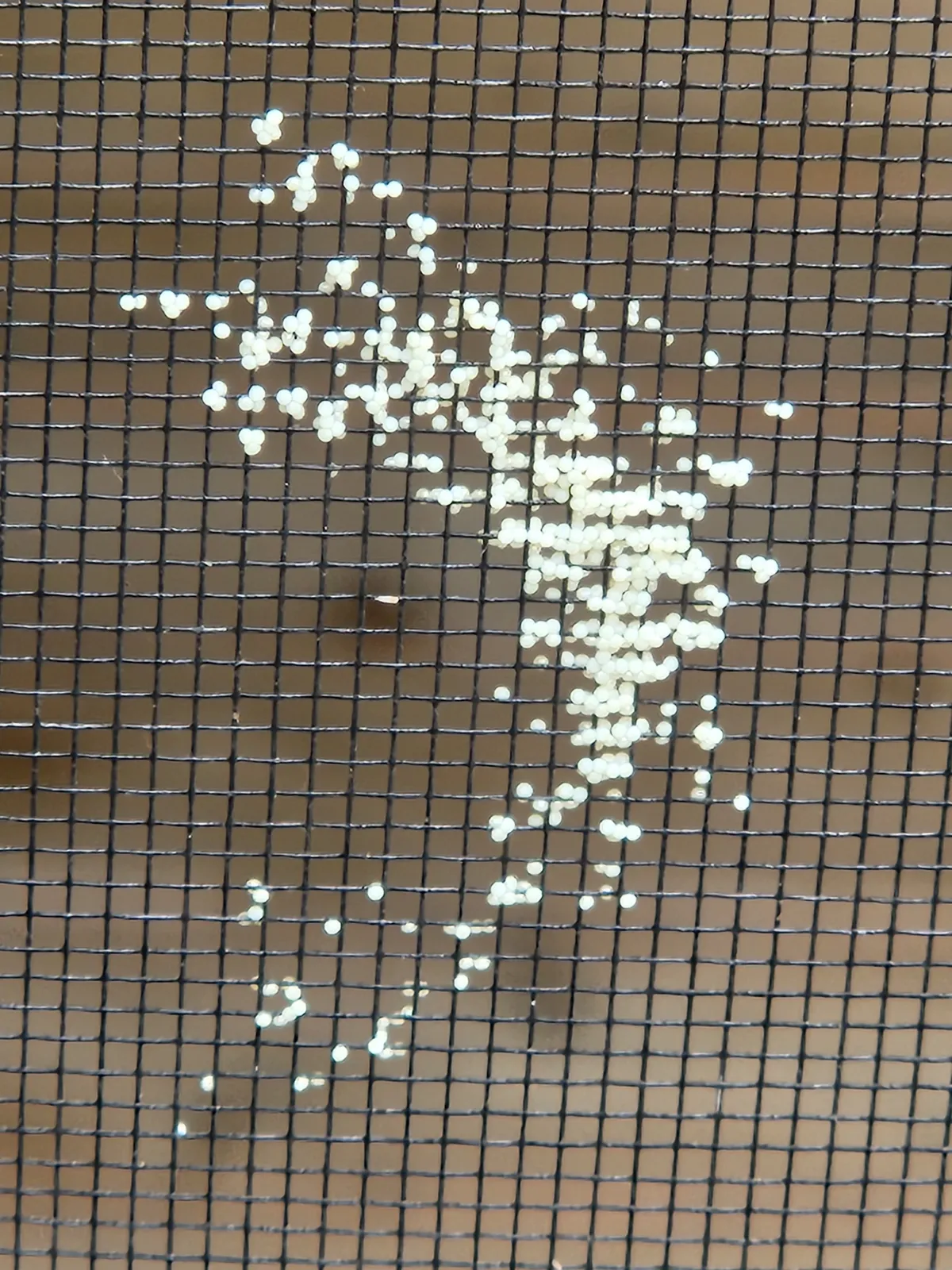
Whose eggs are these, by where you found them?
Where you found the eggs narrows the list faster than color does, because many insects lay beside their young's food: clothes moths on wool, house flies on garbage, lady beetles by aphids.
| Where you found them | Check first | Also check |
|---|---|---|
| Mattress seams, box spring, bed frame | Bed bugs | Their eggshells and shed skins |
| Pet bed, rug or carpet | Fleas | Flea dirt (dried droppings) |
| Hair, close to the scalp | Lice nits | Dandruff or hair spray droplets |
| Wool clothes, rugs, closets | Clothes moths | Carpet beetles |
| Trash can, pet food, spoiled food | House flies | Maggots, if the eggs have hatched |
| Flour, grain or stored pet food | Pantry moths and beetles | Carpet beetles |
| Ceilings, under furniture, closets | Cockroach egg cases | Spider egg sacs |
| Cobwebs in corners and windows | Spider egg sacs | Cockroach egg cases |
| Window screens and glass | Stink bugs, lacewings | Predatory bugs' egg clusters |
| Siding, brick, fences, eaves | Praying mantis egg cases | Spider sacs; spotted lanternfly masses |
| Leaves and stems | Stink bugs, lady beetles, lacewings | Slime molds (not eggs) |
| Twigs and bark | Katydids, mantises, spotted lanternflies | Moth egg masses |
| Car, grill, trailer, patio furniture | Spotted lanternflies | Spongy moth egg masses |
| Bucket, birdbath, flowerpot saucer, vase | Mosquitoes | Mosquito larvae |
From the EPA, CDC, extension and USDA sources linked in the sections below.
A white speck that moves is not an egg: the guide to tiny white bugs sorts those.
What are the tiny white eggs in my house?
These five insects leave tiny white eggs indoors, each in its own kind of place: bed bugs, fleas, lice, clothes moths and flies.
In the bed
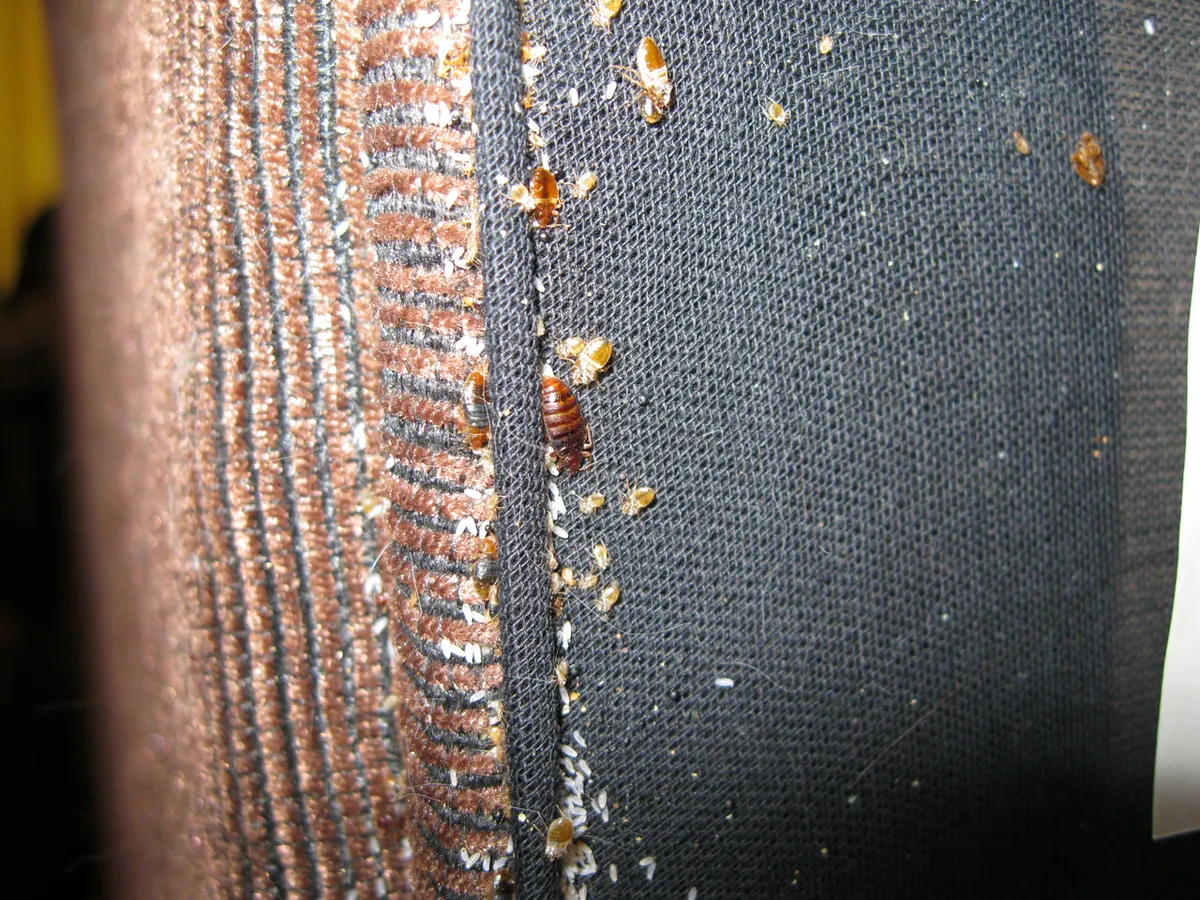
Bed bug eggs are pearl-white and about 1 mm (1/25 inch) long, the size of a pinhead, and show an eye spot once they are more than five days old, according to EPA's page on bed bug appearance. EPA's guide to finding bed bugs says to look near the piping, seams and tags of the mattress and box spring and in cracks of the bed frame and headboard. Bed bug eggs covers live eggs and empty shells, and baby bed bugs shows what hatches.
On a pet's bed, a rug or the carpet
Smooth white specks in a pet's bedding are likely flea eggs. UC IPM's flea guide says adult cat fleas stay on the pet, and that their eggs are pearly white, oval and about 1/32 inch long, readily fall onto bedding and carpet, and hatch in about 2 to 5 days. What flea eggs look like compares them with flea dirt and dandruff.
On hair
Tiny ovals glued to single hairs are lice eggs, called nits. CDC's parasite reference on head lice gives their size as 0.8 by 0.3 mm (about 1/32 inch long), usually yellow to white, cemented at the base of the hair shaft nearest the scalp, and often confused with dandruff or hair spray droplets. Lice eggs explains how to tell live nits from hatched ones.
On wool clothes, rugs and in closets
Pinhead-sized white eggs on wool are a sign of clothes moths. Clemson Extension's fabric pest fact sheet says a female lays 100 to 150 small, pinhead-sized, white eggs on or near the fabric she infests, and that they usually hatch in about five days. Moth eggs covers clothes and pantry moths, carpet beetle larvae covers another fabric pest on Clemson's sheet, and eggs in flour or grain belong in the pantry pest guide.
On garbage, pet food or spoiled food
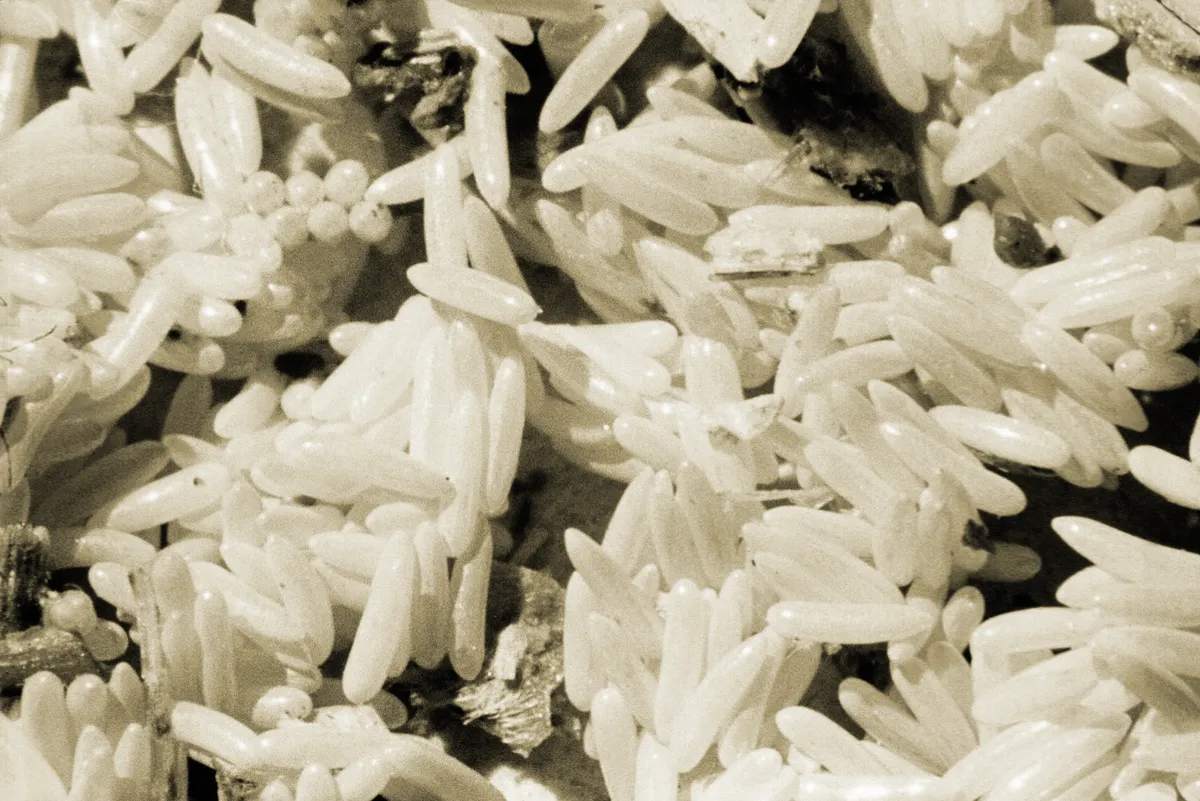
A heap of white, rice-shaped eggs on garbage or spoiled food is a fly clutch. Virginia Cooperative Extension's house fly fact sheet describes house fly eggs as elongated, yellowish-white ovals about 1 mm (0.04 inch) long, laid up to 100 in a cluster on a food source, that hatch quickly into maggots. Where maggots come from and why there are flies in the house cover the rest.
What are the brown capsules and papery sacs in corners and closets?
A purse-shaped brown capsule about 1/4 to 3/8 inch long is a cockroach egg case, not a single egg. UC IPM's cockroach guide says German cockroach females carry their light beige, 1/4-inch case until a day or two before it hatches; brown-banded cockroaches glue light brown cases of the same size to ceilings, beneath furniture and in closets; American cockroach cases are about 3/8 inch and turn from brown to black within a day or two; and Oriental cockroaches leave dark red-brown 3/8-inch cases in sheltered debris or food. What cockroach eggs look like compares them, and baby cockroaches shows what hatches.
A brown, papery ball in a cobweb is a spider egg sac. Penn State Extension's common house spider page says this spider builds its webs in the corners of walls, floor joists and windows, and that its egg sacs are brown and ovoid with tough, papery covers, 6 to 9 mm (about 1/4 to 3/8 inch) across, each holding 140 to 380 eggs. Spider egg sacs shows which spider made which sac, and baby spiders shows the spiderlings.
What bug eggs look like rice, seeds or sesame seeds?
Rice-shaped eggs heaped on garbage are fly eggs (above). The seed-like eggs, and look-alikes that are not eggs at all:
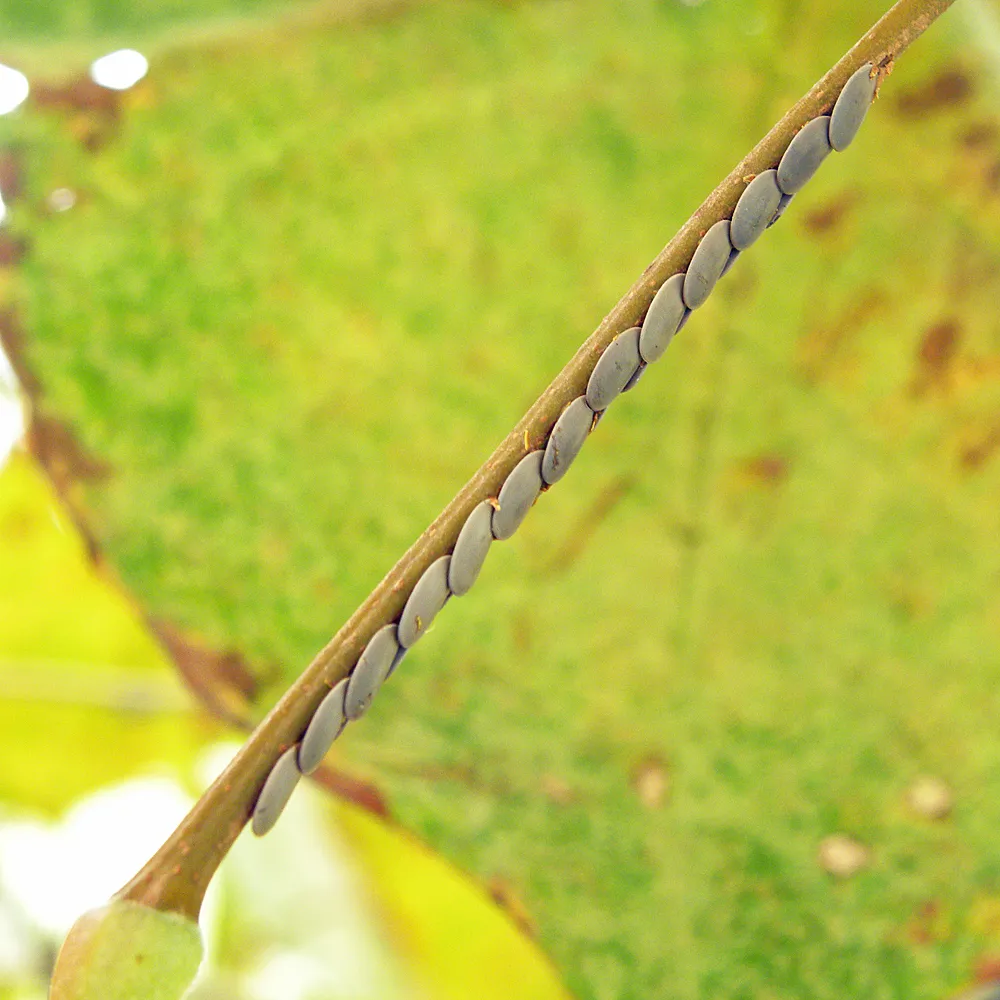
- Like flat seeds in a neat row: katydid eggs. UC IPM's katydid guide says angularwinged, broadwinged and some other katydids line up their eggs on twigs in single or double overlapping rows, each disklike, gray and about 1/5 inch long; the forktailed bush katydid inserts its eggs into leaf edges instead. They overwinter as eggs and, in California, hatch from late March to May, depending on the species.
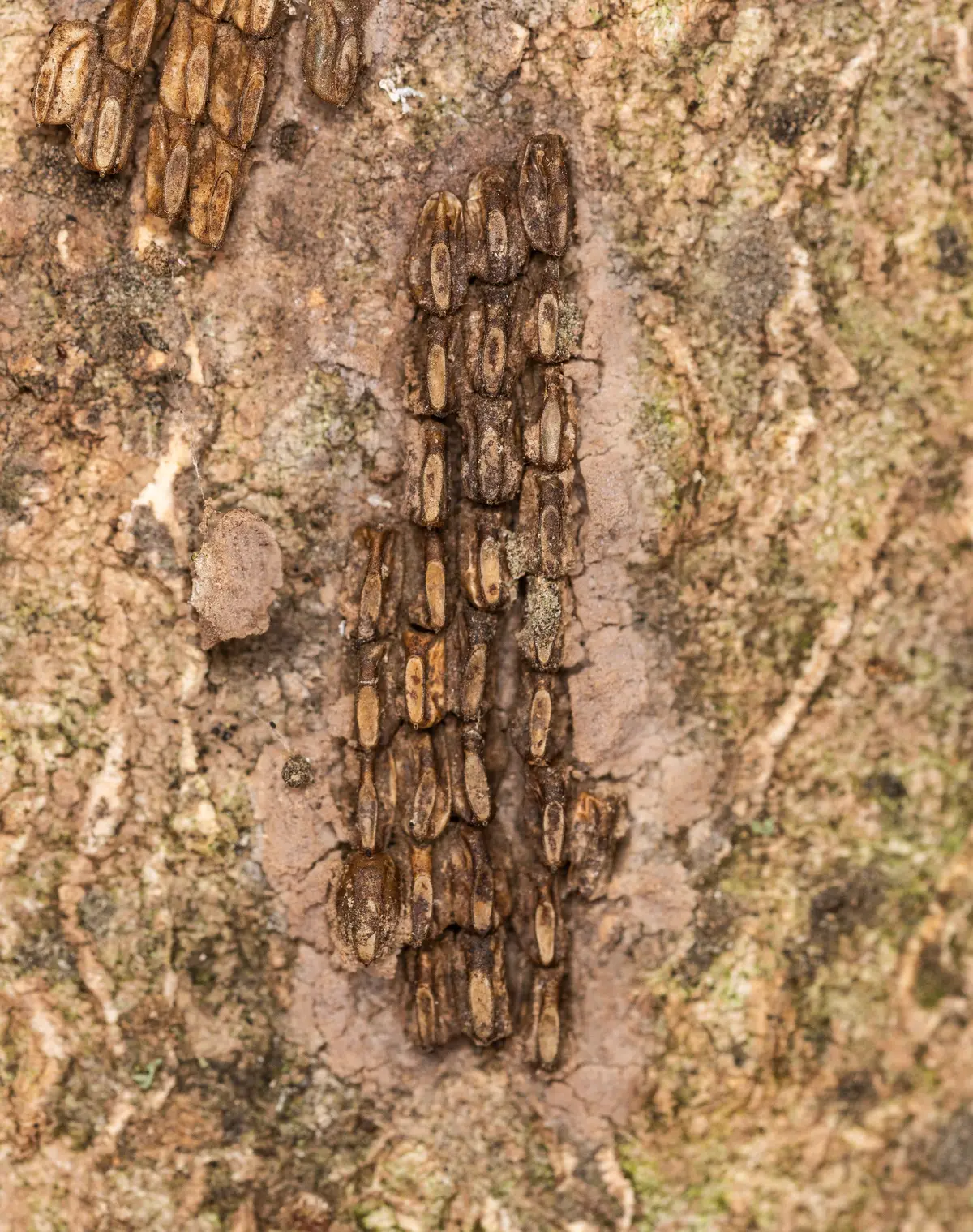
- Like seeds in columns on bark, stone or a car: an old spotted lanternfly egg mass. Virginia Cooperative Extension says each mass holds 30 to 50 grayish-brown eggs laid in four to seven vertical columns, and that older masses can lose their waxy coating, exposing the seed-like eggs.
- Like rice, near a pet's rear end: tapeworm segments, not eggs. CDC's page on dog and cat tapeworm says fresh segments may be seen crawling near the animal's anus, and dried ones look like grains of rice, about 2 mm (1/12 inch), hard and yellowish, sometimes stuck to the fur there; pets catch this tapeworm by swallowing an infected flea. If your pet may have tapeworms, talk to your veterinarian.
- Like tiny, six-sided grains below a small hole in wood: drywood termite droppings. UC IPM's drywood termite guide says the pellets have six sides, are diagnostic for drywood termites and are pushed out through holes less than 2 mm (about 1/12 inch) across; the termite droppings guide has photos.
- Sesame-seed size and moving: an insect, not an egg. CDC compares an adult head louse to a sesame seed, and EPA compares an adult bed bug to an apple seed, 3/16 to 1/4 inch long.
What are the eggs on my window screen, glass or siding?
On a screen, a window or the outside of a house, the shape of the group sorts the eggs: a raft, stalks, a foam-like case or a papery sac. Papery sacs in webs at window corners are spider egg sacs (above); for froth on a cocoon or a fuzzy patch on a wall, see moth eggs, and for the egg clusters of predatory wheel bugs, the wheel bug guide.
A raft of short, pale eggs
Colorado State University's brown marmorated stink bug page describes the eggs as barrel shaped, white or pale green and 1.6 mm (1/16 inch) long, laid on the underside of leaves in clusters of 20 to 30. Predatory bugs lay clusters too, so check the stink bug egg guide, which shows eggs on glass, before you scrape one off.
Eggs on hair-thin stalks
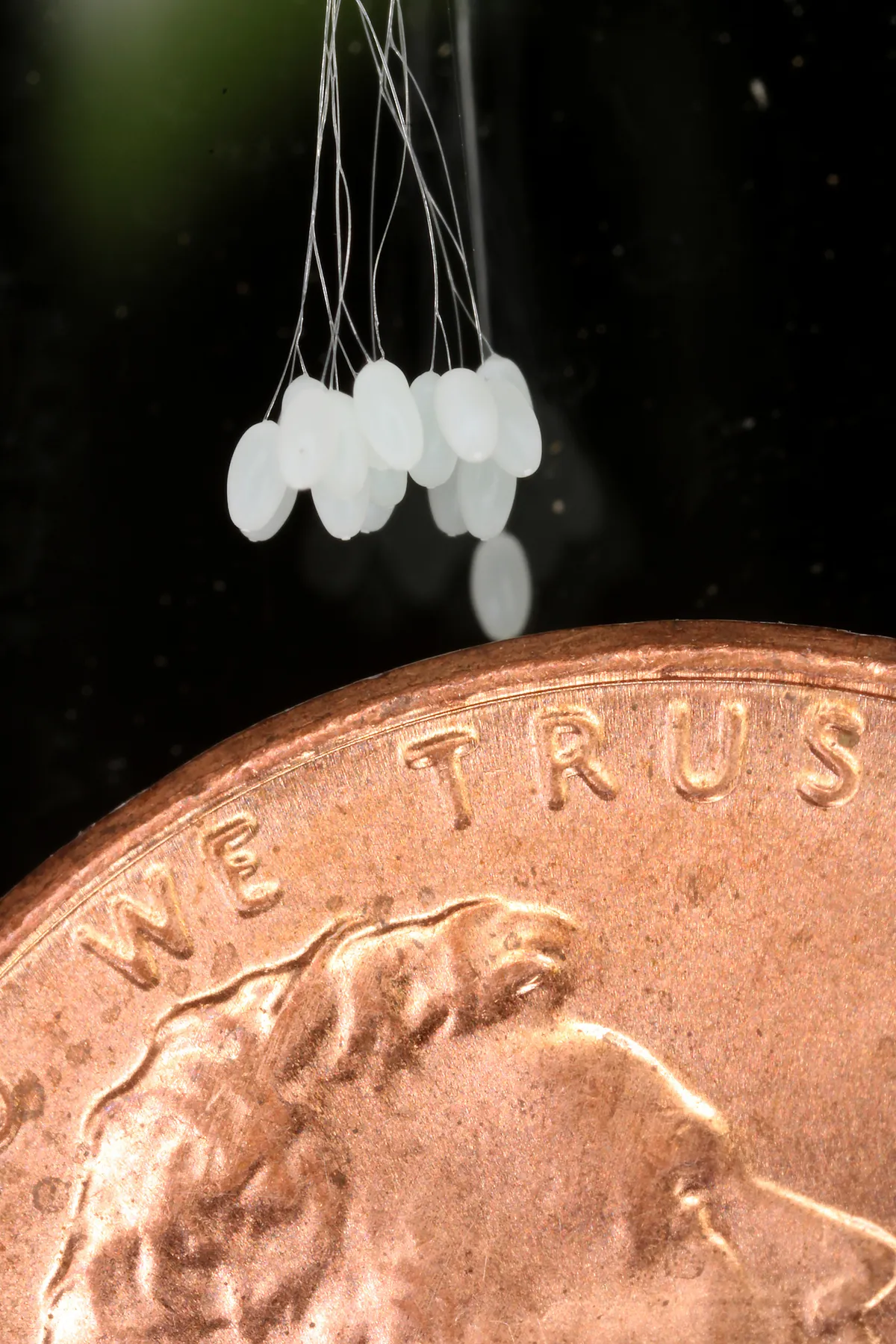
UC IPM's green lacewing page says lacewing eggs are oblong and 1/16 inch (1.5 mm) or less, each laid on the end of a silken stalk attached to plants; they are pale yellowish-green or white when laid, turn bluish-green and then gray before hatching. The larvae eat aphids, mites, mealybugs and other soft-bodied pests, so leave the eggs alone. The cluster below hung from window glass.
A tan, foam-like case
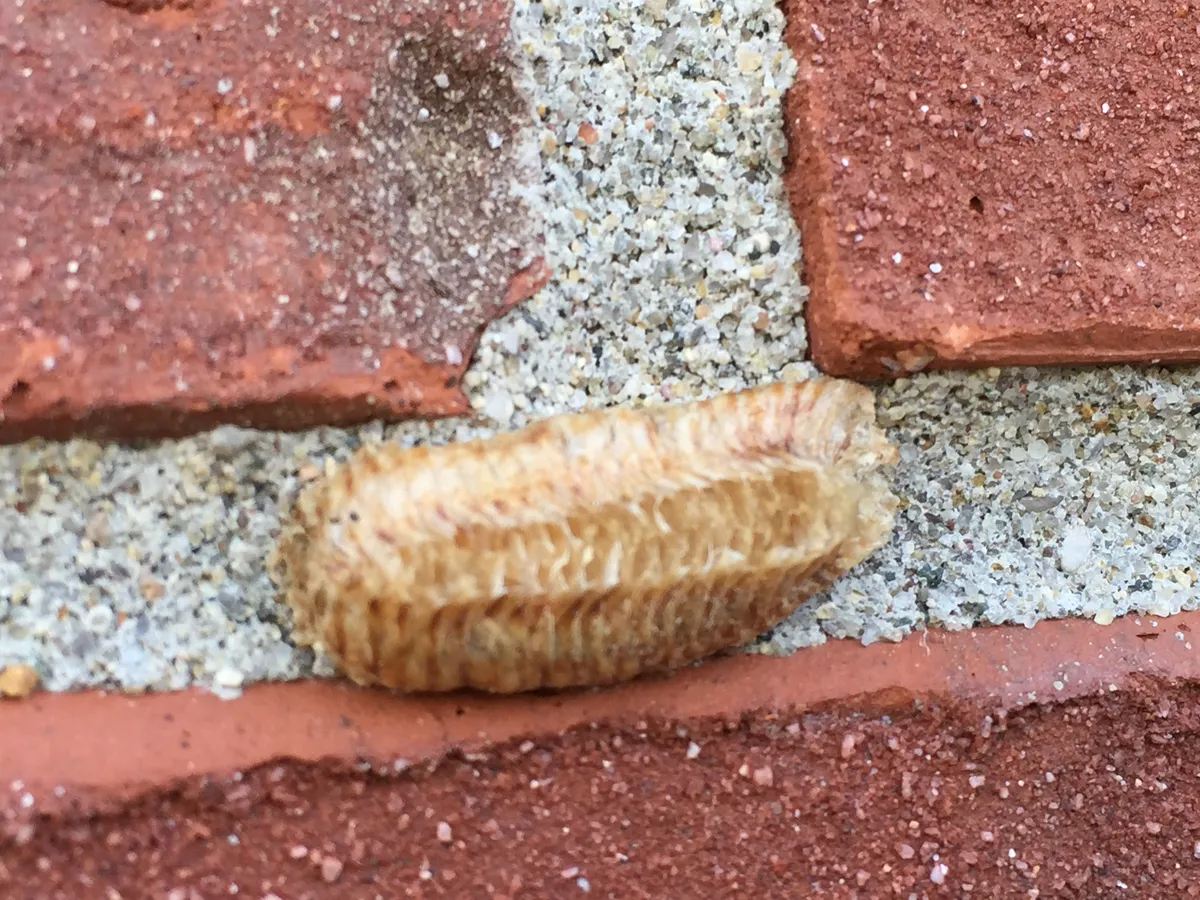
Kansas State University's praying mantid fact sheet says a female lays 200 to 300 eggs in a frothy material that hardens into a foam-like case, found on branches, plant stems, walls, fences, posts, the sides of houses and eaves from November through April. The Carolina mantid's case is tan to light brown, 1/2 to 3/4 inch long, with a white to gray band down the center; the Chinese mantid's is light brown and 1 to 1 1/4 inches long. The young hatch in spring, 50 to 200 from one case.
What are the eggs on leaves and garden plants?
Egg clusters on leaves come from plant feeders such as stink bugs and from predators such as lady beetles and lacewings, so tell them apart before squashing anything. UC IPM's convergent lady beetle page describes lady beetle eggs as oblong, yellow and about 1/25 inch (1 mm) long, laid on end in clusters of about 10 to 30 on leaves and green stems near aphids or other prey, and says the adults and larvae eat soft-bodied insects, insect eggs and especially aphids.
The stink bug egg guide puts lady beetle, squash bug, leaf-footed bug and predator bug eggs side by side, and the Asian lady beetle guide covers that species.
What are the egg masses on my car, grill or patio furniture?
A flat smear about an inch long that looks like wet gray putty or dried, cracked mud is a spotted lanternfly egg mass. USDA APHIS says newly laid masses hold 30 to 50 eggs and look like wet, gray putty before turning dull and brown, that the insect lays them on any hard surface, including grills, vehicles, trailers, firewood, outdoor furniture, bikes and toys, and that the masses can be seen in fall, winter and spring. Virginia Cooperative Extension says laying starts in September and the eggs hatch in late April and early May.
APHIS asks people to inspect vehicles for eggs or insects before leaving a parking lot or work site, to check outdoor items for egg masses, including anything brought indoors, and to smash the masses or scrape them into a zippered plastic bag holding rubbing alcohol or hand sanitizer before throwing it away. The spotted lanternfly guide covers the insect itself.
A fuzzy, buff or yellowish patch about 1 1/2 inches long and 3/4 inch wide is a spongy moth egg mass instead. APHIS's spongy moth page says each holds up to 1,000 eggs, that females attach them to trees, stones, walls, logs and household items such as patio furniture, and that people spread the pest by moving vehicles and outdoor items with egg masses on them.
What are the eggs in a bucket, birdbath or flowerpot saucer?
Eggs in or beside standing water point to mosquitoes. CDC's guide to mosquito control at home says mosquitoes lay their eggs near water, and that mosquitoes that get into the house can lay eggs there too. Its advice, indoors and out, is to empty and scrub, turn over, cover or throw out anything that holds water once a week, such as buckets, birdbaths, flowerpot saucers and vases, to remove the eggs and larvae.
What mosquito eggs and larvae look like describes the floating egg rafts and the eggs some species leave on container walls, the mosquito life cycle explains how fast they develop, and how to combat mosquitoes covers the yard.
What looks like bug eggs but isn't?
Slime molds and droppings get taken for eggs too; termite pellets and tapeworm segments are covered above.
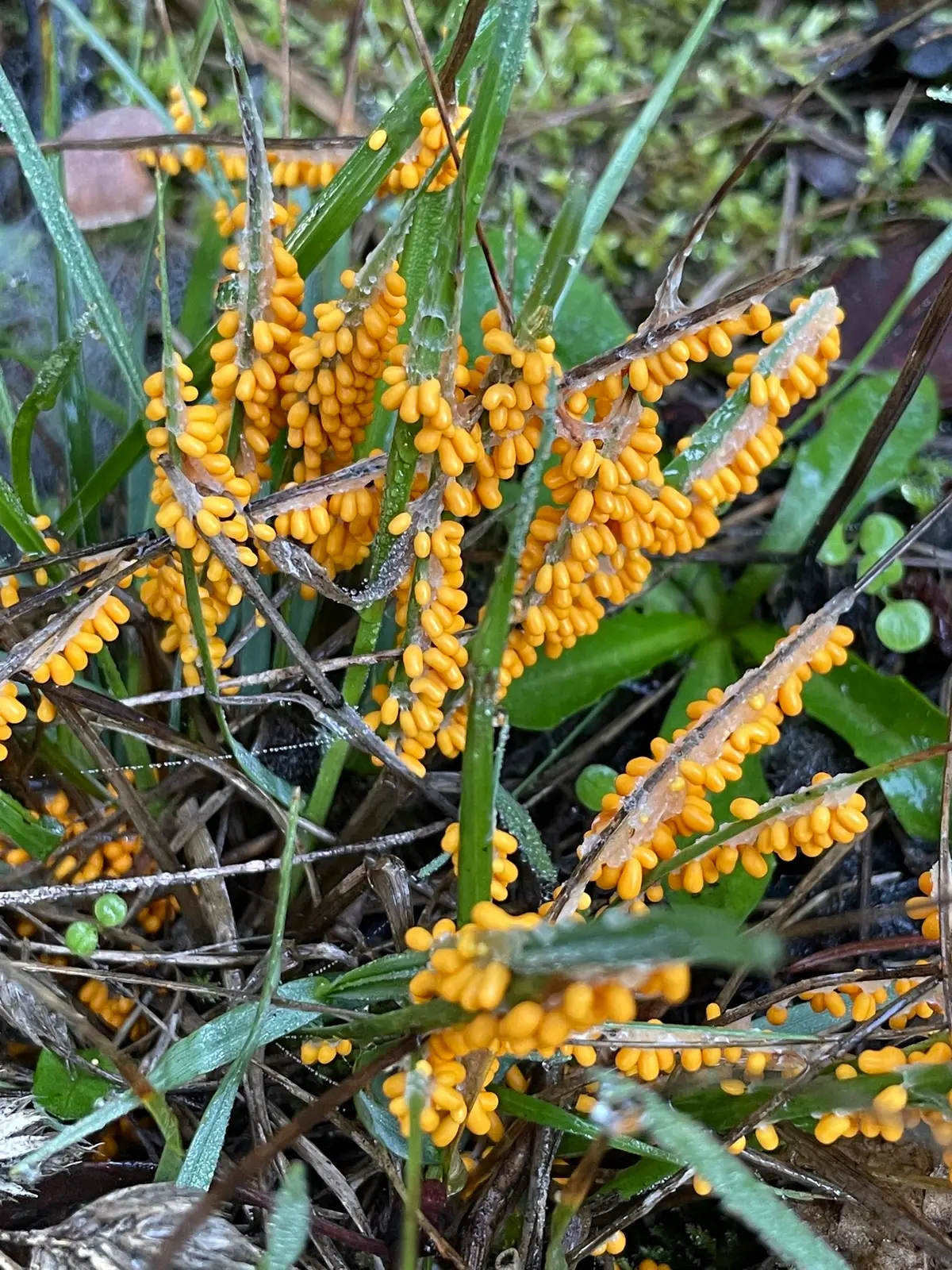
- Yellow to purple-brown beads on grass and other plants: possibly a slime mold. Washington State University's Hortsense fact sheet says slime molds climb grass blades and other plants as a whitish to yellow slime, then form rounded, yellow to purple-brown spore masses that are often mistaken for insect eggs; they feed only on decaying organic matter, do not cause disease in turfgrass and usually disappear in 1 to 2 weeks if left alone.
- Dark specks along walls, in drawers or on bedding: compare them with mouse droppings, cockroach droppings and bed bug stains before you assume they are eggs.
- Gray, seed-shaped cases on an indoor wall: not eggs; the moth egg guide shows the household casebearer case.
How do you tell which eggs you have?
Look closely, with a magnifying glass, before you wipe anything away, then match what you see to the quick-ID table at the top.
Checks to run on eggs you find
- Attached how? Glued in a seam, cemented to a hair, loose, on a silk stalk, or inside a case or sac.
- Grouped how? Singly, side by side, on end, in an overlapping row, in a heap, or in columns under a crust.
- How big? Lay a ruler marked in inches beside them and compare with the table.
- Has the color changed? UC IPM says lacewing eggs turn gray before they hatch, and EPA says bed bug eggs more than five days old show an eye spot.
- Already hatched? Empty shells or open tops mean the young are out, so look nearby for nymphs, larvae or spiderlings.
The egg guides, one kind at a time
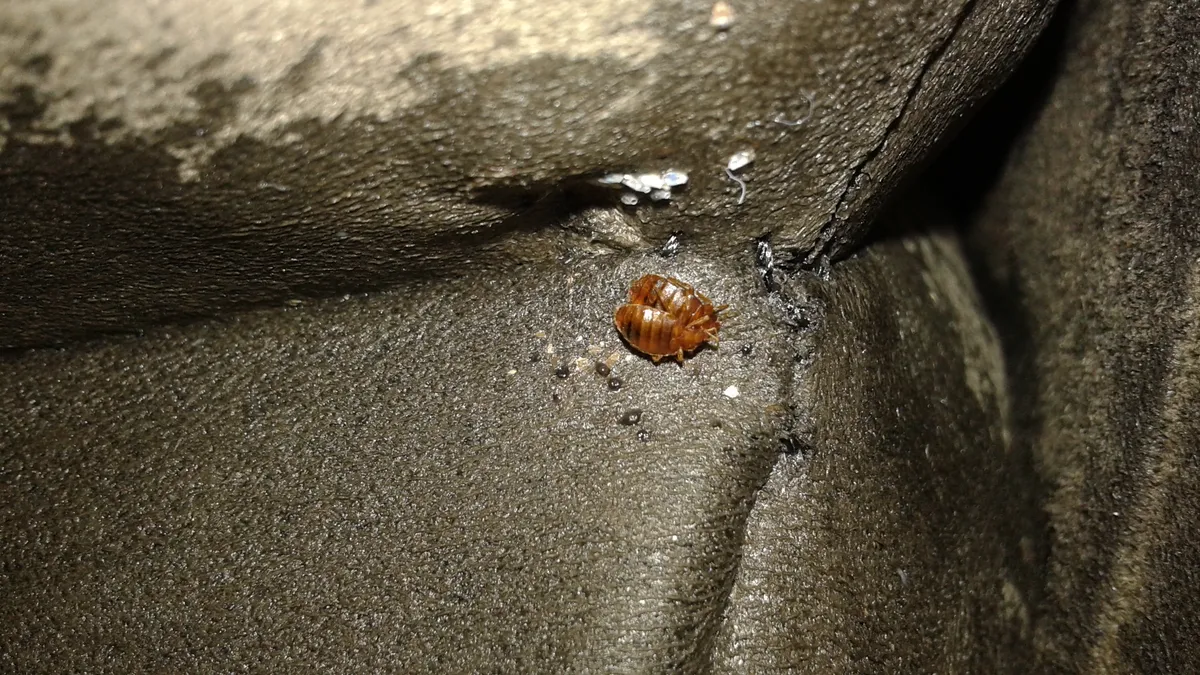 Bed bug eggsPinhead-sized and pearl-white; in mattress seams, piping and bed frame cracks
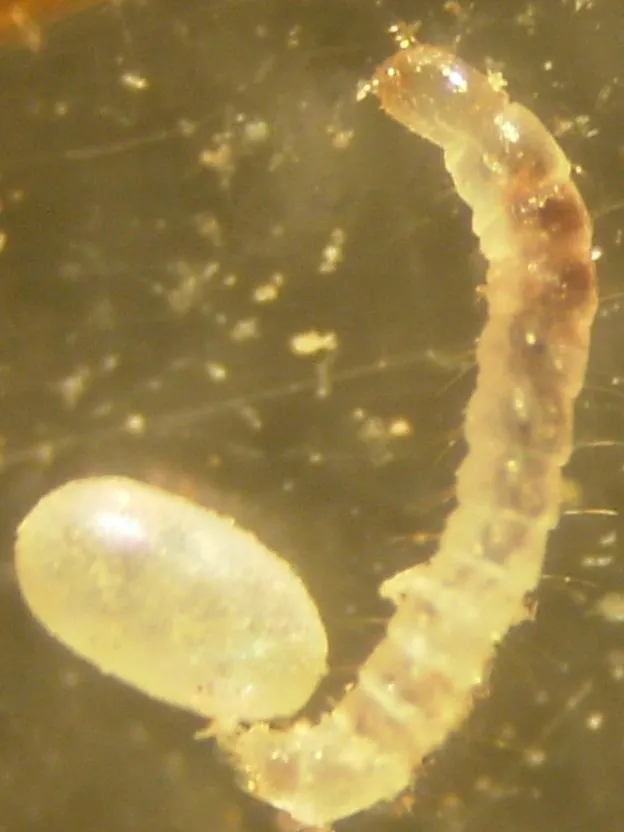 Flea eggsPearly white ovals about 1/32 inch that fall off the pet into bedding and carpet
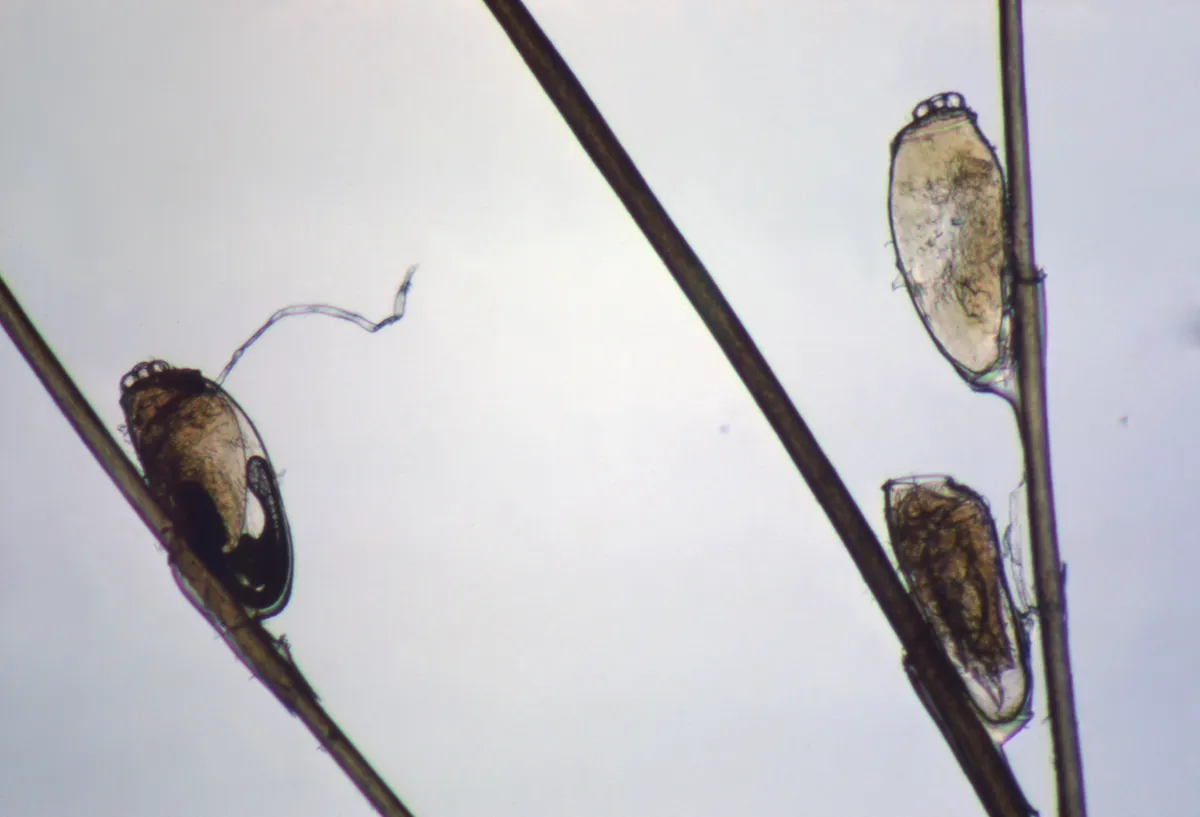 Lice nitsOval, yellow to white, about 1/32 inch, cemented to single hairs near the scalp
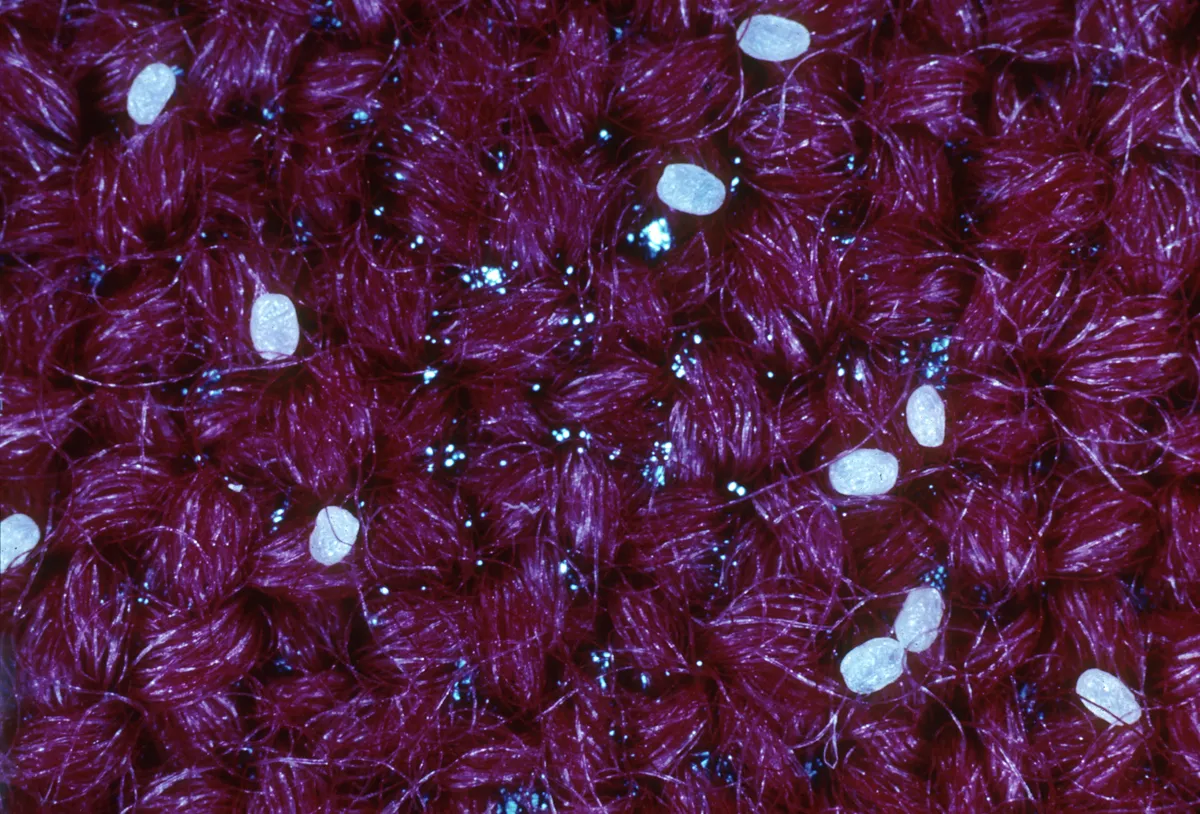 Clothes moth eggsPinhead-sized white eggs laid on or near the wool or fabric they infest
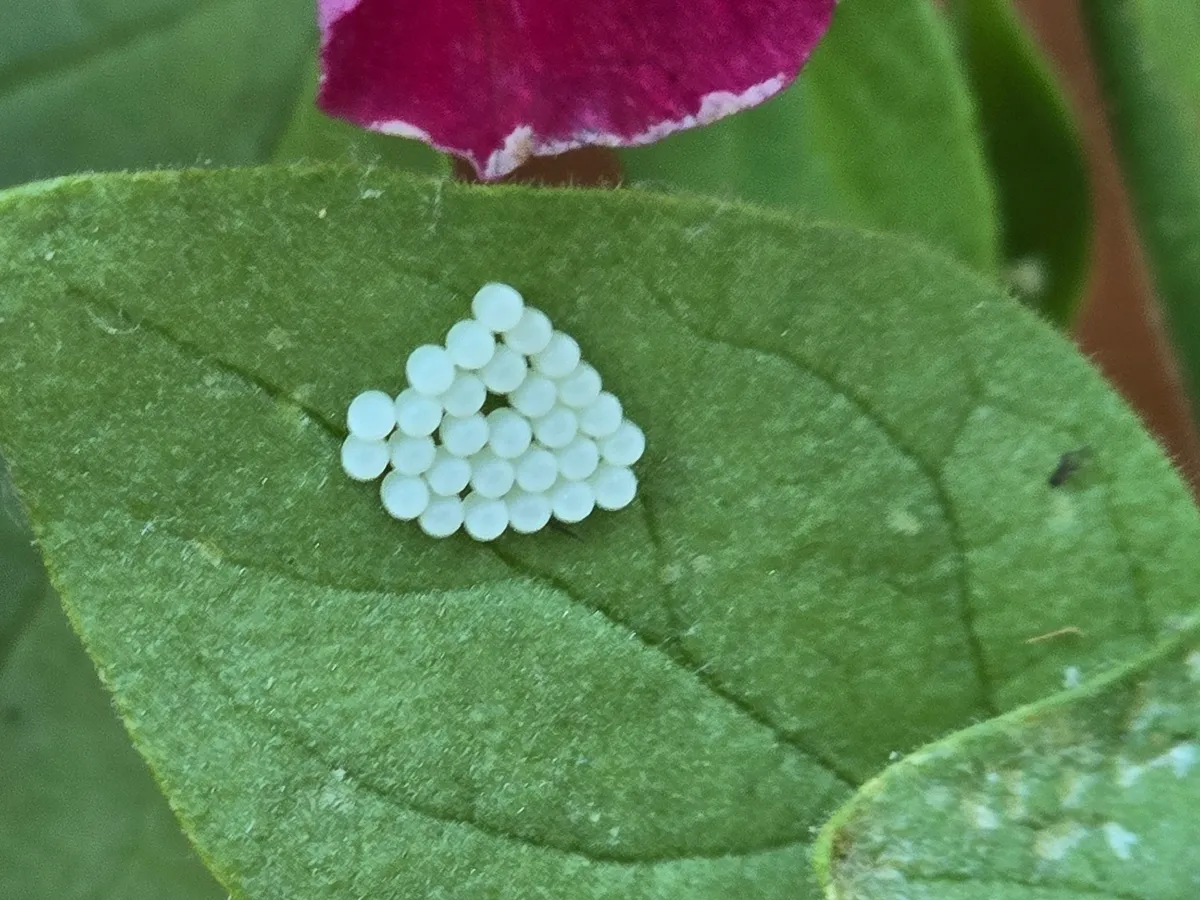 Stink bug eggsWhite or pale green barrels about 1/16 inch, in clusters of 20 to 30 under leaves
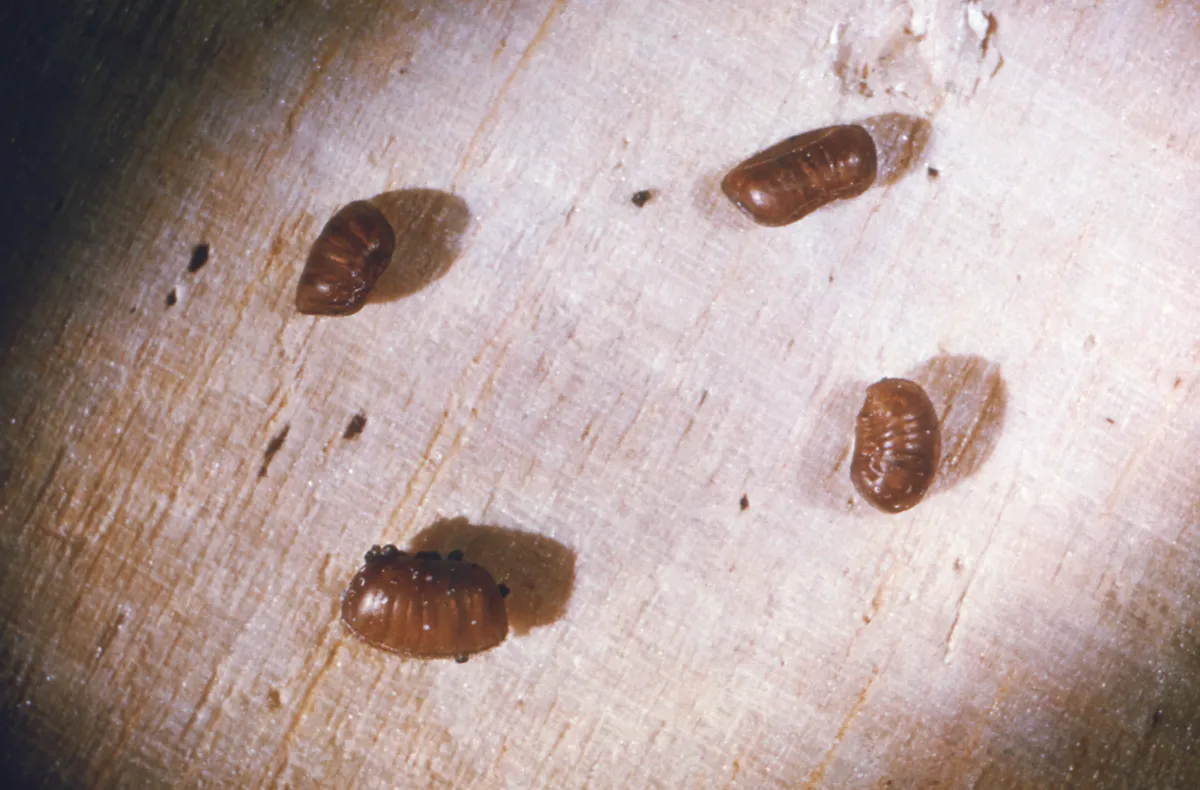 Cockroach egg caseOne purse-shaped brown case, 1/4 to 3/8 inch long, holding about 12 to 45 young
Photos: Bed bug eggs: OH-BugMan, CC BY-SA 4.0, via Wikimedia Commons, CC BY-SA 4.0. Flea eggs: Auguste Le Roux, Public domain, via Wikimedia Commons, public domain. Lice nits: CDC/ Dr. Dennis Juranek (CDC Public Health Image Library, phil.cdc.gov), public domain. Clothes moth eggs: Textile and Fibre Technology, CSIRO, CC BY 3.0, via Wikimedia Commons, CC BY 3.0. Stink bug eggs: no rights reserved, via iNaturalist, CC0 1.0. Cockroach egg case: CDC (CDC Public Health Image Library, phil.cdc.gov), public domain.
What should you do once you know whose eggs they are?
Match what you do to who laid the eggs: some mean a pest is breeding indoors, some belong to predators worth keeping.
- Bed bugs, fleas and lice. Live eggs mean the insect is breeding. See how to get rid of bed bugs, the flea control plan (the eggs fall where the pet rests) and lice eggs.
- Clothes moths, pantry pests and flies. Take away what the young feed on, and keep garbage bagged in a can with a tight-sealing lid, as Virginia Cooperative Extension advises; see moth eggs, pantry pests and maggots.
- Cockroaches and spiders. Cockroach eggs and spider egg sacs each end with what to do with the cases and sacs you find.
- Lady beetles and lacewings. Leave the eggs. UC IPM lists both as natural enemies of aphids and other soft-bodied pests and advises avoiding broad-spectrum, persistent insecticides to protect them.
- Praying mantises. Leave the case outdoors: Kansas State says a case brought into a warm home (70°F) hatches in four to six weeks, so look over branches, cut evergreens included, before you bring them inside.
- Spotted lanternflies and spongy moths. Smash spotted lanternfly masses or scrape them into rubbing alcohol, and check vehicles and outdoor items for both kinds of egg mass before you travel or move, as APHIS advises.
- Mosquitoes. Empty and scrub anything that holds water once a week (CDC).
Frequently Asked Questions
Can you see bug eggs with the naked eye?+
Many, but only just. EPA compares a bed bug egg to a pinhead, about 1 mm or 1/25 inch long, UC IPM puts a cat flea egg at about 1/32 inch, and CDC says lice eggs are hard to see and often mistaken for dandruff. Groups are easier to spot: UC IPM puts a cockroach egg case at 1/4 to 3/8 inch, and USDA APHIS puts a spotted lanternfly egg mass at about an inch. A magnifying glass and a ruler help with the rest.
What bug lays yellow eggs?+
Several do. UC IPM describes convergent lady beetle eggs as yellow and oblong, about 1/25 inch, standing on end in clusters of about 10 to 30 near aphids. Head lice nits are usually yellow to white, according to CDC, and green lacewing eggs start out pale yellowish-green, each on its own silk stalk, UC IPM says. Where you found them sorts these quickly: a leaf, a hair or a silk stalk.
What do spider eggs look like?+
You rarely see the eggs themselves, because spiders wrap them in a sac. Penn State Extension describes the common house spider's sacs as brown and ovoid with tough, papery covers, about 1/4 to 3/8 inch (6 to 9 mm) across, each holding 140 to 380 eggs, and says one female may make twelve or more. Sacs differ from one spider to the next, so compare the shape and the place you found it with a spider egg sac guide.
What do cockroach eggs look like?+
What you find is the egg case, not loose eggs. UC IPM describes German cockroach cases as light beige and about 1/4 inch, carried by the female until a day or two before they hatch; brown-banded cases as light brown, about 1/4 inch and glued to ceilings, under furniture or in closets; and American cockroach cases as about 3/8 inch, brown when laid and black within a day or two. Each case holds about 12 to 45 young, depending on the species.
How long do insect eggs take to hatch?+
It depends on the insect and the temperature. House fly eggs hatch quickly, Virginia Cooperative Extension says; UC IPM gives about 2 to 5 days for cat flea eggs, and Clemson about five days for clothes moth eggs. UC IPM gives about 30 days for a German cockroach's egg case. Praying mantis, katydid and spotted lanternfly eggs wait out the winter and hatch in spring, according to Kansas State, UC IPM and Virginia Tech.
Can insect eggs survive the winter?+
Many outdoor eggs are made for it. Kansas State says praying mantids spend the winter as eggs inside their cases, which can be found from November through April. UC IPM says angularwinged and broadwinged katydids overwinter as eggs, and Virginia Tech says spotted lanternfly egg masses survive temperatures below 0°F. USDA APHIS says spongy moth egg masses can be seen in late summer, winter and spring, and that they spread on firewood, trailers and outdoor items people move.
Should you destroy insect eggs you find?+
Not always. Leave lady beetle and lacewing eggs, because UC IPM lists both insects as natural enemies of aphids and other soft-bodied pests, and leave mantis egg cases outdoors. Destroy spotted lanternfly egg masses: USDA APHIS says to smash them or scrape them into rubbing alcohol or hand sanitizer. Eggs from bed bugs, fleas, cockroaches or clothes moths mean the pest has been breeding indoors, so deal with the infestation, not only the eggs you can see.
What are the egg masses on my car?+
Where these pests occur, check for spotted lanternfly and spongy moth eggs. USDA APHIS says the spotted lanternfly lays on any hard surface, vehicles and trailers included, in masses of 30 to 50 eggs about an inch long that look like gray putty and later like cracked mud, and asks people to inspect vehicles before leaving a parking lot or work site. A fuzzy, buff patch about 1 1/2 inches long is a spongy moth egg mass; APHIS says people spread these by moving vehicles and other outdoor items, and to check for egg masses before traveling out of an infested area.
What happens if you bring a praying mantis egg case inside?+
It may hatch within weeks. Kansas State University says a case kept in a warm home, at about 70°F, releases its young in four to six weeks, that 50 to 200 nymphs can come out of one case, and that nymphs not released promptly or given food will eat each other. It says storing a collected case in a jar in the refrigerator delays hatching, and that cases can go out in the garden once the temperature is above 50°F.
Can you see flea eggs on a dog?+
Sometimes, but many fall off the dog. UC IPM says adult cat fleas stay on the pet to feed, mate and lay eggs, but the eggs are smooth and readily fall onto bedding and carpet. They are pearly white ovals about 1/32 inch long, so look where the dog sleeps as well as in its fur, ideally with a magnifying glass. A flea egg guide can help you tell them from flea dirt and dandruff.
Sources
- Bed Bugs Appearance and Life Cycle — U.S. Environmental Protection Agency
- How to Find Bed Bugs — U.S. Environmental Protection Agency
- Fleas (Pest Notes, UC ANR Publication 7419) — University of California Statewide IPM Program
- DPDx: Pediculosis — Centers for Disease Control and Prevention
- Fabric Pest Control (HGIC 2416, updated April 2020) — Clemson Cooperative Extension, Home and Garden Information Center
- House Fly (ENTO-137NP, revised January 2021) — Virginia Cooperative Extension, Virginia Tech
- About Dog or Cat Tapeworm Infection — Centers for Disease Control and Prevention
- Cockroaches (Pest Notes, UC ANR Publication 7467) — University of California Statewide IPM Program
- Common House Spider (Steve Jacobs, updated January 2026) — Penn State Extension
- Brown marmorated stink bug (IPM pests) — Colorado State University, Department of Agricultural Biology
- Convergent Lady Beetle (Natural Enemies Gallery) — University of California Statewide IPM Program
- Green Lacewings (Natural Enemies Gallery) — University of California Statewide IPM Program
- Katydids (Home and Landscape) — University of California Statewide IPM Program
- Praying Mantids (MF3593, Raymond A. Cloyd, December 2021) — Kansas State University Research and Extension
- Spotted Lanternfly — USDA Animal and Plant Health Inspection Service
- Spotted Lanternfly (ENTO-180NP; Pfeiffer, Day and Dellinger, August 2025) — Virginia Cooperative Extension, Virginia Tech
- Spongy Moth — USDA Animal and Plant Health Inspection Service
- Mosquito Control at Home — Centers for Disease Control and Prevention
- Lawn and Turf: Slime molds (Hortsense) — Washington State University Extension
- Drywood Termites (Pest Notes, UC ANR Publication 7440) — University of California Statewide IPM Program
Read and approved by Alex Francisco. Found an error? Email support@buzzskito.ca.