
Reviewed by Alex Francisco
Published November 10, 2026 · Fact-checked against the sources listed below
What do stink bug eggs look like?
Stink bug eggs look like tiny barrels standing on end, packed side by side in a neat cluster, usually on the underside of a leaf. This page centers on the brown marmorated stink bug (Halyomorpha halys), the invasive species the EPA says is present throughout much of the United States. StopBMSB.org, the site of a research project funded by the USDA's Specialty Crop Research Initiative, describes its eggs as light green and laid in masses of about 28, often under leaves.
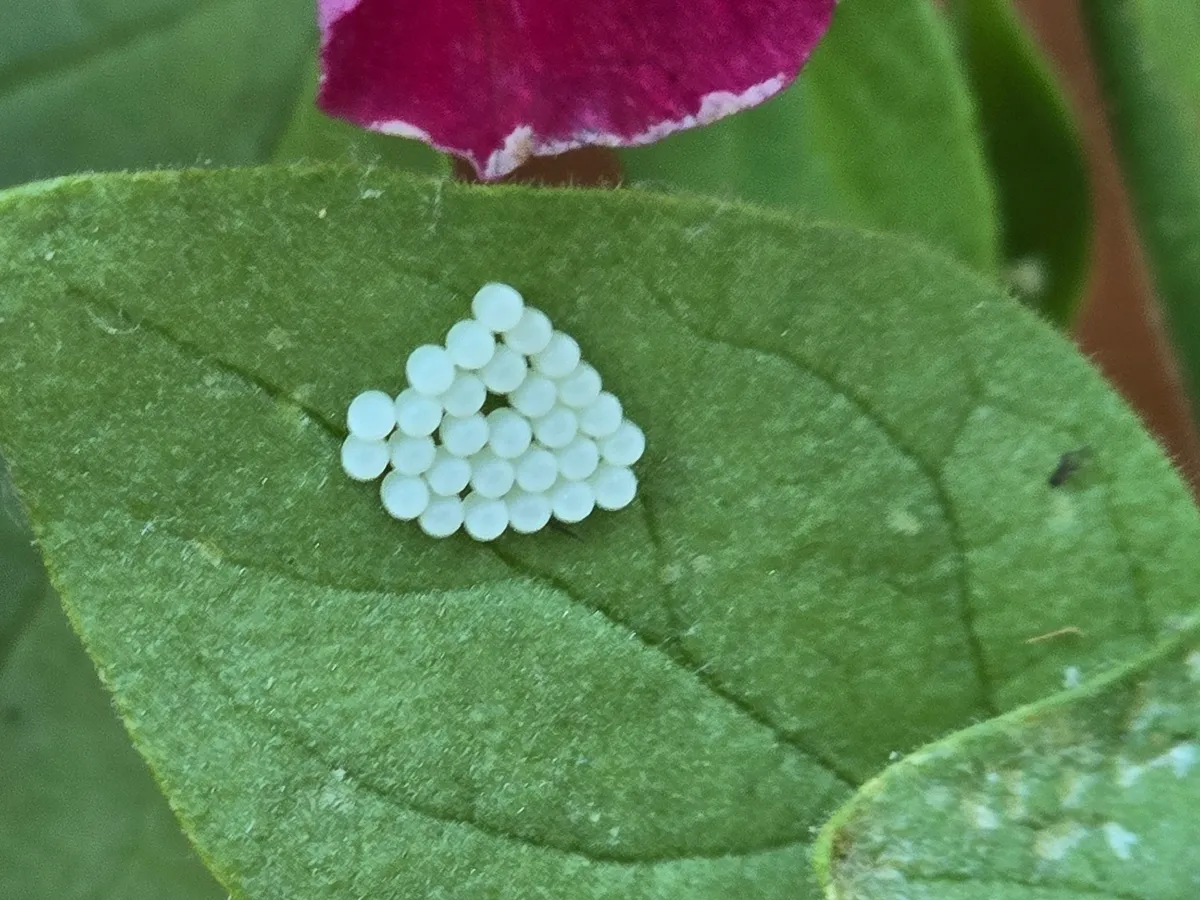
UC IPM's Pest Notes on the brown marmorated stink bug call the eggs barrel shaped and white to pale green. Virginia Tech's field guide to stink bugs, written with entomologists from Clemson, New Mexico State and the University of Arizona, adds that they look somewhat shiny and come in clusters of about 25. Up close, Penn State Extension describes them as elliptical and light yellow to yellow-red, with minute spines forming fine lines, and the EPA as light green or yellow, so the color can run from white to pale green to yellowish.
The count is a good clue. Penn State and the EPA give 20 to 30 eggs per mass, and UC IPM gives clusters of 20 to 28 and a lifetime total of 212 to 486 eggs per female; StopBMSB puts the most at 486. Other stink bugs lay similar barrels in other colors and numbers, compared further down.
How big is a stink bug egg mass?
Smaller than a thumbnail. Penn State measures each brown marmorated stink bug egg at 1.6 by 1.3 mm, about 1/16 by 1/20 inch, so even a mass of 20 to 30 makes a small patch: in the photo below, the hatched mass is narrower than the thumbnail beside it.
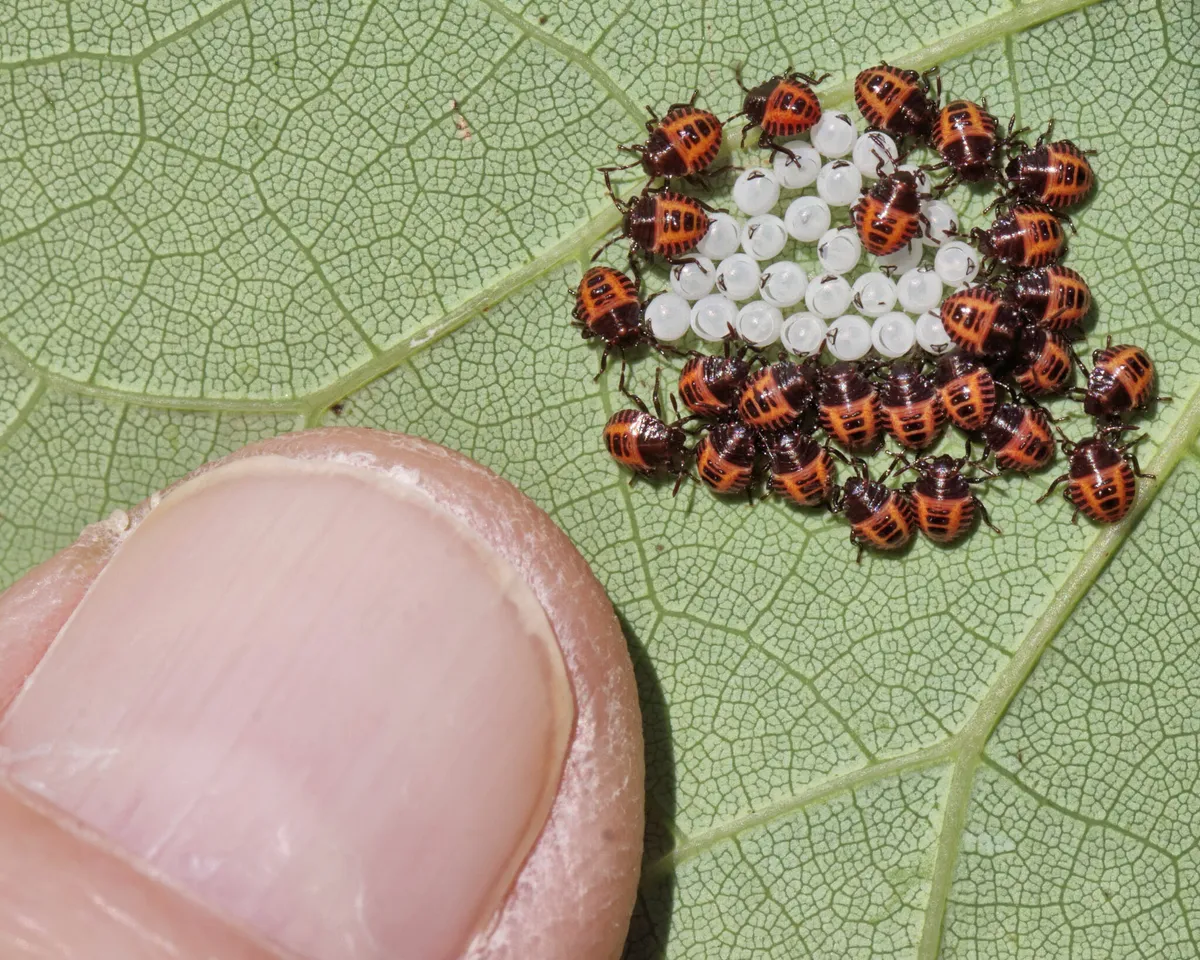
The nymphs that hatch are tiny too: Penn State gives the first stage as 2.4 mm, about 3/32 inch.
Where and when do stink bugs lay eggs?
Outdoors, on the undersides of leaves, from late spring through summer. The University of Kentucky's fact sheet on stink bugs in homes says they lay outdoors on the underside of host plant leaves after a few weeks of feeding in spring. Penn State and the EPA give the egg-laying season as May through August, and the University of Maryland Extension gives June to August.
Host plants run from the vegetable patch to the shade trees. Kentucky lists crops such as tomato, peppers, beans, squash, corn, apple and peach, says the bugs also feed and develop on hundreds of kinds of trees and shrubs, and names redbud, maple, honey locust, serviceberry, crabapple and cherry among the favorites. Those are the leaves to turn over first.
Leaves are where the sources describe the eggs, and Utah State adds fruiting structures and, occasionally, the stems of host plants. None of them mentions glass, so treat the photo below, of a female laying on a glass pane, as an exception rather than the rule. The adult is easy to name, since Virginia Tech's guide describes alternating dark and white bands on its antennae and around the edge of its abdomen.
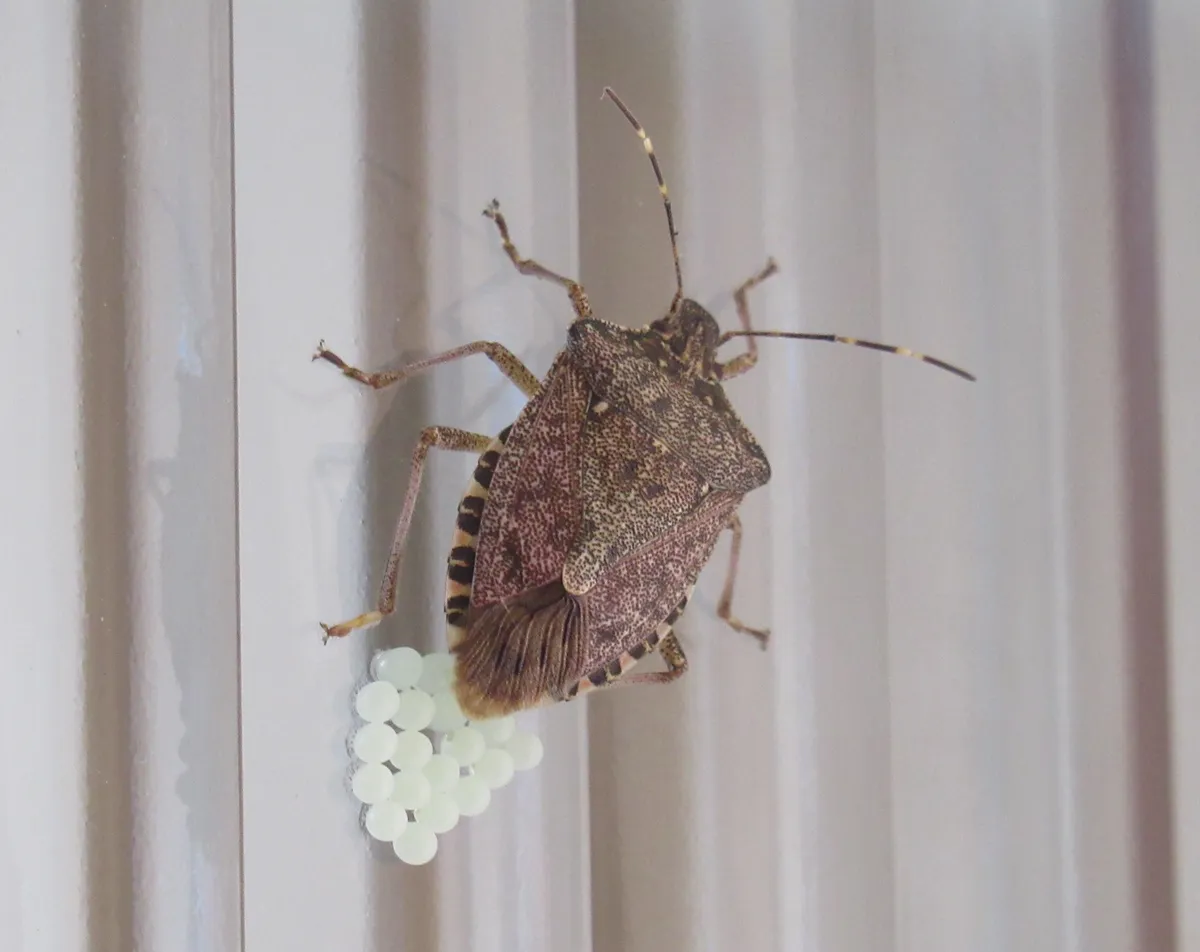
Several generations can lay in one summer. The EPA says there are usually one or two generations a year in cooler climates and up to five in warmer ones, and Illinois Extension says most of the Midwest has two, so fresh masses can turn up until late summer. A fresh-looking cluster on a twig in fall or winter is more likely a wheel bug's (below), since brown marmorated stink bugs lay from May to August and their eggs hatch within about a week.
How can you tell if stink bug eggs have hatched?
Hatched eggs are pale, empty shells with open tops; in the photo below, most also show a small dark triangle at the rim. Utah State University Extension says this triangular egg burster forms in the eggs shortly before the nymphs hatch, and UC IPM's page on Trissolcus parasitoids says a stink bug that has hatched leaves a pale shell with a smooth-edged, round hole, sometimes with the lid still partly attached.
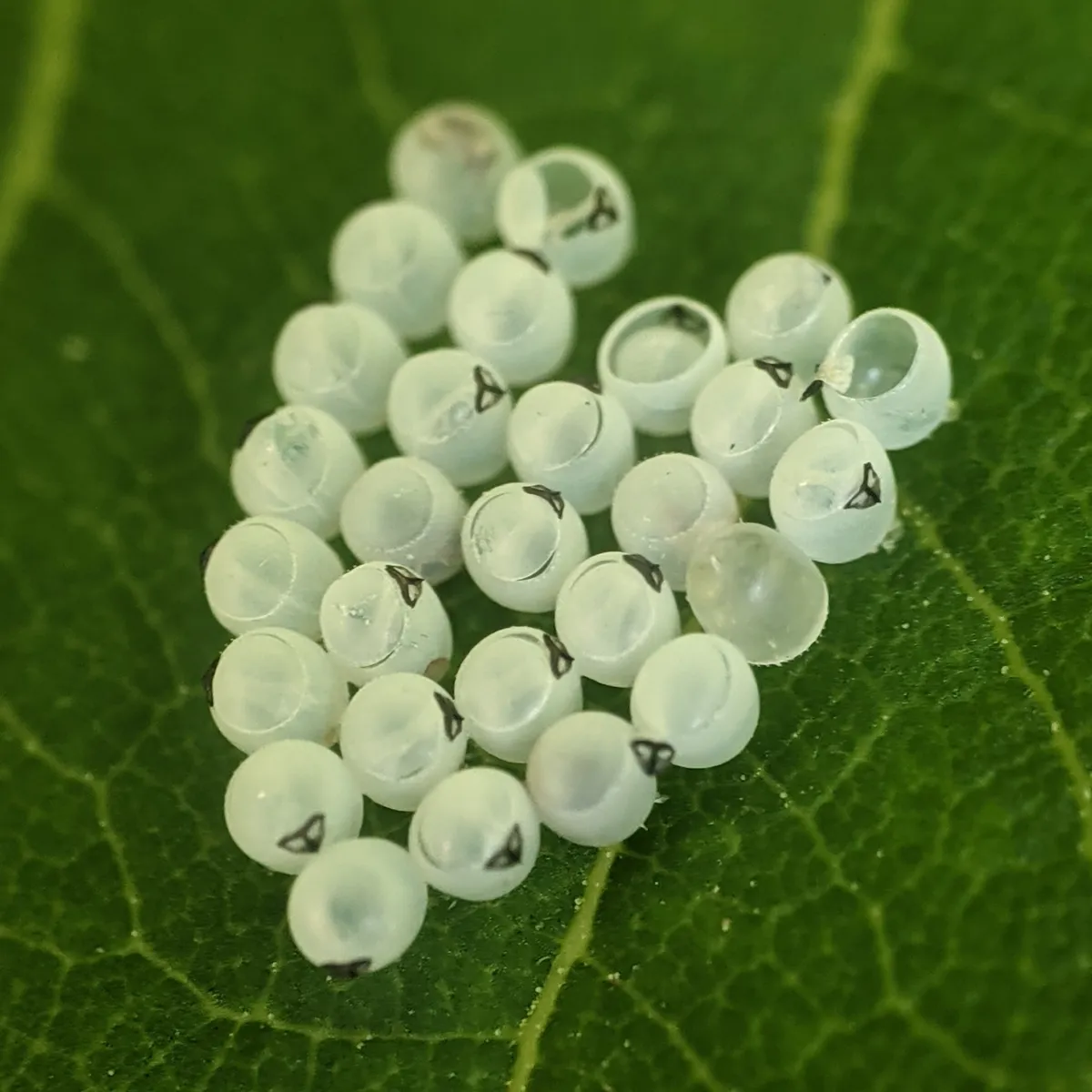
Hatching comes fast in summer. Illinois Extension says the eggs hatch roughly four to five days after they are laid, and Utah State gives 5 to 7 days, so an unhatched mass you find today may be empty within the week. A parasitic wasp leaves a different mark: UC IPM says it chews a somewhat irregular, rough-edged hole in a shell that has turned dark, covered below.
What do baby stink bugs look like?
Newly hatched brown marmorated stink bugs are tiny, about 3/32 inch long, and orange to reddish with dark markings, and they stay bunched on the empty eggs for a while. UC IPM says the first stage feeds at the egg cases before dispersing, sometimes staying until it molts, and UConn Extension's stink bug fact sheet says newly hatched nymphs disperse after a day or more. StopBMSB says the early nymphs have dark reddish eyes, and the EPA describes a yellowish abdomen mottled with black and red.
They molt through five stages, each about a week long by Illinois Extension's count. UC IPM says the second stage looks almost black just after molting, and that later stages have a marbled brown head and thorax, reddish brown, black and white markings on the abdomen, white bands on the antennae and legs, and, in the fourth and fifth stages, wing pads. Illinois Extension notes that nymphs lack working wings.
| Stage | Size | What it looks like | Where you see it |
|---|---|---|---|
| Egg | About 1/16 inch (1.6 mm) | Pale green to white barrel, in a mass of 20 to 30 | Under a leaf; hatches in 4 to 5 days (Illinois) or 5 to 7 (Utah State) |
| First stage | About 3/32 inch (2.4 mm) | Orange to reddish abdomen with dark markings; dark reddish eyes | On the empty egg mass for a day or more |
| Second stage | Between the first and fifth | Almost black just after molting | Moving off the egg mass onto the plant |
| Third to fifth stages | Up to about 1/2 inch (12 mm) | Marbled brown; white bands on legs and antennae; wing pads in the last two stages | On the host plant, about a week per stage |
Sizes from Penn State; colors from UC IPM, StopBMSB and the EPA; timing from Illinois Extension, Utah State and UConn Extension.
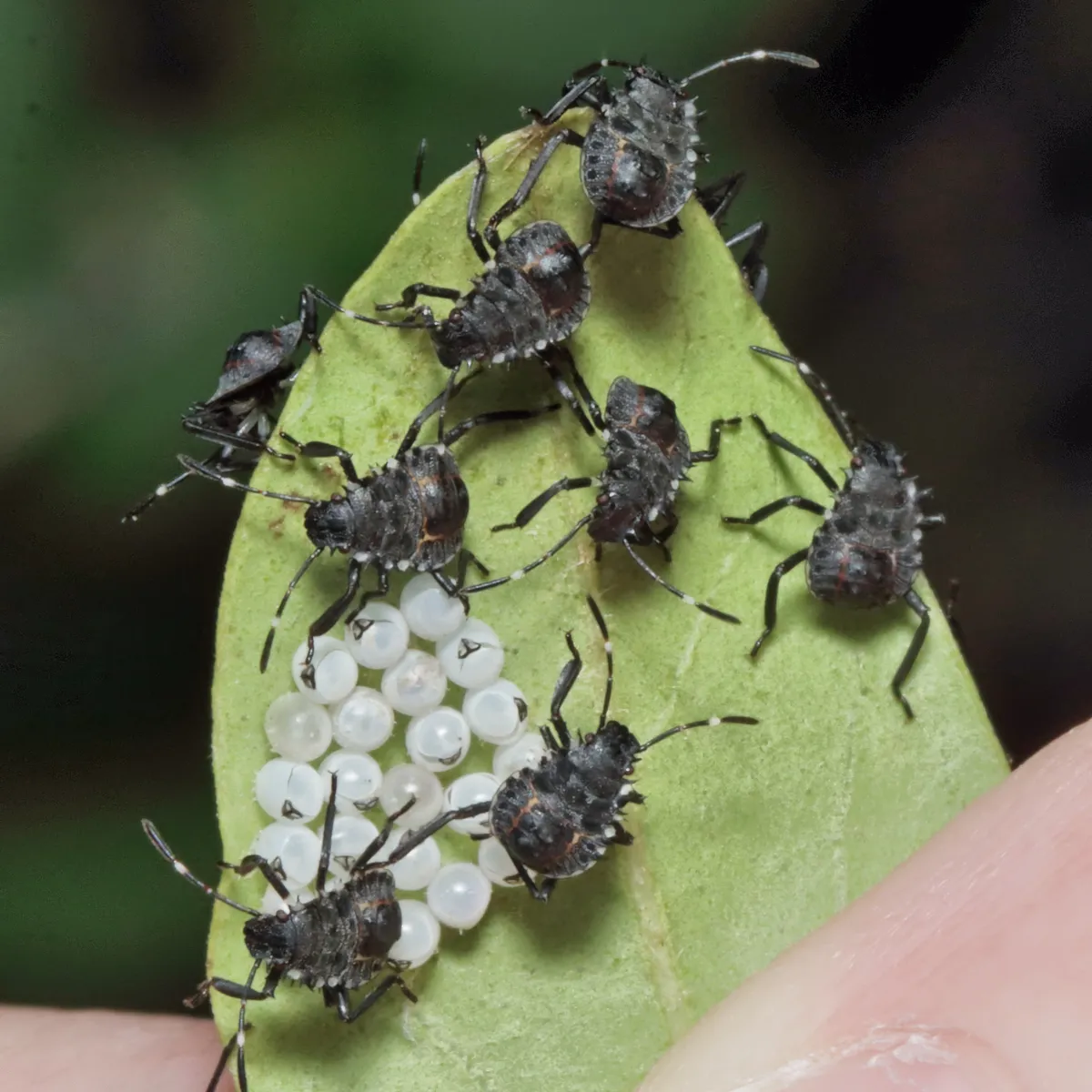
A tiny, round nymph can pass for a tick at a glance. Count the legs: CDC's tick life-cycle page describes tick nymphs as eight-legged (tick larvae have six), while the stink bug nymphs in the photos above have six. The guide to bugs that look like ticks covers this and the other common mix-ups.
Do stink bugs lay eggs in your house?
No. Brown marmorated stink bugs that spend the winter indoors do not breed there: Kentucky says the adults overwinter in an unmated condition and do not breed or reproduce indoors, and UC IPM says they wait out the winter in a resting state called facultative diapause and do not reproduce during those months. Penn State and the EPA also say the bug does not reproduce inside homes.
Egg laying starts outdoors after they leave. Kentucky says the bugs come out of hibernation from March to May and need a few weeks of feeding on host plants before they mate and lay eggs, and StopBMSB says mating starts about two weeks after they emerge. The bugs you see indoors in January are the same ones that came in the fall before, and the guide to getting stink bugs out of the house and sealing the gaps covers them.
Kentucky adds that adults are occasionally found on houseplants in late winter, possibly feeding. None of the sources here describes stink bug eggs laid indoors, so eggs or tiny insects on an indoor plant most likely point to another pest; the guide to bugs on houseplants sorts them.
What do other stink bugs' eggs look like?
Other common stink bugs lay similar barrels in other colors, numbers and patterns. Virginia Tech's field guide and the University of Maryland Extension's guide to common mid-Atlantic stink bugs describe them, though not always the same way:
- Green stink bug (Chinavia hilaris). Among the largest stink bug eggs, in clusters of about 20 to 50, pure white until ready to hatch, with many small nubs around the top that bend at the tips, in Virginia Tech's description; Maryland calls them yellow to green, later turning pink to gray.
- Brown stink bug (Euschistus servus). Manila-colored, less white than the green stink bug's, with a rough-looking shell, in loosely bound clusters (Virginia Tech); white, more kettle-shaped and slightly smaller than the green stink bug's (Maryland).
- Southern green stink bug (Nezara viridula). White turning pink as they mature, in hexagon-shaped clusters of rows with about 150 eggs (Virginia Tech); light tan, more cylindrical and often reddish pink before hatching (Maryland).
- Harlequin bug (Murgantia histrionica). White with a narrow black band at the base, a wider one near the top and a black crescent on top, laid in small clusters of two rows; Virginia Tech says the bug feeds on cabbage.
A pink or gray tint can be normal development rather than trouble: Penn State Extension's article on egg parasitoids notes that egg color naturally changes as many insects develop. To tell whether the barrels belong to a plant feeder or a predator, look at the tops, as the next sections explain.
How do you tell stink bug eggs from ladybug eggs?
Lady beetle eggs are yellow and oblong; brown marmorated stink bug eggs are pale green to white barrels about 1/16 inch long, and the convergent lady beetle's eggs, which stand on end, are smaller. UC IPM's natural enemies gallery describes convergent lady beetle eggs as oblong, yellow and about 1/25 inch (1 mm) long, laid on end in clusters of about 10 to 30 on leaves and green stems near aphids or other prey. Penn State Extension's guide to the multicolored Asian lady beetle calls that species' eggs yellow and oblong, laid in clusters on the undersides of leaves of low-growing plants, and says they hatch in three to five days.
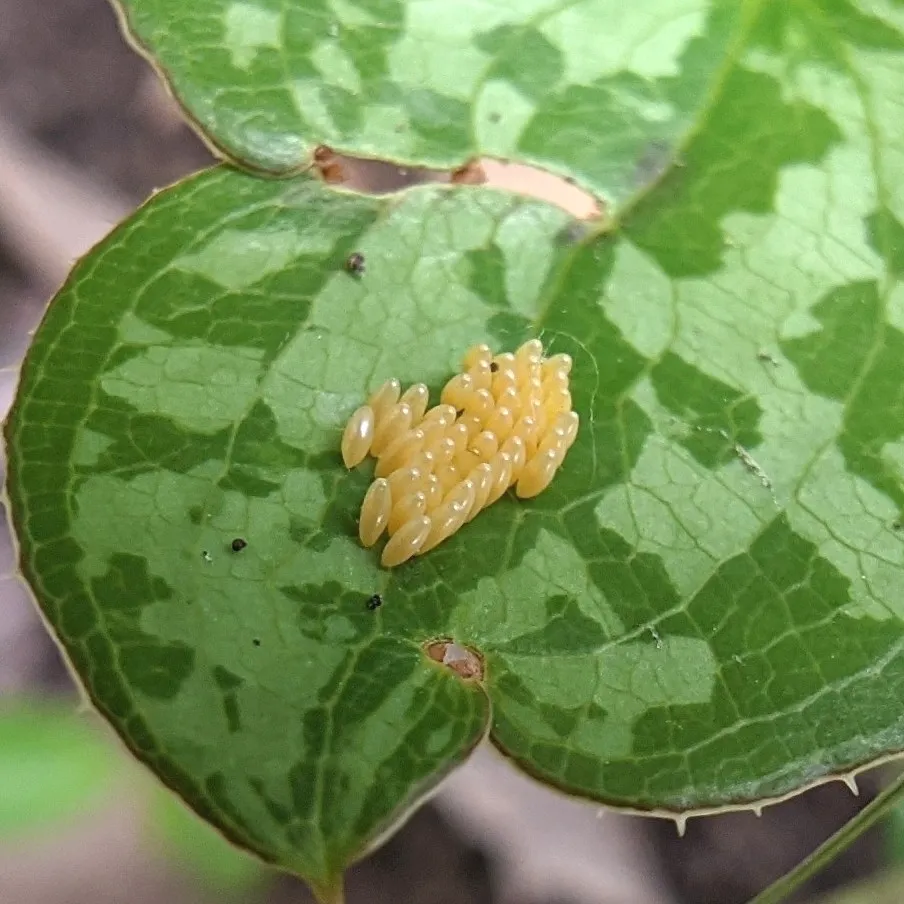
Leave these where they are. UC IPM includes the convergent lady beetle in its gallery of natural enemies, and the aphid control guide explains how lady beetles fit into aphid control. The Asian lady beetle is also the beetle that crowds onto houses in fall, which the Asian lady beetle guide covers.
How do you tell stink bug eggs from squash bug eggs?
Squash bug eggs are shiny, slightly oval and copper colored rather than pale, and they turn up mainly on squash and pumpkins. Colorado State University Extension's squash bug fact sheet describes them that way, laid in small masses mostly on the undersides of leaves, with egg laying often starting around mid-June and pale green nymphs hatching in about a week. Virginia Tech says they start out light, turn coppery and then dark maroon, and are often laid in a diamond-shaped pattern along the leaf veins.
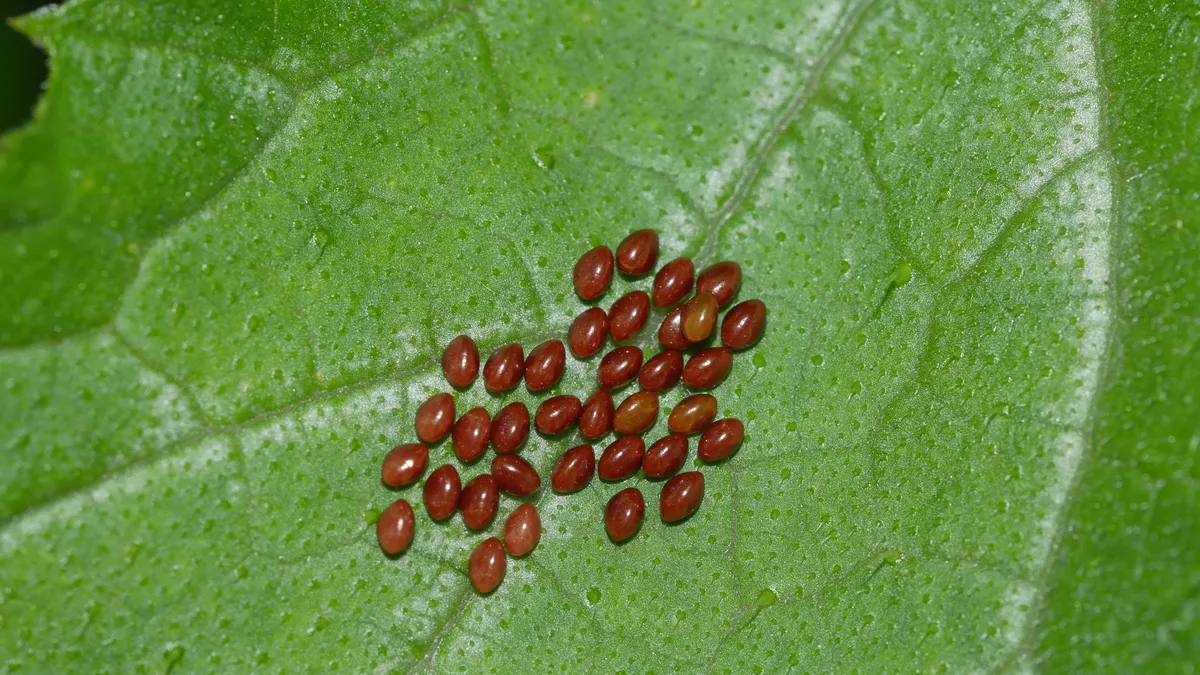
Colorado State says hard winter squashes, pumpkins included, are the plants squash bugs damage most, and that the eggs are easy to find in a garden check and can be crushed when found. A string of brown, cylindrical eggs laid end to end along a stem or leaf vein is a leaf-footed bug's: UC IPM's Pest Notes on leaffooted bugs say most strands hold 10 to 15 eggs and hatch in about a week. See the leaf-footed bug guide.
Which egg clusters should you leave alone?
Leave eggs with a crown of spines, wheel bug eggs and any mass that has turned dark: they belong to predators or may already hold developing parasitic wasps. UConn Extension advises crushing stink bug eggs only once they are identified correctly, and not crushing predatory stink bug eggs when pest insects are on the plant.
Spined soldier bug eggs
The spined soldier bug (Podisus maculiventris) is a stink bug that eats other insects; Maryland calls it the most common predatory stink bug in Maryland and the mid-Atlantic. Maryland says predatory stink bugs in general lay tight clusters of 20 to 30 barrel-shaped eggs on leaves and twigs, gray to black or cream to gold, and that the spined soldier bug's eggs carry spines like a crown around the top. Virginia Tech describes this species' eggs as silvery to metallic-looking with spiny nubs, in loose clusters. Brown marmorated stink bug eggs carry only minute spines in Penn State's description, so a visible crown points to the predator.
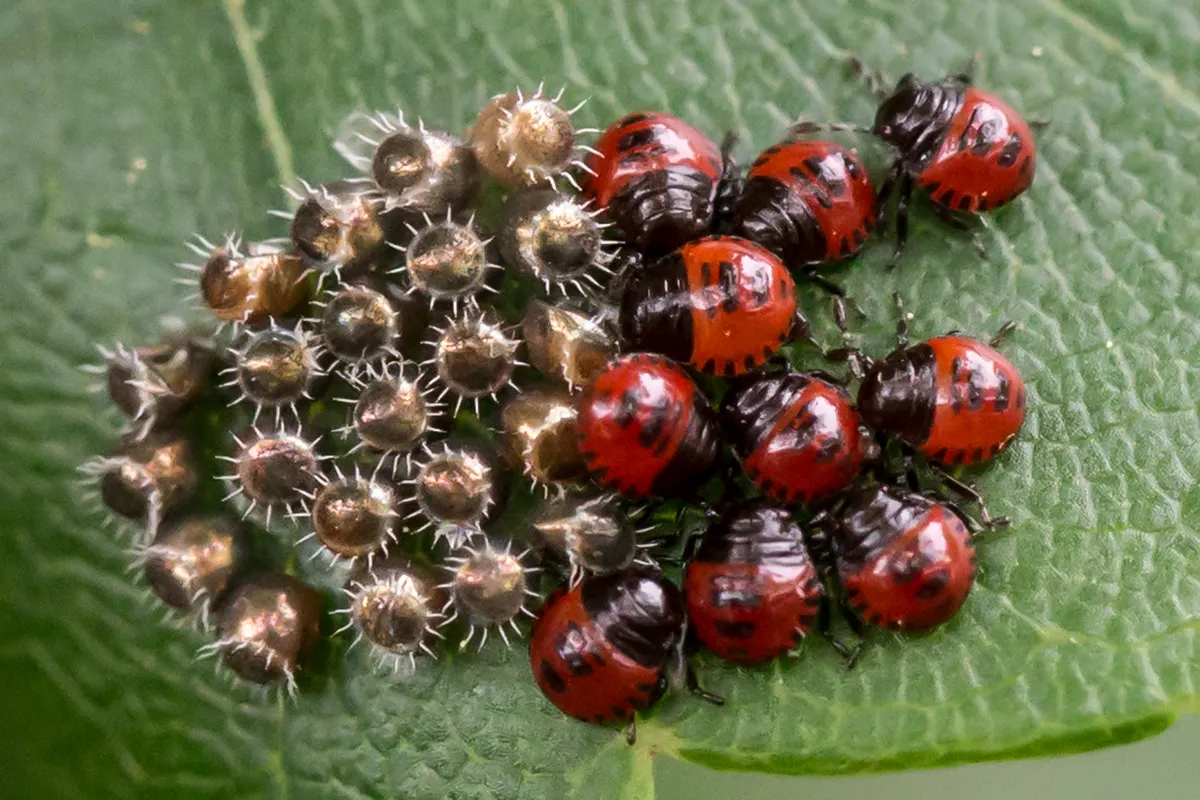
The young can fool you. Maryland says young spined soldier bugs are round and red and black, colors close to those of newly hatched brown marmorated stink bugs, so check the shells they are sitting on.
Wheel bug eggs
Wheel bugs are large assassin bugs, a group UC IPM lists among the natural enemies of the brown marmorated stink bug. Virginia Tech says they lay tight clusters of 50 to 182 eggs that look like small brown bottles with white stoppers, and the University of Kentucky's wheel bug fact sheet says the female glues several dozen on end on small twigs of shrubs and trees in fall, and that they hatch in early spring into small red and black nymphs. Kentucky warns that a wheel bug will try to bite if handled and that the bite is painful, so leave the young alone too. The wheel bug guide covers the adults and their bite.
Why are some stink bug eggs dark or black?
Often because tiny parasitic wasps are developing inside them. Utah State says parasitized eggs turn dark brown or black after about a week and keep darkening until the adult wasps come out about 14 days later, and Penn State adds that such eggs fail to hatch when their unparasitized neighbors do. UC IPM says the wasp chews a somewhat irregular, rough-edged hole as it leaves, and the shell commonly stays dark; Penn State describes the exit hole as tiny and round.
One of those wasps is the samurai wasp (Trissolcus japonicus), an egg parasitoid from Asia. The USDA's Agricultural Research Service says it is about 1.5 mm (1/16 inch) long, the size of a sesame seed, that it strongly prefers brown marmorated stink bug eggs, that it arrived in North America by accident, and that wild populations were in 14 states when the article was written. Penn State says the female lays her eggs inside the developing stink bug eggs and her larvae eat the embryos.
Other Trissolcus wasps attack the eggs of other stink bugs, such as the southern green stink bug, the same way. UC IPM describes them as mostly black, about 1/16 inch long, and says they take about 2 weeks to develop at an average of 80°F and 3 weeks at 70°F.
Leave dark masses on the plant. Utah State says that when parasitoid wasps are on an egg mass, leaving the eggs and the wasps on the plant is the preferred choice, since that may mean more wasps and fewer stink bugs, and that parasitoid wasps are very sensitive to insecticides. Penn State cautions that appearance alone does not always confirm parasitism: predators, disease, weather or failed development can also darken eggs, and a mass that is merely pink or gray may be another species developing normally.
How can you tell which eggs you found?
Check the shape, color, top and layout with a magnifying glass, then note where and when you found the eggs.
Checks to run on an egg cluster
- Shape. Barrels standing on end point to a stink bug; small yellow ovals on end to a lady beetle; brown bottles with white tops to a wheel bug; brown cylinders lying end to end to a leaf-footed bug.
- Color. Pale green, white or light yellow fits a brown marmorated stink bug; copper to maroon, a squash bug; bold black-and-white bands, a harlequin bug; dark brown or black, often a parasitized mass.
- The top of each egg. A crown of spines on metallic-looking eggs points to a spined soldier bug, a predator, so leave it.
- Count and layout. About 20 to 30 in a tight raft fits a brown marmorated stink bug; a diamond-shaped patch along the veins fits a squash bug; two neat rows fit a harlequin bug.
- Hatched or not. Pale shells with smooth-edged, open tops mean nymphs got out; dark shells that never hatched, with small exit holes, mean wasps did.
- Where and when. Under leaves from May to August fits a stink bug; squash or pumpkin leaves from mid-June, a squash bug; twigs in fall or winter, a wheel bug.
- Size. Against a ruler, a brown marmorated stink bug egg is about 1/16 inch and a convergent lady beetle egg about 1/25 inch.
Commonly confused with
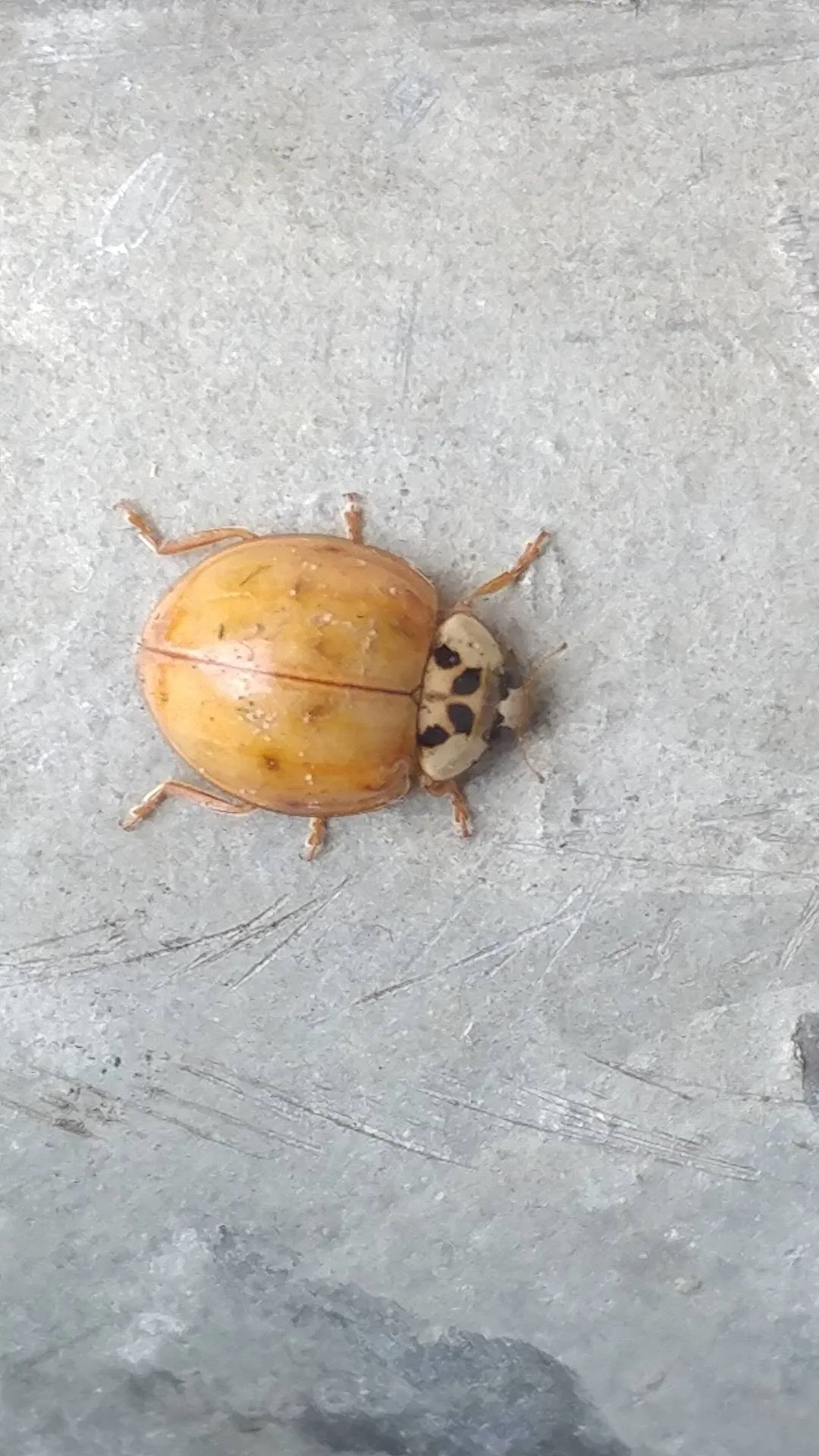 Asian lady beetleLays yellow, oblong eggs in clusters on the undersides of leaves
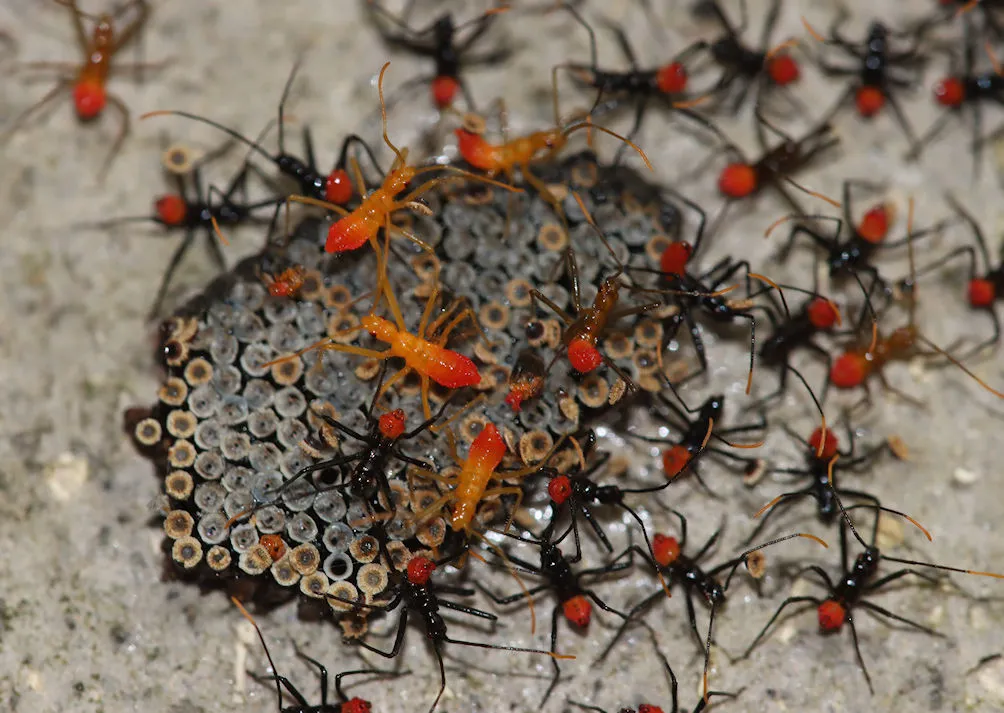 Wheel bug egg massBrown, bottle-shaped eggs with white tops, laid on twigs in fall and hatched in spring
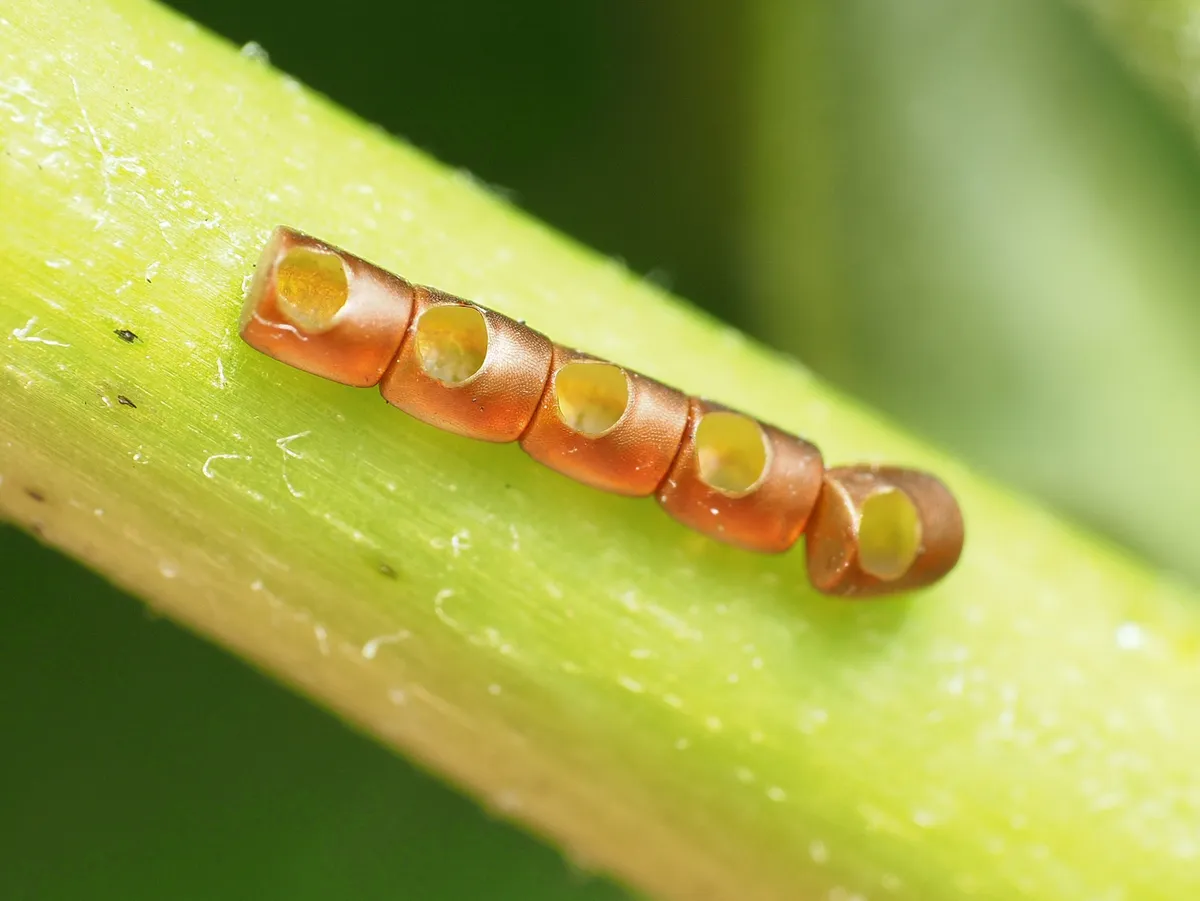 Leaf-footed bug eggsBrown, cylindrical eggs laid end to end in one strand along a stem or leaf vein
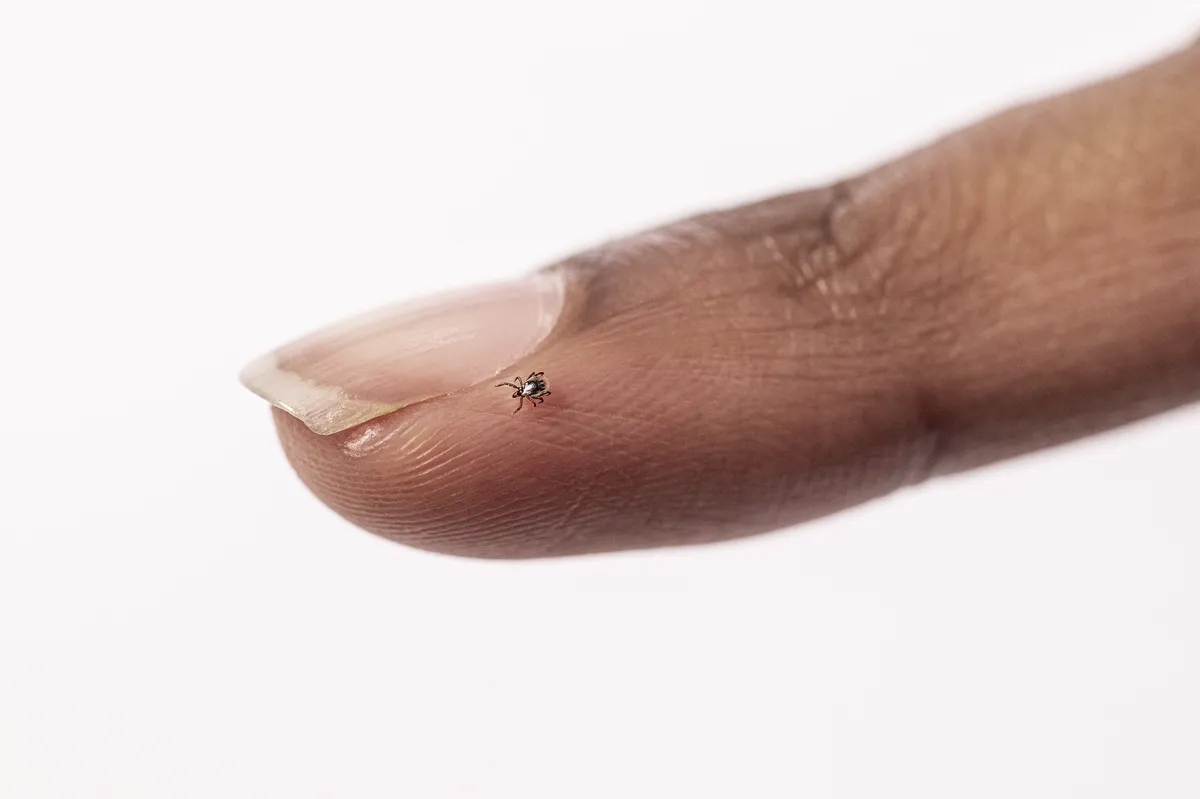 Tick nymphEight legs, as CDC describes tick nymphs; the stink bug nymphs pictured on this page have six
Photos: Asian lady beetle: no rights reserved, via iNaturalist, CC0 1.0. Wheel bug egg mass: (c) hr_dragonfly, some rights reserved (CC BY), via iNaturalist, CC BY 4.0. Leaf-footed bug eggs: (c) Katja Schulz, some rights reserved (CC BY), via iNaturalist, CC BY 4.0. Tick nymph: CDC/ Division of Vector-Borne Diseases Rickettsial Zoonoses Branch; photo: Lauren Bishop (CDC Public Health Image Library, phil.cdc.gov), public domain.
What should you do once you know what it is?
Remove pest eggs before they hatch, and leave the eggs of predators and any parasitized masses where they are.
- Brown marmorated stink bug eggs. UC IPM says to destroy egg masses found on the undersides of leaves, and Utah State describes taking the eggs off the plant and freezing or destroying them before they hatch. Crush the mass, or pick the leaf, seal it in a bag and freeze it.
- Nymphs. UC IPM says stink bugs are easy to handpick and crush or to brush off plants into soapy water. Newly hatched nymphs should be the easiest to catch together, since UC IPM says the first stage stays clustered around the egg cases before dispersing. Kentucky suggests a paper towel or tissue for handling, since handled or crushed stink bugs often give off chemicals that irritate skin.
- Squash bug eggs. Colorado State suggests checking plants at least once a week in June, when egg laying is likely to begin, and crushing the eggs you find.
- Lady beetle, spined soldier bug and wheel bug eggs, and dark masses. Leave them: they belong to predators or may hold parasitic wasps.
- Sprays. UC IPM says most garden insecticides are not very effective against stink bugs, especially adults, though some products may suppress young nymphs, and Utah State says parasitoid wasps are very sensitive to insecticides. If you use one, follow its label.
- Row covers. UC IPM says covering vegetables with row cover material can prevent stink bug feeding, but it also keeps pollinators away from the flowers.
- Adults indoors in fall. They will not lay eggs in the house; the stink bug removal and sealing guide covers them.
For a garden plan built around these natural enemies, see natural garden pest control by season. For other bugs, try the five-question pest identifier or the library of pest guides.
Use any pesticide exactly as its label directs. The label is the law, and what is registered and sold varies by state.
Frequently Asked Questions
How long does it take for stink bug eggs to hatch?+
Roughly four to seven days, going by two extension services. University of Illinois Extension says brown marmorated stink bug eggs hatch roughly four to five days after they are laid, and Utah State University Extension gives 5 to 7 days for stink bug eggs. Shortly before hatching, Utah State says, a triangular egg burster forms in each egg. UConn Extension says the newly hatched nymphs stay over the eggshells for a day or more, and Illinois says each of the five nymph stages lasts about a week.
How many eggs does a stink bug lay?+
A brown marmorated stink bug lays her eggs in masses of about 20 to 30, by Penn State Extension's and the EPA's counts, and StopBMSB.org, a USDA-funded research project, says the masses hold about 28. Over her life, UC IPM says, a female lays 212 to 486 eggs. The EPA says there are usually one or two generations a year in cooler climates and up to five in warmer ones, so several rounds of egg masses can appear in one summer.
Should you destroy stink bug eggs?+
Pale, unhatched brown marmorated stink bug eggs, yes: UC IPM says to destroy egg masses found on the undersides of leaves, and Utah State University Extension describes removing eggs from the plant and freezing or destroying them before they hatch. Make sure of the identification first, as UConn Extension advises. Leave eggs with a crown of spines, which belong to the predatory spined soldier bug, and leave dark brown or black masses, which may hold parasitic wasps: when wasps are on an egg mass, Utah State prefers leaving it on the plant.
Do stink bugs lay eggs on windows?+
Not usually. Penn State Extension says stink bugs usually lay on the undersides of leaves, and Utah State University Extension adds fruiting structures and, occasionally, stems of host plants; none of the sources on this page mentions glass. It can happen, though: the photographer of one picture on this page describes it as a brown marmorated stink bug laying eggs on a glass pane. Compare any eggs on a window or screen with the photos here. A cluster of brown, bottle-shaped eggs found in fall or winter is more likely a wheel bug's; the University of Kentucky says wheel bugs lay their eggs in fall.
What color are stink bug eggs?+
It depends on the species and their age. Brown marmorated stink bug eggs are pale green to white, or light yellow in Penn State Extension's description. Virginia Tech's field guide describes green stink bug eggs as pure white until ready to hatch, southern green stink bug eggs as white turning pink, brown stink bug eggs as manila-colored and harlequin bug eggs as white with black bands. Predatory stink bug eggs run gray to black or cream to gold, and eggs that turn dark brown or black without hatching may be parasitized.
Do baby stink bugs bite?+
Brown marmorated stink bugs do not: UC IPM says they are not harmful to people, houses or pets and do not bite, sting, suck blood or spread mammalian diseases. They feed on plants, and UC IPM says the damage is mainly to fruit. Be careful with look-alikes, though. Young wheel bugs are also red and black, and the University of Kentucky says a wheel bug will try to bite if handled and that the bite is painful. If you are not sure what you have, do not pick it up with bare hands.
Are stink bug eggs harmful?+
Not to people. UC IPM says brown marmorated stink bugs are not harmful to people, houses or pets. The harm comes later, to plants: the nymphs that hatch feed on their host plants, and UC IPM calls the brown marmorated stink bug a serious pest of many fruit and fruiting vegetable crops, naming apple, peach, pepper, sweet corn and tomato among the most affected in the mid-Atlantic. That is why UC IPM advises destroying egg masses found under leaves.
What eats stink bug eggs?+
Tiny parasitic wasps, which Utah State University Extension calls the most promising control for the brown marmorated stink bug. The USDA's Agricultural Research Service says the samurai wasp, an egg parasitoid from Asia about the size of a sesame seed, strongly prefers brown marmorated stink bug eggs, and it counted wild populations in 14 states when it wrote about the wasp. Utah State lists native wasps that attack the eggs too. UC IPM says assassin bugs, earwigs and green lacewing larvae feed on various life stages, and that egg mortality has reached 50 to 60 percent in some situations.
Do stink bugs lay eggs in the fall or winter?+
Not brown marmorated stink bugs. The EPA and Penn State Extension say females lay from May through August. In early autumn the adults look for shelter, often in houses and other buildings, and the University of Kentucky says they spend the winter unmated and do not breed indoors. An egg cluster found on a twig in fall or winter may belong to a wheel bug instead: Kentucky says wheel bugs lay their eggs on small twigs of shrubs and trees in fall, and the young hatch in early spring.
How do you get rid of baby stink bugs on plants?+
Handpick them and crush them, or brush them off the plant into soapy water: UC IPM says stink bugs are easy to deal with that way. Newly hatched nymphs should be the easiest to catch together, since UC IPM says the first stage stays clustered around the egg cases before spreading out. It also says most garden insecticides are not very effective against stink bugs, especially adults, though some may suppress young nymphs. Kentucky suggests a paper towel or tissue for handling, since handled or crushed stink bugs often give off chemicals that irritate skin. Destroying the egg masses under leaves before they hatch, as UC IPM advises, heads off the problem.
Sources
- Life Stages — StopBMSB.org (maintained by the Northeastern IPM Center; a USDA NIFA Specialty Crop Research Initiative project)
- Pest Notes: Brown Marmorated Stink Bug (UC ANR Publication 74169) — University of California Statewide IPM Program
- Brown Marmorated Stink Bug (Steve Jacobs; revised by Michael Skvarla) — Penn State Extension
- Brown Marmorated Stink Bug — U.S. Environmental Protection Agency
- Field Guide to Stink Bugs of Agricultural Importance in the United States (VCE Publication 444-356, ENTO-68) — Virginia Cooperative Extension, Virginia Tech, with Clemson University, New Mexico State University and the University of Arizona
- Stink Bug Infestation of Dwellings (ENTFACT-654, Michael F. Potter and Ric Bessin) — University of Kentucky Entomology
- Brown Marmorated Stink Bug (updated October 17, 2024) — University of Maryland Extension
- Identification, Biology, and Management of Brown Marmorated Stink Bug (Karuna Kafle and Kacie J. Athey, 2024) — University of Illinois Extension
- Parasitoid Wasps of the Invasive Brown Marmorated Stink Bug in Utah (Schumm, Richardson, Holthouse, Mizuno, Alston and Spears, December 2022) — Utah State University Extension
- Stink Bug Trissolcus Parasitoids (Natural Enemies Gallery) — University of California Statewide IPM Program
- Tiny Wasps, Big Impact: Egg Parasitoids as Natural Enemies (Patricia Prade, Tafsir Nur Nabi Rashed and Amanda C. Hodges) — Penn State Extension
- To Deal With the Brown Marmorated Stink Bug, ARS Scientists Bring In Its Arch Enemy — USDA Agricultural Research Service
- Common Stink Bugs of the Mid-Atlantic, Hemiptera: Pentatomidae (Gerald Brust, updated October 23, 2024) — University of Maryland Extension
- Convergent Lady Beetle (Natural Enemies Gallery) — University of California Statewide IPM Program
- Multicolored Asian Lady Beetle (Michael J. Skvarla) — Penn State Extension
- Squash Bug: Management in Home Gardens (Fact Sheet 5.609, W. Cranshaw) — Colorado State University Extension
- Pest Notes: Leaffooted Bug (UC ANR Publication 74168) — University of California Statewide IPM Program
- ENTFACT-705: The Wheel Bug (Ric Bessin) — University of Kentucky Entomology
- Stink Bugs (Publication EXT197, Pamela Cooper, March 2026) — UConn Extension, University of Connecticut
- Tick Lifecycles (October 11, 2024) — Centers for Disease Control and Prevention
Read and approved by Alex Francisco. Found an error? Email support@buzzskito.ca.